Why I’m Voting for Hillary in the SC Primary


luggage-pileMy dear departed high school English teacher, Mrs. Clarice Foster, taught us to make concessions early if inconvenient facts got in the way of our arguments. Say, for example, I chose pragmatism over ideology in determining whom to support for the Democratic nomination. In that case, Mrs. Foster would have me admit right away that Hillary and Bill Clinton have accumulated “some baggage” in their quarter century of public life, though she would probably frown if I quantified that baggage as “a boxcar full.”

[Sigh]

There’s “Clinton fatigue,” for example, the “been-there-done-that factor,” a definite negative in an ADHD nation brought up on quick cut editing.

Fire-breathing lefties also wag chiding fingers at Mrs. Clinton for having forged positive relationships with some denizens of Wall Street and for getting rich (god forbid).

More problematic, for me personally, is her tendency on occasion to reverse stances on issues for expediency’s sake.

Need we add that “vaulting ambition,” the phrase Milton uses in to describe Satan in Paradise Lost, might also apply to Hillary?

hillary satanNot to mention her occasionally awkward public presentation, her unease on the stump, what some have called her “unlikability.”  Indeed, some have depicted her as the female equivalent of the Prince of Darkness.

Enter that septuagenarian Galahad, Bernie Sanders, who unlike Hillary, was for gay marriage before she, Bill, and Barack Obama, and except for his recent flip flop on gun control, has been remarkably consistent over the years with his insistent socialist message.

More than any other candidate, Bernie cares about the widening discrepancy in the distribution of our country’s wealth and understands how oligarchy rends the fabric of national cohesion.

Nor has he spent his years in office accumulating riches – his net worth is reported to be a paltry (by politicians’ standards) 700K.[1]

Given these choices, why would I choose to support the seemingly more flawed Hillary over the seemingly purer Bernie?

Here’s why:

  1. If in the unlikely event he were to defeat the Republican nominee, Sanders would have absolutely no chance of getting his agenda passed in Congress.[2]
  2. More troubling, he seems clueless when it comes to foreign affairs. Just today he suggested we immediately normalize relations with Iran, a leading sponsor of terrorism.[3]
  3. He’ll be pushing 80 at the end of his first term (cf. your aged relatives).
  4. But most of all, I don’t want Ted Cruz (or John Kasich, for that matter) nominating the next three Supreme Court Justices. No matter what unreliable nationwide polls say about hypothetical match-ups, Bernie Sanders’ nationwide appeal is limited essentially to white liberals. Trust me, people who aren’t paying attention yet – in other words, a majority of the electorate – aren’t going to fall in love with, much less vote for, an irascible ideologue with unruly hair who is branded as a socialist ad nauseum in negative Republican ads, especially if fear of terrorism is a major campaign issue.[4]

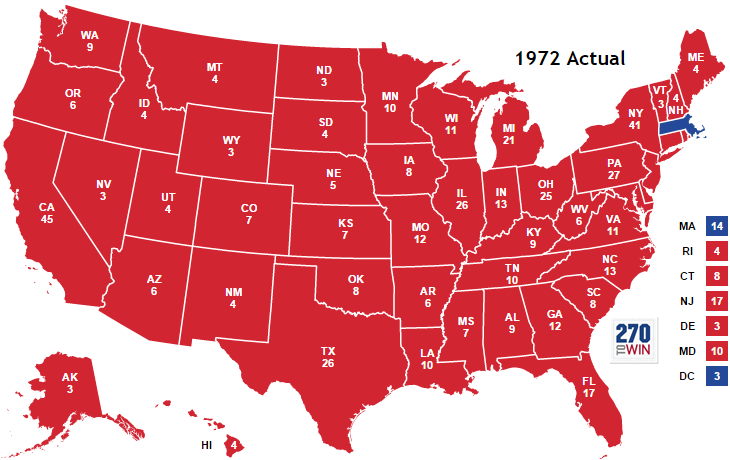
I’ve seen this movie before. It starred Edmund Muskie, George McGovern, and ended very badly.[5]

1972_large

Anyone who claims that there’s no difference between Hillary and the Republicans needs to take a remedial reading course. As a matter of fact, Hillary and Bernie share strikingly similar positions on issues. Unlike every single Republican candidate, they both believe in human acerbated climate change, higher taxes for the wealthy, abortion rights, free community college, diplomatic engagement as opposed to war, etc.

In addition, they both see government as a positive force rather than an anathema. The disheartening news is that neither is going to be able to get legislation through a Congress in which Republicans control both houses. So the contest between them boils down to a choice between someone less liberal and Machiavellian but deeply schooled in international relations to one who is more liberal and principled but seemingly clueless when it comes to foreign affairs.

Unfortunately, I sense a sort of bandwagon effect going on with Bernie among younger voters who are starting to vilify Hillary in Facebook posts. I witnessed the same sort of vibe with McGovern back in the day, i.e., being for McGovern was cool, and that if you weren’t, you would be banished to Squaresville by your hippie peers.

 berniesanders_1Immune to Bernie’s charisma, I opt for pragmatism over cult of personality when the bottom line tells me that a Sanders presidency means no meaningful implementation of his agenda. His purview is narrow, almost exclusively domestic, so I don’t trust him as a vigorous analytical surveyor of the incredibly complicated issues of international diplomacy.  But most importantly, his chances of actually garnering 270 electoral votes are nil.

Even if he were elected, Bernie Sanders was born before the attack on Pearl Harbor — imagine the equivalent of a Pearl-Harbor cyber attack, some North Korean master sabotage of our collective computer systems.

Whom would you rather see in charge, Bernie or Hillary?

The stakes are Himalayan in this election: No matter what happens in the presidential contest, Republicans will continue to control both houses of Congress, and with a Republican president and a conservative majority on the Supreme Court, no telling what might be in store – gigantic tax cuts for the very richest, the privatization of Medicare, an escalation of everything Bernie Sanders detests.

Cast a colder eye, millennials.

[1] Which, by the way, is 600k more than his Marco Rubio’s. Hmmm.

[2] Although Sanders promises to break up the “big banks” via executive action, this claim has been met with doubt from both the right and left. Here’s Matthew’s Yglesias’s take.

[3] Imagine the negative Republican commercials.

[4] By the way, I nailed the electoral vote counts in a prediction on September 14th before the last election, so I do possess a smidgen of credibility here.

[5] Though nowadays, the Republican Party has moved so far rightward that “mainstream’ Jeb Bush makes Nixon look like Leon Trotsky in comparison.

A Taste of Folly


hoodoo headquarters

Outside of Hoodoo Headquarters

11: 10 a.m. Saturday 16 January 2016

As the sun arcs across the bluest of skies on this glorious Saturday of a three-day weekend, why squander my benevolent mood by overturning the rock of US politics and commenting on the spectacle of the scurrying vermin underneath?

Let’s not go into Trump and Cruz bouncing off the ropes of Thursday’s debate delivering forearms and leg kicks like Jessie Ventura and Nikolai Volkkoff.

Let’s not revisit the pairing of Lindsey Graham and Jeb! standing awkwardly abreast at yesterday’s endorsement like Muff and Jeff .

jeb and lindsey

photoshopped cartoon by WLM3

And what about this century’s remake of the 1972 Democratic contest with Hillary Clinton in the role of Edward Muskie and Bernie Sanders playing George McGovern?[1]

Enough! Already I feel dyspepsia roiling the previously pacific pools of my stomach acid.

No, I’m headed to the closet to don my pith helmet for another episode of “Hoodoo Anthropology.” Today, my adopted hometown Folly Beach celebrates its annual culinary extravaganza a “Taste of Folly, which I’ve never checked out, so I’m curious to see what type of crowd the festival attracts. You would think attendees might be a bit more subdued than the roisterers who descend for Folly Gras and Follypalloza, but frankly, I dunno.

What I do know is that the streets have been cordoned off, draught beer is flowing from sidewalk taps, and, of course, the chefs of Folly have taken extra care to present their signature dishes.

1:30 pm

Your intrepid reporter/anthropologist (IRA) and his spouse/assistant (SA) park their bikes at Chico Feo. Charlie, bartender extraordinaire, informs them that a bluegrass trio will be performing at 5, and that the owner/proprietor/chef (OPC) Hank Weed has set up a station offering a taste of Chico on the main drag that bisects this seaside community.

We cover the block to Center Street on foot.

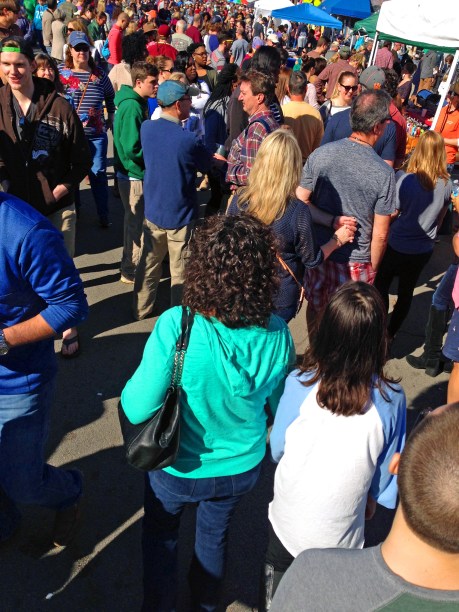
IMG_2495

Over time, your IRA has developed mild anxiety when enmeshed in the amoeba-like pulsations of a crowd. SA Birdsong is hungry, a happy coincidence, but the lines for food are long along the bustling thoroughfare. As luck would have it, the queue for the Jack of Cup’s (JOC) curry is manageable, so the two split up; SA Birdsong procures two bowls while IRA goes inside the saloon to obtain a beer.

As sometimes happens in small villages, sitting right outside of the JOC are two friends, Larry and Jed, who offer an area of the table where SA and IRA can stand and enjoy the absolutely delicious combination of rice, potatoes, curry, peppers, etc.

curry.jpg

Jack of Cups Curry

Since Larry has been on site since “the crack of eleven,” he has procured a wristband that allows him to transport beers as a pedestrian.

wrist band

“Since when do you need a wristband to drink at a Folly festival?” IRA asks.

“It’s new this year,” Larry says. “It’s not too bad. Costs a buck. They make it efficient.”

“Maybe so, “ IRA thinks, “but here’s another instance of government complicating the lives of citizens.” He wonders where Cruz, Trump, and Bush might stand on the issue.  No doubt nanny staters Bernie and Hillary are all for it.

As IRA enjoys his beer, someone approaches him from the back and begins to tenderly massage his shoulders. Out loud IRA wonders who it might be — Emmylou Harris? Chrissie Hynde? Margo Timmins? Ambrosia Parsley?

No, it’s Vinnie Folly Beach’s most prolific songwriter.

vinny

Vinnie

“You know what,” Vinnie says, “I’m going to get drunk today.”

IRA: “You are?”

Vinnie [emphatically]: “Yes I am. You know why?”

IRA: “Nope.”

Vinnie: “Because I got drunk last night, and I can’t get over it.”

Two beers are long enough for IRA to determine that the visitors for a Taste of Folly are very much like the visitors to the other festivals. Bands play, like at any other festival. There’s a Jump Castle (JC) for the kiddies, like at any other festival.

Bottom line: the festival goers seem to be having a fairly good time.

3:41

SA and IRA arrive home safely via bikes. Decompression time before Chico Feo 5pm bluegrass trio.

[1] Dream tickets: Sanders and Sharpton vs. Cruz and Cotton in a “the-center-cannot-hold” contest.

The Mother of Beauty

I saw with my own eyes the Sibyl at Cumae hanging in a cage, and when the boys said to her: “Sibyl, what do you want?” she answered: “I want to die.”

Petronius, The Satyricon.

From man’s blood-sodden heart are sprung
Those branches of the night and day
Where the gaudy moon is hung.
What’s the meaning of all song?
“Let all things pass away.”

Yeats “Vacillation”

Death is the mother of beauty, mystical,
Within whose burning bosom we devise
Our earthly mothers waiting, sleeplessly.

Wallace Stevens, “Sunday Morning”

shapeimage_2

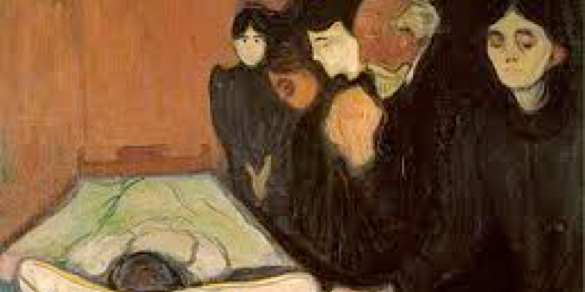
In the catalogue of alienations we Late Empire citizens suffer – estrangement from nature, God, our neighbors, ourselves – our estrangement from death is often omitted. We no longer encounter death on a daily basis. Most of us don’t raise chickens to wring their necks, pluck their feathers, excise their entrails. When our loved ones die, we no longer remove their clothes, wash their corpses, and dress them for one last family photo in the parlor.

5ef76883bf407a501cc6839dd14f0c05bfe2d323-2

Of course, our lack of exposure to death makes it much easier to lock it away deep in the cellar of our consciousness, which might not be such a bad thing given that nothing’s more life negating than death obsession. On the other hand, our isolation from the cold hard facts our ancestors dealt with – butchering animals, infant mortality, etc. – might have contributed to a delusion many seem to suffer, i.e death is unnatural.

A few years ago, an acquaintance’s father, a man approaching ninety, was lying comatose in a hospital. Each day, on Facebook this acquaintance updated his father’s situation, which, not surprisingly, was rather uneventful – the opening and closing of an eye, a sense from a nurse that the old man experienced discomfort when bathed. My acquaintance and visitors read the Bible to him aloud as they sat and prayed for a miracle. This acquaintance battled his father’s physicians who wanted to transfer him to hospice care while the son perceived opening an eye as a harbinger of “the complete recovery” for which he so ardently prayed.

Most of the Facebook commentators were essentially enablers writing messages like “Sounds very encouraging!!! The doctors could be totally wrong……the body can heal in ways that only God knows” or “That’s great. God is in controll” (sic) or “God is the ultimate physician:-).”

A contempt for science and doctors ran through those Facebook posts, and the commentary that followed. No wonder people don’t believe in evolution or global warming if they believe a comatose man dying of an infection brought on my the removal of a cancerous lung tumor could very well attain a complete recovery and enter robustly into his ninth decade.

On the other hand, when my wife Judy Birdsong was dying, some well-meaning soul told her that she was praying for a miracle, and Judy replied, “I’m sixty-three, don’t waste a miracle on me, pray for a child instead.”

This attitude, I submit, is a healthier attitude on dying.

dead doe in a frozen pond in North Carolina

dead doe in a frozen pond in North Carolina

To my mind, an ever aging husk of a body doomed to live for an eternity is a much more horrible fate than passing away in one’s sixth decade. Not only did the Sibyl at Cumae consider it a drag (see above), but we also have corroborating evidence from Chaucer’s “The Pardoner’s Tale.” When a trio of churls accost an ancient man and ask him why he still has the gall to remain alive, he replies,

Not even Death, alas! my life will take;
Thus restless I my wretched way must make,
And on the ground, which is my mother’s gate,
I knock with my staff early, aye, and late,
And cry: ‘O my dear mother, let me in!
Lo, how I’m wasted, flesh and blood and skin!
Alas! When shall my bones come to their rest?

Why, I wonder, would such devout Christians as my acquaintance want to forestall the eternity of bliss that awaited that good man? And his father was a good man, a great provider devoted to his family and his God.

The answer, of course, is love.  Most of us love our parents.  We don’t want them to go.  I miss my own father’s sardonic witticisms, my mother’s hoarse cackle of a laugh, Judy Birdsong’s gentle movements. My acquaintance devotedly loved his father and didn’t want to think of living life without him.

Is that so wrong?

[cue Evangelical voice]: Let us turn to Ecclesiastes 3:1-4.

To everything there is a season
And a time to every purpose under heaven.

A time to be born and a time to die;
a time to plant and a time to pluck up what is planted . . .

Like I said, our aged loved ones’ passing is melancholy, and we miss them when they’re gone. I dream of Judy occasionally, and I awake missing her. Nevertheless, her time had come, and she was rather fortunate given that she didn’t have to suffer for long nor endure the feebleness that Larkin descries in “The Old Fools.”

What do they think has happened, the old fools,
To make them like this? Do they somehow suppose
It’s more grown up when your mouth hangs open and drools,
And you keep on pissing yourself, and can’t remember
Who called this morning? Or that, if they only chose,
They could alter things back to when they danced all night,
Or went to their wedding, or sloped arms some September?
Or do they fancy there’s really been no change,
And they’ve always behaved as if they were crippled or tight,
Or sat through days of thin continuous dreaming
Watching light move? If they don’t (and they can’t) it’s
strange: Why aren’t they screaming?

Yep, there are worse things than death.

That Was the Year That Was

One of the many Mongolians who didn't click on this site in 2014

One of the many Mongolians who didn’t click on this site in 2015

Thanks to all of ya’ll who clicked on the blog this year, which received 20.022 hits by visitors from 110 countries. I’d like especially to thank those solo souls in Lithuania, Guadeloupe, Liechtenstein, Ethiopia, the Isle of Man, Libya, Congo-Kinshasa, not to mention whoever it was in Papua New Guinea looking for porn who got sidetracked in Hoodooland.

Of course, several countries were no-shows, including predictable sourpusses like North Korea, Mongolia, and Greenland, but come on, Botswana, Paraguay, and Fiji, where’s your sense of adventure?

Happily, except for a death-haunted January that featured a stem cell transplant, 2015 was a big improvement over 2014, so I thought I’d offer a reprise of some of the most popular posts.

January

Although “Endangered Lowcountry SC Locutions,” featuring my mother and written exactly a week before my her death, was by far January’s the most popular post, I prefer “Super Bowl XLIX Preview,” which I could easily update this year by merely dropping those clunky Roman Numerals designating forty-nine for the sleek – dare I call them Arabic – numerals 5 and 0.

February

20140511_inq_jriordan11-bOne of the top news stories in February was an outbreak of measles at Disney World, which brought to light that luddites on both the far right and far left are not vaccinating their replicated DNA, so I produced this piece “Natural Selection at Work” that features not only a vintage photo of smiling polio victims but also a full color photo of an autistic dog.

February also brought us the Brian Williams scandal, which sent me into true confession mode. Dear Readers, believe it or not, I’m no stranger to “misremembering,” as the self-explanatory title “My Most Cherished Mismemory Debunked” testifies.


March

March came in like a lion with a very popular post, “Ten Literary Riddles.” If you don’t want to see the answers, don’t scroll down past number 10.”

April

granda-and-ted2What better way to celebrate a month dedicated to fools than a post entitled “A Brief Analysis of the Likability of 2016 Presidential Candidates,” which is so fair and balanced that Larry Sally, my most ardently Republican friend, says he more or less agrees with it.

I also caught Dylan in concert for the only-god-knows-how-manyeth-time, and “Review of Bob Dylan Concert 17 April 2015” got a ton of hits.

May

governor-watching-tvMay brought the news that Texas’s wheelchair bound governor was preparing the state for an invasion from the US Federal government, and I realized what a great movie it would make, hence, “The Invasion of Texas – Coming to a Theater Near You Soon!”

Like Donald Trump, I ain’t no fan of political correctness, as this piece “Political Correctness Academy” demonstrates.


June

Folly Beach, my adopted home barrier island, is a frequent subject, and this piece “Folly Beach’s Cat Lady, Potential Serial Killer” still generates some traffic on the site.

Also, in June, I got my hands on the uncorrected proofs of “Elijah’s Wald’s ‘Dylan Goes Electric,’” which was picked up by the mega Dylan website “Expecting Rain: Bob Dylan.” Wald himself weighs in with a comment on the post.

Alas, June also brought us the Charleston Massacre, and this post “Way Past Time” struck a chord.

I also finally got to go to a Jewish wedding: “My First Jewish Wedding.”

July

A lazy month that featured video of a hotdog eating contest (“Celebrating the 4th on Folly after the Alcohol Ban”), a paean to drive-in movies (“Enjoying Genocide at the Drive-in“), and more spoiled elite college student bashing (“America’s Culture of Hyperachievemnt among the Affluent).

August

donald-trump-750x455Oh my God, where has the summer gone? Life is short. I’ll be dead in no time. Better turn to the Good Book. And who better to lead a Bible lesson than the Donald: “Bible Study with Donald Trump.

September

Here’s a poem: “What Guilt Feels Like: A Series of Pickpocketed Similes,” an exercise in collage.

And a behind-the-scenes peek of my decadent lifestyle hanging out with beat poets at Chico Feo: “Folly Beach Life, Ain’t the Good Life, But It’s My Life.”

kaye-paulAnd I’m surprised this post didn’t catch on, a “Casting the Republican Primary Farce,” in which I find photos of dead movie/tv starts who are – drumroll – dead ringers for the Republican candidates.

October

When yellow leaves, or none, or few, do hang upon those bows that shake against the cold, what better time than to go all nostalgic: “That Time I Threatened to Hang Myself If Student Housing Didn’t Transfer me out of That Dorm Suite I Shared with Antithetical Monsters.

November

Actually, not only do leaves not turn yellow where I live, they don’t even fall from the trees: “Whining on Thanksgiving.”

December

Which brings us to December, today, Christmas. I’ll give Santa the final word:

“Santa Agonistes.”

Naw, I get the final word. Thanks so much for reading. I sincerely appreciate it.

In Lieu of Xmas Cards

Days dwindling into darkness, the sun slipping away, owls perched on naked boughs woo-wooing those sorrowful mating calls.  It’s the very longest night of the year.

Time for a celebration!

Good News/Bad News

The winter solstice holidays fall on practically the darkest day of the year, which metaphorically suggests that now is as bad as it gets, a comforting if dubious sort of reckoning.  Even though civilization has enabled junkies to sleep with the sun and rise with the moon, even though we can flood our showrooms with fluorescent light, even though night time [might be] the right time/ to be with the one you love, our bone marrow hates predatory darkness.

It knows. It remembers the fireless cave and the terror of tooth and claw and the heart-clinching night shrieks that travel in waves through your ears and down your quivering limbs. Deep down inside, your reptilian brain knows, your bone marrow senses that dark ain’t right.

Therefore, sun worshiping makes sense to me. Godzillions of people have worshipped stupider concepts than the sun. And, let’s face it, whether you call it Christmas, Kwanzaa, or Hanukkah, what you’re really worshipping is the sun – the end of its decline and the beginning of its revival.

After the blessed event, for half a revolution, each succeeding day’s light will last [cue Maurice Williams] a little bit longer.  In the deepest darkest December, it’s time to huddle near a crackling fire and celebrate solar rebirth. Hang the mistletoe and ivy . . .

And so the cycles run, both positive and negative, with always something to celebrate and rue, each year’s waxing and waning seemingly swirling faster and faster, our children transforming before our eyes in time-lapsed photography as our faces in the mirror begin to melt.

12th July 1969: Anglo-American poet, playwright and literary critic W H Auden (1907 – 1973). (Photo by Victor Drees/Evening Standard/Getty Images)

Christmas

CHINA_-_TOY_FACTORY

Sure, in the Late Empire, Christmas has devolved into little more than a potlatch, an obscene one at that, one that hideously underscores the disparity of riches: a thumb – if you will – in the communistic eye of the Son of Man – He who divided and distributed the loaves and fishes, who warned that it’s easier for a camel to pass through the eye of a needle than for a rich man to enter the kingdom of God, who exhorted the rich man to sell all he had and give it to the poor – we celebrate His coming by making the rich richer, yet somehow, during the holidays, the poor are so much more obviously with us.

Still,  you have to admit the Christian myth offers about as elegant as a solstice symmetry as you get – the soon-to-be resurrected Son born as our sun is reborn.

Meteors flash in the clear winter sky. Orion makes his nightly journey.  We breathe in and out.

A new year is rising just beyond the horizon.  Time to forge resolutions.  Time to celebrate, to hope.

vlatislavh

Happy Holidays!

Folly’s Rather Subdued Xmas Parade

With the specter of terrorism, both domestic and jihadist, haunting contemporary life, it’s no wonder that yesterday’s annual Folly Beach, SC, Christmas parade seemed somewhat subdued. For example, no eardrum-shattering Shriner-produced gun battles “betwixt” Revenuers and Moonshiners terrified toddlers. Instead, we baby boomers were treated to this rather melancholy spectacle.

[For those not proficient in Southern US English, here’s a translation: “This gentleman right here is 91-years-old, still working for the burned and crippled children (not the burning crippled children)].

Compare that to this scene from four years ago when all the little Masons and Benningtons were treated to some semi-authentic street drama, a Western tradition dating back to the glorious days of the Hundred Years War and the bubonic plague.

police

Also conspicuous in their absence were the vintage car clubs, those MG-Bs, Triumph Spitfires, XKE Jags that ascot-wearing playboys used to tool around the countryside in with their scarf-headed mistresses headed to the Timberland Inn for a mid-afternoon tryst.

red austin healey

And, for me, an owner of two late departed VW microbuses, what a disappointment that nary a one puttered past belching clouds of oil-laden exhaust (as opposed to in years past when they appeared in abundance, transforming Center Street into a miniature Beijing).

parade of buses

Nor did the Surf Rider drill team wow us with their shenanigans.

surfers

Not that the parade was a complete bust. The James Island band was in fine form.

Plus, the Roller Derby girls are always a welcome addition.

roller derby gal

Of course, Santa appeared, albeit with an armed guard:

Santa

And, of course, the after-party at Chico Feo never disappoints. Check out these not-exactly vestal virgins preparing to sacrifice this cloven-footed beast to Jah so Mr. Weed back in the kitchen can whip up some of his world class curried goat.

Amber, Satan, and Judy

And as Solstice present to all of you wherever you be, a rare photograph of your humble narrator at Chico Feo with his bodyguards.

wes, kelly, maureen

Paradise Lost: So Long Hunting, Hello Work Week

black adam and eveA couple of posts ago, I channeled the late Joseph Campbell and echoed his contention that myths should be considered deep unconscious poetic projections that embody profound truths rather than as demonstrably false tales from antiquated religions. Echoing Northrop Frye, Campbell believed that myths provide models that help us navigate the progression of our lives through the blooming and withering we’re all heir to, maps, as it were, handed over to us from old Tiresias to help us find our way to our ultimate destination – oblivion.

Tiresias appearing to Odysseus by Johann Heinrich Füssli

Tiresias appearing to Odysseus by Johann Heinrich Füssli

For example, the requisite trip to Hades that epic heroes like Odysseus and Dante suffer might correspond to the midlife depressions many of us undergo, journeys that though abysmal provide us with secret knowledge, in Odysseus’s case how to navigate his way back to Ithaca and in our case a deeper perspective on what it means to be human.

Take the Eden myth. It offers many interesting possibilities for interpretation. Given that it is a post-agrarian myth (besides death, Adam’s curse is tilling barren soil by the sweat of his brow), I wonder if the myth harkens back to the simpler and more organic lifestyle of hunting and gathering when our ancestors ran around naked picking berries, spearing rabbits, and living communally.

Perhaps knowledge here means the knowledge of agriculture, and if you want to fault anyone for that, why not women, who probably through their foraging discovered that seeds can be cultivated, which led to settled communities, caste systems, factories, ghettos, and ultimately reality television shows like Boy Meets Boy, Megan Wants a Millionaire, and Sarah Palin’s Alaska.

Sarah Palin and Offspring

Sarah Palin and Offspring

In the mid-90’s, I took two graduate anthropology courses to satisfy certification requirements. For my midterm take-home exam, I had to provide my opinion on an essay claiming that agriculture has been disastrous for most of humankind. I can’t find the essay, but here’s the first paragraph of my test essay, which summarizes the argument:

In his essay “The Worst Mistake in the History of the Human Race,” Jared Diamond argues that agriculture is responsible for a diminution in the quality of life for the majority of humans who have lived since its inception. Diamond argues that food foragers enjoy a healthier diet procured with less labor and that the population explosion that accompanied the agricultural revolution has given rises to epidemics of infectious diseases. Furthermore, agriculture is directly responsible for class stratification and the subjugation of women. In essence, Diamond’s essay is the Eden myth revisited: food foraging Adam takes up the hoe, and paradise is lost. Diamond could have taken it even further, I suppose, and argued that agriculture, which gave rise to industrialization, can also be traced as a root cause of an ensuing ecological disaster as cultural evolution outstrips biological adaptation. The ultimate balance of life is being destroyed as holes appear in Gaia’s ozone umbrella, oxygen-producing rain forests are slashed and burned, and the water supply disappears.*


*By the way, I received an A- on this essay, the minus probably attributable to its last paragraph: “The question of whether or not agriculture was humankind’s greatest mistake, like most questions, ultimately ends up being an existential one. If I were huddled in an inner-city tenement or wielding a pick in an Appalachian coal mine, I might prefer non-existence and rue the day agriculture came into being. Indeed, food foragers possess a oneness with nature I truly envy. However, at the present moment (which is ultimately all we ever have), I’m off for the summer, preparing to end this essay and grab my surfboard. The agricultural revolution has been kind to the people I love. Jared Diamond would, no doubt, brand me an elite, but then again, I am just a high school English teacher and have never voted for a Republican. Everything is relative. Diamond has probably never been writhing in the Kalahari Desert with an abscessed tooth. [Instructor’s only comment: I get your point, which is indeed elite by world standards].


yours truly surfing in the mid-90's

yours truly surfing in the mid-90’s

To return to the Eden myth, Adam and Eve run around naked, pick berries, in essence live off the great bounty that Yahweh has provided, but that damn woman who always has to stick her nose into everything upsets the divine plan by discovering a way to produce food differently. Humankind now possesses the knowledge of how to cultivate the land, but it takes hard work. Eating the apple symbolizes the shift from relying on natural food to being dependent on cultivated food. Hunting is more fun than plowing, making clothes is labor, etc. We have abandoned meaningful communal simplicity for complex stratified world of civilizations.

"Cain and Abel" artist unknown

“Cain and Abel” artist unknown

As it happens, a very rarely encountered non-agrarian Peruvian tribe upset by incursion into their territory confronted park rangers this week. In investigating the tribe, the Mashco-Piro, I found video of another tribe, this one from Brazil.

These folks are essentially naked and so far off the grid that they don’t even have immunity to the common cold. Perhaps, Diamond was right after all. Perhaps in the very long run humanity might have had a longer lease on survival if Eve had just left well enough alone.

I’ll leave you with a passage from Mario Vargas Llosa’s The Story Teller as a shaman-like wanderer from tribe to tribe who relates myths to various clans that explain their origins and ways of life:

Thanks to Tsaurinchi, the firefly seripigari, I’m never bored when I’m traveling. Nor sad, thinking: how many moons still before I meet the first man who walks? Instead, I start listening. And I learn. I listen closely, the way he did. Go on listening, carefully, respectfully. After a while the earth feels free to speak. It’s the way the way it is in a trance, when everything and everyone speaks freely. The things you’d least expect speak. There they are: speaking. Bones, thorns. Pebbles, lianas. Little bushes and budding leaves. The scorpion. The line of ants dragging a botfly back to the anthill. The butterfly with rainbow wings. The hummingbird. The mouse up a branch speaks, and circles in the water. Lying quietly, with closed eyes, the storyteller is listening. Thinking: let everyone forget me. Then one of my souls leaves me. And the Mother of something that is all around comes to visit me. I hear, I am beginning to hear. Now I can hear. One and all have something to tell. That is, perhaps, what I have learned by listening. The beetle as well. The little stone you can hardly see, it’s so small, sticking out of the mud. Even the louse you crack in two with your fingernail has a story to tell. If only I could remember everything I’ve been hearing. You’d never tire of listening to me, perhaps.

Now that’s what I call being alive.

Thanksgiving Whining

For all the blah-blah-blah about how killer it is to live in Charleston, the Lowcountry of South Carolina lacks the beautiful season of autumn.   This deficiency is especially heinous to us poetical, metaphor-embracing non-haters of Biden, because autumn represents harvest, fullness, and [sigh] impending decline.

Ideally, outside our windows would blaze a burst of colorful foliage that rages against the dying of the light. You could sit there by the window and read Wallace Stevens —

Death is the mother of beauty; hence from her,

Alone, shall come fulfillment to our dreams

And our desires. Although she strews the leaves

Of sure obliteration on our paths,

The path sick sorrow took, the many paths

Where triumph rang its brassy phrase, or love

Whispered a little out of tenderness,

She makes the willow shiver in the sun

For maidens who were wont to sit and gaze

Upon the grass, relinquished to their feet.

She causes boys to pile new plums and pears

On disregarded plate. The maidens taste

And stray impassioned in the littering leaves.

You could look up from Stevens and out of the window and see for yourself.

photo by WLM3
photo by WLM3

Down here, though, with our loblollies, live oaks, and palms, most leaves don’t change colors, and the ones that do go immediately from green to brown. Autumn down here is like moving aging summer from your house into the nursing home, an extended decline with its good days and bad days, mostly hot and humid, or to shift metaphors, like an older person not aging gracefully, sporting lurid inappropriately tucked-in tropical shirts when tweed blazers with elbow patches are in order.

But, on a more positive note, you could argue that autumns do occur down here but are much subtler. Look closely at the marsh; without your noticing, it’s gone from green to gold, like that Japanese maple you kidnapped and planted in the front of the house. Migrating birds flap their way overhead, like a checkmark, a positive sign that things are in motion the way they should be, and let’s not forget that the impending winter will undoubtedly be mild.

photo by WLM3
photo by WLM3

No, Thanksgiving, is not a time for whining about imperfection, but a time to be grateful for what we have, a time to engorge ourselves, to watch professional football players in their glory years before the CTE sets in.

Home of the Paranoid, and Land of the Constrained

Manar

Manar

We have a Thanksgiving tradition of inviting friends who can’t make it home for Turkey Day to share a meal with us at our house. When he was in graduate school studying linguistics, our younger son Ned invited colleagues whose families live abroad, and, of course, their presence made the holiday more interesting for us, and it provided them with an anthropological peek into some of our American cultural peculiarities, for example, grown men whooping and hollering and dancing around a table to celebrate a game winning interception. Nonjudgmentally, our foreign guests tolerated these absurdities with good humor.

Two years ago Ned brought with him a young woman from Syria. In pursuit of a PhD in linguistics, our guest Manar found herself cut off from her homeland, unable to return to see her parents and siblings, professional people trapped in a maelstrom not of their own making. I could only imagine the anxiety she must have suffered knowing her loved ones were trapped in a civil war in a world where bombs rain down on civilians as well as military targets. How hard it must be to concentrate on your studies when you’re bracing yourself for bad news at any moment.

Yet, except for one point when she wept in front of my wife Judy Birdsong and another female guest, Manar was vivacious, outspoken, generous, and open-minded. Indeed, she’s much more open-minded than many of the xenophobic Facebook feeds I’ve seen in the days following the Paris massacre.

Of course, we can attribute much of these paradoxically un-American outbursts to fear and ignorance. Certainly, these xenophobes don’t realize that the Syrians slated to emigrate to the United States consist of families who have been thoroughly vetted, who have undergone extensive background tests conducted by various agencies and who undergo one-on-one interviews, the entire process taking 24 months according to the State Department.

Certainly, my neighbors writing to Nikki Haley demanding that no Syrians enter Dylan Roof’s home state don’t realize that only 2% of the Syrian refugees are military-aged single males. Forty percent are children, and twenty-five percent senior citizens. Less understandable is that many governors have declared they’ll be no Syrians moving into their states, even though governors lack the power to enforce such an edict. If they possessed that power, I suspect we’d have fewer Ohioans settling in the Palmetto State.

C’mon, Nikki, this isn’t the old Soviet Union where a traveller needed a visa to visit individual republics. Thank goodness, our vehicles aren’t stopped and searched at the North Carolina border when we head to Asheville. I thought we were the home of the brave and the land of the free, not the home of the paranoid and land of the constrained.

What really depresses me, though, are presidential candidates suggesting we close our national borders to Syrians, or more, liberally, to limit admission to only Christians. (Agnostics and Buddhists need not apply). Just today, Jeb Bush blamed President Obama for “creating a quagmire in Iraq” a remarkable act of chutzpah considering it was his brother (and enablers like Hillary Clinton) who created the mess in the first place by scapegoating Saddam Hussein for 9/11 and destabilizing the region by misjudging the Iraqis’ desire for freedom and democracy’s potency in a region unfamiliar with the concept. People on Facebook are actually blaming Obama for the Paris carnage. One of my Facebook friends cited Reagan as a model for the type of leader we need to fight terrorism — never mind that after 241 military personnel were killed in Beirut in 1983 when terrorists blew up their barracks, Reagan removed our soldiers from Lebanon and never launched a retaliatory attack.

Meanwhile, for the sake of making political hay, Cruz, an immigrant, has introduced a bill banning Syrians. Rubio, another immigrant, is also against thoroughly vetted families seeking to escape a repressive regime to start a new life.

Of course, all of this Islam-bashing delights ISIS. Certainly, our stigmatizing all Muslims as terrorists paints us in a bad light with the vast majority of law-abiding moderate Arabs. What would make ISIS even happier is if the West sent ground troops into the region, which is a prerequisite to their theory of the Apocalypse. However, you never hear hawks like Lindsey Graham talk about how we could finance such a massively expensive endeavor. Maybe the Koch brothers might be willing to underwrite it?

Coincidentally, I’m teaching To Kill a Mockingbird now, and today, we dropped in on the lily-white Christian ladies of Maycomb at Aunt Alexandra’s tea party, a get-together orchestrated to help the horrid living conditions of an African tribe. The irony is a bit heavy handed – innocent Tom Robinson has recently been convicted of rape and sentenced to death by an all-white jury – but I beginning to doubt our ability to appreciate irony, much less subtlety.


Teaching Macbeth

John Downman

John Downman

In the Brit Lit high school survey course I teach, around Halloween we do Macbeth with its witches, shrieking owls, and rooky woods. I’m fortunate enough to have available a projector and stream-able copies of Orson Welles’ 1948 movie, the 1979 Trevor Nunn PBS production, and the more recent 2010 Rupert Gould Great Performances movie starring Patrick Stewart and Kate Fleetwood. Alas, we don’t possess Polanski’s psychedelic 1971 Macbeth, but you can cop clips from YouTube. Anyway, I thought I’d share my approach as an offering to novice teachers because even though I’ve been in the business for thirty plus years, I still remember all too well not having a clue that first year as I improvised my way through my classes without a scrap of sheet music.

And believe me, brothers and sisters, I ain’t no Miles Davis, not by a long shot.

Anyway, here’s what I do.

In the 8th and 9th grades, students have read Romeo and Juliet and Julius Caesar, so they’re already hip to triangular plots and blank verse.

Before the first reading assignment, I offer a bit of background: The Queen is dead, James has arrived — he who has written a book on witches — and, oh yeah, Guy Fawkes has just attempted to pull a 9/11 on the British Parliament. Thanks to both our excellent history department and V for Vendetta, most of my students are hip to the 5th of November. In short, the dark clouds of the Jacobean Period have blotted out the Elizabethan sun.

To whet their appetite, on the day I assign the first reading, I show them the Polanski version of 1.1.

Of course, there’s a lot to discuss: language, paradox, the nature of evil, patriarchal views of women, dramaturgy, cinematography.

My first assignment is to read 1.1-1.4.[1]

Day 1 (45 minutes): The next day, after a reading quiz[2], perhaps over accentuating an iamb here or there, I read aloud the wounded Sergeant’s recap of Macbeth and Banquo’s battles.

Once we’re all on the same page action-wise, I mention paradoxes, a major motif. I tell them that every time I run across a paradox, I’m going to make the ah-ooh-ga submarine sound. Over the course of the play, clever students chime in with their own ah-ooh-gas, and whenever a paradox appears, I see most of the other students writing in the books (which they own).

I pick up the action with “Scene 3” “Enter Macbeth and Banquo” and ask for volunteers to read the various parts. Sometimes, I stop a reader and ask, “Can you hear the iambs marching?” I do so throughout the entire play whenever I think the meter is especially worth noting.

“The queen, my lord, is dead.”

Of course, during 1.3 the ah-ooh-gas come fast and furious.

I try to elicit via Socratic questioning the thematic implications of the twinning of “foul” and “fair.”

Then I introduce the “garment motif” and employ the sound of Parisian siren to signal when garment images occur.

I ask for new reading volunteers and have then start with [Enter Ross].

From there, I read Duncan’s “There’s no art/To find the mind’s construction in the face./He was gentleman on whom I built/An absolute trust.”

“What are the next two lines of the play?” I ask.

“Enter Macbeth,” a couple of students say. Bubble light bulbs flash over a few heads.

Their homework is to finish reading Act 1.

Day 2 (45 minutes):

The last motif I distinguish with sound effects is darkness, which is signaled by a melodramatic bum-bum-bum-BUM, the clichéd tension builder of many a bad movie.

We begin by talking about Lady Macbeth’s character, what various critics have to say, and jump to her “unsex me” speech, which I read.

I then have a female read the “Oh, never/Shall sun that morrow see” speech.

I then ask the students to reread Macbeth’s soliloquy, show them Ian McKellen’s rendition, and we dissect the soliloquy.

We end the class with a screening of Dame Judi and Sir Ian bringing the Act 1 to a close.

Assignment: read all of Act 2.

Day 3 (85 minutes)

I break the students into groups of three and have them “story board” the “Is this a dagger I see” speech. I encourage them to visualize the scene and then to create 15 to 20 panels depicting how they would choreograph the action providing quotes on the panel. Then we reconvene as a class, and the students present their visions. Here are a view examples from this year.

is this the dagger

mine eyesI have thee notThous marshellest

After the presentations, I show then Orson Welles’, Roman Polanski’s, Trevor Nunn’s, and Rupert Gould’s renditions of the scene.

We discuss.

Homework assignment; Act 3.1 – 3.3

Day 4 (45 minutes)

I have students read 2.2 aloud, and we discuss Macbeth’s and Lady Macbeth’s post-murder behavior, especially noting the dichotomy between bloody hands making “the multitudinous seas incarnadine” and a “little water” clearing them of the deed.

They’re familiar with comic relief, and I skip the Porter’s monologue and head straight into the dialogue with Macduff, pointing out that essentially it’s a “penis joke.”

(At the end of the Macbeth unit, we watch the entire Gould/Patrick Stewart film, which transforms the Porter scene into a heightening of tension as he obscenely spits out the jokes in front of Lady Macduff and her children).

We don’t spend much time on the rest of the scene, but I do highlight the irony inherit in Macbeth’s “Had I but died an hour before this chance” speech.

After the students are clear on plot info – the somewhat confusing murdering of the grooms, the flight of Malcolm and Donaldbain — we shift to Act 3.

I draw a triangle on the board with Act 3 at the apex. We use Aristotle’s term “peripetia” instead “climax,” and I ask them about the turning points of Romeo and Juliet and Julius Caesar. We draw rising action parallels among the R & J’s marriage, Caesar’s assassination, and Duncan’s murder.

I read the “To be thus is nothing soliloquy,” and we discuss it.

OLYMPUS DIGITAL CAMERA

OLYMPUS DIGITAL CAMERA

I don’t spend much time on the murderers but do point out that the canine catalogue reflects the Chain of Being concept so near and dear to the English back then.

Rather than analyzing the banquet scene, I show them Nunn’s version. I do a little stand-up, depicting the scene in modern terms using whoever is President as Macbeth (Reagan was my first victim; Hillary will be my last)[3].

Class ends with the “blood will have blood speech.”

Reading assignment Act 4.1 – 4.2

Day 5 (45 minutes): Although my students are rhythmically challenged, we attempt a hip hop reading of “double double toil and trouble.”

Despite it’s full-frontal geriatric nudity, I show them Polanski’s version and then Nunn’s.

That leaves the butchering of the Macduff family.

Day 6 (85 minutes)

While I’m critiquing rough drafts, I assign students speeches to paraphrase: Malcolm’s “I grant him bloody,” Malcolm’s “With this there grows,’ Malcolm’s “But I have none,” and Macduff’s “Fit to govern,” and Malcolm’s “Child of integrity.”

In paraphrasing, I ask students to provide 3 alternatives for every significant word, e.g., “sudden” might be rendered “impulsive, spasmodic, non-reflective.”

I hand back their rough drafts, and we look closely at the speeches.

We end the class with Ross’s entrance and the delivery of his horrid news.

Reading assignment: Read Act 5

Day 7 (45 minutes).

I show them Nunn’s rendition of 5.1 featuring Judi Dench’s blood-curdling shriekscream, certainly the greatest scream in the history of “moving pictures.’

Afterwards, I read “Tomorrow, and tomorrow, and tomorrow,” and we analyze it as poetry. I mention nihilism, read the first paragraph of The Sound and the Fury and then show the Nunn version featuring Sir Ian.

We discuss the play in the context of tragedy, the dissolution of Macbeth as a human, the metathesis of his sinning, the moral implications.

Days 8 – 11.

We view the Gould/Stewart/Fleetwood film in its entirety, stopping the action whenever necessary for commentary. This full viewing, of course, is time-consuming, but these students face a very demanding test, and seeing the complete play performed I think is crucial.  It is, after all, great art.

Of course, if you plan using any of this, you’ll need to adjust it according to your students and schedules, and in my case, the days have not necessarily been consecutive. For example, a day of Wordly Wise vocabulary might be utilized to align an 85-minute class.

It’s up to you to pull it all together in discussion.

At any rate, keep fighting the good fight.

[1] Note, our classes meet three times a week for 45 minutes and once for 85 minutes.

[2] These reading quizzes are frequent, one for virtually every assignment.

[3] You heard it first here. Oops, nevermind.