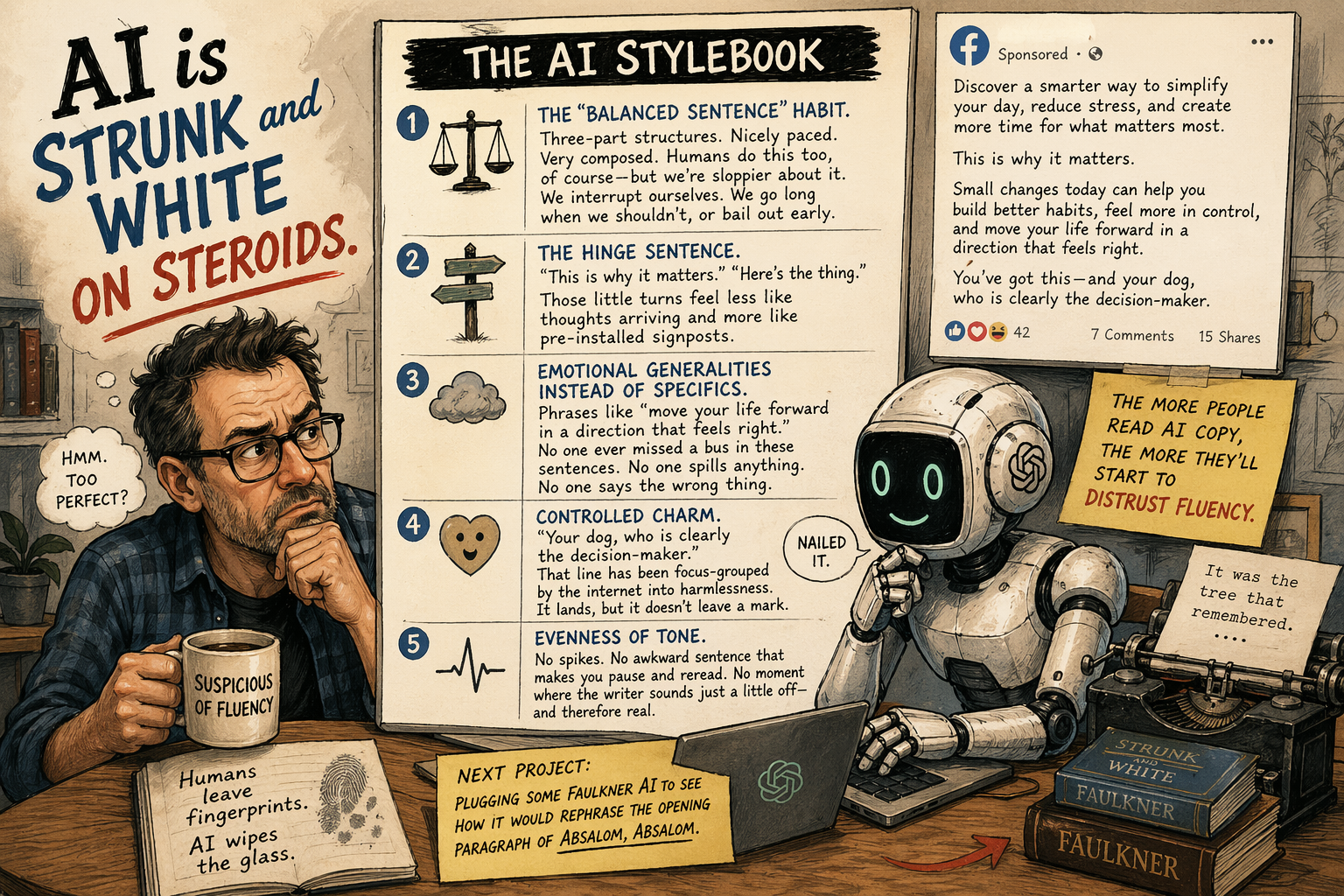
Strunk and White on Steroids
Hypocrite lecteur,—mon semblable, —mon frère!
Baudelaire, “Les Fleurs du mal”
Last night I did something mildly perverse: I fed a commercial Facebook post into my ChatGPT—the same one I use for research, copy editing, and tech triage—and asked it if the copy had been generated by AI.
BTW, I refer to my ChatGPT as “Chad,” not because I think it’s human, but because it’s easier to say (and type) than ChatGPT.
Anyway, Chad conjectured that the Facebook post had been produced by AI and then provided these telltale signs of AI authorship (as if Chad were human, and didn’t engage in the same techniques itself).
The first indicator is that AI produces balanced sentences. [1]
Three-part structures. Nicely paced. Very composed. Humans do this too, of course—but we’re sloppier about it. We interrupt ourselves. We go long when we shouldn’t, or bail out early.[2]
e.g., “Stay alert, stay ready, and don’t talk your way out of the moment.”
The second sign of AI-generated prose Chad calls “hinge sentence moves”—phrases like
“Because it does happen”
“And here’s the part that matters”
Those little turns feel less like thoughts arriving and more like pre-installed signposts.
The third characteristic of AI writing Chad cites is its tendency to engage in “emotional generalities instead of specifics.”
“move your life in a direction that feels right”
That’s technically fine, but it floats. A human writer—especially you— tends to ground emotion in something tactile or slightly odd.[3]
Phrases like “move your life forward in a direction that feels right.”
No one ever missed a bus in these sentences. No one spills anything. No one says the wrong thing.
Number four is “controlled charm.”
“Your dog, who is clearly the decision-maker.”
That line has been focus-grouped by the internet into harmlessness. It lands, but it doesn’t leave a mark.
And, finally, number five: evenness of tone.
No spikes. No awkward sentence that makes you pause and reread. No moment where the writer sounds just a little off—and therefore real.
Humans leave fingerprints. AI wipes the glass.
And here’s the twist: The more people read AI copy, the more they’ll start to distrust fluency.
So, there you have it. ladies and germs, the AI Style Sheet: Strunk and White on steroids.
Stay tuned. My next project is plugging some Faulkner into AI to see how it would rephrase the opening paragraph of Absalom, Absalom.
[1] I’ve italicized Chad’s direct quotes.
[2] Note the self-referential pronoun “we.”
[3] Chad doesn’t mention this, but AI-prose loves them em-dashes. I’m assuming the “you” in the sentence refers to Wesley Moore III.

