Last night I did something mildly perverse: I fed a commercial Facebook post into my ChatGPT—the same one I use for research, copy editing, and tech triage—and asked it if the copy had been generated by AI.
BTW, I refer to my ChatGPT as “Chad,” not because I think it’s human, but because it’s easier to say (and type) than ChatGPT.
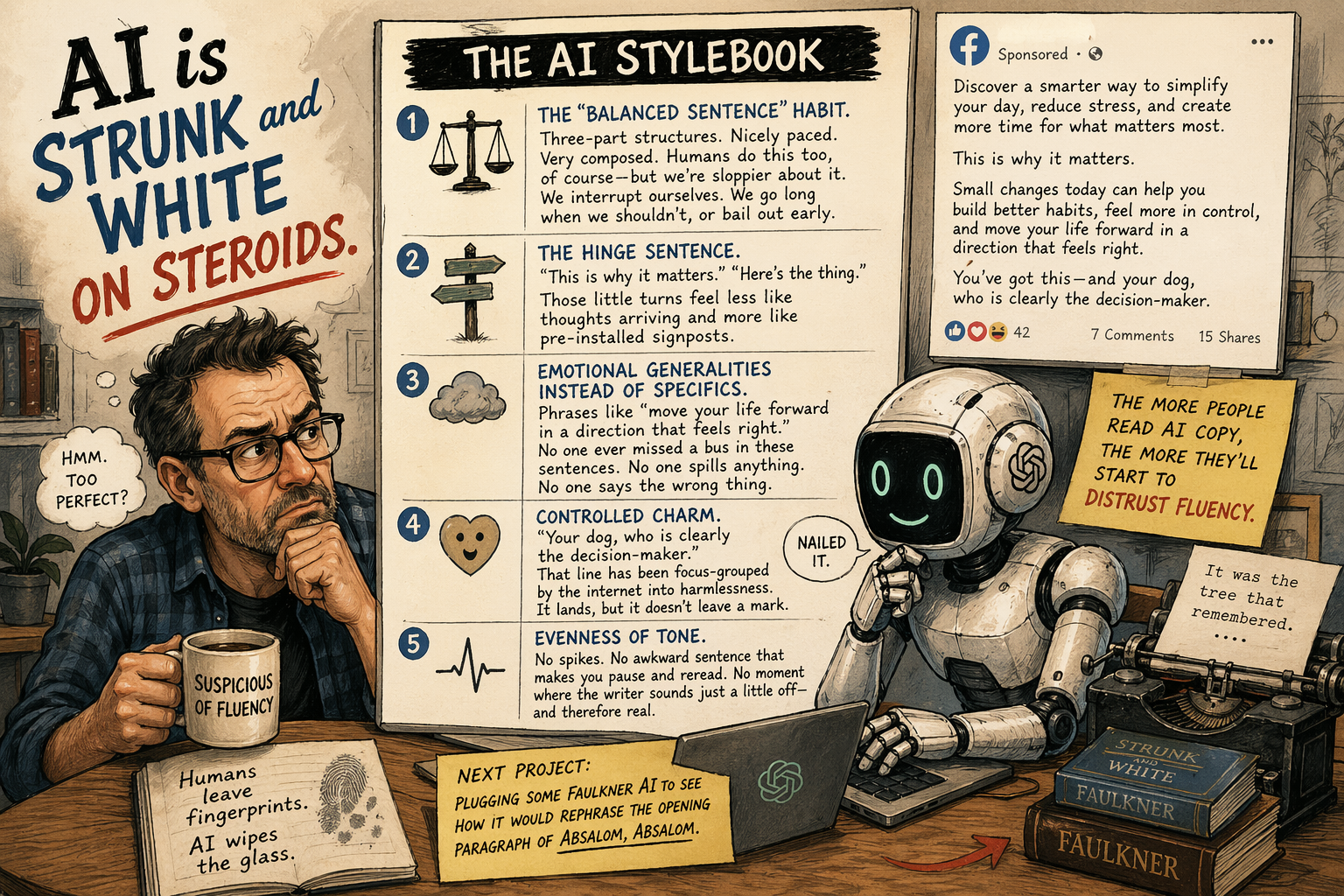
Anyway, Chad conjectured that the Facebook post had been produced by AI and then provided these telltale signs of AI authorship (as if Chad were human, and didn’t engage in the same techniques itself).
The first indicator is that AI produces balanced sentences. [1]
Three-part structures. Nicely paced. Very composed. Humans do this too, of course—but we’re sloppier about it. We interrupt ourselves. We go long when we shouldn’t, or bail out early.[2]
e.g., “Stay alert, stay ready, and don’t talk your way out of the moment.”
The second sign of AI-generated prose Chad calls “hinge sentence moves”—phrases like
“Because it does happen”
“And here’s the part that matters”
Those little turns feel less like thoughts arriving and more like pre-installed signposts.
The third characteristic of AI writing Chad cites is its tendency to engage in “emotional generalities instead of specifics.”
“move your life in a direction that feels right”
That’s technically fine, but it floats. A human writer—especially you— tends to ground emotion in something tactile or slightly odd.[3]
Phrases like “move your life forward in a direction that feels right.”
No one ever missed a bus in these sentences. No one spills anything. No one says the wrong thing.
Number four is “controlled charm.”
“Your dog, who is clearly the decision-maker.”
That line has been focus-grouped by the internet into harmlessness. It lands, but it doesn’t leave a mark.
And, finally, number five: evenness of tone.
No spikes. No awkward sentence that makes you pause and reread. No moment where the writer sounds just a little off—and therefore real.
Humans leave fingerprints. AI wipes the glass.
And here’s the twist: The more people read AI copy, the more they’ll start to distrust fluency.
So, there you have it. ladies and germs, the AI Style Sheet: Strunk and White on steroids.
Stay tuned. My next project is plugging some Faulkner into AI to see how it would rephrase the opening paragraph of Absalom, Absalom.
Yesterday’s being 4/20 and all, I committed a cliche— got confunctificated on cannabis.[1]
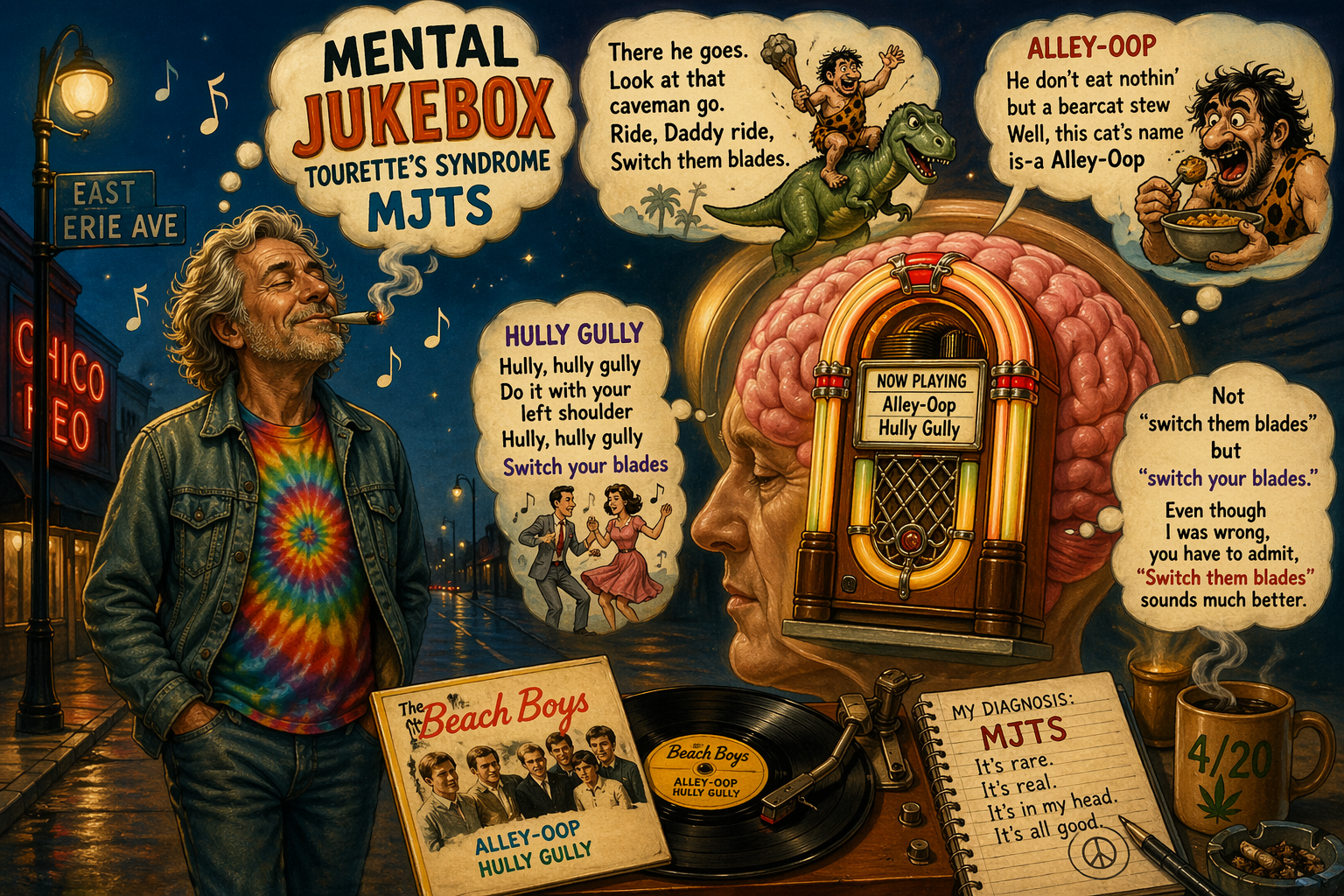
As I made my way home on foot from Chico Feo, East Erie Avenue was blessedly empty, which meant I could recite out loud the lyrics looping in what I’ve come to call my mental jukebox. Saying the words—or singing them—is therapeutic, much preferable to merely letting them swirl unvoiced like dust devils in the attic of your frontal lobe.
No doubt I’m not the only one who suffers from this niche obsessive-compulsive disorder, but I suspect it’s extremely rare. I can’t find anything about it on the internet, so I’ve had to name it myself—Mental Jukebox Tourette’s Syndrome, or MJTS.
Playing in my head on the walk home was a Beach Boys cover of the Hollywood Argyles’ song “Alley-Oop,” a silly novelty tune inspired by a comic-strip caveman.
There’s a man in the funny papers we all know (Alley-Oop, oop, oop, oop-oop) He lives way back a long time ago (Alley-Oop, oop, oop, oop-oop) He don’t eat nothin’ but a bearcat stew (Alley-Oop, oop, oop, oop-oop) Well, this cat’s name is-a Alley-Oop
Here’s what got stuck in my head and what I voiced aloud as I walked along:
There he goes. Look at that caveman go. Ride, Daddy, ride. Switch them blades.
The only way to exorcise these jukebox demons—at least for me—is to listen to a recording of the song. So when I got home, I cued the Beach Boys’ version, and lo and behold, I’d gotten the lyrics wrong. After “Ride, Daddy ride” comes “Heigh-ho, dinosaur,” not “switch them blades.”
Actually, the line “switch them blades” comes from another cover on that Beach Boys album, “Hully Gully.”[2]
‘Hully Gully” is a 1959 tune recorded by the Olympians, one of those songs that celebrates a dance. It was covered by, not only the Beach Boys, but also Buddy Guy, Chubby Checker, the Grateful Dead, and the J. Geils band—among others.
Here’s how it starts:
Well, there’s a dance spreading round like an awful disease Hully, hully gully You just shake your shoulders and you wiggle your knees (Play it like it is!) Hully, hully gully Well, there’s a dance spreading round from coast to coast Hully, hully gully Well, when me and my baby do it, that’s how we do it the most Hully, hully gully.
And here’s the bridge:
Hully, hully gully Do it with your left shoulder Hully, hully gully Do it with your other shoulder, now Hully, hully gully Switch your blades Hully, hully gully,
Not “switch them blades,” but “switch your blades.”
Even though I was wrong, you have to admit: “switch them blades” sounds much better.
Anyway, like its ugly distant cousin tinnitus, I’ve learned how to live with MJTS. So don’t worry—I’m not going to hit you up with a GoFundMe request.
[1]I first heard “conjunctificated” from a Black co- worker in 1977 at Whit-Ash, a furniture store in Columbia. This cat rarely said a word ever, but one day—out of nowhere— he proclaimed, “This place is conjunctificated,” and I knew exactly what he meant.
[2] The album, Beach Boy Party, a 1965 studio recording of mainly covers played with acoustic instruments and overdubbed with chatter to make it sound as if it was recorded at a party. The one hit from the album is “Barbara Ann.”
The Old Testament Ain’t the New Testament But It’s Pete Hegseth’s Testamentthe
air without refuge of silence,
the drift of lice, teething,
and above it the mouthing of orators,
the arse-belching of preachers.
Ezra Pound, “Canto XIV”
One of the most puzzling paradoxes of the Trump era is the veneration he receives from evangelical Christians—those Bible-thumping Pharisees who once considered Bill Clinton’s dalliance with Monica Lewinsky the Marianas Trench of moral decrepitude.
Here’s Franklin Graham in 1998: “The Bible says we’re to pray for our leaders—but it also says we’re to hold them accountable. When a leader lies and deceives, that’s a serious moral failure.”
And here he is twenty years later: “We’re not electing a pastor. We’re electing a president.”
I mean, hypocrisy of this magnitude makes Tartuffe look like Atticus Finch.
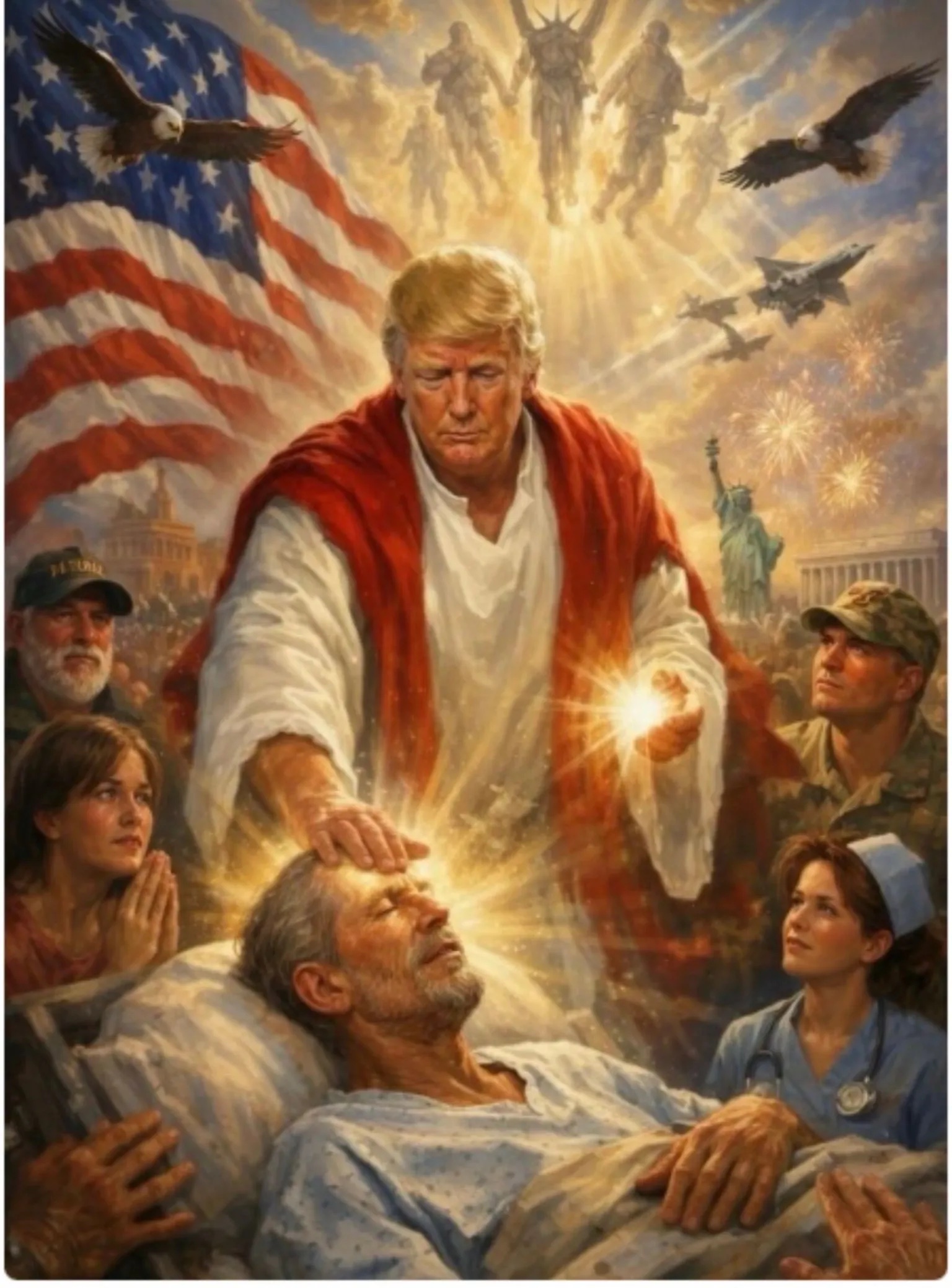
Of course, unless you’ve just emerged from a two-week coma, you’ve seen the above illustration posted on Truth Social by none other than Donald Trump—the same “gentleman” who famously suggested that “pussies” are there for the grabbing.
Trump, of course, claims he didn’t interpret the image of himself miraculously healing one of the eight white figures as Jesus, but simply as a physician.
Graham concurs: “There were no spiritual references—no halo, no crosses, no angels. It was a flag, soldiers, a nurse, fighter planes, eagles. … I think this is a lot to do about nothing.”
Hey, somebody remove the scales from Frankie’s eyes. There might not be a halo, but either the recumbent man (Jon Stewart? Jeffrey Epstein?) has a king-hell high fever, or the divine touch of Trump has transferred the light he’s holding to the man’s body. When’s the last time your physician made a house call in flowing first-century robes?
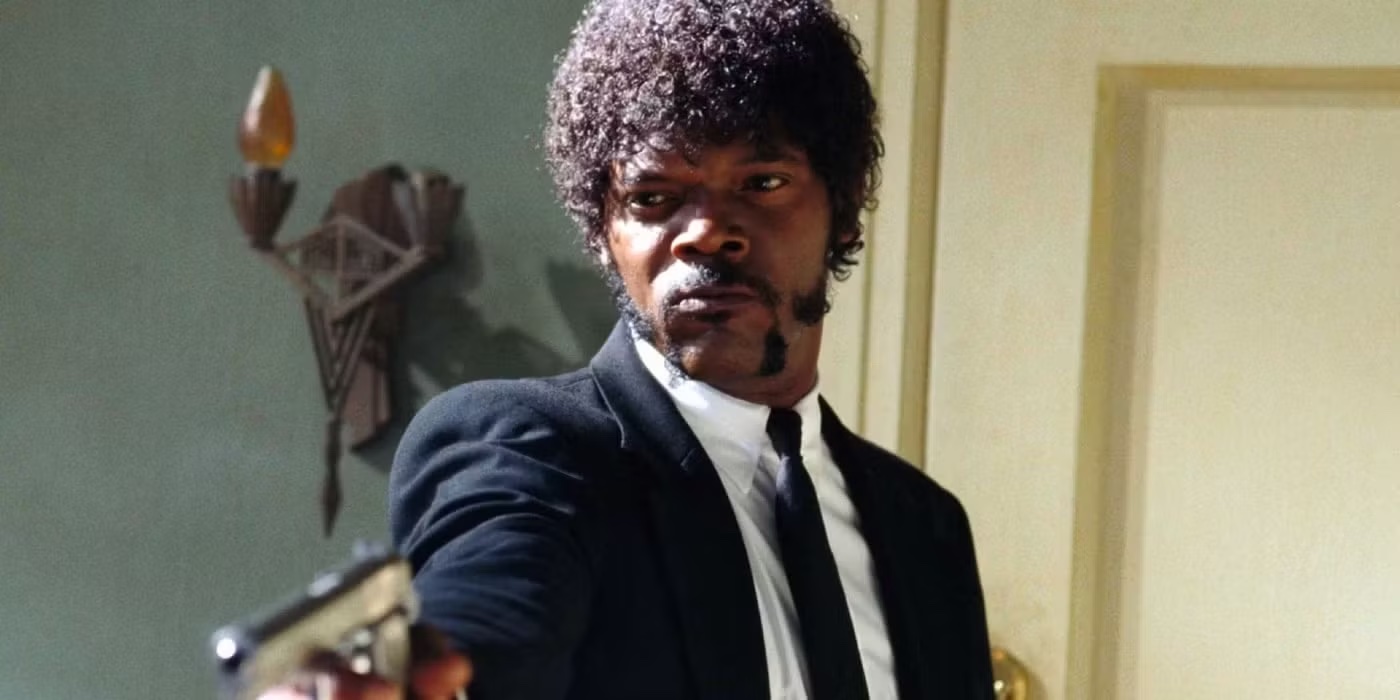
However, my favorite Trump-administration foot shot belongs to Pete Hegseth, who paraphrased Jules Winnfield’s monologue from Pulp Fiction at a monthly prayer service.
Here’s Jules from the movie:
Ezekiel 25:17. “The path of the righteous man is beset on all sides by the Inequities of the selfish and the tyranny of evil men. Blessed is he who, in The name of charity and good will, shepherds the weak through the valley of Darkness, for he is truly his brother’s keeper and the finder of lost Children. And I will strike down upon thee with great vengeance and furious Anger those who attempt to poison and destroy my brothers. And you will know My name is the Lord when I lay my vengeance upon thee.”
Here’s Hegseth’s rendition:
So the prayer is CSAR 25:17, and it reads—and pray with me, please— “The path of the downed aviator is beset on all sides by the inequities of the selfish and the tyranny of evil men. Blessed is he who, in the name of camaraderie and duty, shepherds the lost through the valley of darkness, for he is truly his brother’s keeper and the finder of lost children.”
“And I will strike down upon thee with great vengeance and furious anger those who attempt to capture and destroy my brother, and you will know my call sign is Sandy 1 when I lay myvengeance uponthee. Amen.’”
Okay, I’m willing to give Hegseth the benefit of the doubt. He didn’t say he was quoting the Book of Ezekiel, only that the prayer reflected it. Nevertheless, this is O.T. war-god Yahweh bellowing, not the Jesus they claim to worship—the Prince of Peace, admonishing us to love our enemies.
By the way, the aircraft that was shot down wasn’t dropping flowers on southwestern Iran.