As the sun arcs across the bluest of skies on this glorious Saturday of a three-day weekend, why squander my benevolent mood by overturning the rock of US politics and commenting on the spectacle of the scurrying vermin underneath?
Let’s not go into Trump and Cruz bouncing off the ropes of Thursday’s debate delivering forearms and leg kicks like Jessie Ventura and Nikolai Volkkoff.
Let’s not revisit the pairing of Lindsey Graham and Jeb! standing awkwardly abreast at yesterday’s endorsement like Muff and Jeff .
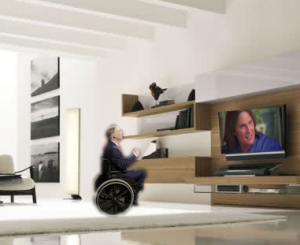
photoshopped cartoon by WLM3
And what about this century’s remake of the 1972 Democratic contest with Hillary Clinton in the role of Edward Muskie and Bernie Sanders playing George McGovern?[1]
Enough! Already I feel dyspepsia roiling the previously pacific pools of my stomach acid.
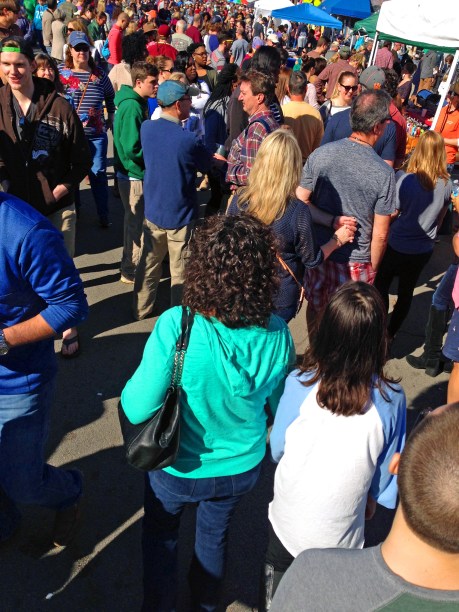
No, I’m headed to the closet to don my pith helmet for another episode of “Hoodoo Anthropology.” Today, my adopted hometown Folly Beach celebrates its annual culinary extravaganza a “Taste of Folly, which I’ve never checked out, so I’m curious to see what type of crowd the festival attracts. You would think attendees might be a bit more subdued than the roisterers who descend for Folly Gras and Follypalloza, but frankly, I dunno.
What I do know is that the streets have been cordoned off, draught beer is flowing from sidewalk taps, and, of course, the chefs of Folly have taken extra care to present their signature dishes.
1:30 pm
Your intrepid reporter/anthropologist (IRA) and his spouse/assistant (SA) park their bikes at Chico Feo. Charlie, bartender extraordinaire, informs them that a bluegrass trio will be performing at 5, and that the owner/proprietor/chef (OPC) Hank Weed has set up a station offering a taste of Chico on the main drag that bisects this seaside community.
We cover the block to Center Street on foot.
Over time, your IRA has developed mild anxiety when enmeshed in the amoeba-like pulsations of a crowd. SA Birdsong is hungry, a happy coincidence, but the lines for food are long along the bustling thoroughfare. As luck would have it, the queue for the Jack of Cup’s (JOC) curry is manageable, so the two split up; SA Birdsong procures two bowls while IRA goes inside the saloon to obtain a beer.
As sometimes happens in small villages, sitting right outside of the JOC are two friends, Larry and Jed, who offer an area of the table where SA and IRA can stand and enjoy the absolutely delicious combination of rice, potatoes, curry, peppers, etc.
Jack of Cups Curry
Since Larry has been on site since “the crack of eleven,” he has procured a wristband that allows him to transport beers as a pedestrian.
“Since when do you need a wristband to drink at a Folly festival?” IRA asks.
“It’s new this year,” Larry says. “It’s not too bad. Costs a buck. They make it efficient.”
“Maybe so, “ IRA thinks, “but here’s another instance of government complicating the lives of citizens.” He wonders where Cruz, Trump, and Bush might stand on the issue. No doubt nanny staters Bernie and Hillary are all for it.
As IRA enjoys his beer, someone approaches him from the back and begins to tenderly massage his shoulders. Out loud IRA wonders who it might be — Emmylou Harris? Chrissie Hynde? Margo Timmins? Ambrosia Parsley?
No, it’s Vinnie Folly Beach’s most prolific songwriter.
Vinnie
“You know what,” Vinnie says, “I’m going to get drunk today.”
IRA: “You are?”
Vinnie [emphatically]: “Yes I am. You know why?”
IRA: “Nope.”
Vinnie: “Because I got drunk last night, and I can’t get over it.”
Two beers are long enough for IRA to determine that the visitors for a Taste of Folly are very much like the visitors to the other festivals. Bands play, like at any other festival. There’s a Jump Castle (JC) for the kiddies, like at any other festival.
Bottom line: the festival goers seem to be having a fairly good time.
3:41
SA and IRA arrive home safely via bikes. Decompression time before Chico Feo 5pm bluegrass trio.
[1] Dream tickets: Sanders and Sharpton vs. Cruz and Cotton in a “the-center-cannot-hold” contest.
I hate it when columnists/bloggers go all ADD and cop out with slapdash hodgepodges entitled “This and That” or “Some Random Thoughts.” I see it as an abnegation of journalistic responsibility, a way to avoid the rigor of crafting a coherent piece on something of interest. How dare they take the primrose path when I’m bored and need intellectual stimulation!
There’s so much out there that begs for thorough study. This week, for example, we have the death of David Bowie, whose passing has generated an enormous outpouring of almost unanimous praise. Sure, when Lou Reed checked out of this Motel 6 of Woe in October of 2013, his death generated a fair amount of interest, but compared to Bowie’s passing, the media response was like Joey Bishop’s dying versus Johnny Carson’s.
I would have never guessed Bowie enjoyed such widespread reverence. I’m not surprised that countercultural, leftwing naysaying card-carrying hedonists like I-and-I were drawn to his androgynous flamboyance/chameleon-like iterations of personae, not to mention to his music, an eclectic body of work that ranged from sunny pop to three-chord rock to apocalyptic ballads to funk to disco and finally atmospheric jazz.
But dig this, even NASA’s official Twitter account paid tribute: “And the stars look very different today.’ RIP David Bowie.” Also, Conservative Prime Minister David Cameron: “I grew up listening to and watching the pop genius David Bowie. He was a master of re-invention, who kept getting it right. A huge loss.” Add to those worthies Chris Hadfield, the first Canadian to walk in space! [1]
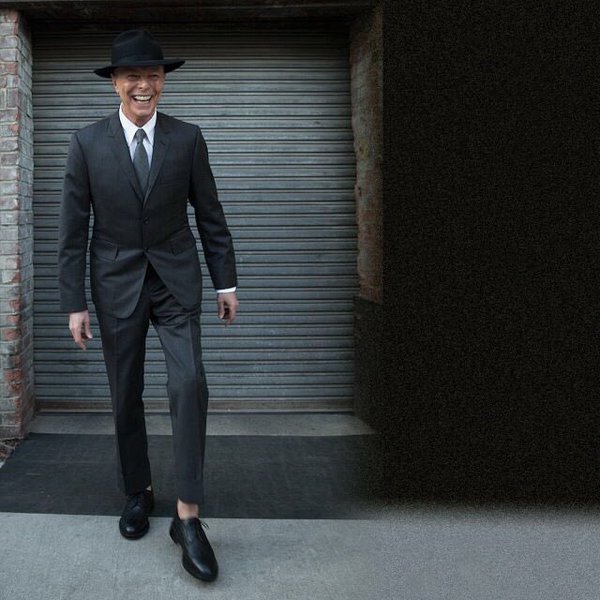
What does this outpouring of love from the mainstream for the fellow pictured below say about our culture?
One of you latterday de Tocquevilles needs to get off your lazy ass and get to work because I’m moving on to another story in the world of sports.
The following attention-grabbing first sentence comes from ace ESPN New England Patriots reporter Mike Reiss:
OXBOROUGH, Mass. — New England Patriots defensive end Chandler Jones had a bad reaction to a substance “that is not illegal” on Sunday, which led to him being admitted to a local hospital, sources tell ESPN.
Was it a really bad case of poison ivy, which, believe it or not, is legal in all 50 states?
Not exactly:
On Wednesday, citing a source familiar with the situation, the Boston Globe also reported that Jones did not overdose on a drug such as cocaine or heroin. The Globe reported that it was synthetic marijuana, which is not illegal in the state. Jones lives near the Foxborough police station, and he walked there to seek help after the bad reaction.
As it turns out, Jones and I share much in common. Not only did I not overdose on a drug such as cocaine or heroin on Sunday, but I also live so close to the police station in my community, I could walk there if I were to ever get a bad reaction from legal synthetic marijuana, but come to think of it, I’d probably opt to seek succor at a different venue.
Oh, yeah, and you’ve probably heard that filmmaker Jon Ritzheimer, undaunted by the poor review I gave to his previous movie, has just released yet another motion picture.
This one is an action flick in which the self-styled militiaman, one of the “ring leaders” of the occupation in Oregon, goes ballistic after receiving sex toys in care passages.
Frankly, I find his performance here much more riveting, more genuine.
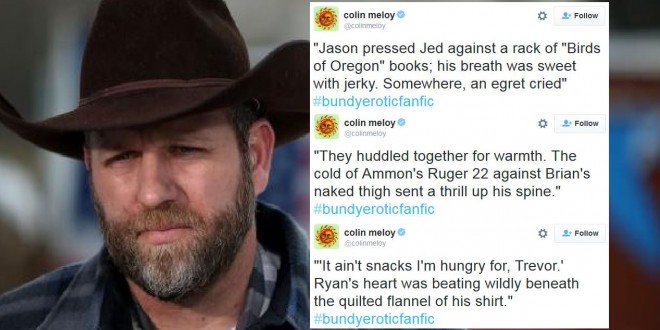
Let’s just hope he’s not read this Twitter thread in which clever non-patriots mock the Bundy Boys with imaginings of what those lonely nights in the Oregon hinterlands must be like:
Has anyone asked those patriots about Bowie’s passing? C’mon journalists, get the lead out. By the way, did you know Bowie’s real last name was Jones, just like the New England defensive end’s? And that “jones” is term that druggies use to describe an addiction?
[1] On the other hand, my prayers that I could find something positive Paul Ryan had to say about Bowie have been fruitless, nor have the Cruz, Bush, Huckabee, or Santorum campaigns responded to my emails asking them to comment on Bowie’s death.
Trigger warning: The following post tells the story of the first time I got drunk and mentions common topics of intoxication like lying to one’s mother, entertaining foolish possibilities, dancing on tables, and vomiting a retainer-like false tooth out of the window of a moving Oldsmobile going at least 70 mph on an Interstate Highway.
Here’s the sad story of the first time I got drunk, a tale of self-inflicted woe, a narrative featuring Brazilian exchange students and bad choices galore.
It occurred on a Saturday night in the late fall of 1969 when three Summerville High juniors and two Brazilian exchange students decided to skip the parent-sanctioned dance at the American Legion Hut and head to Folly Beach for some more sophisticated fun. My pal – I’ll call him Arthur – had connections, could get us in a Citadel Senior Party. We’d be posing as college students from Wofford in a daring act of James-Bond-like subterfuge [cue 007 guitars].
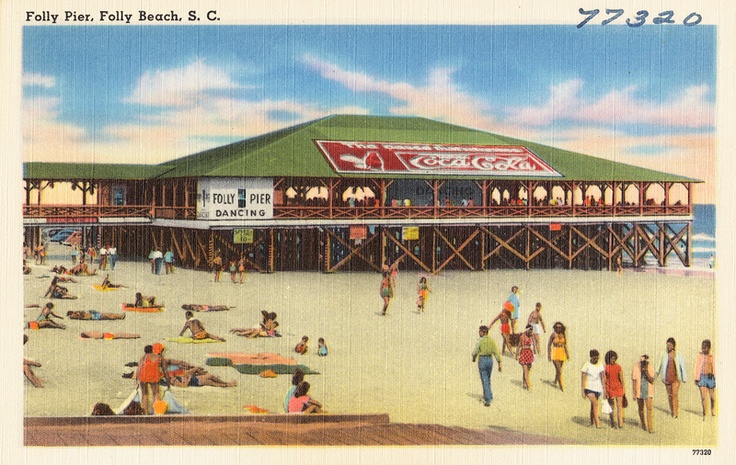
I was all for the change in venue, Folly Pier trumping American Legion Hut for sure. And who knows — it was not out of the realm of possibility — I could conceivably find myself in the arms of some jaded older almost-woman and receive backseat tutelage in the arts of love — about which I had only the slightest of cinematic clues.
It was possible. That very July we had put a man on the moon.
None of us were at the legal beer drinking age of eighteen at the time, but in Summerville in those days, that was not, as the sales clerks say, a problem. If you were tall enough to be able place a quarter and a dime on the counter of S_______’s Grocery, Mr. S________ himself would go back to the cooler and procure for you a Pabst Blue Ribbon beer, place it in a brown paper sack, and presto — fun ahoy! – off you drove.
Our driver was the late Gordon Wilson, a capital fellow, and my other friend — I’ll call him Gene — was someone I’d known for so long we’d been playpen mates.
Two Brazilian exchange students, Paulo and Jacó, who were staying with Gordon, also accompanied us. As it turned out, these two would be our saviors, or at least Jacó would. Thanks to his anti-samba sobriety, his reckoning of his own safety, he volunteered to chauffeur us home (despite not having a valid South Carolina driver’s license).
Sure, he got confused about which way to go and got us stuck for a while in a sand dune, but with the help of Good Samaritans, we – make that the Samaritans — somehow extracted the Olds, and we made it home, not only alive/unparalyzed, but in my case, undetected by my parents, even though the doors were locked and I had to crawl through a window (and in my condition my locomotion would make Buster Keaton look like Rudolf Nureyev).
Okay, I’d be lying if I tried to turn the party into a coherent narrative.
Montage time:
Inside the Folly Pier. Bright lights. Beach music. Citadel cadets, their dates. Bottle-guzzling. Flirting. What you see when looking down from a table you’re dancing on at a Citadel Senior Party.
Slipping and falling and getting up laughing.
Now, I’m in the car. After a long time of not, the car is moving. What’s his name’s driving. We’re going fast. I’m puking out of the window.
I awake, not unlike despair-racked Satan on the burning lake of fire in Paradise Lost; only, actually, I’m in my bed in my underwear and desert boots.
No need for montage here. I remember all too clearly. It felt like someone had jabbed and twisted a screwdriver in the base of my brain after water boarding me during my unconsciousness with bile from Jackie Gleason’s liver.
I vaguely remembered something about my tooth missing. I felt with my hand. No, it wasn’t in my mouth, nor on the dresser, nor in either pocket of my wadded up Levis. Not in the front pocket of my vomit besplattered shirt, whose smell almost prompted a heave. No, my fake tooth was long gone, runover, crushed, obliterated somewhere along the shoulder of I-26.
16-year-old-despair.
I’ve never liked lying, and I’m not good at it. But on this occasion I lied to my mother. I told her I had gotten sick at the dance (technically true) and gone out to vomit (technically true) and lost my tooth somewhere outside the American Legion Hut (patently false).*
She asked me if I had been drinking.
“No ma’am.”
The American Legion Hut in Summerville
She went to look for the tooth because I was in no shape to. I felt fearful and wretchedly guilty, my mother on a Sunday morning scavenging in vain among the discarded beer cans and cigarette butts in the grass of the yard of the American Legion Hut.
The next week, though, Mama got her revenge and tricked me into telling the truth.
The following Saturday, Gordon and I stayed out to 2 am, and when he pulled up to my house, I said. “I sure hope my parents are asleep.”
Like I said, Gordon was a capital fellow. He smiled and said, “Isn’t that them sitting there?”
There, there, very there, as Iago sort of says in Othello, sitting in lawn chairs on the edge of the yard, the tips of their cigarettes glowing orange dots. Gordon let me out without pulling into the driveway, and after offering a meek wave to my parents, drove off down Dogwood Circle.
No, I had not been drinking. I blew into their faces my untainted breath, whose purity did practically nothing to abate my father’s fury. He kicked me in the back of my legs as I walked up the steps. Mama told me that Gordon’s mother had told her Gordon had gotten drunk last week and so had I. I fell for it, cursed Gordon’s mother, which resulted in an “ah-ha!” Mama said she had made that up to trick me. Now I think of it, she probably was lying herself, covering for Mrs. Wilson.
Lies beget lies.
My punishment: I was told that I could no longer be me. I had to start dressing like a preppy and to change my attitude.
But, of course, that was impossible. Like Bob Dylan had sung in that record going on ten years old, I was beyond their command. I did, though, have to go to school without a false front tooth for a month. Being a redhead and freckled, I looked like a skinny Alfred E Neuman. (By the way, that’s actually my head photoshopped on the male hula-hooping dancer on the comic).
So I did suffer for my sins and still feel guilty for sending my mother on that wild goose chase. Let’s not forget that “The evil that men boys do live after them./The good is oft interred with their bones.”
Editor’s Note: Sir Reginald Verbosoclast, whose opinions do not necessarily reflect those of You Do Hoodoo, is the author of today’s guest post.
Sir Reginald Verbosoclast
A little attention is a dangerous thing, as Alexander Pope is reported to have remarked to Lord Petre after the latter allegedly snipped a lock of Arabella Fermor’s hair, an incident that famously led to the launching of a thousand ships in a demitasse (as anyone familiar with the Sparknotes summary of “The Rape of the Lock” is well aware).
Via non sequitur, take Jon Ritzheimer, one of the intrepid so-called “militia-folk” who in an act of brilliant performance art has mock-heroically taken over an abandoned federal building in rural Harney County, Oregon. Ritzheimer, whose name, by the way, is German for “cracked homeland,” began his theatrical career in his one-man ballet entitled, appropriately enough, “Fuck Islam,” an outdoor performance in which he marched back and forth in front of a Phoenix Islamic Community Center wearing a tee shirt emblazoned with those very provocative words.[1] The success of this one-man show led to a sequel called “Freedom of Speech Rally Round II,” a larger production hailed by Loonwatch.com as “the height of irony.”
Mr. Ritzheimer performing the storm scene from “King Lear”
Lately, Mr. Ritzheimer has transitioned into film, producing a series of one-man shows distributed by YouTube. His most recent premiered four days ago, a satiric piece in which he mocks contemporary American sentimentality. The 13-minute monologue begins with Ritzheimer’s alter ego fighting back tears as he declares his love for his wife and daughters, an obvious parody of that stale trope developed by Phil Donahue and seen countless times on celebrity interview shows like Oprah and Ellen. He then launches an epic catalogue of paradoxes castigating as tyrannical a government that allows him not only to march in front of a mosque wearing the aforementioned tee shirt, but also legally to amass a small personal armory.
Although the film is well photographed from the dashboard of his vehicle, Mr. Ritzheimer’s performance is, well, in this critic’s opinion, wooden. It lacks, in a word, verisimilitude. In other words, you can tell he is an actor playing a role. Nevertheless, Mr. Ritzheimer is obviously a very talented and charismatic performer whom I dare say we haven’t seen the last of.
Believe me, I know. There’s nothing more addictive than amassing YouTube views.
[1] For the sake of clarity, Mr. Ritzheimer, not the community center, was wearing the tee shirt. Ed.
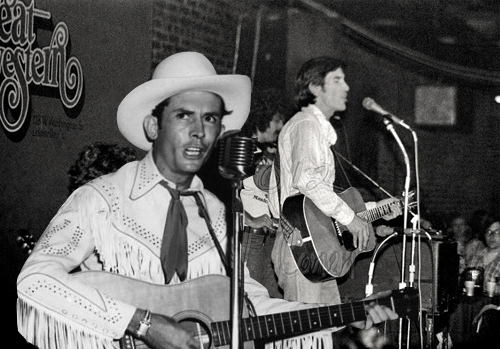
Today, January 1st, marks the anniversary of the deaths of two great American songwriters, Hank Williams in 1953 and Townes Van Zandt in 1997. In addition to their coincidental departure dates, these two shared a lot in common.
They were both long and lanky long gone daddies with dark hair and eyes, and they both had what my granddaddy called “jug ears.” In fact, judging by these two accompanying photographs, I suspect that a DNA test would discover a shared ancestor in the not too distant past.
More significantly, they also possessed the rare ability to create memorable melodies with song lyrics that can stand alone on a page without musical accompaniment.
First Hank:
Hear that lonesome whippoorwill.
He sounds too blue to fly.
The midnight train is whining low.
I’m so lonesome I could cry.
Then Townes:
Everything is not enough.
And nothin’ is too much to bear.
Where you’ve been is good and gone.
All you keep’s the getting there.
Well, to live is to fly, all low and high.
So shake the dust off of your wings
And the sleep out of your eyes.
Theirs was a tragic vision. To quote Richard Sewell:
[The tragic vision] recalls the original terror, harking back to a world that antedates the conception of philosophy, the consolations of the later religions, and whatever constructions the human mind has devised to persuade itself that the universe is secure. It recalls the original un-reason, the terror of the irrational. It sees man as questioner, naked, unaccommodated, alone, facing mysterious, demonic forces in his own nature and outside, and the irreducible facts of suffering and death. Thus it is not for those who cannot live with unresolved questions or unresolved doubts, whose bent of mind would reduce the fact of evil into something else or resolve it into some larger whole.
Like their artistic archetype Edgar Allan Poe, throughout their abbreviated lives, they were besieged by “demonic forces in their own natures,” and like Poe, they attempted to neutralize those demons through drink and more exotic drugs — in Hank’s case, chloral hydrate and barbiturates, and in Townes’s, codeine and heroin.
However, when it comes to self-destruction, I don’t think either EA or Hank could hold a candle to Townes Van Zandt. Supposedly, Poe gambled to augment his stepfather’s meager allowance, but in Townes’s case, his gambling seemed a deep-seated masochistic addiction.
According to John Kruth’s biography, To Live’s to Fly, not only did Van Zandt literally lose shirts off his back, but in one card game, he also lost his gold dental inlays, which he pulled out with pliers and delivered on the spot as payment. He also had the propensity to give all his hard earned money away to winos after getting paid for a gig. Like a crazed character out of Dostoyevsky, he seemed to seek out suffering, perhaps for the sake of his art.
I saw with my own eyes the Sibyl at Cumae hanging in a cage, and when the boys said to her: “Sibyl, what do you want?” she answered: “I want to die.”
Petronius, The Satyricon.
From man’s blood-sodden heart are sprung Those branches of the night and day Where the gaudy moon is hung. What’s the meaning of all song? “Let all things pass away.”
Yeats “Vacillation”
Death is the mother of beauty, mystical, Within whose burning bosom we devise Our earthly mothers waiting, sleeplessly.
Wallace Stevens, “Sunday Morning”
In the catalogue of alienations we Late Empire citizens suffer – estrangement from nature, God, our neighbors, ourselves – our estrangement from death is often omitted. We no longer encounter death on a daily basis. Most of us don’t raise chickens to wring their necks, pluck their feathers, excise their entrails. When our loved ones die, we no longer remove their clothes, wash their corpses, and dress them for one last family photo in the parlor.
Of course, our lack of exposure to death makes it much easier to lock it away deep in the cellar of our consciousness, which might not be such a bad thing given that nothing’s more life negating than death obsession. On the other hand, our isolation from the cold hard facts our ancestors dealt with – butchering animals, infant mortality, etc. – might have contributed to a delusion many seem to suffer, i.e death is unnatural.
A few years ago, an acquaintance’s father, a man approaching ninety, was lying comatose in a hospital. Each day, on Facebook this acquaintance updated his father’s situation, which, not surprisingly, was rather uneventful – the opening and closing of an eye, a sense from a nurse that the old man experienced discomfort when bathed. My acquaintance and visitors read the Bible to him aloud as they sat and prayed for a miracle. This acquaintance battled his father’s physicians who wanted to transfer him to hospice care while the son perceived opening an eye as a harbinger of “the complete recovery” for which he so ardently prayed.
Most of the Facebook commentators were essentially enablers writing messages like “Sounds very encouraging!!! The doctors could be totally wrong……the body can heal in ways that only God knows” or “That’s great. God is in controll” (sic) or “God is the ultimate physician:-).”
A contempt for science and doctors ran through those Facebook posts, and the commentary that followed. No wonder people don’t believe in evolution or global warming if they believe a comatose man dying of an infection brought on my the removal of a cancerous lung tumor could very well attain a complete recovery and enter robustly into his ninth decade.
On the other hand, when my wife Judy Birdsong was dying, some well-meaning soul told her that she was praying for a miracle, and Judy replied, “I’m sixty-three, don’t waste a miracle on me, pray for a child instead.”
This attitude, I submit, is a healthier attitude on dying.
dead doe in a frozen pond in North Carolina
To my mind, an ever aging husk of a body doomed to live for an eternity is a much more horrible fate than passing away in one’s sixth decade. Not only did the Sibyl at Cumae consider it a drag (see above), but we also have corroborating evidence from Chaucer’s “The Pardoner’s Tale.” When a trio of churls accost an ancient man and ask him why he still has the gall to remain alive, he replies,
Not even Death, alas! my life will take;
Thus restless I my wretched way must make,
And on the ground, which is my mother’s gate,
I knock with my staff early, aye, and late,
And cry: ‘O my dear mother, let me in!
Lo, how I’m wasted, flesh and blood and skin!
Alas! When shall my bones come to their rest?
Why, I wonder, would such devout Christians as my acquaintance want to forestall the eternity of bliss that awaited that good man? And his father was a good man, a great provider devoted to his family and his God.
The answer, of course, is love. Most of us love our parents. We don’t want them to go. I miss my own father’s sardonic witticisms, my mother’s hoarse cackle of a laugh, Judy Birdsong’s gentle movements. My acquaintance devotedly loved his father and didn’t want to think of living life without him.
Is that so wrong?
[cue Evangelical voice]: Let us turn to Ecclesiastes 3:1-4.
To everything there is a season
And a time to every purpose under heaven.
A time to be born and a time to die;
a time to plant and a time to pluck up what is planted . . .
Like I said, our aged loved ones’ passing is melancholy, and we miss them when they’re gone. I dream of Judy occasionally, and I awake missing her. Nevertheless, her time had come, and she was rather fortunate given that she didn’t have to suffer for long nor endure the feebleness that Larkin descries in “The Old Fools.”
What do they think has happened, the old fools,
To make them like this? Do they somehow suppose
It’s more grown up when your mouth hangs open and drools,
And you keep on pissing yourself, and can’t remember
Who called this morning? Or that, if they only chose,
They could alter things back to when they danced all night,
Or went to their wedding, or sloped arms some September?
Or do they fancy there’s really been no change,
And they’ve always behaved as if they were crippled or tight,
Or sat through days of thin continuous dreaming
Watching light move? If they don’t (and they can’t) it’s
strange: Why aren’t they screaming?
One of the many Mongolians who didn’t click on this site in 2015
Thanks to all of ya’ll who clicked on the blog this year, which received 20.022 hits by visitors from 110 countries. I’d like especially to thank those solo souls in Lithuania, Guadeloupe, Liechtenstein, Ethiopia, the Isle of Man, Libya, Congo-Kinshasa, not to mention whoever it was in Papua New Guinea looking for porn who got sidetracked in Hoodooland.
Of course, several countries were no-shows, including predictable sourpusses like North Korea, Mongolia, and Greenland, but come on, Botswana, Paraguay, and Fiji, where’s your sense of adventure?
Happily, except for a death-haunted January that featured a stem cell transplant, 2015 was a big improvement over 2014, so I thought I’d offer a reprise of some of the most popular posts.
January
Although “Endangered Lowcountry SC Locutions,” featuring my mother and written exactly a week before my her death, was by far January’s the most popular post, I prefer “Super Bowl XLIX Preview,” which I could easily update this year by merely dropping those clunky Roman Numerals designating forty-nine for the sleek – dare I call them Arabic – numerals 5 and 0.
February
One of the top news stories in February was an outbreak of measles at Disney World, which brought to light that luddites on both the far right and far left are not vaccinating their replicated DNA, so I produced this piece “Natural Selection at Work” that features not only a vintage photo of smiling polio victims but also a full color photo of an autistic dog.
February also brought us the Brian Williams scandal, which sent me into true confession mode. Dear Readers, believe it or not, I’m no stranger to “misremembering,” as the self-explanatory title “My Most Cherished Mismemory Debunked” testifies.
March
March came in like a lion with a very popular post, “Ten Literary Riddles.” If you don’t want to see the answers, don’t scroll down past number 10.”
April
What better way to celebrate a month dedicated to fools than a post entitled “A Brief Analysis of the Likability of 2016 Presidential Candidates,” which is so fair and balanced that Larry Sally, my most ardently Republican friend, says he more or less agrees with it.
May brought the news that Texas’s wheelchair bound governor was preparing the state for an invasion from the US Federal government, and I realized what a great movie it would make, hence, “The Invasion of Texas – Coming to a Theater Near You Soon!”
Oh my God, where has the summer gone? Life is short. I’ll be dead in no time. Better turn to the Good Book. And who better to lead a Bible lesson than the Donald: “Bible Study with Donald Trump.”
And I’m surprised this post didn’t catch on, a “Casting the Republican Primary Farce,” in which I find photos of dead movie/tv starts who are – drumroll – dead ringers for the Republican candidates.
Days dwindling into darkness, the sun slipping away, owls perched on naked boughs woo-wooing those sorrowful mating calls. It’s the very longest night of the year.
Time for a celebration!
Good News/Bad News
The winter solstice holidays fall on practically the darkest day of the year, which metaphorically suggests that now is as bad as it gets, a comforting if dubious sort of reckoning. Even though civilization has enabled junkies to sleep with the sun and rise with the moon, even though we can flood our showrooms with fluorescent light, even though night time [might be] the right time/ to be with the one you love, our bone marrow hates predatory darkness.
It knows. It remembers the fireless cave and the terror of tooth and claw and the heart-clinching night shrieks that travel in waves through your ears and down your quivering limbs. Deep down inside, your reptilian brain knows, your bone marrow senses that dark ain’t right.
Therefore, sun worshiping makes sense to me. Godzillions of people have worshipped stupider concepts than the sun. And, let’s face it, whether you call it Christmas, Kwanzaa, or Hanukkah, what you’re really worshipping is the sun – the end of its decline and the beginning of its revival.
After the blessed event, for half a revolution, each succeeding day’s light will last [cue Maurice Williams] a little bit longer. In the deepest darkest December, it’s time to huddle near a crackling fire and celebrate solar rebirth. Hang the mistletoe and ivy . . .
And so the cycles run, both positive and negative, with always something to celebrate and rue, each year’s waxing and waning seemingly swirling faster and faster, our children transforming before our eyes in time-lapsed photography as our faces in the mirror begin to melt.
12th July 1969: Anglo-American poet, playwright and literary critic W H Auden (1907 – 1973). (Photo by Victor Drees/Evening Standard/Getty Images)
Christmas
Sure, in the Late Empire, Christmas has devolved into little more than a potlatch, an obscene one at that, one that hideously underscores the disparity of riches: a thumb – if you will – in the communistic eye of the Son of Man – He who divided and distributed the loaves and fishes, who warned that it’s easier for a camel to pass through the eye of a needle than for a rich man to enter the kingdom of God, who exhorted the rich man to sell all he had and give it to the poor – we celebrate His coming by making the rich richer, yet somehow, during the holidays, the poor are so much more obviously with us.
Still, you have to admit the Christian myth offers about as elegant as a solstice symmetry as you get – the soon-to-be resurrected Son born as our sun is reborn.
Meteors flash in the clear winter sky. Orion makes his nightly journey. We breathe in and out.
A new year is rising just beyond the horizon. Time to forge resolutions. Time to celebrate, to hope.
Let’s face it, in this artificially flavored, dioxin-laden world of ours, either you or someone you dearly love is going to get cancer, especially if you manage to dodge the jihadists’ and nativists’ bullets to live long enough.
Obviously, people deal with cancer in different ways. Everyone from scientists to your Aunt Tessie will tell you to be positive, which, of course, is good advice, if not all that easy to take, especially if you’re facing chemotherapy.
For the last 17 months, my wife and I have shared our lives with a particularly rare and more-often-than-not fatal form of lymphoma known as Peripheral T-Cell Lymphoma, Not Other Specified, or for shortness sake, PTCL-NOS.
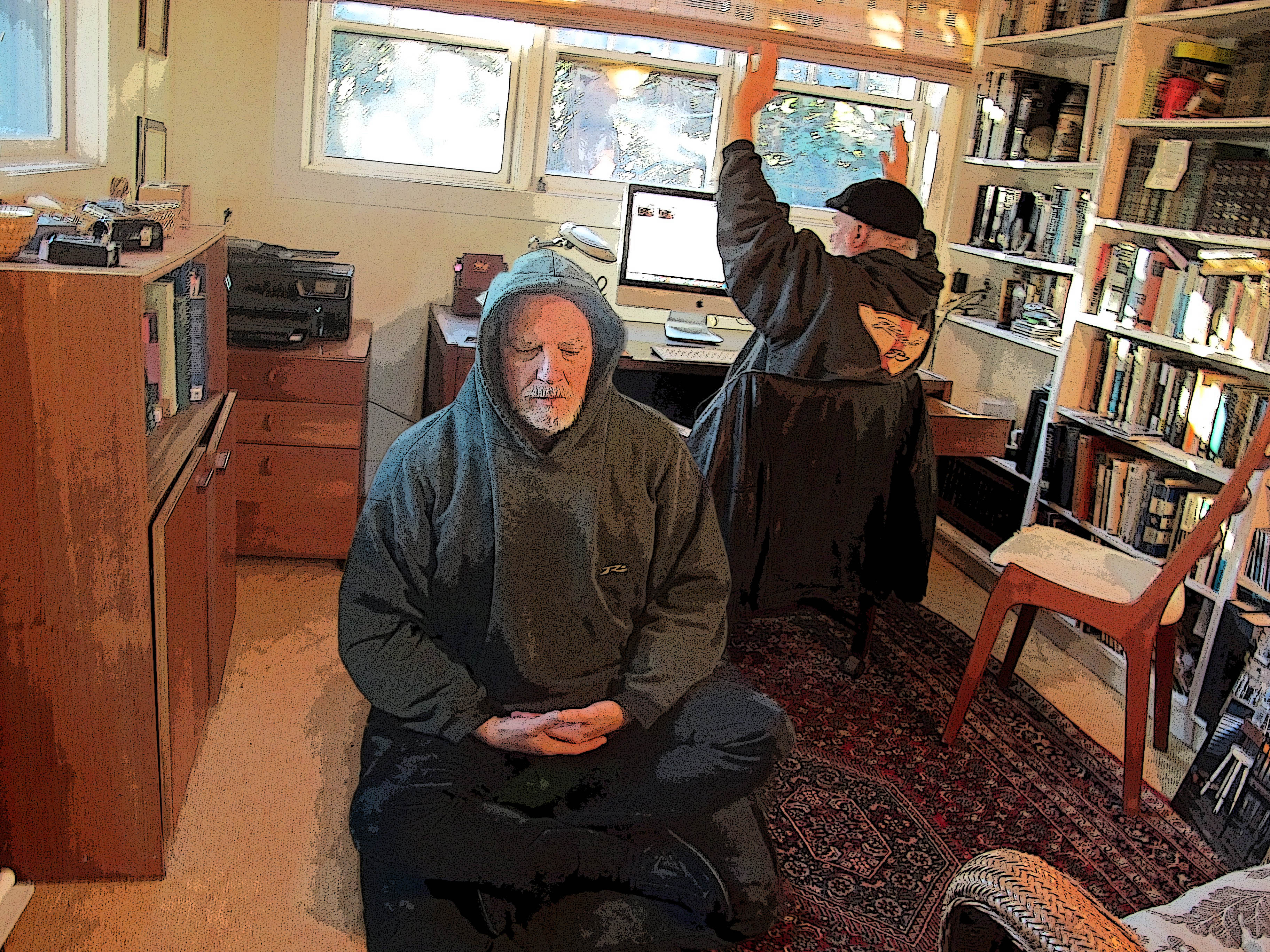
Essentially, you can deal with cancer in two ways, the Dalai Lama way or the Woody Allen way, so I thought I’d recap my wife’s journey of the last year and a half focusing on her husband’s behavior, imagining him as either the Dalai Lama or Woody Allen so you can decide for yourself which role you might play if you ever face similar challenges.
9 July 2014
Woody Allen, husband of Judy Birdsong, spends the morning cleaning the house preparing for guests, an artist friend and former colleague who’s bringing an Italian mother and her two teenaged sons to go kayaking.
Judy has gone out “to run some errands,” and Woody is getting somewhat peeved because she’s been gone so long and has left so much of the housework to him.
Finally Judy calls.
“Where have you been?’ Woody asks.
“Getting a chest x-ray.”
“A chest x-ray? What for?”
“I have this lump near my breast bone. The doctor thinks it’s probably just some bone outgrowth. No big deal.”
“Oh, my God,” Woody thinks, “she’s got lung cancer!”
* * *
Tenzin Gyatso, husband of Judy Birdsong, enjoys picking up each individual knick-knack from the shelf and gently rubbing the dust cloth over its surface. Although he knows Judy’s getting a chest x-ray, he concentrates on the task at hand, gently returning the clay statuette of the Indian mother to her place on the shelf next to the hand-painted Mexican fish.
* * *
That evening around six, the phone rings. Woody, upstairs in his study, sees on the phone’s screen that it’s the doctor’s office. He picks up the receiver just as Judy does but doesn’t hang up.
He hears: “The x-ray is inconclusive. It’s cloudy. Have you had any fever? Coughing? We don’t see a mass, but you have something called a pleural effusion, that is, fluid in your lungs, so you’ll need to come in tomorrow for a C-scan.”
Woody hangs up the phone and immediately googles “plural effusion.”
Numerous medical conditions can cause pleural effusions. Some of the more common causes are:
Woody spends a very miserable night, the worst one since his last night in jail (c. 1978), tossing and turning and speculating just what horrible type of cancer Judy has. Finally, because she’s had no symptoms, Woody becomes convinced that it’s metastatic ovarian cancer.
* * *
That evening around six, the phone rings. Tenzin, upstairs in his study, sees on the phone’s screen that it’s the doctor’s office. He waits to see if Judy picks up, and she does.
After the conversation, she comes up and tells him the x-rays weren’t clear, that she needs a C-scan.
He takes a deep cleansing breath, then exhales slowly.
11 July
The C-scan did detect a mass, “a primary cancer probably a lymphoma,” according to the radiologist. Woody and Judy arrive at Roper Hospital for Judy’s initial visit with her oncologist. When they arrive, they discover the appointment is at a different facility across town, so they rush to their car and take off. Even though the receptionist has assured them they have enough time, this soundtrack plays in Woody’s mind.
They do arrive on time, and the oncologist, an acquaintance, the husband of a colleague of Woody’s, is a calming presence. He shows them the tumor on a screen and agrees that it looks like lymphoma, and says that’s what he hopes it is because lymphomas are curable. He introduces them to the paradox that the faster a cancer grows, the easier it is to kill.
Woody goes home and googles lymphomas, which indeed are very treatable if it’s the B-cell variety. T-cell lymphomas are a different story.
15 July
While Judy’s out kayaking with Tenzin, the oncologist calls and tells Woody they need to run about a thousand new tests on Judy to find out “what type of t-cell lymphoma we’re talking about.”
“Oh no,” Woody says. “T-cells are harder to cure, aren’t they?”
“They can be,” he says tersely.
When Judy returns, she can see it on Woody’s face.
“What’s the matter?”
He tells her. For the first time they weep together.
20 July
Tenzin has put Woody in a strait jacket, jammed a sock in his mouth, and locked him in a closet so he can call his sons and tell them the bad news. He also calls his siblings and closest friends.
Judy is stoic as well, suffering through a barrage of tests without a complaint.
They nervously wait to see how far it’s spread.
22 July
Good News! It’s Stage 1, confined to that one tumor. No bone marrow involvement. The treatment will be aggressive. 96-hour continuous hospital infusion, two weeks off, then another blast. There will be 6 to 8 cycles, then perhaps a stem cell transplant and even after that radiation.
28 July – Early December
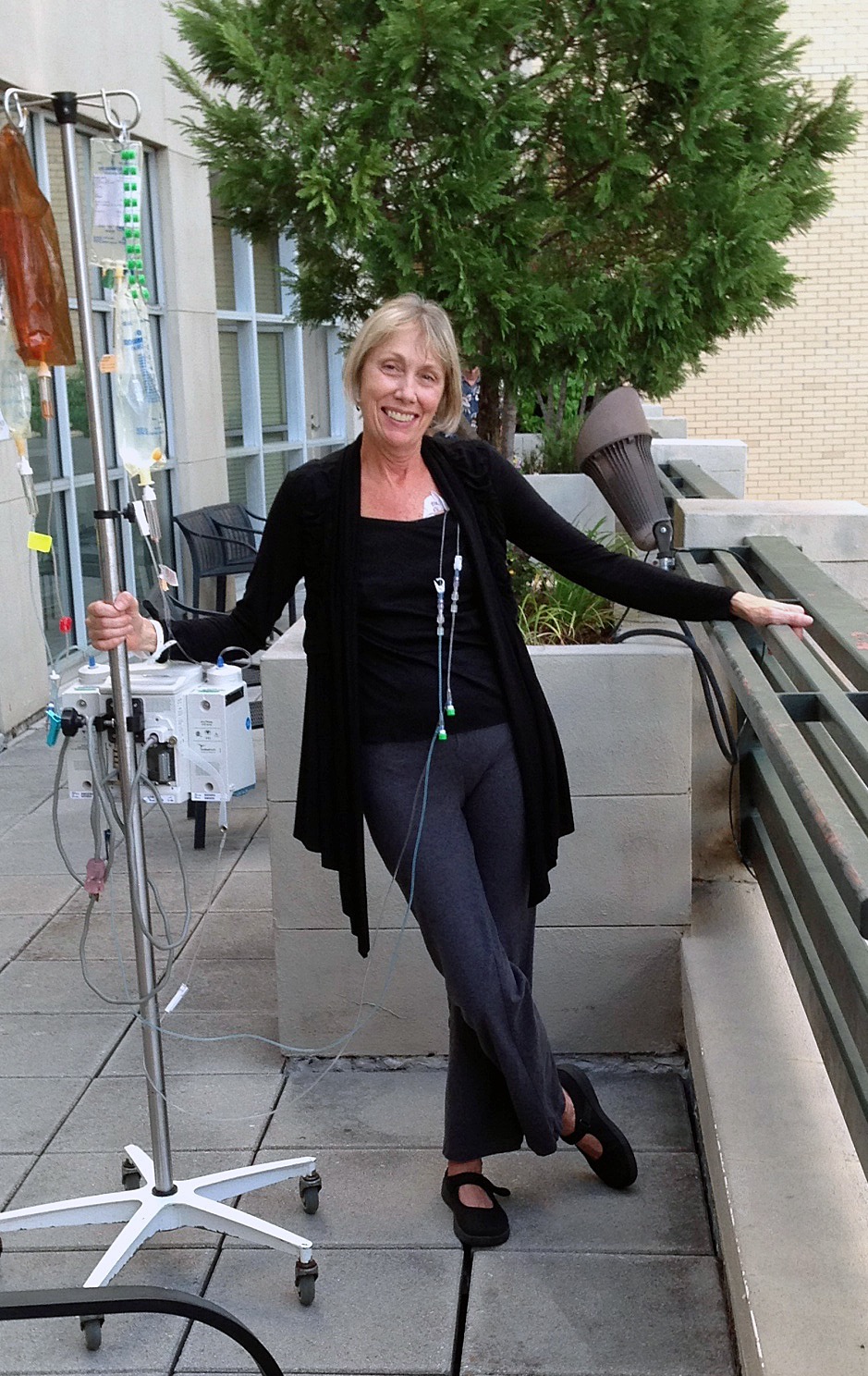
Judy on the 5th Floor Balcony of Roper
Although Tenzin can sometimes hear muffled sounds from Woody’s closet, he – Tenzin – is very much in control. During hospital weeks, he wakes up at 5, walks their doomed dog Saisy, showers, etc., and delivers the paper to Judy on the 5th floor of Roper and sits down to enjoy a cup of coffee. Then he shuffles off in his blue footies, down the hall to the elevator, hitting the first floor, greeting the staff coming on as he heads to the parking garage and to work.
After only four days of chemo, the tumor has shrunk so much that the oncologist says he wouldn’t know it were there by external inspection.
Of course, everyone loves Judy because of her courage and exquisite manners. The nurses try to see to it that she gets the rooms that look out over Charleston Harbor. She walks a lot, dragging the chemo-shit along with her. She continues her work as a school psychologist from her hospital bed, and in the third week goes to work in Berkeley County wearing a wig. In the afternoons when she’s in the hospital, Judy and Tenzin sit on the balcony and note the beauty of the light as it falls upon the steeples of the city.
In October on a Friday, Tenzin returns from work to find a voice message from the oncologist. He’s delighted to inform them that Judy’s scan has come back all clear; there’s not a trace of cancer.
Nevertheless, they’re going to continue for two more cycles of chemo, culminating in a grand total of 6.
Late December 2014 – January 2015
Tenzin’s mother has had a stroke as Judy’s preparing for a stem cell transplant. Tenzin allows Woody to come out of the closet to google stem cell transplants, but marches him right back in there afterwards.
One morning they come downstairs to find that Saisy has died during the night. Tenzin and his neighbor Jim load Saisy’s carcass in the back of Judy’s SUV (Tenzin’s Mini isn’t an option), and she drops Saisy off at the Vet’s to be cremated. She then drives on to work as Tenzin does the same.
Over the next week, Tenzin tries to make it to his hometown to see his fading mother while meanwhile Judy suffers the worst part of her treatment, bone-marrow killing doses of a different type of chemo that incapacitates her.
When Tenzin’s mother dies, Judy’s very ill; she can’t attend the funeral because she’s been hospitalized. The good news is that Judy’s sister and sister-in-law have come to help. Despite all the negativity, spirits are somewhat high.
February – March 2015
Scans again clear. Time for radiation, which is no fun, but it’s much better than chemo.
June 2015
Judy’s and Tenzin’s son is getting married in June, right after another scan. Woody, who has been released from the closet but remains under house arrest, thinks the scan should be put off until after the wedding, but Tenzin and Judy disagree. How great to hear the news beforehand they say.
But they don’t hear the news. Woody is not allowed to come up to DC for the festivities (though he does text twice). The wedding week is wonderful as Judy and Tenzin reunite with loved ones and enjoy interacting with their new in-laws. All agree the ceremony and reception are a blast.
When Judy and Tenzin return to Charleston, they learn the scan was “all clear.”
17 December 2015
Judy goes in for her six-month scan. Woody has been sneaking around googling, looking for PTCL-NOS success stories, and under that heading what’s below is all he can find:
To date: 17 chemotherapeutic drugs in 8 regimens. 4 of those drugs at least twice.
Knowing the redemptive value of suffering makes all the difference.
Woody also discovers that the median time for relapse is 6.7 months after primary treatment, and it’s been seven months since Judy’s ended. Plus her SED rate is way high at 38 (20’s normal). Woody googles for possible reasons for high SED rate. “Cancers: lymphoma, leukemia.”
18 December 2015
Judy tells Woody (who’s wearing a Tenzin mask) he doesn’t need to accompany her to her 3 o’clock appointment.
As soon as she leaves for work, Woody clobbers Tenzin over the head with a walking cane and shoves him in the closet.
Woody goes to work and grades one set of exams, attends a brunch, then goes home at one-thirty and tries to take a nap.
He falls into a fitful sleep but awakens.
The clock crawls. Three finally arrives. Why didn’t meet her there? Imagine a text message. Or if it’s bad, wouldn’t she call? Imagine her driving back by herself knowing. Poor thing. 3:05. Friday’s NY Times crossword puzzle. It’s impossible. 3:15. He imagines Judy being weighed, getting her blood pressure taken. 3:30, no word. 3:35 goes down to play solitaire. 3:50. Knows Judy might get irritated but calls.
She hasn’t been seen yet!
4:05; Billie Holiday’s text ring tone “Comes Love” sounds. He sees ”scan’s all clear” on the screen. Screams Yes!! Literally dances a jig. Judy calls. “Yes!” He texts his sons “Yes!” He texts friends. “Yes!”
He rides his bike down to the Jack of Cups where he finds the owner Nick sitting at the bar with Tyler, a Chico Feo bartender, sitting next to him, and Samantha, a lovely tattoo-covered “girl next door” stationed behind the bar. He shares the good news. Larry comes in. Lesley, Nick’s wife comes in. They all high five. Nick disappears and returns with six shots.
They raise their glasses and chug.
Meanwhile, Tenzin is just coming to back home. He walks slowly up the stairs to his study and takes from the shelf The Selected Poems of WH Auden. He looks at the index of first lines, flips to the sought after page, and reads:




















 You Do Hoodoo