Trump and Hitchcock’s Birds

the-birds-31

I fear that the sheer overabundance of disinformation/information that Trump generates overwhelms the capacity of the media to focus and fixate.  With Hillary, we had the relatively stable narrative of her untrustworthiness, and her private email server coupled with questions about the foundation provided her enemies and the press witha slow-moving target — if not a sitting target — like a hippo sunning on the banks of a muddy river. No matter that compared to Trump’s malfeasance, the emails – literally misfeasance – seemed like a bigger deal because we heard about them constantly. To switch metaphors, each day brought a new e-mail story, and the stories were stacked like blocks throughout the months until they formed a sort of Potemkin monument of mal – as opposed to – misfeasance.

Trump’s issues, on the other hand, remind me of the avian swarms we find in Hitchcock’s The Birds.  They are legion:  Trump University, Trump’s Foundation, stiffing contractors, pussy grabbing, bankruptcies, phantom tax returns, international intrigue, colossal debt, criminal associations, overt cruelty, the deluge of demonstrable false statements.

A flock of these issues comes at us fast furious squawking in a terrible cacophony, then dart away, before another, different swarm descends.  Meanwhile, via Twitter, Trump spews provocative or petty phrases that further distract those whose job it is to place things in perspective and then render them clearly visible.

For example:


Ritualistic Warfare

shapeimage_2

This morning one of my dear friends posted this eminently reasonably question on her Facebook feed: “Ok. Before I go to bed,  I must ask, “Is football really that important?. . . and what if it isn’t?”

This query reminded me of some anthropological  work I conducted five years ago to investigate the role that American football plays as a medium for social cohesion.  I published my findings in another venue, but I have received permission to republish here in its entirety.

Preface

My travels as an amateur ethnologist/anthropologist have taken me to many exotic – dare I say dangerous – locations. Whether it be sampling indigenous herbs in a tourist-unfriendly dance club in Montego Bay, mentioning positively a taboo word like Hillary among Baptists at a cousin’s Orangeburg County funeral, or infiltrating the decadent underbelly of Folly Beach debauchery at the Sand Dollar Social Club, I have repeatedly put myself in harm’s way for the sake of science.
at a club in Mo-bay Jamaica

at a club in Mo-bay Jamaica

So when my friend and colleague Furman Langley suggested we make the trek to Columbia, South Carolina, to witness and study first hand the ritualistic warfare known as college football among a savage and frustrated tribe known as Gamecock Nation, I jumped at the chance. Of course, I have witnessed these fascinating spectacles before, but always as an outsider, someone peering from the periphery, distant, in the upper tier of the stadium squinting my eyes while choking on jet fumes.

This occasion offered, however, the rarest of rare opportunities, to don rooster regalia, to hobnob among, not only proletariat practitioners, but also among the upper echelons of the Gamecock Nation, culminating spectacularly with a meeting with the Big Chief, himself, Dr. Harris Pastides. And, more importantly, I was able to witness the ritualistic warfare from a vantage point from which the combatants didn’t look like ants scurrying across a green and white napkin but like gigantic human beings I wouldn’t want colliding with me at literally break neck speed.

Big Chief Pastides

Big Chief Pastides

Preparations

Based in St. Amelia Island, FL, Furman Langley has concentrated his anthropological career studying Late Empire American behaviors among large crowds. His particular field of expertise is rock concerts. In fact, when I encountered him doing field work at a Springsteen concert in North Charleston a couple of years ago, he informed me that he had attended another Springsteen concert in Jacksonville just days before.

This dedication to science has taken him all over the globe, as he as has repeatedly put his hearing in jeopardy by witnessing live shows by – a full catalogue would run pages – let’s just name three: the Dead, the Stones, and Dylan. So, of course, I leapt at the chance when Furman asked me if I would like to accompany him to Williams Brice Stadium.

We decided that the wealth of data that such a trip might yield demanded we stay overnight to observe the Gamecock Nation’s behavior after the game, to experience their jubilation if they triumphed, or more likely, their despondency if they happened to lose.* So we met at a Travel Plaza outside of St. George, South Carolina, left my rather cramped vehicle there, and proceeded in Furman’s appropriately black Carrera, black being one of the totemistic colors of the Gamecocks.


*The abysmal performances of the Gamecocks over the past century has given rise to a myth called the chicken curse. Indeed, the Gamecocks had not defeated their opponents of today’s game since 1933.

Note the Gamecock hat on the dashboard to signal fellow game goers we’re of their tribe.

Note the Gamecock hat on the dashboard to signal fellow game goers we’re of their tribe.

Pregame

Location 1

Actually, more time is spent during what natives call pregaming or tailgating than viewing the ritual of warfare that follows. To obtain the widest range of data, we tailgated at two different locations, one in the hinterlands of the stadium, an area populated by lower tribespeople, and the other in a so-called cockaboose, a refurbished train caboose that elite members of the tribe purchase for tens of thousands of dollars.

tailgating

tailgating, location 1

Furman selected an area with which he was familiar along a street of various warehouses. Many of these businesses supplement their income by charging money for the privilege of tailgating in their parking lots; however, Furman shrewdly parked in a free spot across from the parking lot pictured above.

Our provisions consisted of a six-pack of Kalik beer (whose name voiced in conjunction with the second syllable of the team’s totem for some reason produces eruptions of laughter from tribesmen and women alike).

We hadn’t been standing there long before two African Americans rolling a cooler down the street asked us if we’d like “a free sausage biscuit.” When Furman answered in the affirmative, they asked us if we wanted condiments. We thanked them profusely and consumed the gifts, which though generously bestowed, consisted of a half-dollar sized sausage on a saucer-sized bun.

Observation 1: Normally capitalistic tribesman engage in communism with total strangers if those strangers have donned the colors and paraphernalia of the tribe.

(The photograph below offers an example of Gamecock paraphernalia – a beverage refrigerator/hand protector called a koozie).

kalick

Minutes later two other tribesmen parked their vehicle behind Furman’s and set up a small table with their provisions: wings, crab dip, and light beer. These two, who consisted of an elder, Frank, and his son, Bruce (both sporting black jerseys) offered us some of their wings, crackers, and crab dip as they discussed recent battles and this particular assemblage of the Gamecock warriors. In fact, they voiced some trepidation about the competence of the Gamecock Field General, a 6-year senior called Garcia. As it turned out, these worries ended up being prophetic.

Observation 1 confirmed: these red state Obama haters communistically offered us members of the intelligentsia their bounty in the name of Gamecock solidarity.

Location 2

Via cellphone, Furman established communication with Jay and Lee Ann, fellow anthropologists who have forged a trusting relationship with the owner of a cockaboose. So we set out on foot to rendezvous with them so we could obtain entrance into the sacred grounds. The following photo of three exuberant tribespeople we encountered on the trek demonstrates how total strangers abandon social inhibitions when they encounter others sporting totemistic regalia. Note the young tribeswoman’s fingers, not, as the uninitiated might assume, declaring cuckoldry, but rather as a sign of solidarity among rooster rooters.
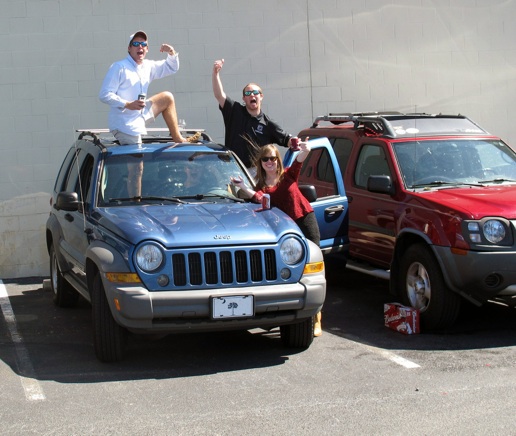
walk-1

Location 3

outside-cockaboose

At the gates of the Cockaboose confines, security officials distributed plastic bracelets designating us as among the cockaboose elite. Jay offered us two malted beverages and escorted us into the inner sanctum of the cockaboose where a cornucopia of high calorie culinary delights stretched before us like a highway to a heart attack.

cokaboose-1

Once again, I found the natives to be absolutely hospitable to me, a total stranger.

After what seemed a short time, we began our journey to the field of combat, but not before Furman and I ascended to the steps to check out the rooftop vantage point.

up-on-the-roof

As we neared the stadium, the density of celebrants increased as did their levels of exuberance. Below we see Jay returning from greeting some natives he has gotten to know.
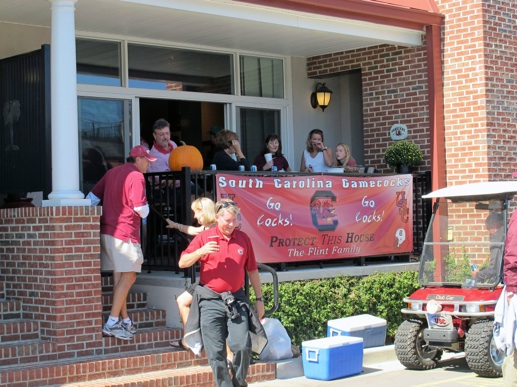
flint-family

The trip to the stadium offered several curiosities:
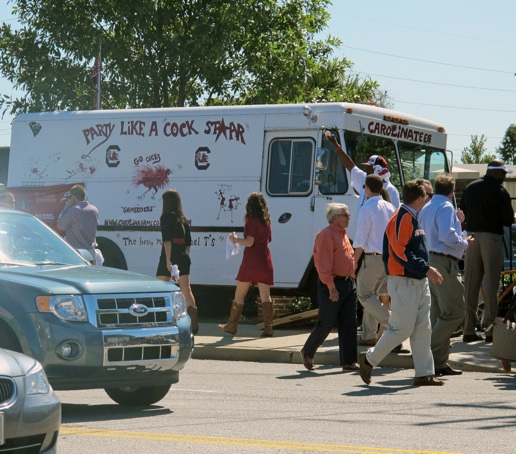
party-like-a-cock-star

Among them an encounter with the Supreme Chief of the Gamecock nation who had his bodyguard snap a picture of us together.
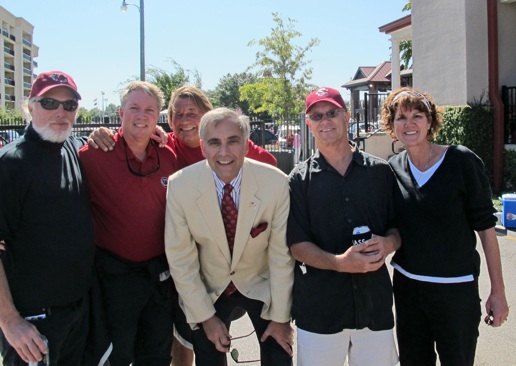
From left, yours truly, Jay, Marty Springs, Big Chief, Furman, Lee Ann

From left, yours truly, Jay, Marty Springs, Big Chief, Furman, Lee Ann

Eventually, we made into the stadium found our seats, and enjoyed the pageantry.
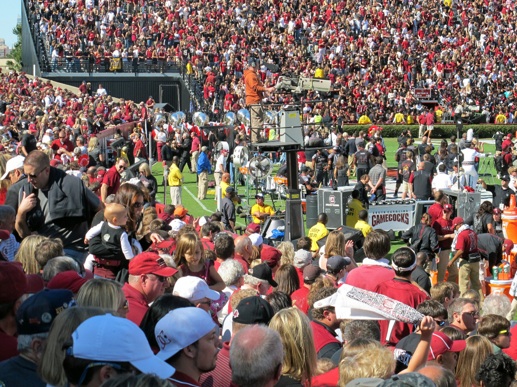
crowd

The Game

Alas, after all of the hullabaloo, the ritual warfare proved to be anticlimactic, to say the least. Frank’s and Bruce’s worries about the field general proved all too prescient as the Gamecocks managed to blow a fourth quarter lead and have defeat snatched from the jaws of victory.

play

After the debacle of the game, the once jubilant nation shuffled off like participants of the Bataan Death March. Some could be heard muttering under their breath Shamecocks and Gamecrocks.

Postgame

Subdued about sums it up.

Conclusion

Although a victory would perhaps offered more interesting data collection, we did, I think, confirm that these ritual gatherings may help to unify a diverse community of otherwise potentially combative elements. Here, Republicans, Democrats, Independents, blacks, whites, hispanics, and the rare albino can for a few hours form a brother/sisterhood.

walk-to-stadium-1

A Year Most of Us Would Like to Forget

Gebhard Fuge: An den Wassern Babylons

Gebhard Fuge: An den Wassern Babylons

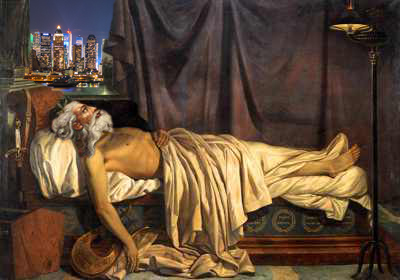
A couple of posts ago, I stated that I wasn’t going to do my annual review because I lacked the courage; however, I’ve changed my mind hoping that the exercise might provide some catharsis, serve as a purgative to wash away pity and terror, as I rent my sackcloth and tear out my few remaining  strands of hair.

January

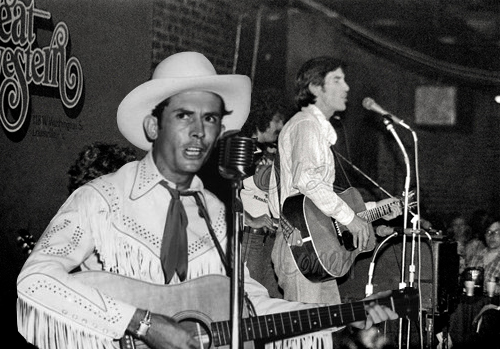
Prophetically setting the tone for horror over the horizon, my very first post this year was a New Year’s Day comparison of Hank Williams and Townes Van Zandt, two doomed cool rocking daddies who both died on New Year’s Day 44 years apart.  Click Here.

hank and townes

Of course, David Bowie would die later that month while those undelightful Bundry Boys, who later would be acquitted, occupied federal property in Montana.  Instead of going there, I’ve linked the cautionary tale of my first acquaintance with alcohol.  Read it and weep. Click Here.

Folly Beach Tales of Intoxication

February

In February my Aunt Virginia died, which led to musing on mortality as my siblings and I scattered her remains to the Folly River.  Click Here.

ashes to ashes

Here’s also a review of Kendrick Lamar’s To Pimp a Butterfly, which I listened to driving to a funeral home after a stranger in a bar the previous evening showed me photographs of her husband’s severed finger stumps, which he had acquired a couple of hours earlier. Click here.

March

patPat Conroy, the father of a close friend, died.  She and her sister stayed with us during his hospitalization. Click here.

In addition, March brought us the news of the return of Judy Birdsong’s T-Cell Lymphoma, which, of course, was profoundly disheartening.

This post was created on Good Friday right after finding out the news.  Click here.

April

Teaching Keats while in despair proved quite difficult but do-able.  Click here.

And, of course, Prince, whom I dubbed “the Lord Byron of Pop, died.  Click here.

screen-shot-2015-12-08-at-7-58-05-am


May

Yet another death, this time a student’s.  Click here.

And I review Don DeLillo’s just released not-exactly-upbeat novel, Zero K.


Edward Hopper: "Morning Sun"

Edward Hopper: “Morning Sun”

June

dylan-ali-2-300x201June brought us a mass shooting in an Orlando Nightclub.  Click here.

Ali, a sort of boyhood hero died, which took me back to the early 60’s when my father tried to teach me how to box.  Click here.

So I decided to cheer myself up by reading the Brothers Karamazov.  Click here.

the author fleeing from an ant attack

the author fleeing from an ant attack

July

Trump + Putin = Love. Click here.

Also, there was that festival of bad taste known as the Republican convention. Click here.

Adelson's luxury suite

Adelson’s luxury suite

August

Okay, how about a little sunshine.  I donned my anthropological pith helmet and crashed a bachelor’s party at Chico Feo (click here) and talked a colleague into letting me publish a brilliant letter she wrote to her students (click here).

September

Snazell, Sarah; Doppelganger; Brecknock Museum and Art Gallery; http://www.artuk.org/artworks/doppelganger-178168

Snazell, Sarah; Doppelganger; Brecknock Museum and Art Gallery; http://www.artuk.org/artworks/doppelganger-178168

In September we travelled to Houston for treatment, and my Judy Birdsong met the other Judy Birdsong, a bright light in a year of darkness (click here).

October

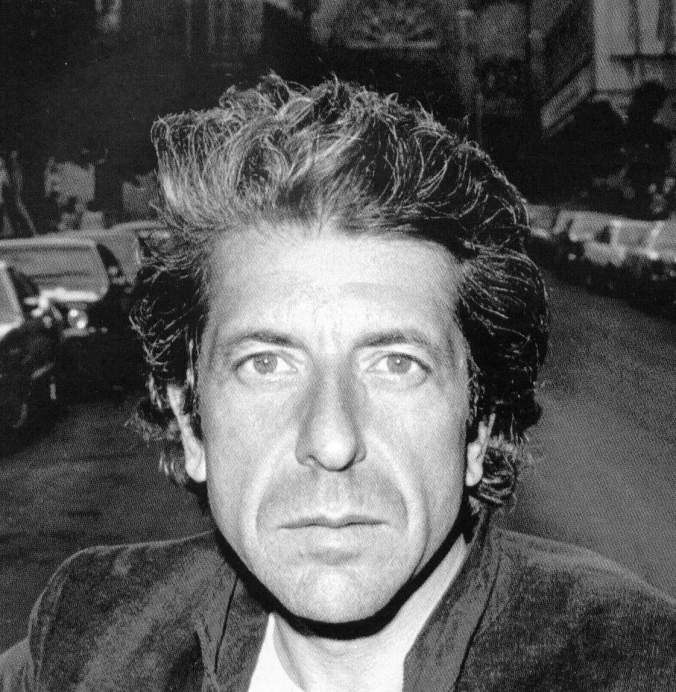
Before Leonard Cohen died, I published this piece after reading David Remick’s splendid New Yorker article.  Click here.

13c6ce05571f948557d191ce5f1d7cb0

Blow Hurricane Matthew, break your checks, rage blow. Click here.

November 

Oh my God NO! Click here.

melania-libertyDecember

So here we are.  On the edge.  Waiting.  But, hey, thanks to all for reading, especially my regular crew.  Happy New Year!
.


God’s in Hospice, and I Ain’t Feeling So Hot Myself

god

God is dead. God remains dead. And we have killed him. How shall we comfort ourselves, the murderers of all murderers? What was holiest and mightiest of all that the world has yet owned has bled to death under our knives: who will wipe this blood off us? What water is there for us to clean ourselves? What festivals of atonement, what sacred games shall we have to invent? Is not the greatness of this deed too great for us? Must we ourselves not become gods simply to appear worthy of it? 

~ Nietzsche, The Gay Science, Section 125, tr. Walter Kaufmann 1882

Why, then, ’tis none to you, for there is nothing either good or bad, but thinking makes it so.

~   Hamlet to Rosencrantz and Guildenstern Hamlet 2.2   c. 1600

Despite the scrumptious, about-to be-devoured meals I see on my hedonistic Facebook feed[1] (accompanied by their self-congratulatory “not-to-shabby” captions), within the concrete walls of my work world, I’m much more likely to hear “Happy Friday” than “Life is Good.”

It could be I’m merely projecting my late life dissatisfaction onto the rest of my American brethren; however, the contemporary novels I read tend to support my thesis that a majority of our citizens are unhappy with their lot. The novelistic worlds of Jonathan Franzen, Jenny Offill, or Colum McCann are worlds of woe, of fragmentation, of fractured families where spouses spit spleen at one another and disaffected children fail to prosper. And certainly, the recent US election suggests that 46% of voters would rather cast their lots with a ranting, inarticulate prevaricator who promises change than suffer through four more years of a considerably less corrupt status quo.

Ch-ch-ch-change.

The reasons for our unhappiness are no doubt manifold, but I’m going to suggest that the decline in religious belief and observation must play a significant role in our Great Dissatisfaction.   Now, I don’t want to get into the barren argument of whether there is or isn’t a deity, of whether belief is an illusion or disbelief a delusion, but rather, how the absence of religious observation – and by observation I mean not only attending services but also following precepts – might lead to malaise.

A recent Pew Research Center study of Religion in Everyday Life supports this contention:

“Highly religious people are distinctive in their day-to-day behaviors in several key ways: They are more engaged with their families, more involved in their communities and more likely to report being happy with the way things are going in their lives.”

The scoop, though, is that in the US Protestant Christianity and non-Orthodox Judaism are in decline.

religiosity-graph1-1170x780


The population of Orthodox Jews is growing by 5,000 per year, but the more liberal, non-Orthodox Jew population is shrinking by 10,000 per year. Liberal politicians used to count on strong support from the Jewish community, and while the more secular leaning Jews still vote mostly Democrat, the growing Orthodox sect identifies much more with a conservative mindset, which further divides its dwindling numbers. from World Religion News

As far as the US is concerned, it seems as if Nietzsche was a bit premature in declaring God dead, but when it comes to not merely believing but also adhering to the precepts of American religion, God has entered hospice care.

It seems to me that observation — what Buddhists and Jews call “practicing” –makes a significant difference in achieving some sort of happiness, that it’s not merely enough to call yourself a Christian or Buddhist or Jew to achieve the peace that passeth understanding.

I’ll use myself as an example. For years – almost thirty to be non-exact – I dabbled in Buddhism, in fact, declared myself to be a Buddhist. I read books, meditated, served ever so briefly on the board of a Tibetan Society, could rattle off the Four Noble Truths and Eight-Fold Golden Path, plus chant the mantra “Om Mani Padme Hum” with the best of them.

the blogger talking Dharma back in the day

the blogger talking Dharma back in the day

Although Buddhism didn’t offer the promise of eternal bliss, it did provide a regimen of meditative exercises to help me come to grips with life’s slings and arrows. When I was a practicing Buddhist, I had at least embraced a system of belief, but here’s the rub, you can’t merely be a Buddhist, you have to practice Buddhism, you have to meditate, you must also do. Therefore, I no longer consider myself a Buddhist but a Dharma Dilettante.

Why did I give it up, you ask. It’s very, very, very hard work, which, as the Bodhisattvas say, may take lifetimes to achieve.

Should I mention distractions like the Internet and the unhappy fact that I enjoy mockery?

Am I happier as a non-Buddhist?

No.

As far as Christianity is concerned, I don’t think you need “to practice” to consider yourself a Christian but you can merely be one. Unlike Buddhism, Christianity does offer the prospect of eternal life, and it seems to me that even if God clings to life, that his adversary Satan is as dead as a doornail when it comes to personal belief (see Hamlet above), so I suspect that most non-practicing Christians don’t see the afterlife as binary, that they’re all going to heaven if they mutter some sort of prayer in what Lucinda Williams has called “those long last moments.”

However, what ultimately makes people happy is the extinction of ego, and if that’s the case, it’s no wonder people in the Age of Social Media are dissatisfied, despite their magical powers of conjuring movies and music instantaneously; it’s no wonder that our   novels depressive, our sci-fi dystopian.

blade-runner-blues-saul-espinosa


[1] I know, given the context, an unfortunate choice of words.

A Fate Worse Than Death

shapeimage_2

This is the time of year when I typically publish my annual “That Was the Year That Was” post, sashaying down memory lane reprising old chestnuts from the last 12 months in an egotistical attempt to drive up my hit totals before the new year. (This year’s total to date 23,358, but who’s counting?)

However, 2016 has been so horrible with the deaths of friends, the reoccurrence of Judy’s cancer, and the election of the Tangerine ManBaby™, I can’t summon the strength to revisit what has seemed the entire 14th Century [1] compressed into 366 dolorous days.

illustration from a Norwegian newspaper

illustration from a Norwegian newspaper

Instead, I’m going to reprise a post from my all-but-defunct Late Empire Ruminations blog from 2011, back when Donald Trump was, according to Barbara Walters, merely one of the year’s “10 most fascinating people” (as opposed to a Mad Tweeter with access to nuclear weapons).

Anyway, Enjoy, and Merry Xmas/Happy Hanukkah/Wonderful Kwanzaa/ Super Saturnalia, etc.


Jean Paul Sartre’s existential hell of No Exit seems downright paradisal if you imagine the unspeakable horror of being trapped in an open boat with Barbara Walter’s 10 Most Fascinating People of 2011*, i.e., Herman Cain, Katy Perry, Eric Stonestreet and sitcom co-star Tyler Ferguson, the Kardashians, Simon Cowell, Derek Jeter, Amanda Knox, Pippa Middleton, Donald Trump, and the late Steve Jobs, who in this scenario would be cannibalized by the survivors.

One wonders if such an array of narcissists in such a small space might upset the delicate balance of matter v. anti-matter, their collective self-absorption sucking the entire universe into the insatiable black hole of their egos.


*For some odd reason BW deems the Kardashian sisters as one person and the duo of Stonestreet and Ferguson as one person as well (perhaps because they play a gay adoptive couple on television). Otherwise, we actually have 14 fascinating people.

black-hole

Come to think of it, this idea would make one hell of a movie, if any investors out there are ready to kick in some capital and send it my way. Of course, the film will begin on the QE2 in the near future, our 14 fascinating cast members on their way to Iran to entertain occupying troops in the first term of the Gingrich Administration.* Unfortunately, killer drones attack the luxury liner, killing Derek Jeter and Pippa Middleton, perhaps the least egotistical of the fourteen.


*2016 note:  Yipes, I wasn’t too far off.

As the survivors vie for attention (imagine the McLaughlin Group in full-throat contention), the electromagnetic force of their egos creates a black hole that sucks them to a new universe where they each form a separate planet (with its unique costuming) and the rest of the movie is devoted to their preparations for an intergalactic war that will put all six Star Wars movies to shame.

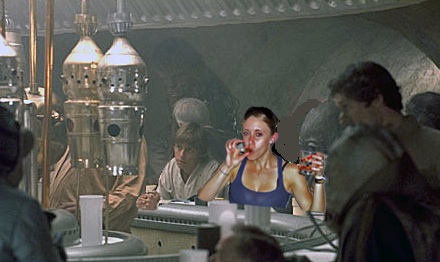
I mean, it’s like Open Water 2 meets Starship Troopers. Picture Donald Trump attempting to fit the cotton-candied parallelogram of his hair inside a space helmet or Amanda Knox skipping out on amassing an air force to go clubbing at the mos-eisley-cantina.

mos-eisley-cantina

We’re talking boffo box office, investors. You know how to contact me.


[1] A few highlights from Century 14: the Great Famine of 1315-1317 kills millions in Europe, the Hundred Years’ War begins in 1367, the bubonic plague hits its peak in the years 1346-1353 reducing the world population an estimated 350-375 million. I know those plague death numbers sound unbelievable, even by Wikipedia standards.

From Decadence to the Muni in Three Short Steps

man-ray-meets-wes


Think at last

We have not reached conclusion, when I

Stiffen in a rented house

TS Eliot, “Gerontion”


When I was young, I courted decadence:

a braless lover in her diaphanous blouse,

my amygdala aglow like phosphoresce,

my rented garret drafty in that crumbling Victorian house.


However, in middle age, decadence became passé,

radiators were ditched for central heat,

Man Ray lost out to Andrew Wyeth, and Sunday buffets

replaced sleeping the Sabbath away until three.


Now I am old, our children grown,

and though retirement offers a chance to pivot,

I must admit my wild seeds have been sown

as I stiffly stoop and replace my divot.


Why Donald Trump Is an Orwellian Nightmare for English Teachers


yakov_guminer_-_arithmetic_of_a_counter-plan_poster_1931

You know I hate, detest, and can’t bear a lie, not because I am straighter than the rest of us, but simply because it appalls me. There is a taint of death, a flavour of mortality in lies – which is exactly what I hate and detest in the world – what I want to forget. It makes me miserable and sick, like biting something rotten would do.

Charlie Marlow to his shipmates in Joseph Conrad’s Heart of Darkness

No, Donald Trump isn’t a nightmare for English teachers because he uses bigly as an adverb. Nor is it that when it comes to oratory, Trump’s speeches make George W Bush seem practically Churchillian in comparison. No, the reason that Donald Trump is a nightmare for English teachers is that words to him are meaningless.

Why bother teaching someone the difference in shades of meaning between the words venial and abominable when 2 + 2 = 5?[1]

To Trump, words are just things, commodities to be manipulated for bargaining or seduction or braggadocio. We English teachers, on the other hand, tend to see words as sacred, as vessels of meaning, and we try to teach our students to choose them carefully so that their descriptions are as clear and accurate as possible, whether they are writing about their grandmothers or analyzing Lear’s betrayal by his daughters Regan and Goneril.

Of course, most if not virtually all politicians occasionally lie, but generally with subtlety and rarely when the lie can be easily refuted.  This is not the case with Trump who seems to be a pathological liar. His lies are legion.  He lies when it’s not necessary, seemingly for the sake of lying.  To me, this lying is a very big deal, and I believe it is both my patriotic and moral duty to point out to my students why his lies are lies when they are applicable to the literature we are studying, the way I would like to think I would with Hitler’s lies if I had been teaching in Germany in the 1930’s.

Our school prayer begins with these words.

May our words be full of truth and kindness . . .

Not only are Trump’s words essentially devoid of truth and kindness, his kleptocratic tendencies as evidenced by his violation of the emolument clause, his packing the cabinet with sycophantic billionaires, and his admiration of Putin as soulmate put our very republic in danger. Nor does it help that it seems as if most Republicans in Congress don’t care about the rule of law now that one of their own can aid them in dismantling health care and cutting taxes for the 1%.

Remember Whitewater? All those Clinton investigations?  Those were different people and different times.

* * *

To see what I’m getting at, allow me just one recent example of Trump’s misuse of a phrase (see italics below) and how it can distort reality to his favor.

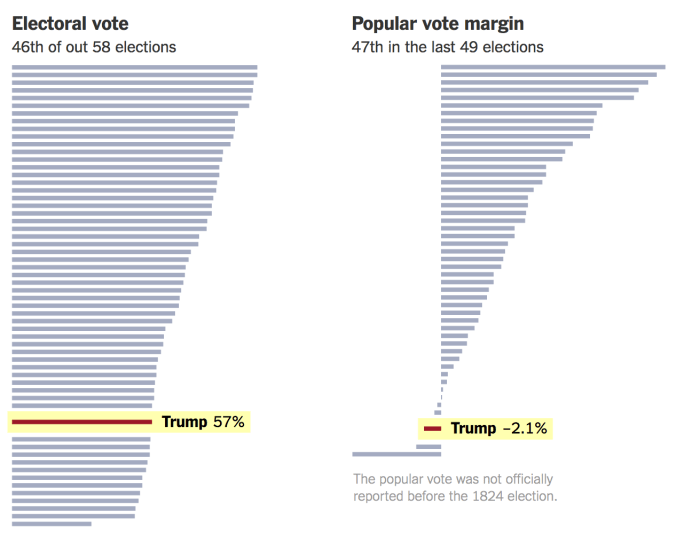
Yesterday, on hearing that the Electoral College had made it official he would be our next president, Trump crowed, “Today marks a historic electoral landslide victory in our nation’s democracy.”

Never mind that he lost the popular vote by nearly 3 million; here’s a handy chart mapping Electoral College margins of victory from Washington to Trump:

screen-shot-2016-12-19-at-6-35-55-am


Politfact quotes Larry Sabato, the director of the Center of Politics at the University of Virginia: “Calling a 306 electoral-vote victory a ‘landslide’ is ridiculous. Trump’s Electoral College majority is actually similar to John F. Kennedy’s 303 in 1960 and Jimmy Carter’s 297 in 1976. Has either of those victories ever been called a landslide? Of course not — and JFK and Carter actually won the popular vote narrowly.”

Of course, by declaring his historically comfortable but by no means overwhelming victory a landslide, Trump gets to have the words “historic electoral landslide” plastered in headlines and on screens across the planet. If he’s won by a landslide, the vast majority of people want whatever he wants, so that means that most people want the wealthiest Americans to receive enormous tax cuts.  If this election has taught us anything, it is that a majority of voters in 30 states aren’t all that discriminating. If some hear it was a landslide on Fox News, that’s good enough for them. Here’s a quote from today’s Washington Post: 

An editor at Breitbart, formerly run by senior Trump adviser Steve Bannon, said that fear [of reprisal from Trump and his minions] is well-founded [among lawmakers].

“If any politician in either party veers from what the voters clearly voted for in a landslide election … we stand at the ready to call them out on it and hold them accountable,” the person said.

In fact, if those who attend Trump rallies hear him say  2+2=5, they very well might believe him, even without having to go through the torture that O’Brian puts poor Winston Smith through in Orwell’s 1984.

How chilling to read these passages from 1984 in light of Trump’s “historic electoral landslide”:

There will be no laughter, except the laugh of triumph over a defeated enemy. There will be no art, no literature, no science. When we are omnipotent we shall have no more need of science. There will be no distinction between beauty and ugliness. There will be no curiosity, no enjoyment of the process of life. All competing pleasures will be destroyed. But always — do not forget this, Winston — always there will be the intoxication of power, constantly increasing and constantly growing subtler. Always, at every moment, there will be the thrill of victory, the sensation of trampling on an enemy who is helpless. If you want a picture of the future, imagine a boot stamping on a human face — for ever.

[. . . ]

We control life, Winston, at all its levels. You are imagining that there is something called human nature which (sic) will be outraged by what we do and will turn against us. But we create human nature. Men are infinitely malleable. Or perhaps you have returned to your old idea that the proletarians or the slaves will arise and overthrow us. Put it out of your mind. They are helpless, like the animals. Humanity is the Party. The others are outside — irrelevant.’

Will I be teaching 1984 in the spring?[2] Yes. Will Trump’s name come up? You betcha!  Will I be teaching “Heart of Darkness” this spring?  Yes sir, of course.

599bd4e393673bf37d243e7cc32b614c


[1] The latter word in this case being a much more accurate descriptor of Trump, a known swindler and self-professed sexual assaulter.

[2] By the way, click here for an extensive Pre-Trumpian lesson plans for teaching 1984.

Post Retirement Projects

Now that my career’s closure lies a mere nineteen months away,[1] I’ve started thinking about how to spend the overabundance of free time that a retirement without ailing parents or wastrel children or impending lawsuits provides a relatively well-to-do Late Empire US citizen.

Some people have suggested I write a book about growing up in a small Southern town teeming with lovable oddball characters (and few mean-as-cuss rapscallions), you know, back in the days when polite whites called African Americans “colored people” or “Negros.”

Hasn’t this story already been done a time or two? Anyway, because my sensibilities run closer to the filmmaker David Lynch’s than to Ferrol Sams’, I can’t see myself pulling anything off that print publishers would touch, even with gloves, certifiably impermeable, approved for Ebola victim corpse-removal. [2]

The character Bobby Peru from David Lynch's "Wild at Heart"

The character Bobby Peru from David Lynch’s “Wild at Heart”

Thinking, as they say, outside of the container, it occurred to me that I might come up instead with a project that benefits society, something like a post-Trump etiquette manual to help citizens negotiate the shifting sands of what’s now socially acceptable while providing them with a historical context for cultural changes, a sort of map of decline in manners over time.

Excerpt from working manuscript:

On Chivalry

In the Age of Elizabeth (1558-1603), an act of chivalry might be a courtier’s removing his cloak and throwing it over a puddle so a lady wouldn’t get her dainty foot wet.

In the Age of Eisenhower (1953-1960), an act of chivalry might be a gentleman’s getting out of the driver’s side of a car, walking around to the passenger’s side, and opening that door for a lady sitting there.

In the Age of Clinton (1993 -2000), an act of chivalry might be a dude’s submitting to a chick’s request that he use a condom.

In the Age of Trump (2017- ), an act of chivalry might be a dudebro’s refraining from grabbing a bitch’s snatch even though she’s oh so fuckable.[3]

Emanuel Gottilieb Leute "Elizabeth and Raleigh"

Emanuel Gottilieb Leute “Elizabeth and Raleigh”

Or maybe I could spend my days in fantasyland, Walter Mitty style, imagining myself riding around in a backseat of chauffeur-driven Cadillac with Memphis Minnie, me in a double-breasted suit and matching fedora, she in cotton dress while playing her guitar and singing about how much she adores me.

chauffeur


Worse idea: Out-Milton-Milton and memorize the Holy Bible and Sartre’s On Being and Nothingness word-for-word.

Better idea: Take golf lessons. Play nine holes a day.

Even better idea, enlightened hedonism: go through the stages of Yoga’s sun salutation upon awakening each morning. Then mindfully concoct breakfast, noting the crack of eggshell on skillet rim, the rain-like sizzle of the bacon. Eat those eggs, bacon and grits deliberately, mouthful by mouthful, savoring. Go retrieve the paper and peruse it on the deck or screened porch while sipping coffee. Discuss the fall of civilization with also retired spouse. Afterwards, meditation followed by a walk on the beach or a paddle on the river or a bike ride off the island to Fort Henry. The remainder of the morning spent reading or writing. Tomato and cheese sandwiches. The NY Times crossword. Happy Hour. Preparing dinner with spouse followed by TCM or conversation. More social media. A nightcap. Yawn. Morpheus descending. Sweet dreams . . . ennui.

Okay, what was the name of the pervert in my hometown who dressed like Castro and rode his bike around town dragging behind it underwear he had traded newcomers for firecrackers?

[1] Discounting the possibility of a nuclear exchange with China

[2] As I write this, I suddenly remember a woman and severely mentally challenged grown daughter who used to patronize my granddaddy’s gas station. I can’t remember the daughter’s name, but she always carried a baby doll with her and spoke in garbled cassette-tape-getting-eaten slo-mo. My Aunt Virginia told me my grandmama forced Virginia to play with the girl/woman. Click here to see why that might not have been such a great idea.

[3] On the function of scatological language in satire, click here.

Celebrating My Two Favorite Commies, Jesus and Santa, to the Tune of Mojo Nixon’s “Santa, Get Straight to the Ghetto”

I know this blog’s been a downer since the election – a negative screed, a longwinded lamentation, a Cassandra-like catalogue of bleak prophecies heralding the end of civilization as we know it.

But, as my ace commentator Sherman T Langston suggests I should, I’m putting on a happy face for this post by providing a heart-warming movie that boasts moving picture images of yours truly introducing Mojo Nixon’s “Santa, Get You to the Ghetto,” which serves as the soundtrack for the rest of the film, featuring Folly Beach’s Christmas Parade.

Hope you enjoy.


Trump as Satiric Butt

2-rabelais-gargantua-1873-granger

Traditionally satire has been classified as Horatian or Juvenalian in honor of two ancient Roman practitioners of the genre. Horace (65-8 BCE) cleverly but gently mocked Roman opinions and institutions that he considered worthy of ridicule. In Horatian satire – Geoffrey Chaucer falls into this category – you get the feeling that overall the satirist generally is fond of humankind (in spite of itself) but wishes to poke fun at its foibles, perhaps in hopes of ameliorating them. Almost all of non-literary contemporary satire falls into this category. For example, Mad Magazine, The Daily Show, and Saturday Night Live exemplify characteristics of Horatian satire, particularly in their employment of exaggeration and irony, holding up, as it were, a funhouse mirror to human nature.

Take SNL’s satires of Hillary Clinton and Donald Trump, for instance. Despite exaggerating those politicians’ personas, the skits do so with good humor. The writers portray Hillary as incredibly calculating and Trump as a bit of a buffoon, but certainly neither comes off as monstrous (despite thin-skinned Trump’s overreactions) as they very well might in a Juvenalian satire.  The fact that Clinton herself has appeared in some skits underscores the “gentleness” of the satire.

Unlike Horace, whose satires might be likened to the clucking of a tongue, Juvenal’s[1] satires are more like spitting into the face of the target. Juvenal held humankind in utter contempt, like his artistic soul brother Jonathan Swift, and employed scatology – images of excrement, disease, and filth – to transform the object of the satire into a monster. In Juvenalian satire, the motive is not so much to emend but to mock, as Swift does in his portrayal of the Yahoos in Gulliver’s last voyage. The ill-fated Charlie Hebdo satires on Muhammad offer another example of Juvenalian satire’s mean-spirited mockery.

If Trump finds the rather light touch of SNL’s satire outrageous, let’s hope he never encounters a Juvenalian satirist’s assessment of his character.

For example, a Juvenalian satirist might come up with the following Trump Insult Kit (based on those Shakespearian insult kits you can find on the Internet). Essentially, these “kits” have three columns, the first two containing adjectives culled from Shakespeare’s plays and the third containing nouns. Scanning the columns, you choose adjectives from the first and second columns and attach them to a noun of your choice from the third column, coming up with something like, “Ye churlish, toad-spotted miscreant.”

Rather than copping words from Shakespeare’s plays, however, the Juvenalian satirist (who shall remain nameless) that came up with the Trump Insult kit mined the scatological recesses of the gothic Anglo-Saxon subterranean wing of his or her vocabulary to choose caustic, ugly words to ridicule Trump’s appearance – his Kraft-cheese colored epidermis, his corpulence, etc. The idea is someone this hideous needs to be described hideously.  It’s as if the satirist has gone beyond stooping to Trump’s level but has out Trumped Trump in a vulgar way that brings to mind Rabelais, another Juvenalian satirist.


***

The Donald Trump Trolling Insult Kit


Choose a term from each column to create a salutation for your next reply to one of Trump’s tweets:


Hepatitis-hued                                     canker-encrusted                              shrivel-dick

Tangerine-tinted                                  syphilitic                                             pus sac

Spray-painted                                       diarrheic                                              sewer spawn

Swag-bellied                                         sociopathic                                          rat’s turd

Cheezit-colored                                   micro-cephalic                                     boar’s snout

Dabbo-brained                                     tick-ridden                                           bed-wetter

Soul-stunted                                        triple-chinned                                      piece-of-shit

Sphincter-mouthed                             fecal-friendly                                       piss pool

Crotch-crippled                                  snot-spewing                                      scum-slurper

Shit-flecked                                         imbecilic                                              offal-gorger

We suggest you mix and match on different days for variety’s sake: “You, tangerine-tinted, tick-ridden boar’s snout” on Monday but then perhaps “You swag-bellied, triple-chinned scum-slurper on Friday.

* * *

Ultimately, Horatian satire tends to be more palatable for most audiences because, let’s face it, Juvenalian satire is disgusting  —  it’s meant to be.  The prudish consider it crude, in bad taste, which ultimately is the point.

Think of it as a Lear-like lacerating scream penetrating the desert air.  It might not help in any practical way, but releasing righteous indignation is cathartic and in that sense healthy — at least for the satirist herself.


[1] Late 1st, early 2nd century CE