Things weren’t exactly off to a hot start. I was waiting at the square at the Isani metro stop, sitting as far away from the homeless as possible. And the stray dogs. It was early, around 7:10, the guide wasn’t supposed to meet me until 7:30, and I didn’t want to talk to anyone besides him. I was tired—I’d been on the road almost a month, and even a private room isn’t the same as your own bed. I looked up and saw a drunk and tough looking man approaching. He was a taxi driver and wanted me to ride. “Rustaveli 10 lari,” he said.
“No, I stay here,” I replied, overly enunciating.
“10 Lari, Didube.”
“I wait for tour. Tusheti.” It didn’t really bother me that he approached. Rather, it bothered me that he was trying to charge me three times the local rate. You can argue double is…
Years ago, when he was visiting writer at my school, the poet Billy Collins told me that he didn’t know of one poet who would be willing to write an inaugural poem for George W Bush.[1]
After last Monday’s debate and the subsequent toxic spew of defamatory tweets, I doubt if we’ll have to consider the possibility of an American poet composing a poem to honor Donald J Trump.
Politics aside, it’s no doubt for the best: orange is probably the hardest word to rhyme in English.
I did some googling, though, and found on Amazon The Conservative Poets: A Contemporary Anthology, edited by William Baer, who offers this estimation of the contemporary literary landscape:
Although it often seems that liberals and the radical Left have assumed complete hegemony over the arts, especially the literary arts, there exists a remnant of very talented American poets who create beautiful, serious, witty, moving, and diverse poetry from a conservative point of view. This unique anthology illustrates the wide range of these determined and sometimes defiant artists, who hope that their work will encourage more like-minded Americans to learn the poetic craft and pursue the literary endeavor.
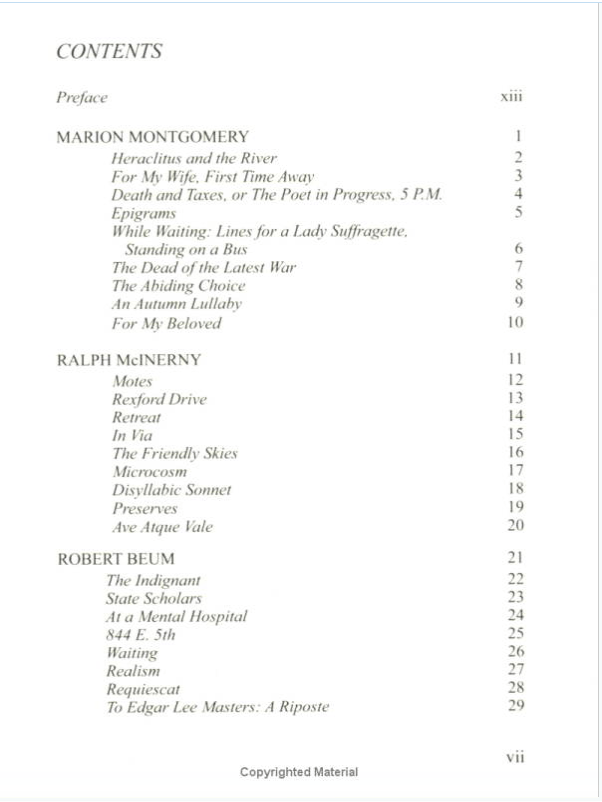
Here’s a snapshot[2] of portion of the table of contents:
I tried to track down some of these poets, only to discover the ones I deemed most suitable to be nominated as Trump’s inaugural poet had, to quote Richard Wilbur, “gone from this rotten/Taxable world to a standard of higher living.” The late Marion Montgomery’s “While Waiting: Lines for a Lady Suffragette, Standing on a Bus” certainly seems to adhere in some ways to Trump’s view of what Montgomery might call the “fair sex.”
Ah, Lady. Ah. It is a stirring sight.
Franchisement by the gods is now complete.
You now have won the inalienable right
Of standing on your own two feet.
Alas, Montgomery checked out of this Motel 6 of Sorrow in the penultimate year of W’s second term.
Editor Baer in his preface admits that most of the anthologized poems’ conservatism lie in their traditional forms rather than politics, but adds, “Some, myself included, would even tend to see meter as a poetic representation of the provident order of God’s universe.”[3]
What led me to these ruminations is the discovery of a web site entitled Scholars and Writers for America. Beneath its banner there is a statement of support: “Given our choices in the presidential election, we believe that Donald J. Trump is the candidate most likely to restore the promise of America, and we urge you to support him as we do.”
Scrolling down my screen looking for a poets or novelists, past names like Burton W Folsom, Jr., author of The Myth of the Robber Barons and Steve Mosher of the Population Research Institute, I discovered, to my delight, at the bottom of the screen, Thomas C McCollum, novelist.
Here’s the second paragraph of text from McCollum’s website, from an article by Louise Cook, the editor of Absolute Marbella Magazine:
If one were to view all aspects of Thomas McCollum’s professional and avocational life, one might be very tempted to call him a Renaissance man–albeit with a strong entrepreneurial bent. Wisely McCollum leaves all such pretentions to others, preferring the doing rather than the talking about.
What follows is a most-interesting-man-in-the-world litany: Can-am racing, bull running in Pamplona [Spain she helpfully adds], man-eating crocodile hunting, a golf-addiction, insurance sales, original pen and ink drawings street-corner sales, med-school matriculation, med-school abandonment, medical laboratory founding, medical laboratory selling, retirement to Marbella, Spain, “to live out all the fantasies of his youth. He has camped, safaried, and traveled to every continent on earth.”
McCollum has published four novels: Whipsocket, Tainted Blood, Palmer Lake, and Uncle Norm.
Here are the first and last sentences from Publisher Weekly’s review of Tainted Blood.
Readers willing to suspend disbelief beyond belief may find McCollum’s first novel an interesting medical thriller; others will be dismayed by characters manipulated by incredible plot contrivances.
McCollum makes the medical details microscopically authentic, but too many standard diatribes against government agencies, characters who speak polemic as often as they do dialogue and a conclusion that’s painfully anticlimactic render a hot topic tepid.
Now compare that MSM review to this one for Uncle Norm from Christopher Feigum, Grammy Award winner and Metropolitan Opera Singer:
“Thomas McCollum has delivered a book of operatic proportions…a tale full of intrigue that tempts us to explore the what ifs of life and the possibility of encountering one profound love. Whether he is delighting pygmies with donuts or sharing his smuggled discoveries along the way, Uncle Norm is a warm, comical hero deeply connected to his fellow lost soul in the Congo, Ottobah Cuguano, and their shared faith in everlasting friendship. As they strive to break down racial barriers and transform the world, their adventures amaze the restless traveler in all of us. This timely piece is a declaration that we each have the choice to leave behind a better place than we found.”
Oh, yeah. There is also this snippet from of all places, Publisher’s Weekly: “an interesting thriller…McCollum makes the adventure microscopically authentic.” Hmmm. “an interesting thriller . . . microscopically authentic.” Where I have I heard that before?
soon coming to an opera house near you
Anyway, I have an idea for the Trump Inaugural Committee in the unlikely event that some less cationic-inducing alternative to Thorazine can be combined with some attention-disorder drug to subdue Trump’s pudgy demons and at the same time focus his attention so he can prep for the second two debates.
Here’s my idea. Instead of having an inaugural poem, have Mr. McCollum write an adventure tale with Trump as protagonist.
No one likes poetry anyway.
[1] By the way, this conversation took place in Folly Beach, SC, at the Sand Dollar Social Club, one of the most exclusive biker bars/literary salons in the Lowcountry of South Carolina
[2] Is snapshot ever used non-metaphorically anymore? Does any one say, “Wait a sec. I have a snapshot on my phone. Actually I ended up using a screenshot to avoid the moiré-like swirls from the iPhone 7 photo. Are you noticing the propensity of the author to name drop?
[3] For example, poetically rendering the series of explosions that occurred after that asteroid or comet or whatever slammed into the planet and did away with the dinosaurs would call for a series of spondees: Splat! Boom! Boom! Boom! Boom!
Doctors say t’ will kill you but they don’t say when
Ho, ho, honey, take a whiff on me
Leadbelly version of “Take a Whiff on Me”
Since last night’s debate, speculation has run rampant as to the cause of Donald Trump’s serial sniffling, which began just after lie #1 and continued right through lie #1,894. Trump himself denies that he sniffled at all, which is tantamount to claiming he has never played a round of golf in his life. We have video of Trump playing golf; we have video of Trump sniffling throughout the debate. Why in the world would he deny something so palpably perceivable to those of us blessed with the senses of sight and hearing?[1]
Obviously, the most likely reason for his sniffling is that he’s suffering from a cold or allergies, but given the hoopla he’s created surrounding Hillary’s health, Trump’s admitting he has a cold would be a sign of weakness. In the not-so-fun house of Trump’s unimaginative imagination, Hillary’s immune system is shot, ruined by the stress brought on because of her husband’s infidelities. Donald J, on the other hand, has a fantastic immune system, a tremendous immune system. He could share a joint with John Keats, blow his nose with George Orwell’s hankie, French kiss a hacking Elizabeth Barrett Browning, and swagger away TB free.
More exotic reasons for those audible inhalations could lie in some sort of reaction to Hillary’s perfume or Lester Holt’s aftershave or some rogue ingredient in his spray tan; however, what immediately came to my mind, and into the minds of a number of worthies on my Twitter feed, was that Donald — sniff — has a — sniff — cocaine problem.
We’ve all known someone with a coke, problem, right? Chronic cocaine snorting irritates the nasal septum, which can result in a perpetual running nose or chronic nosebleeds. Also, cokeheads tend to get agitated and restless. Donald was certainly that last night, and his frequent sniffling sounded like a coke addict’s sniffling, but it didn’t look like a coke addict’s sniffling. For whatever reason, a coke sniffler is constantly bringing his hand up to his nose and messing with in as he sharply inhales, almost as if he’s doing “air coke” the way some people play “air” guitars. Also, there’s an accompanying clenching of the jaw in and widening of the eyes as the head leans forward then back that cokeheads do, and Trump did not do that strange head dance at all.
So even though an immense, spectacular, Olympian, (i.e., Trumpian) coke habit might explain why he has clients funnel money into his foundation, I suspect his sniffling last night can’t be attributable to his shoveling snow.
Whenever anyone who discovers I’m a teacher starts in on the familiar refrain about how underpaid we are, I assure my well-meaning new acquaintance that some of us are not underpaid. For example, take my high school Spanish teacher, Senora Equis, that dour, unimaginative functionary. Her only lesson plan was punching play on a tape recorder and having us repeat parrot-like what we thought we heard. The voices on the recording were not quite human, too cheerful, the words overly annunciated, as if directed at a hard-of-hearing octogenarian in a nursing home located in Disney World.
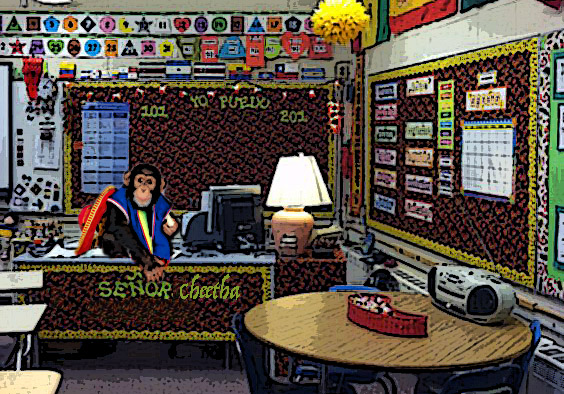
I remember remarking to misamiga Sharon Mallard that a trained chimp could replace Senora Equis and very little would be lost. Dress Cheetah in a poncho, have him knuckle his way into the room, hop on the metal desk, click play, and plop down as we intoned in unison, “Que lastima, lo siento” or “Tengo catarro” or “Las putas estan muy bonita” and you wouldn’t be losing a thing.
On the other hand, if you paid teachers according to how hard they worked, the difficulty of the task, and on the quality and worth of their product, my former colleague Natalie Herford should be making more money than Jadeveon Clowney.
Since I’d given up being Department Chair a couple of years ago, I decided it was high time to discard some of my unnecessary electronic files when I ran across a narrative of an observation I had made of one of Natalie’s history classes. She had been new to the school, and the word was out that she was spectacular. I asked her if she’d mind if I hopped on the train of colleagues who had sat in on one of her classes, and she, said, “Of course. I’d love to have you.”
Part of my duties as Department Chair was observing my colleagues. Rather than using the official form for observations, I wrote narratives of what I observed, trying the best I could to render the action from the objective point-of-view, as if I were video recorder. Let the teacher and principal decide for themselves what is effective and what is not.
Natalie was in the history department, in fact, its chair, so I was not required to document my observation. However, I told her I would compose one of my narratives and share it with her and Sarah, our principal, if she liked. This time, however, for my own amusement, I created a persona I called Henry James Foster Wallace to report what happened during the class.
Henry James Foster Wallace’s Observations of Mrs. Natalie Herford’s AP World History Class on 6 February 2009
When your Semi-Omniscient Narrator (henceforth SON) arrived at Room 204 a couple of minutes before class time, it surprised him to see the students sitting upright and engaged in a group conversation with Mrs. Herford who stood before them in the center of the room. Glancing up at the so-called atomic clock, SON was relieved to see that, no, he wasn’t (at least officially) interrupting class.
Acknowledging his presence, Mrs. Herford in her somewhat patrician precisely annunciated, but indeterminate accent welcomed him to sit anywhere. She added, “Feel free to participate as much as you like.” Demurring, SON bombastically announced that like the novelist Flaubert he would be invisible but omnipresent, hovering like a god. Mrs. Herford offered an indulgent smile at his pomposity and addressed him henceforth as “O Invisible God.” This incident, however silly, was the first instance of a pattern SON would later discern: Mrs. Herford adroitly picks up idiosyncratic comments in the class and later echoes them to create humorous motifs that provide a sort of dramatic structure to the proceedings. Her mental agility, her profound mastery of the subject matter, combined with a brilliant, almost ballerina-like ability to embody abstractions in physical movement, make Mrs. Herford an incredibly dynamic and effective teacher. [1]
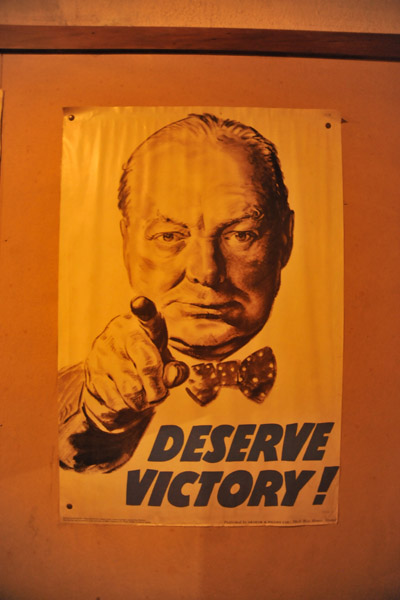
Room 204 is a bright, orderly space with yellow dominating the color scheme. A black and white photograph of the three Camelot-era Kennedy brothers counterbalances on the opposite wall a reproduction of a WW2 poster of Churchill jabbing an index finger Uncle-Sam style. On the back wall hang two large maps of the Western and Eastern hemispheres. Most interesting, however, is a series of typed sayings on 8 1/2 x 11 white paper that create a sort of intellectual wainscoting running across three walls of the room. Alas, being only a semi-omniscient narrator, SON was able to make out the content of only one of these literary ornaments, a colloquial pugilistic quote from Marx about getting kicked and kicking back. The room’s arrangement, its tidiness, suggests that this is a serious place, a place of business.
Which it is. About 30 seconds before class was to start, Chad Livingston[2], looking a bit frazzled, hurried into class, and Mrs. Herford said, “And here is Chad arriving just in time not to be counted tardy,” which SON took to be a subtle corrective, a suggestion to Mr. Livingston that he should arrive earlier so that the show can get on the road promptly the instant the second hand of the atomic clock reaches its zenith denoting 8:10 A.M. Eastern Standard Time. As it happened, Mr. Livingston probably had been rummaging in his locker searching for some lost document, a précis or AP application perhaps[3], because Mrs. Herford asked if he had said document, and Mr. Livingston asked for another. Amusedly disgruntled, Mrs. Herford chided, “This does not bode well, does it, Chad,” and he reversed field, grinning and saying that he was hadn’t lost whatever it was he couldn’t produce, a performance that your SON found unconvincing.
As Mr. Livingston took his seat, instruction commenced. Arranged in a rectangular “semicircle,” two-desks deep, the students maintained excellent posture through the next forty minutes, an impressive feat for high-achieving, over-involved scholars, athletes, and amateur thespians, especially so early on a frigid Friday morning. In fact, throughout the entire class, the students maintained an impressive level of attentiveness, and eight of the nine scholars contributed at some point to Mrs. Herford’s Socratic questioning. The one student who didn’t contribute, the ever-taciturn Pamela Blanton[4], sat directly in front of SON preventing his being able to gauge her level of attentiveness. However, Miss Blanton not only sits on the front row, but also sits closest to the stool upon which Mrs. Herford sometimes perches[5], so it seems extremely unlikely that the bashful Miss Blanton wasn’t mentally engaged in the academic content of the lesson. Throughout the class, on at least three occasions, Mrs. Herford referred to the students as “ladies and gentlemen,” appellations that corresponded aptly to their behavior.
Mrs. Herford began by providing a rough road map of what lay ahead, a revisitation of Russia in light of the previous night’s reading. Mrs. Herford began by asking the students what had been going on the last time they visited Russia. A chorus of contradictory responses rang out, with Hendrik Kohlman harkening back to the Mongols and Angela Nielson remembering something about the Ivan tsars. Mr. Kohlman, who is 15-going-on-65, speaks with such an oddly anachronistic formality that you wouldn’t be surprised to look over and see that he’s sporting knickers and an Eton collar. He immediately recognized his error, and complained, “It’s Friday morning.”
Then, with extraordinary dexterity, Mrs. Herford in a Socratic cross-examination elicited from the students a remarkable distillation of half-a-millennium of Russian history, taking us from Mongols and princes to tsars and serfdom. In forcing the students themselves to provide the correct answers, Mrs. Herford engages in an animated artform that combines ballet and charades. When she asks a question, her face is quizzical, as if she has momentarily forgotten the answer, and when a student comes up with the correct response, her face lights up. Students want to generate that smile, so they take intellectual risks in perhaps being wrong. If they are incorrect, Mrs. Herford asks qualifying questions. To coax the answers from them, she gracefully uses her hands, pushing her palms out towards the students to suggest exile, say, or interlacing her fingers to suggest the combining of forces. Because she’s perpetually in motion and the class is so small, students don’t have the luxury to wander off into the lurid klieg-lit rooms of their imaginations.
Once Mrs. Herford had navigated her students through the ages, from the steppes of the Mongols to the marshes of St. Petersburg, she began the central focus of the day, a demonstration of a succession of Russian rulers who in subsequent administrations oscillated from reformation to reaction, a rather disheartening pingponging between liberalization and repression. To capture visually this historical movement, Mrs. Herford drew a crossgraph on her white board with “reform” and “reaction” as the twin headings. As she was hurriedly constructing her graph, Mr. Kohlman announced that “this is a little off topic” but that he reckoned, somewhat egocentrically perhaps, that there might be a fortune to be made in manufacturing loose leaf paper with vertical rather than horizontal lines, paper that would be well-suited to accommodate the graph Mrs. Herford was creating. Showing a surprising ignorance of product creation and promotion, Stephen Paddington pooh-poohed this idea by saying that you would need special binders if you manufactured vertically lined paper. Some other unidentified voice reasonably suggested that you could in fact turn your binders sideways and accomplish Mr. Kohlman’s objective. Rather than launching into a side trip to enlighten Mr. Paddington about the nefarious practices of the Lords of Capitalism and how creating products that won’t accommodate older products’ plug-ins is one of their dastardly techniques[6], Mrs. Herford, perhaps thinking of the centuries and various cultures stretching before her in the three-and-a-half months before the AP exam, quickly shut down the conjecture by assuring Mr. Gadsden that indeed if there were a market for vertically lined paper, surely some enterprising entrepreneur would have created it by now. Later in the class Mr. Kohlman– who otherwise proved a valuable contributor to providing correct answers to Mrs. Herford’s questions – tried to interject another distraction, which Mrs. Herford ignored, as she talked through his interruption. She did, later on, say that she thought it was a good idea for students to copy the graph in the notebooks, “whether on paper vertically lined, or otherwise,’’ a deft allusion to Mr. Kohlman’s original observation.
As the ping pong ball bounced from tsar to tsar, from Nicholas I to Alexander II to Alexander III, Mrs. Herford scrawled information in the Reaction column or the Reform column, switching alternatively, depending on whether the adjacent rulers were purging dissenters or liberalizing education. Whether consciously or not, she was creating a visual Hegelian historical dialectic that was particularly apropos given that Marx stood waiting just outside the present scope of the day’s lesson. In addition, as Mrs. Herford discussed the concept of Russianization, she successfully encouraged students to synthesize other similar movements in different cultures they had studied such as Sinofication in China and the persecution of Huguenots under Louis XIV. As a side note, Mrs. Hereford’s arrangement of cross-referencing various cultures during similar times (the alternating method) rather than starting with medieval China and taking it to the 2Oth century and then going to India and doing likewise (the block method) mirrors these students’ most recent essay assignment in English, a comparison-and-contrast composition in which their instructors encourage them to use the alternating method rather than the block method.
With energy that never flagged, Mrs. Herford guided her charges to the very end, stating at 9:43 that she had two minutes, “and you know that I am going to use them.” She mentioned a précis that was due Monday and some pivotal, important question that she had hoped to ask today but that would have to wait until Tuesday. Her “marketing” of this question successfully spurred the interest of SON who would have liked to be there to discover what the mysterious question entailed and how the students might respond to it. Unfortunately, however, time was up, because another set of students was filing in for their turn to learn under this extraordinary teacher.
Natalie possesses the same quality that my very best teacher Dr. Jack Ashley possessed, the ability to make students want to please him, so they do their best, revising those essays, trying to make them even better so that the teacher will be proud of them.
And talking about a role model!
Mrs. Natalie Herdford
[1] Mrs. Herford’s command of Russian history is phenomenal. Without so much as a note, she effortlessly rattled dates, names, movements, etc.
Over the years some have accused me of being arrogant, and when it comes to a some things, I guess it might be true, especially if you’re talking about my exquisite taste in the arts or the immense love I have of the sound of my own voice.*
And, yes, especially when it comes to choosing therapists, I’ll admit I’m as arrogant as hell.
For example, a couple of decades ago, my synapses went on the fritz. I lost about twenty pounds in three weeks, and it wasn’t the type of weight loss where people complimented you on your svelteness but wondered if you had shared a needle with the wrong Haitian. “You okay?” they’d ask.
Each afternoon, I’d come straight home from school, climb the stairs to my study where I’d lie on the floor, weep like Niobe, and listen to Peter Gabriel’s Us or the Counting Crow’s August and Everything After.
After all, if you were undergoing a dark night of the soul, what would make a better soundtrack than this:
Anyway, one evening after prying me out of fetal position with a tire iron, my wife Judy insisted I see a therapist. The thing is, because of my arrogance, I didn’t want to deal with a therapist who wasn’t extremely erudite. I didn’t care how empathetic, how many Ivy League degrees she had hanging on her office walls, if she and I couldn’t talk about the Compsons of Yoknapatawpha County or the Tyrones of Eugene O’Neil’s A Long Day’s Journey into the Night or Yeats’s interest in the occult, I wanted nothing to do with her.
After all, characters from literature offer a mother lode of archetypal experience in understanding the human psyche, and by my reckoning someone interested in how the psyche works should necessarily be interested in literature. No, I wanted someone like Jung, someone older than I, someone who spoke High German, not someone who rattled off stock phrases like “I think I hear you saying” in a flat Midwestern monotone.
I longed to administer tests to prospective therapists before I chose one, something quick for them to take and me to assess, like 50 multiple choice questions.
Which of the following Faulkner characters has the mind of a three year old?
A. Vardamen Burden
B. Joe Christmas
C. Homer Barron
D. Benjie Compson
E. No clue
The first therapist I tried didn’t hack it at all. Recommended by my physician, this fellow had a mere masters in social work, which meant he couldn’t prescribe meds, so instead of shoveling serotonin jump-starters my way, he’d have me close my eyes and imagine I was flying like Peter Pan from his office to my childhood home in Summerville. The idea was I could re-experience in a new light some of the unpleasant incidents from my childhood that he considered responsible for the harrowing nightmares that visited me about 3 a.m every fucking morning.
So up and off I’d go with my bad sense of direction, flying straight over the Cooper River Bridge, then just above the steeples of the peninsula, taking 61 instead of 26, checking out the plantations on the Ashley River, noting the traffic, wondering if the cars should be an earlier model since I was ostensibly going back in time — all this while the therapist’s meter was ticking, so to speak, at $75 a half-hour.
Then he’d say it’s time to fly back before I had a chance to go get inside my childhood house, before I’d had a chance to relive some wretched Christmas Eve or stumbled-across suicide note. The house didn’t have a chimney to slide in through a la Santa, nor was I, strictly speaking, a ghost who could walk through walls, etc. I’d be on the roof trying to figure out how to get in when he’d tell me it was time to go. So I’d take off and head back, and like in real life, the trip back was always quicker than the trip there.
Once again, Judy to the rescue. I told the therapist that my wife was displeased at my lack of progress, and he immediately referred me to the Medical University where I was triaged by a woman whom I wouldn’t have minded being my therapist because she was much older than I, a bone fide psychiatrist with a pleasantly patrician foreign accent; however, she had recently moved to Charleston from Johannesburg and couldn’t practice in the US.
Anyway, I passed the triage, got assigned with a fellow who put me on Zoloft and Klonopin, and even though he and I didn’t talk about Wittgenstein or, for that matter, Raymond Chandler, we did have interesting conversations, mostly about his life, how it felt like to tell someone he had a month to live, etc., and I started sleeping through nights and feeling like my old self again, i.e, like a somewhat angry and pessimistic middle-aged man who held most of the bourgeoise in contempt.
Well, that was 21 years ago, so imagine my arrogance level now, especially when these whippersnapper parents-of-students young enough for me to have taught commence to instruct me about how I should be conducting my classes.
For example, at lunch, the other day, one of my colleagues started bitching about a parent who actually texted her after a 9th grade weekend retreat to complain that little Bartholomew or Bianca had declared the retreat was the worst trip the sweet darling had ever been on ever. My colleague texted her back photos of beaming kids looking as if they’d were being filmed in a soda pop ad.
I told her I thought that was great but added that I would have handled it somewhat differently, would have engaged in some dialogue before sending the photos.
Mom: . . . the worst trip my sweet darling has ever been on ever!
Me: You are, Mrs. X, familiar with the philosophical school of existentialism, aren’t you?
Mom: Huh?
Me: You know, the movement started by Kierkegaard, embraced by Nietzsche, espoused by Sartre and Camus.
Mom: What does this have to do with anything?
Me: Well, it has a lot to do with everything. Existentialists posit that each individual perceives the world through her own unique perspective and therefore ‘reality’ is relative. Because your Portuguese water dog lacks the optical cones and rods to perceive your sweater is red, to him the sweater is gray, but your reality is no more legitimate than his, and let’s not forget you can’t hear the high frequencies that he perceives, but that doesn’t mean his reality is more legitimate than yours.
In other words, although this may have been the worst trip ever from B’s perspective, it might have been the greatest trip C has ever been on — or as Hamlet puts it, “There’s nothing good nor bad but thinking makes it so.”
Therefore, I suggest you and B bond together by reading Camus’s “The Myth of Sisyphus. “ And in the mean time please enjoy these photos from the retreat.
Have a nice day!
Like, I say, I can be arrogant when it comes to some things, but I’d arrogantly like to think my arrogance is better than that mother’s arrogance.
* But, hey. I’m not arrogant about the things I suck at, like my inability to find my car in a parking garage or remembering the person’s name I was introduced to 30 seconds ago.
Chances are if you’re waiting at the so-called International Airport in Charleston, SC for a loved one’s arrival from a cancer treatment junket in Houston the day after you discover water dripping from a lighting fixture over your breakfast bar (the consequence of two tropical storms within 6 days having bitch-slapped[1] the barrier island you call home), you might come to the conclusion that your karma sucks, that the odds of your loved one’s arriving on schedule are about the equivalent of Donald Trump’s announcing he’s dumping Melania for Caitlyn Jenner.
if only
And in my case, you’d be right.
Of course, I could have just sat there among those perhaps Pentecostal women in their fusty Little House on the Prairie outfits and watch them stare into their cell phones, or I could decide to make Amoretto Sours out of lemons, to grab the jazz combo by the horns, to get the hell out of there.
It was 7:30, and the flight was now rescheduled to arrive at 9:00.
Go west, Old Man.
Okay, here’s my advice if what happened to me last night happens to you.
Exit the airport and head straight past the Boeing plant, past the 526 on-ramps, straight on International Avenue towards Montague. Keep going until you see the first brightly lit strip shopping center to your left located on Tanger Outlet Boulevard.
That’s where we’re headed, to La Hacienda, specifically into a small barroom inside the restaurant.
the bar inside La Hacienda
I sat in the fourth stool from the left. Two stools over sat a diminutive African American who reminded me of a hatless Thelonious Monk and to my right stood a tall Ricardo-Montalbán-looking cat who was drinking one of these:
I ordered a small Dos Equis on draft and paid in cash. Thelonious was reading a newspaper, working on some chips, the bartender conversing with Ricardo in Spanish, so I decided to leave my beer on the bar and boogie over to Mr. K’s Used Books and Music, conveniently located two stores down. The joint is brightly lit yet cavernous, feels more like a library than a bookstore. I found the non-fiction section and bought a copy of David Sedaris’s When You Are Engulfed in Flames.
Back at the bar, Thelonious had been replaced by a different African American, a handsome twenty-something wearing a baseball cap cocked to one side and sporting gold caps on his front teeth.
So I reclaimed my seat and flipped to an essay entitled “Solution to Saturday’s Puzzle.” The essay is about Sedaris refusing to change seats on a flight to Raleigh as a favor to a woman “wearing a T-shirt and cutoffs” so she can sit with her husband. The woman is the opposite of gracious. Once in the air, she takes off her shoes, and Sedaris, who’s doing the Saturday Times crossword, notices “her toenails were painted white and each one was perfectly sculpted.”
Eighteen across: “Not Impressed.”
Eleven down: “Whore.”
I wasn’t even looking at the clues anymore.
I chuckled a couple of times, but when I hit this paragraph, I let loose one of my godlike laughs:
It’s always so satisfying when you can twist someone’s hatred into guilt — make her realize that she was wrong, too quick to judge, too unwilling to look beyond her own petty concerns. The problem is that it works both ways. I’d taken this woman as the type who arrives late at a movie, then asks me to move behind the tallest person in the theater so that she and her husband can sit together. Everyone has to suffer just because she’s sleeping with someone. But what if I was wrong? I pictured her in a dimly lit room, trembling before a portfolio of dimly lit X-rays. “I give you two weeks at the most, the doctor says, “Why don’t you get your toe-nails done, buy yourself a nice pair of cutoffs and spend some quality time with your husband. I hear the beaches of North Carolina are pretty this time of year.”
The fellow with the baseball cap to my left said, “You sho seem to be having fun.”
“This book’s hilarious,” I said.
Just then my cell rang. The scoop with Judy, my beloved, is that even though an hour ago her flight was circling Charleston, it had to turn around to refuel in Charlotte. She was calling me to let me know they were getting ready to take off for the thirty-minute flight.
“But I’m having fun at La Hacienda,” I whined. “Why don’t you just take a cab home?”
She laughed.
“I’ll see you in about half hour,” I said.
The man to my left said apropos of nothing that he had beer at home but no liquor and that he just wanted a taste of liquor before he went home. He was drinking something cranberry-colored in a short glass.
I asked the bartender, who called me señor instead of sir, for the tab and told him to add the fellow’s drink to it.
“Thank you,” my friend to the left said. “That’s a blessing.” He shook my hand with the lightest of handshakes. He finished before me and tapped me on the shoulder to thank me again as he walked out.
I asked Ricardo what he has drinking, which was essentially a margarita getting slow-dripped by a pony Corona. It’s delicious,” he said with an elegant Spanish accent.
“Well, so long,” I said once my Dos Equis was history, having successfully resisted the impulse to say “adios.”
When I hit the airport the arrivals sign now said the flight would arrive at 9: 30, but just then I got the text “landed.”
So I waited for Judy, who eventually appeared, wearing her wig, trudging exhaustedly. Over at the baggage area stood the five pioneer-clad sect members. I told one of them that my wife could literally see the island where we live when the plane turned around to head to Charlotte, that it was like a Marx Brothers movie. They found the entire episode amusing and were happy now that Emily had joined them.
And Judy’s bags were the first two off. Maybe our luck was changing.
[1] I’ve searched the Dewey Decimal System of my pre-digital vocabulary for a better descriptor than bitch-slapped, but pounded, drenched,scraped, etc. seem too much or too little or too inappropriately concretely rake-like, so I’ve opted for an admittedly sexist cliché rather than going with the weaker synonym backhanded.
On the Sunday night before the Monday morning of my return, given that I had missed seven consecutive days of school, I could have predicted that when I lay me down to sleep in my half-empty bed, I would suffer a potent spell of insomnia.
My wife and I had been on a medical junket to Houston, Texas, where she received a PET scan, an MRI, an extra-scheduled brain MRI, and subsequent “lumbar puncture” (née spinal tap). Add to that existential dread the students’ missed work, the now screwed-up syllabi, my dislike of grog-producing sleep aids, and insomnia was, as Richard Nixon once said, a foregone conclusion.
When that switch goes off in my head and those darkened corridors become suddenly illuminated and I’m instantaneously wide, wide awake, I don my imaginary Sigmund Freud mask with its glasses, white beard, and cigar. A re-visitation and evaluation of recent dreams is in order.
Dream 1: During my absence the government has constructed a road that runs through the marsh and river that are in essence my back yard. So long serenity; hail ceaseless traffic. [Interpretation: cancer invasion].
Dream 2: I’m at a family reunion where my mother and father are among the quick, and some female baby relative cousin is screaming her head off — no one can quiet her — so I pick her up to see what I can do and discover that feces is flowing lava-like from her dripping diaper onto a Persian rug, so I hand her off to my mother and grab rags and paper towels and try to sop up the diarrheic outpouring. [Interpretation: cancer has shitted on our lives].
Dream 3: I’m in some exotic location in the South Seas where a swimming pool overlooks the most pacific of Pacific seascapes. I’m having a conversation with two of my former students, Allen and Willy Hutcheson, and Allen is telling me about his life when I detect some commotion in the pool. I look down and see a dead Macaw lying at the bottom, which I know will upset Willy because he is an ornithologist, but then there’s this terrible thrashing, and low and behold, an exotically neon-hued very alive crocodile has replaced the dead parrot. [Interpretation: sigh].
Okay, perhaps a different mental activity might be in order.
This is probably stupid, but when I have these spates of insomnia, I create overly metric nonsense verse, stupid adult versions of nursery rhymes, and the following is what I came up with last night, and I share it, not because it is any good at all, or even particularly clever, but because of where it leads us next.
Dr. John and I
shared a piece of apple pie
baked by that angel grandma
Chloe of Senegal
who is as scrawny
as the doctor is brawny,
though if I weren’t
bound by rhyme
I might opine
that big-bellied would be better
to describe a waistline so unfettered.
The Great Dr. John, aka Mac Rebennack
This exercise leads me to think about English, that hybrid language with its blunt Anglo-Saxon roots, supple Norse syntax, and treasure trove of French words. We’re talking here the assimilation, not of immigrants, but of invaders, yet Anglo-Saxon girls married Vikings, their offspring married Normans, who ate poultry instead of chicken, the combination of the three languages creating such a wealth of ways to express ourselves.
Scrawny, brawny – a potent spell of insomnia . . .
[scrawny – probably from Old Norse skrælna to shrival]
[brawny – from Old French braon fleshy or muscular part, buttock]
[potent – from Latin potentem powerful]
[spell – from Old English gespelia – a substitute, shift work, continuous stretch]
[spell – from Proto German spellam “report, tale, fable. ” From c. 1200 as “an utterance, something said, a statement, remark”; meaning “set of words with supposed magical or occult powers, incantation, charm, first recorded 1570s; hence any means or cause of enchantment.” (Oxford Dictionary of Folklore via Online Etymology Dictionary)
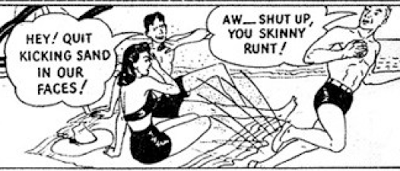
I think of the ad in Back of the Boy’s Life magazines I read when I was a Cub Scout, the ad with the 98 pound weakling sharing a beach blanket his a buxom companion, their outing spoiled by having sand kicked in their faces.
“Hey, you pathetic emaciated excuse for a hominid,” ejaculates the muscular ruffian.
“Hey, you scrawny bitch,” spews the rock-hard bully.
And these thoughts of assimilation lead me to think of how many Muslims I saw in Houston, all the women in hijabs, both at the Galleria Mall and at MD Anderson, one woman sitting in the hospital in a black niqab but also wearing a mask beneath the veil to ward off infection, and then there was the Iraqi veteran who had worked as a translator for the US Army and who was now working as a concierge at the Wyndam Suites, and also we met with a former student and his Pakistani wife, their marriage being the first non-arranged union in the history of her family, and she told Judy and me that even as a coed at the University of Georgia her curfew at her home in the summertime was seven p.m. and, oh boy, a yawn, a good sign, my body hinting to just breathe, and maybe the mind will empty if I pay attention to inhalation and exhalation, if I just let go and allow the swirls of grey behind my eyelids to take whatever shape whatever.