Blitzkrieg Report Card Comment Seminar

taamann_jacob_when_teachers_back_is_turned

One of my least favorite activities as a teacher is writing report card comments. It used to be worse, though. In my former incarnation as Department Chair, I actually had to read every comment each Upper School teacher wrote to ensure that some slip of the finger, unwanted auto correction, or careless cutting and pasting didn’t send the wrong message:

Harold’s prose feces[1] strong verb selection, but he needs to vary sentence structure. Looking ahead, in preparation for the research papers due November 1st, she should make sure to update her working biography as she adds new sources.

Remember how in the lower grades, you’d pack your book reports with unnecessary prepositional phrases to jack up the word count? Well, some teachers lard their comments with detailed synopses of the course curriculum. Sure, it fills up space but fails to provide any insight into how adept young Anastasia is in synthesizing the various components that led to the Russian Revolution. As a parent, I found these descriptions of the courses’ content boring and skipped down to see how sons Ned and Harrison were handling the material, which reminds me of my favorite report card comment ever.

In the 6th grade, my younger son Ned had taken Jesus for his Spanish name. His end of the year report card started with this not very promising topic sentence: “I’m so disappointed in Jesus.” [2]

Anyhow, here’s my method. First, I break down their averages into components:

Daily 58 Essays 84 Tests 60 Independent Reading 90[3]

A parent should infer from this information that young Livingston hasn’t been doing his homework. Ideally, the parent would understand the correlation of Livingston’s not doing his homework with his paltry test average. On the other hand, he’s not a bad writer.

Here’s what I might write below the averages on Livingston’s report card:

Livingston needs to make sure that he reads each of his homework assignments slowly and carefully. He should consider, not only the content of the pieces, but also the authors’ techniques.

Livingston’s writing is solid, though he relies too heavily on linking verbs and occasionally mistakes phrases and subordinate clauses for sentences. I encourage him to proofread his essays backwards, i.e., the last sentence first, the second to last sentence second, etc. This method slows students down and helps them to focus on each individual sentence.

Although the administration would probably prefer that I end the comment with something positive like “Livingston is very bright, and I encourage him to cultivate his native talents,” I generally don’t.  I’m a busy man.  I’ve demonstrated I’m very familiar with their son’s work (or lack thereof) and provided  practical suggestions (which of course I’ve already mentioned to Livingston in person several times).

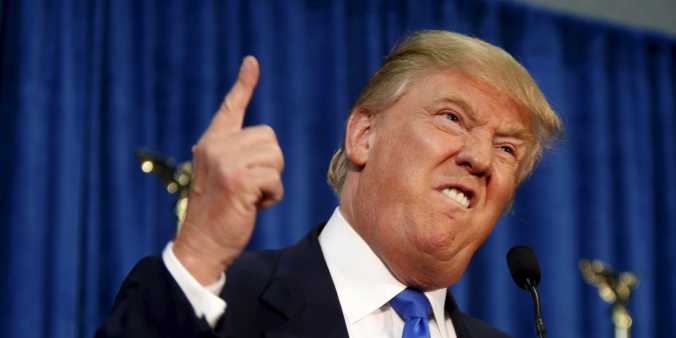
Donald Trump was up this morning at 3 a.m. tweeting. Maybe I could farm out some comments to him.

Lazy Livingston can’t be bothered to read his assignments. He keeps this up and he’ll be flunking out of mediocre UMass next year. That is, if he  gets in. Pathetic!

181uy69xylwpujpg


[1] A very unfortunate auto correction of the intended “features.”

[2] Which brings to mind a stanza from the Ezra Pound poem “Ballad of the Goodly Frere”:

When they came wi’ a host to take Our Man

His smile was good to see,

“First let these go!” quo’ our Goodly Fere,

Or I’ll see ye damned,” says he. (my emphasis)

[3] Which would result in a 75 for the quarter.

The Pea Brains of the South

51kdl6fwrhl-_sx326_bo1204203200_Ladies, gentlemen, bulldogs, and babies, I’d like to introduce you to Henry Heppleworth, a product of the brilliant comic imagination of my expat pal, Charlie Geer, author of Outbound: The Curious Secession of Latter-Day Charleston.  Do yourself a favor and cop a copy here.

Charlie and his wife Concha, who live in Andalusia, Spain, visited Judy and me last summer during an extended stay in Charleston, and I passed along to Charlie a copy of WJ Cash’s The Mind of the South, a fascinating, intuitive study of that section of our great nation that Winston Churchill called “a minstrel show wrapped in an episode of Hee Haw inside of a Euripidean tragedy.”

Yesterday Charlie sent me a link featuring Henry with this message:

[The clip is] Heavily inspired by The Mind of the South, for which I thank you dearly. The clip started out as satire, but is starting to feel like tragedy [. . .] The original script was much more nuanced, but alas, there’s not much room for nuance on YouTube. Hopefully future installments will redeem Henry in some way, once he understands he’s been used and abused by the people he votes for.

So without further ado, dig it:


mind-of-the-south

Leonard Cohen’s Saunter into ‘That Good Night’

13c6ce05571f948557d191ce5f1d7cb0

I first heard Leonard Cohen in David Williams’s black pick-up truck, and it was the very first time I had seen a cassette deck. As far as I knew, 8-tracks were still the only way to listen to recorded music in a moving vehicle. I think Robin Kellam was with us. I think we were driving north on Highway 61. But one thing I do remember for sure: it was the song “So Long, Marianne” that snatched my attention.


The female back-up singer in the chorus struck me as deliciously retro bordering on clunky, and then there was that gypsy vibe, those exotic Middle Eastern instruments[1] and the lush religious imagery. In the David Remnick profile that appears in this week’s New Yorker, Cohen describes the audience he sought to reach: “inner directed adolescents, lovers in all degrees of anguish, disappointed Platonists, pornography peepers, hair-handed monks and Popists.”

In other words, Keatsian/Yeatsian romantics like I-and-I.

I lit a thin green candle

to make you jealous of me,

but the room just filled up with mosquitos.

They heard my body was free.

cropped-album

Yes, I was a romantic back in those days but thankfully not of incurable variety. By the time I was out of college, Cohen had begun to bore me a little (and still does). Even his former lover Joni Mitchell dismisses his as “a boudoir poet.”

Bores me except for the occasional killer composition like “Tower of Song” and “First We Take Manhattan,” which I heard Warren Zevon cover explosively at the old Music Farm on East Bay Street.

They sentenced me to twenty years of boredom

For trying to change the system from within

I’m coming now, I’m coming to reward them

First we take Manhattan, then we take Berlin

However, what do I know? Here’s Remnick quoting Dylan:

I asked Dylan whether he preferred Cohen’s later work, so colored with intimations of the end. “I like all of Leonard’s songs, early or late,” he said. “” ‘Going Home,’ ‘Show Me the Place,’ ‘The Darkness.’ These are all great songs, deep and truthful as ever and multidimensional, surprisingly melodic, and they make you think and feel. I like some of his later songs even better than his early ones. Yet, there’s a simplicity to his early ones that I like, too.”

Speaking of the end, when Cohen learned his former lover and muse Marianne Ihlen, the Marianne of the song, was dying, he sent her this email:

Well Marianne it’s come to this time when we are really so old and our bodies are falling apart and I think I will follow you very soon. Know that I am so close behind you that if you stretch out your hand, I think you can reach mine.

I’ve always loved you for your beauty and your wisdom, but I don’t need to say anything more because you know all that… Goodbye old friend. Endless love, see you down the road.”

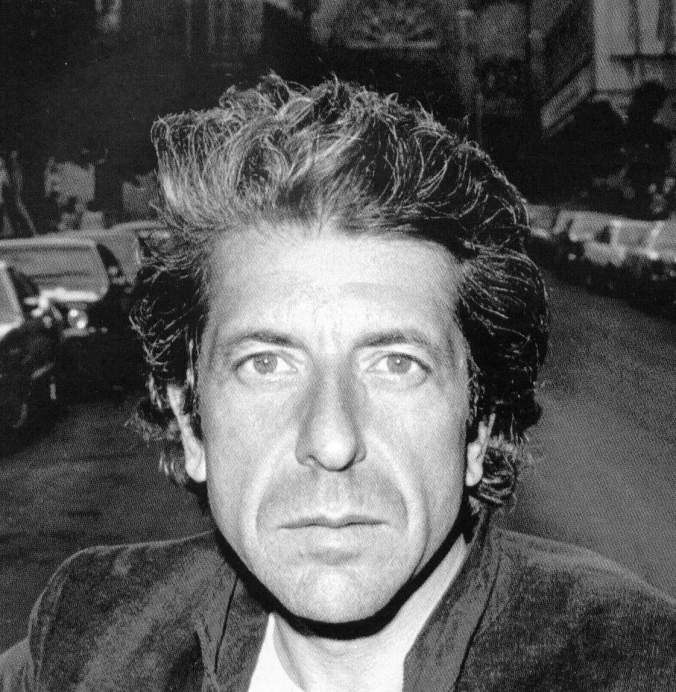
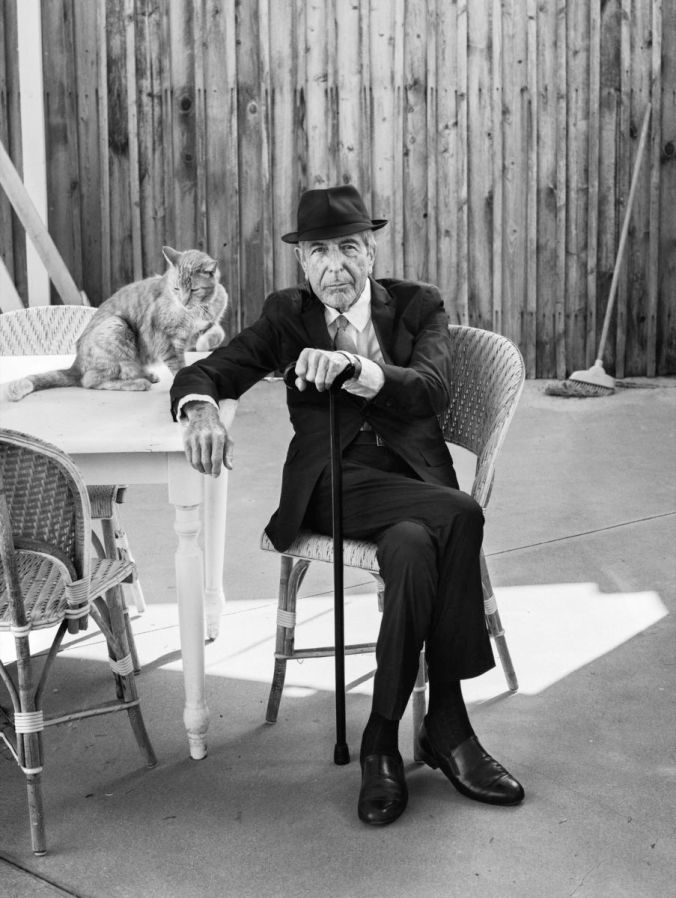
Leonard Cohen at home, Los Angeles, September, 2016. PHOTOGRAPH BY GRAEME MITCHELL FOR THE NEW YORKER

Leonard Cohen at home, Los Angeles, September, 2016.
PHOTOGRAPH BY GRAEME MITCHELL FOR THE NEW YORKER

One night you’re barreling up Highway 61, and the next thing you know you’re an old man getting your house in order.

It’s clear from Remnick’s article that Cohen wasn’t joking in his email to Marianne. He’s “not long for this world.”

Again Remnick quoting Cohen:

“I’ve got some work to do.  Take care of business.  I am ready to die.  I hope it’s not too uncomfortable.  That’s about it for me.”

Let’s cue up some Yeats, one of Cohen’s boyhood heroes:

The death of friends, or death
Of every brilliant eye
That made a catch in the breath—
Seem but the clouds of the sky
When the horizon fades,
Or a bird’s sleepy cry
Among the deepening shades.

Whatever else you can say about Cohen, you cannot deny this: he is, in the phrase of my dear friend Jim Klein, “a cat.”


[1] Played, by the way, by David Lindley

Literary Prototypes for Trump

joker

I’ve been rummaging through the dusty book-lined, cobweb-covered garret of my mind trying to find the literary character who most resembles Donald J Trump.

First, we need someone who is not particularly articulate.  Sure, Trump is quick-witted, capable of an occasional laser-guided zinger, but no one would ever mistake him for Macbeth (though the Thane of Glamis and Cawdor does share with the Emperor of Orange a lack of restraint and total unfitness for office).  What Angus said of Macbeth, Lindsey Graham could say of Trump, “Now does he feel his title/ Hang loose about him, like a giant’s robe/ Upon a dwarfish thief.” However, no way does Trump possess the depth and eloquence to mutter, “Life’s but a walking shadow, a poor player/ That struts and frets his hour upon the stage/ And then is heard no more.”  When Macbeth is out for revenge, he says, “I am in blood stepped in so far that should I wade no more,/ Returning were as tedious as go o’er.”  Instead, with Trump we get, “If I win-I am going to instruct my AG to get a special prosecutor to look into your situation bc there’s never been anything like your lies.”

There’s perhaps a closer cousin to be found in Dickens, but the sad truth of the matter is that my moth-ridden mind only houses three volumes — Great Expectations, The Tale of Two Cities, and Hard Times — and I can’t think of anyone from those tomes who really reminds me of the Donald – though when it comes to holding grudges, Mr. Trump could give Mrs. Havisham a run for her pound sterling.

The best I can come up with his Michael Henchard from Thomas Hardy’s The Mayor of Casterbridge.

the-mayor-of-casterbridge

Henchard, in the likely case you haven’t read the novel, gets drunk and sells his wife and daughter to a sailor, awakens the next day, suffers remorse (a very un-Trumpian emotion), swears off hooch, builds a thriving business, goes into politics, and is elected mayor of Casterbridge.

Here’s Wikipedia’s patched together character analysis:

Henchard has a very impulsive temperament, although he also has a tendency to depression. He tends to take a sudden liking, or a sudden dislike, to other people and can be verbally aggressive even when sober. Henchard is respected in Casterbridge, having built up a strong business almost from nothing, but he is not well liked, and when he drinks, he can be abusive. Indeed, one of the reasons he does so well in business is because, after he sells his wife and child, he swears an oath not to touch alcohol for twenty-one years. When he decides Farfrae [a former business partner] is his enemy, he wages an economic war that, at first, is extremely one-sided. A risk-taker, Henchard eventually lets his personal grudge against Farfrae get in the way of his reasoning abilities. He takes too many risks, gambles too aggressively, and loses his credit, his business, and most of his fortune.

Nevertheless, although Henchard is exasperating, you somehow can identify with him.  You – or at least I – was terribly moved when I read Henchard’s last will and testament:

“That Elizabeth-Jane Farfrae be not told of my death, or made to grieve on account of me.

“& that I be not bury’d in consecrated ground.

“& that no sexton be asked to toll the bell.

“& that nobody is wished to see my dead body.

“& that no murners walk behind me at my funeral.

“& that no flours be planted on my grave,

“& that no man remember me.

“To this I put my name.

MICHAEL HENCHARD

To cut to the chase, Trump lacks the stature to be tragic and is too dangerous and mean-spirited to be truly comic.  Perhaps if we’re looking for a literary doppelganger, we’re better off searching comic books.  In fact, with his outrageous hair, orange complexion, and out-sized ego, Trump would make a fairly cool Batman villain.  The terrifying thing, of course, is just how close this Joker has come to being elected President of the United States.

trump_angry

Blow, Matthew; Crack Your Cheeks; Rage, Blow

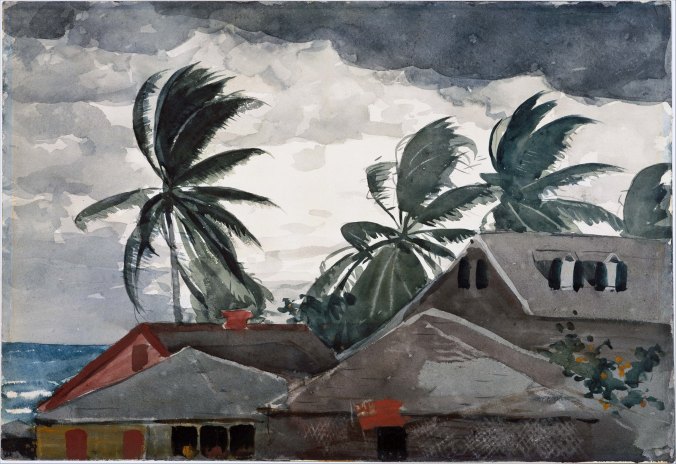
Winslow Homer:

Winslow Homer: “Hurricane”

Between foreseeing and averting change
Lies all the mastery of elements
Which clocks and weatherglasses cannot alter.
Time in the hand is not control of time,
Nor shattered fragments of an instrument
A proof against the wind; the wind will rise,
We can only close the shutters.

                              Adrienne Rich, “Storm Warnings”

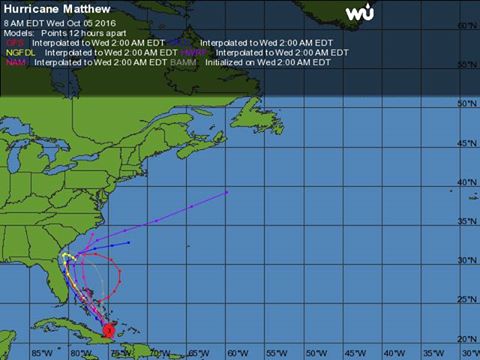
As I type this, my wife Judy Birdsong and I are awaiting Hurricane Matthew’s arrival on a barrier island off the coast of South Carolina. Ominously enough, Folly Beach is the name of this island. Folly’s main historical claim to fame is that Union soldiers occupied the island during our Civil War[1] and Gershwin wrote the music for Porgy and Bess here while staying at DuBose Heyward’s beach house. Heyward’s novel Porgy, by the way, features a hurricane, but one that sneaked upon the characters in those simpler days before Jim Cantore became a household name.  Nothing against Jim and the well-meaning folks at the Weather Channel, but enduring the high keen of their histrionic prophecies is a bit of a drag for us seasoned veterans of what Adrienne Rich calls later in the poem quoted above “troubled regions.”  Also, no doubt, well-meaning, Governor Nikki Haley of South Carolina shut down the state from the capital to the coast Tuesday evening.  She actually decreed all capital city schools be closed, including the University, even though the capital, Columbia, is situated 100 miles inland, and the order came over 48 hours ago.[2]

Here’s what it looks like right now from our bedroom window (i.e. 3:05 EDT 7 Oct 2016).

Our decision to defy Governor Haley’s mandatory evacuation order worries some of our friends, and it ‘s not surprising given the Weather Channel correspondents’ brow-beating and pleading. Perhaps because I am a native here, and this will be my sixth storm, I’ve come to resent the complete and utter lack of nuance we are subjected to during tropical events.

For example, we’ve been warned that there will be “storm surges that we’ve not seen since Hurricane Hugo,” which is true, though with Matthew the surges at Charleston are estimated to be 4 – 6 feet and with Hugo the largest was measured at 21 feet.

post Matthew damage on Daytona Beach

post Matthew damage on Daytona Beach

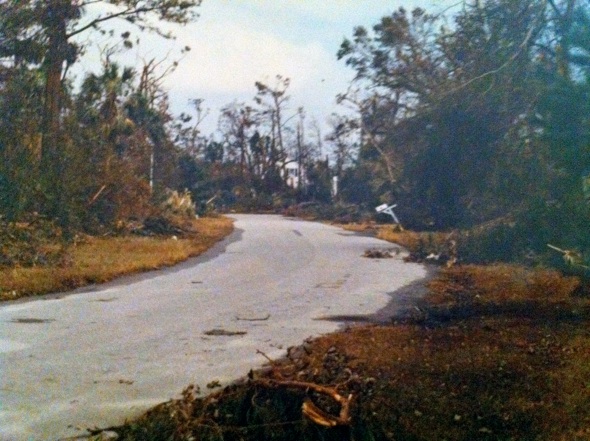
Sullivans Island post Hugo

Sullivans Island post Hugo

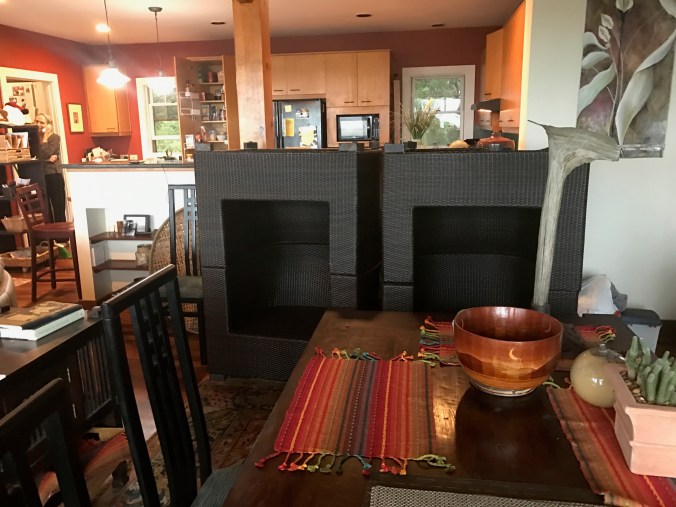
Believe me, if I lived in a mobile home or a one-story house on a slab at sea level, I would be long gone. However, we don’t, are in our 60’s, and as Judy puts it, “I  have cancer anyway.” In other words, we’re having fun, an adventure.   If only Fernando and Alameda Marcos could join us and sit in these throne-like stacked chairs hauled in from the screen porch.

img_0101

We believe in science. Matthew’s pressure has risen 9 millibars in 6 hours, our house was built to exceed hurricane codes, and its bottom floor is 30+ feet above sea level.

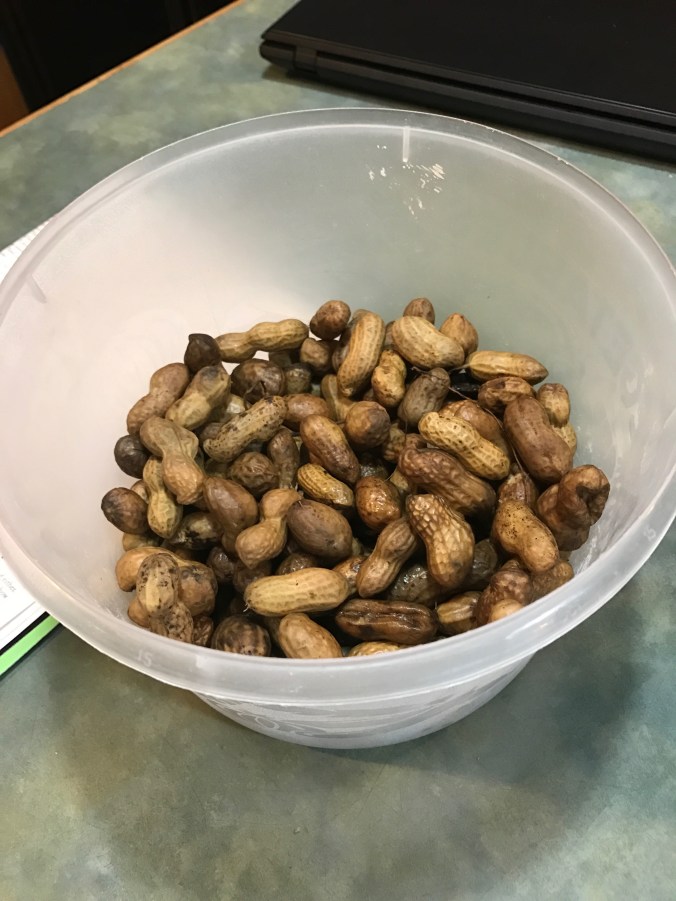
In fact, my biggest concern is that we’re going to run out of boiled peanuts.

img_0103

[1] AKA among the unreconstructed as “the War Between the States” or, worse, “the War of Northern Aggression.” As Hamlet put it, “though I am native here/And to the manner born,” I somehow ended up a liberal and acknowledge my region’s “manifold sins and wickedness” yet still somehow love Dixie, treasure my native soil. Go figure.

[2] Governor Haley, once the darling of Sarah Pallin, perhaps, to use hurricane lingo, has jogged to the left during her two terms, though it would appear that she’s not all that big on science. My son, who teaches in Orlando, much closer to the storm’s “wrath,” had a full day of school on Wednesday and a half day yesterday.

Hurricanes I’ve Known and Loved

wave-breaking

6th Street East Folly Beach 26 August 2011 photo by Ned Moore

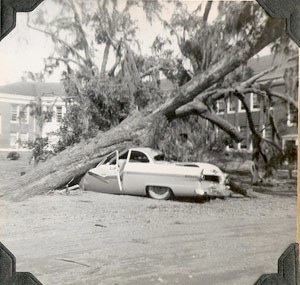
If you’re a native of the Lowcountry and eligible for AARP membership, you’ve experienced your share of hurricanes (or, as we pronounce them down here, hur-rah-kens).  Gracie is the first one I remember, which hit in September of’59, my first full month of first grade. My parents, adventurous folk, rented a small cottage in Summerville and had little to lose, so the preparations for the storm took on a rather festive air.  Gracie offered excitement – a glorious pre-storm sunset, the solemn glow of hurricane lamps, howling winds, and a week off from school spent scrambling up and down uprooted oaks, their tangle of limbs creating grotto-like openings and aerial opportunities for make-believe Johnny Weissmullers.
gracie-1959

Gracie 1959

After Gracie, whenever a hurricane churned its way northward from the Caribbean, I desperately wished it would strike so that we’d miss school and enjoy the romance of 19th century lighting and outdoor grilling.  Alas, my boyhood hopes were always dashed, though a few storms coyly teased us every so often, only to run off to North Carolina and the Outer Banks.  At any rate, I had become very interested in hurricanes and became very good at determining their ultimate destination, a talent that has served me well.
moffett-house

The Andrew Moffett House

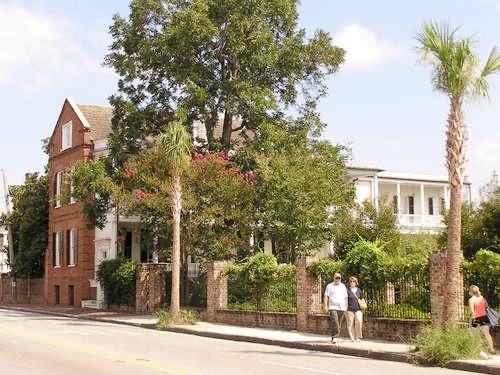
There was one pre-Hugo glancing blow, Hurricane David, but I was grown, in fact, lawfully wedded, and living in the Andrew Moffett House on East Bay Street.  JBirdsong and I-and-I hauled our furniture, paintings and books to the upper floor to avoid a storm surge that never materialized.  Yet, I confess, I still wanted David to hit.  For some perverse reason, I craved chaos. Concerned relatives cajoled us to flee inland, but I told them I suspected that the Moffett House had seen its share of hurricanes and would hold up just fine, thank you.

By the time Hugo appeared in ’89, we were homeowners on the Isle of Palms with two springer spaniels and two sons.  Harrison was in kindergarten, and, like his ol’ man, was about to experience some hurricane vacation, though his was to be longer and a lot less fun-filled. As a matter of fact, Hugo destroyed his school, and he had to finish the year inland in Mt. Pleasant at Whitesides Elementary.

hurricanhugo

Now, wasn’t that a mighty storm?

As the storm approached, I could see we were about to get clobbered.  This hurricane wasn’t following the typical pattern of sweeping up from Florida but was funneling between upper level low and high pressure systems.  Hugo was bearing down on Charleston from the wide open ocean.

Pressure drop, oh, pressure drop!

On the Tuesday before Thursday’s landfall, I went to hear Allan Garganus read from his just published The Oldest Confederate Widow Tells All at Chapter Two Bookstore.  I bought a copy, had him sign it, drove home, and boarded up the house in the dark.

With dogs, sons, photographs, books, paintings, and insurance policies in tow, we drove to Summerville around eleven, spent the night, and were off to Columbia by six the next morning, beating the horrid traffic jams to follow.  The Garganus novel ended up being a good antidote for the ensuing destruction.  Reading about the horrors of Reconstruction put our plight in perspective.

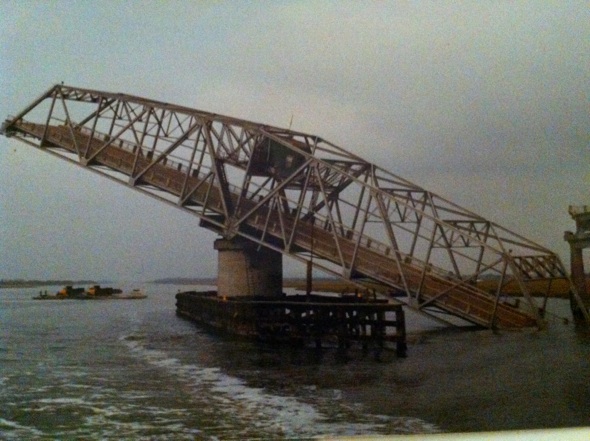
So, I’ll spare you the saga of our homelessness –  the inability to return to the island to find out if we still had a house, the pulling up ocean-soaked carpets, etc. and instead offer these photos, all taken by JBirdsong:
Back Camera

Sullivan’s Island Bridge

Back Camera

Our street, Forest Trail

Back Camera

the boys’s tree house in our back yard

Back Camera

Harry and Ned posing in our front yard in front of debris

Perhaps, however, my greatest Hurricane coup was deciding to ride out Floyd here on Folly in 1999. We avoided the nightmarish gridlock of I-26 where it literally took hours to inch up a couple of car lengths.  (I’d rather huddle in a closet in fetal position all night than be stuck in non-moving Interstate traffic).

HURRICANE FLOYD EVACUATION

Hurricane Floyd traffic

Floyd was the typical Florida skirter who bumps more northerly than the prognosticators predict, and having seen this phenomenon so many times in the past and realizing that Floyd was no Hugo, we enjoyed a night of swaying on pilings in gale force winds and watching the transformers blow across James Island.  As an added benefit, the next day, no one but residents could return, and the boys and I had the 6th Street swell all to ourselves.

Hurricane Irene

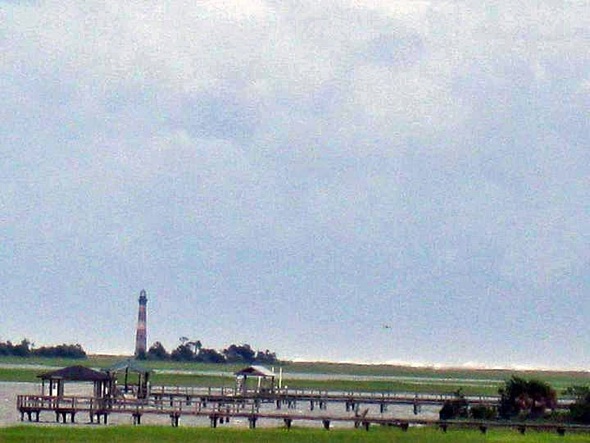
Of course, I no longer wish for hurricanes, but as soon as I saw the Irene’s first trajectory, I knew that she wouldn’t be hitting Charleston.  In fact, I was sorry that school closed because I wanted to organize a happy hour expedition to Blu to watch the breakers from the front beach.  I knew the surf was going to be enormous because on Thursday evening we could see from our deck waves crashing out beyond Morris Island.
back-yard-copy

waves breaking on the horizon, zoom shot from our deck 25 August 2011

Alas, when I awakened Friday at 5:30 to walk Saisy, a phone message informed me that school was cancelled.  JBirdsong, on the other hand, drove inland to Berkeley County for a half day of work, which, given the looming daylong power outage, wasn’t that bad of a fate.
double-overhead

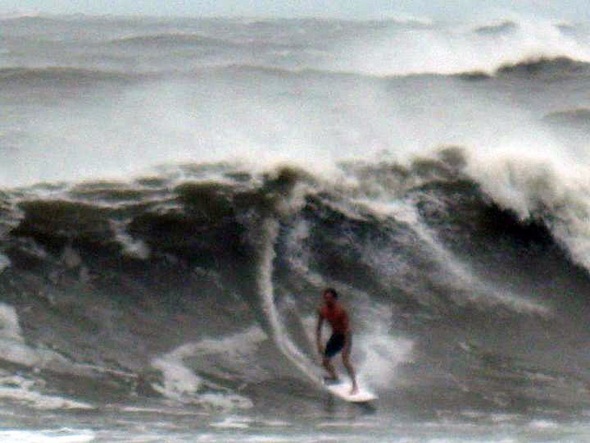
Washout at Folly Beach 26 August 2011, photo by Ned Moore

By 7:30 a power pole had snapped and fallen across the bridge, robbing us of electricity and all of its beloved by-products – air-conditioning, lights, refrigeration, and the Internet, so Ned and I drove down to the Washout to check out the waves.  There, a professional photographer informed us that the beach was closed to traffic.  Lance Crosby, the cat who rakes reeds and builds dunes on the east beach, regaled us with his libertarian views on public drinking and pissing.  “Where are the Port-o-lets?” he asked, extending his arms in exasperation.  “People were drinking on this beach before we were born and people will be drinking on this beach after we’re gone.”

A few brave surfers made it outside and were rewarded with some steep and hairy drops but no one was, as they say, “ripping it up.”

Lance said he thought it was better at 6th, my spot of choice.  Here’s a shot by Ned of 6th Street:

wave-breaking

6th Street East Folly Beach 26 August 2011 photo by Ned Moore

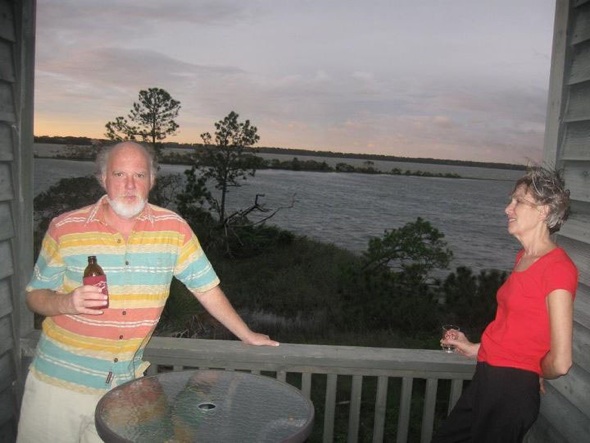
So once Judy got home we spent a lovely day sitting on the bug free deck being buffeted by the winds, and sure enough, once the storm passed, we were treated by one of those surreal hurricane sunsets, as beautiful a phenomenon you’re likely to witness on the 3rd planet from the sun.

sherbert-sunset

photo by Ned Moore

The breathtaking beauty lasted at least a half hour with every ensuing second bringing a different shade – robin egg blue, sherbet orange, aquas, and purples.

Heaven on earth and the very best aftermath imaginable – a few shorn palm fronds, some reeds on the dock, and a sky whose beauty affirms the pricelessness of being alive to witness.
patriach-and-matriarch

patriarch and matriarch after the light show

It’s enough to make you type something stupid like “bring on the next one.”

The Road to Tusheti

Another terrifying post from my deadpan boy Ned.

kingofnowhere's avatarKing of nowhere

Things weren’t exactly off to a hot start. I was waiting at the square at the Isani metro stop, sitting as far away from the homeless as possible. And the stray dogs. It was early, around 7:10, the guide wasn’t supposed to meet me until 7:30, and I didn’t want to talk to anyone besides him. I was tired—I’d been on the road almost a month, and even a private room isn’t the same as your own bed. I looked up and saw a drunk and tough looking man approaching. He was a taxi driver and wanted me to ride. “Rustaveli 10 lari,” he said.

“No, I stay here,” I replied, overly enunciating.

“10 Lari, Didube.”

“I wait for tour. Tusheti.” It didn’t really bother me that he approached. Rather, it bothered me that he was trying to charge me three times the local rate. You can argue double is…

View original post 1,633 more words

I’ve Found the Perfect Writer to Read at Donald’s Inauguration

book-cover


Years ago, when he was visiting writer at my school, the poet Billy Collins told me that he didn’t know of one poet who would be willing to write an inaugural poem for George W Bush.[1]

After last Monday’s debate and the subsequent toxic spew of defamatory tweets, I doubt if we’ll have to consider the possibility of an American poet composing a poem to honor Donald J Trump.

Politics aside, it’s no doubt for the best: orange is probably the hardest word to rhyme in English.

I did some googling, though, and found on Amazon The Conservative Poets: A Contemporary Anthology, edited by William Baer, who offers this estimation of the contemporary literary landscape:

Although it often seems that liberals and the radical Left have assumed complete hegemony over the arts, especially the literary arts, there exists a remnant of very talented American poets who create beautiful, serious, witty, moving, and diverse poetry from a conservative point of view. This unique anthology illustrates the wide range of these determined and sometimes defiant artists, who hope that their work will encourage more like-minded Americans to learn the poetic craft and pursue the literary endeavor.

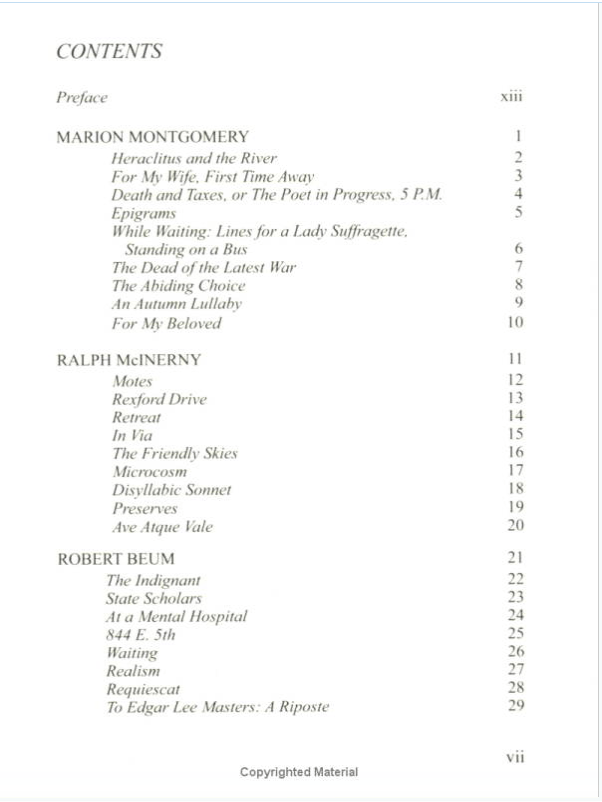
Here’s a snapshot[2] of portion of the table of contents:

table-of-contents


I tried to track down some of these poets, only to discover the ones I deemed most suitable to be nominated as Trump’s inaugural poet had, to quote Richard Wilbur, “gone from this rotten/Taxable world to a standard of higher living.” The late Marion Montgomery’s “While Waiting: Lines for a Lady Suffragette, Standing on a Bus” certainly seems to adhere in some ways to Trump’s view of what Montgomery might call the “fair sex.”

Ah, Lady. Ah. It is a stirring sight.

Franchisement by the gods is now complete.

You now have won the inalienable right

Of standing on your own two feet.

Alas, Montgomery checked out of this Motel 6 of Sorrow in the penultimate year of W’s second term.

Editor Baer in his preface admits that most of the anthologized poems’ conservatism lie in their traditional forms rather than politics, but adds, “Some, myself included, would even tend to see meter as a poetic representation of the provident order of God’s universe.”[3]

What led me to these ruminations is the discovery of a web site entitled Scholars and Writers for America. Beneath its banner there is a statement of support: “Given our choices in the presidential election, we believe that Donald J. Trump is the candidate most likely to restore the promise of America, and we urge you to support him as we do.”

Scrolling down my screen looking for a poets or novelists, past names like Burton W Folsom, Jr., author of The Myth of the Robber Barons and Steve Mosher of the Population Research Institute, I discovered, to my delight, at the bottom of the screen, Thomas C McCollum, novelist.

Here’s the second paragraph of text from McCollum’s website, from an article by Louise Cook, the editor of Absolute Marbella Magazine:

If one were to view all aspects of Thomas McCollum’s professional and avocational life, one might be very tempted to call him a Renaissance man–albeit with a strong entrepreneurial bent. Wisely McCollum leaves all such pretentions to others, preferring the doing rather than the talking about.

What follows is a most-interesting-man-in-the-world litany: Can-am racing, bull running in Pamplona [Spain she helpfully adds], man-eating crocodile hunting, a golf-addiction, insurance sales, original pen and ink drawings street-corner sales, med-school matriculation, med-school abandonment, medical laboratory founding, medical laboratory selling, retirement to Marbella, Spain, “to live out all the fantasies of his youth. He has camped, safaried, and traveled to every continent on earth.”

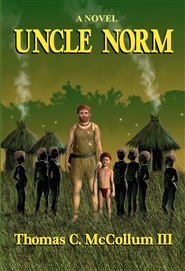
McCollum has published four novels: Whipsocket, Tainted Blood, Palmer Lake, and Uncle Norm.

Here are the first and last sentences from Publisher Weekly’s review of Tainted Blood.

Readers willing to suspend disbelief beyond belief may find McCollum’s first novel an interesting medical thriller; others will be dismayed by characters manipulated by incredible plot contrivances.

McCollum makes the medical details microscopically authentic, but too many standard diatribes against government agencies, characters who speak polemic as often as they do dialogue and a conclusion that’s painfully anticlimactic render a hot topic tepid.

Now compare that MSM review to this one for Uncle Norm from Christopher Feigum, Grammy Award winner and Metropolitan Opera Singer:

“Thomas McCollum has delivered a book of operatic proportions…a tale full of intrigue that tempts us to explore the what ifs of life and the possibility of encountering one profound love. Whether he is delighting pygmies with donuts or sharing his smuggled discoveries along the way, Uncle Norm is a warm, comical hero deeply connected to his fellow lost soul in the Congo, Ottobah Cuguano, and their shared faith in everlasting friendship. As they strive to break down racial barriers and transform the world, their adventures amaze the restless traveler in all of us. This timely piece is a declaration that we each have the choice to leave behind a better place than we found.”

Oh, yeah.  There is also this snippet from of all places, Publisher’s Weekly:  “an interesting thriller…McCollum makes the adventure microscopically authentic.”   Hmmm.  “an interesting thriller . . . microscopically authentic.”  Where I have I heard that before?

soon coming to an opera house near you

Anyway,  I have an idea for the Trump Inaugural Committee in the unlikely event that some less cationic-inducing alternative to Thorazine can be combined with some attention-disorder drug to subdue Trump’s pudgy demons and at the same time focus his attention so he can prep for the second two debates.

Here’s my idea. Instead of having an inaugural poem, have Mr. McCollum write an adventure tale with Trump as protagonist.

No one likes poetry anyway.

donald-solo-with-croc


[1] By the way, this conversation took place in Folly Beach, SC, at the Sand Dollar Social Club, one of the most exclusive biker bars/literary salons in the Lowcountry of South Carolina

[2] Is snapshot ever used non-metaphorically anymore? Does any one say, “Wait a sec. I have a snapshot on my phone. Actually I ended up using a screenshot to avoid the moiré-like swirls from the iPhone 7 photo.  Are you noticing the propensity of the author to name drop?

[3] For example, poetically rendering the series of explosions that occurred after that asteroid or comet or whatever slammed into the planet and did away with the dinosaurs would call for a series of spondees: Splat! Boom! Boom! Boom! Boom!

Two Stanzas of Ottava Rima Written in Earshot of a Skate Board Park

Skateboard Wipeout by Robert Mooney

Skateboard Wipeout by Robert Mooney


I said, ‘It’s certain there is no fine thing   

Since Adam’s fall but needs much labouring.

                                                                      WB Yeats


Willie B makes it seem so damned easy,

each iamb in it is appointed place,

but whenever I try it, I feel sleazy,

like a Byron wannabe pissing in the lake.

Yet even to Yeats it didn’t come easy.

A line would take him hours. Better to “break

stones,” he whined, “in all kinds of weather”

than try “to articulate sweet sounds together.”


Form versus execution. I hear the clatter

of skateboarders’ failed attempts at competence.

They flip the board, fall off, curse, batter

their knees as they try to perform the tricks

they see on TV — as if mind over matter

weren’t a myth, as if practice makes perfect,

as if talent can be willed. I say

time to shut down this computer, call it a day.