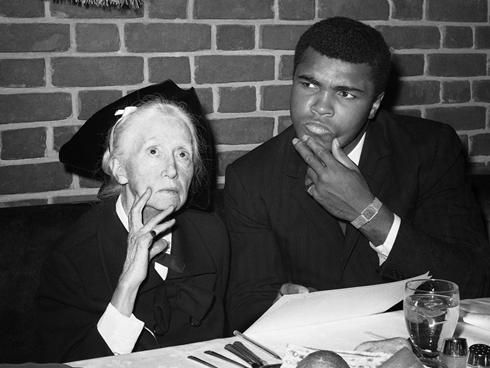
Writing free verse, Robert Frost once noted, is like playing tennis without a net, and although I disagree with that overly simplistic characterization, I do think when it comes to political verse satire, you’re better off possessing the talents of Ogden Nash over those of William Carlos Williams. In other words, you want the inherent attraction of traditional verse — standard meter, rhyme, alliteration, etc. In the realm of satire, sing-song trumps subtle sonic stitching; Muhammad Ali KOs Marianne Moore.
For example, this ain’t gonna hack it:
Nor will this:
One obvious problem in the current Presidential campaign is coming up with words that rhyme with the candidates’ names. This difficulty is especially pronounced for surnames with two syllables.
Sanders isn’t too bad – sanders/pander – but John Kasich and Hillary Clinton, ugh.
Kasich/ wasted.
Clinton/sent in.
Of course, with HRC, you can go with her first name, and bam, you get pillory, which offers many illustrative possibilities.
But let’s face it, as far as rhyme goes, the candidate with most promising last name is Trump, which offers a veritable plethora of pejorative rhymes:
bump/clump/dump/frump/grump/hump/ lump/mumps/ rump, sump, etc.
Cruz comes in second with dues/snooze/ flooze/abuse/news/, etc.
But then, even if you can get the rhymes going, you have to worry about meter.
Forget it.
What muse worth her whispering is going to descend and inspire you to write some shit about Carly Florina?
Years ago, I invited my former student, Paul Edward O’Brien, to introduce a unit on poetry to jaded high school seniors. It was springtime, and they were sick of school — sick of their childhoods. To most of them poetry was the language arts equivalent of a math problem.
Paul, an oncologist by profession and actor by avocation, majored in English at Harvard, taught freshman composition there during a sabbatical from med school, so he is a man of science and of letters. The old-fashioned word “dashing” does him justice, so I thought a swashbuckling evangelist for poetry might at least hold their attention. Maybe even convert one.
He began by quoting “Who Goes with Fergus” and explained how he fell in love with the poem without even having any idea what it meant. He told the students at one point that “Poetry can be your friend, your companion, help you in times of need.”
Indeed.
* * *
Last Monday, with about three-and-a-half hours of sleep and feeling something very close to despair, I stumbled into my first period class of sophomores to discuss John Keats’s “Ode to a Nightingale.” The poem had been slated for this day on my syllabus before I had received some very disturbing news, and it’s not necessarily a poem I would choose to teach right now given what is going on in my life.
I started the class by asking students to close their eyes and for three minutes and attempt to remember vividly a time when they’d been blown away by nature – overawed by a breath-taking vista or a ferocious thunderstorm or an encounter with a wild animal. I asked them to try to conjure images – sights, sounds, smells and then to capture those images with words.
Once I saw that all their eyes were shut, I closed mine as well and thought of last summer when my wife Judy and I sat at a picnic table on top of Mount Mansfield in Vermont.
. . . behind us clouds rush over the summit, revealing a patch of blue sky. A waterfall of light pours through the opening and cascades down the side of the summit, progressively devouring shadows. Actually, the light’s more like lava because a waterfall is always pouring forth, but this light is creeping, shimmering its way down, illuminating boulders and green growth . , ,
Instead of reading their responses, they shared them orally. One, nighttime in Oxford, England, green-green-green night grass and a profusion of stars. Another, atop a mountain with fog blanketing below, except for a rectangular opening, like a window, through which he could see the sloping vegetation below. A third, the sound of water rushing over river rocks during a night of utter solitude.
I asked them to articulate their emotional responses. Virtually everyone agreed egos tended to disappear in the face of their experiences. No one thought, “How cool that I’m experiencing these wonders,” but the wonders themselves took precedence over the perceiver.
I tied their experiences to Romanticism and explained in the ode Keats is trying to escape his anguish via nature and imagination.
We then turned to the poem itself, that beautiful meditation on death, suffering, attempted escape, the failure of the imagination, among other things.
I’ve given up having students read poems out loud in class; I read them myself for the sake of fluidity.
So I started the first stanza, and as I did, sunlight flickered across the page underscoring, as it were, the delicacy of the verse, the ephemera of poor Keats’s rapidly disappearing days. I tried to keep my voice steady.
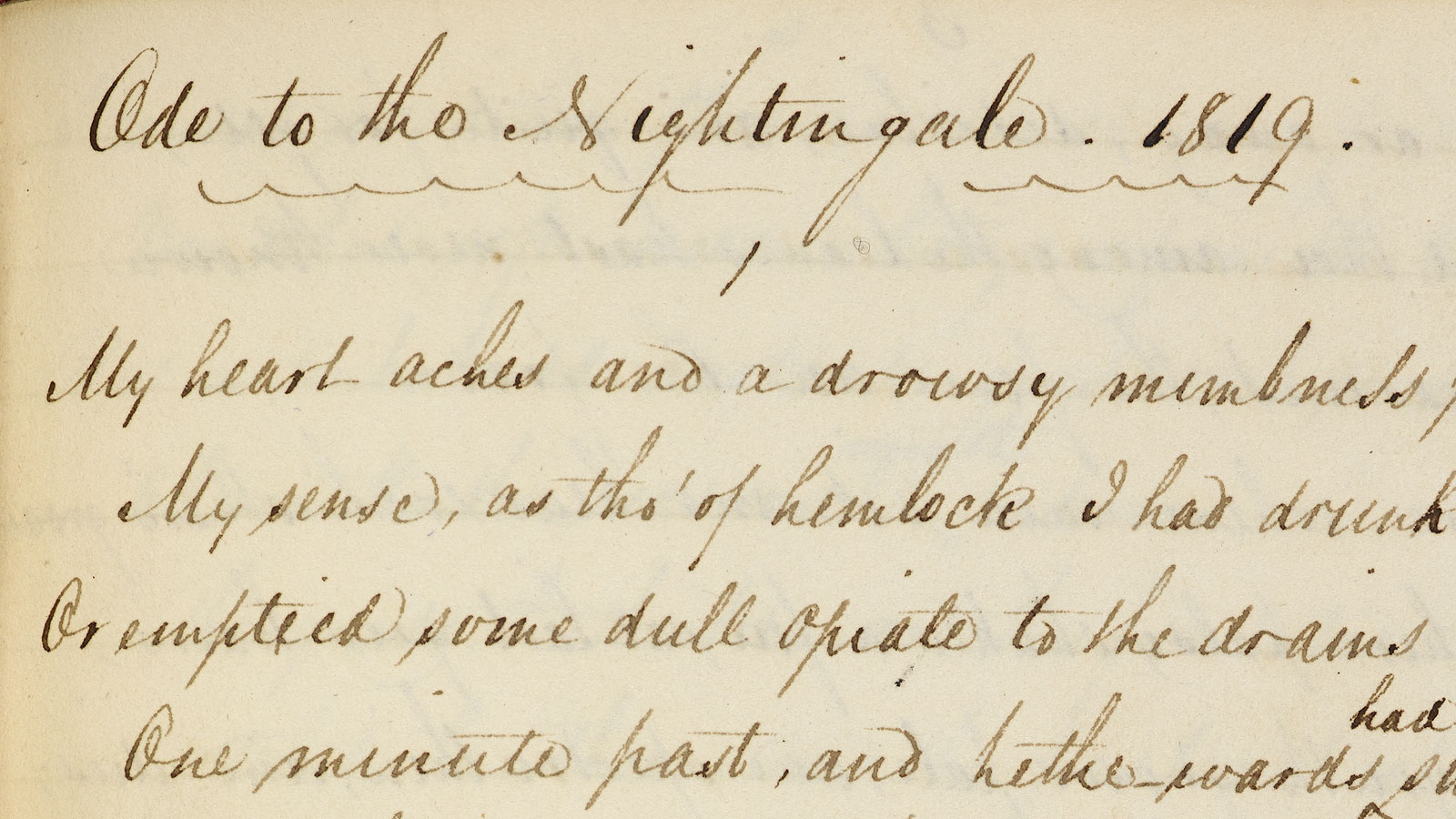
My heart aches, and a drowsy numbness pains
My sense, as though of hemlock I had drunk,
Or emptied some dull opiate to the drains
One minute past, and Lethe-wards had sunk:
‘Tis not through envy of thy happy lot,
But being too happy in thine happiness,—
That thou, light-winged Dryad of the trees
In some melodious plot
Of beechen green, and shadows numberless,
Singest of summer in full-throated ease.
Keats was suffering from depression. His beloved brother Tom had died of TB the summer before, and TB’s first symptoms were beginning to manifest themselves in him.
I asked the students to identify the tone using the first line: “aches” “numbness,” “pain.”
“What is hemlock? I asked. “Opiate?” “Lethe?” “Dryad?”
I had trouble with the third stanza in that I feared if I might start to weep.
Fade far away, dissolve, and quite forget
What thou among the leaves hast never known,
The weariness, the fever, and the fret
Here, where men sit and hear each other groan;
Where palsy shakes a few, sad, last gray hairs,
Where youth grows pale, and spectre-thin, and dies;
Where but to think is to be full of sorrow
And leaden-eyed despairs,
Where Beauty cannot keep her lustrous eyes,
Or new Love pine at them beyond to-morrow.
The sunlight flickering shadows from the trees outside the window upon the words of the poem was quite beautiful.
John Austen’s Hamlet
“Dissolve.” I recited Hamlet’s first soliloquy. “O would this too too solid flesh melt/And dissolve itself into a dew. . .” I explained Hamlet’s sad situation, his father’s death his mother’s marrying his uncle within a month.
This is true misery, I said; Hamlet and Keats long for vaporization, demolecularization, surcease of sorrow, absolute disappearance.
We discussed the slowness of the lines – the caesuras – how those commas make the reader hesitate, to limp along with “the weariness, the fever, and the fret” . . . where palsy shakes a few, sad, last gray hairs.”
The sunlight flickering on the page. The sound of my own voice reading the words.
I was not alone. I had the students, of course, but also Hamlet, Keats, those old immortal friends, to help me get through those miserable moments. No, not alone, and paradoxically, I felt keenly alive, felt something like joy by the time it was time to let them go.
Above and beyond the computer screen outside the closed window of my study, palmetto fronds and magnolia boughs shimmer in a sunny morning breeze. Seemingly, inside my computer, Robert Plant (and to a lesser degree Allison Krauss) is pleading for someone somewhere to “please read the letter [he/she] wrote.”
Some algorithm created by Steve Job’s brain trust has selected this song from a mix called Singer/Songwriter that shuffles music I have purchased. I happen not to like the song, nor that album. Critics convinced me to fork out ten bucks to buy it, so I did. It’s not a big deal, but it has not made me happy. Perhaps the next song will better suit me, and as it turns out, it does, Joni Mitchell’s “Car on a Hill” from Court and Spark, an album I first purchased in 1974.
I think back to the Joni Mitchell concert I attended that year with Debbie Kellam with whom I was madly in love. Now Andrew Marvell is whispering in my ear: deserts of vast eternity.
photograph by Kaisern Chen
In his History of Happiness, Darrin McMahon informs us:
Language reveals ancient definitions of happiness. It is a striking fact that in every Indo-European language, without exception, going all the way back to ancient Greek, the word for happiness is a cognate with the word for luck. Hap is the Old Norse and Old English root of happiness, and it just means luck or chance, as did the Old French heur, giving us bonheur, good fortune or happiness. German gives us the word Gluck, which to this day means both happiness and chance.
In other words, etymologically, happiness is happenstance, the luck of the draw, whether it it be a full house or the inherited brain chemistry that creates a naturally sunny disposition.
McMahon notes that the classical philosophers came to believe that happiness could be attained, not as feeling, but as a state earned through living a virtuous life, “measured,” as McMahon says, “in lifetimes, not moments.” Hence, happiness must be earned through the cultivation of virtues, which Malcolm catalogues for us in Macbeth:
[. . .] justice, verity, temperance, stableness,
Bounty, perseverance, mercy, lowliness,
Devotion, patience, courage, fortitude (4.1, 92-4
In desert-born religions, the world becomes a vale of tears and ultimate happiness only possible in some exalted state, e.g., in prelapsarian Eden, i.e., the past, or in some future state, i.e., at the return of Christ in the millennium or in one of the many mansions of heaven.
Massah ain’t treating you right. Keep working. The low swinging chariot will be here any minute.
Swing Low, Sweet Chariot by Richard Bennett
Now, coincidently, Paul Simons is singing “Slip Sliding Away”:
We work at our jobs
Collect our pay
Believe we’re gliding down the highway
When in fact we’re slip sliding away.
Slip sliding away,
Slip sliding away,
You know the nearer your destination
The more you’re slip sliding away.
The Christian view described above provides a theoretical escape hatch for Simon’s paradox, but left-brained Enlightened philosophers and Founding Fathers supplanted that view and argued that happiness was, again in McMahon’s words, “more than a divine gift, less fortuitous than fortune, less exalted than a millenarian dream.” In fact, it is an American right to pursue it, and God knows we do.
detail from The Palace of Hedonism by Kris Kuksi
God bless the Enlightenment! It has taught us that sensuality is not sin, that we deserve happiness because we are, and rather than donning hair shirts and spending our winter nights barefooted in the snow self-flagellating, we should make the best out of a sure thing, the here and now, for, yes, death is just around the corner. In fact, Lucretius, following the wisdom of Epicurus, argued 1600 earlier essentially the same concept.
However, happiness as a constant state is unsustainable in the flux of day-to-day occurrences, medications, moods, adrenal secretions. The classic philosophers and stoics were correct: True happiness is impossible without a foundation of compassion that directs one’s thoughts from the self to others.
In other words, lasting happiness is impossible outside the context of a virtuous life, but, of course, a virtuous life doesn’t guarantee “lasting happiness.”
Hap
BY THOMAS HARDY
If but some vengeful god would call to me
From up the sky, and laugh: “Thou suffering thing,
Know that thy sorrow is my ecstasy,
That thy love’s loss is my hate’s profiting!”
Then would I bear it, clench myself, and die,
Steeled by the sense of ire unmerited;
Half-eased in that a Powerfuller than I
Had willed and meted me the tears I shed.
But not so. How arrives it joy lies slain,
And why unblooms the best hope ever sown?
—Crass Casualty obstructs the sun and rain,
And dicing Time for gladness casts a moan. . . .
These purblind Doomsters had as readily strown
Blisses about my pilgrimage as pain.
Nevertheless, let’s give Epicurus the last word:
It is impossible to live a pleasant life without living wisely and well and justly. And it is impossible to live wisely and well and justly without living a pleasant life.
Twit twit twit
Jug jug jug jug jug jug
So rudely forc’d.
Tereu
TS Eliot, “The Waste Land”
Although Yeats gets quoted a lot in these traumatic days – things fall apart, the center cannot hold, etc. – TS Eliot was no slouch himself when it came to apocalyptic naysaying. For example, dig this ditty from “The Waste Land”:
What is that sound high in the air
Murmur of maternal lamentation
Who are those hooded hordes swarming
Over endless plains, stumbling in cracked earth
Ringed by the flat horizon only
What is the city over the mountains
Cracks and reforms and bursts in the violet air
Falling towers
Jerusalem Athens Alexandria
Vienna London
Unreal
Because most of us Americans are consumed with the 24/7 Jerry Springer extravaganza that is the current presidential campaign, I doubt if your casual consumer of the news is aware that Europe’s political turmoil makes ours seem rather bland by comparison.
For example, on New Years Eve in Cologne, Germany, gangs of young males assaulted scores of females celebrating the holiday. Some blame newly arrived Muslim immigrants for the outrages while others suggest caution before jumping to conclusions.
Here’s a snippet from the conservative British paper the Spectator:
The German police made a similar point: they are used to handling drunks. But gangs of young men encircling and then groping women at large public gatherings: who has ever heard of such a thing?
In the Arab world, it’s something of a phenomenon. It has a name: ‘Taharrush gamea’. Sometimes the girls are teased and have their veils torn off by gangs of young men; sometimes it escalates into rape. Five years ago, this form of attack was the subject of an award-winning Egyptian film, 678. Instances of young men surrounding and attacking girls were reported throughout the Arab Spring protests in Cairo in 2011 and 2012. Lara Logan, a CNN journalist covering the fall of Hosni Mubarak, was raped in Tahrir Square. Taharrush gamea is a modern evil, and it’s being imported into Europe. Our authorities ought to be aware of it
On the other hand, here is Ishaan Tharoor from the Washington Post:
To be sure, there are legitimate security concerns posed both by the surge in new arrivals as well as the continuing instability and conflicts in the Middle East. The attacks in Cologne, writes the Algerian novelist Kamel Daoud, were a reminder to the West of the Muslim world’s “sick relationship with women” — a product both of patriarchal and religious norms as well as the stifling legacy of authoritarian rule.
But perverse, misogynist behavior is not the province of just one culture or society. And much of Europe’s anti-refugee hysteria, as my colleague Adam Taylor charted this week, has been overblown and fueled by often misleading innuendo and rumor circulating on social media.
Very few of the identified culprits in the Cologne attacks were themselves refugees. And countries like Poland and Hungary, while leading the conservative charge against E.U. policies that would allow in desperate Middle Eastern asylum seekers, still have minuscule Muslim populations of their own. The risk of a cultural invasion somehow contaminating their societies is, frankly, a phantasm conjured by fear-mongers.
Of course, this week, we Americans were treated to some man-on-woman physicality when police charged Donald Trump’s campaign manager Corey Lewandowski with battery after an encounter with “former Breitbart reporter Michelle Fields.”
In this case, we have video, so you can make up your mind yourself.*
*My personal view is that by the standards of Summerville High School that encounter doesn’t approach “battery.”
The bottom line is that the big blinding, buzzing cacophony of computerized existence obliterates contemplation. The blitzkrieg of information, much of it contradictory, is harmful for a species who has spent most of its existence sitting in small groups on a savannah among birdsong and rustling leaves.
The ruling class – the Koch Bros, etc. – should know that oligarchies lead to revolutions, that the Occupy Movement was a Shakespearian comet of foreboding, but who has time to contemplate history or to think beyond tomorrow’s Dow Jones closing averages?
Then there’s Hillary trying to thread the needle between big business and young debt-ridden would-be socialists as she attempts to be all things to all people.
Meanwhile, followers of Bernard Sanders engage in magical thinking imaging 30+ redneck gerrymandered districts somehow going blue so that he’ll be able to break up the banks, overhaul our healthcare system, make college free while by creating the largest middle class tax hike in the history of our republic.
What we see here in the Republican Party – factionalism – is also playing out in Europe. Things are falling apart – perhaps most alarmingly, glaciers!
Oh, by the way, it’s my spring break, and we all know that April is the cruelest month, so I’ve been having a sort of TS Eliot holiday, riding around with the radio/cd player off, popping Ativans like M&Ms, reciting poetry out loud to myself:
After such knowledge, what forgiveness? Think now
History has many cunning passages, contrived corridors
And issues, deceives with whispering ambitions,
Guides us by vanities. Think now
She gives when our attention is distracted
And what she gives, gives with such supple confusions
That the giving famishes the craving. Gives too late
What’s not believed in, or is still believed,
In memory only, reconsidered passion. Gives too soon
Into weak hands, what’s thought can be dispensed with
Till the refusal propagates a fear. Think
Neither fear nor courage saves us. Unnatural vices
Are fathered by our heroism. Virtues
Are forced upon us by our impudent crimes.
The phrase “ashes to ashes, dust to dust” is a not so subtle suggestion that human beings don’t ultimately amount to much as far as corporeal matters go.
Just ask Hamlet. Here he is next to Ophelia’s freshly dug grave ruminating on what base uses we may return:
Alexander returneth into dust; the dust is earth; of
earth we make loam; and why of that loam, whereto he
was converted, might they not stop a beer-barrel?
Imperious Caesar, dead and turn’d to clay,
Might stop a hole to keep the wind away:
O, that that earth, which kept the world in awe,
Should patch a wall to expel the winter flaw!
Yesterday, we disposed of Aunt Virginia’s cremains,[2] which, and I’m not making this up, smelled like cigarettes. My brother Fleming kept them in his car, and as soon as he opened the door, I could smell that distinctive Virginia smell.
Nothing dealing with Virginia was ever easy. We had planned to scatter the ashes in the Folly River via kayak from our dock, but when Fleming arrived, it was dead low tide, so we decided to try the dock at the Folly River Park instead, hoping on such a chilly day that at 5 o’clock it might be deserted.
The park is across from a Catholic church, which was celebrating mass, so parking was a problem. Nor was the dock deserted. Three young men, National Guardsmen as it turned out, were fishing. It occurred to me that dumping human remains in water where people were fishing would be a gross violation of the Golden Rule, but as luck would have it, they started packing up their gear to leave. As I glanced down the long dock, another man was approaching in the far distance with his dog.
“Look, fellows,” I said. “I want to give you a head’s up. We’re getting ready to scatter my aunt’s ashes, that is, if y’all don’t object.”
“Not at all,” the tallest one said. “Sorry about your loss.”
So Fleming opened the velvet bag, brother David cut open the plastic bag inside, and Fleming poured the contents over the rail and into the water. I had never seen human ashes before, and I was quite shocked how beautiful they were as they drifted down into the water, creating a cloud as they dispersed, as if matter cannot really be created nor destroyed, as if Virginia were getting a second chance via recycling.
As we made our way down the dock to Fleming’s car, as if on cue, the church bells began to chime as mass let out, a beautiful sound, and I thought of this poem by Richard Eberhart:
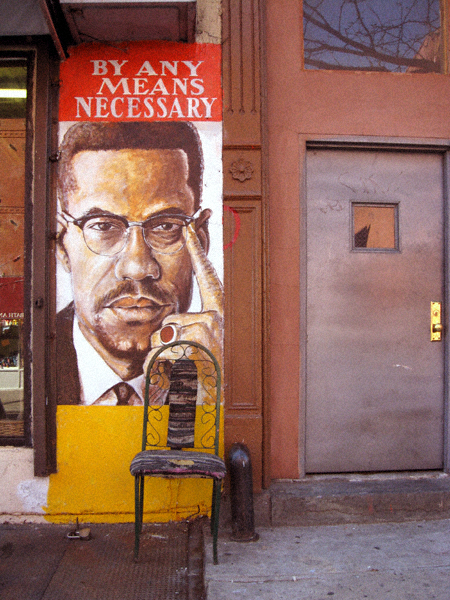
On the corner of Robert E Lee Avenue and Malcolm X Boulevard, I pick up a hitchhiker — there’s a knapsack on his back — he’s unwashed, emaciated, Whitmanesque in a Johnny Winter sort of way, somewhere between the ages of 40 and 65.
I’m in a good mood, have just gotten word The Kenyon Review has accepted one of my poems. When I pull over, I sing, “Val-deri, val-dera” as I lean over and open the door for him.
There’s the spring 2014 issue of The Paris Review on the seat, which I stick into the side pocket of the open door. He frowns, takes off the knapsack, which is actually a blackened, tattered bookbag, and struggles to jam it between the seats into the back compartment of my Fiat. Finally successful in the stowing, he sits down and turns and grabs for the seat belt like he’s just fallen overboard.
“Where to?” I ask, once the commotion is over, a little ashamed of myself for singing.
“Ultimately, way out west, I reckon.”
He reeks of cigarettes, campfire, mildew, and that metabolic sour wino sweetish stench that in-excess Mad Dog 20-20 and digestive systems produce.
He says, “Let me amend that. Wherever.”
“Wherever?”
“Drop me off wherever?”
The smell is getting to me as we tool down Malcolm X past Eldridge Cleaver Middle School. I decide I’ll take him to the Interstate exit, which is both headed west and qualifies as wherever.
He turns to me, and I can tell he’s looking at me, so I take my eyes off the not-so-heavy traffic and make eye contact with his barely blue eyes all rheumy and sad and staring at me.
“Who’s your favorite poet?” he asks.
I know the answer to this one: “Me.”
“You’re a poet?”
“Yep, as a matter of fact.”
“Published?”
“You bet.”
“Okay, then. Who’s your second favorite poet?”
“Frederick Seidel,” I say, thinking I’ll name someone he’s never heard of.
“Okay,” he says. “You can let me out here.”
“Here? How come?
“Seidel’s a pervert; that’s why.”
You sure you don’t want me to take you to the Interstate?”
“Positive.”
I pull over, he gets out, and I bid goodbye with a sarcastic salute. Self-righteous son-of-a-bitch.
I pull back into traffic, the post-industrial claptrap warehouses scrolling past my side windows, but I can still smell him five blocks away. I have a theory that loud noises drown out odors. I click on the music. Big Brother. Cheap Thrills.
It’s not until I’m past the Huey Newton on-ramp that I realize his bookbag’s still in the back.
“Harlem Madness” – Fletcher Henderson, Ned Williams, and Irving Mills
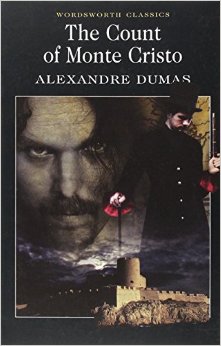
I was eaten up with Romanticism when I was a boy growing up in Summerville, SC. On any number of bright, sunny spring days, perfect for playing outside, you could find me in the cave of my bottom bunk reading The Count of Monte Cristo or The Complete Stories of Edgar Allan Poe.
I was especially a sucker for doomed protagonists who suffered the perpetual ache of unrequited love, sardonic swashbucklers like Cyrano de Bergerac or Poe’s gloom-devoured intellectuals forever grieving for their lost Lenores. Of course, I didn’t share these somewhat pathological predilections with my friends or family. Maybe if I had, some kind soul might have pointed out that celebrating heartache is unhealthy and Darwinianly ineffective when competing for mates.
A consequence of this peculiar focus is that I developed an anachronistic, almost Victorian, appreciation of females as icons worthy of worship, practicing what Yeats describes in his poem “Adam’s Curse” as “the old high way of love.”*
There have been lovers who thought love should be
So much compounded of high courtesy
That they would sigh and quote with learned looks
Precedents out of beautiful old books;
Yet now it seems an idle trade enough.
“Idle” as in non-productive. In those days, snagging a touchdown pass or smacking a double was a more reliable pathway to a young girl’s heart than penning cliché-ridden verse that doesn’t scan — still is, as a matter of fact.
So I had a string of crushes I worshipped from afar, for example, the beautiful Joanne Elder, whom I would escort around the circumference of Dogwood Circle never daring to clasp her hand and confess my adoration. I had cultivated an ideal medieval maiden in my psyche and projected her onto this not intellectually curious but practical girl. Meanwhile, in any number of carport utility rooms and out in the still abundant woods around the subdivision of Twin Oaks, other less literary 7th graders were learning how to French kiss. I still can clearly remember one day on an overcrowded school bus Joanne’s writing in the dust on the back door’s window the name of Steve Hoates.
[cue funereal violins]
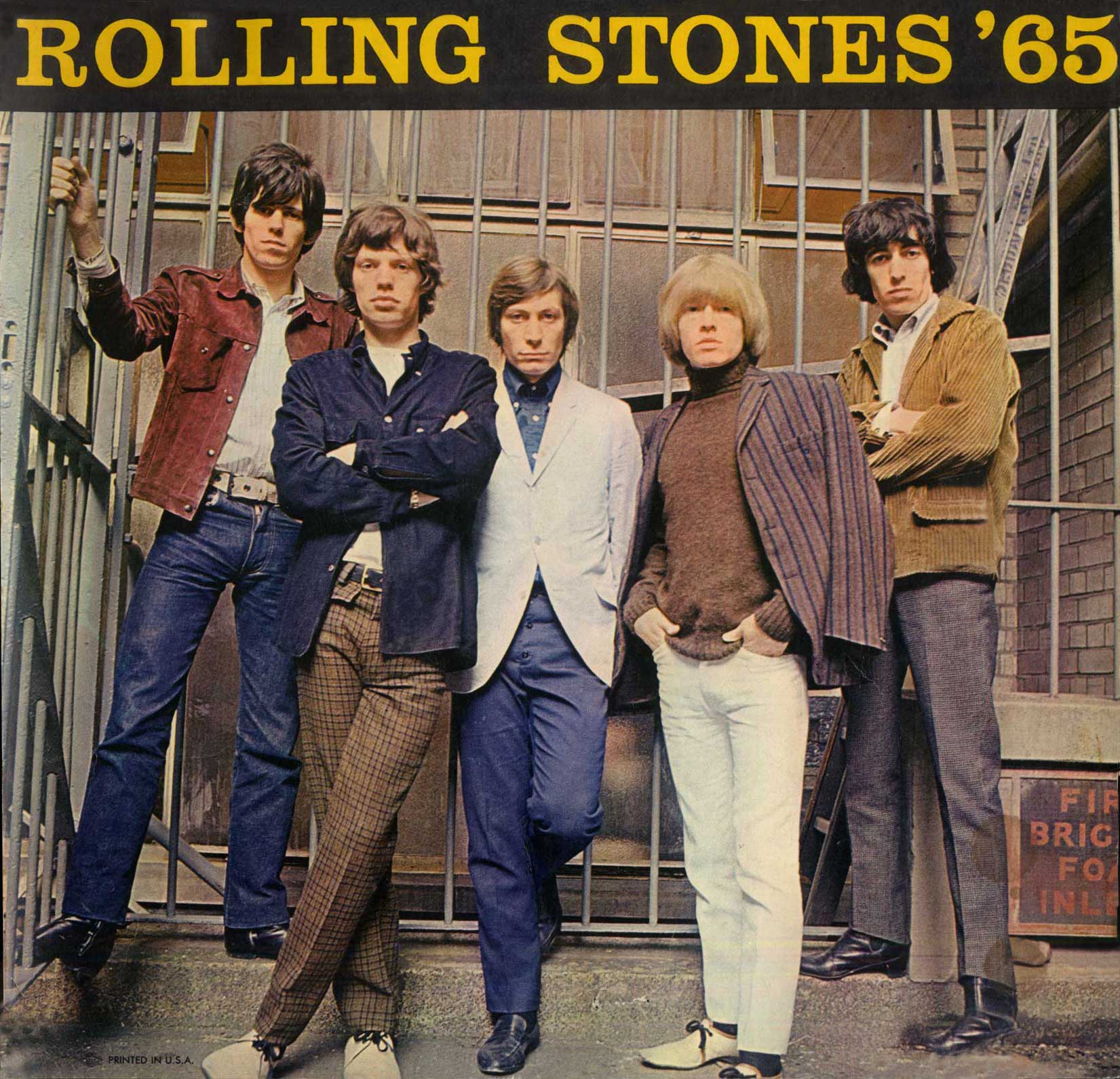
Puberty itself was a great help in overcoming the blight of romanticism. I began reading less and listening to music more, Mick Jagger replacing Edmond Dantès as a role model, and despite singles like “As Tears Go By,” many Stones songs like “Under My Thumb” and “Stupid Girl” were openly dismissive of “the fair sex,” if not downright misogynistic.
My attitude coarsened a bit.
A couple of real live heartbreaks made me realize that the Marvelettes were right about the vast number of fish teeming in the sea of love. I came to realize that when you “got a heartache,” you’re much better off using your fingers to punch in jukebox selections rather than manipulating typewriter keys.
I figured out that the old Yeats was wiser than younger Yeats. Take it away, Crazy Jane:
A woman can be proud and stiff
When on love intent;
But Love has pitched his mansion in
The place of excrement;
For nothing can be sole or whole
That has not been rent.
Cyrano and Me
*Of course, over a half-a-century later, I realize this attitude of placing females on pedestals is sexist, a byproduct of the patriarchy, etc, but look up at that less-than-ninety- pound weakling right above this note. He didn’t know any better.