On Police Blotters and Street Preachers

3036413-GDKXVVDB-7

Oh, the side-splitting counter-Darwinian hijinks those headline-capturing police blotter inebriates produce each week on the highways, byways and beaches of the Lowcountry![1]

Whether it be a wobbly motorist telling a cop “he’s had five beers plus one beer,” a naked bicyclist peddling towards a fast-food drive-thru, or a domestic dispute involving tire irons and trash can lids, the police blotter is sure to bring a winsome smile to even the crabbiest of malcontents.

Not too long ago, you had to riffle to the back of the City PaperFolly Current, or Section 12B of the Post and Courier to discover who had tried to drive his car up the stairs leading to the Battery’s promenade or who had stuffed two bottles of champagne in his pants in a failed heist; however, in these latter days seeking out the absurd is almost too easy.  For example, here is a screen capture from a recent Live 5 web posting:

live5 1.0

Still, I prefer the paper, whose account of the Halloween mishaps of a luckless 21-year-old who drove his vehicle into Colonial Lake offers more details than Live-5’s recap.  For example, in the paper we learn that divers were employed to see if another passenger was in the car, the one the 21-year-old claimed had been driving.  Live-5 did, however, estimate the parameters of his intoxication, between .10 and .16.

I’m not one to talk, though. I once drove my MG Midget down the steps of a parking garage into Campus Police Headquarters, which resulted in a reckless driving ticket and six points off my license and a hefty increase in my insurance rates.

Too bad I didn’t pay more heed to those street preachers who haunted the streets of Columbia back in the day.

Street Preacher


A fire-breathing preacher named Mitch

From a street corner bellowed his pitch

He warned of the horrors of hell

Where one day I was bound to dwell,

That sanctimonious, psalm-singing son-of-a-bitch.


[1]  Not to mention beneath bridges, inside the cabs of heavy construction equipment, and upon picnic tables.

passed-out-drunk-toast


Halloween

Hallowen


For this agnostic/ lapsed Buddhist dilettante, Halloween stands supreme among quasi religious holidays, towering over Christmas and Easter the way the skyscrapers of commerce on Wall Street dwarf Trinity Episcopal Church.

trinity wall street
Here’s the church; where’s the steeple?

People in the Lowcountry of South Carolina don’t decorate all that much for Halloween, a pumpkin on a porch maybe, but in suburban Atlanta a few years back I encountered some killer (literally) decorations, my favorite a mangled bike in the front lawn of a $800,000 house, a skeleton lying next to the bike, the helmet overturned not far from the skull.  Other celebrants had festooned their azaleas with spun cotton to counterfeit cobwebs; others had skeletons hanging from trees or cardboard black cats arching their backs with their hair on end, brandishing serious predatory dentistry. 

Dig store-bought monstrosity below.

half buried


Let’s face it, zombies trump archangels in contemporary America, the walking dead a more relatable metaphor for the populace than gravity defying beings of European descent levitating above cloud banks.

For me as a child, the joy of Christmas lay in expectation, the idea of playing with the electric train certainly more fun than actually watching it go around and around in its little circle ad nauseam until the transformer inevitably blew.

Plus, your parents never took you away on Halloween to visit great aunts and their spinster daughters, that looming visit casting shadows of dread over the toy strewn landscape of the living room.  We generally purchased from Poppelton’s Five and Dime our inexpensive flammable costumes, skeleton smocks and cheap plastic-coated masks or maybe a Zorro get-up.  I especially loved Halloween carnivals with their apple bobbing booths, candied apples, and haunted houses.

bobbing-for-apples-okay-image-1

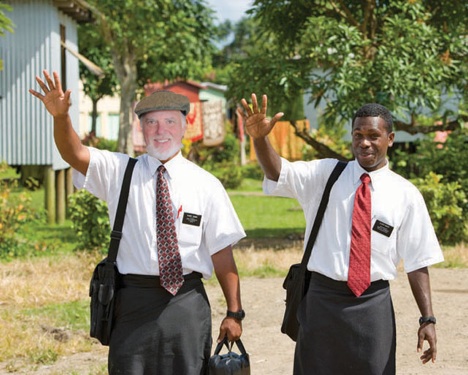
However, my innate shyness always made trick-or-treating feel a bit uncomfortable.  Knowing what I know now, I might have chosen to dress up like a Book-of-Mormon-toting Evangelist or a Jehovah’s Witness and trade some tracts for some candy corn.

missionary-mormons1

Nevertheless, I certainly enjoyed the gluttonous aftermath of OD-ing on tiny Snickers and Mars bars and bartering less-loved goodies with my buddies. Oh, and to score some malted-milk-ball Whoppers was like copping cocaine, whatever that was.

Of course, as an adult, Halloween can be a drag if you live in a neighborhood where trick-or-treaters ring your doorbell every 42 seconds; however, it’s not a problem on Folly Beach, the barrier island where I live, where trick-or-treating is forbidden because of vacant vacation homes, unlighted streets, and the likelihood  of motorists being hepped up on something stronger than sugar.

So as the year shuffles off towards its hospice, let’s celebrate the macabre, the zombie apocalypse, an eternity spent in everlasting agony, and other terrifying possibilities.

Once there was a little boy who wouldn’t say his prayers,
and when he went to bed at night away up stairs,
his mammy heard him holler and his daddy heard him bawl,
and when they turned the covers down,
he wasn’t there at all!

They searched for him in the attic room
and cubby hole and press
and even up the chimney flu and every wheres, I guess,
but all they ever found of him was just his pants and round-abouts
and the goblins will get ya if ya don’t watch out!!

James Whitcomb Riley: “Little Orphan Annie”

childr6


My Own Little, Dystopia — Halloween Edition

escher like

Real World 1

Adam’s curse: not death, but labor, the rudeness of the alarm, the digits glowing heartlessly: 5:55 AM.  Henry David Thoreau you ain’t:

We must learn to reawaken and keep ourselves awake, not by mechanical aids, but by an infinite expectation of the dawn*, which does not forsake us in our soundest sleep.

                                                                                Walden, Chapter 2


*emphasis mine

No, you’re of this ilk:

Little is to be expected of the day, if it can be called a day, to which we are not awakened by our Genius, but by the mechanical nudgings of some servitor [buzz or ring or melliferous radio voice]. That man who does not believe each day contains an earlier, more sacred, and auroral hour than he has yet profaned, has despaired life, and is pursuing a descending and darkening way.

TrafficJam

the darkening way

You’re, let’s say, a resource teacher for severely mentally disabled students in Mississippi or South Carolina.  Cutbacks mean you’re working 1.25 jobs, that your free periods are long gone, that you’re lucky if you manage 20 minutes for lunch.  Although mandated by federal law, meetings concerning disabled children’s IEPs are virtually impossible to coordinate.  Having the required individuals free at the same time  – classroom teachers, speech therapists, school psychologists, and principals – is like trying to solve a Rubik’s cube while riding a roller coaster.  They – whoever they are (the top 1%? K-Street lobbyists?  Smiling State legislators? The voters? All /none /a combination of the above?) – whoever they are literally expect you somehow to do the impossible.

No, for you, the dawn doesn’t “awaken infinite expectations.”

roller-coaster-4

Ronald Reagan’s Body Lies A Mouldering in the Grave

Somehow the nation has elected a sociopath as president who once supported choice and wrote checks to Democratic candidates but who know seems hellbent on accelerating global warning.  Despite the historical lessons that trickle down economics doesn’t work and deregulation can cause financial meltdowns a la 2008, he is gutting environmental regulations and, aided and abetted by Republicans in Congress, has passed a tax cut for the 1% that has created a gargantuan budget deficit.

Despite the Romanesque Super Bowl Halftime extravaganzas, we don’t have enough money to repair aging bridges, to hire fireman, much less to provide healthcare for our children.

The Real World 2

Meanwhile, back in Mississippi or South Carolina in a public school that possesses all the aesthetic warmth of a juvenile detention center, emails sprout in your in-box like the heads of a hydra – each expecting a prompt reply, each unanswered one burrowing into your brain like parasites, calcifying the neurons, overloading the circuitry, shutting it down – only to snap you awake at 3:41 A.M!

artistic-paintings-jeffrey-batchelor-20

Insomnia II by Jeffrey Batchelor

Where Have You Gone, Franz Kafka, a Lonely World . . .

Given the material richness of the USA, why are so many people so dissatisfied with contemporary American life?

Wordsworth posits one answer:

THE world is too much with us; late and soon,

Getting and spending, we lay waste our powers:

Little we see in Nature that is ours;

We have given our hearts away, a sordid boon!

We live in a world where increasingly our time is devoured by abstractions – meetings that go nowhere, data demanding input, those hydra-headed emails, texts from acquaintances that we glance at and ignore.

A sordid boon indeed.

Of course, Franz Kafka’s Gregor Samsa is the archetype of the harried worker, so caught up in the intricacies of his meaningless job that the first thing he thinks of when he discovers that he has been transformed into a giant insect is that it will be almost impossible to negotiate the public transportation that takes him to his office.  He, that “gigantic vermin,” should be this year’s top-selling Halloween costume.

metamorphosis2-img_assist_custom

Real World 3

Leave School at 4:10 . . . pick up Abigail from DayCare . . . run in Publix to pick up supper  . . .   grab bills from the mailbox . . . get Abigail started on her homework . . . cycle through the voicemails . . . empty the dishwasher . . . think for a second about your ex . . . start supper  . . .  glance at Wolf Blizter’s head flickering on the screen . . . say grace . . . start the bath water . . . read Abigail a bedtime story . . . put off paying the bills . .

Sleep, that knitteth up the raveled sleep of care . . .

I WAKE and feel the fell of dark, not day.

What hours, O what black hoürs we have spent

This night! what sights you, heart, saw; ways you went!

And more must, in yet longer light’s delay.

With witness I speak this. But where I say

Hours I mean years, mean life. And my lament

Is cries countless, cries like dead letters sent

To dearest him that lives alas! away.

I am gall, I am heartburn. God’s most deep decree

Bitter would have me taste: my taste was me;

Bones built in me, flesh filled, blood brimmed the curse.

Selfyeast of spirit a dull dough sours. I see

The lost are like this, and their scourge to be

As I am mine, their sweating selves; but worse.

                                                Gerard Manley Hopkins

[cue magical laughter]

Happy Halloween!

keep_out_

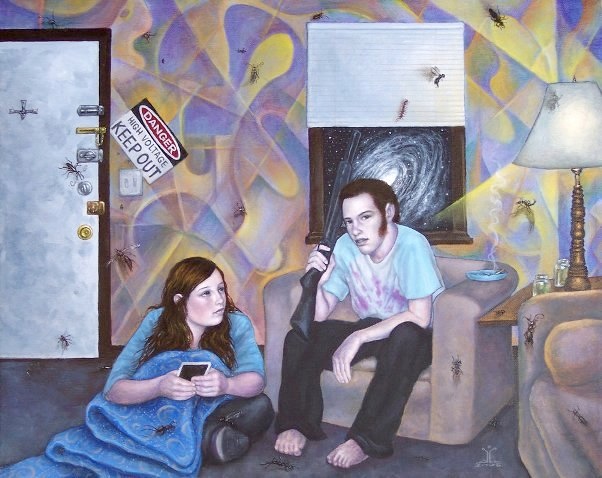
Keep Out, By Larkin

Lindsey Graham and Me


1977-mgbgt 2

Lindsey and Me in the late 70s

Although I enjoyed my teaching career at Porter-Gaud, the happiest job I ever had was tending bar at the Golden Spur, an alcohol dispensary located in the student union building at the University of South Carolina in those glorious days when 18-year-olds could legally imbibe beer and wine. It was there that I met the mother of my children, the late Judy Birdsong, and there where I became known as “the Reverend” after an impromptu Dionysian sermon delivered in Afro-jazz riffs a la Dr. John to my pals Furman Langley and Steve Rhea.[1]

I always looked forward to going to work and never, as they say, took work home with me.

What brings this to mind is that I’ve been contemplating the psychological underpinnings of my fellow South Carolinian Lindsey Graham, wondering about his formative years, contemplating what mental dynamics allow him to flip flop so shamelessly, sometimes in the matter of days, from one position to its opposite. In this respect, his switch from revering McCain to pimping for Trump is instructive.

Anyway, as it turns out, the story of Lindsey Graham’s youth is somewhat sad, especially his late youth. He was born a Baptist in the small Pickens County hamlet of Central, South Carolina. Despite that religious affiliation, Lindsey’s parents ran what Wikipedia describes as “a restaurant-bar-pool hall-liquor store, the ‘Sanitary Café’.”  So at an early age, Lindsey must have grown accustomed to dealing with paradoxes, alcohol considered by strict adherents as evil manifest, the antithesis of what they considered sanitary.

Prohibition 1

He was the first person in his family to attend college and joined ROTC, but here’s where his life takes a dolorous turn.  His mother died of Hodgkin’s lymphoma at the age of 52, and, bam, 15 months later, a heart attack dispatched his father, leaving orphaned Lindsey with the responsibility of being the legal guardian of his 13-year-old sister.

He studied – get this — psychology at the University of South Carolina, pledged Phi Kappa Phi, and graduated in 1977, the same year I dropped out of graduate school.  Therefore, Lindsey and I were both at USC from 1973-1977, which means, in all likelihood, I served him beer either at the Spur or at Bell Camp where I also bartended for fraternity parties.  Although extremely unlikely, he literally could have been in the Spur the very night I delivered my Dionysian sermon. Back then,  I’m fairly certain that I wouldn’t have given him the time of day – or in this case night.

Obviously, I’m not a fan of Senator Graham’s.  I would love to see him defeated, Trump driven from office, etc.  However, I have to admit that delving into his past has resulted in a bit of sympathy on my part.  He faced adversity at a young age and succeeded mightily as resumes go.  On the other hand, it must be horrible to be so conflicted, to have your better angels drowned out by the braying of a sociopathic vulgarian.

That said, the harm that he has imposed is real, extremely perilous as far as the American Experiment goes, and for that he can’t be forgiven.


[1] I commenced in Dr John’s voice to sermonificating on the glorification of the party impulse present in all of us – Baptist and Bohemian alike – and why that party bud must be allowed to bloom into boogie, cause if it ain’t, your existiment bound to be as flat and tasteless as BiLo brand Tonic Water what ain’t had the cap screwed on tight.

Or worser, that block-up party impulse knocked back down, squeezed back down in the reptilian recesses of your brain gonna mutate into some awful sexual dysfunctification like dwarfophilia or bovineophlia or hollywoodstar-obessification or some such other mental donemessedupness.


Haunting Our Days

shapeimage_2.png

  We curse thee Carolina and sing our dismay,

   Heartbreaking loses haunting our days . . .

                            Wesley Moore, “A Parody of the USC’s Alma Mater”                   


Question 1 :  Why did WM become a Gamecock? 

A. he couldn’t break 1200 on the SAT

B. he had mediocre grades

C.  his father was unemployed

D. USC had a journalism school

E. all of the above

F. none of the above

Question 2 : Why has WM squandered so many gorgeous autumn afternoons in darkened dens or benighted sports bars screaming imprecations at cathode tubes or hi-def screens?  

A. because football is a ritualization of innate masculine territorial aggressiveness

B. because the South lost the Civil War

C. because he enjoys feeling sorry for himself as he whimpers in fetal position on floors littered with carelessly dropped popcorn

D. because the his school team, the Mighty Gamecocks, have enjoyed unparalleled success

E. A & B

F. B & C

Answers: 1. E  2. E

Actually, as a child, WM was a rabid Clemson fan, listened to the games on AM radios.  No doubt, if he had been interested in engineering or horticulture, he would have matriculated to Clemson and continued to pull for the Tigers.  Thus, the irrationality and absurdity of his banal haphazard tribal association with the University of South Carolina is not lost on him.

On the rare occasions that he has attended in person a Carolina football game, it has occurred to WM how little he has in common with the rest of the members of his frenzied atavistic tribe, a garnet and black sea of philistines:  Trump supporters, used car dealers, evangelicals – in other words, typical South Carolinians. (Picture Jean-Paul Sartre at a Tupperware party).

Tupperwareparty2

Alienated at these events, he spends most of the games cringing at poor tackling and the viciousness of the invectives that pour from sub literate fans who have turned on the young men they had erst while cheered.

hardys trophy sc vs clemson 11-28-09.jpg

Gamecock fans celebrate a rare victory over Clemson

Many scholars have underscored the obvious: for Southerners of a certain age, male and female, college football is a compensation for the ignominy of the Civil War and its humiliating aftermath, Reconstruction.*  Although it seems like ancient history to most folks now, I can remember two of my great-grandfathers and my maternal grandfather’s hateful reproaches regarding the cruelty of carpetbaggers.

The thinking (using the term loosely) goes like this: Because of under-industrialization, we lost the Wa-ah; otherwise, we would have whupped those pasty-faced, vowel clipping Yankees, the way we do every year in BCS bowl games.**

In fact, Konrad Lorenz went so far to say that team sports like football are a necessary evil, a way for testosterone-blinded cretins to channel their innate territorial aggressiveness.  Otherwise, we might have Neighborhood Watch associations taking to the streets battling one another, blinding their enemies with flashlights, pummeling each other with pitching wedges.

Unfortunately (for WM, that is) rather than offering an antidote to the ignominy of hailing from a land of losers, pulling for the Gamecocks has doubled his legacy of losing. Add over a half-century of pulling for the Atlanta Braves, and you got losing to the third power, a river-of-tears breaching the levees of endurance.


*Of course, rationally speaking, in my relatively well-educated adulthood, I’m glad the Confederacy was vanquished, but when I picked up the college football habit in the early 60s, this was not the case.

** Thanks largely to that fact that  more descendants of slaves dwell in these parts, but never mind that.

cry-me-a-river-lick-jazz-lick-24-1024x250

Cry Me a River

Why devote all this time and energy inside samsara’s swirling pit of baneful desire and disillusion?

Habit?

Masochism?

Answer:  search me.

How Not to Generate a Dating Profile

wes and yorick
I’m sure we have a lot in common

People tell me I haven’t missed anything at all by never really dating someone I hadn’t known rather well. The fact is that I’ve never dated a stranger, except for a blind date that was sprung on me without my knowledge when I visited an out-of-town cousin. It was a double date at that, and I was exclusively seeing someone else, which I mentioned to my blind date right away.

I did go on one other date in college with a girl from my hometown I didn’t know well, but we had had a couple of long conversations, and I could tell she was interested.  Plus, we had a host of mutual friends, so it wasn’t as if we needed to strain to find something to talk about.

My late wife Judy Birdsong and I had worked together for months in a bar before we started seeing each other, so we were very comfortable together.  It wasn’t like meeting a stranger for coffee to see how you got along.

judy wes beth's reception
Judy and I a decade or so ago

Similarly, my wife Caroline and I had been friends and members of the same book club for five years before we started our romance, so ditto.

Caroline and Wes Tides-2
Caroline and I

So the long and short of it is that I’ve never created a dating profile for eHarmony or any of the other dating platforms, which no doubt is a good thing because I’ve never really known anyone who has successfully cultivated a lasting relationship through electronic dating (or whatever you call it).

I guess, you need to market yourself, to choose a flattering image, and then to present your personality in a way that would make a congenial spirit willing to devote a few hours in your company.

As a thought experiment, I thought I’d create a theoretical dating profile, just to see what it would be like.

So I filled out this dating profile generator I found on-line.[1]  It asks you questions, you supply answers, and it creates an introductory essay.

Here’s what it came up with.

Good day ladies!

I’m a learned sort of gentleman, who likes nothing more than drinking with the right woman.

The first thing people usually notice about me is my ironic personality, closly (sic) followed by my smashing legs. I am not one of those fake people who pretends not to notice their (sic) own qualities. My legs and ears are top notch. These gems of honesty are just part of the learned person I am.

I work as a retired teacher[2], helping students. This allows me to exercise my skills: eloquence and humor. I would like to tell you about the time I met Dizzy Gillespie, which is true, but it’s important to me that you know I’m honest, so I’ll save the wilder parts of my life for another time.

My life goals include:

  • Meet Eric Idle
  • Become the best retired teacher I can be
  • Help all the students in the world[3]

If you’re the right woman for me, you’ll be intelligent and kind. You won’t be afraid to skinny dip and will have a healthy respect for integrity.

My ideal date would involve writing in Folly Beach with a tall woman by my side. While we’re there, I compliment your proportional face.

Honesty and openness are the most important qualities in a relationship. I will be honest with you, if you will be honest with me. I will never hit on your best friend whilst (sic) you’re visiting a sick relative, never text my ex behind your back while you’re asleep, never post naked photos of you on Facebook. That’s just the kind of gentleman I am.

A nod’s as good as a wink to a blind bat, eh?

I urge you, get in touch,

Kingbeat

As the youngsters say, OMG! Believe it or not, I chose “earnest” as the type of profile I wanted.


[1] From its diction, I’m pretty sure this thing originated in the UK.

[2] Work by not making lesson plans, not grading papers, not teaching classes, not attending faulty meetings.

[3] By remaining retired.

Free Lesson Plan: Teaching Point-of-View

XIR3675

In fiction, especially short fiction, determining the point-of-view of the narration is often key in analyzing the piece.  From whose perspective do we experience the action?  From godlike omniscience; a particular character; or an objective, camera-like recorder?

Take Hemingway’s often anthologized story “Hills Like White Elephants.”   Hemingway presents the action from the objective point-of-view, showing an unmarried couple at a railroad station in Spain arguing about whether they should maintain or abort a pregnancy.  The subject is never explicitly mentioned, nor do we enter either character’s mind.  Essentially, the male is browbeating his lover into having the abortion, though she is hesitant.  Because the presentation is objective, the reader doesn’t necessarily take sides, the way he or she would if the narration had been first person or limited objective from the man or woman’s point-of-view.

Take a peek at the painting above, Pieter Breughel’s Landscape with the Fall of Icarus. Imagine it’s fiction, not a painting.  What if the story were told from plower’s point-of-view or the shepherd’s?  They may have heard the splash but would not have seen Icarus  plummeting into the ocean, or to quote Auden,  “the white legs disappearing into the green water.”  I suggest to students that the omniscient point-of-view is the best mode to depict the action of the painting.

So what follows is an overview of the various points-of-view with an original narrative depicting the same scene from various perspectives.

Here are the basic points-of view:

omniscient

limited omniscient

objective

first person

second person

stream-of-consciousness

Omniscient Point of View

The omniscient point of view provides the author with the most freedom because he is, as the word omniscient suggests, all-knowing.  The narrator can see all,  go anywhere, knows all, can read multiple minds.  This point-of-view is excellent for wide ranging narratives like WW2 sagas and offers excellent economy but is somewhat distancing and demands the action to be rendered in rather straightforward prose.

Here’s the central narrative of this lesson told from the omniscient point of view.

Abby Huffington, an attractive young brunette in her early twenties, sat at her desk before a blank sheet of paper preparing to write a dear john letter to her boyfriend, Ashton Gray.   In the distance a lawnmower sputtered its dull ceaseless hacking growl as an irritating accompaniment to the hangover that clouded her thoughts.  Abby had met Ashton not long after her breakup with Bennington.  She realized now that shouldn’t have jumped into a relationship so soon.  She swung her head to the side, slinging her brown bangs out of her eyes and placed her pen into the corner of her mouth. Just at that moment a bluejay chased a wren from the bird feeder just outside her window.   Taking the pen out of her mouth, she wrote “Dear  Ashton,” thought better of it, then scratched through “Dear.”

Meanwhile, across town in his second story apartment, Ashton Gray with trembling fingers looped his madras tie in front of the mirror over his dresser.  It had been a rough night last night.  Something was bothering Abby.  At Taco Boy she was slinging down Singapore Slings like a sailor.  Now, at the last minute, she had decided that she wasn’t going to accompany him to church.  He walked over to his bedside table and picked up her photograph. Putting it down gently, he turned to retrieve his blazer from his closet and caught sight of his roommate’s calico cat on the hood of his car.  Opening the window, he shouted, “Hey, Jo-Jo, get off of there.”

Note that booth characters and their thoughts are presented in two different settings. This is impossible from the limited omniscient and first person points-of-view.

Limited Omniscient

In limited omniscience, all of the action is experienced through one character’s perceptions but is expressed in the third person.  The narrator intimately knows the character, can step outside of her for description’s sake, can read her thoughts but is tied to her perceptions; therefore, the character must appear in all scenes.

Abby Huffington, a young woman in her early twenties, sat at her desk before a blank sheet of paper preparing to write a dear john letter to her boyfriend, Ashton Gray.   In the distance a lawnmower sputtered its dull ceaseless hacking growl.  It wasn’t that Ashton was a bad guy; it was just that he was no Bennington. At the thought of Bennington’s name, she sighed. Why had she rushed into this relationship with Ashton?  It’s not as if she hadn’t been warned.  Her mother had warned her, Jaclyn had warned her, even her hairdresser had warned her.  She jerked her head to the side, slinging her brown bangs out of her eyes, and placed her pen into the corner of her mouth just as a blue jay chased a wren from the bird feeder that hung just outside her window. Taking the pen out of her mouth, she wrote “Dear  Ashton,” thought better of it, then scratched through “Dear.”

From this point-of-view we’re likely to take sides with Abby because she’s in the center of the action; we read her thoughts, not Ashton’s.  It’s more intimate than the omniscient rendering.

Also, I point out to students the name symbolism, Huffy Abby, dull, gray ASH-ton, and how the bluejay chasing the wren off parallels her chasing Ashton off.  I ask my students if they think the author consciously intended the symbolism, and if they say no, I remind them that I wrote it.

Objective

On the objective point-of-view, the narration is limited to camera-like observations in plain prose.  It’s akin to a stage play or movie and has the advantage of immediacy and verisimilitude. Its major drawback is a lack of economy.

A slender young man in his mid-twenties loops the bottom of his madras tie into position with trembling fingers as he peers into a dresser mirror.  Leaning into the mirror, he bares his teeth to inspect them, then turns and walks over to his bedside table and picks up a photograph of a smiling, fresh-faced brunette. He shakes his head as he gently places the picture back.  Turning, he glances out of the window, suddenly rushes over to it, flings it open, and shouts, “Hey, Jo-Jo, get off of there.”  A calico cat has left eight paw prints on a Dodge Neon sedan parked in front of the building.

Here we’re hardly aware of the central conflict, unlike the the omniscient version where we see both sides in very few words.

First Person

Obviously, in first person a character narrates using the pronoun I and speaks in his or her own voice.  The limitations are the same as limited omniscient, and it’s important to realize that narrator might be unreliable, though readers tend to side with a first person narrator even if he’s a murderer.

I don’t know why I decided to dump Ashton that Sunday.  My splitting headache might have had something to do with it.  I guess I could have delivered the news when he called to see if I wanted to do breakfast before church, but I chickened out, told more or less the truth, that I felt like hell.  His reaction was typical – quiet whining, I’d call it.  Even though he didn’t say anything, even though I couldn’t see him – it’s hard to explain – it’s like I could feel him whining through my cell.  I mean Ashton’s a nice guy and all, but he just didn’t do it for me.  Let’s face it.  I wasn’t over Bennington.  Anyway,  I was hungover, a lawnmower was roaring outside, birds squawking outside my window, so I got out a piece of stationary and had at it.

Note the prose can be as informal and as ungrammatical as you like.

Second Person

In second person, an imaginary you narrates in second person, so essentially it’s just like first person.  Ask students why an author might choose second person instead of first.

It’s Sunday morning, and you’re getting ready for church, trying to whip a half-Windsor into shape.  The problem is you have an awful feeling. Your fiancée has been acting weird lately, really weird.  Last night at Taco Boy she was so drunk she actually started smoking cigarettes.  You ended up practically having to carry her into her apartment, rooting through her purse to get the keys.  You really hope no one saw you, but you bet someone did.  Of course, she’s backed out of going to church. Unlike you, the model of moderation, she’s party, party, party.  You can even see it in her face in that photo you pick up from the end table.   That little sly smile.     You glance outside the window.  Not that cat again.  There he is tracking dirt on the hood of your car.

Stream of Consciousness

Here the narration consists of a person’s stream of disjointed thoughts.  It’s poetic, can reveal deep psychological insight, but too challenging for most readers.

Round and round we go, where we stop is a half-windsor, a half-windsor, son, a half windsor is the most distinguished knot.  Round here, we always stand up straight. Taco Boy, Salem Lites for petes’ sake..  Round here, something ain’t right.  Look at her, look at her.  What you smiling about, girl?    Round here, we stay up very very very late.  What the?  “Hey, Jo-Jo, get off of there.”

So that’s it.  Use the above with my blessing however you see fit.  I have narrative essay assignments for each (except stream-of-consciousness).  If you’d like to use them, let me know how to contact you in the comments.

Wesley Moore

Keystone Kops, Kold Turkey, and House Koncerts

o-HEROIN-facebook copy

Last night, Caroline, Brooks, and I attended Porter-Gaud’s Homecoming, and, of course, several people asked me how I liked retirement and what I was doing with my life.

Well, spending an inordinate amount of time screeching an ATT robots, listening to music manufactured by ATT for people on hold (martial drum machines, melodies based on the three signature tones of their branding, music certainly composed to encourage the holder to hang-up, if not take her own life).  Oh yeah, and talking to American and Asian troubleshooters — all in vain.

It’s Kafka meets the Keystone Kops.  You see, last Friday, my Internet went out.  I glanced out of the window to see a backhoe gouging a hole in my yard.  Subcontractors from Anson had come to repair what didn’t need to be repaired, severed the wire that conveys to me the digital world to which I’ve become hopelessly addicted.[1]

Because the two incompetent subcontractors didn’t “close the ticket,” I was left in limbo.  I finally got a new ticket, an appointment set up on last Tuesday from 4 to 8 pm.  I could track my technician, who at 8 am that morning had just left and at 8:30 pm had just left, the linear map on my screen having forever frozen him one stop from the dispatch center.  Of course, he or she never showed.  There had been “a computer glitch,” and because that ticket was invalid, other tickets that had been issued subsequently to other customers had to be honored.  So they’re supposedly coming out next Tuesday.

In happier news, Caroline and I hosted our very first ever house concert featuring politico sibling singer songwriter Fleming Moore and the hugely talented Danielle Howle, who is going to be included in the Oxford American music cd featuring performers from the Palmetto State.

Here are some photos taken by another Lowcountry musician Stefanie Timmerman.

fleming

Fleming Moore


house shot

Danielle performing during a mud slide

george

George Alan Fox and I discussing the immense panorama of futility and anarchy that is contemporary history

Danielle take us away to some darker dilemma than the First World problems I whine about.


[1] Picture me as Miles Davis going cold turkey, trembling like a victim of Huntington’s disease, beaded sweat bursting into torrents, puddling the rug where I writhe in fetal position.

Republicans Grasping at Straws: Defending the Indefensible

Dum_and_Dee

And those who had lied for hire;
the perverts, the perverters of language . . . 
     Ezra Pound "Canto XIV"

Hey, Lindsey and Tom, I’ve read Emmanuel Kant, and you’re no Emmanuel Kant (Though You Might Qualify as Lindsey and Tom Cant)

Dig these arguments.

Argument 1

Lindsey Graham:  There’s no quid pro quo because Trump didn’t explicitly say, “Hey, man, unless you dig up some dirt on Hunter Biden, we’re not going to sell you any more weapons.”[1]

No, Trump said after President Zelensky mentioned purchasing more Javelin missiles from the US, “Hey, man, we’ve done a lot for you, you not so much for us.  I need a favor.  Dig up some dirt on Hunter Biden.”

See, it can’t be a quid pro quo unless it’s spelled out explicitly.  He needed to say “no dirt on Biden, no weapons.”

We’ll just ignore that soliciting a foreign national to aid in an election is against the law.  Gotta have an explicit quid pro quo.  No explicit quid pro quo, impeachment a no go.

Argument 2

Tom Cornyn: The Whistleblower wasn’t present during the call.  It’s second and third hand information, which automatically renders his claims invalid.

Of course, Linda Tripp wasn’t present when Monica Lewinski performed fellatio on President Clinton, but as the poet says, “But that was in another [century], and besides the wench is dead.”

Shall I lower myself to make an argument by analogy?  The hearsay argument is like the rumors about this year’s Folly Gras celebration on beautiful Folly Beach, SC.  People there described a drunken shitshow.  I mentioned it some off-island friends, but they dismissed my account as secondhand and therefore not credible, even though scores of eye-witnesses agreed on what transpired.

Folly Gras 2019 1.0

An artist’s rendition

But wait, back to DC.   Hey, Tom, it seems to me like the transcript memo was pretty damned accurate.  Also, there might be a witness or two who might corroborate?

You’re gaslighting, my man.  You’re from Texas, right?  Remember the Alamo.

Non-Readers

Here’s a partial list of Republican Senators who haven’t bothered to read the nine-page eloquently clear whistleblower complaint:

Mitt Romney

Martha McSally

Lisa Murkowski

Rob Portman

Tim Scott (who had started reading but hadn’t finished it yet)[2]

Todd Young

Mike Baun

Makes you wonder if they’ve ever read the Constitution.  Most Pocket Constitutions consist of 34 pages, and the prose isn’t nearly as accessible.

Anyway, this scandal pales compared to the fact that Hillary stored her emails on a secret server.

Oh Wait, But There Is a Super Duper Private Server Where the Administration Hides Trump’s Conversations with Foreign Leaders

 From Carol E Lee of NBC News:

The whistleblower, whose complaint is at the heart of calls for an impeachment inquiry into Trump, also asserted that White House officials have misused the classified system multiple times to bury “politically sensitive” information detailed in records of the president’s interactions with world leaders. Former and current intelligence officers who spoke on the condition of anonymity said that, if true, such misuse should spark an investigation into the potential mishandling of a classified system.

Oh, by the way, Tom, the validity of this story about the secret server has been corroborated, which brings to mind that old saw that “it’s not the crime; it’s the cover-up.”

We shouldn’t Tax Obliterated Attention Spans with These Damning Extra Added Complications

Although named in Trump’s call as a potential intermediary in digging up dirt on Biden’s son, Attorney General William Barr hasn’t recused himself, and he gets to decide who gets prosecuted.

World Leader Zalensky bragged in the call that he stays at Trump Hotels in New York, which brings to mind that constitutional bagatelle, the Emoluments Clause.

Oh, yeah, and Trump’s suggestion that it would be smart like in the good ol’ days to execute whoever leaked to the whistleblower, which sounds somewhat like witnesses tampering.

Anyway, I’m about to hit 500 words, so I better quit in the off chance my junior senator Tim Scott stumbles across this little piece of debased liberal propaganda.


[1] “Any more weapons in your war against my BFF Vladimir.”

[2] Boooor-ing