True Detective Revisited: The Fall of American Culture

Let’s talk about Pulp fiction — not the movie — but its namesake, those lurid narratives printed on cheap paper that, to cop the cliché of their heyday, explored the “seamy underside” of American culture, publications like True Detective, which enjoyed a 71-year existence from 1924-1995.

oRAxXq56vZyUSjcwrvanqDl72eJkfbmt4t8yenImKBVvK0kTmF0xjctABnaLJIm9

The HBO television series of the same name follows the magazine’s tradition of exposing lurid depravity, though it does so on a much higher artistic plane with shades of David Lynch and Flannery O’Connor, and the depravity depicted in the television series is like to 10th power of the seemingly quaint pistol whippings and murders of the magazine’s beginnings. Furthermore, the series seems to me to be an indictment of American culture, its spiritual poverty embodied in the corrupt Christianity of Southern Protestantism and in the rapacious capitalism of multinational corporations.

The director, Cary Joji Fukunaga, constantly underscores these two themes with the visual motifs of crosses and industrial wastelands, which bring to  mind landscapes depicted in the paintings of Hieronymus Bosh.

Check out the opening credits, for example:

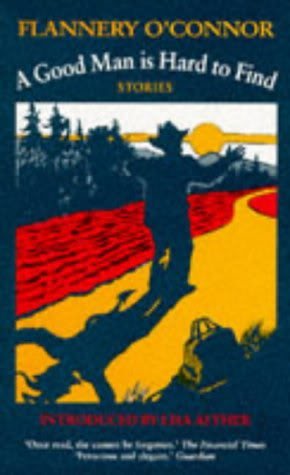
Obviously David Lynch’s influence is profound here, not only in the arid, dispassionate images but also in the soundtrack, and this landscape is populated by characters right out of Flannery O’Connor — shiftless Southern scumbags, depraved criminals, corrupt preachers. The twin protagonists Marty and Rust offer an interesting contrast with Marty embodying the hollow hypocritical Protestantism that O’Connor despised and Rust the nihilism that O’Connor, though a devout Catholic, preferred to the mealy-mouthed ignorant insincerity of many of her nominally Christian characters, as we can see in her treatment of the Grandmother and the Misfit in “A Good Man’s Hard to Find.” In fact, in the sixth episode, a grown up child whore whom Marty tried to rescue from a trailer park brothel years ago calls him “a good man” in a restaurant, echoing the Grandmother’s comment to Red Sammy Butts in a restaurant in the O’Connor story. Of course, neither are good men, as Marty clearly demonstrates when he engages in extramarital sex with the woman.

(Here’s an earlier post dealing with Marty and Rust).

goodmanhardtofindThe complex characterization in the context of the cinematic images that create surreal beauty from ugliness makes the series both intellectually and aesthetically interesting, and there’s also a subplot dealing with public education money being funneled into Christian schools to overcome what one character calls “secular, global education.”  These Christian schools lie at the center of the ritualistic Satanic murders the two detectives have spent the better part of two decades trying to unravel.

Certainly, an anthropologist studying the magazine True Detective and the series would conclude that American culture, despite great inroads in civil rights, has declined precipitously since the decades the magazine flourished, and I can’t help but wonder if the creator Pizzolatto is himself a moralist, perhaps even a Catholic in the tradition of both Bosch and O’Connor.

At any rate, the same cultural anthropologist would also have to agree that television has gotten a whole hell of a lot better in the last fifty years.


Pep Talk for Brazil

At the beginning of Budding Prospects, TC Boyle’s protagonist Felix Nasmyth confesses

I’ve always been a quitter.  I quit the Boy Scouts, the glee club, the marching band.  Gave up my paper route, turned my back on the church, stuffed the basketball team.  I dropped out of college, sidestepped the army with a 4-F on the grounds of mental instability, went back to school, made a go of it, entered a Ph.D. program in nineteenth-century British literature, sat in the front row, took notes assiduously, bought a pair of horn-rims, and quit on the eve of my comprehensive exams.  I got married, separated, divorced.  Quit smoking, quit jogging, quit eating red meat.  I quit jobs: digging graves, pumping gas, selling insurance, showing pornographic films in an art theater in Boston.  When I was nineteen I made frantic love to a pinch-faced, sack-bosomed girl I’d known from high school.  She got pregnant.  I quit town.


Pep Talk

[. . .] nor can foot feel, being shod.

Gerard Manley Hopkins

I know what it feels like to give up,
to say ‘that’s it — fuck it — I quit’.

No one over thirty can stand
blowhard braggarts like
William Ernest Henley
who bellowed

“It matters not how strait the gate,
How charged with punishments the scroll,
I am the master of my fate,
I am the captain of my soul”

but who lost his eleven-year-old daughter
and died of tuberculosis at fifty-three.

No, give me unromantics like Philip Larkin
who “work all day” and “get half-drunk at night,”
who lie in bed in the mornings
squandering precious existence dreading death,
contemplating what it will be like
“Not to be anywhere,
And soon.”

“Nothing more terrible, nothing more true.”

Or tortured souls like Gerard Manley Hopkins
who “pitched past pitch of grief”
birthed dissonant poems that screech like talons
scratching across blackboard slate.

* * *

That’s right, Brazil, down by seven,
quit playing defense, get the goddamn thing over,
drive past the favelas to your sturdy houses afterwards,
get into to your beds, pull the covers up over your heads,
and with a flashlight read “Terrence, This Is Stupid Stuff:”

“Therefore, since the world has still

Much good, but much less good than ill,

And while the sun and moon endure

Luck’s a chance, but trouble’s sure,

I’d face it as a wise man would,

And train for ill and not for good.

’Tis true, the stuff I bring for sale

Is not so brisk a brew as ale:

“Out of a stem that scored the hand

I wrung it in a weary land.

But take it: if the smack is sour,

The better for the embittered hour;

It should do good to heart and head

When your soul is in my soul’s stead;

And I will friend you, if I may,

In the dark and cloudy day.

Amém!

yours truly running down a street in Rio

yours truly running down a street in Rio


True Detective: Existential Nihilism for the Masses

In his 1996 novel Infinite Jest, David Foster Wallace has a seventh grader, Hal Incandenza, write an essay contrasting Hawaii Five-O and Hill Street Blues, an essay that ponders the evolution of American television heroes.

Remarkably observant, young Incandenza underscores sociological differences in the programs. For example, Five-O’s Steve McGarrett has the luxury of working on “one case per week” in an office that resembles “the libraries of the landed gentry, hushed behind two heavy doors and wainscoted in thick, tropical oak.” On the other hand, Hill Street’s Frank Furillo, a precinct captain, juggles several cases at once in the chaotic confines of a cluttered cubicle-crammed station house teeming with clashing personalities. Essentially, “McGarrett is not weighed down by administrative State-Police-Chief chores, or by females, or friends, or emotions, or any sorts of conflicting demands on his attention” whereas Furillo “is beset by petty distractions on all sides [. . .] with suspects and snitches and investigating officers and angry community leaders and victims’ families all clamoring for redress.”

Colbert Root in his Summer of Jest, a handy on-line scene-by-scene summary and analysis of the novel, recaps the essay for us:

Where McGarrett exemplifies the modern man of action, Hal argues, Furillo typifies a man of postmodern “reaction.” Both protagonists are heroes of their own show’s culture, but both are also ill-equipped for the other’s world. McGarrett, as the modern man of action, is single-minded, acting to “refashion a truth the audience already knows into an object of law, justice, modern heroism.” Contrariwise, Furillo succeeds because he is cast within a large system; he excels at being a cog in a very large and bureaucratic machine [. . .] That Furillo comes after McGarrett as a typical US protagonist reflects a shift in US cultural preferences. Audiences, Hal says, want the stoic bureaucrat. His successes and shortfalls more closely align with their own. But, Hal ponders, what comes next? What hero will succeed Furillo?

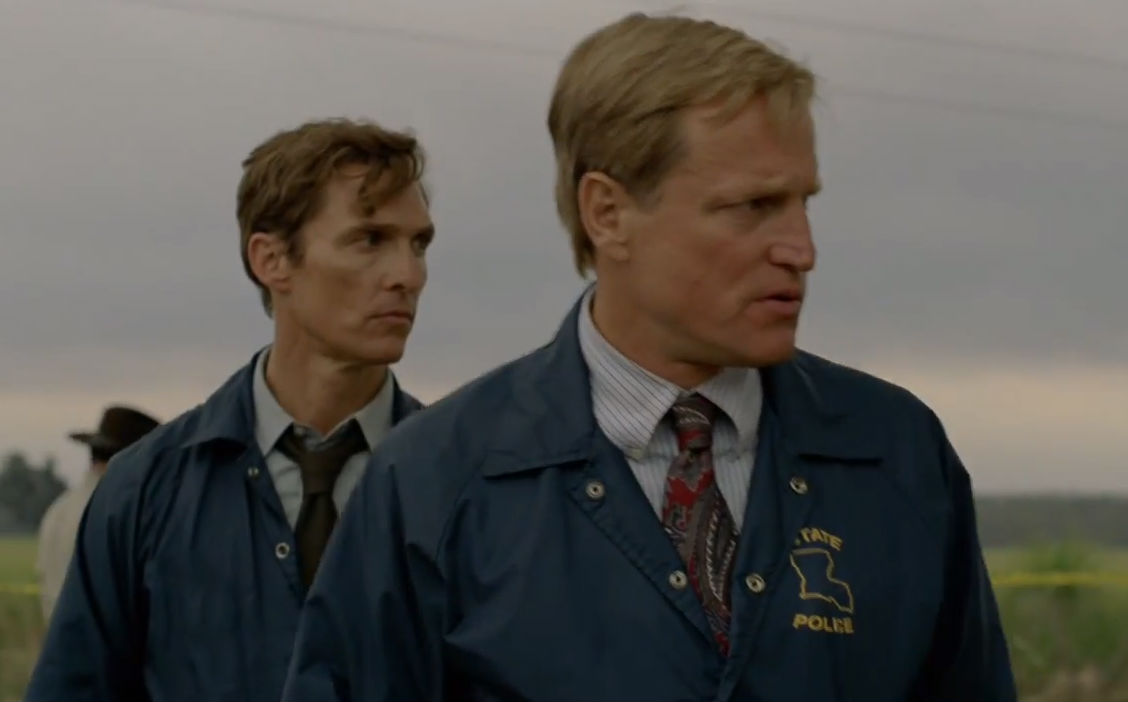
from left Rust (McConaughey) and Marty (Harrlesson)

from left Rust (McConaughey) and Marty (Harrlesson)

Well, if we look to the current HBO crime drama True Detective, the answer is Rust Cohle (played by Matthew McConaughey), a nihilistic metaphysician, an agoraphobic detective who considers human consciousness “a tragic misstep in evolution” that enables us “to labor under the illusion of having a self” when we’re merely “accretions[s] of sensory experience and feeling, programmed with total assurance that we are each somebody, when in fact everybody is nobody.”

This cat makes Sam Spade, Philip Marlowe, and Mike Hammer seem downright dewy in comparison. His partner Marty Hart (played by Woody Harrelson) considers Rust “the Michael Jordan of being a son-of-a-bitch,” and when Rust says shit like, “It’s all one ghetto, man, a giant gutter in outer space,” Marty virtually begs him to shut up. You see, despite having kinky handcuffed sex outside of his marriage, Marty is a family man, a Christian who holds essentially a Medieval view of the cosmos, a belief that divine reward or punishment keeps folks (though obviously not himself) in line. Rust responds, as you might expect, with scorn:

If the only thing keeping a person decent is the expectation of divine reward then, brother, that person is a piece of shit. And I’d like to get as many of them out in the open as possible. You gotta get together and tell yourself stories that violate every law of the universe just to get through the goddamn day? What’s that say about your reality?

Set in the semi-industrialized backwoods of Louisiana, the narrative features superb characterization and brilliant acting as the two detectives try to solve a series of grisly ritualistic murders. So many symbolic crosses (e.g., aerial shots of perpendicular lines of trees) sneak into the story I can’t help but wonder if its creator, Louisiana fiction writer Nic Pizzolatto, is making some sort of statement.

Whatever the case, Rust is not the fellow you want your sons to grow up to be. He’s a bit of a throwback, a cross between Dostoyevsky’s Underground Man and a Zen Buddhist.

He’s also about as fascinating a character as television has ever produced.

A Pat Conroy Family Reunion of Sorts

An acquaintance, the poet Cathy Smith Bowers, once told me something that should be obvious but had never occurred to me: The adrenal glands of children who grow up in chaotic households pump Vesuvian eruptions of the hormone epinephrine when their parents (or their parents’ boyfriends/girlfriends) hurl invectives and/or furniture at each other.

In plainer English, growing up in fucked-up households tends to fuck you up, not only mentally, but physically as well — as if there is a difference anyway.

Cathy Smith Bowers

Cathy Smith Bowers

Cathy went on to say that once these children leave the war zones of their childhoods, they often develop a need for high levels of adrenaline and a hankering for jangled nerves, for that elevated heart rate, that feeling of excitement, and, of course, there’s nothing like a little snort of cocaine to replicate that bodily high, and nothing like a drug habit to create chaos, and thus, to bring the family melodrama back full circle.

Cathy, like many of us, is no stranger to the toll of growing up in an unhappy home. Here’s her poem “The Boxers” that makes manifest her point:

When my father, after twenty years, came home

to die, circling, circling, like an animal

we believed extinct, it was my crazy aunt

who took him in, who told later

how the taxi had dumped him

bleached and whimpering on her porch.

And she who had not lived with him

thought his sons and daughters cruel

not to come when he began to call our names.

He died, and soon after, a package in brown wrapping

arrived at my address. My sister, who did not

attend the funeral, kept urging me to open it

and I kept saying I would, soon. Every day

when I came home from work, there it was

sitting at my back door, the remnants

of my father’s life—years in the mill

spinning and doffing, then drinking into morning

as he railed at the walls, the cotton

still clinging to his fists. Weeks had passed

when finally my sister and I, after two stiff bourbons,

began to rip the paper, slowly in strips

like archaeologists unclothing a mummy.

And all that was there were a few plaid flannels,

the jacket to a leisure suit, and a pair of boxers,

white and baggy, Rorschached in urine—a smaller size,

my sister said, than the way she remembered him.

Then she offered to drop the things at the Salvation Army

store she passed on her way home. In July

we went shopping for swim suits and I could

see her in the curtained stall across from mine.

She was pulling her slip over her head when I saw

she was wearing them, her thighs like the pale stems

of mushrooms emerging from the boxers’ billowy

legs, whiter, softer now, washed clean. I still

can’t say why my sister, that day in the Salvation

Army store, glanced up, as I’ve imagined,

to see if anyone was watching

before she slipped those boxers from the soiled heap

of our father’s clothes. Nor why

I took so long to open that package, both wanting

and fearing whatever lay inside. Like a child

huddled by the campfire who cries out in terror

at the story someone just told

and, still weeping, begs for it again.

“The Boxers” by Cathy Smith Bowers, from The Love that Ended Yesterday in Texas. © Texas Tech University Press, 1992. Reprinted with permission. (buy now)

* * *

When we look to literature for examples of dysfunctional American families, we immediately think of Faulkner’s Compsons, any number of Tennessee Williams’ people, the Tyrones of Eugene O’Neill’s A Long Day’s Journey into the Night, and the tortured families who inhabit the pages of Pat Conroy’s novels.

Our friend Megan Conroy sometimes stays with us for a few days in July when she travels from California to visit her famous father, stepmother, and aunts and uncles at Fripp Island. Unfortunately, this year she couldn’t make it up to Charleston, so she invited us down to Fripp to her father’s beach house.

back yard

back yard

Situated on a lagoon, the Conroy beach house is the antithesis of gothic — open and airy and looking out onto a backyard where practically tame deer feed. When we arrived, Megan greeted us and introduced her uncle Mike, who bears a remarkable resemblance to his older brother and who can give him a run for his money as a raconteur. Also there were Mike’s wife Jeannie, his sister Kathy, Megan’s sisters Jessica and Melissa, their husbands, and a host of grandchildren too numerous to name.

Pat and his wife the novelist Cassandra King arrived after a midday dinner of fired chicken, macaroni and cheese, red rice, cantaloupe, and coleslaw. The older folk traded stories in typical Southern fashion in the open family room while younger members of the clan watched Germany battle Algeria in another space.

Rather than what you might expect, hanging out with Pat Conroy on that day was more like hanging out with Sam Clemens than Eugene O’Neill.

A few excerpts:

Pat: [My arch-conservative ex-father-in-law] makes Rush Limbaugh look like Chairman Mao.

Megan: I didn’t want a fancy wedding dress until I tried one on.   I didn’t want a veil until I tried one on. When they told me don’t you want to take off your veil after the ceremony, I said, “No, when do you ever get to wear a veil?”

Pat: That dress cost a million dollars. Cassandra, remember when you opened the closet door and found it standing up by itself? Horrifying!

***

In other words, the Conroys seemed like one big happy family and that at least the youngest have broken the dysfunctional cycle of self-generated misery that dysfunction tends to generate, which is remarkable given the scorched earth of the Great Santini’s children’s childhoods. To wit an excerpt from Pat’s memoir The Death of Santini:

When I was thirty years old, my novel The Great Santini was published, and there were many things in that book I was afraid to write or feared that no one would believe. But this year I turned sixty-five, the official starting date of old age and the beginning count down to my inevitable death. I’ve come to realize that I still carry the bruised freight of that childhood every day. I can’t run away, hide, or pretend it never happened. I wear it on my back like the carapace of a tortoise, except my shell burdens and does not protect. It weighs me down and fills me with dread.

The Conroy children were all casualties of war, conscripts in a battle we didn’t sign up for on the bloodied envelope of our birth certificates. I grew up to become the family evangelist; Michael, the vessel of anxiety; Kathy, who missed her childhood by going to sleep at six every night; Jim, who is called the dark one; Tim, the sweetest one – and can barely stand to be around any of us; and Tom, our lost and never-to-be found brother. My personal tragedy lies with my sister, Carol Ann, the poet I grew up with and adored…

I’ve got to try and make sense of it one last time, a final circling of the block, a reckoning, another dive into the caves of the coral reef where the morays wait in ambush, one more night flight into the immortal darkness to study that house of pain one final time. Then I’ll be finished with you, Mom and Dad. I’ll leave you in peace and not bother you again. And I’ll pray that your stormy spirits find peace in the house of the Lord. But I must examine the wreckage one last time.

Yet they appeared to me one big happy family!

from left to right Pat's feet, his sister Kathy, wife Cassandra, brother Mike and sister-i-law Jeannie

from left to right Pat’s feet, his sister Kathy, Cassandra King, brother Mike and sister-in-law Jeannie


Fútbol, Football, WWI, and Me

I’m sincerely glad to see that so many of my compatriots are giddily suffering the delirium associated with World Cup fever.

I’ve witnessed hordes of them on television, men and women, boys and girls, painted like patriotic Comanches, flag-draped, chanting USA-USA-USA. I’ve seen my countrymen go apeshit over a USA goal, and after Portugal’s last minute score, I’ve seen them wear the horror-stricken dazed looks of family members gathered at an airport after a plane crash.

undistraught fansweeping americanPerhaps, the number of North American fútbol fans will increase through extended exposure to the balletic-Bataan-death scramble of a soccer match, learn to appreciate 90-plus minutes of virtually non-stop action, understand the arduous difficulty of netting a goal, and so will become more tolerant of low scores and tied matches.

Let me hand the mike over to my pal Charlie Geer who offers this unflattering description of the other American football:

Visitors to the US should understand that American ‘football’ is a game in which ‘foot’ and ‘ball’ have very little interaction with each other. This is but one of the many mysteries surrounding the popular American sport, which requires (metric) tons of equipment, dozens upon dozens of players and coaches, innumerable false starts and sudden stops, as well as an unending stream of television advertisements to move a ball from one end of a field to another. Because of the beastly amount of time and crap required, a team that successfully moves the ball from one end of the field to the other is awarded not one point, but six. Some Americans, it seems, like their scores the way they like their houses, their cars, and the egos of their professional blowhards: overinflated.

Of course, ideally, one can appreciate both, as, in fact, Charlie does, though unfortunately in the guise of a Florida Gator fan.

Another thing, however, that distinguishes fútbol from football is that the latter is essentially a North American peculiarity whereas fútbol enjoys world-wide popularity. In American football, we don’t even have a professional North American championship game between the Canadian Gray Cup and USA Super Bowl champions, no epic battle between the Miami Dolphins and Edmonton Eskimos, much less a world wide championship.

On the other hand, in international fútbol, any number of nationalistic matches can take place, for example, games pitting Koreans versus Venezuelans, Algerians versus Finns, or, good old fashioned shootouts like the upcoming match between France and Germany.

Which brings me to my final point: the 2014 World Cup tournament coincides with the Centennial of WWI, a conflict I never quite understood the origins of, despite my university education. Take it away Mr. Dylan:

Oh the First World War, boys,

It closed out its fate.

The reason for fighting

I never got straight.

The best that I can tell the assassination of an Arch Duke sparked unstable, combustible European nationalism into a horror show to end all horror shows, which, of course, didn’t end up being the case at all. But what has struck me watching several of these games is the frenzied nationalism that is apparent as the camera cuts to public squares around the globe.  Negative social critic that I am, I find all of the flag waving and screeching sort of creepy, unsettling, especially given the above-mentioned coincidence.

The truth be known, I have never been much of a patriot. Perhaps my lack of patriotism stems from hearing as a young boy the unreconstructed rantings of great-grandfathers or my coming of age during the Viet Nam War or the general misanthropy that makes me a non-lover of my fellow man. After all. most people I encounter happen to be fellow Americans, and I hate it when we change the name of French fries to freedom fries or when Waffle House stops selling Belgian waffles on game day. (They’ll take away my high-gravity Belgian beer when they pry the can away away from my stiff dead fingers).

On the positive side, perhaps Konrad Lorenz was correct, that sport provides a substitute for humans’ innate drive to wage war, and the World Cup affords a vicarious opportunity to channel that animus into non-destructive avenues.

At any rate, today I plan to venture from the bobby-trapped carapace of the Moore/Birdsong compound (beware the Burmese tiger pit, solicitors, the Malay man-catcher, Jehovah Witnesses) to enjoy the game at my favorite watering hole, Chico Feo, where I’ll try my best to pull for Clarence Thomas’s team.

Not Trending on Yahoo

Monty Hall

94868733

Bet you thought the host of Let’s Make a Deal was already dead, didn’t you? Well, not only is Hall alive, but he’s still married to the woman he wed in 1947.

Fun facts to know and share: Hall’s wife Marilyn is a distant cousin and was introduced to Hall by another distant cousin.

Legacy: Since watching reruns of quiz shows in which contestants win obsolescent products manufactured in the 1960’s is about as much fun as scrubbing grout with a toothbrush, Hall’s legacy probably lies in the so-called “Monty Hall problem,” a brain teaser made famous from a question from a reader’s letter quoted in Marilyn vos Savant’s “Ask Marilyn” column in Parade magazine.

Marilyn vos Savant is also not trending on Yahoo.

The Man in the Gray Flannel Suit.

c96e01fe85df4111f5b924e760380a88

Although Sloan Wilson’s most famous novel was a sensation when published in 1955, it’s as dated today as congealed salad, no matter what Jonathan Franzen says to the contrary.

Fun facts to know and share: Ted Kaczynski, the Unabomber, sent Percy Wood, the president of United Airlines, a bomb concealed in another of Sloan Wilson’s books, Ice Brothers, severely injuring the recipient.

Legacy: The phrase “the man in the gray flannel suit” became synonymous with boring white-color conformists, though nowadays, no self-respecting Republican, not even Mitt Romney, would be caught dead wearing a gray flannel suit.

Tiddlywinks

PBR-17This description of the game from Wikipedia tells you all you need to know why tiddlywinks isn’t trending:

Tiddlywinks is an indoor game played on a flat felt mat with sets of small discs called “winks”, a pot, which is the target, and a collection of squidgers, which are also discs. Players use a “squidger”: a disk (nowadays made of plastic) used to propel a wink into flight by pressing down on the edge of a wink, thereby flicking it into the air. The objective of the game is to score points by sending your own winks into the pot and preventing the opponent from “squopping” your winks by placing your own winks on top of them. As part of strategic gameplay, players often attempt to squop their opponents’ winks and develop, maintain and break large piles of winks.

Fun facts to know and share: none

Legacy: search me.

Aneta Corsaut

Aneta Corsaut

Aneta Corsaut

Best known for playing Andy’s sweetheart Helen Crump on The Andy Griffith Show, Ms Corsaut also appeared in episodes of Bonanza, the Real McCoys, and Gunsmoke. In addition, she had a continuing role in the TV drama Blue Knight playing what Wikipedia calls “policeman Bumper Morgan’s pawnshop owner friend.”

Fun facts to know and share: She’s the co-author of The Mystery Reader’s Quiz Book, which Amazon ranks as #9,985, 760 on its best seller list.

Legacy: Though few will know who in the hell she is, a few senior citizens will for the next decade or so recognize the name Helen Crump.

 asta-2Skippy

Not unlike Aneta Corsaut (see above), Skippy, a wire-haired terrier, is better known as Asta, the pet he played in the 1930 Thin Man films, than he is by his birth name. In fact, his owners Henry and Gale East changed his name to Asta after the release of the first Thin Man. Skippy/Asta also appeared in The Awful Truth starring Cary Grant and Irene Dunne, Bringing Up Baby starring Katherine Hepburn, and Topper Takes a Trip.

Fun facts to know and share: During the height of the Great Depression, Skippy’s weekly salary was $250 a day.

Legacy: Asta lives on as a frequent answer in New York Times crossword puzzles.

Interview with Ann Coulter

Hoo Doo

Hoo Doo

Good morning, Ms Coulter.

Ann Coulter

Ann Coulter

I prefer Miss to Ms., girly-boy. Do I look like a feminist? [holds her armpit to the FaceTime camera]. See, it’s shaven. Obviously you haven’t done your homework. The only women who want to be called Ms are hideous fem-Nazis like Andrea Dworkin, a woman ugly enough to turn the Medusa into stone. Thank God she’s dead. Goes to show you God hates hideousness. Do you even know who Andrea Dworkin is, shit-for-brains? Here’s a picture of her. I always carry a picture of her to remind me that God despises assholes.

Andrea Dworkin

Andrea Dworkin

Hoo Doo

Hoo Doo

So You believe in God?

Ann Coulter

Ann Coulter

For Christsakes, you idiot. Ever heard of Google? Type in ‘Coulter Christianity’ and you get 704,000 hits in 0.25 seconds. Here’s hit number one: “In fact, Jesus’ distinctive message was People are sinful and need to be redeemed, and this is your lucky day because I’m here to redeem you even though you don’t deserve it, and I have to get the crap kicked out of me to do it. That is the reason He is called ‘Christ the Redeemer’ rather than ‘Christ the Moron Driving Around in a Volvo”‘.

Hoo Doo

Hoo Doo

I take that to be a yes. You’re a Christian.

Ann Coulter

Ann Coulter

And let me guess, Mr. Obvious. Your next question is going to be that given my pit-bull pugnaciousness, doesn’t my calling myself a Christian  smack of hypocrisy given the turn-the-the-cheek ethos espoused by the Redeemer? Here’s what I have to say to that: “Some slaveholders claimed to be Christians, too. Howard Dean, Bill and Hillary Clinton, Teddy Kennedy and John Kerry all belong to a church that believes it’s okay to stick a fork in a baby’s head. To the extent one is practicing liberalism, one is not practicing the religion of our Father.”

Hoo Doo

Hoo Doo

All righty. Moving on to another subject. You’ve recently created a virtual firestorm by suggesting that America’s increasing interest in soccer signals . . .

Ann Coulter

Ann Coulter

. . . a sign of the nation’s moral decay. So you can google after all. Yes, I realize this probably offends your decadent Marxist leftist ideology, but I resent the force-fed aspect of soccer. Like I’ve said, “The same people trying to push soccer on Americans are the ones demanding that we love HBO’s ‘Girls,’ light-rail, Beyonce and Hillary Clinton. The number of New York Times articles claiming soccer is “catching on” is exceeded only by the ones pretending women’s basketball is fascinating.”

Hoo Doo

Hoo Doo

Excuse, Miss Coulter, but it just occurs to me that despite your differing views on body hair on females, you and Andrea Dworkin are a lot alike — I mean, as far as tolerance goes, you both make the Inquisition look like Mr. Rogers-

Ann Coulter

Ann Coulter

Okay, that’s it. This interview’s over. [turns off Skype]

Ann Coulter enjoying some good old-fashioned fun

Ann Coulter enjoying some good old-fashioned fun

Why Discovering Noah’s Ark Might Not Be Such a Good Thing

L Dumond: Noah's Ark by a Waterfall

L Dumond: “Noah’s Ark by a Waterfall”

Today I ran across yet another article describing an intrepid literalist’s quixotic quest to discover proof that Noah’s voyage was historic rather than mythic. Of course, from my point of view (post-post Enlightenment Modernistic Existential Groucho-Marxian) scouring Mount Ararat for splinters from Noah’s Ark makes about as much sense as sending deep sea divers into the South Pacific in an attempt to recover Captain Ahab’s ivory leg.

The article features protagonist Porcher Taylor, “a professor of paralegal studies in the School of Professional and Continuing Studies at the University of Richmond.”

Space.com provides details:

“The cognitive genesis of my journey began in 1973, some 41 years ago, in my junior year as a cadet at West Point.” [Taylor] told Space.com. Back then, Taylor came across “credible rumors” ricocheting off the walls of the academy that a CIA spy satellite had accidentally imaged “what appeared to be the bow of a ship sticking up out of the ice cap on Mt. Ararat,” Taylor said.

(As it turns out, I, too, was an undergraduate in 1973, some 41 years ago, but, of course, no CIA rumors ever ricocheted in my circles because, as many of you know, “Rasta don’t work for no CIA.”)

rasta don't work for no cia

At any rate, in addition to immersing himself in the esotericism of paralegal studies, Taylor has devoted much time and energy in a crusade to declassify “five 1949 US Air Force aerial photos of Mt. Ararat.” In addition, “thanks to Taylor’s invitations,” a number of experts over the years have “performed analyses of the satellite imagery” of the site. This analysis, Taylor says, has “thankfully tempered my zeal as an amateur.” The image of what Taylor contends are the remains of Noah’s Ark is now known as “Ararat Anomaly.”

As it turns out, Taylor is only one of a long line of literalists seeking scientific proof of the Ark’s existence. According to The Daily Mail in April of 2010 (some four years ago), Yeung Wing-cheung, one of a “15-strong team of fundamental Christians exploring the Turkish mountain” declared of the wood he had supposedly discovered on Ararat, “It’s not 100 percent it’s Noah’s Ark, but we think that 99.9 per cent that it is.”

Now, I’m not going to waste your or my valuable time debunking the ridiculous concept that a post-agrarian Middle Easterner gathered a male and female of all the animals on the globe; however, I am going to suggest something that these literalists seem incapable of grasping: If the Noah narrative is literally true, then the deity they worship makes Hitler and Stalin seem benign in comparison, and proof that the Noah story is literally true would do grave damage to the concept that “God is Love.”

For if we actually look at Genesis 6.6-7, we learn that a disconcertedly un-omniscient, unstable Lord “was sorry that He had made man on the earth, and He was grieved in His Heart. So the Lord said, ‘I will destroy man whom I have created from the face of the earth, both man and beast, creeping thing and birds of the air, [not to mention innocent infants and adorable puppies], for I am sorry I made them.'”

Of course, he has a change of heart and tasks Noah with the [forgive me] Herculean labor of building the vessel. Nevertheless, he dooms the rest of his creation to a horrific death, a decimation that goes beyond your typical “ethnic cleansing.”

How do you reconcile that with “God is Love?”

So I say let’s call a myth a myth and let sleeping arks lie.

Detail from Gustave Dore's "Noah's Flood"

Detail from Gustave Dore’s “Noah’s Flood”


The novel opens with a mini mystery– Philip Marlowe and Colonel Kurtz speculate on the owner of an alligator wallet left in their office by an unknown visitor. Wowing Kurtz with his extraordinary common sense, Marlowe opens the wallet and looks at the drivers license to discover that the wallet belongs to DH Lawrence, which provides a convenient entree into the history of British pornography.

Entering the office and opening a laptop, Lawrence plays for Marlowe and Kurtz an 18 1/2 minute porno film that features an unknown actor portraying Richard Nixon. Playing the role of Rosemary Woods in the film is the tragically beautiful porn star Tess Baskervilles, who mysteriously disappeared without a trace four years ago.

Lawrence maintains the film was shot within the last year because the director has carelessly left on the bedside table an anachronistic copy of Hillary Clinton’s recently published memoir Hard Choices. Slowing down and stopping the action, Lawrence zooms in to Tess’s right ear, which because of a childhood dog attack, has a jagged lobe. “See, it is she,” he stiltedly says. Oddly enough, throughout the film the only stitch of clothing the actress wears in one red Chuck Taylor Converse All-Star hightop.

Agreeing to take the case, Marlowe and Kurtz quickly discover that Charles G Koch and David H Koch, the billionaire Republican political operatives, were the producers of the film and the screenplay was written by Peggy Noonan, the first Bush’s head speechwriter, the author of the famous “ten-thousand points of light” slogan and the less famous line “Oh, Dickie, lick me,” from the Nixon/Woods porno vehicle starring Baskervilles and the mystery actor portraying Nixon.

Once in Washington, DC, where the film was shot, Kurtz discovers a state of emergency as someone has released scores of filthy pigeons in Battery Kemble Park. Kurtz meets potential suspects of the release in the park, two aides of Senator Ted Cruz, and decapitates them, placing their heads on stakes to demonstrate that he is “beyond their petty, lying morality.”

A series of mysteries transpire in rapid fire succession. Condoleezza Rice is seen skulking around the grounds of 3067 Whitehaven St NW, the home of Bill and Hillary Clinton; Kurtz spies a lonely figure keeping watch on the Clinton mansion; and after being threatened with blackmail by Marlowe, Robert Koch reveals that the porn film was directed by David Mamet.

Doing his best to unravel these threads of the mystery, Kurtz dispatches a camera drone to discover the lonely figure is none other than Marlowe himself.

Marlowe has discovered through his observations a mysterious woman being secreted in and out of the Clinton’s house, whom he suspects is none other than Lady Gaga, nee Tess Baskervilles. The Kochs, Cruzes, Mamets, and Noonans have only been pawns in the Clintons’ machinations — both Bill and Hillary have been Tess’s lovers, and unknown to the right-wingers, it was Slick Willie himself disguised by his eerily accurate Nixon make-up who played Rosemary Woods’s lover in the 18 1/2 minute porno film.

In a dramatic final scene, Kurtz and Watson use the Obama’s dog Sunny to track down Tess/Gaga using the scent of the sister shoe of the red Converse sneaker worn in the film.

Despite state-of-the-art burglar alarms and secret service agents, Marlowe and Kurtz gain entrance into the Clintons’ house where they discover Tess Baskerville/Gaga in bed with Condoleezza Rice.

They snap photos and threaten to sell them to the tabloids unless Condoleezza apologizes for her role in the Iraq debacle, which she hesitantly does by admitting “mistakes were made.” They then confront the Clintons who are upstairs scrutinizing poll data. Bill and Hillary brush off the two detectives maintaining the whole fiasco was a vast rightwing conspiracy and rattle off the names Koch, Mamet, Cruz, Noonan to prove their point.

Back in LA, Marlowe ties up a few loose ends with DH Lawrence while Kurtz writes a high-strung novelization of the porno film, an account that throbs with eloquence.

fin

If you enjoyed this write-up, be on the lookout for the next exciting product from Mash-up Lit, The Hound of the D’Urbervilles.

Tess of the Baskervilles: A Literary Mash-Up