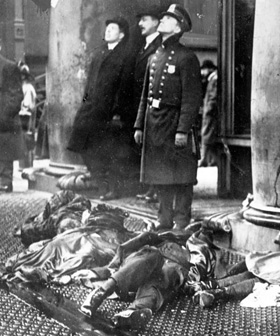
Robin Williams, Maria Bamford, and Shamanism

Last night CNN’s Errol Barnett and Larry King pondered why someone like Robin Williams, a man whom they claimed had everything — genius, riches, awards galore – would take his own life.

King went on to paraphrase EA Robinson’s famous poem “Richard Cory,” the one Simon and Garfunkel put to music; only King misidentified Richard Cory as “Mr. Blackwell” and embellished with extra info like “he had parties on every Halloween.”

Here, look at it yourself. (And also enjoy the dulcet tones of Judy Birdsong yakking on the phone in the background)

Here’s the poem “Richard Cory”

Whenever Richard Cory went downtown,

We people on the pavement looked at him;

He was a gentleman from sole to crown,

Clean-favored, and imperially slim


And he was always quietly arrayed.

And he was always human when he talked;

But still he fluttered pulses when he said,

“Good morning,” and he glittered when he walked.


And he was rich — yes, richer than a king —

And admirably schooled in every grace:

In fine, we thought that he was everything

To make us wish that we were in his place.


So on we worked, and waited for the light,

And went without the meat, and cursed the bread;

And Richard Cory, on calm summer night

Went home and put s bullet through his head.

Here is Errol Barnett extolling the nuanced wisdom of Larry King.

Now, dear reader/viewer, take a look at Robin Williams’s first appearance on Johnny Carson.

Nancy C Andreasen’s article “Secrets of the Creative Brain” in the July/August Atlantic explores the connection between creativity and mental illness.  According to her 15-year study of participants of the Iowa Writer’s Workshop that included the likes of Kurt Vonnegut, Richard Yates, John Cheever, “and 27 other well-known writers,”  Andreasen writes that her “writer subjects came to my office and spent three or four hours pouring out the stories of their struggles with mood disorder — mostly depression, but occasionally bipolar disorder.  A full 80% percent of them had some kind of mood disturbance, compared with just 30% of the control group.”

Although Williams never acknowledged that he suffered from bipolar disorder, his manic highs certainly seem to suggest that a BPD diagnosis is reasonable, and if we can imagine lows that counterbalance the highs on display in the clip above, those those lows would be Marianas-Tench-like, bottomless.

Coincidently, just last week I caught the comedienne Maria Bamford being interviewed on NPR describing a visit she received from a Whole Foods aficionado while Bamford was in a mental hospital.  Bamford, who’s famous for channeling voices, echoed the all-knowing tone of a Californian new ager as she impersonated the visitor.

Visitor: Look, Maria, you need to, like, get into nature.

Maria:  You mean like Virginia Woolf and the river?

old pictures 004Even before yesterday’s dismal news, I wondered in a different culture if Williams might turn out to be a shaman, and watching Bamford’s most recent special (see trailer below), it’s almost as if she’s possessed, not by demons, but by a number of different personalities.  Here’s Joseph Campbell explaining the difference between a Shaman and a priest:

There’s a major difference, as I see it, between a shaman and a priest. A priest is a functionary of a social sort. The society worships certain deities in a certain way, and the priest becomes ordained as a functionary to carry out that ritual. The deity to whom he is devoted is a deity that was there before he came along. But the shaman’s powers are symbolized in his own familiars, deities of his own personal experience. His authority comes out of a psychological experience, not a social ordination.

To become a shaman or shamanka (the term for a female shaman), one must undergo a psychological crisis.

Here’s anthropologist Douglas Mackar’s description of the shaman state:

The most basic aspect of how we are Shamans is the experience of the trance state.
 All creation occurs in a trance state. In trance, your old attitudes can’t disrupt creation and evolution. It’s only when you release from that trance state that you fall back into your old mind state. It’s always a temptation to go back to the familiar. True change- transformation- is incorporating new knowledge into your psyche and holding it there long enough for it to become a permanent part of your thinking. (Douglas Mackar)

Of course, the 20th and 21st Century LA was Williams’s and Bamford’s milieu, and I don’t mean to imply that they literally were sha-people, only that they share some similarities, and a trance state is not a bad way to describe some of their comic performances.

And also we shouldn’t conflate Williams with Richard Cory.  Cory “glittered when he walked” and Williams bounced around whatever room he was in like an Indian rubber ball.

His suicide didn’t surprise me.

Mamas, Don’t Let Your Sons Grow Up to Be Poets or House Painters

Thanks to a steady intake of fumes from solvents, house painters suffer a greater susceptibility to alcoholism than any workers except for maybe poets.[1]

You think you got it rough, surveyor, roofer, house painter, Mr. Sisyphus?

Dig this poetic whining:

A line will take us hours maybe;

Yet if it does not seem a moment’s thought,

Our stitching and unstitching has been naught.

Better go down upon your marrow-bones

And scrub a kitchen pavement, or break stones

Like an old pauper, in all kinds of weather;

For to articulate sweet sounds together

Is to work harder than all these, and yet

Be thought an idler by the noisy set

Of bankers, schoolmasters, and clergymen

The martyrs call the world.’

Not to mention that you also have to teach college to pay your bills.

The horror! The horror!

Yet, you could — and I do — argue that house painting is more dangerous to your health than banging out villanelles.

the good life

For example yesterday was, in the words of a house painter acquaintance, “paycheck Friday,” which brought him to the bar at Chico Feo with more than enough cash to tie one on. HP — as I will call him —  is a rather handsome but unkempt 40-year-old who sports shoulder-length brown hair, a greying beard, and a number of eclectic tattoos, including the dog Odie of Garfield fame, tongue out, panting on his left bicep. HP hangs with Gregory, a gentlemanly toper who also sports shoulder-length hair and a Whitmanesque beard.

Bespattered with paint and suffering from a case of psoriasis on his arms and legs worthy of an illustration in a medical encyclopedia, HP took a seat a couple of stools to my right. In between sat at my pals Jim Crow and John Harvey Rogers. Across the bar from us were a young, wholesome couple from Asheville who happened to have been married by a former student of mine.

joker club

Anyway, somehow the conversation turned to the Wild Wild Joker, Charleston’s most famous but now defunct strip club. Before I go any further, I guess I should admit that I once visited the Joker in the late ’70’s when I was being groomed for management in a company that sold safety equipment. Part of the job entailed entertaining out-of-town customers, many of whom, not surprisingly, would rather take in a strip show than a Chekhov play. Anyway, I have a vague memory of the joint. It had a stage, booths, tables, and women who walked around offering to let you buy them a bottle of $100 champagne.

As it turns out, HP worked as a DJ at the Joker as a 22-year old.

“DJ?” I asked. “You spun records there?

“No, I would introduce the acts, do some bouncing.”

“MC, not DJ,” I wondered.

A smile suddenly brightened HP’s face. “If there wasn’t a lady present,” he said. “I could tell you a great story about one night when me and the girls and the manager and bouncer stayed up till eight in the morning partying at the Joker.”

I gently chided him, informing him in so many words just how insultingly sexist his statement was because the “she” he referred to was a grown woman and probably as interested in a tale of Chaucerian bawdry as we.

I asked him if I could record the story with my phone, and he said no. Who could blame him? Maybe this story would rival the one I recently heard about a pal who had worked his way through college picking up bodies for a funeral home, and who had, when tripping on acid in the funeral home’s morgue, accidently shot an old-lady-viewing-ready corpse in the face with a .22.

“Okay,” HP said, “I’ll tell it.

We all leaned toward him as he lowered his voice. “That night I’m talking about. We did lines off the bodies of the girls.”

He wore the grin of a former athlete reminiscing about a touchdown of yore. Just sat there grinning.

“And?” I said.

“That’s it.”

“That’s it? That’s the story?”

“That’s the story.”

The End

[1] http://www.ncbi.nlm.nih.gov/pmc/articles/PMC1012122/

Cancer, Camaraderie, and Clichés

Unless you’re atypically morbid, like David Sedaris, who whiles away his time in airports “wondering which of the many people around me will die first, and of what,” chances are you’ve exiled the thought of your own mortality to the deepest, remotest outpost in the penal colony of your consciousness. And nothing screams mortality like a bald, cadaverous middle-aged woman sporting a pink baseball cap and a tee that reads “I Got Chemo Brain. What’s Your Excuse.”   Encountering her on a sidewalk, you might nod a quick greeting, or if she were preoccupied, avert your eyes.

That is, unless you — or someone very close to you — have/has been diagnosed with cancer. In that case, this plucky woman is a cognoscente, a knower, a fellow sufferer, a sister, so you look her in the eye, smile your most winning smile, and say hello.

Since my wife Judy’s diagnosis of lymphoma, we’ve by necessity been hanging out with cancer patients — at Roper’s/St Francis’s West Ashley Cancer Center, on the fifth floor of the old downtown Roper, and at an adjacent building where nurses administer white-blood-cell-enhancing injections on Sunday mornings to folks undergoing chemo.

Our first visit takes place on a day so bleak weatherwise that I expect to see the words “Directed by Ingmar Bergman” projected on the bank of dark gray clouds squatting over the harbor. There’s a flash flood warning until eleven, and the rain is steady but not torrential at the moment.

We arrive, take the elevator to the fifth floor (what is it about cancer and fifth floors?) to find at least a dozen people waiting for their injections. What strikes me foremost is how cheerful these folks seem to be. At first, the office is so crowded that we stand out in the hall and have a conversation with a robust-seeming but patchily bald thirty-something who is  (cliche #1) battling relapsed colon cancer, a disease first diagnosed when he was overseas on active duty. Obviously, he’s been dealt an unlucky genetic hand; his brother is also battling cancer, a lymphoma. He gives us the name of an author and book about some miraculous diet.

caneAs people exit, we make our way inside and have a seat. I’m across from a large man in his seventies wearing suspenders and holding a hand-carved cane in the shape of an egret in the big paw of his hand. This man’s head looks like a giant flesh-colored bowling ball, and he doesn’t have any eyebrows. As it turns out, he lives in the town of my birth, Summerville, and commissioned some local artisan to carve the cane for him. He says with a smile that his wife was supposed to come with him, but her head was under the covers when he left. “So I’m going to get some breakfast,” he says good-naturedly. “She can get her own breakfast.”

And then there is the smiling, petite, and ever so fragile-seeming older woman who looks as if she might weigh all of her eighty pounds. She’s wearing a baseball cap and speaks in a cheerful, clipped Northern cadence.

She knows things we as yet don’t know and serves as a wonderful role model. She’s come here alone with her (cliche #2) head held high, and seems perfectly happy.

Oh, these cliches! They’re impossible to avoid. When people ask, we say we’re optimistic but (cliche #3) taking it one day at a time, which, if you stop to think of it, is how we should live whether we’re suffering from cancer or just won the Powerball Jackpot. When I walk Saisy now, I take note of what I might have missed before, the smell of lighter fluid, the sight of pelicans in an unbalanced vee overhead, the sounds of squealing little girls dabbling in the waves.

In Defense Of Hipsters

Background

In the 2014 edition of the United States, prudent people don’t criticize the state of Israel, nor do they praise hipsters.

Certainly, I have no intention of casting aspersions Israel’s way; however, as imprudent as it might be, I have decided to attempt an apologia for hipsterdom, that haven for non-alphas where unconventionality breeds a sort of countercultural uniformity that many find off-putting. What interests me most about this topic is the degree of animus the word “hipster” engenders among several acquaintances and one very good friend, who, ironically, might be the hippest person I know.

A while back, I started to notice a proliferation of on-line deprecations of hipsters, and when the post office version of this month’s Atlantic arrived, I checked out James Parker’s piece “The Twee Revolution” in which he attempts to understand “the strangely persistent modern sensibility that fructifies in the props of Wes Anderson movies, tapers into the waxed mustache ends of young Brooklynites on bicycles, and detonates in a yeasty whiff every time someone pops open a microbrewed beer.”

“Consider the cultural degradation of the ‘hipster’ [Parker goes on to say] — once a jazz-and-orgasms spirit warrior with battle hymns by Norman Mailer, now a dude with a funny hat rooting through a bin of used vinyl.”

What’s so insidious about wearing funny hats or preferring vinyl to CDs? Why so much contempt for someone doing so little actual harm?

Etymology

By the way, if you’re unfamiliar with the derivation of hip, it comes from hep, a jazz term originating in the ’40’s, a term describing an avant garde aficionado of hot jazz and/or bebop (as opposed to swing), in other words. a cat or chick in the know, or as Cab Calloway would put it, a cat or chick who got their boots on. Somehow hep morphed into hip, though I have also read that hip as a synonym for cool might owe its derivation to the posture of the habitués of opium dens who lay on their sides (i.e., hips) as they toked their hookahs.
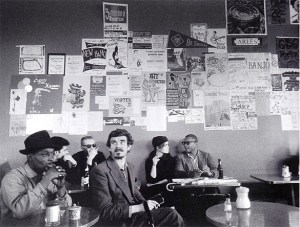
mid- 20th Century hipsters

mid- 20th Century hipsters

Cab Calloway, who published in 1940 The Hepster Dictionary, would not necessarily physically recognize the person Mr. Parker describes above as a hep cat; however, the hep cat of Cab’s day and Parker’s hipster do share some common characteristics.

Here’s a Wikipedia copped quote from Frank Tirro’s Jazz A History that describes 1940 version of hipster: “He is amoral, anarchistic, gentle, and overcivilized to the point of decadence.”

Anecdotal Evidence

typical Tuesday at Chico Feo (featuring self- portrait by the artist)

typical Tuesday at Chico Feo (featuring self- portrait by the artist)

I brought up Parker’s article at Chico Feo, the hippest bar in the most bohemian town in South Carolina, and wondered aloud why so many people hate hipsters so.

Suddenly, Charlie, the most affable of bartenders (and who sports a Whitmanesque beard[1]) launched into a passionate denunciation of the subculture, of its uniformity, its too-cool-for-you-ness.

John, sitting across the bar from me and rolling a cigarette, joined in on the spirited dissing.

Their antipathy genuinely surprised me. These two rather unconventional-looking men’s animus for hipsters probably rivaled, or even surpassed, your typical frat boy’s.

“C’mon,” I say, “they’re not as nearly bad as your typical, entitled, swaggering Lacrosse jock. I never hear about hipsters inviting strippers to parties where alleged sexual assaults take place. These assholes certainly deserve to be hated more than hipsters.”

As my luck would have it, Charlie played lacrosse in high school.

John’s disgust with hipsters seemed to lie in their lack of utilitarian usefulness. “They’re caught up in this fake world of bullshit,” he said. “They’re not living in the real world; they’re living in the cyber world. When something breaks, they don’t fix it. They throw it away and buy a new one.”

“Plus,” he added, “They’re always multi-tasking, doing four things at once. You can’t multi-task. You can only do one thing well at a time.”

The fog of one too many high gravity micro brews was starting to roll in, so I didn’t do a good job of expressing the sentiment that comes immediately to mind after typing John’s response: so what? It’s not as if they caused the Great Recession through avarice and idiocy and walked away scott free with billions in their offshore bank accounts.

Easter in Brooklyn (from left to right Judy Birdsong, Wesley Moore, Jim Cline, Jim Crow)

Easter in Brooklyn (from left to right Judy Birdsong, Wesley Moore, Jim Klein, Jim Crow)

So I got on my bike and pedaled home to call the hippest cat I know, Mr. Jim Klein, the Abstract Expressionist, who lives in Brooklyn, a subway stop or two from Williamsburg, the Ground Zero of hipsterdom. You can read about Judy and my Easter visit to Jim and his wife Sue’s loft here, but suffice to say, it’s got to be one of the most interesting domiciles anywhere, and Klein possesses an encyclopedic knowledge of jazz and the arts in general.

Mr. Klein ended up being just as down on hipsters as my barmates. “Zombies controlled by stupidity,” he called them. Echoing John, he cited their dependency on technology, their exuding a vibe of unearned superiority. In a voicemail he sent the following day, he added their sense of entitlement as a negative; they exude a sense of superiority without every having accomplished much of anything.

Possible Explanations for the Passionate Dislike

As I’m found of saying, even though I am not a psychologist, I do sleep with one, so allow me to posit a possible reason hipsters produce what seems to me such a disproportionate quantity of spleen for the petty misdemeanors of their outré aesthetic, technological proclivities, and lack of productivity.

All I can come up with is that hipsters evoke some aspect of insecurity or some shared but repressed negative characteristic the hipster-hater harbors within his or her own being.

I remember some student back in the day telling me that I reminded him of the asshole comedian Dennis Miller. “What,” I complained, “I hate Dennis Miller. He’s arrogant, sarcastic, flaunts his learning, goes out of his way to use arcane diction to prove just how effing smart he is and is needlessly vulgar.”

The student’s look screamed, “Like I said, you remind me of Dennis Miller!”

What else can it be? Skinny jeans, shitty dyed hair, vintage store dresses, leggings don’t strike me as any more pernicious than Ralph Lauren polos or those garish Hawaiian shirts geezers of my generation sport. Why not hate surfers as much — they, too, lead hedonistic lifestyles, sport their own types of uniform, engage in their own distancing argot.

Surfers tend to be attractive — or at least fit. Maybe, the hipsters’ tendency to flip off fashion also contributes to their unpopularity. Rumor has it even hipsters with 20/20 vision sport clunky horn-rims for effect. Maybe the fact that this dweeby, pasty, pink-haired girl thinks she’s cooler than her bleached blonde beauty queen cousin is what drives some people to foam at the mouth.

Personal History

I attended Summerville High School, an institution where football is taken as seriously as Ayatollahs take Ramadan. Especially, when I was there, if you weren’t a jock, particularly a football player, you were a lesser being. The star players and cheerleaders, on the other hand, were celebrities. Jerry Reese, the starting quarterback, once told me near the school bus line-up, “Hey that little guy just told his friend, ‘that’s Jerry Reese.’” Also, it goes without saying that some of the players (not Jerry) were bigoted, bullying assholes.

In 1969, I started hanging out with an iconoclast named Tim Miskel, swapped out my alpaca sweater for a blue jean jacket, cultivated my anger by straining it through irony, and ended up abandoning my childhood friends for a new set, Summerville’s first hippies, people like Adam Jacobs, Gray Eubank, Jack McDonagh, Christine Richards, Glen Farrah, Margie Bradshaw, Mike Moore, among others. We, too, all more or less dressed alike and received much First World abuse for our unconventionality. Once, my Spanish teacher asked derisively if I had gotten my shirt at the Psychedelic Shack.

Nevertheless, this subculture, I bodily state, was much more interesting than the preppie/jock Green Wave culture where virtually everyone stupidly and reflexively supported the Viet Nam War, preferred Three Dog Night to Jimi Hendrix, and were okay with school segregation.

Although I would have had trouble bench-pressing a broomstick, I could satirize school culture knowing I had a supportive band of renegades behind me. Hipness — knowing the difference between Ingmar and Ingrid Bergman — became sort of cool. After all, it offered others like ourselves an alternative path to popularity, which is what most high school students crave.

Schools desperately need countercultures, and the hipster students at my school also offer counterweights to the cult of the athlete. As it so happens, the hipsters at my school are some of my favorite students — they’re bright, interesting, skeptical, artistic.

Anyway, who am I to criticize funny hats and skinny jeans?

[1] Was Walt Whitman the very first hipster? “The scent of these armpits is aroma finer than prayer,” he writes in “Song of Myself.”

a couple of hipsters

the author at the Poetry Outloud Regional Finals
Hanging Out at the Cancer Ward

Roper Hospital and I go way back, way back to the early 50’s, back before my gestation, when my student nurse mother met my GI-Bill Clemson undergraduate father whose own mother was dying of cancer.

Smitten by a redhead in a uniform, Future Daddy asked Future Mama out.

As the story goes, Daddy’s go-to dating strategy was sympathy — not only was his mother dying, but he was so poor that he didn’t own any underwear. To prove he lacked boxers/briefs, he lifted his shirt, yanked checkered swim trunks into view. Perhaps being impoverished was sexy to children who grew up in the Depression.  Don’t think it would necessarily work today.

Anyway, this counterintuitive romantic ruse worked. Sue and Wes went out. My grandmother died. Sue and Wes eloped, dropped out school, engendered me. [1]

A bad karma kind of coming to be, if you stop and think about it.

 * * *

My beloved has been diagnosed with a difficult, rare, and therefore frightening cancer called Peripheral T-Cell Lymphoma.

I won’t burden you with the existential horrors of waiting . . . waiting . . . waiting,   . . . in the primary care physician’s outer rooms/inner rooms . . . in the West Ashley Roper Cancer Center’s outer rooms/ inner rooms . . . trying to read the faces and body language of the physicians as they enter . . .

. . . a pleural effusion . . . a mass . . . cancer . . . probably lymphoma . . . t-cell lymphoma . . . blood work . . . CT scans . . . marrow bone biopsies . . .

 * * *

We’re at the downtown Roper, my mama’s Roper, my dead grandmama’s Roper.

My beloved’s here for five days, Monday through Friday, for 96-hours of constant infusion of a chemo regimen that goes by the acronym EPOCH. She’ll go home Saturday, have two weeks off, then return to Roper for five more days and repeat this pattern for six to eight cycles.

judy walkingSo Roper has become our home away from home.

What this hospital lacks in Spa-like aesthetics it makes for in interesting walks and outdoor venues. Because it’s been added on so often, Roper’s labyrinthine hallways might give Theseus a run for his money. It’s almost as if MC Escher himself designed the building. I park in the Doughty Street parking lot, which offers a fairly straight shot through the back door to the D elevators, which I take me up to the 5th Floor, Oncology. On the other hand, reaching the cafeteria from my beloved’s room is the human equivalent of a white rat’s journey towards the cheese.

The room itself is spacious and looks out on a narrow walkway. Because the walkway is only about fifteen feet wide, it gets no sun, so when you look through the narrow slats of the Venetian blinds, it’s always 9-pm dark out there, whether it’s 7am, noon, or 3 in the afternoon, I’ve dubbed this space the Twilight Zone. As it turns out, the window’s tinted black, which accounts for the perpetual night outside.

My beloved’s oncologist wants her to walk, so she does, hauling the chemo cart as she goes. On her excursions, she has discovered an accessible deserted hallway that brings to mind the former Soviet Union.

Here they store broken beds and other non-functioning equipment. The names of dead doctors appear beneath some of the doors. I love it back there — an objective correlative for aging’s entropy. Perhaps in one of these small rooms my grandmother died — but probably not. Even this old wing probably post dates her.
empty roombalcony view


The nurse’s station on the 5th Floor looks out onto the Ashley River. The 5th Floor also boasts a balcony with a view of Charleston’s most notable steeples. This morning’s humid breeze was strong enough to blow a string of meds off my beloved’s cart.

Of course, you can’t expect residing on a cancer floor not to have its downsides, like the constant moaning of a sleeping man a twist and turn further down in the hall.

Nevertheless, this isn’t Solzhenitsyn’s Cancer Ward. The nurses are great, and you hear a lot of laughter here.

[1] Crass Casualty and dicing Time.

There Goes Peter Cottontail

Who was the first to go?

"Tooth Fairy" by Greg Becker

“Tooth Fairy” by Greg Becker

The Tooth Fairy, that’s who, that little fetishist, sneaking into children’s bedrooms, trading money for teeth. I suppose the Tooth Fairy is the least definite of the fantasy commies who distribute goodies among the masses. I can’t even tell you if the Tooth Fairy is supposed to be male or female, old or young, corporeal or diaphanous. As it turns out, virtually every google image that comes up is female. Anyway, I’m not sure I ever believed in her.

Even more preposterous is the Easter Bunny, I remember being about five or so, and my old man telling me that the Easter Bunny wouldn’t be showing up because he’d been hit by a car. Daddy claimed to have seen the rabbit’s roadkill carcass on the side of the highway. Of course, I knew he was kidding by the bemused look on his face; however, his story made me try to visualize the dead Easter Bunny. How big was he?   Was he wearing a bow tie?

8571e424cbad2765eb1500bb3fb6e4f7How idiotic — a rabbit toting a continent’s worth of tooth-rotting chocolate and jelly beans from house to house from Maine to California.

Of course, that left Santa, whom I did believe in until I was nine or so, refusing to heed the cross-my-heart-hope-to-die sworn statements of my more sophisticated buddies. By the time Mama broke the official news, we kids had been scoping out the yuletide stash for a couple of years, sneaking up into the attic when the parents were away, or, when no one was around, peeking under the door of the vacated apartment across the hall from my grandmother’s.

And they are right: Christmas was never the same after that.

Which brings us, as James Joyce might say, past Eve and Adams, to Jesus himself, whose legitimacy as the Son of God I also started doubting at a tender age, and as far as believing goes, I’ve given it my very best — took my confirmation classes very seriously, read CS Lewis, studied the gospels — but, alas, I just can’t will myself to believe, and that is that.

So I took up Buddhism instead in the hope of achieving an equanimity with the mysterious universe that can seem so beautiful but also so cruel; however, let’s face it: you can’t pray to Siddhartha, and he certainly ain’t gonna perform any miracles for you.

How wonderful it must be to have a bedrock of faith, to be certain that you are loved and can conquer death, and certainly, in my family’s current situation, it would be particularly nice to be able to “talk” to a greater power and seek solace and strength. Some of my Christian friends have seemed a bit hesitant to share with me after hearing Judy’s diagnosis of lymphoma that they’re praying for us, but as Judy said just yesterday, “I’ll take prayers, vibrations, chi. Bring it on”

“What about sacrificial heifers?

“Those, too”

In other words, we’re not the arrogant Christopher Hitchens or Richard Dawkins brand of non-believers, so please pray if you’re a praying person, and think good thoughts if you’re not.

We’ve been really humbled by the outpouring of love we’ve received so far. Thank you all!

Robert Cray and John Hiatt: Review 25 July 2014

You might say that last night’s concert featuring Robert Cray and John Hiatt was too much and too little of a good thing — too much of the excellent Robert Cray but too little of the brilliant and dynamic John Hiatt. promotional poster

The tour’s promotion suggests equality as if the show is a double billing, and indeed stage time for both performers and their bands is equally divided into two one-hour-and-fifteen-minute sets separated by an intermission when roadies strip down Cray’s slicker set-up with its elevated drum kit and replace it with Hiatt’s down home array of amps and instruments.

Nevertheless, someone has to go first, and that someone is Robert Cray. I’ve always admired Cray as a musician and ambassador for the Blues.  Certainly, his eloquent guitar solos come to life with an anguish that articulates the despair inherent in the genre — the lost love, poverty, betrayal, and hopelessness that the Blues uniquely expresses.  Cray’s guitar screams, moans, flashes anger — almost as if it’s on the verge of human articulation, like Benjy Compson attempting to utter the unutterable.  Certainly, Cray’s performance of “Don’t You Even Care” was killer urban blues, passionate music coupled with effective imagistic lyrics that brought to life rain-slicked city sidewalks and shitty motels.

And yet, because he performed so many of the tunes in the same rather up-beat tempo and because virtually every song was about some woman who done him wrong, a sameness seeped into the set, a repetitiveness not helped by his starting each number by saying, “This next one is called [so-and-so].”  Also, I found odd that he didn’t cover any blues standards but relied on his own songs, which, although certainly competent in every aspect, are by no means classics. How I would have loved to hear him cover some Willie Dixon tune like “The Same Thing” or “Spoonful.”I know this might sound demeaning — and I don’t mean it to — but Robert Cray is sort of like “The Peyton Manning of the Blues” — richly talented, technically perfect, but somehow mechanical.

Certainly, “mechanical” doesn’t describe John Hiatt, whom I’ve been following since his third album, 1979’s Slug Line, a punkish romp featuring songs like “Take Off Your Uniform” and “The Night That Kenny Died,” which features these lyrics:

It seemed so spooky that the nerd we all detested

Would die so gloriously and unexpected

A wonderful guy God knows

They kept the casket closed.

As Hiatt matured, so did his music, bolstered by recording with some of the finest studio musicians in the world including the incomparable Ry Cooder on guitars, Jim Keltner on drums, and Nick Lowe on bass.

Last night’s performance featured several of his best.  He kicked off the show with “Your Dad Did,” from Bring the Family, a witty song about the frustrations of the working life, in which the hapless narrator’s “seen the old man’s ghost/Come back as creamed chipped beef on toast/Now if you don’t get your slice of the roast/ You gonna flip your lid/ Just like your dad did.”  He followed that with “Detroit Made,” a paean to that classic  automobile beloved of African American males, the Electra 225, better known as “a deuce and a quarter.”

In addition to a series of his most famous songs — “Perfectly Good Guitar,”  “A Thing Called Love,” and “Memphis in the Mean Time,” e.g. — Hiatt included three excellent new ones from his current album, to wit, the title track “The Terms of My Surrender,”  plus “Long Time Comin’,” and the haunting, country-bluesy “The Wind Don’t Have to Hurry.”

Not only was the music engaging — the Combo rocked — but Hiatt is a consummate showman with an incredibly expressive mug.  As he struts loose-limbed across the stage like a modern minstrel, he grimaces, smiles, expresses disbelief, sticks out his tongue. I’d call him a kind of musical comic genius.

Then, boom.  It was over.

They came out for one encore, “Have a Little Faith in Me,” and that was it.

My son Ned commented as we were leaving that he now had a better appreciation for Einstein’s Theory of Relativity. Hiatt’s hour-and-a-quarter had been much shorter than Robert Cray’s.

John Hiatt and his Combo exiting the stage last night 7/25/2014

John Hiatt and his Combo exiting the stage last night 7/25/2014


Fragments from a Southern Gothic Childhood

Fragment 1

I’m two or three swinging in a backyard swing and am attacked by an angry rooster. (Escaped cock fighter? Demented sufferer from bird fever?). I pump my legs to swing higher to escape the onslaught, though, of course, gravity sweeps me down across and up through the pecking zone. I’m screaming at the top of my little lungs. Mr. Long, a neighbor, runs over to my rescue.

Fragment 2

I’m six or seven. My mother, grandmother, and Aunt Vee (who is only six years older than I) are traveling by car through rural Dorchester County to visit my Great Aunt Creesie, my paternal grandfather’s sister. My grandfather, whom we call Kiki (short for his Christian name Kistler) is not along. According to Mama, Kiki hasn’t been “right” since a Greyhound bus door smashed closed on his head and fractured his skull. By being “not right,” they mean that Kiki gets mean as hell when drunk and spends his days under voluntary house arrest holed up in his room listening to the radio and playing his ukulele. (You can read about one of my visits to see him here).

Mama explains as she drives past corn fields that Aunt Creesie is “very poor” and that her son Trim is retarded — the word in those days preferable to the less scientific but often used “half wit.” She tells me that Trim is an epileptic and could have a seizure while we are there.

spursWe eventually arrive at Aunt Creesie’s unpainted shack. Beautiful oaks surround the house, but not a blade of grass grows from the dirt yard, which is crawling with hens and a couple of roosters. Aunt Vee informs me that roosters have spurs on their legs and that they can attack. I’m, of course, terrified. The spurs look downright lethal.

Inside the house the most conspicuous piece of furniture is a player piano on which are arranged gaudy, orange-colored pitchers and vases. Trim shambles in, a bear of a man whose mouth is always open and twitches.

He sounds like this:  

I don’t want to go outside and play as instructed. Rooster-phobia. But I do. The roosters don’t attack.

Later, I poo poo in an outhouse, my tiny butt positioned over the hole. I have no memory of wiping.

Fragment 3

I’m thirteen or fourteen and visiting with Mama, Daddy, and my brother David our Great Aunt Ruby, my mother’s mother’s sister. There is also an aunt Pearl, and my grandmother’s name is Hazelwood, but all of her people call her Saisy.

Aunt Pearl lives on Warren Street near Condon’s Department store in a downstairs apartment. She lives with her daughter Zilla, who is one of the founders of the New Republican Party in South Carolina. She is a Bircher, claims Lucille Ball is a communist, and entertains us with comic books depicting Kruschev banging his shoe promising to bury us. Not only has Zilla never married; she’s never been on a date.

Sallman JesusThe house, which reminds me of a train — one room lined up after another — is Jesus haunted. Warner Sallman’s painting of Jesus (see left) hangs over the bricked in fireplace in the living room. Arts and crafts from vacation summer Bible school are displayed all over the place.

On this particular visit, there’s an inflatable man sitting on the sofa. David and I start smacking him as if he were one of those bottom heavy clowns you punch that falls over but returns to the upright position for more punishment.

We’re told to stop. As it turns out, Zilla is afraid of being raped. If she has to go out at night, she rides with the inflatable man next to her.

Sardonically, my father reassures Zilla that she needs not fear being raped.

 * * *

My own children have enjoyed essentially Gothic-less childhoods. No visits from Daddy’s aunt, my Great Aunt Lou, tipsy on sherry, telling us about the time that her in-law Sarah locked herself in a bedroom with a gun threatening to kill herself, then opened the door, put the gun to her temple, and fired.

“I don’t think she knew it was loaded,” Aunt Lou said with a twinkle in her eye. “I’ve never seen a person with a more surprised look on her face when the gun went off.”

My boys do, however, eat some holiday dinners with their Great Aunt Vee, who was once diagnosed as schizophrenic because she thought she was Queen Nefertiti.

So their childhoods haven’t been completely deprived.

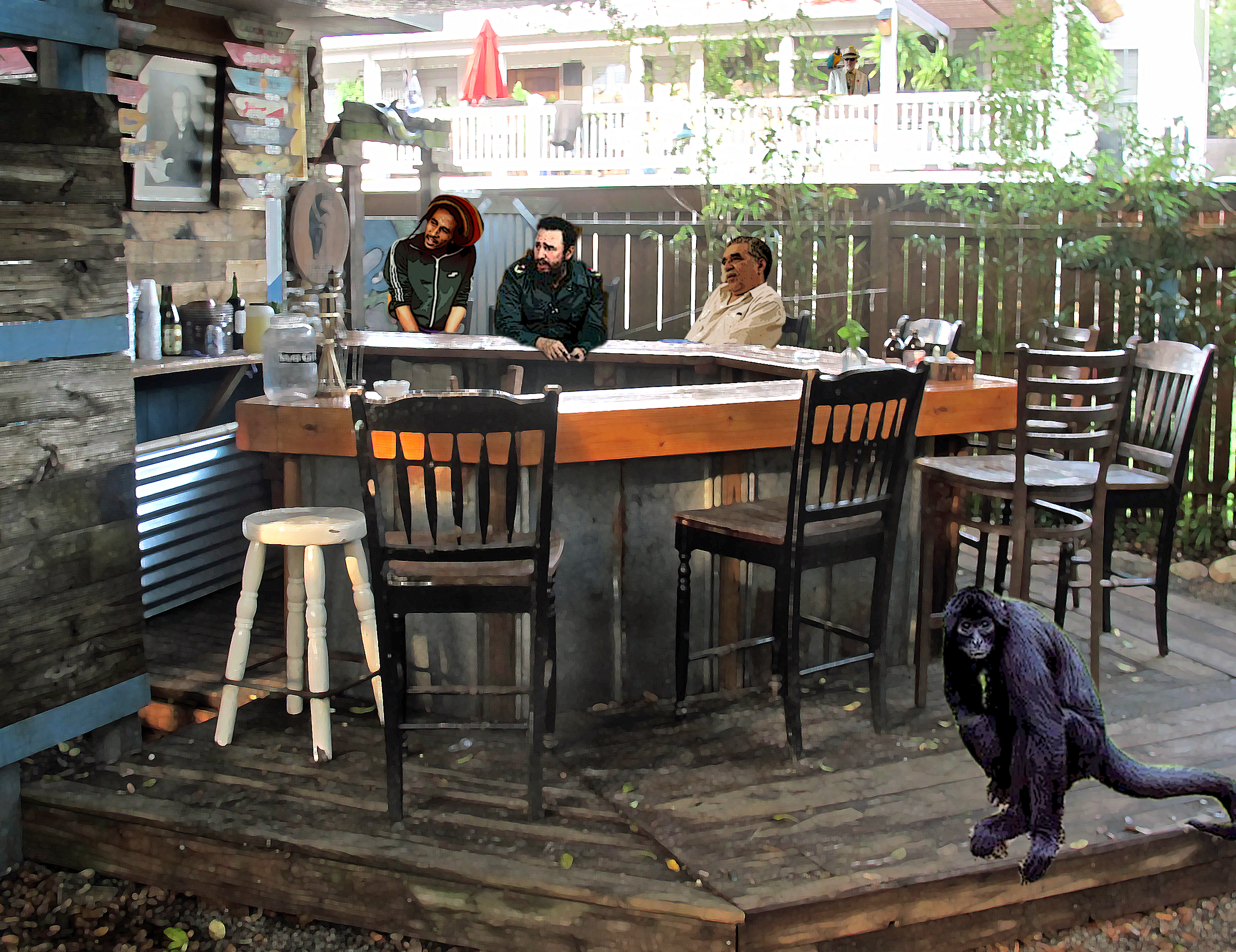
Folly Beach, East Coast Macondo

chico feo in the morning 1.0

Chico Feo in the Morning, original art by Wesley Moore

A decade ago, sick of the blood-sucking capitalists at the MLA changing their research paper guidelines every other year, I decided to create my own how-to guide, something I could run off and hand out to students but also update whenever some OCD sufferer at the Modern Language Association decided that placing periods after abbreviations was so last century.

I decided that rather than writing a dry, clinical exposition, I would make this how-to-guide a narrative featuring two fictional Porter-Gaud students, Bennington Rhodes and Robert “Flip” Burger. Bennington, a good student but not particularly interested in literature, goes about the process systematically whereas poor Flip waits to the night before due dates, which, as the omniscient narrator points out, is not the way to go. Not only could I provide students with a handy guide, but I could also mock their fads and peccadilloes.

Here’s a snippet to show you what I’m talking about, the protagonist Bennington going through the process of selecting a novel for his research paper project:

macondoEven though White Noise looks interesting, Bennington is going ahead to see about Chronicle of a Death Foretold while he’s at it. He types in “garcia marquez literary criticism bibliography,” and presto, right away the number one hit is applicable: “Garcia Marquez – Criticism.” Once again this site yields a plethora of potential sources including one of those handy Harold Bloom anthologies. Although he’s leaning toward White Noise, a painting on the Garcia Marquez site catches his eye. It’s called “Macondo” and features a Latina sleeping with her hair in her hands next to two oranges that are about to be scaled by a trio of ants on a dish next to her bed.

To save time, Bennington logs onto the Porter-Gaud Library page and discovers to his delight, that not only does the library own White Noise and Chronicle of a Death Foretold, but also that both books are available. He punches the call letters into his cell phone and heads to the library before the bell rings. As he passes the back entrance to the S&T building, he sees his friends playing hackysack. One of these, Robert Burger (aka Flip) is going to wait until the last minute and choose on a whim Henry James’s The Ambassadors because he’s heard of Henry James and thinks being an ambassador would be a great job because you have diplomatic immunity and can park anywhere you like. Not until it’s too late he discovers his error as he attempts to read the fourth sentence of that novel:

“The principle I have just mentioned as operating had been, with the most newly disembarked of the two men, wholly instinctive–the fruit of a sharp sense that, delightful as it would be to find himself looking, after so much separation, into his comrade’s face, his business would be a trifle bungled should he simply arrange or this countenance to present itself to the nearing steamer as the first “note,” of Europe. “(9)

Not only is the novel virtually unreadable, the criticism might as well be rendered in Sanskrit for all of the sense it makes to Flip. Even Pink Monkey and Spark Notes summaries are way over his head. If only he had taken his sage teacher’s advice and devoted the time to select a book more to his liking!

Gabo and Clinton

Gabo and Clinton

As part of the process, I decided to have Bennington compose a high school research essay on Chronicle, which, of course, meant I actually had to do a bit of research.  I discovered a fascinating piece from Salon by Gabriel Garcia-Marquez about his first meeting Bill Clinton at a dinner party at William Styron’s on Cape Cod that also featured Carlos Fuentes.

When [Carlos and I] talked about Latin America in general, we realized that
[Clinton] was much more interested than we had supposed, although he
lacked some essential background. When the conversation seemed to
stiffen a bit, we asked him what his favorite movie was, and he
answered “High Noon,” by Fred Zinneman, whom he had recently
honored in London. When we asked him what he was reading, he
 sighed and mentioned a book on the economic wars of the future,
author and title unknown to me.

“Better to read ‘Don Quixote,’” I said to him. “Everything’s
in there.” Now, the ‘Quixote’ is a book that is not read nearly
as much as is claimed, although very few will admit to not having
read it. With two or three quotes, Clinton showed that he knew it
very well indeed. Responding, he asked us what our favorite books
were. Styron said his was Huckleberry Finn.

I would have said Oedipus Rex, which has been my bed table
book for the last 20 years, but I named The Count of Monte
Cristo,”mainly for reasons of technique, which I had some
trouble explaining.

Clinton said his was the Meditations of Marcus Aurelius, and Carlos Fuentes stuck loyally to Absalom, Absalom,
Faulkner’s stellar novel, no question, although others would
choose  Light in August purely personal reasons. Clinton,
in homage to Faulkner, got to his feet and, pacing around the
table, recited from memory Benji’s monologue, the most thrilling
passage, and perhaps the most hermetic, from  The Sound and the
Fury.

Faulkner got us to talking about the affinities between
Caribbean writers and the cluster of great Southern novelists in
the United States. It made much more sense to us to think of the
Caribbean not as a geographical region surrounded by its sea but
as a much wider historical and cultural belt stretching from the
north of Brazil to the Mississippi Basin.

Mark Twain, William Faulkner, John Steinbeck and so many
others would then be just as Caribbean as Jorge Amado and Derek
Walcott. Clinton, born and raised in Arkansas, a Southern state,
applauded the notion and professed himself happy to be a
Caribbean.

* * *

As I was sipping on an “All -Day IPA” at Chico Feo in those amiable days before the pandemic, a polite young couple plopped down next to me at the bar. The male was unusually clean cut for the clientele, with short well-kempt hair and sporting some subdued ink on his right arm. His lovely companion spoke with a slight accent, so I asked her where she hailed from.

“Colombia.”

“Ah ha,” I said, “the homeland of the great Gabo – Gabriel Garcia-Marquez!”

“He is dead, you know,” she said with a rueful smile.

So we shot the mierda about the great man’s canon, of which she was very familiar, and that wonderful little magical village Macondo, Gabo’s Yoknapatawpha County, and I mentioned that even though Ronald Reagan wouldn’t give Gabo a visa to visit the US , he and Bill Clinton ended up being drinking buddies. I mentioned Gabo’s comment about Southerners and Caribbean folk sharing folkways and attitudes.

Given that probably most people associate Colombia with drug cartels, I suspect it was nice for her to hear praise for her homeland, and suddenly it occurred to me that Gabo was right, that the eastside of Folly was Mercondo-like. I have Folly friends with a parrot who tortures their dogs by mimicking both the owners’ accents, asking the dogs if they’d like to go for a walk, and then the parrot does a dead-on sound effect of a screen door creaking open. Magical realism right here in the Lowcountry.

“Especially this place,” she said, talking about Chico Feo. It reminds me of home.”

No roof, beers sold out of coolers, the aroma of curried goat wafting from the kitchen inside, free music, day and night . . .

Oh me oh my oh, Chico Feo.

I shook hands with them both and waved good-bye

My Colombia sister

My Colombia sister


True Detective Revisited: The Fall of American Culture

Let’s talk about Pulp fiction — not the movie — but its namesake, those lurid narratives printed on cheap paper that, to cop the cliché of their heyday, explored the “seamy underside” of American culture, publications like True Detective, which enjoyed a 71-year existence from 1924-1995.

oRAxXq56vZyUSjcwrvanqDl72eJkfbmt4t8yenImKBVvK0kTmF0xjctABnaLJIm9

The HBO television series of the same name follows the magazine’s tradition of exposing lurid depravity, though it does so on a much higher artistic plane with shades of David Lynch and Flannery O’Connor, and the depravity depicted in the television series is like to 10th power of the seemingly quaint pistol whippings and murders of the magazine’s beginnings. Furthermore, the series seems to me to be an indictment of American culture, its spiritual poverty embodied in the corrupt Christianity of Southern Protestantism and in the rapacious capitalism of multinational corporations.

The director, Cary Joji Fukunaga, constantly underscores these two themes with the visual motifs of crosses and industrial wastelands, which bring to  mind landscapes depicted in the paintings of Hieronymus Bosh.

Check out the opening credits, for example:

Obviously David Lynch’s influence is profound here, not only in the arid, dispassionate images but also in the soundtrack, and this landscape is populated by characters right out of Flannery O’Connor — shiftless Southern scumbags, depraved criminals, corrupt preachers. The twin protagonists Marty and Rust offer an interesting contrast with Marty embodying the hollow hypocritical Protestantism that O’Connor despised and Rust the nihilism that O’Connor, though a devout Catholic, preferred to the mealy-mouthed ignorant insincerity of many of her nominally Christian characters, as we can see in her treatment of the Grandmother and the Misfit in “A Good Man’s Hard to Find.” In fact, in the sixth episode, a grown up child whore whom Marty tried to rescue from a trailer park brothel years ago calls him “a good man” in a restaurant, echoing the Grandmother’s comment to Red Sammy Butts in a restaurant in the O’Connor story. Of course, neither are good men, as Marty clearly demonstrates when he engages in extramarital sex with the woman.

(Here’s an earlier post dealing with Marty and Rust).

goodmanhardtofindThe complex characterization in the context of the cinematic images that create surreal beauty from ugliness makes the series both intellectually and aesthetically interesting, and there’s also a subplot dealing with public education money being funneled into Christian schools to overcome what one character calls “secular, global education.”  These Christian schools lie at the center of the ritualistic Satanic murders the two detectives have spent the better part of two decades trying to unravel.

Certainly, an anthropologist studying the magazine True Detective and the series would conclude that American culture, despite great inroads in civil rights, has declined precipitously since the decades the magazine flourished, and I can’t help but wonder if the creator Pizzolatto is himself a moralist, perhaps even a Catholic in the tradition of both Bosch and O’Connor.

At any rate, the same cultural anthropologist would also have to agree that television has gotten a whole hell of a lot better in the last fifty years.