The Sunny Side of the Abyss

shapeimage_2

I’m not a fan of gimmicky numbered steps that lead to success, whether it be in dating, procreating, parenting, succeeding, leading, divorcing, or dying.  Following these formulae brings to mind toddlers stacking blocks in chaotic playrooms – that big bully life ain’t gonna be placated by no mumbo jumbo, kiddos, no A-B-C/1-2-3 recipes.

And O, my brothers and sisters, believe me, I’ve suffered through more than one formulaic in-service presentation in which participants broke into small groups to ponder magically numbered ladder rungs:

Make lists, plan ahead, breathe deeply, keep records, avoid heroin.

A fellow who is no stranger to making an egregious mistake (thousands of lives, millions of dollars), Colin Powell, contributed to the canon with his 2012 memoir It Worked For Me: In Life and Leadership [1]

Defying Babylonian symmetry and folk superstition, General Powell offered “13 Rules” for success.

The money steps:

Step 1 assures us “It ain’t as bad as you think. It will look better in the morning.” [Unless as dawn arrives, you’re bobbing in a lifeboat playing scissor, rock, hammer to see who eats whom].

[zip forward]

Step 2 sez: “It can be done!” [restoring your credit rating/stealing the Mona Lisa!]

[zip forward]

Lucky Step 13 proclaims, “Perpetual optimism is a force multiplier.”

The_Sunny_Side_of_the_Street-708724

Of course, there must be some unfortunate incidents that defy optimism.

Aimee Copeland—a 24-year-old Georgia woman who has spent more than two months recovering after contracting a rare flesh-eating bacteria in a zip line accident—has been released from the hospital, officials at Doctors Hospital in Augusta said Monday.

Copeland, who had one of her legs and most of both hands amputated and endured multiple skin grafts while fighting the Aeromonas hydrophila bacteria, will now spend the next several weeks in a rehab facility, her father, Andy Copeland, said.

Well, there you go.  Certainly, this tragedy seems unredeemable.

But wait!

I don’t have any regrets about what has happened,” [Aimee] said, according to her father. “I don’t focus on what I’ve lost, I would rather focus on what I’ve gained. I feel like I’ve been blessed.”

WTF!

Naysayer that I am, would harbor at least a couple of regrets.   No, I have to admit that I would feel, if not exactly cursed, desolately bitter over the tragic turn of events, the frivolous adrenaline rush of a zip line excursion costing (if not literally an arm and a leg), hands and a leg, the excruciating pain (the wound took 20 staples to close) followed by the sci-fi-like horror of bodily invasion from a zombie-like lower life form, the protracted stays in hospitals and rehab, the burden of learning to live with protheses, diminished marriage prospects, etc.

But then again, I’m a negative person. In fact, rather than scouring the wasteland for scraps of sustenance, I’d turn to master naysayers like Philip Larkin to teach me how to see in the dark.

For example, check out this little ditty of despair:

This Be the Verse

BY PHILIP LARKIN

They fuck you up, your mum and dad.

They may not mean to, but they do.

They fill you with the faults they had

And add some extra, just for you.

But they were fucked up in their turn

By fools in old-style hats and coats,

Who half the time were soppy-stern

And half at one another’s throats.

Man hands on misery to man.

It deepens like a coastal shelf.

Get out as early as you can,

And don’t have any kids yourself.

Of course, this poem is darkly comic with its rather jaunty meter and end rhymes.

In fact, “This Be the Verse” is relatively positive compared to “Aubade.”  Here’s the last stanza of that great poem:

Slowly light strengthens, and the room takes shape.
It stands plain as a wardrobe, what we know,
Have always known, know that we can’t escape,
Yet can’t accept. One side will have to go.
Meanwhile telephones crouch, getting ready to ring
In locked-up offices, and all the uncaring
Intricate rented world begins to rouse.
The sky is white as clay, with no sun.
Work has to be done.
Postmen like doctors go from house to house.

Of course, it’s churlish to mock Aimee Copeland’s attempt to be positive in light of such misfortune.  You do what you gotta do.  I only hope, however, that whenever fresh horrors come a-calling on me, I will see them for what they are – not blessings – but blights to be endured.

What do they think has happened, the old fools,

To make them like this? Do they somehow suppose

It’s more grown-up when your mouth hangs open and drools,

And you keep on pissing yourself, and can’t remember

Who called this morning? Or that, if they only chose,

They could alter things back to when they danced all night,

Or went to their wedding, or sloped arms some September?

Or do they fancy there’s really been no change,

And they’ve always behaved as if they were crippled or tight,

Or sat through days of thin continuous dreaming

Watching the light move? If they don’t (and they can’t), it’s strange;

Why aren’t they screaming?

from “The Old Fools”


[1] To his great credit, Powell, unlike Rice, Cheney, etc., admits he was totally wrong about the Iraqi War and regrets his speech to the UN in which he presented false evidence that Iraq was developing nuclear weapons.

Gary-Kelley

Larkin, by Gary Kelly

Art Versus Life

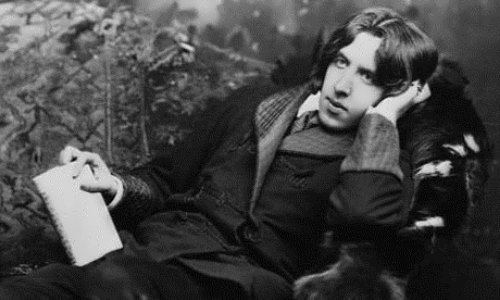
Oscar-Wilde-2

When aesthetes like Oscar Wilde or critics like Harold Bloom proclaim that “life imitates art” or “Shakespeare invented the human,” I imagine people rolling their eyes and thinking, “Puh-leez!”

Of course, their adopting these mannerisms confirms Wilde’s and Bloom’s claims.  No doubt cinema popularized eye-rolling as a fetching way to express exasperated contempt, and “puh-leez,” as in “give me a break,” probably can trace its origins from somewhere in Sitcomland.

What Wilde meant is that artists’ rendering of what they perceive provides the inartistic with images they project onto world, and in the case of characters from literature, models for imitation.

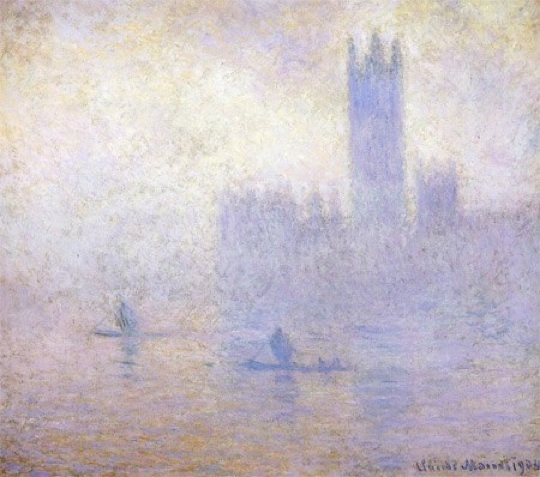
Consider [Wilde writes] the matter from a scientific or a metaphysical point of view, and you will find that I am right.  For what is Nature?  Nature is no great mother who has borne us.  She is our creation.  It is our brain that she quickens to life.  Things are because we see them, and what we see, and how we see it, depends on the Arts that have influenced us.  To look at a thing is very different from seeing a thing.  One does not see anything until one sees its beauty.  Then, and only then, does it come into existence.  At present people see fogs, not because there are fogs, but because poets and painters have taught them the mysterious loveliness of such effects.  There may have been fogs for centuries in London.  I dare say there were.  But no one saw them, and so we do not know anything about them.  They did not exist until Art invented them.  Now, it must be admitted, fogs are carried to excess.  They have become the mere mannerism of a clique, and the exaggerated realism of their method give dull people bronchitis.  Where the cultured catch an effect, the uncultured catch a cold.

                                               Oscar Wilde,  “The Influence of the Impressionists on Climate”

monet-houses-of-parliament-effect-of-fog

Claude Monet: Le Parlement, effet de brouillard

To follow up on the second point, since the Renaissance, literature has provided models for imitation for playgoers and readers eager to customize their personas. For example, males for 4+ centuries have channeled Hamlet, donned black and parroted his depressive wit; clever girls, in turn, have modeled their personalities on Elizabeth Bennet, that arch, articulate social critic. Perhaps the most copied “type” for males of my generation is the Hemingway code hero. Nick Adams and Jake Barnes wannabes around the world have embraced wounded, stoic, epicureanism for going on a century.  On a less grandiose scale, Bogart as Sam Spade; John Wayne as, well, John Wayne; and Aubrey Hepburn as Holly Golightly have also offered archetypes for imitation.

Come to think of it, perhaps exotic Papa Hemingway deserves some praise/blame for our current culinary obsessions.

2010-02-25-Blackmarket-oysters

In the late Victorian era, the aestheticism of Pater and Wilde reeked of decadence.  Who could take Pater’s advice “[t]o burn always with this hard gemlike flame, to maintain this ecstasy” if employed as a grocery boy, seamstress, coal miner, or pedagogue?

No, you had to loll your days away reading the “Rubaiyat of Omar Khayyam” in exquisitely decorated gardenia-scented rooms  (while across town some tailor pricked his finger hand crafting the smoking jacket you had commissioned).

Nowadays, few folk perceive decoration as decadent, though decorators have been conspicuously  gay, as have been hair-dressers, fashion designers, and at least nowadays on King Street, male salesclerks in clothing stores.  The effeminacy of caring about what flowers to place perhaps only occurs in Late Empire cultures. (I don’t see Dan Boone fussing over container of black-eyed susans).  And, yes, many grandsons of D-Day GIs are now uncloseted metrosexuals, and I say this is a good thing.

Certainly, I’d prefer to imbibe my afternoon Colt 45s pinot in James T Crow’s pleasant arts-and-craft cottage overlooking the Folly River than seated upon motel-like furnishings in a condo overlooking the Mount Pleasant Bypass.

We might disagree about what is beautiful, but we can all agree that beauty beats its alternatives.

metrosexual decor

Poor Boy, Long Way from Home


from left to right, Charlie, I-and-I, Concha

I said “Listen brother poor boy
Don’t be worry crime
Somebody, somebody, somewhere”

Jeff Buckley version of Bukka White’s “Poor Boy Long Way from Home”


Wish I could say I taught Charlie Geer, but I can’t. I worked with him on the school magazine, but that’s about it. We’re talking mid-80’s when my boys were in diapers, and Charlie was like an undersized Atlas hauling around the sins of the South, [warning: trying to visualize this salad of mixed metaphors could trigger an acid flashback] spiking the cauldron of his tragic vision with vitriol, developing a brilliant sense of humor to ward away the absurdities of Charleston, which he was later to bring to life in his very underappreciated novel Outbound.[1]

In his early years, Charlie dabbled in various trades and professions: worked as a country schoolteacher, a circus roustabout, a carpenter, an orchard keeper, a shrimper, a college professor. Like his work, his friendships span a democratic demographic that extends from members of the St. Cecilia Society to patrons of Florida juke joints. Now he lives in Andalusia with his beautiful wife Concha, so I only get to see them in August when they come to Charleston to visit Charlie’s relatives. It’s interesting how age democratizes relationships. I consider Charlie my contemporary, and I suspect he feels the same about me.

We brothers now.

In between essays and a memoir he’s working on, Charlie has created a character called Henry Heppleworth, whom I wrote about here in October of 2016. Henry came to being after Charlie read WJ Cash’s The Mind of the South.[2] You wouldn’t call Henry, a Trump supporter, deplorable, no not at all. In fact, I find him sympathetic. Henry, like Charlie, is a sensitive soul, who laces his dialogues with “durns” instead of “damns.” And over the course of his ten-month existence, Henry is developing, become more human.  Cracks are forming in the foundation of his ideology.

With Charlie’s permission, I’m sharing three of the videos here so you can sort of chart Henry’s progress. I encourage you to hop on YouTube and check them out. If you do, you’ll get to meet Concha as well.

Okay, here’s the very first one, Henry’s background story.

Poor boy, long way from home. He takes up his guitar.

Of course, there’s obvious irony here. Henry is an immigrant-hating immigrant. In Spain, he’s living in a much more socialistic society, which, of course, is the bane of the rural Trump voter who relies on the emergency room for his wellness plan and despises them inheritance taxes them 1%ers suffer.

After his meeting a nice lady at a festival, you can detect a shift in Henry’s perspective. And in his most recent video, you can tell it’s starting to dawn on him, it’s bullshit. It’s a sort of a sigh of a song/poem. A tragic vision tempered with humor, for sure.

Henry deserves more exposure, y’all. Click away.


[1] Do yourself a favor and hit the link and check out the video on Charlie’s Amazon page.

[2] It’s a goddamned classic.

Positive Vibrations

Jah foot soldier circa 1982

It was the summer of ’76 when I first heard the effervescent syncopation of a Bob Marley recording:

Pop-a-top-a, pop-a-top-a, irie ites, whoa whoa.

Wit dat proto-Gullah Belafonte tone to it, mon. Wit dat religious reverberation, mon. Lyrics conflating African slave descendants’ displacement in Kingston with the biblical Babylonian captivity.  A revelation.

     The sun shall not smite I by day

     Nor the moon by night.

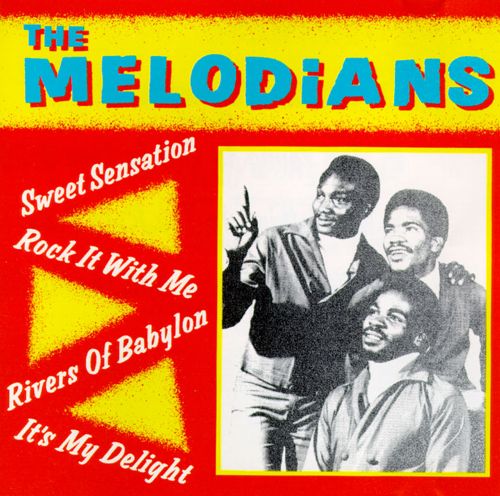
This mythic element provided a depth rarely encountered in pop music, which usually traffics in blooming young love or sexual swagger or the pitter patter of tear drops.  Check out these lyrics by the Melodians from the soundtrack of Jimmie Cliffs’ movie The Harder They Fall:

For the wicked

Carried us away captivity

    Required from us a song

    Now how can we sing King Alpha song in a strange land?

“Psalm 137” in a percolator.

I listened to a lot of reggae and ska that year and actually made it down to Jamaica a couple of times careening in a rented car along winding roads in the left lane with the car radio blasting calypso, ska, and reggae.  At Beverly’s, the record store in Mo Bay, you took LPs out of their sleeves and test ran them on a turntable before you plopped down your Jamaica currency for a Yellowman or U Roy disc.

photo by Wesley Moore (note punching discs at Volcano records was not a precise science)

At Rick’s Cafe before it got all touristy you’d see dread-locked natives who looked as if they’d been carved out of ebony hit on spliffs the size of Louisville sluggers.

Judy Birdsong all alone at Rick’s Cafe

Hertz car-rental clerks in the airport trying to sell you ganja.

Women carrying baskets of fruit on their heads trying to sell you ganja.

House bands trying to sell you ganja.

Hitchhiking entrepreneurs lean forward from the back seat offering to take you to see their plants with  “buds as big as your fist, mon”  while you skim past wrecked cars abandoned on the side of the road.  You round a bend that suddenly opens to a glinting expanse of turquoise that looks as if it just might be pirate-infested. Up ahead coming in the opposite direction a barreling Opel almost clips your right side rearview mirror.

Exotica fueled adrenaline.

And, yes, Babylon, too.

In Negril, next to the funky Sundowner Hotel where Judy Birdsong and I stayed stretched the protective barricades of Hedonism II behind which, as rumor had it, a clothing optional beach offered unlimited daiquiris and nude limbo contests.  Having paid for everything up front, these people generally stayed inside of their little compound getting to know each other while JB and I would hit the local dance hall for the two-to-six super mix dance contest.  Back then, Jamaican dancers didn’t move their feet but sort of undulated to the rub-a-dub sounds percolating from ragged PA systems.

On road trips you could buy Red Stripe beer from shanty stores just a little larger than a Port-o-let.  Lightening crackled overhead along the crests of mountains.  We were, as David Bowie put it, young Americans, young Americans, young Americans (singing in our chains like the sea).

Years later, when I found out that Bob Marley was a goner, I suffered a Don McLean-like “Bye Bye American Pie”  Buddy Holly-less-ness.  Eventually the novelty waned, and reggae faded from my own speakers as I returned to  Rahsaan Roland Kirk, the Boss, Warren Zevon, Steve Earle, Lucinda Williams, Lester Young, and Muddy Waters.

Yet, even today, whenever I hear Reggae, my mood brightens  No matter what the singer’s chronicling – the government yard in Trench Town, a Concrete Jungle, 400 years of slavery, or Johnny Too Bad – there’s that positive vibration bubbling beneath the pain and suffering.

Postscript 11 May 2024

Caroline and I just saw the Bob Marley biopic, One Heart at the Terrace Theater, and we both loved it. The NYT review I had read complained that the movie failed to capture the complexities of Marley’s character, glossed over his and his wife Rita’s many affairs, etc. Some aficionado pals of mine complained that Peter Tosh and Bunny Wailer were ignored, but as a novelist myself, I’m here to tell you condensing someone’s life into 90 minutes is a Herculean task, and these filmmakers did a superb job. I’m no sentimentalist, but in the dream sequence when Hailie Selassie tells seven-year-old Bob that he’s his son, my rheumy eyes misted over.

The Swashbuckling Syphilitic and the Jolly Drill Sergeant


blickt der Abgrund auch in dich hinein


The swashbuckling syphilitic looks a little like

a walrus with that mustache of his.


The jolly drill sergeant is, of course, clean-shaven,

close-cropped, and he barks his orders like a ramrod ringmaster.

“Step right up and burnish that brass!”


The swashbuckling syphilitic and the jolly drill sergeant

don’t see eye-to-eye. “God is dead,” cries the former.

“I must have missed the obituary,” chuckles the latter.


“Gaze into the abyss,” intones the syphilitic,

“but don’t lean too far over,” warns the drill sergeant.


“Whoever does not have a good father . . . ”

“What’s done is done.”


The jolly drill sergeant

Puts his hand on the syphilitic’s shoulder.


“Enough of this nonsense.

The Shnapps’s on me.”


“Alcohol, like Christianity, intoxicates!”

“Okay, okay, forget it,” says the jolly drill sergeant.


And so they go their separate ways,

neither one the wiser.

Cool Runnings, Island Breezes

the porch at Island Breeze

When I was a kid, Channel 5, Charleston’s CBS affiliate, broadcast a locally produced American Bandstand-like dance show called Jump Time. Hosted by (I think) Big Bob Nichols, the show featured local African American teens dancing to the magnificent R&B and soul hits of the mid-60s. I tuned in religiously, and in between numbers, Big Bob (or whoever it was) would catalogue upcoming events in the exaggerated smoothness of his on-air radio voice. One of the most frequently mentioned party sites was Mosquito Beach.

Back then Folly was off limits for blacks, so they came up with their alternative. When I was watching Jump Time, I’d conjure images of a strand with a pavilion swarming with dancers listening to the likes of Rufus Thomas live. The name, Mosquito Beach, enhanced the air of mystery, its negative connotation for me reversed the way African American argot tends to flip negative denotations and turn them positive, like funky connoting not the odor of mullet-gone-bad but the syncopated riffs of Jimmy Nolan chopping away at “Papa’s Got a Brand New Bag.”

Mosquito Beach back in the day (courtesy of the College of Charleston’s Avery Research Center for African American History an Culture)

Truth is ain’t no ocean at Mosquito Beach, though it does front a gorgeous Lowcountry marshscape. Unfortunately, over the years, the beach became rather notorious for black-on-black violence and developed the reputation of being a place where white people weren’t welcome.

I have a pal who owns the funkiest spot on Folly, Chico-Feo. Hank had mentioned before that he used to hang out at this black roadhouse on Folly Road called Phas 2. I asked him if he’d ever been to Mosquito Beach, and he said sure. He offered to take me out there to introduce to Norman and Nora, owners of the Island Breeze, a kickass cool bar/restaurant with a huge backyard that boasts a covered stage.

I’m the kind who doesn’t like to share. I didn’t dig it when loudmouth attendants of a destination wedding party showed up at Chico, and I’m very leery of getting the word out about the Island Breeze. Like most natives of this area, I like things to remain the same. Heading down Sol Legare Road to get to Mosquito Beach is like driving through a time warp and entering the 60’s, like driving into a Jonathan Green painting. I’d really, really hate to see it ever “developed” by Charleston real estate magnates.  I’d hate to see Island Breeze overrun with tourists.

On the other hand, keeping the Island Breeze a secret borders on Scrooge-like selfishness.

Here’s yesterday’s menu. You see those prices?

Here’s what the finished product looks like.

It’s delicious!

Norman, who hails from Ocho Rios, and Norma, a James Island native, are as nice and welcoming as they can be. You got rub-a-dub reggae pulsating from the speakers, a pool table, a porch, inside dining, and very comfortable bar stools. So if you’re reading this in Charleston, you really ought to check it out. Tell Norman or Nora the Teecha with the hat sent you.

Confessions of an Impulsive Procrastinator


people say I’m the life of the party

Certainly, I’m no stranger to what Eliot called “the awful daring of a moment’s surrender.”  One of my few memories of my family’s 9-month stay in Biloxi, Mississippi, is leaping from a chest-of-drawers onto a rocking horse Roy Rogers style, an act of derring-do that produced buckets of blood and pain so intense that it is pointless to even attempt to describe it.[1]

Alas, I could enumerate more recent acts of stupidity spurred by impulse rather than contemplation, whether it be driving my MG Midget down steps leading to the campus police department, an act of bravado that cost me a reckless driving fine of $200 dollars, an overnight stay in an establishment with bars (way too many in fact), and six points from my license. Even more recently, in the present century, impulsiveness has led to my machine-gunning undiplomatic emails and cc-ing everyone from the Pope to Mr. Peanut.

On the other hand, when it comes to everyday non-academic living, I’m the worst type of procrastinator. For example, my upper-story AC unit shut down last Wednesday, and I’ve just set an appointment to have it fixed tomorrow. The handle one of the doors leading to screen door has been broken longer than Barron Trump has been alive.[2]

Often when things do get repaired, it’s thanks to my neighbors. Friday, I was piddling around in my sweltering study upstairs when I heard banging below.

It was next-door neighbor Jim and his pal Gino working on the door. This morning another neighbor Whitney, whose landscaping company provided our yard maintenance before she and her husband sold Good Natured Gardening, arrived with a fellow to offer a quote for cleaning up the vine ridden back yard (think of Faulkner’s Miss Emily’s yard in Jefferson).

Asiatic jasmine, not a lawn, is hidden beneath the vines.

I did get a couple of things done. Went to my new classroom to draw it for my friend Kris who’s going to feng shui it. I contacted Judy’s life insurance company to hear the welcome news that after 12 weeks the claim is finally in the process of being processed. I also deposited Judy’s social security death benefit check, $255 dollars that I will no doubt spend unwisely.

Can you tell it hasn’t been feng-shuied yet?

However, these small victories were offset by failures.[3] I was rejected in my attempt to buy fill dirt for the almost always water-filled swale in my driveway that dips and rises like a ride at Six Flags.[4] My rejector suggested several other places to call, which I may one day. Also, I can’t find the red Chinese envelopes I need for the feng-shui-ing. Nor did I call a plumber to fix a toilet in the guest room bath, which I will get to tomorrow or the next day or the day after that. In fact, among today’s a dozen to-dos: “clean bedroom, read 50 pages, finish civil rights presentation, dispose of no-longer necessary artifacts “ all remain undone.

But I did crank out number 9 on the list – “create a blog post” — and accomplished something not even listed – boiling three pounds of peanuts.

So farewell sloth, hail gluttony.


[1] Okay, I can’t help myself.  Imagine vice-squeezed testicles (my landing on the saddle of the spring-loaded rocking horse) coupled with a bully taking you by the hair and slamming your face on the sidewalk (my face-first landing on a tiled-floor).

[2] Though Judy did get someone out to fix it 5 years ago but he fiddled with it for an hour, left, and never came back.

[3] Shut up, Microsoft word suggestion; that sentence needs to be in the passive voice.

[4] It does, however, dissuade tourists on golf carts to hang a right on my property.

A Pickpocket of a Poet Rips Off Wallace Stevens

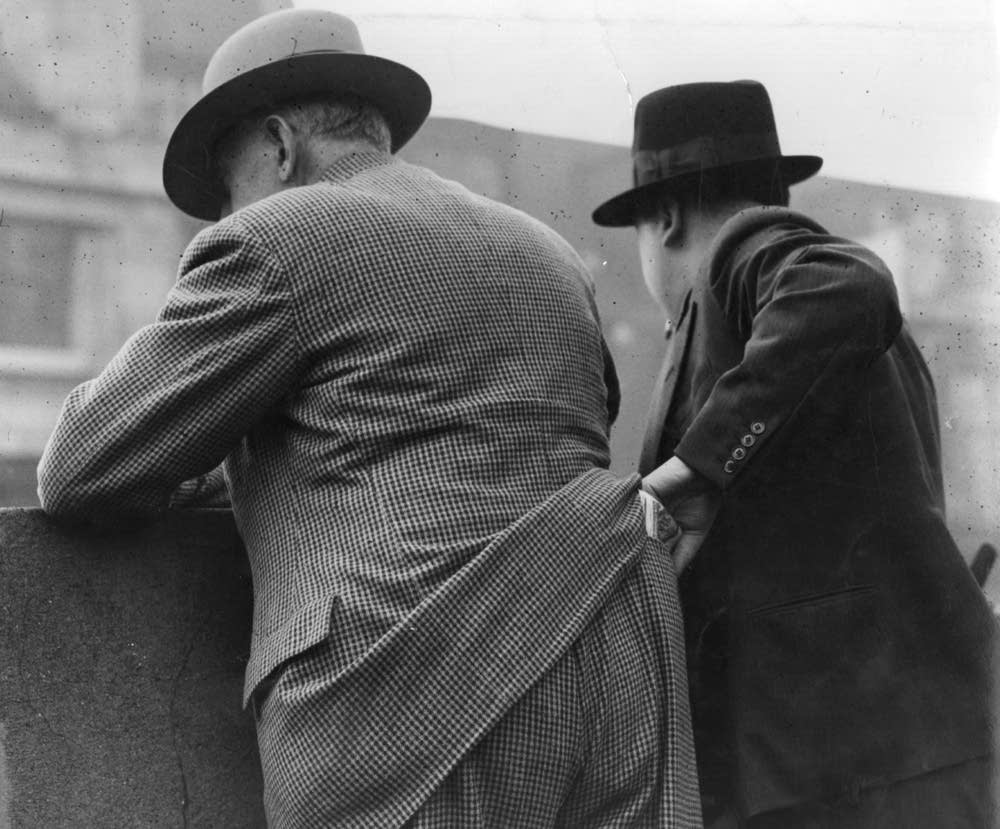
circa 1940: A pickpocket at work in New York. (Photo by William Davis/General Photographic Agency/Getty Images)

accompanied by a labored window unit


A motion, the sea voice fluttering, a cry

understood word for word, a summer sound,

tilting in the air, perishing, erased by rain.


A serenade, a night wind sigh, out of the spirit

of black waves, the virtuoso ocean

drowning out a song.


The wind blowing, a metaphysician

in the dark, a woman, drunk,

dancing a stumble on the shore.


Dee Dee Ramone, master of the mamba,

tell me in a doo wop how to get from East Erie

to the Commodore Club. All I know

it’s way above of the Crosstown.

Dee Dee Ramone


A Thing Called Perception: A Review of “Portraits of a Marriage” by Sándor Márai

[…] all that we behold

From this green earth; of all the mighty world

Of eye, and ear,—both what they half create,

And what perceive.

Wordsworth, “Tintern Abbey”


Whether your sunglasses are off or on

You only see the world you make.

John Hiatt, “A Thing Called Love”


I’ve just finished at a former student’s strident insistence the Hungarian novelist Sándor Márai’s last work, Portraits of a Marriage. I don’t know if we lose something in the translation of the title, but the narrative might more accurately be dubbed: Satellites of Love or Chain, Chain, Chain of Partners or A Sociological Study of Class Relationships in Hungary from 1930 – 1950.[1]

The thing is that no title can do justice to the mighty compression of meaning that the novel holds. Divided into four parts, the narrative unfolds in the style of a Robert Browning dramatic monologue, with each section narrated by a different character. We are in a concrete setting, a bar or bed, and along with us there is someone listening to a monologue, but we never hear that person speak. Instead, we get remarks like: “Sorry . . . What did you say? Why I started weeping when I saw him just now?”

This auditory technique may be off-putting in a culture dominated by visual imagery where we expect cinematic quick cutting, and I admit the conceit does add a bit too much ballast to suspension of disbelief; however, the articulation of the perceptions of the first three monologists is at once meaningful and conversational.[2]

It begins in Budapest between the wars. Here is Ilonka, the first wife of Peter, an industrialist, describing to a female companion her reaction to finding a decades-old love token in her husband’s wallet, a token that predates her relationship with him:

And now I knew that whatever wonderful or terrible things were happening in the world, it was pointless to accuse myself of selfishness, lack of faith, lack of humility, pointless comparing my problems to those of the world of nations, the problems of millions suffering their various tragedies, because there was nothing I could do – selfish and petty as I was, obsessed and blind as I was – except to get out on the street and search out the woman I had to confront face-to-face, the woman I had to talk to. I had to see her, to hear her voice, look in her eyes, examine her skin, her brow, her hands.

We can’t blame Peter for fleeing such suffocating obsession, and in the second section he tells a colleague what that first marriage was like and how he fared in his second marriage to a servant girl of his household named Judit, the girl who had given him that token, a peasant who literally grew up in a ditch. In England, after she leaves the household, she transforms herself into a highly credible Pygmalion-like creature who knows which fork to pick up. Upon her return, Peter defies social convention and marries this underclassling.[3]

Here is Peter describing the object of his obsession:

It wasn’t a “lady” or a glittering socialite I yearned for. I hoped for a woman with whom I could share a lonely life. But she was terrifying ambitious [. . .] wanting to conquer and take occupation of the world.

The only things she fears is

[h]er own hypersensitivity to offense, some mortal wound to the pride glowing in the depths of her life, her very being. That was what she was afraid of, and everything she did by word, silence, and deed was a form of defense against it. It was something I could never understand.

So what we have here is the Rashomon effect, contradictory accounts of the same event. In the course of these dialogues a quarter of a century passes; we see the class stratification of Hungary before the war, Budapest’s leveling during the war, and its Soviet occupation after the war. All of our principals but Ilonka become ex-pats.

It’s Judit who devours the narrative scenery, talking to her latest lover, a jazz drummer whose stage name is Ede. They’re in Rome in a hotel bed after one of his gigs.  Judit possesses the most experience, having risen from abject poverty to enormous wealth. She’s the least socially conditioned one, and she is able to look upon the events of her life with a sort of anthropological detachment:

High culture, it seems, is not just a matter of museums but something you find in people’s bathrooms and kitchens where others cook for them. Their way of life did not change, not a bit, not even during the siege, would you believe it? While everyone was eating beans or peas, they were still opening tins of delicacies from abroad, goose liver from Strasbourg and such things. There was a woman in the cellar, who spent three weeks there […] on a diet, a diet she maintained even when the bombs were falling. She was looking after her figure, cooking some tasty something on a spirit flame using only olive oil because she feared that the fat in the beans and gristle everyone else stuffed themselves with out of fear and anxiety might lead her to put on weight! Whenever I get to thinking about it, I marvel what a strange thing this thing called culture is.

There is one other character, Lazar, who doesn’t get his own monologue but who appears in every section. He’s a writer, perhaps Márai’s alter ego. Of course, I identify with him because, not only is he bald, but he’s also a pessimist (and who wouldn’t be scrounging around a bombed out city).  He has several quotable passages throughout, but I’m going to have Judit describe him instead of having him speak for himself:

What’s that? Was he a snob? Of course, he was, among other things, a snob. He couldn’t stand being helped because he was solitary and a snob. Later I understood that there was something under this snobbish manner of his. He was protecting something, trying to preserve a culture. It’s not funny. I expect you’re thinking of those olives. That’s why you laughing? We proles, we don’t really get the idea of “culture,” sweetheart. We think it’s a matter of being able to quote things, of being fussy, of not spitting on the floor or belching when we’re eating, that kind of thing. But that’s not culture; it’s not a matter of reading and learning facts. It’s not even learning to behave. It’s something else. It was the other idea of culture he was wanting to protect. He didn’t want me to help him because he no longer believed in people.

As I was reading through the individual sections, I found myself put off by these people’s egocentricities, their obsessiveness, but once I got halfway through Judit’s monologue, the cumulative effect suddenly came upon me like revelation. What we have here is a deep meditation on love, loneliness, obsession, culture, family, and perhaps most profoundly, the limitations of personal observation.  The gulf between these people’s perceptions of themselves and others’ perceptions of them is an unbridgeable breach.

This might not be a great novel – I won’t judge until a second reading – but if you’ve reached this final sentence, you’re likely to find it worth your while.


[1] In Spanish the title translates into “The Righteous Woman”

[2] The 4th narrator Ede, a jazz drummer-cum-bartender, lives in “a pad.”

[3] Let’s not forget that Hunagry in the early part of the previous century was not L.A. I can’t come up with a good analogy. Prince Phillip marrying Billie Holiday?

Sándor Márai as a child

Trafficking In Mockery

illustration by Pawel Kucynski

Constant change, or anicca, is a central concept of Buddhism, one of the three marks of existence, along with dukkha (suffering) and anatta (non-self). The Gautama Buddha (c. 567- 487 BCE) taught that attaching to impermanence (e.g., your childhood goldfish, your adolescent puppy love, your undergraduate hairline, your spouse, your existence) ultimately results in sorrow. To escape the natural inclination to become attached to objects of desire, Gautama Buddha points out a pathway that enables one to transcend ego, i.e., to enter a state of anatta, in which one becomes not even zero but this [1] [                    ].

The concept of constant change is inherent in quantum mechanics, cellular division, and, more obviously, in the shifting shapes of the clouds above. Everything is always in a state of flux. Not only did Eastern sages like Gautama come upon this concept of constant change, but also so did the Greek pre-Socratic philosopher — a contemporary of Gautama — Heraclitus, whose dates are c. 535 BCE – 475 BCE.

It’s easy to imagine Heraclitus’s most famous saying “No man ever steps into the same river twice” coming come from one of Gautama’s sermons. Unlike serene Gautama who suggested “a middle way,” Heraclitus, known as “the weeping philosopher,” was profoundly pessimistic. No doubt his pessimism contributed to what I hope are apocryphal accounts of his death.

According to Neanthes of Cyzicus, Heraclitus, suffering from dropsy, attempted to cure himself by covering his body with manure and lying out in the sun to dry, but he was made unrecognizable by the dung covering and was finally eaten by dogs. [2]

Heraclitus and Democritus
Johanness Moreelse

Not surprisingly, impermanence has been the theme of many a poet, and my main man WB Yeats is no exception. Take his masterpiece “Nineteen Hundred and Nineteen.”

Many ingenious lovely things are gone

That seemed sheer miracle to the multitude.

He offers examples of ancient art that has been lost:

[ . . .] There stood

Amid the ornamental bronze and stone

An ancient image made of olive wood –

And gone are Phidias’ famous ivories

And all the golden grasshoppers and bees.

Or as the latin poet Aaron Lipka puts it:

Vita brevis, ars longa,
tamen non est sempiterna.

Yeats goes on to lament the end of the pax Victoria when “a great army [was] but a showy thing.” However, in 1919 the “days are dragon-ridden,” and “[t}he night can sweat with terror as before/ We pieced our thoughts into philosophy.”

He adds that he (or she) “who knows no work can stand [. . .] has but one comfort left: all triumph would/But break upon his ghostly solitude.”

He ends the first section of the poem with this stanza:

But is there any comfort to be found?

Man is in love and loves what vanishes,

What more is there to say? That country round

None dared admit, if such a thought were his,

Incendiary or bigot could be found

To burn that stump on the Acropolis,

Or break in bits the famous ivories

Or traffic in the grasshoppers or bees.

(Or, in the case of Hobby Lobby, traffic in stolen ancient Mesopotamian clay cuneiform tablets, perhaps looted by ISIS.)

Is what Yeats calls “ghostly solitude” anatta?

Probably not. In Section 3, he refers to a Platonic theory of an afterlife. This theory holds that the greater a person’s accomplishments, the more likely those accomplishments will encumber her in her passage to the next world. Therefore, “if our works/Could vanish with our breath/That were a lucky death/For triumph can but mar our solitude.”

From the Cambridge Introduction to WB Yeats:

Before the poet can take comfort in his conclusions, it dawns on him that the evanescence of mortal triumphs is precisely what makes us love them. The fact that great works vanish does not make it easier to cast off our attachment to them. Indeed it makes it harder.

Andrew Wyeth

Today marks the 8th Sunday since my Judy died. The Buddhist ideal of total detachment, although wise, is better suited for one with a monastic temperament. If you are a husband or wife, a father or mother, a pet owner, a lover of Billie Holiday or the Marx Brothers, detachment is inexcusable. That doesn’t mean, however, you should embrace Heraclitus’ model and wallow in melancholy.

Weep when you must; party when you can.

Also, cynicism, though not ideal, can offer some satisfaction:

Come let us mock at the great

That had such burdens on the mind

And toiled so hard and late

To leave some monument behind,

Nor thought of the levelling wind.

Come let us mock at the wise;

With all those calendars whereon

They fixed old aching eyes,

They never saw how seasons run,

And now but gape at the sun.

Come let us mock at the good

That fancied goodness might be gay,

And sick of solitude

Might proclaim a holiday:

Wind shrieked — and where are they?

Mock mockers after that

That would not lift a hand maybe

To help good, wise or great

To bar that foul storm out, for we

Traffic in mockery.


[1] Insert “the sound of one hand clapping? The formula “form = emptiness; emptiness = form? The inexpressible mental concept of non-concept? Your original face before you were created?

[2] Janet Fairweather.“The Death of Heraclitus,” Greek, Roman, and Byzantine Studies.