
Adjustments
My cigarette dangling dragon nostriled daddy
post war bared his teeth when he smiled.
“Go tell your father,” Mama would say,
“supper’s on the table.”
Wake him up, his fists would fly
dog paddling into the empty air.
Adjustments
My cigarette dangling dragon nostriled daddy
post war bared his teeth when he smiled.
“Go tell your father,” Mama would say,
“supper’s on the table.”
Wake him up, his fists would fly
dog paddling into the empty air.

No, I’m not one of those self-flagellating must-do-it martyrs who vow to finish every book they start, no matter how unpalatable. Not finishing a bad book is as easy for me as zoning out during the welcoming comments at a Chamber of Commerce convention, or to keep the previous metaphor going, declining to finish an undercooked fat-choked pork sandwich.
No, I don’t have that mitigating principle to explain my finishing (it’s been several years now) EL James’ pant-fest, Fifty Shades of Grey (which I have handcuffed to a library carrel and urinated on here).
Certainly, anyone who read the above linked-to-post might find it improbable that such a severe and sarcastic critic would continue to squander the few, precious, and dwindling hours of his life’s eventide following the escapades of Anastasia Steele and Christopher Grey, characters as finely wrought as a pre-schooler’s drawing of an octopus; however, this critic did, albeit skimming through the novel’s latter emails, sex-scenes, and interior monologues with the concentration of a meth addict perusing Henry James’s The Ambassadors.*

*Indeed, I dedicate that one-paragraph 83-word sentence to the Master.
But finish it, I did, as I might a 32-ounce Slurpee, knowing that it was bad for me, didn’t even taste good, but that it went down easy. However, I will give Ms. James’ high school English teacher this compliment: ol’ EL has gotten the bit about active voice/vibrant verbs. I haven’t been exposed to so much clambering since the fall of Saigon.

3 April 1975
Whatever the reason – the active prose, its socio-historical late empire ramifications, the fairly well-choreographed sex scenes – I finished the damned thing, and I might add that Fifty Shades of Grey’s success demonstrates that the novel as a form is far from dead. Future story tellers need not abandon first person narration and turn to screenplays to make their fortunes.
You go, fan fiction aficionados!
***
Nevertheless, I did finish Fifty Shades, but it left me famished for something beyond solid. Yet, I wanted it to be very roughly analogous – Lolita perhaps – but then it hit me like a revelation – The Ambassadors, a novel about another naive American’s initiation into an exotic world. Although universes apart in style, structure, and depth of characterization, Fifty Shades and The Ambassadors do share some shading in the Venn diagram of their thematic concerns.
Not to mention authors with matching surnames.
So I clambered up ascended the stairs to my drafty garret study to greedily snatch remove the 60-cent 1965 paperback that literally falls apart in my hands as I squint at negotiate its microscopic minuscule type.
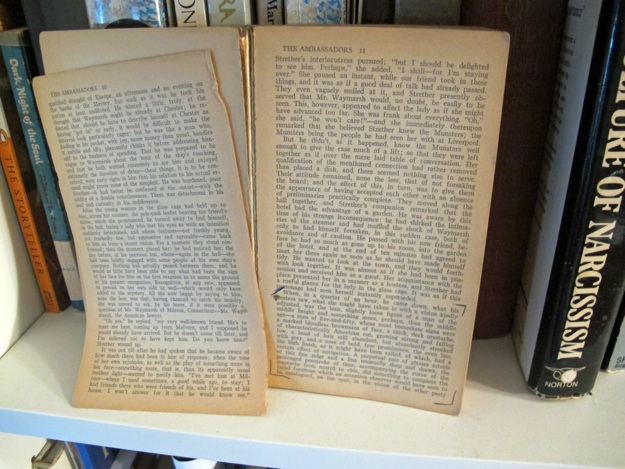
Oh, my sweet Buddha, but we are in different universes. Compare Henry’s description of our protagonist Lewis Lambert Strether to EL’s description of Christian Grey.
As they say, age before beauty. Take it away, Mr. James:
[. . .] what his hostess saw, what she might have taken in with a vision kindly adjusted, was the lean, the slightly loose figure of a man of the middle height and something more perhaps than the middle age–a man of five-and-fifty, whose most immediate signs were a marked bloodless brownness of face, a thick dark moustache [sic], of characteristically American cut, growing strong and falling low, a head of hair still abundant but abundantly streaked with grey . . .
Your turn, Ms. James.
I surreptitiously gaze at him from beneath my lashes as he stands in line waiting to be served. I could watch him all day . . . he’s tall, broad-shouldered, and slim, and the way those pants hang from his hips . . . Oh my. Once or twice he runs his long, graceful fingers through his now dry but still disorderly hair. Hmm . . . I’d like to do that. The thought comes unbidden into my mind,**and my face flames. I bite my lip and stare down at my hands again, not liking where the wayward thoughts are headed.

** a thought comes unbidden “into [her] mind” – as opposed into her genitals?
Which one is talking?
“I’m always considering something else; something else, I mean, than the thing of the moment. The obsession of the other thing is the terror. I’m considering at present for instance something else than YOU.”
“I’ve never slept with anyone, never had sex in my bed, never flown a girl in Charlie Tango, never introduced a woman to my mother. What are you doing to me?”
Which passage ends with “His eyes burn, their intensity takes my breath away?”***

*** Answers available at 1-900-144-5412 ($1.20 per minute fee)
***
So what’s my point?
Good question. First of all, despite egregious flaws, the plot of 50 Shades of Grey carries you along (and it has as at least as many sex scenes as Slaughterhouse Five has death scenes). However, it’s definitely lower middle brow. (I was somewhat interested to see how the narrative would be translated onto the big screen but but not curious enough to bother to go see or rent it). I figured that the viewer would be doomed to a thousand voiceovers and that moviegoers might perceive Anastasia as more pathological than the reader does if they didn’t hear her story in her own words.
Once, when a parent called to complain about A Clockwork Orange’s being on our reading list after having seen Kubrick’s film, I had to explain that in the novel Alex’s quaint phrase “a malinky little tolchock to the gulliver” on screen is transformed into the objective depiction of a woman being clubbed to death. Likewise, Anastasia’s “orgasm ripping through [her], a turbulent, passionate apogee that devours [her] whole” could come off on screen as trite pornography
Second, the tsunami success of Fifty Shades must tell us something about sex in the Late Empire. One, women who thirty years ago might have discretely ordered the book and read it behind closed doors are now reading it on airplanes and discussing it at happy hours with their girlfriends. Sex is a powerful obsession, an innate need, and it is probably impossible to sustain passion’s fire on a marriage bed dampened by the constant distractions and stresses of the working world – getting the kids ready for school, picking up something from Harris Teeter, opening that audit notice from the IRS.
If EL James were to follow the adventures of our heroes into the second decade of matrimony, she may very well be writing sentences like this:
My back to him, I feel his hand reach over and touch my well-worn tee shirt, and I clench, trying to stifle a yawn. He rolls over me and his gray eyes are red-veined and floating in a puckered slough of discoloration. Holy shit, he wants me, but I want him about as bad as I want a yeast infection.
EL James 50,000 Degrees of Ennui
I’ll leave you with this. Check out the first and last pages of the outline of The Ambassadors that James submitted to his publishers.


The meme “OK Boomer” is — forgive me — booming[1] on Twitter and TikTok as an expression of Generation Z’s frustration with the older generation’s outdated ideas and technological cluelessness. It’s a mild insult, it seems to me, a sort of bored sigh of “whatever.” It says, “You’re boring and inept and unfashionable.” In other words, you’re outdated, out of it.
For some reason, more than a few snowflakey boomers have taken great offense at this rather mild rebuke. It could be worse, fellow boomers. It could be Lenny Bruce on steroids. It could be Fuck You, Boomers. Imagine a Gen Y or Z Lenny Bruce or George Carlin ripping into Mitt Romney and me.
Fuck you, you old crone/codger with varicose veins mapping your legs/porcupine needles of hair poking from your nostrils/cottage cheese masquerading as cleavage/your freckled baldpate resembling some dying planet in a third rate solar system.[2] Speaking of dying planets, you’ve made a shithole disaster of this one, not to mention robbing us of a portion of our paychecks with Social Security deductions that could be putting a dent in the gargantuan student debt we’ve amassed (or are amassing or will amass) so you can sit around in your second home condos stuffing your fat faces watching Fox News’ anchors thumbing their noses at science while we slave away as baristas or unpaid interns with no health insurance. Shut the fuck up about our dependence on our cell phones. It’s not like we’re bound to see anything of interest in the over-crowded infrastructurally decrepit cityscape/boring commercial suburban sprawl you’ve bequeathed us . . .
I’ll admit the above lacks pithiness. It would be difficult to fit on a baseball cap.
By the way, the phrase “OK Boomer” has already been merchandized.
This from the New York Times:
Hundreds of “ok boomer” products are for sale through on-demand shopping sites like Redbubble and Spreadshirt, where many young people are selling “ok boomer” phone cases, bedsheets, stickers, pins and more.
This, of course, means the phrase will be co-opted by a multinational corporation, which along with the petrol-chemical component of its conglomeration might also feature a manufacturing side business that transforms plastic sludge into OK Boomer Frisbees.
Remember the grunge craze, flannel shirts pre-faded, blue jeans pre-ripped?
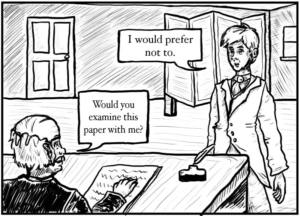
Ah, capitalism, ah Bartleby.
[1] This lame Dad pun epitomizes the inherent essence of Boomer-unhipness.
[2] This gender balance can be a real pain in the posterior. It’s exhausting.

Oh, the side-splitting counter-Darwinian hijinks those headline-capturing police blotter inebriates produce each week on the highways, byways and beaches of the Lowcountry![1]
Whether it be a wobbly motorist telling a cop “he’s had five beers plus one beer,” a naked bicyclist peddling towards a fast-food drive-thru, or a domestic dispute involving tire irons and trash can lids, the police blotter is sure to bring a winsome smile to even the crabbiest of malcontents.
Not too long ago, you had to riffle to the back of the City Paper, Folly Current, or Section 12B of the Post and Courier to discover who had tried to drive his car up the stairs leading to the Battery’s promenade or who had stuffed two bottles of champagne in his pants in a failed heist; however, in these latter days seeking out the absurd is almost too easy. For example, here is a screen capture from a recent Live 5 web posting:

Still, I prefer the paper, whose account of the Halloween mishaps of a luckless 21-year-old who drove his vehicle into Colonial Lake offers more details than Live-5’s recap. For example, in the paper we learn that divers were employed to see if another passenger was in the car, the one the 21-year-old claimed had been driving. Live-5 did, however, estimate the parameters of his intoxication, between .10 and .16.
I’m not one to talk, though. I once drove my MG Midget down the steps of a parking garage into Campus Police Headquarters, which resulted in a reckless driving ticket and six points off my license and a hefty increase in my insurance rates.
Too bad I didn’t pay more heed to those street preachers who haunted the streets of Columbia back in the day.
Street Preacher
A fire-breathing preacher named Mitch
From a street corner bellowed his pitch
He warned of the horrors of hell
Where one day I was bound to dwell,
That sanctimonious, psalm-singing son-of-a-bitch.
[1] Not to mention beneath bridges, inside the cabs of heavy construction equipment, and upon picnic tables.


After a Saturday of crushed dreams (Volunteers devouring the Gamecock Nation whole) and last night’s Washington Nationals World Series triumph, I should probably draw the drapes, take to bed, and place a camphor-soaked handkerchief on my forehead.
But no, despite being infused with a tragic vision that makes Cormac McCarthy’s world view seem like a Cialis commercial, I take mouse in hand and swerve my despair Lucretius-like into some positive tips for unusual-themed Halloween costume combinations, especially suited for undergraduate bio majors.

Cormac McCarthy, 1992 Cormac McCarthy, 1992
© Gilles Peress/Magnum Photos
One thing that makes these costumes unique is that, not only are they frightfully hideous, but they also form a Darwinian food chain of predation, a theme that should frighten anyone who has seen Jaws or read Camus’s La Peste.
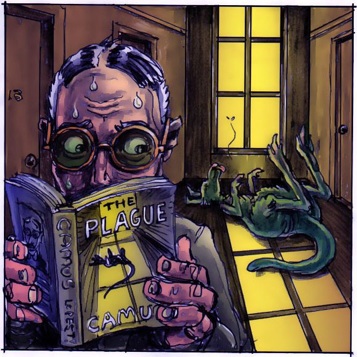
Chris Johnson’s Heat Plague
So Let’s start at the bottom down for our first costume, an alga known as Gephyrocapsa oceanica.

Making this costume would be a breeze. Just buy three dozen tutus, scissor off the bodices, and dye the skirts scum green. Staple the tutus in a circular combination as above, leaving the bottom hollow. Traverse the tutu openings with strong pieces of Styrofoam wrapped in green crepe. As Bob Dylan put it in “I Shall Be Free No. 10,” “Wowee, pretty scary.”
Next up, how about a pelagic sea slug?

Glaucus atlanticus
This cool-looking devourer of algae actually only measures ~2.5 cm, but who’s counting? For the costume, two possibilities come to mind. You could go for the above picture in a two-person, two part, donkey-head/donkey tail configuration, but I’d advise for a costume that mimics the illustration below so you can walk upright. All you need is a close-fitting white Garboesque dress, strips of blue fabric, and a 100 or so ostrich feathers dyed blue.

Sea slugs are one of the many delicacies upon which the star-nosed mole feeds. This strange creature’s eyes disappear in utero and are replaced by a series of fan-like appendages. You could go as an embryonic (but sort of too cuddly in an Olympics-mascot-sort-of-way) star-nosed mole (see below),

but I’d go ahead and opt for the scarier full adult version:

You could almost adapt a gorilla costume sans head and attach some red chili peppers (or rooster-comb red dyed sea sponges) to a white Lone Ranger mask, then attach spray-painted pez dispensers sans heads to gloves to create this truly hideous being that can smell underwater as it tunnels through east coast marshes.
The star-nosed, by the same token, offers owls a tasty if somewhat fishy-tasting mammalian repast.* Of course, whoever opts for the owl costume in your posse is going to be the least unusual creature, but still, given the multiplicity of owl species, you’re sure to find one your your liking.
*Think river otter but stringier.

One last suggestion, though it doesn’t fit in this particular food chain (it’s a denizen of the Pacific and is inedible ) is the Blobfish, a sort of hybrid of Rodney Dangerfield and the baby in Eraserhead. Hell, unless you have some marine biology PhD candidate at the party, no one is going to know the difference.
Blobfish
So, boys and girls, have fun horrifying folks with the random mutant horrors of evolution as you blast Barry McQuire’s “Eve of Destruction” from your dorm windows!

For this agnostic/ lapsed Buddhist dilettante, Halloween stands supreme among quasi religious holidays, towering over Christmas and Easter the way the skyscrapers of commerce on Wall Street dwarf Trinity Episcopal Church.

People in the Lowcountry of South Carolina don’t decorate all that much for Halloween, a pumpkin on a porch maybe, but in suburban Atlanta a few years back I encountered some killer (literally) decorations, my favorite a mangled bike in the front lawn of a $800,000 house, a skeleton lying next to the bike, the helmet overturned not far from the skull. Other celebrants had festooned their azaleas with spun cotton to counterfeit cobwebs; others had skeletons hanging from trees or cardboard black cats arching their backs with their hair on end, brandishing serious predatory dentistry.
Dig store-bought monstrosity below.

Let’s face it, zombies trump archangels in contemporary America, the walking dead a more relatable metaphor for the populace than gravity defying beings of European descent levitating above cloud banks.
For me as a child, the joy of Christmas lay in expectation, the idea of playing with the electric train certainly more fun than actually watching it go around and around in its little circle ad nauseam until the transformer inevitably blew.
Plus, your parents never took you away on Halloween to visit great aunts and their spinster daughters, that looming visit casting shadows of dread over the toy strewn landscape of the living room. We generally purchased from Poppelton’s Five and Dime our inexpensive flammable costumes, skeleton smocks and cheap plastic-coated masks or maybe a Zorro get-up. I especially loved Halloween carnivals with their apple bobbing booths, candied apples, and haunted houses.

However, my innate shyness always made trick-or-treating feel a bit uncomfortable. Knowing what I know now, I might have chosen to dress up like a Book-of-Mormon-toting Evangelist or a Jehovah’s Witness and trade some tracts for some candy corn.

Nevertheless, I certainly enjoyed the gluttonous aftermath of OD-ing on tiny Snickers and Mars bars and bartering less-loved goodies with my buddies. Oh, and to score some malted-milk-ball Whoppers was like copping cocaine, whatever that was.
Of course, as an adult, Halloween can be a drag if you live in a neighborhood where trick-or-treaters ring your doorbell every 42 seconds; however, it’s not a problem on Folly Beach, the barrier island where I live, where trick-or-treating is forbidden because of vacant vacation homes, unlighted streets, and the likelihood of motorists being hepped up on something stronger than sugar.
So as the year shuffles off towards its hospice, let’s celebrate the macabre, the zombie apocalypse, an eternity spent in everlasting agony, and other terrifying possibilities.
Once there was a little boy who wouldn’t say his prayers,
and when he went to bed at night away up stairs,
his mammy heard him holler and his daddy heard him bawl,
and when they turned the covers down,
he wasn’t there at all!
They searched for him in the attic room
and cubby hole and press
and even up the chimney flu and every wheres, I guess,
but all they ever found of him was just his pants and round-abouts
and the goblins will get ya if ya don’t watch out!!
James Whitcomb Riley: “Little Orphan Annie”


Real World 1
Adam’s curse: not death, but labor, the rudeness of the alarm, the digits glowing heartlessly: 5:55 AM. Henry David Thoreau you ain’t:
We must learn to reawaken and keep ourselves awake, not by mechanical aids, but by an infinite expectation of the dawn*, which does not forsake us in our soundest sleep.
Walden, Chapter 2
*emphasis mine
No, you’re of this ilk:
Little is to be expected of the day, if it can be called a day, to which we are not awakened by our Genius, but by the mechanical nudgings of some servitor [buzz or ring or melliferous radio voice]. That man who does not believe each day contains an earlier, more sacred, and auroral hour than he has yet profaned, has despaired life, and is pursuing a descending and darkening way.

the darkening way
You’re, let’s say, a resource teacher for severely mentally disabled students in Mississippi or South Carolina. Cutbacks mean you’re working 1.25 jobs, that your free periods are long gone, that you’re lucky if you manage 20 minutes for lunch. Although mandated by federal law, meetings concerning disabled children’s IEPs are virtually impossible to coordinate. Having the required individuals free at the same time – classroom teachers, speech therapists, school psychologists, and principals – is like trying to solve a Rubik’s cube while riding a roller coaster. They – whoever they are (the top 1%? K-Street lobbyists? Smiling State legislators? The voters? All /none /a combination of the above?) – whoever they are literally expect you somehow to do the impossible.
No, for you, the dawn doesn’t “awaken infinite expectations.”

Ronald Reagan’s Body Lies A Mouldering in the Grave
Somehow the nation has elected a sociopath as president who once supported choice and wrote checks to Democratic candidates but who know seems hellbent on accelerating global warning. Despite the historical lessons that trickle down economics doesn’t work and deregulation can cause financial meltdowns a la 2008, he is gutting environmental regulations and, aided and abetted by Republicans in Congress, has passed a tax cut for the 1% that has created a gargantuan budget deficit.
Despite the Romanesque Super Bowl Halftime extravaganzas, we don’t have enough money to repair aging bridges, to hire fireman, much less to provide healthcare for our children.
The Real World 2
Meanwhile, back in Mississippi or South Carolina in a public school that possesses all the aesthetic warmth of a juvenile detention center, emails sprout in your in-box like the heads of a hydra – each expecting a prompt reply, each unanswered one burrowing into your brain like parasites, calcifying the neurons, overloading the circuitry, shutting it down – only to snap you awake at 3:41 A.M!

Insomnia II by Jeffrey Batchelor
Where Have You Gone, Franz Kafka, a Lonely World . . .
Given the material richness of the USA, why are so many people so dissatisfied with contemporary American life?
Wordsworth posits one answer:
THE world is too much with us; late and soon,
Getting and spending, we lay waste our powers:
Little we see in Nature that is ours;
We have given our hearts away, a sordid boon!
We live in a world where increasingly our time is devoured by abstractions – meetings that go nowhere, data demanding input, those hydra-headed emails, texts from acquaintances that we glance at and ignore.
A sordid boon indeed.
Of course, Franz Kafka’s Gregor Samsa is the archetype of the harried worker, so caught up in the intricacies of his meaningless job that the first thing he thinks of when he discovers that he has been transformed into a giant insect is that it will be almost impossible to negotiate the public transportation that takes him to his office. He, that “gigantic vermin,” should be this year’s top-selling Halloween costume.

Real World 3
Leave School at 4:10 . . . pick up Abigail from DayCare . . . run in Publix to pick up supper . . . grab bills from the mailbox . . . get Abigail started on her homework . . . cycle through the voicemails . . . empty the dishwasher . . . think for a second about your ex . . . start supper . . . glance at Wolf Blizter’s head flickering on the screen . . . say grace . . . start the bath water . . . read Abigail a bedtime story . . . put off paying the bills . .
Sleep, that knitteth up the raveled sleep of care . . .
I WAKE and feel the fell of dark, not day.
What hours, O what black hoürs we have spent
This night! what sights you, heart, saw; ways you went!
And more must, in yet longer light’s delay.
With witness I speak this. But where I say
Hours I mean years, mean life. And my lament
Is cries countless, cries like dead letters sent
To dearest him that lives alas! away.
I am gall, I am heartburn. God’s most deep decree
Bitter would have me taste: my taste was me;
Bones built in me, flesh filled, blood brimmed the curse.
Selfyeast of spirit a dull dough sours. I see
The lost are like this, and their scourge to be
As I am mine, their sweating selves; but worse.
Gerard Manley Hopkins
[cue magical laughter]

Keep Out, By Larkin

Unfortunately, I suffer from insomnia. Unfortunately, some nights/a.m.s I try to deflect thoughts by constructing verse. Unfortunately, some nights/a.m.s the result might be a limerick.
For example:
Vulgar But Not Profane
A wayward nun from Bangkok, Maine
screamed hail marys whenever she came.
She had sex with her jailer
and cursed like a sailor,
but never took the Lord’s Name in vain.
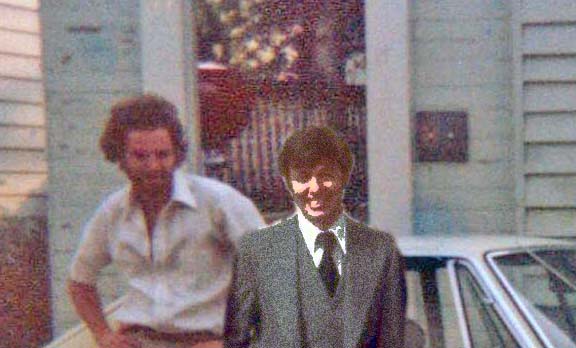
Lindsey and Me in the late 70s
Although I enjoyed my teaching career at Porter-Gaud, the happiest job I ever had was tending bar at the Golden Spur, an alcohol dispensary located in the student union building at the University of South Carolina in those glorious days when 18-year-olds could legally imbibe beer and wine. It was there that I met the mother of my children, the late Judy Birdsong, and there where I became known as “the Reverend” after an impromptu Dionysian sermon delivered in Afro-jazz riffs a la Dr. John to my pals Furman Langley and Steve Rhea.[1]
I always looked forward to going to work and never, as they say, took work home with me.
What brings this to mind is that I’ve been contemplating the psychological underpinnings of my fellow South Carolinian Lindsey Graham, wondering about his formative years, contemplating what mental dynamics allow him to flip flop so shamelessly, sometimes in the matter of days, from one position to its opposite. In this respect, his switch from revering McCain to pimping for Trump is instructive.
Anyway, as it turns out, the story of Lindsey Graham’s youth is somewhat sad, especially his late youth. He was born a Baptist in the small Pickens County hamlet of Central, South Carolina. Despite that religious affiliation, Lindsey’s parents ran what Wikipedia describes as “a restaurant-bar-pool hall-liquor store, the ‘Sanitary Café’.” So at an early age, Lindsey must have grown accustomed to dealing with paradoxes, alcohol considered by strict adherents as evil manifest, the antithesis of what they considered sanitary.

He was the first person in his family to attend college and joined ROTC, but here’s where his life takes a dolorous turn. His mother died of Hodgkin’s lymphoma at the age of 52, and, bam, 15 months later, a heart attack dispatched his father, leaving orphaned Lindsey with the responsibility of being the legal guardian of his 13-year-old sister.
He studied – get this — psychology at the University of South Carolina, pledged Phi Kappa Phi, and graduated in 1977, the same year I dropped out of graduate school. Therefore, Lindsey and I were both at USC from 1973-1977, which means, in all likelihood, I served him beer either at the Spur or at Bell Camp where I also bartended for fraternity parties. Although extremely unlikely, he literally could have been in the Spur the very night I delivered my Dionysian sermon. Back then, I’m fairly certain that I wouldn’t have given him the time of day – or in this case night.
Obviously, I’m not a fan of Senator Graham’s. I would love to see him defeated, Trump driven from office, etc. However, I have to admit that delving into his past has resulted in a bit of sympathy on my part. He faced adversity at a young age and succeeded mightily as resumes go. On the other hand, it must be horrible to be so conflicted, to have your better angels drowned out by the braying of a sociopathic vulgarian.
That said, the harm that he has imposed is real, extremely perilous as far as the American Experiment goes, and for that he can’t be forgiven.
[1] I commenced in Dr John’s voice to sermonificating on the glorification of the party impulse present in all of us – Baptist and Bohemian alike – and why that party bud must be allowed to bloom into boogie, cause if it ain’t, your existiment bound to be as flat and tasteless as BiLo brand Tonic Water what ain’t had the cap screwed on tight.
Or worser, that block-up party impulse knocked back down, squeezed back down in the reptilian recesses of your brain gonna mutate into some awful sexual dysfunctification like dwarfophilia or bovineophlia or hollywoodstar-obessification or some such other mental donemessedupness.

Yeats and Maude Gonne by Anne Marie O’Driscoll
Half close your eyelids, loosen your hair,
And dream about the great and their pride;
They have spoken against you everywhere,
But weigh this song with the great and their pride;
I made it out of a mouthful of air,
Their children’s children shall say they have lied.
WB Yeats “He Thinks of Those Who Have Spoken Evil of His Beloved”
A by-product of breathing, that mouthful of air, exhalation tracking up through the trachea, plucking the vocal c[h]ords: vowels, consonants, syllables, words, words, words. Say outloud the title of this post – “screech me a poem, sugar britches.” Dissonant, sharp, as unlovely as the scraping of a rake on gravel, echoing Juliet’s lament as Romeo vacates their marriage bed:
It is the lark that sings so out of tune,
Straining harsh discords and unpleasing sharps.

Romeo and Juliet by Todd Peterson
Perhaps even more discordant is Gerard Manly Hopkins postlapsarian description of industrialization:
And all is seared with trade; bleared, smeared with toil;
And wears man’s smudge and shares man’s smell: the soil
Is bare now, nor can foot feel, being shod.

Train Tracks by Valerio D’Ospina
Who sez that poetry’s supposed to sound pretty?
Not Alexander Pope:
But when loud surges lash the sounding shore,
The hoarse, rough verse should like the torrent roar.
Nor that barbaric yawper Walt Whitman:
Nor him in the poor house tubercled by rum and the bad disorder.
Nor Ol’ Ez in St. Elizabeth’s Mental Hospital ranting his way to a Bolligen Prize:
the drift of lice, teething,
and above it the mouthing of orators,
the arse-belching of preachers.

Ezra Pound
Thanks to its Anglo-Saxon roots, English is well-suited to screech. However, thanks to its French invaders, our language can also coo. And don’t forget the ess-cee (sc) words of the Vikings with their skalds singing of skulls and skies and dragons’ scales.
English-speaking poets possess quite a synthesizer through which to sample sounds, orchestrating Anglo-Saxon, Norse, and French symphonically (Milton) or piping a simple Saxon tune in tetrameter (Anonymous).
Given global warmification/climatic alternation, the following worry may seem as trivial as the date of Alfred Tennyson’s death, but I wonder, given our beeping visual small screen secondhand exposure to actual sights and sounds, if off-the-cuff eloquence might become as rare as first edition Kafkas.
In my youth, among my compatriots, having a way with words held sway. I think of Jake the Snake Williams politely stringing together sonorous sentences to a Jehovah’s Witness in Richland Mall explaining why he wouldn’t take the tract, and the fellow smiling, nodding his head, and saying, “Brother, you got you an excellent rap.” Or Furman Langley lamenting in a Lowcountry gumbo of gullah-echo the legend of the Boo Hag.

The “like-like” syncopatations of youthful inarticulation and the ubiquitous interrogative lilt of their declarative sentences gives me pause?
I guess it all boils down to a matter of culture.
Bewildered, bewildering primate. Absinthe. Circumcision. Couplets.
Grudges., beliefs. The war of my childhood, Europe tearing at itself.
Scarification. Conceptual art. Classic celebrated scholarly papers
On the Trobriand Islanders, more fiction or poetry than science.
Absorbed or transmitted always invisibly in the air
From a digital Cloud. Visible and invisible in the funny papers . . .
from “Culture by Robert Pinsky

