Copping Hamlet’s Rap

Art by DP Sullivan

Art by DP Sullivan

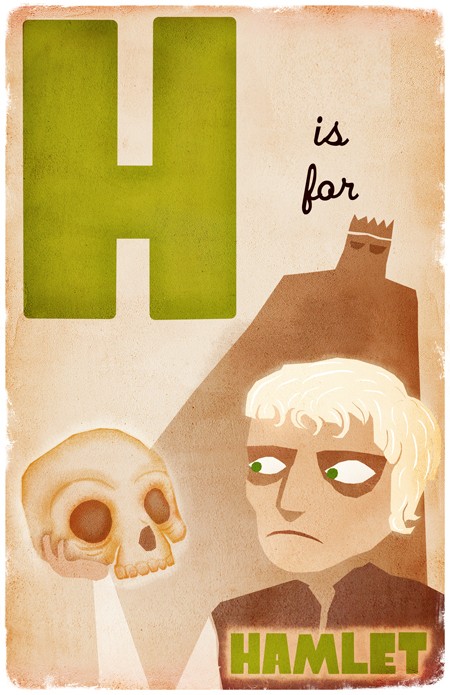
For the last 30 winters I have taught Hamlet to high school seniors. Obviously, this cat Hamlet has his issues — we all do — but I think the world of him, and unlike a lot of people, I don’t judge him, don’t consider him a coward or a misogynist.

Let’s face it: Professor Naysayer Ph.d. might not be so rational if he lost a beloved father, had his mother remarry of all people his uncle within the time frame of one menstrual cycle. Follow up that trauma with getting dumped by your girlfriend — and to escalate matters to the unbearable — receiving a visitation from your dead daddy who informs you your mama was fucking the above uncle before that uncle offed your daddy by pouring a leprous distillment into the porches of [his] ears.

Oh, yeah, and the ghost daddy guilt-trips poor Hamlet into promising to go all Beowulf on the uncle’s ass by revenging his murder, even though Hamlet, unlike Othello, has moved past all that Medieval shit into a more progressive, less-tribal sensibility.

But I’m not here to sparknote the play but to share with you some ways you can have fun with the text of Hamlet because what I love most about the poor boy is his way with words.

Not surprisingly, I have recorded in the book and volume of my brain many of the Prince’s quotable quotes, so much so that when I’m teaching the play I can recite in context line after line with my eyes fixed, not on the text, but on my students to determine who’s got a soul and who ain’t or who might be thinking about transmitting some surreptitious text neath the seminar table.

But here’s the thing; you can take Hamlet’s words out of context and slip them into your rap and nobody knows you’re echoing or alluding — they just think you’re incredibly articulate or incredibly weird.

Before I give you an example, I’ll go ahead point out something I reckon should be obvious: I express myself differently at school than I do at home, and I speak differently when I’m hanging with real cats like JT Williams, JT Crow, Keefus Sanders, Mr. Jim Klein, Ed Burrows, and Furman Hurry-Curry Langley than I do when I’m talking to my wife Judy Birdsong. In fact, this is the first post in the history of this blog where I’m indulging in my [warning: Un-PC terminology alert] redneck negro lowcountry gumbo patois.

PorterGaud-495x400Okay, here’s an example of co-opting lines from Hamlet to spice up (or obscure) your speech in everyday life. This morning I’m walking at a brisk pace from the faculty parking lot towards the vaguely Disneyesque facade of the school, walking briskly because it’s -5 degrees C. in Charleston, South Carolina, and we ain’t used to Arctic air.

I enter the double doors of the lobby and somebody says “good-morning, how ya’ doin’,” and I say, “Tis bitter cold, and I am sick at heart.”

They smile, I smile, and head to my room. Truth is, though, not only is it bitter cold but I am truly sick at heart. After school I’m driving straight to Summerville to visit my mother who’s lying in a hospice-supplied hospital bed and on a sort of bummer LSD death trip in which she thinks I’m her daddy, can hardly utter an intelligible word, and tries vainly time and time and time again to rise from bed to be somewhere else.

But back to the exchange of morning greetings. By copping Francisco’s lines to Bernardo from 1.1 in the play, I can comment on the weather in a more interesting way than my typical “damn it’s cold,” I can be completely honest in my answer about how I’m doing without being specific, and I can treat me and my greeter to metrical music:: tis BIT-ter COLD and I am SICK at HEART: bum-BUMP-bum-BUMP-bum-BUMP bum-BUMP bum-BUMP.

Or, you can use it as I did forty years before as a pick-up line in a university bar. Talking about an ice-breaker.

But you can also take quotes completely out of context and apply them to completely different situations. For example, dig this great prose speech when Hamlet’s explaining to his treacherous college acquaintances Rosencrantz and Guildenstern why he’s been out-of-sorts, the most eloquent description of clinical depression out there:
I have of late–but

wherefore I know not–lost all my mirth, forgone all

custom of exercises; and indeed it goes so heavily

with my disposition that this goodly frame, the

earth, seems to me a sterile promontory, this most

excellent canopy, the air, look you, this brave

o’erhanging firmament, this majestical roof fretted

with golden fire, why, it appears no other thing to

me than a foul and pestilent congregation of vapours.

Okay, let’s go with “a foul and pestilent congregation of vapors.”

Examples:

Colleague: You think this Congress might get something passed this term?

You: What? That foul and pestilent congregation of vapors?

Or somebody has farted and you demand to know who is responsible for the foul and pestilent congregation of vapors.

Ever been hunched over a book in an outside venue and some total stranger comes up and asks, “What you reading?”

Look up at him looking crazy and say, “Words, words, words.”

I could go on and on, but it’s been a rough day so I’m bidding adieu, but returning to my poor mother’s condition, no one has ever put it better than my princely pal:

If it be now,

’tis not to come; if it be not to come, it will be

now; if it be not now, yet it will come: the

readiness is all . . .

She’s headed, of course, to that undiscovered country where no traveller returns, and a helluva lot of people are going to miss her.

Mama

Mama

Cub Scout Psychic Scars

I was probably the most ineffectual Cub Scout in the history of that organization, the ineptitude of my tenure comparable to that of Samuel Taylor Coleridge’s career as a cavalryman in the Light Dragoons. The Norton Anthology of English Literature claims, and I quote, Coleridge was “probably the most inept cavalryman in the long history of the British Army.”  Of course, Shelley never joined the Light Dragoons, nor did Keith Richards. Come to think of it, I don’t think Keith Richards would make a very good Cub Scout either, an organization that promotes:

  • Character Development
  • Spiritual Growth
  • Good Citizenship
  • Sportsmanship and Fitness
  • Family Understanding
  • Respectful Relationships
  • Personal Achievement
  • Friendly Service
My Father and I

My Father and I

I did, I think, climb a rung from Bobcat to Bear, but only because my father signed documents claiming that I had completed steps I hadn’t, like planning a fire drill in the home. Daddy hated scouting because he had been, or so he claimed, chased around a tent by a  lascivious scoutmaster on a camping trip in his youth.

I do, though, remember successfully satisfying one requirement all by myself: going outside to watch the weather. When it came to carving a replica of the Statue Liberty out of soap (or tying my shoelaces for that matter), I was a complete – to use a quaint term from those days – spaz.  Whenever it came to father-and-son projects like the Pinewood Derby, the ol’ man performed about 99.8 of the work (he’d take the kit to work the day of the big race and construct the car on the government’s dime) and I about .02% (I’d apply decals after the paint had dried).

Mosey's car 2 web

The one aspect of Scouting I did enjoy, though, was receiving each month an issue of Boys’ Life where I could travel “[t]hrough the Himalayas with Lowell Thomas,” learn about fitness exercises that would transform me from a 40-pound weakling into a 75-pound he-boy, and read inspirational sports fiction.   However, what I really loved about Boys’ Life (and my Aunt Virginia’s Cosmopolitans) were the cheap ads in the back.

Even back then — perhaps I’m imagining this — I suffered a bit of cognitive dissonance in the clash between the high-minded goals catalogued above and the prurience and dishonesty of the ads. For example:

specs-300x203Of course, any Good Citizen, future radiologist who bought the glasses, would stare at the bone structure in his hand rather than directing his penetrating gaze leftward to check out the chick.

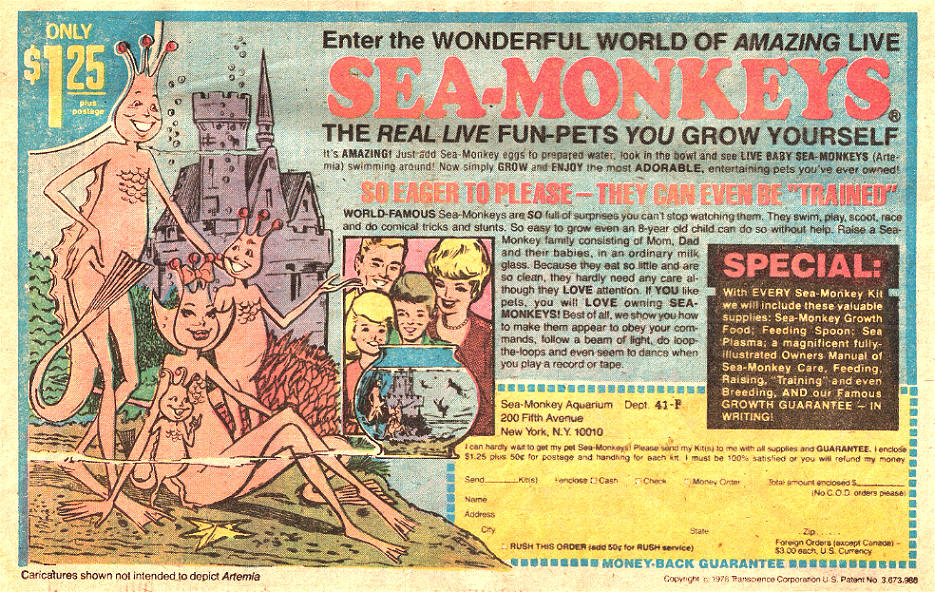
Or what could be more creepily Freudian than this family drama:

SeaMonkeysAd


The good news is that all bad things must end, and with the onset of puberty, I lost interest in scouting and Boys’ Life and the Hardy Boys.  David Johnson’s father had a copy of Terry Southern’s Candy in the drawer of his bedside table.

So it was “Farewell, Sea Monkeys; Hail Perverted Hunchback.”

5334316196_3c495f31aa_z

Are You Telling Me or Asking Me?

I’ve been digging around the internet trying to discover the linguistic answer to why so many females (and increasing numbers of males) end declarative sentences with an interrogative lilt. You know, no matter what they say, even when it’s a universally accepted fact, their voices rise at the end of sentences as if they’re asking a question.

kim-jong-un_416x416Kim Jong-un is a North Korean dictator?

Kim Jong-un has a bad haircut?

Kim Jong-un isn’t blessed with a self-deprecating sense-of-humor?

For whatever reason, this linguistic affectation bugs the hell out of me. I know, I certainly have more pressing concerns — shit like spousal cancer, maternal dementia, my dog Saisy’s insufferable halitosis — but goddamn it, I’m sick and tired of hearing far flung NPR correspondents say “the critical mass of a bare mass sphere of plutonium-239 is 8-10kg? as if they’re asking, “Do you think breast-feeding at a rodeo is tackier than breast-feeding at a Miss Utah beauty pageant?”

I started my quixotic linguistic NetQuest by typing into Google “interrogative lilt” and garnered lots of hits. My first stop was Answer.com, a website where you can pose a question and have site visitors provide possible answers. Whoever asked the question gets to choose what she considers the best answer and then some sort of arbiter at the site sifts through the received answers and selects what he/she/it deems worthy of mentioning. It’s sort of like Wikipedia except that the responders aren’t even knowledgeable amateurs but uninformed web addicts with way too much time on their hands, in other words, cranks like me. It’s about as scientific as a History Channel feature on Noah’s Ark, but, anyway, here’s Answers.com best guess:

[The interrogative lilt] is mildly irritating. I think it is an attention getting (sic) device. People do it who are used to being ignored. Asking a question often gets an answer; the listener’s ears perk up. That is why it is annoying because you perk your ears up for nothing.

transformations-identity-construction-in-contemporary-cultureSecond on the Interrogative Lilt hierarchy of Google search hits was endnote 221 on page 367 of Grant McCracken’s Transformations Identity Construction in Contemporary Culture. From what I can glean, McCracken writes about how consumers construct new identities through acquisitions, like newbie surfers peroxiding their hair and stocking up on Rusty tee shirts and Reef footwear (though he doesn’t use that example).

Anyway, I don’t know the context of the endnote, but it reads, “The Interrogative Lilt turns statements into questions, listeners into authorities, and it helps mark and construct power difference between two conversational partners.” This statement is not all that different from the Answer.com supposition – but the endnote also provides two other ways to describe the interrogative lilt – “uptalk” and High Rising Terminal (HRT), which is official linguistic terminology.

These two terms allowed me to expand my search, and I discovered that what I’m going to continue to call the interrogative lilt (IL) is a hot topic that spawns wide-ranging responses. Many people see the predominance of women ILers as a signal of insecurity. Linguist Robin Lakoff first noticed the phenomenon in 1975 in Australia and attributes the effect to the speaker’s seeking affirmation.

There’s a notable study by William and Mary sociologist Thomas Linneman that analyzes Jeopardy contestants’’ use of IL. According to Bloomberg Business Week’s Caroline Winter, “In total, [Linneman] found that contestants answered 37 percent of the 5,473 given questions using upstalk. In terms of gender, the findings, published in 2013, exposed an unexpected correlation: Successful women were more likely to use uptalk than less successful women, whereas the reverse was true for men.” Linneman dismisses the notion that IL’s only function is to indicate uncertainty but contends that it’s meant to compensate for success.

Mark Liberman who publishes the blog Language Log cites new studies that “show that people who use uptalk are not insecure wallflowers but powerful speakers who like getting their own way: teachers, talk-show hosts, politicians and facetious shop assistants.”

Of course, what do I know, but my theory is that people use IL because they think it sounds cool, or they unconsciously parrot it because people they consider cool talk that way.

spicoli-fast-times-ridgemont-high-surf-no-diceI ran across a couple of Brit sites (the Guardian and BBC) that claim the trend started in Australia. One theory is that it became the cool-speak of the Australian surf sub culture and migrated to California where it morphed into Valley Girl Speak and then spread via the media via Moon Zappa and Clueless. This theory resonates with me. I remember West Ashley surfers I hung with in the early ’70’s affecting this whiny faux-Californian cool-speak.

Anyway, it seems that every generation develops verbal ticks, the “you-knows” of my youth morphing into “likes” and now the interrogative lilt. Is “uptalk” here to stay or will it give way to some new, even more irritating affectation?

The Academic Magnet Watermelon Fiasco

The best news I’ve heard in a long while is that 3 Academic Magnet parents “filed a defamation lawsuit claiming characterizations of the team’s controversial postgame watermelon ritual damaged their [unnamed] sons’ reputations.”

unnamedThe Academic Magnet is public charter school located in Charleston, South Carolina, where American Civil War began. Although a public school, blacks at Academic make up only 2,3% of the school’s population. According to a report issued by the school’s principal Judith Peterson, after the second game of the season, team members bought a watermelon from a roadside stand, and after they won the game, the team broke open the watermelon, cheered as a team, and ate the melon. To quote Principal Peterson, “as teams sometimes believe in superstition, the boys bought a watermelon for the next game, which the team also won.” Thus, the team concluded that pregame purchasing and postgame smashing of watermelons resulted in victory.

Magnet v. Bonds Wilson

White Magnet v. Black Magnet

After defeating Military Magnet, a predominantly black school, the Academic Magnetic team returned to campus and, again quoting Principal Peterson, “ran with the melon into the AMHS Courtyard and threw the melon to the ground.”

[Note to Academic High School Teachers and Coaches. Perhaps you might want to introduce students to the logical fallacy post hoc; ergo, propter hoc.].

This self investigation does not include troubling details included in other reports, particularly by the City Paper (hence their being named in the lawsuit) that the students painted faces that could be construed as “caricatures” on the watermelons and made “grunting sounds” and wrote “Bonds Wilson” on one of the watermelons.  Bonds Wilson was a historic black high school that once stood at the present site of Academic Magnet.

With+obama+back+in+the+office+eat+that+watermelon+eat_22b4ec_4244117To quote Wikipedia, Protesters against African Americans frequently, among other things, hold up watermelons;[2] racist imagery of President Barack Obama consuming watermelon has been the subject of viral emails circulated by political opponents. After his election, watermelon-themed imagery of Obama has continued to be created and endorsed.

The coaches were aware of the ritual but didn’t associate smashing watermelons after defeating predominately black teams with racism. An African American player on the team characterized the “grunting noises” as “football noises.” Principal Peterson referred to them as “chants.”

[Note to Academic High School History teachers: introduce a chapter in American History on racism and racial stereotypes].

Why do I say the law suit is good news, you wonder?   Because it will make one hell of a movie, that’s why — Inherit the Wind meets Friday Night Lights. I’d cast Ned Beatty as Coach Walpole and Glenn Close as Superintendent McGinley. Plus, what a boon for watermelon growers in the Lowcountry as melon after melon would need to be busted in take after take. The growers may need the help since the Magnet has put a stop to “smashing a watermelon, cheering together, and eating pieces of the melon.”

Folly Beach, a Scary Place!

You have to wonder if the reputation of the tiny sleepy hungover hamlet of Folly Beach, SC, will ever recover from last Saturday’s shocking assault at Snapper Jack’s. In case you’re just emerging from a coma and haven’t heard the news, Amber Fortson of Little River is outraged because Barbra Green 59, allegedly mistook Amber’s five-month-old son for a doll and “punched her baby in the face,” committing in the words of Mrs. Fortson, “a random act of stupidity.”

You can read the Post and Courier’s account HERE.

Aspiring Model Baby Doe Fortson

Aspiring Model Baby Doe Fortson

The day had started so promisingly for the Forstons who took little Baby Doe Fortson* “to Folly so their son could participate in a modeling tryout at the Tides Hotel” because Amber “just want[ed] him to develop confidence.”

Mrs. Fortson hopes, to quote Post and Courier staff writer Dave Munday, that “being punched in the face by a stranger doesn’t undermine that goal. Her doctor [obviously not a practicing psychoanalyst] told her children that young usually forget about such traumatic events.”

Alleged Assailant Barbra Green

Alleged Assailant Barbra Green

I’m not so sure. It wouldn’t surprise me if the poor boy starts blinking up a storm well into his toddler years whenever a scowling, slack-faced red-headed stranger approaches him.

At any rate, this unfortunate incident has not only reddened the little one’s nose, but has also given a black eye to the tiny seaside hamlet I call home. For example, in the Comments Section, Sean Kennedy of UF School of Law writes, “I absolutely hate Folly. So many scumbags, drifters and rednecks infest Folly Beach.” Judy Auld Byrd, a graduate of Roper Hospital School of Nursing, adds, “Folly has always been a scary place to visit.”

Gil Luckytohaveallgirls White probably had the most poetic comment: “This city is nuking futs.”

the upstairs bar at Snapper Jacks

the upstairs bar at Snapper Jacks

Lee Bonifay of Trabuco Canyon California (bad news travels fast) writes that Folly “has turned into a giant human toilet. This is sad bc (sic) when I grew up surfing there, all the locals were close-knit and respectful. You use crappy bait….you catch crappy fish…..perfect example of what Folly has become.”

This comment started the equivalent of an on-line shouting between Mr. Bonifay and someone called Erik Swartz of Snug Harbor Design. Bonifay supports his toilet analogy with some fairly convincing anecdotal evidence:

Just came back to visit in Sept and stayed down there for ONE NIGHT. Saw three fights, one drunk guy get arrested for drunk and disorderly for standing outside Snapper Jacks screaming and cussing at the football game he was watching through the window…AND saw another guy drive his truck head on into a ditch..wasted drunk….and that was ONE DAY!!!! I understand your desire to defend it if you live there. BUT, you OBVIOUSLY can’t see the forest for all the trees. Try leaving for a little while (ya know…get OUTSIDE the bubble) and you’ll see what it has become.

All of this Folly bashing ignores the most interesting aspects of the incident. What prompted Barbra Green to punch the baby? What does she have against dolls? Why does she feel no remorse? Perhaps barren, she resented the fuss everyone was making over what Amber calls “her little man.” Or perhaps Green actually mistook the baby for a little man, a midget, and thought he shouldn’t be standing on a man’s lap “laughing, smiling, and dancing to the music.”

We’ll probably never know because Ms. Green, out on $25,262 bail, “did not immediately return a phone message asking for comment.”

*Mrs.Fortson asked that the baby’s name not be published to avoid “future embarrassment.”


On Teaching

For some teaching is a calling – my colleagues Ralph Nordland and Chuck McCarver come to mind. To them, it’s as if teaching is a vocation in the religious sense. These individuals devote their lives in almost monastic fashion to educating young people, in Ralph and Chuck’s cases, educating young people about the profundities and intricacies of history, a subject they revere almost religiously.

James Gasque

James Gasque

These dedicated teachers approach the academic year like generals mapping out a campaign. No improvisation for these masters. Each precisely planned class (to abruptly shift metaphors from the martial to the aesthetic) creates a distinct picture but also serves as a mosaic piece that occupies a place in an arrangement of other pieces that collectively form a “bigger picture” – in Ralph and Chuck’s cases, portraits of civilizations. We’re talking here – if you’ll allow one last metaphor shift — – motifs, tapestries.*

Not coincidently, these teachers demand much, receive much in return, and are almost universally revered by their students.

Another teacher of this ilk was the late James Gasque, a legend at Dreher High School and Heathwood Hall in Columbia.


*I wish I could blame my inability to sustain a metaphor on over-exposure to the attention-span obliterating frenetics of Sesame Street, but that was before my day.

* * *

Still other teachers enter the profession because they love children as a species. They think science or math is cool but don’t live and breathe their chosen subjects the way the “called” teachers do.

Still others — like me — stumble into teaching because they haven’t planned their lives out well, and, in my case, as HL Mencken said, “all that’s required of an English teacher is that he can read and write.”

Plus, you get the summers off.

* * *

Who in his right mind would spend the majority of his life in high school?  I hated it when I was a student at Summerville High: the hierarchies of popularity, the drab concrete walls plastered with bright propagandist posters, the jock friendly administration that suspended you when exercised your First Amendment rights by wearing a black armband to protest a stupid war. The principals, vice-principals, coaches considered non-conformity a personal affront.

T-A67107LIn my case, I majored in English in college because I enjoyed reading and especially poetry. I remember being in kindergarten and checking out old editions of Mother Goose from Summerville’s Timrod Library. I read the rhymes out loud, despite suffering from a speech impediment that rendered s-sounds lispingly and prevented me from pronouncing L-and-R sounds. Hick-o-wee, dick-o-wee, dock.

At any rate, I ended up being a teacher thanks to a series of fortuitous accidents.   Engaged to be married and having dropped out of grad school with 27 hours, I was unemployed and responded to an ad in the paper to teach at community college even though I lacked both of the requirements it demanded, a Masters degree and teaching experience. The ad said to contact Ed Bush, English Coordinator.

So I did, not by sending him a letter or resume but by showing up on campus, standing in a drop-ad line with students, and being hired on the spot, sans resume, sans transcript. As they say, timing is everything.

Years later Ed Bush, who was close friends with the English Chair at my current school, suggested me as a replacement for someone who had been fired. I didn’t realize that the Chair himself had been forced to resign, but thanks to the compassion of the incoming chair (she felt bad for the departing chair who wanted me), I was hired.

Despite my lack of credentials and high school experience, I had published a couple of short stories, and as it turns out, being a working writer is advantageous in teaching writing, so all in all, it’s worked out all right, despite my lack of dedication, my not particularly liking children any more than I do adults or old people, despite my inability to shovel propagandist bullshit (like consoling the losing team by telling them everyone is a winner) or my inability to buy into the latest pedagogical methodology. Yawn.

Anyway, if every teacher were super dedicated, the kids would have 10 hours of homework a day, which might lead to an armed insurrection, or in the case of independent schools, a mass exit for less Spartan education.

So I raise my glass to the average teacher, the Joe or Joanna who does the best she can without sacrificing the rest of her life — romantic relationships, outside hobbies, lazy Sunday afternoons — for the sake of the hormonally unbalanced. After all, it ain’t the best paying job; plus society holds you to a higher standard in your personal behavior than it does doctors, lawyers, and Congressmen.

What Exactly What Does a Comet Smell Like; Plus, Why Is It So Hard to Describe Smells?

Osmanthus fragans

Osmanthus fragans

Words certainly fail us when it comes describing smells – flowers, sewers, and as it turns out, comets.

How, for example, can we convey the odiferous deliciousness of Osmanthus fragans (aka tea/sweet olive), that evanescent wafting olfactory hint of autumn?

The adjective “sweet” doesn’t do much good. Cherry sweet? Peach sweet? Rancid wino-breath sweet?

No, sweet olive smells like sweet olive.

Essentially, all you can do to attempt to replicate the experience of smelling is to employ a noun and have the reader associate that noun with the smell: pine, smoke, cedar.

Fred Swan, a wine expert, offers this explanation of why:

Aromas bypass the thalamus entirely. They go from the olfactory bulb to part of the amygdala. The amygdala is also crucial for processing long-term memories and some aspects of emotion. So, with apologies to the brain surgeons among you who will be writhing in pain at this generalization, our sense of smell is uniquely tied to our memories and emotions but is more separated from our words than the other senses.

Yes, for me, sweet olive whispers of childhood, Mama Blanton’s backyard, football season, pine cones shedding, shredding, littering the ground and sidewalks in flakes of orange and brown.

I certainly won’t live to see the day when our computers are able to reproduce smells by a stroke of a keyboard. You can digitalize a photo, digitalize a sound, but you can’t digitalize an odor.*

This inability to capture odors isn’t that big of a deal, unless you’re trying to imagine how something alien smells — like a wild boar, a 19th Century Parisian courtesan, or say, a comet.

the author wishing he had a gas mask

the author wishing he had a gas mask

News flash: According to scientists at the University of Bern, comets exude an impossible to imagine combination of hydrogen sulphide (rotten eggs/farts), ammonia (horse shit), formaldehyde (fetal pigs ripe for dissection), hydrogen cyanide (almonds), methanol (rubbing alcohol), sulphur dioxide (vinegar), and carbon disulphate (who knows?).

The nose boggles trying to conjure the combination. Certainly the obvious go-to phrase “smells like shit” won’t do.

Calling Father Arnall:

Consider then what must be the foulness of the air of [a comet]. Imagine some foul and putrid corpse that has lain rotting and decomposing in the grave, a jelly-like mass of liquid corruption. Imagine such a corpse a prey to flames, devoured by the fire of burning brimstone and giving off dense choking fumes of nauseous loathsome decomposition. And then imagine this sickening stench, multiplied a millionfold and a millionfold again from the millions upon millions of fetid carcasses massed together in the reeking darkness, a huge and rotting human fungus. Imagine all this, and you will have some idea of the horror of the stench of [a comet]. (Joyce, Portrait of the Artist as a Young Man}

Or something like that.

*Hat tip to Aaron Lipka.

Going Back in Time Down Highway 162 South

drowning treesBecause we don’t work from June through July, Judy Birdsong and I tend to take trips to far flung places like Chicago, New Orleans, Lisbon, Paris.

We had planned last summer to head out on a whim in late July to a yet-to-be-decided somewhere, like Nova Scotia or the Pacific Northwest, but just after the 4th, Judy was diagnosed with PTCL-NOS, a more-often-than-not fatal non-Hodgkin’s lymphoma.

I’ll spare you the Lifetime movie of our dealing with uncertainty, calling our sons with bad news, the cheery waiting room posters pushing upcoming studies for the recently relapsed. To make a long, painful story short, after four rounds of in-hospital 96-hour continuous EPOCH chemo, Judy’s last PET scan came back “completely normal.” Although the process is far from over, the quick disappearance of the cancer bodes well for a permanent cure.

Time, then, to celebrate. We hadn’t vacated town since last October’s Leaf Festival to see Dr. John and the New Orleans brass band the Soul Rebels*, so we decided to drive down to Edisto last Sunday before Judy’s fifth round of chemo** and visit Botany Bay, 5,000 acres of what once were cotton fields from plantations that are [cue “Tara’s Theme”] no more.

Botany Bay’s main attraction, though, is a three-mile stretch of pristine beach whose bleached dead trees succumbing to the assault of the encroaching ocean serve as poignant symbols of what the ravager Time has in store for all of us. The copious shells that crunch under your feet and decorate the trees along the strand like grave ornaments offer their own testimony that time, time, time, ain’t on our side.


*Click HERE to see a video of Judy, the Soul Brothers, and Dr. John in action.

** She still has two more rounds of chemo, a stem cell transplant, and perhaps radiation before it’s over.

 The Drive Down

Rantowles

This trip down to Edisto took us right past the first house owned, a brick-veneer 3-bedroom ranch-style monstrosity custom-built by a good ol’ boy who couldn’t believe we were taking out the red and orange shag carpet he had just put in last year. We didn’t have the heart to tell him the red sink in the green bathroom was also slated for removal. The house’s redemption was that it overlooked Logbridge Creek, which connected to the Intercoastal Waterway. The view from the backyard and bedroom bay window was like, as my friend Steve Rey put it, a cover off of South Carolina Wildlife.

Judy and Me at our first house in Rantowles

Judy and Me at our first house in Rantowles

So Judy and I detoured right down Chaplin’s Landing Road to check out those digs of yore.

Guess what?

It’s changed. Our old dirt road is now a paved street lined with handsome houses that make our original seem like an embarrassing uncouth great uncle, you know, the one who wears suspenders that clash with his flannel shirt. A large Beware of Dog sign graced the busy front yard with its un-pruned Azaleas, garden do-dads, and array of automobiles.

Hollywood

Once we got back on Hwy 162 headed towards Edisto, we discovered that things haven’t changed that much since the early ’80’s, in fact, haven’t changed much since I was a boy.

Lining the road stood small modest domiciles, a mixture of wooden cottages, manufactured homes, and dilapidated house trailers. Business establishments include Parry Ruth’s Beauty Parlor, Youmans Natural Gas, small engine repair shops — lots of family owned businesses. The one incorporated town you pass through, Hollywood, hasn’t suffered the ever growing proliferation of traffic lights that plague the Charleston area. However, I don’t remember this antique store whose outside sentinel certainly headembodies the theme of the post.

Nevertheless, on the drive down, I felt as if I were once again in the Old South, here where black country folk seem to outnumber white country folk, and what a pleasure to see brothers and sisters in all of their finery chatting on the steps of an AME church.

Well, a couple of things had changed. The house trailer we remember perched on concrete block stilts is gone, along with a full sized mattress that hung like a hammock with four chains dangling from the boughs of a giant live oak, each chain attached to one of the mattress’s four corners.

Hollywood to Botany Bay

churchOnce you’re out of Hollywood, you enter even deeper into the disappearing South, pass through tunnels of moss-festooned live oaks, transverse bridges offering marsh vistas, pass a generous sampling of white-washed churches of various denominations. Genteel establishments like the Old Post Office Restaurant closed on Sunday stand as mute reminders of days gone by.


The Beach at Botany Bay

Natural Resources runs the Preserve, so you have to stop and sign in. The friendly ranger, who looked like he might be a volunteer, provided us a map and warned us of what not to do (collecting a shell can cost you a $470 fine), and gave us a brief history of the plantations that once stood on the property.

The beach is being engulfed by the sea, which has created a sort of graveyard of entangled trees, some blanched white and prone, others with beautiful swirls of root wood, other’s standing alone in the ocean like a crazy old doomed King Canute.

A variety of shells carpet the sand, but a chambered nautilus I saw not among the Darwinian litter.

tangleHow wonderful to be alive on this island of the dead! How wonderful to know the little that we know.

The Plantation Ruin Tour

Ain’t nothing left to speak of — an ice house, a tabby tool shed, dikes, and part of a plantation house’s foundation.

I couldn’t help but think of the slaves on this Sabbath, their only day off, nothing much to look forward to.  Their cottages used to line the Creek, according to our map.  Evil.

The six mile dirt road drive was pretty enough, but after four so hours of unrelenting beauty, I longed for the familiar squalor of Chico Feo’s.

We hauled ass home opting for the short cut via Toogoodoo Road where you can go 60 and not encounter another car for miles and miles.

shellsbutterflies

What do Salem, the Rosenbergs, and Ebola Have in Common?

To say that Americans tend to overreact in times of stress is like saying Spaniards roll their Rs, New Yorkers honk their horns, and drivers with Confederate flags decals on their pick-ups support the 2nd Amendment.

article-2451403-18A3707800000578-728_638x546Overreaction Exhibit A: The Salem Witch Trials

Okay, a couple of tweens, Elizabeth Parris and Ann Putnum, throw conniption fits.

Next thing you know, 200 hundred people have been accused of witchcraft and 20 executed — hanged by descendents of freedom lovers who fled England and the horrors of the “Anglican Inquisition” so they could practice religion in “their own way.”

Overreaction Exhibit B: McCarthyism, aka The Red Scare:

Okay, a couple of Jews leak atomic secrets to the USSR; therefore, artists/Jews = witches, and the color red becomes anathema.

1863232_origThank God Jesus wasn’t working in Hollywood. They would have crucified black-listed his commie Jewish robe-wearing ass for sure.

Overreaction Exhibit C: The 2003 Iraqi War

Thanks to the brilliant choreography of the attacks themselves, images from Ground Zero bewitched us (in a way the collapse of the Murrah Building in Kansas City didn’t)[1], but scapegoating Saddam because he happened to be Muslim and prone to gassing Kurds hasn’t worked all that great. Just ask the Iraqis, the Syrians, the Turks, and ironically, the Kurds.

Overreaction Exhibit D: ISIS or ISIL (or whatever you wanna call those benighted medieval mother-daughter-and cousin fuckers).

Once again, theatrics. Beheadings appall civilized people, the way that Texas blithely executes minorities appalls Scandinavians. Executions are barbaric. On the other hand, you reap what you sow (see above). But let’s look beyond theatrics and do some serious assessments before we blunder into yet another[whatever the desert equivalent of a quagmire is].

7-ebola-apv2Overreaction Exhibit E: Ebola

By my anecdotal reckoning, Ebola has led every single newscast I’ve encountered in the last 3 weeks – NPR, the CBS news, MSNBC, etc. I don’t know if this over attention is mere fear-mongering for ratings or yet another instance of American overreaction. I suspect that the odds of my dying from stray pellets from a shotgun while I paddle my kayak in the Folly River are much greater than my contracting and dying from Ebola. I read recently that it’s not even all that contagious, that measles, for example, is 9 times as contagious.

C’mon, America, get a grip. Let’s go apeshit about something real, like the disappearance of bees, the drying up of our aquifers, the return of the Chicken Curse.

[1] No rounding up of survivalists for internment in Japanese-like WW2 camps.

The Alienation of the Lone Ranger

On Fridays untethered from chemo tubes and free to flush whenever she likes, Judy Birdsong leaves Roper Hospital. Although she’s happy to get back to Folly, she isn’t up for a night of doing the wa-wa-tusi at the Sand Dollar Social Club, so we sit together on the sofa, she surfing the Web, me searching for something to watch on TV.

IFAs far as television goes, the Birdsong-Moores watch on average fewer hours per week than the typical American does in a day (five to seven depending on what site you check to get the data). If we think of it, on Tuesdays we turn on Making It Grow, but outside of college football, the occasional Turner Classic movie, or a kickass series like True Detective, watching the tube just ain’t our thing. In fact, the last major network series I member watching on a regular basis was the first season of 24.

Last night, though, was one of those Fridays, and in search of something to distract me, I left the small orbit of choices in “Rusty’s” designated Dish Network guide and ventured into the vast realm of viewing choices that lie beyond — programming that targets every conceivable viewing niche imaginable — from sci-fi to Japanese animation to Gerbil Week on the Small Caged Pets Network, or SCPN.

For a while, I hung out at [cue amused trombones] the Hang Out festival, an outdoor concert somewhere near a beach in Alabama featuring Edward Star and the Magnetic Zeroes, Gary Clark, Jr., Wilco (by far the most interesting), and Dave Matthews, but, alas, I grew bored with the redundant camera cuts from frenetic jamming musicians on stage to clichéd crowd shots of swaying hippie chicks, Frat boys, and if my eyes weren’t playing tricks on me, a redneck or two.

So I rapidly clicked through the scrolling choices of the guide until I ran across a Lone Ranger episode from 1952, the year of my birth. The Lone Ranger was one of the first TV shows I remember watching. (The only earlier one I remember is Howdy Doody. whose theme song I can still sing).[1] Anyway, as a kid, I really dug the Lone Ranger, Tonto, the black mask, the silver bullets, the horse-hoof-like theme song from William Tell’s Overture, and the repetitions of “Hi-Ho Silver, away!” and “Who just was that masked man?” Also, it didn’t hurt that the last name of the actor who played the Lone Ranger was Moore, but I think what I most liked about the Lone Ranger was his isolation, his alienation. Although I wouldn’t be able to conceptualize this as a child, the Lone Ranger has rejected what he considers a corrupt culture, not only Western Culture in general, but specifically, the lawless culture of the Old West itself, which in a way makes him a heroic antihero, a true man of mystery.

I entered the action about two-thirds through the episode. A Mexican grandfather and his grandson had been arrested by Gates, a corrupt tax-gatherer, who confiscated the haciendas of citizens who couldn’t pay. The Lone Ranger had lifted some damning documents and was galloping a breakneck speed through the dark night to show them to the governor. The image I first saw was the grandfather begging Gates to kill him, an old man, instead of his grandson, Don Rodrigo, a young man.   Gates warns if they can’t retrieve the documents, both will be shot by a firing squad at dawn. Tonto tries to bust the two out of jail, but he himself is captured and thrown into the communal cell.

51DHVNCRPSLThe Lone Ranger franchise began as a radio show, and this early episode seems oddly bound to the traditions of radio narratives. For instance, the episode features a narrator with a velvety radio baritone who intones “as Gates continues to interrogate the prisoners” [on screen actors mutely interact with each other], then segues into “the Lone Ranger pushes his mighty stallion Silver at top speed across the desert to the Governor’s” [on screen: the Ranger flailing away at a white horse galloping at breakneck speed].

Although, admittedly, the plot is lame, it has an unmistakable theme, which one of the characters on more than one occasion speaks outloud: American citizens must fight to insure that their way of life is not taken away by dictatorial assholes like Gates.

The episode ends in a predictable manner,[2] and what followed was a full-length in color movie from 1958, The Lone Ranger and The City of Lost Gold. The film begins with the creation legend of the Lone Ranger narrated by music-backed chorus of male singers[3] telling us what we’re seeing: an ambush, five dead Texas Rangers, one survivor discovered by an Indian on a painted horse, six graves (one for the survivor as well so the world will think he’s dead), a masked man loading silver bullets into a revolver, the masked man and his Indian savior galloping off in a cloud of dust.

I didn’t make it far into this movie, by far enough to notice the Lone Ranger seems opposed to taking human lives (he’s really good at shooting guns out of hands) and that the screen writers and director didn’t pull punches when depicting racial prejudice. Interestingly enough, given one of the current NFL controversies, a sheriff tells Tonto, who is seeking a doctor, “We don’t allow no redskins in here.” When Tonto refuses to leave, he has his ass kicked by the police.

In checking Wikipedia, I discovered, among other things, that the Lone Ranger speaks correct grammar and never uses slang. The silver bullets signify to him the preciousness of human life. I also learned that one of the writers copped the word” Kemosabe,” the term Tonto uses when he addresses the Lone Ranger, from “the name of a summer camp in upper Michigan.” By the way, in Spanish, tonto means foolish, so in Mexico he is known as toro.

Also, and this is really weird: The Green Hornet is a radio spinoff from The Lone Ranger. The Green Hornet character, according to Wikipedia, is “the son of the Lone Ranger’s nephew Dan [Reid]” and that “[i]n the Green Hornet comic book series [. . .] the Lone Ranger makes a cameo appearance by being in a portrait in the Reid home.” However, “[c]ontrary to most visual media depictions ,[. . . ] his mask covers all of his face.”   It seems as if the Lone Ranger franchise really keeps close reins on its property rights.

After being exposed briefly again to this boyhood hero of mine, I recognize the Lone Ranger’s affinity to both Natty Bumppo and Ishmael, alienated, like them, from his culture and seeking, like them, only male companionship with a native Other.

No, it’s not the Green Hornet the Lone Ranger reminds me of, but Caine from Kung Fu. The Lone Ranger’s reluctance to kill people seems more Eastern than Western, if not downright un-American.kungfu1

[1] Actually, the lyrics aren’t that difficult: “It’s Howdy Doody time/It’s Howdy Doody time/It’s Howdy Doody time/It’s Howdy Doody time . . .

[2] Actually, the episodes of the episode are broken into odd segments that are sandwiched between seemingly interminable commercials aimed at octogenarians, the catalogue of potential side effects seeming to take as long as the episodes themselves. My favorite side effects of the night, both appearing in the same sentence, “If you get an erection that last more than three hours or your breasts starting making milk, stop taking [can’t remember the product] and see a doctor.” I swear I’m not making that up.

[3] Think of the narrative chorus in The South Park episode on Mormonism.