Commencement Set-Up (image from Walton Sign and Graphics)
Surprisingly, I haven’t missed teaching much at all – until last night when I crashed Porter-Gaud’s Class of 2021’s graduation. These were the last students I had taught and wanted to see them as a group one last time.
Because of the pandemic, the ceremony took place in the stadium, not the Green, and there was no stately procession to the tune of “Pomp and Circumstance.”
The candidates-for-graduation sat with their families in rows designated by blown-up images of their senior portraits printed on large cardboard placards. Large video screens straddled the temporary stage that had been set up in front of the home seats, so once it got dark enough you could see the students receive their diplomas close up.[1] Traditionally, on the Green, faculty members presenting awards share the stage with the graduates, but last night, faculty, administrators, and staff sat six feet apart on white wooden folding chairs diagonally facing the stage.
As a non-invitee, I was not hip to the change, so after parking my car in the Lower School lot, I headed to the Green, but the gates were locked, and a weird, Twilight Zone silence prevailed. I heard the soft growl of a golf cart, and my pal Andrew of the Security Staff allowed me hop abroad with a couple of grandparents and whisked me to the stadium about five minutes before the ceremony began.
Several faculty chairs were empty, and my friend Kael Martin graciously invited me to grab one.
Truth be told, attending graduation was not one of my favorite Porter-Gaud responsibilities. In fact, I didn’t enjoy my own high school graduation with all the speeches and award presentations. However, what made last night so special for me was seeing just how grown up the sixteen-year-olds I had taught two years ago seemed. On a day-to-day basis, you don’t notice the transformation; however, twenty-four months is one-ninth of their lives, and the changes were profound. They were taller, leaner, more confident. I hadn’t realized how much I had missed them. What hadn’t changed was their openness and friendliness.
By all accounts from my colleagues – and I heartily agree – the Class of 2021 was superlative, one of the top classes ever. They were dealt a bad hand by historical forces beyond their control and made the best of it with stoicism, good humor, and grace.
I wish every last one immense success and happiness.
Here’s an abbreviated PG version from a longer post describing the summer afternoon when my brother and I were picked up hitchhiking by serial killer Pee Wee Gaskins. You can access the original post here; however, it’s R-rated because of language and violence.
***
I don’t remember how we — my brother David and I — ended up in the middle of the back seat on that beat-up old Buick. Did one of the boys get out and let us in? Did we crawl over the boy? We were seventeen and fourteen, and the boy maybe seven, but he had a cigarette in his mouth and a beer in his hand.
“Where y’all going?” The driver asked.
“Folly Beach,” I said.
“We’ll take you there then.”
He was a very short man chauffeuring a carload of Cub Scout-aged juvenile delinquents. There were four of them, all younger than David and I, all smoking, all drinking cans of Old Milwaukee.
For forty something minutes en route from Summerville, we had been stuck hitching on the side of St Andrews Boulevard across the street from a typewriter repair shop . It was David’s first time hitchhiking. Sure, the car looked sketchy, but we were desperate.
Once we were settled in the back seat, the seven-year-old next to me got out the empty casing of a Bic pen, loaded it with a spitball, and shot the driver in the back of the neck. He whirled around and stubbed the glowing orange tip of his cigarette into the boy’s arm, which immediately brought forth a yowl, tears, and a cacophony of spiteful laughter from the rest of the crew.
It was weird enough to witness a seven-year-old with a beer and cigarette in hand crying, but as I slouched down in my seat, I noticed that the driver had three spitballs lodged in the creases of the back of his neck.
The boys asked the driver to tell them about the [racial epithet] he had killed last week, but he wasn’t forthcoming. Then they asked him how many men he had killed in total. I assumed they were merely trying to frighten us. Throughout the twenty-minute trip, the boys liberally jettisoned trash, including empty beer cans from the moving car. I was hoping — how I was hoping — that a police car might pull us over but no such luck. Needless to say, their language was filthy.
But true to his word, the driver took us all the way to Folly. In those days, before the Holiday Inn obstructed the view, you could see the ocean itself as you crossed the bridges, and what a welcome sight it was. I told the driver to please let us out in front of the police station, that my daddy was chief of police, and he did, and then two of the boys tossed empty beer cans at us, and the car pulled away in a cloud of smoke.
Happily, we ran into some friends from Summerville at the Washout so didn’t have to hitch home; however, I can’t say that I learned my lesson and continued to hitch until I purchased my first car at age 25, thanks to Ralph Birdsong, my soon-to-be father in law. [You can read about a subsequent and in many ways scarier hitchhike encounter here].
So, I more or less thought about the incident as time spent in a Flannery O’Connor story until my late wife Judy purchased for me as a whim Pee Wee’s autobiography from the dollar bin at a Mount Pleasant book store. To my horror, I read that Pee Wee used to take his nephews and their friends down to the beach occasionally but would “never do no murders on them trips” because you couldn’t trust kids not to blab.
I can’t say for absolutely sure it was Pee Wee, but I do know this: there was evil in that car. You could sense it; it was palpable.
Although sometimes mocked, often parodied, Ernest Hemingway’s prose is clean and compact.
Here is prepubescent Nick Adams, who has just witnessed a Caesarian operation and a simultaneous suicide, headed back to camp after an emergency call with his physician father.
They were seated in the boat, Nick in the stern, his father rowing. The sun was coming up over the hills. A bass jumped, making a circle in the water. Nick trailed his hand in the water. It felt warm in the sharp chill of the morning.
In the early morning on the lake sitting in the stern of the boat with his father rowing, he felt quite sure that he would never die.
Prolife: sunrise, a bass jumping, warm water.
Here’s Nick a decade or so later after a stint in the trenches:
The coffee was bitter. Nick laughed. It made a good ending to the story. His mind was starting to work. He knew he could choke it because he was tired enough. He spilled the coffee out of the pot and shook the grounds loose into the fire. He lit a cigarette and went inside the tent. He took off his shoes and trousers, sitting on the blankets, rolled the shoes up inside the trousers for a pillow and got in between the blankets.
Nick’s practicing the art of un-seeing, concentrating on simple actions to shut down synapses so they won’t flash like artillery fire in the darkness of the night. Eight mechanical declarative sentences without introductory clauses or phrases to describe a series of mechanical, mundane actions. Mindfulness to choke off memories.
I wonder how Nick would get along with Quentin Compson, one of William Faulkner’s offspring?
Here’s Quentin in Absalom, Absalom ruminating about the legend of Thomas Stupen’s arrival in Yoknapatawpha:
Out of quiet thunderclap he would abrupt (man-horse-demon) upon a scene peaceful and decorous as a schoolprize water color, faint sulphur-reek still in hair clothes and beard, with grouped behind him his band of wild [racial epithets] ]like beasts half tamed to walk upright like men, in attitudes wild and reposed, and manacled among them the French architect with his air grim, haggard, and tatter-ran. Immobile, bearded, and hand palm-uplifted the horseman sat; behind him the wild blacks and the captive architect huddled quietly, carrying in bloodless paradox the shovels and picks and axes of peaceful conquest. Then in the long unamaze Quentin seemed to watch them overrun suddenly the hundred square miles of tranquil and astonished earth and drag house and formal gardens violently out of the soundless Nothing and clap them down like cards upon a table beneath the up-palm immobile and pontific, creating Sutpen’s Hundred, the Be Sutpen’s Hundred like the oldentime Be Light.
Like Faulkner’s prose, Quentin is overwrought.
Although we don’t know what eventually happens to Nick Adams in his later life, we do know where Quentin’s going to end up, self-drowned in the Charles River. And, of course, we do know what happens to Nick’s alter ego, Ernesto himself, dispatched in Idaho by a self-inflicted shotgun blast.[1]
We in the West insist on judging. Who is the greater author, Hemingway or Faulkner? I would say Hemingway is the better writer; I find his crisp cinematic prose superior to Faulkner’s adjective-laden forays into over-description. They’re working at cross purposes, though; Hemingway wants you peel back the prose that leaves so much unsaid to explore what’s underneath while Faulkner wants you to see and feel the rush of reality as it sweeps past in torrents.
That said, I believe that Matthew Arnold would agree that Faulkner is the greater author. After all, he created an intricately linked multigenerational population of men and women, flesh and blood, White, Black, and Red, who embody two centuries of history. That’s not to say Hemingway isn’t great. In fact, I can’t think of a more powerful, better crafted story than his “A Clean Well-Lighted Place” – if you want to judge by one piece rather than a body of work.
I happen to admire both immensely and applaud their tragic visions, admire their courage in exploring godless darkness, empathize with their need to self-medicate.
For me, Hemingway is rum, Faulkner whiskey. It’s Hemingway in the summer, and Faulkner in the winter for me.
Bless their moldering corpses, I say. And yours, too, Mr. James Joyce, another booze hound extraordinaire.
[1] Faulkner, on the other hand, drank on and on until his 64th year.
Heathcliff (after Cathy’s death) by Clare Leighton from The Victorian Web
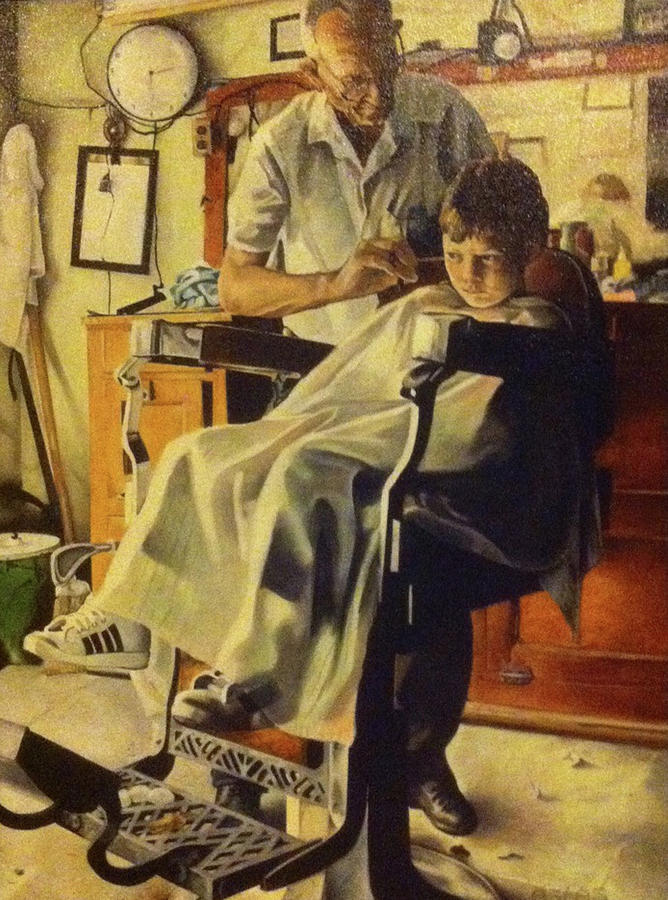
To say my late father, my namesake, did not love his fellow man is an understatement; in fact, he held most of them in bitter contempt. To complicate matters, he also had it in for the Old Testament god Yahweh, although he didn’t believe in him. On occasion, Daddy would wax evangelic, touting his atheism, which could be embarrassing, especially at Homer’s Barbershop, not exactly a hotbed of radical rhetoric.
So, in my early youth, rather than attending church on Sunday mornings, we watched religious dramas on our Zenith black-and-white TV, the one that occasionally required a hand slap on the side to restore reception.
Along with the Sunday morning show, Look Up and Live, my father also enjoyed hating Lamp Unto My Feet, another of its ilk, an ecumenical program that staged dramas fraught with moral conundrums. In the last five minutes of each broadcast, theologians analyzed the implications of the characters’ actions in light of various religious traditions. Not surprisingly, brotherly love was a recurring theme, whether the characters were Catholic, Protestant, or Jewish.
I remember one rainy Sabbath my father shushing my brother David and me as he watched Lamp Unto My Feet. He identified with the protagonist of this this particular episode, a righteous loner who kept to himself because he couldn’t tolerate the hypocrisy of his neighbors. When one neighbor found himself in serious trouble, rather than lending a helping hand, the protagonist turned his back on him. My father considered the protagonist’s behavior reasonable. Sometimes solitude is best society. Que sera, sera.
The theologians, not surprisingly, disagreed. In their estimation, the protagonist lacked brotherly love, which sent the old man into an eloquent tirade against mealy-mouthed moral blandishments.
Now that I think about it, my father didn’t have any close friends that I can remember. In fact, he rarely socialized at all, except with Junior Locklair and Lowdnes Bailey, who shared his love for aviation and, like him, owned aircraft they kept at Summerville’s airport. My mother, on the other hand, possessed friends galore, friends from childhood, friends from the neighborhood, friends from work, friends of all ages, young and old. They often dropped in at our house; my father’s friends seldom did.
us circa 1955
Unfortunately, it was my father’s contempt for the bourgeoise, not my mother’s open heartedness, that rubbed off on me. After all, my formative years took place in the 60s, an era of iconoclasm, rebellion, mockery. Jealousy, I’m sorry to say, fueled much of my dyspepsia. I couldn’t understand why dullards enjoyed more popularity in high school than red-headed, acne-ridden, sarcastic 120 pound me. How could the seniors vote Soupy Sales wittiest when Oscar Wilde was in the class?
The system seemed unfair, rigged, as poor losers are wont to say.
I packed this negative attitude in my suitcase with my bellbottoms as I headed off to the University of South Carolina, where I naively thought I’d encounter a more intellectual climate than Summerville offered. I was mistaken.
In my freshman and sophomore years, I cultivated a very small group of close friends. I rarely trooped en masse with my dormmates to Cornell Arms or the Russell House for meals, which was their custom. In other words, I never felt a sense of community in college – not in the dorms or with the school at large. In fact, in my four years at USC, I never attended a single football game.
It wasn’t until my thirties after I became a teacher at Porter-Gaud School that I learned the advantages that community can offer, especially in times of woe. Retirement and the pandemic have separated me from my Porter-Gaud pals. However, in my ripe old age, I’ve also found a sense of community at Folly Beach, that strange wave-pounded strip of sand south of Charleston, a mecca for misbehavior, a popular bachelor and bachelorette party destination, a place John Bunyan would abhor.
Bachelor Party at Chico Feo by Wesley Moore III
Most afternoons, I find myself at Chico Feo, where my wife Caroline and I are celebrities. As the bartenders see us approach on foot from afar, they reach into the cooler to fetch a Founders All-Day IPA and a “party water” (aka a White Claw). I can swap surfer stories with the young dudes; talk Slim Harpo with John, a badass harp player who fronts the revolving Sunday blues combo; discuss art with Tommy, the muralist who has brightened the bathroom door with a Lichtenstein-like rendering; enjoy the camaraderie of performers at Monday night’s open mic; shoot-the-shit with any number of people I hold in esteem rather than contempt.
I’m talking about Brotherly and Sisterly love, which beats the hell out of pulling a Heathcliff, ego-tripping in isolation, dining on resentments as bitter as the cud of vile, seeking shadows rather than sunshine, humming dirges instead of digging on Toots Hibbert.
Amen.
Tommy the artist posing by one of his murals
[1] I don’t mean to imply my father lacked compassion. In the mid-60s, he once welcomed into our home an abused African American boy, much to the chagrin of our all-white South Carolina subdivision.
Over my long reading career, I have come to esteem several fictional literary characters and consider them, if not friends, boon companions, individuals whose company I continue to enjoy. I’m talking about people[1] like Mark Twain’s Huck Finn, Jane Austen’s Elizabeth Bennet, Joseph Conrad’s Charlie Marlow, and Richard Ford’s Frank Bascomb.
When you come to revere such characters, finishing a novel or play becomes somewhat bittersweet because you really hate to see them hit the road.
My favorite, given his high intelligence and depth of feeling, is Hamlet the Dane. I wouldn’t go so far as Harold Bloom and claim that Shakespeare via Falstaff and Hamlet “invented the human” by setting in motion “the spark of human consciousness.” However, to me Hamlet is as real a person as my barstool companions at Chico Feo or my Great Aunt Lou, a formidable woman, but one not nearly as self-aware as the black clad prince.
Come to think of it, Aunt Lou is dead except in the minds of a diminishing number of Social Security recipients, whereas Hamlet has been alive now for over 400 years. The bottom line is that I feel great affection for him, and in an excellent stage performance, his death can still bring me to tears, and I don’t cry easily.
Of course, not everyone likes Hamlet as a person, which makes sense given that he is multifaceted and possesses an abundance of flaws.
Here’s the critic, director, and playwright Charles Marowitz:
I despise Hamlet. He is a slob. A talker, an analyzer, a rationalizer. Like the parlor liberal or paralyzed intellectual, he can describe every facet of a problem, yet never pull his finger out. Is Hamlet a coward, as he himself suggests, or simply a poseur, a frustrated actor who plays the scholar, the courtier, and the soldier as an actor (a very bad actor) assumes a variety of roles to which he is not naturally suited? And why does he keep saying everything twice? And how can someone talk so pretty in such a rotten country given the sort of work he’s got cut out for himself? You may think he’s a sensitive, well-spoken, and erudite fellow, but, frankly, he gives me a pain in the ass.
“Sensitive, well-spoken, and erudite,” but also witty, Churchillian in his ability to instantaneously whip up a bon mot or devastating insult. For example, here’s Polonius confirming to Hamlet that he acted in the university.
LORD POLONIUS:
I did enact Julius Caesar. I was killed i’ the
Capitol. Brutus killed me.
HAMLET:
It was a brute part of him to kill so capital a calf there. Be the players ready?
Here he is in so many words calling his “uncle-father” a piece of shit:
King Claudius:
Now, Hamlet, where’s Polonius?
HAMLET
At supper.
KING CLAUDIUS
At supper! where?
HAMLET
Not where he eats, but where he is eaten: a certain convocation of politic worms are e’en at him. Your worm is your only emperor for diet: we fat all creatures else to fat us, and we fat ourselves for maggots: your fat king and your lean beggar is but variable service, two dishes, but to one table: that’s the end.
KING CLAUDIUS
Alas, alas!
HAMLET
A man may fish with the worm that hath eat of a king, and eat of the fish that hath fed of that worm.
KING CLAUDIUS
What dost you mean by this?
HAMLET
Nothing but to show you how a king may go a progress through the guts of a beggar.
KING CLAUDIUS
Where is Polonius?
HAMLET
In heaven; send hither to see: if your messenger find him not there, seek him i’ the other place yourself. But indeed, if you find him not within this month, you shall nose him as you go up the stairs into the lobby.
KING CLAUDIUS
Go seek him there.
To some Attendants
HAMLET
He will stay till ye come.
“He will stay till ye come” could have come out of the mouth of James Bond.
To harken back to Bloom, how’s this for a 21st Century diagnostic catalogue of symptoms of depression delivered in the early 17th Century:
HAMLET:
I have of late, —but wherefore I know not, —lost all my mirth, forgone all custom of exercises; and indeed it goes so heavily with my disposition that this goodly frame, the earth, seems to me a sterile promontory; this most excellent canopy, the air, look you, this brave o’erhanging firmament, this majestical roof fretted with golden fire, why, it appears no other thing to me but a foul and pestilent congregation of vapours. What a piece of work is a man! How noble in reason! how infinite in faculty! in form, in moving, how express and admirable! in action how like an angel! in apprehension how like a god! the beauty of the world! the paragon of animals! And yet, to me, what is this quintessence of dust? man delights not me; no, nor woman neither, though, by your smiling, you seem to say so.
I could go on and on, but the point is that multifaceted fictional characters and poetic personae can provide for us in times of trouble some solace. One of the great fortunes of my life was stumbling into a teaching job at Porter-Gaud School where by necessity I was forced to reread time and time again great works of literature that provided vicarious lessons in the wisdom of stoicism. As I have said elsewhere:
“What I discovered in Thebes and Elsinore and Yoknapatawpha is that suffering is universal. To quote Rick from Casablanca, “It doesn’t take much to see that the problems of three little people don’t amount to a hill of beans in this crazy world.” In other words, suffering doesn’t make you special; it makes you human.”[2]
[1] Yes, I consider them people, people with complex inner worlds who change as they strut and fret through plot entanglements, finding at last (in most cases ) resolution, whether it be at their wedding or among the carnage of a corpse strewn stage.
I suspect that most small North American towns in the latter half of the previous century featured a commercial spot where teenagers gathered to be seen, to strut, to make asses of themselves, a spot like Mel’s Drive-In in American Graffiti.
At these gathering places cars and trucks crammed with hormonally imbalanced funseekers cruised the parking lots looking for love, or in the case of my hometown, Summerville, South Carolina, if you couldn’t “be with the one you loved,” you could start a fist fight “with the one you were with.”
In Summerville, Tastee Freez was the place. There we gathered after football games or dances to keep the night alive. At Tastee Freez, I ordered my first cup of black coffee as an antidote for the two beers I had forced down like castor oil in those early days of intoxication. At Tastee Freez, I witnessed an acquaintance break his hand punching a brick wall after receiving his draft notice. At Tastee Freez, I received an apology from Bobby Bosheen[1] for punching me at the Curve-Inn Pool the previous weekend.
“Sorry Bubba,” he said, “beer and liquor just don’t mix.”
With its circular driveway that allowed vehicles to “round, round, get around,” Tastee Freez was the place to check out the scene and to be seen. The bigger and louder the engine the better – 440 magnum bush cam, 4-on-the-floor, Hedman Headers, dual exhaust, and all that jargony jazz.
Before the OPEC embargo, gas cost as little as 35 cents a gallon, about the same as a can of PBR, the brew of choice in Flowertown circa 1969. Commercial radio stations were more likely to play oldies like “Stand by Me” than Hendrix, though “Crosstown Traffic” would have been somewhat apropos – though, come to think of it, much more so now.
On a Friday or Saturday night, my parents might let me borrow our 1964 Ford Falcon station wagon, a white four-cylinder bland-mo-bile with 3-on-the-steering-column. After my friend Gordon Wilson plowed into a runaway mule from Middleton Gardens and totaled the Falcon, my father in an act of spontaneous irrationality replaced it with a Triumph Spitfire two-seater, a convertible, which jacked-up my cool quotient a couple of notches as I orbited the Freez with the top down.
Little did we know that Summerville would soon explode, not from napalm or an ICBM, but from a population influx. As Springsteen put it, “there’s just different people coming down here now, and they see things in different ways.” Even though “everything we’ve known [wasn’t] [completely] swept away,” crosstown traffic does makes it hard “to get to the other side of town.”
Inching along the Berlin G Meyers Parkway ain’t exactly my cup of tea. Folly Beach, where I now live, is supposed to be overrun with people, but Summerville isn’t. But, hey, c’est la vie; you can’t blame folks for wanting to live in a beautiful place.
I guess it’s way past time to retire the cliché “hot off the presses,” and, as a matter of fact, the term BREAKING has supplanted HOTP as an indicator of new news “coming down the pike,” i.e., speeding down the turnpike headed your way in a 1961 Studebaker.
Anyway, hot off the proverbial presses, BREAKING, coming down the pike, this from the Associated Press:
The South Carolina House has voted to add the firing squad to the state’s execution methods amid a lack of lethal-injection drugs. The bill now goes to [prolife]Republican Gov. Henry McMaster, who has said he’ll sign it.
Dunno, wouldn’t hanging be a better alternative? Less messy? After all, gas chambers, electric chairs, hangings, and lethal injections seem more appropriately impersonal than shooting someone. Less messy, no hosing off blood splattered walls. Plus, only one or two people drop the pellets, pull the switch, knot the noose/trigger the trap door, or wield the syringe. A fire squad expands the number killers. Why spread potential guilt around?
Speaking only for myself, I’d hate to shoot a sentient being– and don’t beat me up for being sexist here – especially a woman, whether she be Elizabeth Bathory[1], Ma Barker, or Lizzy Bordon.
Questions arise. Where will the event take place? In the prison yard, at a firing range, or William Brice Stadium? How will the participants be chosen? From SLED, the Columbia Police Department, a local chapter of the NRA? Hopefully, the squad will wear uniforms; otherwise, it would seem very much like a lynching. The whole concept seems barbaric to me. I think of poor Fyodor Dostoevsky[2], the Easter rebellion participants[3], Eddie Slovik, etc.
Here’s a suggestion, state legislators: why not go 20th Century and opt for carbon monoxide poisoning?
Less fuss, less muss.
Or here’s an even better idea: pull the switch on capital punishment.
[1] Guinness World Records has her pegged as history’s most prolific serial killer/torturer/mutilator (~ 650 women between 1585 and 1610). Rumor also has it she “bathed in the blood of her victims to retain her youth.”
[2] The victim of the cruelest of practical jokes.
The last time I donned the ol’ pith helmet and ventured inside the rich anthropological domain of Folly Beach, SC, was on 17 March 2020 at the beginning of the COVID-19 epidemic. Even though it was St. Patrick’s Day, a holiday associated with the consumption of intoxicating spirits, a day when inebriates typically jampack the bars of the so-called Edge of America, only a few foolhardy hedonists stumbled the streets that Saturday, their left hands clutching red cups, their right hands thumbing their noses, as it were, at Dr. Fauci’s fervent pleas to stay indoors to stem the contagion.
Why would I – whom sociologists classify as geriatric, advertisers term a golden ager, and young people consider an old fart – expose myself to possible infection? After all, at 67, I fell into the likely-to-die demographic. Why, you ask?
Because I’m a scientist, damn it; that’s why.
Of course, I submitted a report of that field work, including video, which you can accesshere.
Well, 407 long days have elapsed since that death-defying foray onto the potentially contagious sidewalks of FBSC 17 March 2020. Now, with COVID cases waning nationwide (albeit spiking in India and elsewhere abroad) and having received two doses of the Moderna vaccine – the second one a month ago – I decided it was high time to investigate. With Caroline, my invaluable anthropological colleague, erstwhile grief counsellor, and crackerjack photographer at my side, we trekked to Center Street to determine to what degree behaviors have changed since the early days of the pandemic.
We set up base camp at Chico Feo and found that outdoor eatery a-swarm with Friday night foragers, mostly tourists, but a considerable number of local denizens lolled there as well. After one low-impact libation, Caroline and I decided to head straight to Ground Zero, the shitshow known as the Rooftop at Snapper Jack’s, a two-block walk. Before departing however, our sponsors, pictured below, suggested we be on the lookout for topers tippling drinks that Jenny (pictured far right) has dubbed “ho-a-canes” and “bro-nados.”
from left to right, Dylan, Patrick, Faith, and Jenny
At the base of the stairs leading to Snapper Jack’s rooftop bar, we encountered our first bachelorette crew, pictured below. They seemed to me, despite the festive pink cowgirl hats, a bit subdued. Caroline and I peppered them with questions. The 23-year-old bride-to-be (second from the left) had found, according to her, the “man of her dreams,” but her companion, the most loquacious of the quartet (far right), said she was patiently waiting for a man who “worshipped the very ground she stood upon” and would settle for nothing less. Upon hearing this, my subconscious selected from its poetic jukebox these lines from Yeats’s “Never Give All the Heart”:
Never give all the heart, for love
Will hardly seem worth thinking of
To passionate women if it seem
Certain, and they never dream
That it fades out from kiss to kiss . . .
Anyway, we bade them good fortune, wished the bride-to-be a long happy and fruitful marriage, and climbed the stairs passing through a portal that ferried us to the Jersey shore.
No doubt these images can attest far better than my spendthrift prose.
Ladies and gentlemen, as far as these folks are concerned, the pandemic is kaput.
And alien tears will fill for him Pity’s long-broken urn, For his mourners will be outcast men, And outcasts always mourn.
Oscar Wilde, “Ballad of the Reading Gaol”
In 1882, Oscar Wilde visited Charleston, South Carolina, a late stop on his tour of the United States and Canada. Although the tour had begun triumphantly with a fawning press hanging on the Irishman’s every word and with Wilde’s having killed a bottle of wine with Walt Whitman at his Camden home, trouble ensued when Wilde shared a train from Philadelphia to Baltimore with Archibald Forbes, a Scottish war correspondent who, according to Richard Ellmann, “found Wilde’s knee breeches [. . .] particularly repellent” and who “stung Wilde with stupid jokes about the commercializing of aestheticism.”
Wilde was, in fact, on his way to attend a lecture by Forbes entitled “The Inner Life of a War Correspondent,” but after suffering Forbes’ slings and arrows, Wilde decided to skip the lecture and head to Washington. This slight spurred Forbes to mock Wilde in that lecture and in letters to various newspapers. This negative publicity spilled over to influence other philistines of the press who found Wilde’s clothes and manners effeminate and ostentatious.
Forbes
Wilde
I say who is without ostentation cast the first stone.
At any rate, by the time Wilde rolled into the Holy City, he was an inviting target for smug homophobes like the News and Courier reporter who provided the following story excerpted from Oscar Wilde in America, The Interviews:
Of course, that Archibald Forbes and the unknown Charleston reporter are mere footnotes to Wilde’s story would not surprise Wilde, who said about his treatment by the press during his tour:
“I have no complaints to make. They have certainly treated me outrageously, but I am not the one who is injured; it is the public. By such ridiculous attacks the people are taught to attack what they should revere. Had I been treated differently by the newspapers in England and in this country, had I been commended and endorsed, for the first time in my life I should have doubted myself and my mission.”
As a former teacher in a middle and high school, I am all too familiar with this ostracizing of people who are different, and I warned students that bigoted impressions they make could become indelible, and though I won’t name names, I consider several people of classes who graduated in the early years of the previous decade cruel, the latter-day equivalents of Archibald Forbes, that boorish metal-bedecked blowhard Lilliputian pictured above. Unfortunately, for him, his boorishness lives on whereas those student bullies’ acts of unkindness will be merely remembered by their victims. Perhaps they have changed, but perhaps they’ve merely become more circumspect in expressing their contempt.
The good news, however, is that, for whatever reason, students today are so much more open-minded, especially towards homosexuality, than ever before, which no doubt is part of the sea change that has occurred in this country in the last three decades.
Tolerence, on the whole, is on the rise.
Shadow Self-Portrait with Judy Birdsong at Wilde’s tomb.
I’ve never cared for rock songs with lush orchestral arrangements, cellos and violins sugar-coating the three or four chords that make up the melody. Take the Stones’ “As Tears Go By,” for example, overwrought in every way, the lyrics lamenting unspecified dissatisfaction, the strings transporting the speaker’s melancholy to the suburbs of tragedy, Schmaltzville, where eyes mist over at the slightest sentimentality: puppy dogs, Grandmas, Eugene Fields’s bathetic “Little Boy Blue.”[1]
This is what I’m talking about:
snippet from “As Tears Go By”
Hey, crybaby singerboy, take a hint from Frederick Henry, read some Lucretius, grab an umbrella, and head to a pub.[2]
Compare “As Tears Go By” with this ditty from the same album, December’s Children.
snippet of “Get Off My Cloud”
Now, that’s more like it.
And speaking of the Stones, man oh man, after the psychedelic silliness of Their Satanic Majesties Request, hearing the six successive opening G chords of “Honky Tonk Women” was like welcoming home a long-lost prodigal cousin returning deprogrammed from some sort of Scientology-like hypno-indoctrination.
beginning of “Honky Tonk Women”
To quote that Big Mama Thornton of Modernist literature, Sweet Molly Bloom, “Yes!”
Anyway, I really dig garage bands, Sam the Sham, ? & the Mysterians, the Kingsmen, the Human Beinz, etcetera.
Forgive my Western predilection to have to rank things. It’s sort of stupid really, but that said, in my not-all-that humble opinion, the greatest garage album of all time – and this may surprise you – is Patti Smith’s first release, Horses – a masterpiece whose subtitle could be “TS Eliot meets the Troggs.”
For example, here’s a snippet from the first song of the flipside, “Kimberly.”
snippet of Kimberly
You “Waste Land” junkies out there no doubt caught the echoic allusion to bats with baby faces and violet skies.
Horses is Modernist garage band, flashing with fragmented musical and literary allusions that imbue its songs with concentrated meaning and ultimately create a constellation of images revolving around alienation.
In other words, it’s a work of art.
The masterpiece cut of this masterpiece album is the 9:42 penultimate song “Land,” which, to my ear, has the greatest transition in all of rock-n-roll. Check it out. (The transition occurs at 1.11 minutes.)
the beginning of “Land”
The boy was in the hallway drinking a glass of tea From the other end of the hallway a rhythm was generating Another boy was sliding up the hallway He merged perfectly with the hallway, He merged perfectly, the mirror in the hallway
The boy looked at Johnny, Johnny wanted to run, but the movie kept moving as planned The boy took Johnny, he pushed him against the locker, He drove it in, he drove it home, he drove it deep in Johnny The boy disappeared, Johnny fell on his knees, started crashing his head against the locker, started crashing his head against the locker, started laughing hysterically
When suddenly Johnny gets the feeling he’s being surrounded by horses, horses, horses, horses coming in in all directions white shining silver studs with their nose in flames, He saw horses, horses, horses, horses, horses, horses, horses, horses. Do you know how to pony like bony maroney Do you know how to twist, well it goes like this, it goes like this Baby mash potato, do the alligator, do the alligator
What follows is eight minutes of stream-of-consciousness as Johnny’s brain transitions from sentience to eternal silence.
Now that’s what I call transcending a sub-genre. It’s simultaneously raw and polished, gritty and eloquent, Rimbaud and Wicked Wilson Pickett playing pingpong backstage in a dance hall.
[1] I’m being unfair to the Stones, “As Tears Go By” isn’t nearly as bad as “Little Boy Blue.”
[2] Here’s Henry describing leaving the corpse of his wife in A Farewell to Arms.
“But after I had got them out and shut the door and turned off the light it wasn’t any good. It was like saying good-bye to a statue. After a while, I went out and left the hospital and walked back to the hotel in the rain.”