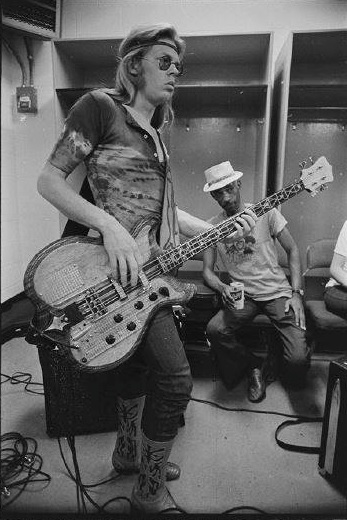
Hey, you’re probably too young to remember when Jack Casady, the bassist for the Jefferson Airplane, admitted that, like President Ford’s son Jack, he, too, had experimented with marijuana.
These twin bombshells dropped in October of 1975. President’s Ford’s “shaggy-haired, free-spirited son’s”[1]admission created quite a brouhaha, making the front pages of the New York Times and Washington Post.
ALEXANDRIA, VA – AUGUST 9: (NO U.S. TABLOID SALES) President Gerald R. Ford (R) and First Lady Betty Ford (L) pose with three of their four children (L-R) Steven Ford, John “Jack” Ford (not looking all that shaggy-haired), and Susan Ford in the family home on August 9, 1974 in Alexandria, Virginia. Ford stepped into office as president that afternoon, after the resignation and departure of ex-President Richard M. Nixon. (Photo by David Hume Kennerly/Getty Images)
Good ol’ Jack just celebrated his 80th birthday 13 April 2024
Of course, the Airplane’s bassist’s tongue was firmly in his cheek when he followed up Jack Ford’s confession with his own. After all, Jack Casady had laid down the bass licks on the Airplane’s 1967 hit “White Rabbit,” which ends with this exhortation – “Feed your head, feed your head, feed your head!”
Needless to say,[2] people had been fueling their crania via cannabis long before the double Jacks discovered its mind-altering qualities, as this soporific sentence from Wikipedia attests[3]:
The oldest archeological evidence for the burning of cannabis was found in Romanian kurgans dated 3,500 BC, and scholars suggest that the drug was first used in ritual ceremonies by Proto-Indo-European tribes living in the Pontic-Caspian steppe during the Chalcolithic period, a custom they eventually spread throughout western Eurasia during the Indo-European migrations.
Not surprisingly, it was the French, the inventors of un baiser avec la langue[4], who introduced marijuana to the West. Jacques-Joseph Moreau experimented with and wrote about cannabis during his travels to North Africa and the Middle East in the late 1830s.
In 1842, an Irish physician William Brooke O’Shaughnessy copped some quantity in Bengal and brought it back with him to Britain. Later, Charles Baudelaire got a hold of some hashish and extolled its effects. The red-eyed munchie-afflicted genie was out of the bottle.
Baudelaire demonstrating why it’s preferable to wear shades when you’re stoned. At least with shades, people might guess you’re stoned rather than seeing for sure that you are.
I won’t bore you with the history of its criminalization/ decriminalization. Even in South Carolina, which is about as progressive as electric shock therapy, a medicinal marijuana bill made it out of committee last week in a 9-5 vote. Now, it’s headed to the full Senate. At this rate, who knows, recreational legalization might take place by the centennial of the two Jacks’ admissions in 2175!
I should add, however, that the argument about whether cannabis is a gateway drug is still in dispute, despite the appearance of Wesley Moore’s score-settling poem published over a decade ago.
On the Slave Ship Lollipop
I used to stuff my face with candy when I was a little boy, couldn’t cop enough Mary Janes, would kill for an Almond Joy.
Then I graduated to the Real Thing – Coke. I was popping five cans a day, plopping nickels and dimes upon the counter under caffeine and sugar’s sway.
Now I’m hooked on heroin, am little more than a thug. Wish I’d known then what I know now – that sugar is the gateway drug.
[1] This hipster description comes to us from Business Insider’s website.
[2] EB White would disapprove of this transition, but he’s dead, and I don’t care.
[3] Don’t even attempt to read the senetence if you’re stoned.
[4] Or as it was known in my hometown of Summerville, SC, “swapping spit.”
If you know anything about language, you can tell immediately that the English adjective smug is of Anglo-Saxon origin. It’s short – one syllable – but certainly not sweet. After all, smug rhymes with ugh, that imitative sound of a cough that over time evolved into an interjection of disgust, the involuntary mouthing you might make when running across roadkill or this photograph.
[As in the case of Melville’s detailed explanations of various aspects of cetology in Moby Dick, an impatient reader is advised to skip the next two paragraphs and pick up the prose following the book image below.]
In English, smug first appeared in the 1550s and meant “trim, neat, spruce, smart.” Smug and smock are the immigrant offspring of Middle Low German smücken, “to dress,” as in “to creep or slip into.”[1] You smücken into a smock. Smücken itself comes from Low German smuk, which means “pretty,” even though it’s a homophone for the Yiddish word schmuck, which means dick, as in penis or schlong.
I can’t speculate on why the Low German word for pretty sounds so ugly or how it morphed into the Yiddish word for penis, which over time came to mean “a contemptible person.” I would hazard to say, however, that smug people are generally schmucks.
Ugh, smug Matt Gaetz is a dick, an entitled asshole[2], the type of insecure Lothario who carves notches in his bedpost (i. e., flashes photos of sexual conquests to acquaintances from his cell phone), the type of scuzzball whose success stems from being the scion of a wealthy shitwad who made a fortune providing hospice care, the type of chuff who frat-boyed his way from prep school to Congress exuding entitlement like a princeling dipped in AxL. Obviously, anyone who behaves with such reckless abandon has never faced any real consequences for his misdeeds.
And perhaps he’ll sidestep repercussions this time as well. After all, he’s hired Harlan Hill (pictured below) as his spokesperson.
But I wouldn’t bet on it.
[Full Disclosure: over the years, some have accused me of smugness just because of my relaxed demeanor, because I’m trim, neat, and smart, but they are wrong. I’m just snazzy, that’s all[3]].
I wonder what Matt Gaetz is up to this weekend. Shopping for lawyers? Taking one last peek at nude pix of his sexual conquests before erasing them on his iPhone 12?[1] Checking out rehab facilities?
I suspect right about now Matt probably agrees with TS Eliot’s assessment that April is the cruelest month, breeding investigations out of his sordid past, mixing memory with desire, etc.
You’ve probably heard the Hemingway definition of beauty: grace under pressure. Well, Matt’s initial response to the revelation that he may have been involved with sex trafficking with minors wasn’t exactly pretty. He allowed himself to be interviewed by Tucker Carlson and spewed a bucketful of ill-considered information, for example, that his father wore a wire in an FBI investigation. And although Gaetz has categorically denied the various lurid allegations, the long list of colleagues and acquaintances who can’t stand him are sharing raunchy stories of deviant behavior stretching back to his days in the state legislature where he represented Florida’s Panhandle, the setting of the murder in Easy Rider, i.e., a rustic-ridden south-of-Alabama rightwing hellhole.
Well, all I can say to Representative Gaetz are the very words I said to a drunk who got punched out by a woman last night at the Surf Bar, “There’s some danger in being an asshole.”
This incident is the second instance in which I’ve been interviewed by the Folly Police in the last year. The first dealt with a couple behaving Gaetz-like on the screened porch of a neighbor who had moved. He had asked me to keep an eye on the house, and when I saw a strange car in the driveway and the workshop door open, I donned my Philip Marlowe persona and investigated.[2] Despite my deafness, I heard some clamor on the screen porch and caught a heterosexual couple in flagrante delicto.[3] I suggested they leave, and they apologetically obliged, but the police caught wind, so I had to be interviewed. The owner was benevolent, didn’t press charges, but wanted the lustbirds to suffer some slight discomfort for their misdeeds.

The fellow last night at the Surf Bar suffered more than a little discomfort: he got punched twice in the face by a young woman who could have been Laila Ali’s sparring partner.
Caroline, our friend Whitney, and I were braving the cold on the porch of the Surf Bar enjoying their excellent Philly cheesesteak. This short White fellow in his twenties, dressed like an Eminem wannabe, approached our table and asked for a light, which we couldn’t provide.[4] There’s a fireplace on the porch, and five young women were sitting in a semicircle in front of it, enjoying the flames. After a while, I noticed that the young lighter-seeking man had joined them on the far end of the semicircle. I also noticed that the man and a couple of the women were engaged in a heated conversation. I asked one of the women who had returned from the restroom if the fellow was bothering them, and if so, I’d be happy to intervene. She smiled and said, “No thanks.” She then circled around the back of the dude and yanked the leg of his chair, sending him sprawling backward. As he attempted get up, she smacked him in the face twice with two well-delivered rights. Before she could cause more carnage, I leapt up and pulled them apart. He, of course, had been harassing them, had called one next to him the c-word, told her she was too ugly to sit next to, and continued to harass them until our heroine had had enough.
the fireplace at the Surf Bar
I suggested to the fellow that he mosey along because he wouldn’t want the police involved, but he adamantly refused and sat back down in the now upright chair, whining about how he had been hit. Some muscle from inside the bar emerged and escorted him out, trying, as I had, to reason with him.
It was sort of exciting in an adrenaline pumping way, and our meals were comped, but then who returns with policemen in tow. The twerp. He actually summoned the police because “a girl” had punched him. After interviewing the provocateur, the officer asked for my version, and I gave him a non-judgmental cinematic retelling of what had transpired, including the toppling and punching. The officer said this fellow had already been banned from several Folly bars and that he was from Philly on the lam from a petty larceny charge that was too smalltime to warrant extradition.
So that was that, but I couldn’t help but feel in light of how horribly Gaetz treats women, how horribly many men treat women, a certain warm glow of satisfaction to see the sawed-off Kid Rock get coldcocked by a pissed-off damsel.
Yes, there is some danger in being an asshole.
[1] I understand that nude photography is now commonplace among romantic partners and that sending explicit photos of oneself can be part of the early stages of wooing, and although I have no personal experience in the phenomenon, I do have some advice for Representative Gaetz: hire an airplane, fly down to Costa Rica, and drop the phone into the volcanic vent of Arenal.
[4] A less delicate sensibility than mine might tag him as a w-word, you know, that designation for funky clad White hip-hop aficionados that rhymes with the name of Roy Rogers’s horse.
When I was a child, I grew up across the street from Mr. Fagylalt, a Central European immigrant who owned and operated an ice cream truck.[1] In the summers, he circumnavigated our neighborhood, his truck tinkling repetitive music that lured nickel-and-dime-toting children to the edges of their yards. Back then, even in the heavy humidity of a South Carolina August, we mostly played outside.
I doubt that Mr. Fagylalt could make it today with children ensconced in their rooms engaged in Mortal Kombat or OD-ing on TikTok videos. I know I would have stayed inside if I had owned Madden NFL 2020 instead of the electric football game we owned. Most of the vibrating plastic players merely rambled around and around in circles. With an open field in front of him, a running back would suddenly hang a hard right and run out of bounds. You passed the ball by putting a felt oval in the quarterback’s hand, pulling his arm back, and catapulting the felt in hopes of hitting the receiver. It was so boring I rarely found anyone willing to play it with me.
Anyway, in those days, people called mobile ice cream vendors “good humor men, ” and, sure enough, Mr. Fagylalt was always in a good mood when I talked to him, or rather, when he talked to me. However, now when I think of Mr. Fagylalt, the adjectives “dirty” and “old” have supplanted “good” and “humor” as modifiers. Let’s put it this way: although Mr. Fagylalt never attempted to molest me in any physical way, he did infuse my vocabulary with a host of Anglo-Saxon vulgarities, words that no one used (at least in front of us) in our house. He didn’t define the words; I picked up their meanings in context from the same old stories he told over and over.[2]
Stories delivered in an accent as thick as Porkolt.[3] One of his favorites featured a mutt named Champ and our neighbors the Foxes, who lived on the corner of Lenwood and Dogwood. The Foxes kept a meticulous yard with neatly trimmed shrubbery and manicured grass. They took great pride in their yard’s appearance, seemingly removing fallen pine needles on a daily basis. One day Champ got into some ice cream chemicals stored in the Fagylalt carport. He ended up slurping down the found treasure and urinating on the Foxes’ chain link fence. “Oh, zat, dog,” Mr. Fagylalt would say in an aside and launch into a side story about the time he saw Champ mount such-and-such a bitch vividly describing the apparatus involved in the procreative act. Eventually, he’d return to the main plot, to wit: Mr. Fox mistook the brownish urine staining his fence for rust until a rainstorm washed it away. At the end of these too-oft-told tales, Mr. Fagylalt laughed and laughed. I hated every minute but was too timidly polite not to stand there for at least one retelling. I don’t remember if I faked-laughed myself, but I doubt it.
Luckily, Mr. Fagylalt and I had a falling out. One summer, when the Fagylalts vacated their house for several weeks, some friends and I entered his ice cream truck, which was unlocked. When inside, we merely looked around to see what it was like in there, and I discovered to my delight that the truck’s music was produced just the way a jack-in-the-box makes music – with a crank that propels a rubber mechanism that goes around and around plucking out notes.
Unfortunately, others at various times also got inside the truck and engaged in a bit of vandalism. When the Fagylalts returned and made inquiries, someone noted that he or she had seen a red-headed boy over there, so Mrs. Fagylalt told my mother, who ended up taking my word that I had not vandalized the ice cream truck. I also think my parents (and others in the neighborhood) were hip to Mr. Fagylalt’s off-color ramblings.
When I left for college at eighteen, the Fagylalts still lived across the street. I remember bumming a ride home one Friday for a weekend in Summerville. Upon arrival, as I walked across our lawn with a sack of dirty clothes slung over my back, a swarm of kids on banana bikes were popping wheelies in our yard. As I shouted “hey” to my nine-year-old brother Fleming, he yanked back on the handlebars too hard and landed on the ground on his rear end.
“If you keep that up, you gonna break your coccyx,” I warned.
He looked up at me with a puzzled expression.
“Sounds like you’ve been talking to Mr. Fagylalt.”
[1] Even though this man and his wife must be long dead by now – they were older than my parents – I’m going to obscure his identity in the very unlikely event that one of his offspring were to happen upon this post. Just for fun, though, see if you can guess his country of origin, as I sprinkle hints throughout the post. Hint #1: his native language is not Indo-European in origin.
[2] In James Joyce’s short story “An Encounter,” the young narrator runs across a Mr. Fagylalt-like man whose stories also orbit in circles: “He began to speak on the subject of chastising boys. His mind, as if magnetized again by his speech, seemed to circle slowly round and round its new centre. He said that when boys were that kind they ought to be whipped and well whipped. When a boy was rough and unruly there was nothing would do him any good but a good sound whipping.”
[3] A meat and vegetable stew popular in Székesfehérvár.
What do you think of when you think of Sweden? Viking ships? Ingmar Bergman? The Girl with the Dragon Tattoo? The blues?
The blues? What in the hell am I talking about?
I’m talking about Robert Lighthouse – nee Ivan R. Palinic[1], the Swedish blues guitarist who at the tender age of fourteen heard an Alan Lomax field recording of Muddy Waters – boom – Road to Damascus. Farewell, Nazareth, hail, Dr. Ross, John Lee Hooker, and Jimi Hendrix.
“Muddy ’67” photograph by David Gahr
I chatted with Robert in bright sunshine on our dock yesterday before his gig at the Singer/Songwriter’s Soapbox at Chico Feo, the best free music you’ll find in anywhere in what once was called Tri-County Area.[1]
Prompted by my questions, Robert related a CliffNote summary his life: moving to the States at eighteen, playing for tips on DC street corners, getting discovered by Charlie Sayles, the one-eyed harp master (who also got his start in music playing for tips on street corners).
Charlie Sayles
Robert toured Belgium and Holland with Charlie’s band and ended up landing a record deal of his own. His critically acclaimed first album, Drive-Thru Love, available on Smithsonian Folk Ways Recordings[2], includes both covers and originals. In addition to his second record, Deep Down in the Mud, Robert also appears on the Folkways compilation 1996 album, The Blues You Would Just Hate to Lose, Vol. II. He has shared a stage with Dr. John and opened for Taj Mahal and Johnny Winter, whom Robert describes as a man of few words but many bong hits.
The pianist/blues impresario Gary Erwin (aka Shrimp City Slim) recruited Robert to appear at blues festivals in Camden, Greenwood, and Charleston, and somehow, Robert and my brother Fleming met, and, the rest, as they say, is history.
If you ever get the chance, check him out.
Here’s a clip of his version of the Charlie Patton tune “Rattlesnake Blues.”
And him warming up at Chico Feo last night (8 March 2021)
photo credit I-and-I
[1] That be Charleston, Dorchester, and Berkeley Counties. The Soapbox runs on Mondays from 6 to 10. Be there are be square.
[2] How cool to share a label with Woody Guthrie, Pete Seeger Leadbelly, and Dave Van Ronk. I made the mistake of clicking on their website and see a Lord Lavender calypso record I can’t live without.
[1] Robert tells me that his surname, which is Croatian, means fire-starter, as in arsonist, so he anglicized it to “Lighthouse” in the sense of setting a house on fire, not in the sense of guiding sailors safely to shore.
During the 50s and 60s, my grandmother’s television, a small black-and-white model perched on a metal stand, played constantly, both day and night, commencing with Dave Garraway’s Today Show and ending with Jack Paar’s Tonight Show. [1]
When I spent the night with Mama Blanton, she allowed me stay up as long as I could keep my stinging eyes open. As a young child, I fought sleep as if it were an enemy, as if it were death itself. At home, I had to be in bed by 7:30 on weekdays and nine on weekends, so I always looked forward to staying over at Mama Blanton’s on Saturday nights and watching those old black-and-white movies, which seemed in my naivety ancient artifacts from a more glorious age.[2]
When I was five or six, I recall watching a Marx Brothers movie – probably Duck Soup – and making it past midnight. The Brothers’ antics enthralled me, especially horn-honking Harpo. I struggled mightily that night to stay awake but eventually succumbed to the Sandman’s strangle hold. Mama Blanton let me sleep on the couch until the movie ended, then led me, shuffling like a blind boy, to bed. I can’t recall if I realized then that the Groucho in the movie was the same Groucho (now twenty years older) who hosted the gameshow You Bet Your Life. However, I do I remember some time after the movie purchasing one of those Groucho masks featuring glasses, nose, eyebrows, and mustache.
I didn’t see another Marx Brothers’ film until college when my high school friend and Citadel cadet Gene Limehouse visited USC for a weekend. High on whatever, we decided to catch a matinee screening of A Night at the Opera at the Russell House theater in the student union building. Fifteen or so years had passed since that first taste of manic Marx Brothers madness at Mama Blanton’s, but once again, I was laughing out loud, though now appreciating more than the slapstick, taking note of the verbal cleverness and also the mockery of the upper classes, most deliciously, Groucho’s offering a tuxedoed opera attendee a tip for retrieving his top hat that had fallen from the balcony. “Go buy yourself a stogie,” Groucho says, leaning over the railing and offering the fuddy-duddy a coin, which he refuses in a huff.
Yet another fifteen years later when I taught AP English and we studied Marxian criticism, I’d show A Night at the Opera on the week of Porter-Gaud’s musical, offering exhausted students a reprieve of sorts. I’d explain how the promotion of the impoverished tenor, the rollicking fun the peasant passengers below deck enjoy on the trans-Atlantic voyage (as opposed to the stiff stiltedness of the first-class passengers), and the Marx Brothers’ revolutionary takeover of the performance of La Traviata conform to Karl Marx’s theories.
Although students back then – perhaps still do – balked at anything in black-and-white, the classes eventually got into it, sometimes applauding at the film’s conclusion.
A Night at the Opera, Marx Brothers’ movie with a Marxian message.
At any rate, I appreciate my grandmother’s liberality in allowing me to wander into her late-night adult world and watch movies not not necessarily suited for children, a benefit I passed along to my boys when they were growing up.
Despite the clucking of a few disapproving tongues at the time, I’d say we turned out okay.
[1] I remember the local NBC station’s signing off with the National Anthem, followed by a short film featuring the poem “High Flight,” and then an announcer’s canned spiel about kilowatts and licensing. That done, the Indian head test pattern appeared with its accompanying high-pitched whine. Finally, exactly at one a.m., a blizzard of static would obliterate the test patten. Time to go nighty-night.
[2] Ironically, many had been filmed during the Depression.
Captain Phil (You Can’t Keep a Maimed Man Down) Frandino
If you live within thirty miles of the Edge of America and can afford to party on Monday nights, you owe it to yourself to take in the Singer/Songwriter Soapbox held at Chico Feo from six to ten.
This event, hosted by the killer musician and songwriter George Alan Fox, showcases an eclectic array of music makers and poets, not only rockstar wannabes, but established entertainers like Danielle Howle and Robert Lighthouse.
The sessions have led to community building on Folly the likes I’ve never seen. Caroline and I I have met so many talented musicians – Pernell McDaniel, Jeff Lowry, and Captain Phil Frandino, for example. Plus, I’ve developed a greater appreciation for talents of people I already knew, like Charlie Stonecypher and his funky ukulele (complete with wha-wha pedal), and now I’ve developed an even greater appreciation of the deep and soulful poetry of my pal Jason Chambers. Not only have the performers grown closer with each other, but they have also formed friendships with the audience as well. The word family is overused, but it is sort of like that, like distant cousins at a family reunion.
Last night the guitarist David Sink sat in with the acts, and man, oh, man.
The first clip features George Fox performing a lovely original song “Books, Seeds, and Bullets” inspired by the Singer/Songwriter Soapbox.[1]
[1] And what an honor have my name mentioned in the lyrics.
video shot by Fleming Moore
Next some solo guitar work by David Sink at the end of Brother Fleming Moore’s paean to marital discord, “Busted Husband.”
Oh yeah, and Pernell McDaniel was in the house selling copies of his new CD. More about that later!
Jack the Mighty Springer in Rantowles, SC, circa 1982
If dogs run free, why not me Across the swamp of time? – Bob Dylan
Several years ago, my late wife Judy Birdsong and I rented a car and crisscrossed Costa Rica on a combination surf safari and sight-seeing tour. Among my favorite spots was the surfing mecca Malpais located at the southeastern tip of the Nicoya Peninsula on the Pacific coast. The town itself hardly qualifies as a town, consisting of a handful of shops and small dwellings along an unpaved road running parallel to some of the most beautiful coastal scenery I’ve ever seen.
Malpais (photo credit Judy Birdsong)
What really struck me about Malpais, however, wasn’t the stellar surf or the intricate rock formations that studded the beach, but it was just how happy everything around there seemed to be – the school children in their colorful uniforms smiling and skipping along the muddy road, the shopkeepers beaming from the doors of their humble establishments, the birds trilling somewhere out-of-sight. Even the dogs seemed to be grinning as they trotted to and fro unencumbered by fencing or leashes. The only discouraging sound to be heard was the dragon-like bellowing of howler monkeys looking askance from treetops.
A Facebook post from my former student Elizabeth Rowell Griffiths has awakened my memory of the happy pooches of Malpais. In her post, Elizabeth reminiscences about a couple of canines that ran free on the Porter-Gaud campus in the previous century, a golden retriever named Chief and a basset hound named Rufus. Rufus belonged to Berkeley Grimball, the headmaster, whose house was part of the campus, so it makes sense that Rufus might wander among the students of the Lower, Middle, and Upper Schools; however, I don’t remember to whom Chief belonged – maybe he lived in the Crescent, an upper end neighborhood adjacent to the campus.
What a charmed life these dogs led, beloved by scores of children who knew them by name, cooed to them, petted and scratched their heads. Elizabeth’s post elicited happy responses like “We loved those dogs” and “Those were our dogs.” Some fellow I don’t know added, “I never went to PG but I remember those dogs! We lived in Wappoo Heights.” So it seemed these free-range dogs enjoyed a rather large territory.
Of course, it comes as no surprise that my hometown of Summerville featured dogs that ran free in the less regulated ‘50s and ‘60s. My favorite was Ludie, a springer belonging to the Baldwin family who lived between South Main and Sumter Avenue. Ludie frequently visited James Spann Junior High and, like Chief and Rufus, enjoyed both fame and devotion. My friend Becky Baldwin tells me that Ludie was named after a bootlegger from Hell Hole Swamp. Even when Becky’s mama would lock him up to prevent him from following Becky to school, Ludie would head to Spann immediately after being let out later in the day. He was, I think, the first springer I’d ever seen and played a prominent role in Judy’s and my choosing springers as our first pets as a married couple. We eventually through carelessness bred Jack and Sally who produced two litters. In fact, we ended up selling one of the puppies to a family who lived in the Crescent. After the second litter, we had Sally fixed, which put an end to that. I have to say, though, those puppies sold like Chick-Filet sandwiches.
Ludie and Becky
My boyhood dog, a black cocker named Bozo, also enjoyed freedom but rarely wandered outside our half acre. Perhaps “Beetle” (as in Beetle Bailey) would have been a more appropriate moniker given Bozo’s propensity to spend the vast majority of his days asleep under a tree.
I recall sadly that day when Bozo did wander off and we couldn’t find him for a few hours until our neighbors the Foxes informed us that they had discovered Bozo dead in their backyard.
Alas, for me, it’s sad that dogs’ abbreviated life spans mean that we get to know them both as puppy toddlers and stiff-legged geriatrics. In my adulthood, I have gone through the springers Jack and Sally, a golden retriever Bessie, a short-lived German longhaired pointer named Saisy (you can read her elegy here), and now KitKat, a chihuahua rat terrier mix who is two and has a very good chance of outliving me.
From James Fenimore Cooper through Toni Morrison, American Literature features themes that appear again and again in different guises.
One theme is interracial bosom friendship, which is much more common in American literature than in American life. Before the Revolution, Natty Bumppo and Chingachgook roam the wilderness of the eastern seaboard battling bloodthirsty tribes and rescuing damsels. Later, Ishmael and Queequeg circumnavigate the seven seas in pursuit of the great white whale while Huck and Jim drift down the Mississippi encountering scalawags at every bend of the river. And let’s not forget about the Lone Ranger and Tonto thundering forever westward on the backs of Silver and Scout.
Adventure!
Tall tales constitute another motif in the American canon in exaggerated heroes like Paul Bunyan and Pecos Bill. Occasionally, more serious works incorporate characteristics of tall tales, as in Faulkner’s magnificent story “The Bear” where Sam Fathers, an ancient native American, teaches young white Ike McCaslin the ways of the woods. Each year, the generations of Jefferson’s menfolk have hunted for Old Ben, a seemingly immortal bear of mythic proportions. Old Ben remains unvanquished until the hunters encounter and half tame a wild airedale mix that might well give Cerberus, the Hound of Hades, a dog-whipping. Alas, Ben’s killing, so long sought after, depresses his pursuers, marks the end of an era, because Ben himself had become synonymous with the wilderness. The old days are done. Farewell, country store; hail Walmart.
Indeed, the wilderness itself represents the most constant motif in American literature, and even as early as The Leatherstocking Tales, it is beginning to vanish, “the doomed wilderness whose edges were being constantly and punily gnawed at by men with axes and plows who feared it because it was wilderness.”[1]
As children growing up in Summerville, South Carolina, we Twin Oaks kids enjoyed acres and acres of woods where we built forts, played cowboys and Indians, and acquired chiggers. Of course, those woods were also doomed, their trees eventually felled, replaced by ranch-styled three-bedroom houses with lawns of centipede and Bermuda.
Along with Salisbury Acres and the Tea Farm, Twin Oaks was one of the earliest settlements subdivisions, and as other housing developments sprung up, more and more of the woods within and surrounding Summerville disappeared. By the time I was in high school, much of it was gone, except for a large tract of undeveloped land behind Newington Plantation, an old phosphorous or sand-mining site we called “the Clay Pits.”
The “Clay Pits” with its ponds and crisscrossing dirt roads provided a refuge for crazy mixed-up kids seeking a secluded spot for, as we called it back then, “making out”[2] or adventures as we rode motorcycles back and forth on the rutted dirt roads and camped out among the loblolly pines. Although we didn’t realize it, our carefree days were receding as rapidly as the woods in and around Summerville.
In fact, it was on one of these campouts in the Clay Pits that I first dropped LSD. It was the night of my 18th birthday, and let me assure you, a good time was not had by all. That December night marked the end of my childhood. It was not an adventure that Tom Sawyer might enjoy, but a misadventure, a depressing sequence of hapless events more suited for a documentary on social decline than a celebration of youthful exuberance.
To protect the guilty, I’ll change the names in “Dear Abby” fashion. There were “Farley,” “Micky,” “Marty,” and “Ian.” Farley had acquired four hits of the same variety of acid and one hit of something called “Czechoslovakian Cherry,” which I unfortunately ingested.
After an hour or so, everyone but me had gotten off and was oohing and aahing at phantasms invisible while I shivered forlornly in the cold. Farley suggested we take a drive within the Clay Pit confines, which would at least provide some warmth, and it was during that drive that I first started feeling the effects. While the Hollies’ hit “He Ain’t Heavy, He’s My Brother” – a song I didn’t particularly like – was playing on the radio, an electrical rush of sensation shivered up my spine.
Back at the campsite, suddenly I found myself in the throes of harrowing hallucinations and felt overwhelmed, only to discover that my girlfriend and her best friend had sneaked out of their houses and ridden their bikes to the campsite. Under normal circumstances, I’d be delighted, but my girlfriend’s appearance filled me with dread that her mother would discover her disappearance and track us down somehow. At one point as we lay on my sleeping bag, it felt as if a gigantic boulder was crushing me.
Eventually, the boulder lifted, my girlfriend and her friend pedaled off, and my paranoia abated. At one point Ian said to me, “Look, Micky looks just like Moses,” and sure enough, there Micky stood with a long white beard and wearing a long white robe.
The last phase of an LSD trip, a physiological event that for me negates whatever fun you might have had, is crashing, coming down off the drug. They said back then that LSD contained strychnine, which was responsible for the bodily trauma that crashing produced, but as it turns out, that’s an urban myth. Whatever the cause, when the sun came up on the first day of my nineteenth year, I was one miserable, guilt ridden human being, racked by remorse and bodily aches and pains.
Farley drove me home. When I arrived at the house, everyone but my father had gone to church. He was lying in bed smoking cigarettes as I slipped into my room, then headed to our one bathroom equipped with a tub. Lying there guilt-ridden in lukewarm water accompanied by a bit of floating pine straw, feeling as woebegone as I had ever felt, I heard my father’s voice booming from his bedroom.
“Rusty, what did you do with my wingtips?”
This really pissed me off. Rusty wore desert boots, not wingtips, in fact wouldn’t be caught dead in a pair of wingtips and didn’t wear the same size shoe as his father.
“Rusty, what did you do with my wingtips?”
Oh, to be able to hop on that raft with Huck and Jim or to sign onto a whaling voyage (albeit a doomed one) with Ishmael and Queequeg or to track a mythic bear through the wilds of Yoknapatawpha County with Ike and Sam!
Oh, to be anywhere else besides 201 Lenwood Drive with Wesley and Wesley.
[2] Some called the activity “parking,” but none of us, to my recollection, ever called it “petting” or “canoodling,” the last being a word I never heard until adulthood. One night, my former school bus passenger-turned-police-officer Pike Limehouse shooed my girlfriend and me from the Clay Pits, an embarrassing encounter if there ever was one. By the way, have you ever noticed that in ‘50s horror films, teens making out tend to be the monsters’ first victims, a tribute to the puritanism that is also a major American literary motif.
In Hawthorne, unlike Thoreau, the Wilderness is manifest darkness, the abode of witches and Old Scratch himself, the New England equivalent of the Clay Pits.
If ever an event exists that epitomizes Late Empire decadence, it’s the Super Bowl, the trashy teenage illegitimate daughter of Walt Disney and Joan Rivers.
First, there’s the obscenity of the salaries of these gladiators who essentially entertain us through ritualistic war, a string of overhyped “battles,” each becoming less memorable as the Roman numerals march on into Super Bowl oblivion. Admittedly, it can be fun to watch these impressive specimens of predatory machismo smash into one another, sidestep tackles, propel perfect spirals, and make acrobatic diving fingertip grabs (though their inability to master the snap count can become tedious).[1] Nevertheless, you can’t help but wonder if the over-compensation for these essentially physical skills is indicative of some sort of skewed cultural atavism that harkens back to Spartacus. Why, for example, does the secondary coach of the Baltimore Ravens, whoever he is, earn considerably more per annum than Pulitzer winning novelist Richard Ford? Not to mention Deion Sanders[2] whose career earnings undoubtedly dwarf Cormac McCarthy’s, Toni Morrison’s, and Philip Roth’s combined?
Can you guess which house belongs to Deion Sanders and which to Robert Frost?
Second, there’s the Roman circus of the halftime show, which began innocently enough in the late Sixties with marching bands, but now features antediluvian rockers like Steve Tyler and the Who or commercial hiphoppers like the Black-Eyed Peas. These performances nearly always end up flat (Prince and Springsteen being exceptions) and occasionally can be painful to watch (Grandpa Jagger frenetically cavorting back and forth across the stage as if it were strewn with red hot coals).[3] I’m far too lazy to research the cost of these extravaganzas, but I suspect we could coax the Dalai Lama to meditate on the artificial turf at halftime for free, which would be more entertaining than 90% of the halftime shows I’ve suffered through.
Brittany Spears passing gas at the 2008 spectacle
What, may you ask, binds together all of these facets of this undeclared national holiday – the verbal jostling of the interminable lead-ins (Terry Bradshaw bickering with Howie Long) – the game itself, the outsized attempt at halftime entertainment, the pratfalls of the commercials?
Aggression, that’s what. Aggression is what separates the winners from the losers, those who pay sticker price from those who browbeat the salesperson into surrender, those who claw their way to the top from those who rely on honor and integrity to guide their lives, those who bury their helmets into the runner’s chest from those who wanly attempt an arm tackle.
Aggression is what fuels capitalism, and sports is a wonderful training ground for aggression, from the bestial grunting of tennis players returning volleys to the narcissistic celebratory endzone fandangoes of wide receivers. These gladiators are worshipped in their high schools and wooed by head coaches who during recruiting banter with mothers they would never actually associate with otherwise. No wonder most professional football players possess Caligula-sized egos. These mannish boys have clawed their way to fame and fortune (the latter thanks in part to their labor unions).
Who can blame them for copping the Conan the Barbarian look?
Mike Roemer Photography Inc
[1] When I played junior varsity football for the mighty Summerville Green Wave, we were so collectively stupid that we could only go on “hut one.”
[2] I had the misfortune to share an elevator with Deion once, who exuded all of the warmth of a Secret Service agent as he avoided eye contact with the children asking for his autograph.
[3] To be fair, I saw the Stones in 2019, and they were terrific. The Supper Bowl performance was an aberration.