Dog Gone


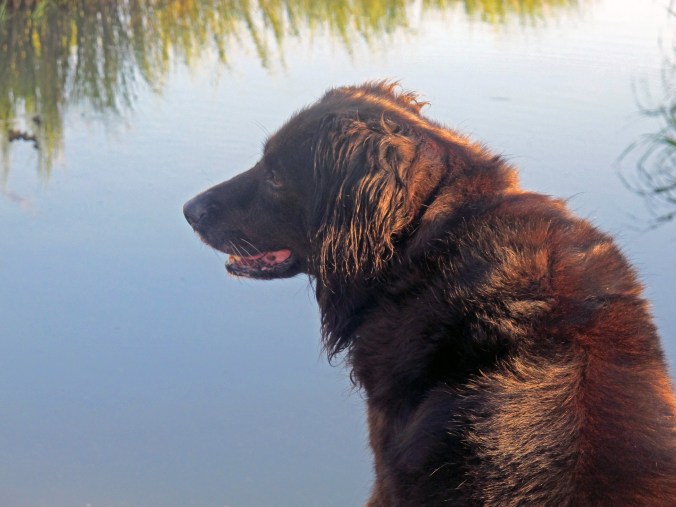
Long gone Saisy (read and hear her elegy here)

When I teach poetry, I get technical, especially with meter, because to me the marriage of sound and sense is what alchemizes verse into poetry.   Over the years, trying to get students to replicate a line of iambic pentameter or anapestic trimeter, I’ve had them bopping bongos, rapping desktops with drumsticks, clapping their hands.

Frankly, rhythm doesn’t come naturally to many — if not the majority; nevertheless, I’ll continue to emphasize meter until the end of my career, which is just around the corner, almost within shouting distance.

With the six-month anniversary of Judy’s death approaching, I have been ever so slowly inventorying and eliminating. Going through some drawers yesterday, I ran across this twenty-year-old poem/parody I wrote as an answer to a student who asked after a session of metric hand clapping, “Is there such a thing as iambic monometer?” Right then and there, I composed an answer on the chalkboard (I believe it was still the age of slate and chalk, but I could be wrong).

That night in my drafty garret at the Isle of Palms, I typed the poem and went on an over-interpreting binge, which was probably bad pedagogy since most students believe that teachers read far too much into poems anyway, but I just couldn’t help myself. I had to justify the reason for anyone ever to write a poem in iambic monometer.

Without further ado, I present it to you here, the annotated version.  Read it and weep.


Yes, Preston Wendell, There Is Such a Thing as Iambic Monometer[1]

The old dog barks backward without getting up.

I can remember when he was a pup.

The fret-[2]

ful Dog

is dead

and gone.[3]


[1] Preston Wendell studied under Wesley Moore in 1996-7. Wendell’s question led to the genesis of the poem. The epigraph is from Frost’s “The Span of Life.” Obviously, the choice of iambic monometer and the resultant abbreviated lines with their clipped cadences offer a visual and auditory parallel to the relative brevity of a dog’s life.

[2] Cf. Macbeth 5.5 “Out, out brief candle/Life’s but a walking shadow, a poor player/ That struts and frets (emphasis mine) his hour upon the stage/And then is heard no more.”

[3] It was been pointed out that the approximate rhyme dog/gone, not only embodies the crux of the poem, but also may be taken as a minced oath bemoaning the transitory nature of life.


Now, let me remove tongue from cheek and put some whiskey there instead.

Old Dog, New Tricks, featuring Dick Dale and Jimi Hendrix

Stratocaster

“Don’t know much about history.” Sam Cooke: “(What a) Wonderful World”


This semester I’m teaching my first history course ever, America in the ‘60s, which has been a challenge because (one) I wasn’t even a history minor, much less a major, (two) I’ve never taken a course on the ‘60s [1], and (three) I’m beat (as in Ginsberged/Kerouaced [2]), i.e., beaten down. Like, every glance in the fluorescently brutal faculty restroom mirror finds me staring into the red-rimmed eyes of Charles Bukowski’s doppelgänger, a visage that makes Bill Murray look dewy.[3] It’s not the face of a novice teacher. Or a middle-aged teacher.

Charles Bukowski

And this teaching a new course takes energy. I find myself in a sort of a footrace with my students, maybe half a block ahead, as I learn the material and create content through multimedia lectures. It always feels as if they’re gaining on me.

On the other hand, I have learned a great deal about civil rights and Vietnam. Ask me about the Little Rock Nine, the Gulf of Tonkin Resolution, or My Lai, and I can name names, Calley and Colburn, for example. In fact, when that trove of Kennedy assassination papers came out last week, I could better appreciate LBJ’s’ theory that JFK’s offing was tit-for-tat revenge after the CIA had sanctioned the assassination of South Vietnam’s sorry-ass Premier Diệm.

Of course, acquiring knowledge is a valuable side benefit of teaching. You reread Emerson and discover you were too young to appreciate him back when it was pimples, not crevices, you saw in the mirror. The Faulkner sentences you couldn’t unravel back then start singing. Hairs stand up on the back of your neck. Those hairs begin to samba.

Anyway, with those students in hot pursuit, I decided to segue from campus protests to the counterculture and the evolution of 60s pop music. I figured with my not inconsiderable knowledge of those areas, [4] I wouldn’t have to prepare as much, which hasn’t been quite true, but getting the scoop on Berry Gordy isn’t as nearly a downer as revisiting the 16th Street Baptist Church bombing.

I don’t have a text, so, like I said, I’m creating the factual content in Keynote presentations that students download from my website. They’re pretty cool because you can embed videos without jumping off to access YouTube. You can watch Elvis swivel instead of reading descriptions of him swiveling.

I’ve divided the decade into four mini-eras: Early 60s (1960-3)[5], the British Invasion (1964-66), the Summer of Love (1967), and the Late 60s (1968-1970, including Woodstock and Altamont).

Of course, this division is overly simplistic. I’ve put Motown and Stax in the early 60s despite Marvin Gaye’s “What’s Going On” and Otis Redding’s triumphant, heartbreaking performance at Monterey in ’67.

One of the subdivisions of early 60’s is surf music, which I divide into vocal groups (Jan and Dean, The Beach Boys) and instrumental groups (The Safaris, Dick Dale). What occurs to me after watching some Dick Dale performances and interviews is that he might be one of the most under-appreciated innovators and influences in rock history.

Methamphetic bio: Arab descent, Eastern music scales, California surf breaks, Stratocaster reverb, souped-up riffs.

Dig this from 1963.


Hendrix in 1969


Hendrix famously said, “You’ll never hear surf music again.” Did he mean the Beach Boys? That Hendrix was so good surf guitars wouldn’t hack it?

Here’s what Dale says in an interview with Surfer Magazine:

I read that when Jimi Hendrix said, “You’ll never hear Surf music again,” that was in reference to your battle with cancer. Is that true?

You know what’s so funny? Why didn’t they say the rest of his sentence? Do you know what the rest of the sentence is?

No, I have no idea. What is it?

I had never missed a gig in my life, and I had a temperature of 104, and I couldn’t even talk…and had got hit real bad with rectal cancer. Jimi was recording in the studio and said, “I heard Dale did a no-show. That’s not like him. You know?”

His guitar player said, “No man, he’s dying.”

They had given me three months to live.

Then Jimi said, “You’ll never hear surf music again.” And then he said, “I bet that’s a big lie. Let’s pack up, boys, and go home.”

That was the full f–king sentence.

Gotta go.  I got class tomorrow and the British Invasion to tee up.


[1] I did, though, pay attention while stuff was happening like the assassinations, the fire-hosing, the ’68 convention, etc.

[2] Pronounced Karo-whacked.

[3] The trade off in losing 25 pounds is resulting gaunt face looks older because facial fat has a Botox like effect.

[4] Note the arrogant modesty in the double-negative.

[5] I place Motown and Stax in this unit, though, of course, those artists flourished in the mid-to-late 60s as well.

The Duchess of Doggerel

On the week after his thirtieth birthday at the onset of the Great Recession in June of 2008, the day after his girlfriend of two years had dumped him, Bennington A. Rhodes IV lost his job at Citigroup.
On that Thursday at her condo in the early evening, Amy had lowered the axe, explaining that their relationship had “plateaued upon a plain.”

“So being with me,” Bennington had asked, “is, like, a long, boring stretch of Kansas Interstate?”

Amy, a slender, doe-eyed only child with a tiny mouth and incredibly meticulous handwriting, was going places, and Bennington had liked to imagine that he’d be tagging along.  He meekly stormed out of her building (an emphatic door shut, carpeted condo stomp) and headed downtown to drown his sorrows in a tsunami of single malts.  (After unwadding the $68 bar tab the next day, he came close to weeping when he saw the $32 tip).

When Zaubi called him into his office at five the next afternoon, Bennington was still feeling terrible, suffering the worst hangover since Kappa Alpha.  As Zaubi’s soothing baritone – the voice of reason – clicked off the numbers, Bennington sat there across the desk dumb. It wasn’t as if getting laid off was such a shock – he was the most recent hire – but psychologically the timing couldn’t have been worse.  It seemed like a curse.

Axed, and then, axed, whack, whack.

Amy had assured him that there was no one else in the picture and perhaps their relationship might resume somehow in the vague future, but that had been four months ago, and he’d only seen her once since, at Rue de Jean’s among a too loud table enjoying a late lunch that had stretched to four on a Friday afternoon.  Sitting at the bar nursing a Miller, Bennington glanced over to his left to try to catch Amy’s eye, but every time it seemed her head was tilted back in open-mouthed laughter. The table was raucous – there were nine of them – ricocheting guffaws off the dark brick walls of the converted warehouse.  Bennington, pointing to the table with his thumb, asked the bartender Smoak if he had a taser he could borrow, and Smoak said he’d put on music to create some background noise.  Somehow, when Bennington was in the toilet, Amy had disappeared.  He was running out of money. The economy was tanking, He was heartsick.

Saturdays had become especially grim.  No longer able to afford the sports bars, he sat alone in his mortgaged condo in front of his no-money-down flat screen TV watching SEC football, pulling for his alma mater Vanderbilt, whose games were virtually never broadcast in the Charleston market.  He watched whatever SEC game was on, keeping a vigil to catch the current Vandy score that periodically crawled across the bottom of the screen.  Today’s CBS broadcast, Georgia vs. LSU, was a blowout.  However, if Vandy could beat lowly Duke this afternoon, the Commodores would become bowl eligible for the first time since 1982 – since Ronald Reagan. The bad news, though, was that they were down early, so Bennington sat on a beanbag chair munching Cheese Nips, keeping an eye peeled for the score.  How he used to look forward to Saturdays, furloughs from panicky investors and irksome emails; now he dreaded Saturdays the way he once had dreaded Mondays.

The final score crawled across the screen:  Duke 10 Vandy 7.

He had to get out.  To rent a DVD from the library, to read a good biography, to somehow shake off the lethargy. With gas prices soaring, he thought about walking to the Library on Calhoun, but it was too far, especially round trip, so he drove instead, crossing the bridge with the top down, the wind ruffling his hair,  a month past its usual close-cropping.  Parking was free under the library building if you got your ticket stamped, but as it turned out, traffic was light, so he snatched an open space on the street.

Once inside, Bennington decided to scan new book releases before heading to biographies and then the DVD section.  This new library, open and airy, was so unlike the old one on King Street with its dusty stacks and down-and-out warmth-seekers.  Here, high school students paraded past t-ball moms laden with stacks of books while retirees stared into computer monitors.  In the new releases section, Bennington toyed with picking up Hot, Flat, and Crowded, hoping that the imminent destruction of the planet and all its life forms might put his own puny problems into better perspective, but he left it there and made his way upstairs to check out the biographies.

On his way through the stacks, walking slowly, he ran his finger across spines of volumes of poetry making a soft rat-a-tat when one of the titles caught his eye: From the Green Horseshoe: The Poetry of James Dickey’s Students.  Marisa, a summer Vandy fling, had been one of the last of Dickey’s students.  Maybe one of her poems had made it into the anthology.  He removed the volume and opened it, rifling the pages, looking for her name.

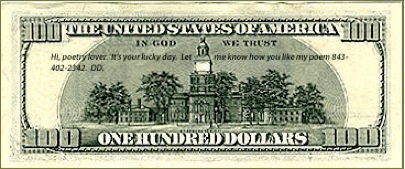
Whoa!  Wait a minute!  What was that?  He thumbed through more slowly, and it was there, a  $100 bill.  Excited, he flipped the note over to assure himself it was legal tender.  Someone had written something above the trees and steeple of Independence Hall.  A message?

Hi, poetry lover. It’s your lucky day. Let me know how you like the poem on page 137. 843-
402-2342. D.D.

Bennington pocketed the bill and read the poem:

From the Porch of Her Glass House, the Duchess of Doggerel Chunks Rocks at the Grave of Joyce Kilmer

                                                                                  By Delaney Dodd

The metronomic tick-tock of his maudlin verse

is like Chinese water torture, only worse.

Worse, because his sugary singsong strut

goosesteps across your forehead, then stomps down your gut.

And those monosyllabic Dollar Tree words!

Plopping in sequence like marshmallow turds!

Sure, Joyce, trees are worthy of our veneration,

even if they’re the products of random mutation.

But, dude, it’s great poetry, like Milton’s, that a-stone-ishes me,

not the prosaic process that produces a tree.

Bennington wasn’t a fan of poetry.  He had often wondered in school why they made you read it all the time.  At least this poem rhymed.  But it didn’t flow right.   Should he call this woman?  He was guessing it was a woman. Would she want the hundred back?  She had to be crazy.  Desperate for attention.

Really, really, lonely.

Her answering machine engaged:  “Leave a message.”

Beep.

“Uh, Delaney. I found your note and the money in the book.”

Click.

“Hello.”  Her voice was breathy.  “What’s your name?”

“Uh, Bennington Rhodes.”

“I see. A man of truth.”

“Huh?”

“Like, it says on my Caller I.D. ‘Bennington Rhodes.’  You’d be surprised how many Bobs claim to be Antoines.”

He wondered how many c-notes she had distributed in libraries. “Really?  Why?”

“To cop a cool vibe from a new name.  Like, Bennington, your name screams Republican, municipal bonds, bow ties.  You might think, ‘I’ll punk this chick by copping the name Slade Rucker.’  Now what kind of vibe do you get from Slade Rucker?”

“Sounds like a cross between a private eye and some sort of industrial machinery.”

She laughed. “Bingo!  Look, Benny, I hear you’ve come into some cash.  How bout buying me a drink?”

“When?”

“Now.”

“Right now?”

“Where are you, Benny?”

“Downtown.”

“Great, I’m just around the corner on Heart Attack and Vine.  Say fifteen minutes at The Roof Top Bar on Vendue?”

“But how will I know you are you?”

“Don’t worry.  I’m me.”

***

On the short drive to Vendue, Bennington suffered a pang of buyer’s remorse.  He’d read about people hooking up on-line with imposters, sultry-sounding sirens who were actually hairy-backed bald-guys in wifebeaters. This woman sounded young, but she could be in her fifties for all he knew.  Though he didn’t hang with artistic types, his poet friend Marisa had been stuck on herself, as if her tendency to see dewdrops on eucalyptus leaves as symbols made her somehow precious.

The bar was on top of the Vendue Inn, a quaint hotel with dark pine floors and Oriental runners. In a narrow hall, he waited for a tiny elevator, the kind you might find in a European hotel.  As the elevator door opened, an attractive twenty-something blonde in jeans and a black turtleneck hurried through the lobby, so Bennington pressed the open-door button to wait for her.  Could this actually be Delaney?  No way his luck could be this good.

“Thanks,” she said, as the elevator jerked into motion.

“Read any good poetry lately?”

“Can’t say that I have,” she said coldly, staring at her toe cleavage.

The bar was nearly empty. Bennington ordered a Yuengling and sat at a table outside on the uncovered terrace.  The first beer disappeared, and he wondered if she might not show.  Poets who put $100 bills in library books were probably not the most dependable people.  He walked back to the bar and ordered another Yuengling.  He’d down that, and then, if she didn’t show, he was out of there.

Leaning over the bar, he felt someone touch his shoulder.

Jumping back, he said, “Damn, Amy!”

“C’mon, what kind of greeting is that?”  She was smiling, those big brown eyes wide open.

“Hey, I heard about you getting laid off.  Sorry.”

“Who’d you hear it from?”

“Phil.  I keep up with you through Phil, though he says he hasn’t seen you lately.”

 He hoped to God that she wasn’t seeing Phil.

“Well, you could have called. I would have told you how I was doing.”

“I thought it might be awkward, you know.”

A tall woman in black slacks and a black vest and sporting a backwards tweed Irish cap stepped up from the elevator pit and strolled across to the bar.  A long black scarf dangled from her neck.

“Well,” Bennington said.  “I think I see my date.  So long, Amy.”

He left her standing there and approached the woman, who was somewhat older, well a lot older now that he got a closer look at her, in her forties with salt and pepper shoulder length hair.  She was attractive, what his mother would call dark Irish, with very brown eyes and a small upturned nose.

He gave it another try.  “Read any good poetry lately?”

“You must be Ben-ning-ton.”

“And you must be Delaney.”

“My friends call me the Duchess.”

“The Duchess, huh?”

 “Just Duchess will do.”

 “What are you drinking, Duchess?”

“Vodka martinis.”

He glanced over his shoulder.  I thought it would be awkward, you know.

“Somebody tailing you, Bennington? A stalker?”

“Naw, just Ol’ Man Trouble.”

“Benny, I like you already.  You in the mood to hear my life story?”

“Does it rhyme?”

She hacked a smoker’s laugh. “Tell me something.”

“Okay.”

“How’s Ol’ Man Trouble been messing with you?”

“Stole my job and my girl.”

“Look on the bright side.”

“The bright side?”

“Today’s your lucky day.”

Bennington wasn’t too sure about that, but at least he wasn’t sitting at home watching two Big Ten teams clash.  Though this tough talk Bogey and Bacall business would probably get old soon, he did have the feeling that his luck might be changing.

I thought it would be awkward, you know.

The martini and the Yuengling arrived.

The Duchess tapped his glass.  “To the New World Order of Obamarama,” she said.  “The times they are a-changin’.”

He raised his bottle and managed a smile.

“How’s that beer, Benny?”

 “Okay.  How’s the martini?

 “Mos scocious.”

 “I take it that means good.”

 “Better than good.  But hey, tell me about the poem.  Did you dig the poem?”

“Yeah, sort of.  I’m not going to lie.  Poetry’s not my thing.”

“I, too, dislike it.”

“Huh?”

“Benny boy, you got a lot to learn, but, like I said, this is your lucky day.”

“Who’s your favorite poet?”  he asked.

 “You mean besides me?”

 “Besides you.”

She clinked her glass with his bottle again and took another sip of her martini. “Not Joyce Kilmer,” she said.

 “Hey, you want to go sit out there on the terrace?”

She led the way, not exactly swaggering but sort of stalking, thrusting one foot in front of the other as if she were headed up the aisle to receive her Oscar.  She chose a table in the corner at one juncture of the wrought iron railings that wrapped around the terrace to keep people from wandering too close to the edge.

She sat facing the harbor and he just around the corner to her right.  Scraping her chair closer to the table, she looked at Bennington. “Hey, Benny – I hope you don’t mind me calling you Benny-“

“Not unless you mind me calling you Dutch.”

She smiled.  “Well, then Bennington,” she said in a mock patrician voice, “I have a question for you.”

“Okay.”

“If poetry’s not your ‘thing,’ how come you’re checking out poetry anthologies?”

He smiled sheepishly, scratching the label of his beer with his thumb.  “Well, I happened to be passing by and noticed the name James Dickey.  I had a friend, Marissa, who studied under Dickey. She was a poet, and I thought she might have a poem in there.”

“And it might have been about you?”

 “No, not at all.”

 “What was Marisa’s last name?”

 Bennington started.  “How did you know her name was Marisa?”

 “I’m clairvoyant,” she deadpanned.

 He leaned back slightly in his chair.

Again, she gently touched his arm.  “Bennington, earlier you said her name, Marisa.  Look, I’m going up to the bar and grab us another round. Before a waitress intrudes herself.”

“Put it on my tab,” he said.

While she was away, Bennington looked around.  The Roof Top was becoming more crowded.   Two couples and a triple had grabbed tables on the terrace, and the bar was about full.  This Delaney woman was intriguing, entertaining, though full of it.  Her rough words didn’t match her light touch.  She talked like a toughie, but when she leaned over and touched your arm, it was almost maternal, then again, not at all maternal.

She returned with a new martini and yet another Yuengling.

“Now, it’s my turn for a question,” Bennington said,  “Why in the world did you put a hundred dollar bill in that book?  How long has it been there?”

“Let’s see.  The first question’s easier.  I did it on a bet, a bet with my Ex.  She bet me that no one would ever check out that book, in other words, that no one would ever read my poem, and I bet her a hundred dollars someone would.”

Bennington was disappointed.  Why was she flirting with him if her ex wasn’t a he?  There went one of his more hopeful scenarios.

“So how long did it take?”  he asked.  “I mean, for me to find your message.”

“Let’s see,” she hummed.  “A decade give or take.”

“Man.”

“And let me tell you, something, Benn-ing-ton, a hundred dollars was real money way back then in the last mil-len-ni-um.” She huffed it out like a hip-hop artist.

“Well,” he said.  “Are you still in touch?  Can you collect?”

“Not yet.”

“Why not?”

“Not only does someone have to read the poem, but I have to write a short story about them, about you as it turns out, about you finding the poem and me meeting you.”

“A story about meeting me?”

“Exactly.”

“What would you write?”

“More or less the truth.  You call me.  We meet here at the Roof Top. The autumn sun’s melting like butterscotch.  Having you unemployed and heartbroken is a plus.  I wasn’t counting on being so lucky – no offense.”

“My turn to fetch the libations,” he said and noticed Amy leaving with her sister Jill.

When he returned, Delaney had an unlit cigarette in her hand, holding it between her fingers as if she were smoking it.

“Anyway,” he said, glancing at the cigarette and then away.  “How does it end?  The story, I mean.”

For the first time, she seemed entirely sincere.  “Don’t ask me if you don’t really want to know.”

He waited for a smile.

No smile.

“No, really, I want to know.”

“Bennington, here’s where fiction is much better than real life.  By meeting me, the Duchess of Doggerel, you realize that being a Republican ain’t all that it’s cracked up to be, that the system’s played you for chump.  Thanks to unregulated markets, you’re out of a job – I’m guessing insurance, something like that – and that you own a condo whose equity has deflated in this housing meltdown like a post parade Macy’s Day Snoopy.  And, look, don’t take this personally – I see your ex as a – forgive me – as a vapid, spoiled woman who color codes her to-do list.  In other words, boring.  You realize after our chance meeting that there’s more to life, that ultimately your ex is small-minded, materialistic, so you end up being a so-called developing character, which makes the story much cooler.”

“Damn,” Bennington said smiling goofily, “You’re good.  You about got Amy nailed.”

“But seriously, Bennington, that’s not how real life works.  It’s too big of a change in too short of a time.  Even the Duchess’s charismatic personality can’t undo a quarter century of Republicanism in twenty minutes.”

“Wait,” Bennington said.  “How did you know I was a Republican?  I’m thinking seriously about voting for Obama.”

“What’s this?  The end of Perry Mason?  Look, Bennington, puh-lease. You winced when I toasted Obama; your name is Bennington; you don’t like to be called Benny; and you’re wearing a polo shirt and khakis for godssake.  Case closed.   But, let’s forget all of this mumbo jumbo and go out and have a good time, okay?  You up for an early dinner?  My treat. Look, I like you Benny.  If I didn’t, I’d drop you like a bank stock.”

Bennington looked out beyond the steeples at the river and remembered that daylight savings time was over tonight, that tonight he could turn back the hands of time. A whole extra hour and then the Sabbath to recover and nowhere to go Monday except maybe up to the mountains to see his good friend John Woodmansee.

“Hey Dutch, I like you, too.  You’re a character.”

“No, Benny, you’re the character, remember, and don’t hand me any static.  We’re going to have us a little denouement tonight.  How does Snapper Jack’s sound?”

“Sounds good.”

She downed what was left of her martini.  Pushing her chair back from the table, she stood, flicking her hair away from her eyes and throwing her scarf over her shoulder.  Bennington followed her out into the night.  It wasn’t until they rounded the corner of Vendue and East Bay that he realized that they hadn’t paid.

What My Horoscope Say

original painting by George Quaintance, photoshopped by I-and-I


Sagittarius, my name’s Wes. Half

Shetland pony, half man, half drunk,

Spunky, funky feetswise, street wise

Not so much. Hobbling on All Day IPA

Crutches, engaged to a duchess, a

Non bullshitter my horoscope say.


My horoscope say I promise more

than deliverable, say I so un-

diplo make Donald Trump

shiver with the faux pas machine

I be revving 24/7. A freedom craving

charming ass knave, it say.


But I know this cat born on the same day

who be ain’t at all like me, good at math,

half Chinese, don’t waste his time

pumping out faux funk, got good

teeth, non-nomadic, tactful, wrath

less, leave no mess, a Sagittarius?


Wonder what his horoscope say.


My Favorite Vulgarity

I can’t believe it’s been five years since Aaron James published Assholes, a Theory, a book that got me in trouble at school when I explained to a star student athlete breaking in the lunch line that he was an “asshole” according to a philosophical treatise I’d just read.

Much to my surprise, although a senior, the violator-of-queue-protocol told his mama, who called the higher-ups demanding an apology, which I refused to offer. “Would she rather I call him despicable?” I asked rhetorically, mentioned he was older than an acquaintance of mine killed in Nam, that I had offered the Anglo-Saxon descriptor in the context of a bone fide academic argument, etc. My bosses, to their credit, demurred. After graduation, I did, however, tell him that I was sorry calling him an asshole had upset him, but he claimed it hadn’t.

Anyway, “asshole” is an example of synecdoche, one of the gadgets poets use in their bag of tricks, a part standing for the whole, illustrated here in Eliot’s famous lines from “Prufrock”:

I should have been a pair of ragged claws

Scuttling across the floors of silent seas.

Synecdoche, a sort of cinematic device, focuses the mind’s eye on concrete images, renders the airy world of words in flashes of substantiality as we atomistically see the part and perceive the whole, our mental cinematographer panning out from the rugged claws to the crab itself and our imaginations morphing the symbol into meaning however our imaginations will.

In explaining this concept to students, I actually use asshole as in a despicable person to illustrate synecdoche because, flash, they immediately get it and tend not to forget it.

I have to admit I love the word [1] – almost a perfect spondee – bam-bam.  Not surprisingly, it comes to English via the Vikings [2], those juvenile delinquents with battle-axes, as one of my history professors described them.  Actually, though, according to Wiktionary.com (my OED doesn’t list asshole), its vulgar usage as a despicable person doesn’t appear until the 1950’s in of all places, the Harvard Advocate 137, March 1954.

Asshole’s popularity as a derisive term is not only evident in its broad usage but also in the number of offshoots it has spawned – assholery, assholic, etc.

But back to James’s book and his ruminations. He writes

Our theory has three main parts.  In interpersonal or cooperative relations, the asshole:

  1.  allows himself to enjoy special advantages and does so systematically;
  2.  does this out of an entrenched sense of entitlement; and
  3.  is immunized by his sense of entitlement against the complaints of other people.

I say, bravo.

Professor James is less successful, however, in classifying assholes because he doesn’t base his division on one principle; therefore, he creates categories that overlap, e.g., the boorish asshole, the smug asshole, the asshole boss, the corporate asshole, the self-aggrandizing asshole.  Obviously, it’s easy to perceive a corporate boss like Donald Trump as being smug, self-aggrandizing, and boorish all in one.

Certainly, he is by far, according to James’s theory, the ass-holiest US president in this and the last century if not the most egregious of all time.

At any rate, I enjoyed James’s book and now that it’s five years old you can probably cop it for pennies on Amazon.


[1] Cognate with Norwegian rasshøl (“asshole”), Swedish arsle (“asshole”). Compare also German Arschloch (“asshole”). Attested from the 1370s, replacing earlier Old English earsþerl (“anus”, literally “arse thirl”). First recorded in Middle English, as ers hole (Glouc. Cath. Manuscript 19. No. I. , dated 1379, cited after OED), ars-hole (Bodleian Ashmole MS. 1396, dated ca. 1400, ed. Robert Von Fleischhacker as Lanfrank’s “Science of Cirurgie”, EETS 102, 1894, cited after OED.) Wikipedia.com

[2] Check out TC Boyle’s “We Are Norsemen” for a primer on Norse assholedom: “The idiot.  The pale, puny, unhardy idiot. A rage came over me at the thought of it – I shoved [the monk] aside and snatched up the book, thick pages, dark characters, the mystery and magic.  Snatched it up, me, a poet, a Norseman, an annihilator, an illiterate.  Snatched it up and and watched the old man’s suffering features as I fed it, page by filthy page, into the fire.  Ha!”

No Photo Survives

artist Martin Snipper


“Lordy, lordy,” my grandmama used to say,

and “over yonder” and “I swunny.” She was

fat and lazy and loving. Called me “Ducky Mo,”


played the piano at Sunday school, kept

her false teeth in a glass of water on

the bedside table, which I hated to see.


She liked it dark inside with the gas

heater going full blast, the dry heat

like an oven when you stepped


in the front door. She bruised easily,

my grandmama. She waddled, had silver

hair down to her waist, which she wore in


a bun. Cheap dresses. White cardigans.

In the hospital, the last time I saw her,

she looked terrible and terrified.


No photo of her survives.


There Is a Lounge in New Orleans

Out Back of Kermit’s Mother-in-Law Lounge

Introduction

With my pith helmet safely stowed in the overhead bin, photographer/videographer/grief counselor Loquacia Muldoon and I took our seats on a 6 a.m. Southwest flight bound for New Orleans. Jacob T Williams II, with whom I’ve been practicing anthropology going on 45 years, had invited us to his home base in the Big Easy to observe the peoples of that city doing what they do best, getting down.

As my regular readers know, when I practice ethnography, I try to blend with the people I’m observing by mimicking their garb, whether it be donning a Gamecock baseball cap to study a college football game or slithering into a silk dress and feathery boa to rub elbows with drag queens. In the case of New Orleans, though, I found I could dress pretty much normally just as long as I cocked my fedora at the appropriate angle, steeper than usual.

During the expedition, the events became more dramatic from day to day, each successive 24-hour period becoming more funktastic than the next, culminating in the patio area of the bad-ass-iest place I’ve ever set foot in, Kermit Ruffins’ Mother-in-Law Lounge up on North Claiborne in Treme.

Here is my report.

Front Door

Saturday

Our flight arriving just after noon, Jake himself retrieved us from the airport, then took us to an eating establishment called the Cochon Butcher. Mostly white the clientele, this establishment could have been mistaken for a Charleston eatery except for some of its decorative touches.

After a much-needed nap, we met Jake and his assistant Susan at Jefferson Square to catch a bit of Robert Cray, who was playing for free at the Barbecue and Blues Festival. I know, I know, the following statement is going to sound hypocritical, but the place was crawling with bourgeoisie, lazy white people lolling in lawn chairs, nodding sedately to the gentlemanly blues of Mr. Cray.

As Jake and Susan announced their departure, I mentioned I wanted to check out the Rock-n-Bowl. Jake informed me the brass band the Soul Brothers were playing there, so Loquacia and I hopped a Uber and made our way to the venue, a combination bowling alley, bar, and music showcase.

The Soul Rebels were, of course, great, but the infirmity of age required I leave during their very first set. Oh, how the funk be wasted on the bachelorette party participants there dressed in their kitty kat kostumes.

Sunday

Jake mentioned that every Sunday various organizations sponsor a second line parade, so via google, I discovered one was happening on North Broad Street come one o’clock, so Loquacia and I, with photographic equipment in tow, tromped the two-mile, thirteen minute walk. When we arrived at the destination, the drizzle that had been falling went all downpour on us, but some friendly folk invited us to join them on a porch out of the rain.

While we were standing there, a float arrived claiming to be the Big Chief’s float, and some generous souls stood at the railing handing out half pints of some kind of clear liquor, and when those ran out, Mardi Gras beads.  Not wanting to intrude, Loquacia and I had to settle for refreshments provided by street vendors.

As we waited, a drummer in a wheelchair was playing his heart out, sounding like a full-fledged band, until finally the festivities got under way. The video below is the first line, and if you love soulfulness, you need to check it out.

Monday

Well, you might reckon that the line parade would be the apotheosis of the party, but, lo, no, on Monday afternoon Jake us took us to  Kermit’s Mother in Law Lounge, owned, obviously, by trumpeter Kermit Ruffins.  When we arrived, a trio was playing, maybe recording.  Only Jake, Loquacia, a couple of staff members, and I were inside.

An old man who seemed to be in maintenance introduced us to Spodie, aka Derrick Shezbie, who spent some time with us, pontificated, bore gifts, etc.

from left to right, humble ethnographer, Jake, and Spodie

Oh yeah, Kermit and Cyril Neville were also hanging around.  Kermit is a happy soul, smiling, generous with the fist pump, hospitable.  Loquacia played tetherball with a young teenager as ten or so adults tended to their hedonism.

Kermit in the pink hat, Cyril Neville with back facing the camera

Eventually it was nap time, and we had a farewell dinner at Mr. Ed’s Oyster Bar, watched some youtube videos of Dr John and Etta, Muddy Waters, and the Eurythmics, but alas, the night was old, and so am I.

Tuesday

A mournful flight home, but the memories remain.

I Got a Hole in My Bucket List

I don’t like to work at home, so if I can’t (as the young people say) “do” essays at school, I prefer to “do” them in a bar. Two beers = six essays, and that’s my limit, an hour and a half’s work.

I drink slowly, caught in the aesthetic dissonance of delicious hops and comma splices as I scrawl my comments, making sure my desk, the surface of the bar, is dry.

No doubt many might consider this methodology unprofessional, but trust me, I possess a godlike laser-like remarkable better-than average-ability to focus and shut the rest of the world out as I assess and comment. There are too many distractions at home, too many memories, not enough presences.

However, this week I’ve finished my two sets of essays two days early, so tonight when I biked down to my joint on Second Street, I set out merely to savor a couple of All Day IPAs and consume one pork taco.

I mingled, talked to acquaintances. As usual, listened but said very little. Over the course of my stay, I heard three cool stories by three different narrators.   All three narratives had this in common: really bad shit going down 8 or 15 or 30 ago, but in the retelling, the narrators all smiled and laughed when recounting the horrors.

I’m only going to share the most frightening, because it’s definitely climbed to number one on my ever expanding anti-bucket list.

***

As it turns out, there was a high-speed chase on Folly Monday night. According to my source, the pursuit humped from Artic Avenue across to East Indian, which meant stop signs were run perpendicular to the main Folly Beach thoroughfares (if you can call them that).

Yipes!

My pal on the stool next to me offered that he himself had been a participant in a high-speed chase and was lucky enough to be allowed to drive his arrested pal’s car after the arrest.

Of course, we were all ears.

To edit a ten-minute narrative down to 30 seconds:

Peninsula Charleston.

A cop inhabited Gold Explorer looking down on a front seat of a parked vehicle loaded with cash and heroin.

The driver of that vehicle ignoring the command “don’t move” and taking off a la Tarentino.

Careening across the peninsula, the number of cop cars in pursuit growing and growing.

“It’s like a glow of blue,” the narrator says.

Now they going seventy-plus swallowing bags of dope like starving people raw oysters.

As they reach the summit of the Ravenel Bridge, they see the blue lights of Mt. Pleasant police headed their way.

“You done swallowing?” the driver asks.

“Yes,” the narrator answers.

They come to a stop on the bridge.

All the subsequent search yields is a long hidden cannabis pipe.

They don’t die from the ingestion.

Let’s strike high-speed chases off our bucket lists.*

You can listen to the this song courtesy of Mr. Tom Waits instead.  It’s a vicarious high speed chase extraordinaire.


*Of course, the assumption here is that you’ve already struck becoming a junkie off.

Hating Redheads, a Time Honored Tradition

“Red hair is my life long sorrow.”
L.M. Montgomery, Anne of Green Gables


No doubt psychologists and philosophers have delved deeply into dynamics of hatred, how it develops, both physiologically and socially.

However, I’m a layman, unfamiliar with any such studies. It seems like a worthwhile line of questioning, though, especially in this land of mass shootings. I’m interested in what the latest research has to say.

I do believe through personal experience, however, that prejudice is learned, that Dylan Roof wasn’t born hating blacks. He picked racism up somewhere along his stumbling through youth in a land “where old times are not forgotten.”

Here’s a personal example that suggests racism is learned.

In the 90’s, my older son Harrison was into the Ghostbuster franchise, and Winston, the African American Ghostbuster, was his favorite.

One day when he and his brother Ned were playing with those action figures in the playroom, I said, “Harrison, you know, if you ever have a son, you can name him Winston,”

His response: “I will if he’s black.”

Here’s a better example found in that Flannery O’Connor story where a young boy and his grandfather are riding a train to Atlanta,. The boy Nelson has never seen an African American until he encounters a fellow passenger (who just happens to be his social-economic superior}.

A huge coffee-colored man was coming slowly forward. He had on a light suit and a yellow satin tie with a ruby pin in it. One of his hands rested on his stomach, which rode majestically under his buttoned coat, and in the other he held the head of a black walking stick that he picked up and set down with a deliberate outward motion each time he took a step. He was proceeding very slowly, his large brown eyes gazing over the heads of the passengers. He had a small white mustache and white crinkly hair. Behind him there were two young women, both coffee-colored, one in a yellow dress and one in a green. Their progress was kept at the rate of his and they chatted in low throaty voices as they followed him.

[. . .]

“What was that?” [the grandfather, Mr. Head] asked.

“A man,” the boy said and gave him an indignant look as if he were tired of having his intelligence insulted.

“What kind of a man?” Mr. Head persisted, his voice expressionless.

“A fat man,” Nelson said. He was beginning to feel that he had better be cautious.

“You don’t know what kind?” Mr. Head said in a final tone.

“An old man,” the boy said and had a sudden foreboding that he was not going to enjoy the day.

“That was a nigger,” Mr. Head said and sat back.

[. . .]

[Nelson] felt that the Negro had deliberately walked down the aisle in order to make a fool of him and he hated him with a fierce raw fresh hate; and also, he understood now why his grandfather disliked them.

* * *

But what, I wonder egocentrically, are the dynamics that give rise to a hatred of redheads? Even the webpage TV Tropes acknowledges the phenomenon:

“I’m gonna beat you like a redheaded stepchild.”

— LyleBuffy the Vampire Slayer

Redheads who are bullied, picked-on, beaten, or just plain hated for no reason other than having red hair. Sadly, this is not a Discredited Trope.

What is it about a having been born, no fault of your own, with a “carrot top” that makes some people despise you? Certainly, it’s not because you offer a convenient scapegoat for dispossessed Southerners who need to feel better about the lower rungs they inhabit on the social ladder. I mean, the lower classes of our region boasts wagon loads of gingers.

That some people hate redheads came to me early on, when I was 9 or so, at the post office in my hometown Summerville, SC. My mother had sent me inside to fetch the mail. As I turned the key to open a box, I heard a man, a complete stranger, say, “Red on the head like a dick on a dog.”

I realized at the time the remark was inaccurate. I had seen Paul Smith’s dog Champ do it with a neighbor’s dog, and I knew my hair wasn’t the color of a dog’s penis — not a pinkish hue – not even Irish orange – but what people called auburn.

I wasn’t so much insulted but surprised. It made me feel weird.

Flash forward 13 years. I’m a college freshman walking on a sidewalk with my pal Warren Moise, and a total stranger, much older than we, walking in the opposite direction, says in passing to me, “You ugly enough to raise a blister on a bulldog’s ass.”

I’m absolutely certain he said so because my red hair was shoulder length.

me in 1973

I was already late to class, so I let it be — although I would have liked to unleash a Jerry-Lee-Lewis barrage of Anglo-Saxon epithets on his cracker ass. I was pretty good high-flown cussing back then. Still am, as a matter of fact.

Anyway, once again, I knew even though my complexion was more pepperoni-like than Scandinavian, there was no way the sight of my visage spontaneously could erupt a serum filled pustule on a bulldog’s sphincter.

Still, it didn’t make my day, and obviously, I haven’t forgotten either incident.  But it raises the question what is it about redheads that they become unmated stepchildren ripe for abuse? All I can up with is people don’t dig differences. My dog Jack despised the 3-legged dog that used to hop past our house. I bet albinos receive their share of slurs. And what am I whining about anyway?   What little hair I have has gone white, though I do still support a galaxy of freckles from my ankles to my baldpate.