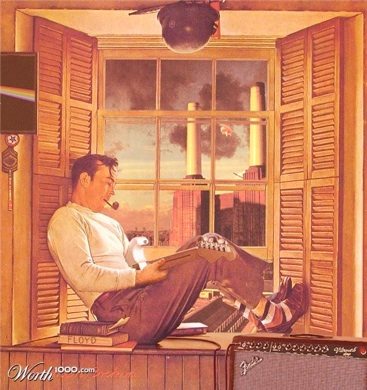
Alas, even though Folly Beach is the Edge of America, even though it’s the mostest bohemianest spot in South Carolina, it is, nevertheless, Protestant. You gotta have Lent to have a good carnival. At a Protestant Mardi Gras parade, like on Folly Beach, they ain’t no nudity, so the closest thang we got what I’d call Dionysian is the purple headed chick on stilts on this here video.
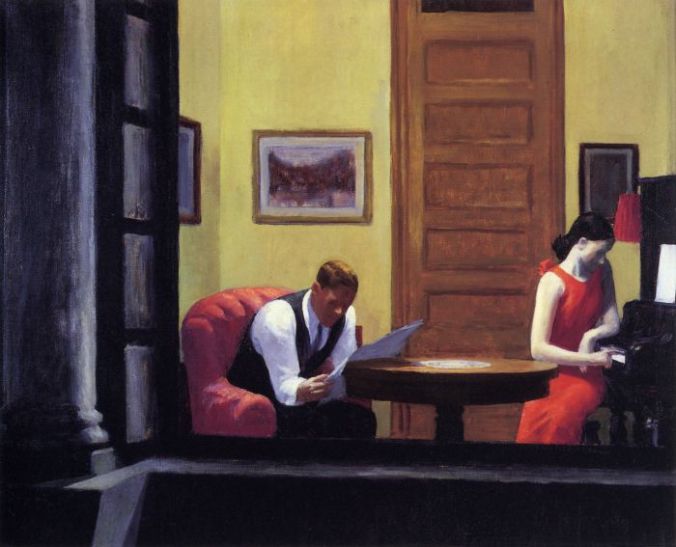
Someone who goes by the appellation “arsidubu” has finally answered the graphical question, “What do you get when you cross Norman Rockwell with Edward Hopper?”
Ta Da!
Certainly, the two artists share a comic book illustrator aesthetic in their depiction of the life in mid-20th-Century America, and both cast their paintings in similar venues; however, their denizens inhabit different planets – at least when it comes to mood and human interaction.
Paying the Bills
Room in New York
In Rockwell, a Protestant deity smiles upon a beloved middle class who in turn smile and wink their way from cradle to grave. Even coal miners seem bemused by their lot in life.
Conversely, in Hopper’s world God is dead, and as poet Victor Enyutin has observed, the people’s shadows seem more alive than they do.
Here’s Enyutin’s take on the painting People in the Sun:
People depicted here by Hopper cannot just relax in the sun. Instead, they project to the situation of taking sun their rigidities and stresses, and their business oriented energies over-stimulated by science fiction – poetry of entrepreneurial world. In their solemnly frozen poses we feel their unconscious intention of taking trip… to the sun – we see that they are as though physically moving/traveling towards the sun while sitting in a kind of starship (may be, with a dream of starting a business there of getting some of the sun’s “natural resources”).
Both artists hailed from New York and enjoyed prosperous childhoods, though Edward Hopper grew up in a strict Baptist household, i.e., in a fallen world. Both embarked upon their careers early, worked for magazines, employed their wives as models, and enjoyed public affirmation.
The first Mrs. Rockwell
Mrs. Hopper
On the other hand – and given the mood of their paintings/illustrations, the following statement seems profoundly counterintuitive – Hopper’s biography seems the saner of the two. Thrice married, Rockwell’s second wife spent time in a psychiatric hospital and Rockwell himself received psychiatric care from Eric Erikson, who once told Rockwell that “you paint your happiness but don’t live it.”
Though much more restless and slower to gain recognition than Rockwell, Hopper enjoyed 44 years of a happy marriage, despite possessing the temperament of a curmudgeon.
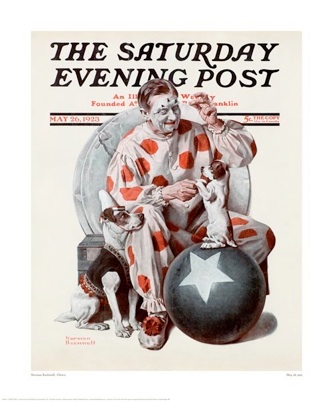
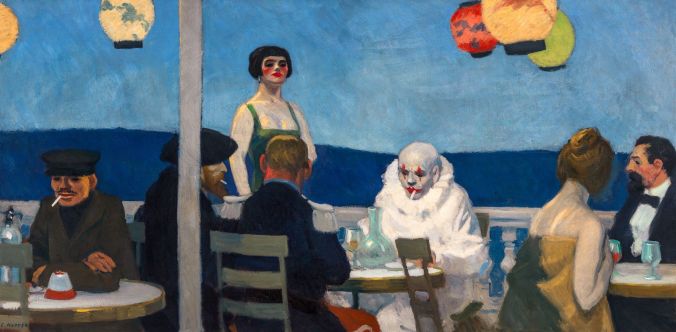
Given the sunshine and shadow of their paintings, guess which one of these artists voted for Roosevelt and which for Hoover.
That’s right. It’s a trick question. The lefty painted this clown:
And the righty painted this one:
Perhaps we have forgotten that traditionally conservatives like Swift, Pope, and Johnson have been the world-weary gloomsters and liberals the naive optimists. Whatever the case, I feel much more at home in Edward Hopper’s world.
Each winter, our English Department requires students to memorize a poem that’s at least the length and girth of a sonnet. We select whom we consider the best, and they compete on grade levels to represent the freshmen, sophomore, junior and senior classes in front of three judges and an auditorium packed with their peers. We call the competition Porter-Gaud Outloud, and once students reach the finals, they’re spot on. Believe me, choosing the ultimate winner is difficult.
I, too, memorize a poem out of solidarity, and even though I’m renowned (yes renowned, dammit!) for having put to memory veritable library shelves of verse, I’ve discovered this year that if I’m not all that familiar with a poem, I have trouble memorizing it.
Now, if it’s a poem I know well, like Yeats’s lament “To a Friend Whose Work Has Come to Nothing,” I can memorize it in no time and spit it out like a Gatling Gun:
Now all the truth is out,
Be secret and take defeat
From any brazen throat,
For how can you compete,
Being honor bred, with one
Who were it proved he lies
Were neither shamed in his own
Nor in his neighbors’ eyes;
Bred to a harder thing
Than Triumph, turn away
And like a laughing string
Whereon mad fingers play
Amid a place of stone,
Be secret and exult,
Because of all things known
That is most difficult.[1]
Last year, I did “Adam’s Curse,” a poem of forty lines, and had it down in a day.
This year, however, I’ve chosen a poem I’ve read only a dozen or so times, Dylan Thomas’s “In My Craft or Sullen Art,” a hyper-Romantic ditty suitable for someone bound to drink himself to death at the Chelsea Hotel at the age of thirty-nine. I chose it because I’ve always dug the lines
The thing is, I keep mucking something up, like substituting “practiced” for “exercised” or swapping out a “nor” for an “or” or dropping the line “On the ivory stages.”
The good news is that I’ll have it down by the due date of February 25, but the bad news is that now I have Thomas’s rhythms and peculiar diction looping non-stop in the tape deck of my mind.
There’s only way to exorcise these voices, and that’s to write some doggerel, and because misery loves company, I’m sharing it with you:
From the Juke Box of Dylan Thomas
In my scratched and dented car,
With a broken right tail light,
I drive to and fro from bar to bar
Squandering a day that turns to night.
Not for the dead left in my wake I drink,
Nor for the lasses who have broken my heart,
But for the tunk-a-tunk-tunk, rinky dink dink
Of lovely pints on a luscious lark.[2]
[1]How apt a poem for the Age of Trump.
[2]If I weren’t channeling Thomas, the last line would be “Of yeasty brews on a beer-slopped bar.”
You may have forgotten, but ten years ago this week, the Obama White House was embroiled in one its most serious scandals: the President of the United States worked in the Oval Office without a coat and tie.
I’ll let former Bush Chief-of-Staff Andrew Card explain:
The Oval Office symbolizes…the Constitution, the hopes and dreams, and I’m going to say democracy. And when you have a dress code in the Supreme Court and a dress code on the floor of the Senate, floor of the House, I think it’s appropriate to have an expectation that there will be a dress code that respects the office of the President.
Here’s Ken Langone, co-founder of Home Depot from 1 August 2011:
I think our sitting president is acting so unpresidential …. He is dividing us as a nation. He is not bringing us together. He’s willfully dividing us. He’s petulant [. . .]
Ronald Reagan would never go into the Oval Office without his jacket on — that’s how much he revered the presidency. This guy (Obama) worked like hell to be president, okay? He’s got it. Behave like a president.
Fastforward to 2019.
Thank God, we now have a president who possesses a sense of propriety, one who isn’t “divisive” or “petulant.”
Sure, the Trump Presidency hasn’t been without controversy:
Investigations by special counsel Robert Mueller:
Russian government’s election attack (the Internet Research Agency and GRU indictments\
WikiLeaks
Middle Eastern influence: Potentially the biggest unseen aspect of Mueller’s investigation is his year-long pursuit of Middle Eastern influence targeting the Trump campaign.
Paul Manafort’s activity
Trump Tower Moscow project
Other campaign and transition contacts with Russia
Obstruction of justice
Investigations by the U.S. Attorney for the Southern District of New York:
Campaign conspiracy and Trump Organization finances
Inauguration funding
Trump super PAC funding
Foreign lobbying
Investigations by the U.S. Attorney for the District of Columbia:
Maria Butina and the NRA
Investigations by the U.S. Attorney for the Eastern District of Virginia:
Elena Alekseevna Khusyaynova, the alleged chief accountant of the Internet Research Agency who was indicted separately earlier this fall, charged with activity that went above and beyond the 2016 campaign. Why she was prosecuted separately remains a mystery.
Turkish influence: Michael Flynn’s plea agreement includes some details of the case, and he is cooperating with investigators.
Investigations byNew YorkCity, New York State and other state attorneys general:
Tax case: In the wake of an N.Y. Times investigation that found Trump had benefited from more than $400 million in tax schemes, city officials said they were investigating Trump’s tax payments, as did the New York State Tax Department.
The Trump Foundation
Emoluments lawsuit: The attorneys general for Maryland and D.C. sent out subpoenas earlier this month for Trump Organization and hotel financial records relating to their lawsuit that the president is in breach of the “Emoluments Clause” of the Constitution, which appears to prohibit the president from accepting payments from foreign powers while in office.[1]
Oh yeah, and that business about paying off the Playboy model and the porn star with campaign funds. But, come on, nitpicking.
I dare you find me a photograph of President Trump in the Oval Office without a coat and tie and label pin. I dare you!
A member of the SC Medical Association and Attorney General Alan Wilson experimenting on a marijuana user
Alas, I find it necessary yet again to haul down from the attic James Petigru’s way-too-often quoted description of my native state:
South Carolina is too small for a republic and too large for an insane asylum.
What prompts today’s revival of Petigru’s apt observation is Attorney General Alan Wilson’s idiotic proclamation that marijuana is “the most dangerous drug” in America, edging out, it would appear, crystal meth, cocaine, crack, heroin, and [drum roll] aspirin.
[1]
Here are some 2017 numbers from the CDC:
According to the Centers for Disease Control, using data available for analysis on September 5, 2018, there were a reported 70,652 deaths attributed to drug overdose in the US for the year ending December 2017. Some deaths were still under investigation. The CDC projects that the total for 2017 will be 72,222.
Of these:
Opioids were detected in 47,863 reported deaths, and are predicted to be involved in 49,031 deaths.
Synthetic opioids, excluding methadone, were detected in 28,644 reported deaths, and are predicted to be involved in 28,644 deaths.
Heroin was detected in 15,585 reported deaths, and is predicted to be involved in 15,941 deaths.
Natural and semi-synthetic opioids were detected in 14,553 reported deaths, and are predicted to be involved in 14,940 deaths.
Cocaine was detected in 14,065 reported deaths, and is predicted to be involved in 14,612 deaths.
Psychostimulants with abuse potential were detected in 10,420 reported deaths, and are predicted to be involved in 10,703 deaths.
Methadone was detected in 3,209 reported deaths, and is predicted to be involved in 3,286 deaths.
Here’s what the House of Lords Select Committee on Science and Technology has to say about marijuana:
Tetrahydrocannabinol is a very safe drug. Laboratory animals (rats, mice, dogs, monkeys) can tolerate doses of up to 1,000 mg/kg (milligrams per kilogram). This would be equivalent to a 70 kg person swallowing 70 grams of the drug—about 5,000 times more than is required to produce a high. Despite the widespread illicit use of cannabis there are very few if any instances of people dying from an overdose. In Britain, official government statistics listed five deaths from cannabis in the period 1993-1995 but on closer examination these proved to have been deaths due to inhalation of vomit that could not be directly attributed to cannabis (House of Lords Report, 1998). By comparison with other commonly used recreational drugs these statistics are impressive.”
What prompted Wilson’s injudicious misrepresentation of the facts was not a call for the legalization of marijuana in South Carolina but merely the introduction of legislation “that would allow patient’s to obtain it with a doctor’s prescription.”
More from Wilson’s press conference:
[Users employ] words like stoned, high, wasted, baked, fried, cooked, chonged, cheeched, dope-faced, blazed, blitzed, blunted, blasted, danked, stupid, wrecked — and that’s only half the words they use,” Wilson said. “Are these consistent with something that describes a medicine?”
Now that’s what I call scientific!
The truth of the matter is that your chances of croaking, bellying-up, kicking the bucket, cashing in chips, joining the invisible choir, buying the farm, and shuffling off the mortal coil are infinitely greater from a perfectly legal prescription of OxyContin than it would be from medical marijuana.
I’m in no way advocating the use of marijuana but merely pointing out the inanity of our public officials, how the Republican Party ignores science in formulating policies.
Speaking of gateway drugs, I’ll leave you with this:
On the Slave Ship Lollipop
I used to stuff my face with candy
when I was a little boy,
couldn’t cop enough Mary Janes,
would kill for an Almond Joy.
Then I graduated to the Real Thing – Coke.
I was popping five cans a day,
plopping nickels and dimes upon the counter
under caffeine and sugar’s sway.
Now I’m hooked on heroin,
am little more than a thug.
Wish I’d known then what I know now –
that sugar is the gateway drug.
[1]According to a recent study, “Taking a daily aspirin is far more dangerous than was thought, causing more than 3,000 deaths a year.
I realize that most Late Empire Americans don’t literally believe in angels – celestial beings that predate the Earth’s creation, minions of the Creator, avian humanoids who play harps and warble hosannas.
Of course, some Christians literally believe the story of Gabriel’s Annunciation, literally believe insemination had come via the Holy Spirit, a Dove delivering via ear the Holy DNA, and I sincerely envy them.
I love the concept of Angels, thrill to see them aloft in Renaissance paintings, violating anachronistic Newtonian laws. When I was with Judy Birdsong at her bedside in her very last moments, I chanted, “May flights of angels sing thee to thy rest” over and over until it was over.
Nevertheless, questions arise: how are angels spawned, or begot, or ushered into being? Fully formed with pubic hair? Perfect fingernails never in need of clipping?
Or do angels grow like children, appearing post-fetal in an opening lotus bloom via asexual birth?
Do they, without lacking mothers and fathers, learn to fly via instinct?
You’d think angels would be the happiest of happy beings, winged Bodhisattvas, egoless, ennui an impossibility.
Not in Paradise Lost. Angels have not only personalities but hierarchal social status.
Nor do they seem all that happy in 15th Century painter Jean Fouquet’s Madonna and Child.
I’m not arrogant to declare there”s not an afterlife. In fact, I’m a fan of the concept. However, if there is an existence beyond this Vale of Tears, I bet it’s not all that anthropomorphic.
In other words, unimaginable, to which I can only say, “Praise God.”
Sometimes I fantasize capping* otherwise innocent people who use the word awesome to describe piss-ant phenomena like the grooviness of their athletic shoes, the merely competent performances of tweens at recitals, or even the ho-hum occurrence of a flight being on time.
“Awesome, dude!”
The word, as you may have forgotten, used to be reserved for extraordinary occurrences like a volcano rising from the sea or the aurora borealis strobing above a winter horizon. For whatever reason, awesome’s sibling awful has remained immune to hyperbolic overuse. I guess it makes sense that human beings wouldn’t want to jack up merely unfortunate events into the realm of tragedy the way we do mundane matters into the realm of apotheosis.
Hmm, these tomatoes are rather tasteless.
Oh my God, dude! That’s awful!
This Late Empire compulsion towards hyperbole is stripping language of meaning, which bodes poorly for a culture with really serious problems that demand precise articulation of nuanced parameters.**
*With a low-caliber derringer that would merely result in a ‘flesh wound.’ After all, I do practice Buddhism.
** I’m talking, apocalyptic tsunamic horrorshow problems like athletes taking steroids and traffic backups on Bees Ferry Road.
ओं मणिपद्मे हूं
Think of how many times lately you’ve heard the word ‘hilarious’ to describe something that wasn’t even all that amusing. Almost always the superhyperbolification is delivered in a deadpan voice that might be rendered “THAT is hilarious.”
For example, I recently shared with colleagues the Bataan Death March frustrations I suffered a few years ago when I drove my schizophrenic aunt from her facility to a lawyer’s office in Summerville. Our mission was to sign some papers disentangling the gordian knot of my late uncle’s estate in which he left half of his house to his live-in girlfriend’s three Tweetle-dee-dum daughters while the deceased live-in girlfriend had left a third of her house to him.
OMG! TMI!
At any rate, it was to be a long day that included rushing to the bank between classes to lend the estate two grand to buy off the ravenous daughters; picking up said schizophrenic aunt from said facility on Dorchester Road; picking up aged mother from Tennessee Williams Estates; driving to the lawyer’s for the melancholy transactions; driving to the CVS so S.A. could pick up toiletries; dropping her back off at the facility but then returning to my place of employment to attend a “milestone dinner” where I would sit and eat and chitchat at a table with the parents of 8th graders anxious about the transition from adjacent buildings, i.e., from the Middle to the Upper Schools; and finally leaving there for my book club, normally an enjoyable experience, though this night’s topic of discussion was Eugene O’Neil’s The Iceman Cometh, a play that is about upbeat as Chopin’s “Funeral Dirge.”
All in all, I was to spend fifteen hours away from the shelter of my home and the bosom of my family, not exactly a tour in Afghanistan, but irksome nevertheless.
When I went to pick-up my aunt – let’s call her Blanche – she was sitting on the front porch of the facility with a couple of wheelchair bound residents. I beckoned her to the car, but she hollered that I would have to sign her out. “Let me park then,” I said, getting ready to shift from neutral to reverse.
“No,” she said. “It’ll only take a second.”
Here, she was exaggerating. It took at least two minutes, more than enough time for my car to roll down an incline and smash into another car parked along the curb.
As I surveyed the damage, Blanche suggested we leave the scene, but, of course, I went back in and tracked down the owner of the car, exchanged insurance information, and then behind schedule, finally began the dismal journey down Dorchester Road in the rain.
All in all, things went smoothly at the Lawyer’s, though I was a bit distracted wondering how much the wreck would add to the two grand I had bestowed on the estate.
On the way back, Blanche asked me what I thought about Obama, and I gave her my 3.5-star review, but then she said, and I quote directly, “Obamacare terrifies me.”
Let’s say I wasn’t in a good mood, let’s say that I blamed Blanche for my accident because if it hadn’t been for her I wouldn’t have been at her facility on a Tuesday afternoon, and if she hadn’t suggested that I leave the car running in front of the facility, I would have found a parking place and avoided the accident.
“For Christ’s sake, Blanche,” I said in exasperation. “Has it not occurred to you that you haven’t had a job in forty years? When’s the last time you’ve written a check to anyone? Who do you think pays for the roof over your head, your meals, your prescriptions? Good God, woman!”
I shared with my colleagues – who, like you, were suffering through this account – that I felt like stopping the car and literally throwing Blanche out onto the street.
“THAT is hilarious,” one of them said.
The truth is that we need hyperbole to spice up our mundane existences, and throughout the above narrative, I have had to strike through inclinations to inflate (and left in the gordian knot metaphor); nevertheless, I do wish that we would not use the same degree of astonishment when describing this:
I’m teaching Paradise Lost for the very last time, a poem I absolutely love.
I love its baroque poetry. Here’s Satan regaining consciousness after being flung across the cosmos into the fiery pit of perdition:
At once, as far as Angel’s ken, he views
The dismal situation, waste and wild,
A dungeon horrible, on all sides round,
As one great furnace flames.
And I love Satan, tragic antihero extraordinaire. Here he is, going all existential, vaunting heroically to his nearest mate Beelzebub:
The mind is its own place, and in itself
Can make a Heaven of Hell, a Hell of Heaven.
What matter where, if I be still the same,
And what I should be, all but less than he
Whom thunder hath made greater? Here at least
We shall be free; the Almighty hath not built
Here for his envy, will not drive us hence:
Here we may reign secure; and, in my choice,
To reign is worth ambition, though in Hell
Better to reign in Hell than serve in Heaven.
But later, outside the gates of Eden in a soliloquy to the sun, he becomes perhaps the greatest of all tragic heroes, giving voice to his anagnorisis:
Me miserable! which way shall I fly
Infinite wrath and infinite despair?
Which way I fly is Hell; myself am Hell;
And, in the lowest deep, a lower deep
Still threatening to devour me opens wide,
To which the Hell I suffer seems a Heaven
Here he sounds like John Wayne in a western:
Whence and what art thou, execrable Shape,
That dar’st though grim and terrible, advance
Thy miscreated front athwart my way
To yonder gates? Through them I mean to pass,
That be assured, without leave of ask of thee.
The poem encompasses all of time (the war in heaven precedes the creation of earth) and all of space (hell is on a distant planet on the opposite side of heaven). Not only that, but Milton also evokes the Holy Spirit as a muse so he “may assert Eternal Providence,/And justify the ways of God to men.”
I teach the poem as adventure, as a sort of Marvel/DC Comics movie wannabe with Satan as a super-super villain who out-Hulks the Hulk, o’er leaps Spiderman, makes Superman seem like a forty-pound weakling in comparison.
For decades, I’ve put on this shtick where I pitch an investment opportunity to the students. I argue that PL would make one kickass blockbuster recordbreaking animated epic motionpicture experience.[1] For a mere 100K investment per student, I could get the project off the ground.
Truthfully, PL really would be, if you could get around the full-frontal nudity of Books IV & IX, profoundly entertaining. Certainly, the poem’s noble aspiration to justify Christianity should offset the horror that the darkened pigmentation of aureoles seems to provoke in red-blooded Americans. After all, we could run this disclaimer from Milton himself:
Nor those mysterious parts were then concealed:
Then was not guilty shame. Dishonest shame
Of Nature’s works, honour dishonourable,
Sin-bred, how have ye troubled all mankind
With shews (sic) instead, mere shews (sic) of seeming pure
And banished from man’s life his happiest life,
Simplicity and spotless innocence!
But dig this: as I was scouring the internet looking for images the spiff up my Keynote presentation, I ran across this fake trailer for Paradise Lost, the movie. Dig it:
I mean, y’all, just sayin’.
[1]Look at me going all Joycean with these fused compound adjectives.