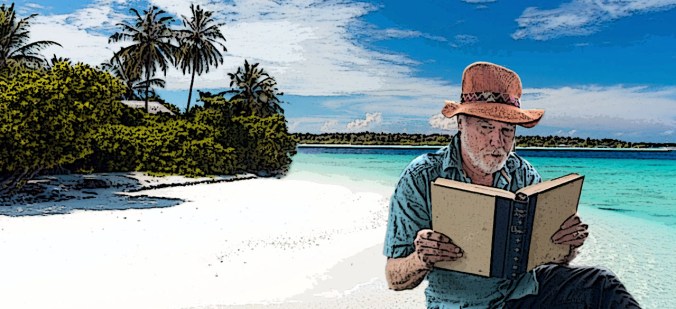
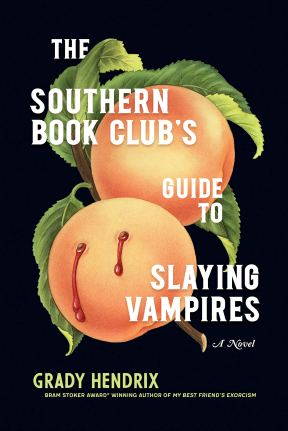
We’ve all been asked the desert island question, what recordings we’d choose, what three books we’d take if limited to that magical number.[1] Although being stuck inside the house with the Chico Feo blues again is vaguely akin to being stranded on some palm shaded atoll in the South Pacific, many of us do possess (unlike Robinson Crusoe) the ability to order out, whether it be rib-eyes from Omaha, Toots and the Maytals from Apple, or Grady Hendrix’s latest novel The Southern Book Club’s Guide to Slaying Vampires.
This quarantine offers those of us who have been idled a chance to catch up on our reading. I know that eBooks are all the rage, but this old curmudgeon prefers printed paper, to strum pages with his thumb, to be able to reckon the heft of the tome and how much is left.
Recently, the excellent local independent bookstore, Buxton Books, hosted a poetry reading featuring David Tillinghast, a former professor of mine. Although Amazon is cheaper, that faceless conglomerate doesn’t provide the opportunity to meet authors and hear them read aloud from their works. In this age of e-tail, independent book and record stores need our support, but during the pandemic, even more so. The next time you order a book, please consider ordering from your local bookseller.
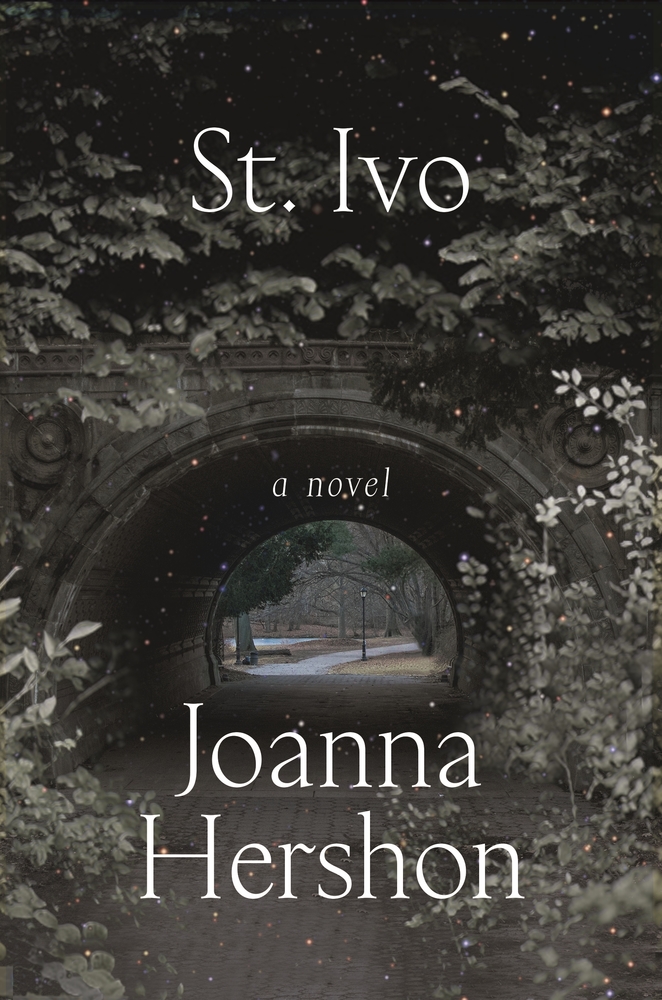
My most recent acquisition from Buxton Books is Joanna Hershon’s latest novel St. Ivo, which is being released tomorrow (14 April 2020) by Farrar, Strauss, and Giroux. I met Joanna and fell in love with her work when she came to Porter-Gaud School as our visiting writer in 2009. At the time of her visit, her most recent novel, The German Bride, had not been released. Joanna was kind enough later to mail me a copy, and, man oh man, the novel transported me right out of my reading chair to 19th Century Berlin and eventually to our own wild, wild West.
Joanna Hershon (source Good Reads)
Here’s a snippet from the thank you letter I sent her:
The breadth of the book is remarkable. You’re able to concretely conjure the sights and smells of Berlin, the passage overland, the starkness of Santa Fe, the Shein Brother’s store, and the stage couch’s journey. Indeed, the last part of the novel, the trip to San Francisco, is a tour de force. You turn something inherently boring – a slow crawl over virtually featureless terrain – into a psychologically fascinating page-turner.
I was fortunate enough to read an advance copy of St. Ivo, and once again, Joanna’s work has captivated me. She possesses the ability to create a tangible world of sights, sounds, odors, and actions while creating characters who come alive on the page. As her characters negotiate that vivid outer world Joanna has created, the reader is also privy to the rich inner world of their memories, aspirations, and fears. The novel is suspenseful, mysterious. I can’t express it better than Nell Freudenberger’s dust jacket blurb: “Vivid and cinematic . . . St. Ivo has the eerie quality of a fairy tale, as if something inexplicable might be waiting around the next bend in even the most familiar path.”
Oh, yeah, and the prose, at once beautifully crafted yet unobtrusive. Here’s Sarah remembering getting her first pair of glasses as a child:
The case was blue. She wore them on the trip home. While sitting in the back seat of the car, she looked out the window. It was as if the world had suddenly announced itself in every leaf on every tree. She hadn’t realized that one could actually see the shapes of leaves, that it was even possible from a distance. The ordinary view was crystalline suddenly and all too much. She remembered now the sound of her father’s gravelly voice and the static on the radio; she remembered returning the glasses to their blue suede case. She’d closed her eyes for the rest of the trip. This, she realized, was how she felt just then.
So afford yourselves a chance to take an imaginative trip, for a few hours to get out without the chance of contagion, to enter a vivid world whose dangers will thrill you without actually endangering you.
[1] Shakespeare’s complete works (duh), Joyce’s Ulysses,Norton’s Anthology of Poetry.
John Prine’s first album came out in 1971, the year I graduated from high school and entered college. I can’t remember if it was David Williams or Mitch Kellam who turned me on to it, but in any case, has a better debut album ever been released? I mean “Illegal Smile,” “Hello in There,” “Sam Stone,” and “Angel from Montgomery” all on the same record, a masterpiece.
What distinguishes Prine from most from most other songwriters is a combination of imagination and empathy. Like a talented fiction writer, he creates characters we care about and places them in a world that’s palpably real.
Take, “Hello in There,” a song about the loneliness of old age. The lyrics stand up remarkably well by themselves unaccompanied by music:
We had an apartment in the city
Me and Loretta liked living there
Well, it’d been years since the kids had grown
A life of their own left us alone
John and Linda live in Omaha
And Joe is somewhere on the road
We lost Davy in the Korean war
And I still don’t know what for, don’t matter anymore
Ya’ know that old trees just grow stronger
And old rivers grow wilder ev’ry day
Old people just grow lonesome
Waiting for someone to say, “Hello in there, hello”
Me and Loretta, we don’t talk much more
She sits and stares through the back door screen
And all the news just repeats itself
Like some forgotten dream that we’ve both seen
Someday I’ll go and call up Rudy
We worked together at the factory
But what could I say if asks “What’s new?”
“Nothing, what’s with you? Nothing much to do”
So if you’re walking down the street sometime
And spot some hollow ancient eyes
Please don’t just pass ’em by and stare
As if you didn’t care, say, “Hello in there, hello”
Not only could John do sad, he also could be really funny. Take “Illegal Smile,” for example.
When I woke up this morning, things were lookin’ bad
Seem like total silence was the only friend I had
Bowl of oatmeal tried to stare me down… and won
And it was twelve o’clock before I realized
That I was havin’ no fun
But fortunately I have the key to escape reality
And you may see me tonight with an illegal smile
It don’t cost very much, but it lasts a long while
Won’t you please tell the man I didn’t kill anyone
No I’m just tryin’ to have me some fun
Last time I checked my bankroll,
It was gettin’ thin
Sometimes it seems like the bottom
Is the only place I’ve been
I Chased a rainbow down a one-way street dead end
And all my friends turned out to be insurance salesmen
But fortunately I have the key to escape reality
And you may see me tonight with an illegal smile
It don’t cost very much, but it lasts a long while
Won’t you please tell the man I didn’t kill anyone
No I’m just tryin’ to have me some fun
Well, I sat down in my closet with all my overalls
Tryin’ to get away
From all the ears inside my walls
I dreamed the police heard
Everything I thought… what then?
Well I went to court
And the judge’s name was Hoffman
Ah but fortunately I have the key to escape reality
And you may see me tonight with an illegal smile
It don’t cost very much, but it lasts a long while
Won’t you please tell the man I didn’t kill anyone
No I’m just tryin’ to have me some fun
Well done, hot dog bun, my sister’s a nun
When John contracted the Virus, I figured that with only one lung, he was a goner, and sure enough, he’s a long gone daddy now. However, what a body of work he has left behind. If his debut self-titled album is the only one you know, check out this link from Billboard.
And I’ll leave you with this duet with Iris Dement before the YouTube people snatch it away.
Trouble took my money, Cadillac’s gone
Best suit of clothes, all raised up in the closet, oh lord
But I’m so glad
Trouble don’t last, always
“Trouble You Can’t Fool Me” as performed by Ry Cooder
I was born on a rare snowy December afternoon in Summerville, South Carolina, during the waning weeks of the Truman Administration. It was the very same year that J. Fred Muggs, the chimp on NBC’s Today show, was born and the year the first issue of Mad Magazine appeared. Six months later, on June 19th, 1953, Julius and Ethel Rosenberg received 1700 volts of electricity in New York State’s Sing Sing Correctional Institute.
Hello, World; hello, Cold War.
Mama, look an H-Bomb (sung to the tune of “Shortening Bread”)
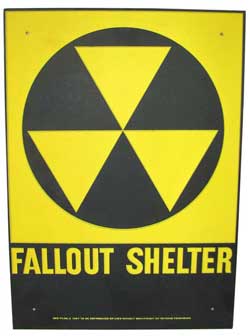
I remember standing in the weeds of the front yard of our two-bedroom rented house watching Sputnik travel across the night sky and recall squatting underneath a desk in the third grade during the Cuban Missile Crisis. Also, there was a sign hanging in the stairwell of Condon’s Department Store designating it as an official fallout shelter. I’ll admit the sign creeped me out whenever I saw it, but to say I grew up under the specter of nuclear annihilation would be inaccurate. The skies of my childhood were mostly sunny. I had escaped polio, my parents and pets lived long lives, though I did, come to think of it, suffer from an unrelenting series of unrequited crushes.
John F Kennedy had the top of his head blown off when I was a fifth grader. I remember my teacher Miss McCue dabbing her eyes, but no tears were shed at my house. The following year our Ford Falcon station wagon sported a “Goldwater for President” bumper sticker, and I lamented when I woke up on 5 November 1964 to learn that ol’ AuH2O had been buried in a landslide. My first year of high school, James Earl Ray picked off Martin Luther King, and the following year Sirhan Sirhan shot Bobby Kennedy at point blank range after he had won the California Primary. Of course, all the while men and boys in body bags were flying in from Southeast Asia, and African Americans were being battered with billy clubs across the South.
Geopolitically speaking, it was a lousy time to grow up. You sort of winced when you picked up the paper each morning.
Well, I don’t know, but I’ve been told
The streets in heaven are lined with gold
I ask you how things could get much worse
If the Russians happen to get up there first
Wowee! pretty scary!
Now, I’m liberal, but to a degree
I want ev’rybody to be free
But if you think that I’ll let Barry Goldwater
Move in next door and marry my daughter
You must think I’m crazy!
I wouldn’t let him do it for all the farms in Cuba.
Bob Dylan, “I Shall Be Free No. 10”
The Seventies, Eighties, and Nineties seemed less traumatic. September 11th, of course, was horrible, but you have to be extraordinarily unlucky to be killed by an international terrorist. You’re more likely to be gunned down in a theater, school, night club, church or synagogue by a red-blooded American.
Whatever the case, Apocalypse was in the air. Stephen King and Cormac McCarthy wrote about it. Across both large and small screens zombies marched and pandemics raged.
Horror is all the rage in Late Empire America. Walking your rescue dog past young Bentley’s house, you can hear heavy gunfire and explosions emanating from his manipulations of a video console. Hmm, sounds like he’s playing Mortal Kombat Armageddon, or is it World of Welfare: Let’s Kill the Bloodsuckers?
All of this got me to wondering when the West quit writing utopias a la Thomas More and started portraying the future world as a nightmare. Of course, my go-to unscholarly source is Wikipedia, and it anoints Jonathan Swift’s Gulliver Travel’s as the first dystopian “literature” – though Oedipus Rex might lay some claim to being the first, with its plague-ridden Thebes ruled by a tainted king whose sexual misdeeds make the Clinton/Lewinski dalliance seem downright wholesome in comparison. But Oedipus Rex predates empire, and I suppose you must have an empire, a nation state, or a polluted planet to qualify as a dystopian society. My colleague Aaron Lipka tells me the civilization must be a fallen one in a dystopian society.
So what we have been dreading has arrived, a crippling pandemic; we have become actors ourselves in a historical drama. Nothing in my past can compare to what’s going on right now, and, of course, economically no one really knows what’s going to happen, but with all due respect to the President, we have seen something like this before.
In fact, Elizabeth Kolbert of the New Yorker provides a succinct history of pandemics in the 30 March issue. Here’s a brief catalogue:
541-50 CE – the Bubonic plague known as the Justinianic plague spreads from Egypt to Britain, playing a significant role in the fall of the Roman Empire.
1400s through 1720: smallpox. “Parents would commonly wait to name their children until after they had survived smallpox.” Exported to the Americas, smallpox essentially wiped out indigenous populations.
1817 – now – Cholera, a resurgent pandemic whose latest outbreak has killed approximately 10,000 Haitians in 2010.
20th century – influenza, polio, measles, typhus . . .
21st century – influenza, Ebola, Covid-19 [to be continued].
Forgive the cliché, but what goes around comes around. Here are Kolbert’s final three paragraphs:
Whenever disaster strikes, like right about now, it’s tempting to look to the past for guidance on what to do or, alternatively, what not to do. It has been almost fifteen hundred years since the Justinianic plague, and, what with plague, smallpox, cholera, influenza, polio, measles, malaria, and typhus, there are an epidemic number of epidemics to reflect on.
The trouble is that, for all the common patterns that emerge, there are at least as many confounding variations. During the cholera riots, people blamed not outsiders but insiders; it was doctors and government officials who were targeted. Smallpox helped the Spanish conquer the Aztec and Incan Empires, but other diseases helped defeat colonial powers. During the Haitian Revolution, for example, Napoleon tried to retake the French colony, in 1802, with some fifty thousand men. So many of his soldiers died from yellow fever that, after a year, he gave up on the attempt, and also decided to sell the Louisiana Territory to the Americans.
Even the mathematics of outbreaks varies dramatically from case to case. As Adam Kucharski, a professor at the London School of Hygiene & Tropical Medicine and the author of “The Rules of Contagion” (forthcoming in the U.S. from Basic Books), points out, the differences depend on such factors as the mode of transmission, the length of time an individual is contagious, and the social networks that each disease exploits. “There’s a saying in my field: ‘if you’ve seen one pandemic, you’ve seen . . . one pandemic,’ ” he writes. Among the few predictions about covid-19 that it seems safe to make at this point is that it will become the subject of many histories of its own.
The good news, however, is that at least as far as contagion goes, we non-medical personnel are the masters of our fate. We can distance ourselves, wash our hands if we go out, and train ourselves not to touch our faces. In the catalogue of pandemics, Covid-19, to quote a physician I saw online, “is a wimpy virus,” done in by a simple soap. Perhaps, if you allow me to wax all Panglossian, some good will come out of all of this, greater respect for science maybe, a reconfiguring of our medical insurance situation, a change of political leadership, a more equitable distribution of wealth.
Hang in there, y’all. Who knows?
Thinking of Noah, childheart, try to forget
How for so many bedlam hours his saw
Soured the song of birds with its wheezy gnaw,
And the slam of his hammer all the day beset
The people’s ears. Forget that he could bear
To see the towns like coral under the keel,
And the fields so dismal deep. Try rather to feel
How high and weary it was, on the waters where
He rocked his only world, and everyone’s.
Forgive the hero, you who would have died
Gladly with all you knew; he rode that tide
To Ararat; all men are Noah’s sons.
Richard Wilbur, “Still, Citizen Sparrow”
[1] I’ve scoured the Internet in vain seeking the issue in which this ditty appeared. However, I’m confident the lyrics are accurate because it’s one of the myriad of selections recorded in the juke box of my brain.
I think I’ve mentioned before that the use of vulgar language has grown apace (as they used say) in recent years. At least Richard Nixon spewed his vulgarity and profanity[1] behind closed doors (though the tapes were running). I can’t imagine Jimmy Carter or Ronald Regan saying BULLSHIT when addressing the nation as Trump did in a tweet last October.
I heard in person Beto O’Rourke say “shit” in a stump speech last summer, and on Twitter, oh do Lawd, even such staid conservatives as Bill Kristol and Jennifer Rubin will occasional tweet an obscenity. Don’t get me wrong: I’m not squeamish. Vulgar language doesn’t offend me. I’m only pointing out a Late Empire anthropological trend.
For some reason, twenty or so years ago, the Muse of Light Verse, Hiccuppia, descended upon me and whispered the following in my tiny little ears:
A Meditation on the Sounds of Indecorous Words
By Gorgons with long whips pursued
How naked go the sometime nude!
Robert Graves
Fellatio is a lovely word,
Operatic in a way:
“The role of Fellatio will be played
By Mr. Richard Cabot Clay.”
Sodomy, on the other hand,
Lacks that light Italian ring.
Biblical, confessional.
A cry of pain! A serpent’s sting.
Cunnilingus could be a caliph
Thundering across desert sands,
Seeking long lost treasure troves
Guarded by jinn in distant lands.
Fuck, of course, isn’t exotic.
Its harsh cough can cause vexation,
But when a car door smashes your fingers,
it sure beats fornication.
The idea, obviously, it that vulgar words can be beneficial in certain situations. I used to encourage my students to use them sparingly, or those Anglo-Saxon monosyllables would lose their magic, wouldn’t be there for them when they need them to express rage or alleviate pain.
I can recall my late wife Miss Birdsong using the f-word only once, and it certainly got my attention. If I recall correctly (and I do), a second person pronoun followed the present tense verb.
On the other extreme, dig this cat who is featured in Sean Dunne’s documentary film American Juggalo.
Here he is ruminating on his adventures at a Juggalogathering and how being a Juggalo has made him a better person. You should hit the link and fast-forward to 5:09 and hear him for yourself because I can’t begin to do justice to his intonations, rhythms, phrasing.
Juggalo: The only way I got that vomit off me was to get to the fuckin raid.
Interviewer: What happened?
Juggalo: I got fucked up. I was drinking Caribou Lou on the fuckin carnival rides and fuckin got fucked up. Apparently, I fuckin passed out and then my fuckin homeboy fuckin comes, shows up out of nowhere, and gets me to the fuckin tent, and man, I fuckin fell out in the middle of the fuckin road. I had motherfuckers come ask me how I am. That how bad it was. I was a fuckin spectacle, and shit, I don’t give a fuck because it was fuckin righteous.
I’ll tell you for real about being a Juggalo, man. That shit made me the motherfucker I am today. Honest to God, man. If it wasn’t for Jay and [inaudible] that shit wouldn’t be on. I don’t wanna fuckin think about the kind of motherfucker I would be. I grew up a fuckin decent, fuckin good-hearted motherfucker. I’m a fuckin nice person. I can cook like a motherfucker who makes some straight up motherfuckin grub. Fuckin chicken fried steak, fuckin collard greens, fuckin mashed potatoes and all that. Fuckin sausage gravy biscuits, fuckin everything, man. I fuckin cook like a motherfucker.
I wanna find me a skinny ass little bitch and make her fat, and then we’ll lose weight together, and then we’ll bond.
[amiable maniac laughter]
But, o my brother, my dear Juggalo, what you gonna scream when you’re entangled in the metal mess of your wrecked car waiting on the Jaws of Life to extricate you?
Then again, an vulgarity can be sometimes effective when one is on the verge of a massive cerebral hemorrhage. Take it away Jeff Tiedrich:
listen to this lying sack of amphetamine-fueled shit as he wheezes, mispronounces and stumbles over the one-syllable words on his extra-large-type printout. what an utter fucking embarrassment
I admire those people in this period of suspended animation who have their chins up and memes cued-up. After all, there’s little else a non-billionaire can substantially do as the economy itself is rolled into ICU, except to try to make the best of a bad situation.[1]
It’s not bad to channel ol’ Norman Vincent and to tell yourself positive thinking is, well, positive. Look at all the time you have on your hands to start that herb garden, learn French or German or Sanskrit, read those classics you claimed you’d tackle after retirement.
After all, the sky flashes, the great sea yearns.
John Berryman
Me, on the other hand, I’m spending this gorgeous spring morning trying to pinpoint the perfect word to describe my present misery.
Let’s go alphabetically.
Angst. This word, of course, German, a language especially suited to embody dread in sound, and in, fact, can make pleasant situations sound somewhat dreadful with its “harsh discords and unpleasing sharps.”
For example, “Schlaf in himmlischer Ruh!” is usually translated as “Sleep in heavenly peace.”
But I digress. Angst means fear in German, but in English that fear is more generalized. It’s not as if you’re afraid of that night shriek outside your pup tent but fear that life is merely a tale told by an idiot, full of sound and fury, signifying nothing. Angst is stronger than anxiety, which for most people is a temporary discomfort rather than an entrenched world view.
So, no, it’s not angst I suffer from, nor anxiety either, now that my son Ned has almost fully recovered from his bout with the novel coronavirus or the Covid-19 virus or the Coriolanus virus or whatever you call it.
Rockwell Kent
Ennui. When I taught English, “ennui” appeared in three of the four high school editions of our Wordly Wise workbook. The editors defined it as “boredom,” but once again, it’s more generalized than mere tedium. It connotes a world weariness rather than a momentary I-wish-I-were-somewhere-else, expressed so well by soon-to-be suicide John Berryman’s “Dream Song 14”:
Peoples (sic) bore me,
literature bores me, especially great literature,
Henry bores me, with his plights & gripes
as bad as achilles,
who loves people and valiant art, which bores me.
So, no, I’m not suffering from ennui.
Walter Richard Sickert
Weltschmerz. This German world means “world pain” and so correlates with ennui but connotes more pain and sadness. So, no, that’s not it.
Well, what is it then? Coopedinsocialestrangement. That’s what I’m suffering from. Coopedinsocialestrangement.
I’m enjoying my bike rides with Caroline and Brooks, the uncrowded beach a quarter of a mile away, the movies we’ve seen, but I also miss my drinking buddies, Ellis and Bob, my beloved bartenders Jen and Rochelle and Solly and Sydney, my man Jeremy down at Lowlife Bar.
So instead I’ve been hanging out with Elmore Leonard and his crowd of criminals, cops, and cool black dudes. Still, it’s not the same. I guess the good news is that unlike angst, ennui, or weltschmerz, you can eventually get over Coopedinsocialestrangement without undergoing a religious conversion.
Here’s a kickass poem by a friend of mine, Jason Chambers, a cat who every morning clambers out of bed in the dark to encounter the dawn in a marsh or on a beach or some other natural setting unsullied by humankind. Afterwards, he posts a photo on Facebook, an appropriate quote from his wide reading, and usually a link to a song he deems appropriate. Once the plague is done, you can catch him at the Pour House when it hosts one of its poetry readings.
A poem by Jason Chambers, read by Wesley Moore
In the first month of this year
I saw a thing as pure and true as any
but did not then know what it meant.
I stood behind the Kings on the deck,
and though I could not see it,
Liz knew without looking that
Brian’s head hung for a
moment just a little too heavy,
his shoulders had dropped, just so,
wounded by the world in
some invisible way.
She reached her arm up and
around him to squeeze for a
moment one shoulder, just so,
and let her head fall on the other.
Four months later our neighbors
up the creek shoot day and night
at paper silhouettes on which they
can never quite find their fear.
The report hangs over the water
like a foretaste of despair,
and we are all the time being
urged to temper our hopes,
to be realistic, and practical.
But I have met enough dogs,
low, shimmying, tail-waggers,
squirming back-layers, and
all manner of face-lickers, to
know there is no upper limit
to bliss, and the line between
heaven and earth was never there,
and I ignore their advice.
Finally it is clear why God,
however perfect, chose not
to exist alone for even
one whole second.
Listen: everywhere musicians
sit in empty rooms yet play
and sing to thousands.
And my friend is for the first time
planting every inch of his farm,
the low field, the far field,
even the wet field.
He says, I’m going right up
to the house.
Whatever else happens,
we will all eat.
When Liz let go, they both stood
up straight, taller than before,
determined as only those
deeply in love can be.
We start from a place of joy,
and quiet astonishment.
We do not end anywhere.
We do not end at all.
Now is the barefoot season.
It cannot be taken away.
Jason and me, Caroline Tigner Moore’s sunglasses, and a couple of All Day IPAs
My son Ned (second from left) and his housemates. Two of the four have Coronavirus
In Germany, where my younger son Ned has been suffering from the coronavirus for nine days, Chancellor Angela Merkel has “barred groups of more than two people from gathering” and has herself gone into isolation after learning her doctor had tested positive. Ned, who is fluent in German, listened intently to a speech she gave a few days ago on how her government planned to combat the contagion.
He described her as calm, straightforward — a well-educated, unemotional, yet empathetic grandmother telling her brood that matters were serious, the greatest challenge the country had faced since reunification, but that by coming together and following her advice that they would overcome the disease.
Ned said that he felt fortunate to be living, as he put it, “in a first world country.” He might have added in a country not so horribly polarized by political divisions. Although I voted against Ronald Regan twice, I think he’d be an excellent spokesman in a time like this because he possessed a sort of serene confidence. He did not require a coterie of toadies to preface their technical expertise with praise for his unmatched leadership. He would not have lied in ways that could be so easily refuted, nor make statements like “the world has never seen anything like this before.”[1] He would have projected a calming presence and have reassured the populace.
I’m not going into what might have been done differently to mitigate the virus’s rapid spread here in the States. I’m pleased to see a sort of a sort of un-self-pitying camaraderie developing, virtual get togethers, musicians performing virtual concerts. We’re all in the same boat, more or less, stuck at home with worries galore, but it’s not like we’re in London during the Blitz. Nevertheless, war is an apt metaphor, and we all certainly owe much gratitude to the men and women on the front lines, the health care workers who are battling this pernicious disease.
Today, Ned says he feels much better, that his breathing is almost back to normal. He and his housemates are making the best of a bad situation. Here’s a photo of a Corona Cake they made for a birthday party they couldn’t go to, and it ended up that the birthday boy or girl only had three rolls left.
I’m not much of a silver-lining sort of person, but at the very least, this experience should remind us not to take life for granted, and while forced to forego televised sports, we now have a chance to notice the “birds in the trees/ — those dying generations — at their song.”
A park in Munich (Laetitia Vancon for The New York Times)
[1] In the mid-14th century, the bubonic plague killed ~20 million people, roughly a third of Europe’s population.
the half-man searching for an ever-fleeing other half,
and the countryside not caring,
a shadow of cloud on the stream.
A cento, sometimes referred to as a “collage poem,” consists of lines from other poems cut out and reassembled.
Poems sampled Robert Browning’s “Childe Roland to the Dark Tower Came,” Tennyson’s “In Memoriam,” Michael Field’s “O Eros of the mountains, of the earth,” AK Ramanujan’s, “Elements of Composition,” Philip Larkin’s “MCMVI,” Yeats’s “Easter 1916”
Note: Michael Field was the pseudonym of Katharine Harris Bradley and Edith Emma Cooper, pictured below.