Dialectics

Let’s face it, nuance went out with the rise of cable news.  Not only do politicians not reach across the aisle to seek compromises, but they essentially don’t associate with members of the other parties.  Gone are the days when polar politicians like Orrin Hatch and Teddy Kennedy could become bosom friends, when Ronald Reagan and Tip O’Neil could “after six o’clock” be friends.


No, nowadays, middle ground is no man’s land.

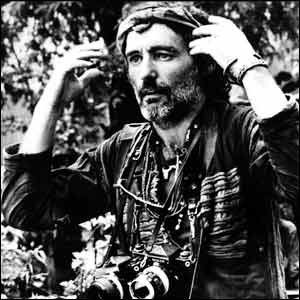
Yesterday, as I was showing my tenth graders a clip from Apocalypse Now in conjunction with teaching Heart of Darkness, it occurred to me that the photojournalist’s speech to Willard as Kurtz reads from TS Eliot’s “The Hollow Men” is a superb commentary on contemporary American politics.  I offer it without comment except for the tidbit that one of the epigraphs for “The Hollow Men” is “Mistuh Kurtz – he dead,” so essentially Kurtz is reading a poem in which he appears.


The Hollow Men

Mistah Kurtz-he dead
A penny for the Old Guy

I

We are the hollow men
We are the stuffed men
Leaning together
Headpiece filled with straw. Alas!
Our dried voices, when
We whisper together
Are quiet and meaningless
As wind in dry grass
Or rats’ feet over broken glass
In our dry cellar

Shape without form, shade without colour,
Paralysed force, gesture without motion;

Those who have crossed
With direct eyes, to death’s other Kingdom
Remember us-if at all-not as lost
Violent souls, but only
As the hollow men
The stuffed men.

II

Eyes I dare not meet in dreams
In death’s dream kingdom
These do not appear:
There, the eyes are
Sunlight on a broken column
There, is a tree swinging
And voices are
In the wind’s singing
More distant and more solemn
Than a fading star.

Let me be no nearer
In death’s dream kingdom
Let me also wear
Such deliberate disguises
Rat’s coat, crowskin, crossed staves
In a field
Behaving as the wind behaves
No nearer-

Not that final meeting
In the twilight kingdom

III

This is the dead land
This is cactus land
Here the stone images
Are raised, here they receive
The supplication of a dead man’s hand
Under the twinkle of a fading star.

Is it like this
In death’s other kingdom
Waking alone
At the hour when we are
Trembling with tenderness
Lips that would kiss
Form prayers to broken stone.

IV

The eyes are not here
There are no eyes here
In this valley of dying stars
In this hollow valley
This broken jaw of our lost kingdoms

In this last of meeting places
We grope together
And avoid speech
Gathered on this beach of the tumid river

Sightless, unless
The eyes reappear
As the perpetual star
Multifoliate rose
Of death’s twilight kingdom
The hope only
Of empty men.

V

Here we go round the prickly pear
Prickly pear prickly pear
Here we go round the prickly pear
At five o’clock in the morning.

Between the idea
And the reality
Between the motion
And the act
Falls the Shadow
For Thine is the Kingdom

Between the conception
And the creation
Between the emotion
And the response
Falls the Shadow
Life is very long

Between the desire
And the spasm
Between the potency
And the existence
Between the essence
And the descent
Falls the Shadow
For Thine is the Kingdom

For Thine is
Life is
For Thine is the

This is the way the world ends
Not with a bang but a whimper.

art by Claire Lambe

art by Claire Lambe


Vanilla Pudding’, Suburban Rapper

Vanilla Puddin'

Vanilla Puddin’


I have 99 Problems, but Disposable Income Isn’t One of Them


Vanilla Puddin’ is my name,

And rapping is my avocation,

Muthasmoocha!


Jay-Z can’t rhyme better than I,

So ‘cuse me while I kiss the ground,

Muthasmoocha!


I own a late model Volvo with leather seats and air bags.

You know I don’t like to boast,

But that Volvo’s paid for,

Muthasmoocha!


An officer pulled me over for rolling thru a stop sign,

Then asked me for my registration,

Which was up to date and everything,

So you can kiss my alabaster derriere,

Muthasmoocha!


I have 99 problems

But disposable income isn’t one of them.


So dig it, fellow homeowners!

Yeah!


The Art of the Political Insult

Mountrushmore


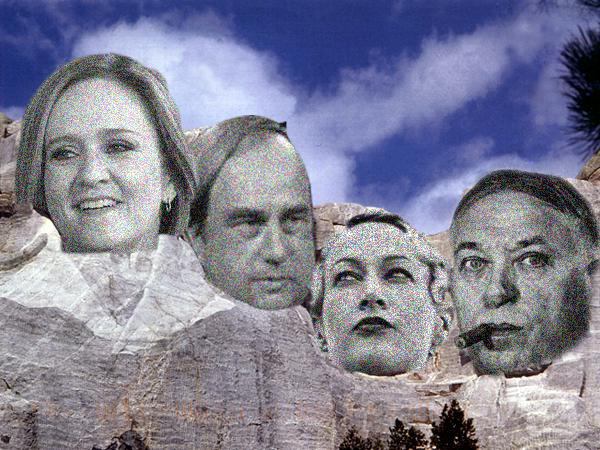
In her recent column, Gail Collins reminds us that Trump’s crude political discourse is not unprecedented in this hard-to-govern, rambunctious nation that consists essentially of cast-offs from other continents:

People, [she writes] this is the point at which I’m supposed to make you feel better by pointing to all the terrible presidential campaigns of the past. I could remind you that the first Republican presidential candidate, John Charles Frémont, was accused of being a cannibal. Or that poor Grover Cleveland was tortured by newspaper stories claiming he was “a boon companion to Buffalo harlots, a drunken, fighting, roistering roué.”

What great phrasing — “a boon companion to Buffalo harlots, a drunken, fighting, roistering roué” — it rolls off your tongue like an ee cummings poem, topping even the great HL Mencken’s depiction of Cleveland: He sailed through American history like a steel ship loaded with monoliths of granite.

Slightly less musical but imagistically more powerful is Samantha Bee’s (or one of her writer’s) description of Donald Trump as “a tangerine tinted trash can fire.”

Or dig this dig from a true master, James Wolcott:

An orange Elvis squirted from a can of Cheez Whiz, the Trump of The Apprentice bent the distortion field of Reality TV until it fit him like a girdle.

As far as exuberant insulting prose goes, it’s difficult to top Cintra Wilson:

If Marilyn Monroe and Princess Diana were “candles in the wind,” and Anna Nicole Smith was a bonfire in a hailstorm, and Lindsay Lohan is an electric toaster thrown intentionally into a Jacuzzi, then Paris Hilton s a strobe light in an epilepsy ward.

Compare those well-crafted quips to Trump’s insults culled from The Hill:

“[George W] Bush didn’t have the IQ [to be president].”

On Lindsay Graham: A total lightweight. In the private sector, he couldn’t get a job. Believe me. Couldn’t get a job. He couldn’t do what you people did. You’re retired as hell and rich. He wouldn’t be rich; he’d be poor.”

On former Texas Governor Rick Perry: He should be forced to take an IQ test before being allowed to enter the GOP debate.”

“I hear that sleepy eyes [Chuck Todd] will be fired like a dog from ratings starved Meet The Press?

It reminds me of that scene from Cyrano de Bergerac when the Viscount De Valvert insults Cyrano by saying, “ir, your nose is. . .hmm. . .it is. . .very big!”

And Cyrano responds

Ah no! young blade! That was a trifle short!

You might have said at least a hundred things

By varying the tone. . .like this, . .

Truculent: ‘When you smoke your pipe. . .[I] suppose

That the tobacco-smoke spouts from your nose–

Do not the neighbors, as the fumes rise higher,

Cry terror-struck: “The chimney is afire”?’

So come on, Donald, you can do better. Hire someone like PJ O’Rourke to come up with something a bit more barbed like “George W Bush has more belly button lint than brains” or “Rick Perry makes George from Of Mice and Men sound like Cicero” or “Hillary is as crooked as Lombard Street.”

We, as a nation, deserve better.

Andrew Sullivan’s Take on “This Dystopian Campaign”

facists

[. . .] individuals going about their business in the assurance of perfect safety

Joseph Conrad, Heart of Darkness

Last night as I watched the Indiana Primary returns on MSNBC, Steve Schmidt, John McCain’s 2008 campaign manager, splashed some very frigid water on the prevalent view that Hillary Clinton is a shoo come November. Schmidt pointed out that the conventional wisdom of a Clinton victory doesn’t factor in unexpected events that could alter the electoral landscape.

I had encountered a very similar but more cogent argument earlier in the day via Andrew Sullivan:

Those who believe that Trump’s ugly, thuggish populism has no chance of ever making it to the White House seem to me to be missing this dynamic. Neo-fascist movements do not advance gradually by persuasion; they first transform the terms of the debate, create a new movement based on untrammeled emotion, take over existing institutions, and then ruthlessly exploit events. And so current poll numbers are only reassuring if you ignore the potential impact of sudden, external events — an economic downturn or a terror attack in a major city in the months before November. I have no doubt, for example, that Trump is sincere in his desire to “cut the head off” ISIS, whatever that can possibly mean. But it remains a fact that the interests of ISIS and the Trump campaign are now perfectly aligned. Fear is always the would-be tyrant’s greatest ally.

Sullivan offers this warning in an impressively constructed and detailed argument that commences with Plato’s theory on why democracies ultimately give way to tyranny. Sullivan’s reading of Plato is that “the views and identities” of the populations of what he calls late democracies “become so magnificently diverse as to be mutually uncomprehending.” As religious orthodoxy wanes, so does certainty. Much of the citizenry loses respect for authority. No one has the authority to tell anyone what to do or think:

The very rich come under attack, as inequality becomes increasingly intolerable. Patriarchy is also dismantled: “We almost forgot to mention the extent of the law of equality and of freedom in the relations of women with men and men with women.” Family hierarchies are inverted: “A father habituates himself to be like his child and fear his sons, and a son habituates himself to be like his father and to have no shame before or fear of his parents.”[1] In classrooms, “as the teacher … is frightened of the pupils and fawns on them, so the students make light of their teachers.” Animals are regarded as equal to humans; the rich mingle freely with the poor in the streets and try to blend in.[2] The foreigner is equal to the citizen.

With the proliferation of blogging, social media, etc., “there are dramatically fewer elite arbiters to establish [what] is actually true.” The result is that “without such common empirical ground, the emotional component of politics becomes inflamed and reason retreats even further. The more emotive the candidate, the more supporters he or she will get.”

I’m not quite sure Sullivan is right on this point. Certainly, Bernard Sanders is more “emotive” than Hillary Clinton (or at least his emotions seem more genuine), but she has approximately 2 million more votes. However, I do believe that the more emotive the candidate, the more passionate his or her supporters — something we see in the ardor of both Bernard Sanders’ and Donald Trump’s bandwagons.

Interestingly, enough, although he’s writing about Trump’s followers, Sullivan’s words could just as easily describe Sanders’ most ardent supporters:

And what’s notable about Trump’s Sanders’ supporters is precisely what one would expect from members of a mass movement: their intense loyalty. Trump Sanders is their man, however inarticulate they are when explaining why. He’s tough, he’s real, and they’ve got his back, especially when he is attacked by all the people they have come to despise: liberal Democrats and traditional Republicans moderate Democrats.

The bottom line is that Sullivan argues Donald Trump is very, very dangerous, and that we cannot afford to be sanguine:

And so those Democrats who are gleefully predicting a Clinton landslide in November need to both check their complacency and understand that the Trump question really isn’t a cause for partisan Schadenfreude anymore. It’s much more dangerous than that. Those still backing the demagogue of the left, Bernie Sanders, might want to reflect that their critique of Clinton’s experience and expertise — and their facile conflation of that with corruption — is only playing into Trump’s hands. That it will fall to Clinton to temper her party’s ambitions will be uncomfortable to watch, since her willingness to compromise and equivocate is precisely what many Americans find so distrustful. And yet she may soon be all we have left to counter the threat. She needs to grasp the lethality of her foe, moderate the kind of identity politics that unwittingly empowers him, make an unapologetic case that experience and moderation are not vices, address much more directly the anxieties of the white working class—and Democrats must listen.

[1] On many more than one occasion, I have seen and heard students openly mock their parents.

[2] Pre-ripped jeans are all the rage with the moms at my school.

apocalysenow_dennishopper_kurtz-787639

The Art of Not Thinking

tree painting
The sages tell us that the knack of not thinking is the pathway to serenity, that we should focus on the here and now because the past and future are abstractions existing only in the present. Rather than obsessing about your worsening health, your culture’s decline, or the peril the planet faces as oceans rise and deserts expand, you should play it cool, like the lilies of the field.

Don’t fritter away your time worrying – they say — taste the sweetness of the apple upon your palette, appreciate the miracle of the buzzing fly battering against the brilliance of the windowpane.

Be present in the present.

However, to riff on/off Elizabeth Bishop, “The art of not thinking is difficult to master,” especially if you’re staring down the barrels of big time problems like bankruptcy, prison, or debilitating disease. Obviously, if creditors are leaving angry messages on your phone or your joints throb or you’re packing a suitcase for the Big House, it’s extremely difficult not to dwell on these much-more-than-inconveniences.

Yet, the sages are right: worry and fret don’t help the situation. They short-circuit your taste buds, blind you to the beauty of the world, the paragon of animals. Unrelenting worry can turn your life into a Gerard Manley Hopkins dark night of the soul:

Pitched past pitch of grief,

More pangs will, schooled at forepangs, wilder wring.

Hence, philosophies like stoicism, religions with afterlives, spiritual exercises like Zen meditation, and of course, drugs.

The problem with drugs, even though they offer the quickest respite, is that they wear off, leaving you possibly worse off than before, so you tend to turn to them more and more often, and the more and more you rely on them, the less and less effective they become. Eventually, if you manage to stay alive and out of jail, they stunt the amygdala, the pleasure center of the brain, and joy becomes increasingly difficult to experience.

But it’s not like you can become a stoic in a day or a Zen master with a week’s worth of sitting. Religions with afterlives can offer speedier relief, but generally, non-believers don’t opt for them until they hit the bottom of the abyss.

When I was a child, I was a crybaby.  I’d cry when I lost my crayons at school, when my favorite team lost, when I thought about something sad that happened to my mother as a child. However, over the course of my life, through reading literary fiction, I developed a sort of stoicism. What I discovered in Thebes and Elsinore and Yoknapatawpha is that suffering is universal. To quote Rick from Casablanca, “It doesn’t take much to see that the problems of three little people don’t amount to a hill of beans in this crazy world.”   In other words, suffering doesn’t make you special; it makes you human.

And, yes, in moderation, alcohol and drugs can help as well, help you relax after a hard day or get your serotonin levels back to normal so you don’t wake up at 3 a.m. and feel the fell of dark, not day.

Ultimately, treasure right now what one day will be gone without thinking of the fact that one day it will be gone.

That’s knack of not thinking.

* * *

The saddest noise, the sweetest noise,

The maddest noise that grows, –

The birds, they make it in the spring,

At night’s delicious close.


Between the March and April line –

That magical frontier

Beyond which summer hesitates,

Almost too heavenly near.


It makes us think of all the dead

That sauntered with us here,

By separation’s sorcery

Made cruelly more dear.

It makes us think of what we had,

And what we now deplore.

We almost wish those siren throats

Would go and sing no more.


An ear can break a human heart

As quickly as a spear,

We wish the ear had not a heart

So dangerously near.

~Emily Dickinson

c7b562ea7d294ff1a1282c160926b947f1e2da29

Free Verse Fails as Political Satire

835e266c248d463ba9bd4ed6b9c32742

Writing free verse, Robert Frost once noted, is like playing tennis without a net, and although I disagree with that overly simplistic characterization, I do think when it comes to political verse satire, you’re better off possessing the talents of Ogden Nash over those of William Carlos Williams. In other words, you want the inherent attraction of traditional verse — standard meter, rhyme, alliteration, etc. In the realm of satire, sing-song trumps subtle sonic stitching; Muhammad Ali KOs Marianne Moore.

For example, this ain’t gonna hack it:

Screen Shot 2016-04-27 at 8.48.46 PM

Nor will this:

Screen Shot 2016-04-27 at 8.49.15 PM

One obvious problem in the current Presidential campaign is coming up with words that rhyme with the candidates’ names. This difficulty is especially pronounced for surnames with two syllables.

Sanders isn’t too bad – sanders/pander – but John Kasich and Hillary Clinton, ugh.

Kasich/ wasted.

Clinton/sent in.

Of course, with HRC, you can go with her first name, and bam, you get pillory, which offers many illustrative possibilities.

But let’s face it, as far as rhyme goes, the candidate with most promising last name is Trump, which offers a veritable plethora of pejorative rhymes:

bump/clump/dump/frump/grump/hump/ lump/mumps/ rump, sump, etc.

Cruz comes in second with dues/snooze/ flooze/abuse/news/, etc.

But then, even if you can get the rhymes going, you have to worry about meter.

Forget it.

What muse worth her whispering is going to descend and inspire you to write some shit about Carly Florina?


No Replicating Prince, the Lord Byron of Pop

screen-shot-2015-12-08-at-7-58-05-am


Okay, you’re Dr. Frankenstein, and your mission is to construct not merely a living, breathing hominid, but to piece together Prince.

Let’s start with the brain – to replicate Prince’s virtuosity one puny human brain ain’t gonna hack it.

First, you need to cop James Brown’s primary sensory cortex and those regions called caudate nucleus and thalamus. They control dance gyrations, and when it comes to busting moves, no one compares to the Godfather and Prince, unless you want to throw Michael Jackson into the mix – but let’s face it, both Jackson and Prince owe an unpayable debt to the late, great hardest working man in show business. He is the progenitor.  Here’s some very low quality video of Brown, Jackson, and Prince on stage together.


In addition, Prince’s exquisite thumping funk originally comes from that same source, James Brown. So that part of the brain that rules the beat, the cerebellum, we need that to come from the Godfather as well.

At one count Prince played 27 musical instruments, but it’s his searing guitar solos that stand out. You’ve probably heard the story of Clapton’s remark, “I dunno, ask Prince” when someone asked him how it felt to be the greatest guitarist in the world.


So we need slices of Hendrix’s brain as well.

Prince’s song writing — where to begin? He could be as melodic as Smokey Robinson, as raucous as Rick James.

And charisma, where in the hell does charisma come from?

It’s time to drop this stupid Frankenstein conceit. There’s no replacing, no replicating Prince, a true virtuoso.

I’m just thankful I got to see him live twice, once with the Musicology tour in Columbia, SC 21 April 2004 and then in North Charleston 30 March 2011.

The Columbia concert was the second best concert I’ve ever seen, just losing out to the time I was on the front row of a Springsteen concert during the Darkness on the Edge of Town tour. The crowd at the Prince concert in Columbia was largely African American, and there was an electricity in the air, something smacking of Beatlemania, for the lack of a better term.

And what a friendly, generous performer. You got the idea he loved the audience as much as we loved him.

But now he’s dead, gone all Lord Byron on us. Poof!

29cfafa17a8c0a6d0cef13a3fb76124b


The Unhappy, Self-Righteous Warrior

In your spleen, you know he's right

In your spleen, you know he’s right

I’m wondering if the pro-Bernie bombardments on my Facebook feed have diminished because his followers are losing faith in his high-mindedness or because the algorithms dictating what I see there have determined I consider Sanders a tiresome scold, an inflexible ideologue, a magical thinker, a self-righteous prick capable of cruelty.

Let’s take the last charge first. Here’s a piece from the 16 April 2016 New York Times:

In Vermont, however, Mr. Sanders was known for belittling opponents at times, rather than merely challenging their ideas. During one debate in the 1986 governor’s race, Mr. Sanders was asked if he viewed Governor Kunin as “the lesser of two evils,” given his descriptions of the Democratic and Republican parties as “Tweedledum” and “Tweedledee,” and if he thought he might contribute to her political “demise.”

Mr. Sanders chuckled and then looked at Ms. Kunin, seated a few feet away.

“Governor, how does it feel to be the lesser of two evils?” he asked. “I think that really is what this campaign is about.” Ms. Kunin was stone-faced.[1]

Here’s an example of self-righteousness:

Peter Smith, the Republican candidate for governor in 1986 and the congressman Mr. Sanders ousted in 1990, said that Mr. Sanders used passion to create “a contrast between him and his opponent that may not, in fact, exist.” Mr. Sanders’s aides in the 1990 campaign said they would regularly taunt Mr. Smith about his positions on issues like the minimum wage, which the congressman would dispute, and then Mr. Sanders would come forward and accuse Mr. Smith of dishonesty. As a result, a running theme of that campaign was that Mr. Sanders had integrity and Mr. Smith lacked it.

“The tool he uses is his intensity and his belief that, on the major issues he cares about, there is only one right answer,” Mr. Smith said. “And it is his.”

No wonder Sanders wanted to meet the Pope — he could meet a peer in infallibility.

In his current race, of course, he has abandoned the high road he promised to take and has now launched a series of negative ads even though the only way he could possible win the nomination is if Clinton is indicted over her email server. In the 2008 cycle, Clinton found herself in a similar position mathematically, and although she didn’t drop out (as I wished she had), she did start to tone down her attacks on Obama. Although Sanders has backed off from questioning Clinton’s qualifications, you can bet either Cruz or Trump will use Sanders’ quotes in blistering TV ads.

Of course, if in the unlikely event that Sanders were to be the Democratic nominee, it would take an unprecedented landslide in Congressional races to provide him with the pie-in-the-sky Democratic majorities needed to enact legislation so he could break up the banks, provide free tuition, etc. However, Sanders doesn’t bother to raise money for Congressional races. I guess he believes the force of his righteousness is contagious or either he doesn’t want to dirty his hands, like Brutus in Shakespeare’s Julius Caesar, raising tainted money.[2]

I can’t help but wonder if Senator Sanders’ hatred of Wall Street trumps his compassion for people, if he sees them as abstractions, figures on a spreadsheet. Certainly, some of his supporters who don’t bother to vote for down ballot Democrats in primary and caucuses and say they’ll sit out an election between Clinton and Trump or Cruz.

So what if the ACA is overturned, if Trump gets to appoint the next Supreme Court justice, if Medicaid is slashed if it means you have to vote “for the lesser of two evils?”

Of course, none of the above will convince the true believers of the Bernie Cult. As someone on my Twitter feed said, “Admitting you’re for Hillary sort of feels like coming out in the ‘60s.”  Sanders supporters tend to take criticisms of him personally as if he’s a religious figure beyond censure. If Clinton supporters took criticisms of her personally, they’d very well might need hospitalization.

I sort of dread posting these comments, and I certainly expect a tsunami of dyspepsia in response to this post; however, I felt that venting a bit of spleen of my own might be therapeutic this melancholy spring.

[1] Cf “self-righteous prick.”

[2] Cf. “magical thinker”

Shakespeare’s 2016 Election Endorsement

tumblr_nthmbnnhJR1r9xd1wo1_500I remember the 400th anniversary of Shakespeare’s birth back in 1964. I was 12 and wouldn’t have made the connection, but someone mentioned the anniversary of the Bard’s birthday on a TV program I was watching.   I can’t swear to it, but I think the show might have been That Was the Week that Was, which was broadcast live on Friday nights and satirized the week’s news, a sort of prototypical cross between The Daily Show and Onion TV, only with lots of musical skits.

Unfortunately, the show has essentially been lost – only the pilot survives along with some amateur audio recordings, one of which you can listen to on YouTube if you’re a nostalgia junkie or history freak.

Interestingly enough, the episode on YouTube from 12 June 1964 mentions a stop-Goldwater movement within the Republican Party and features a skit lampooning unsophisticated Goldwater supporters.

8baae185de80f51c0b9df60316bdc5f8I’d forgotten what cigarette ads sounded like – Raleighs came with coupons —  and also forgotten about Twist-O-Flex watchbands that were so flexible you could tie them in a knot.

Ultimately, for me, though, in 2016 the skits fall flat. Topical humor has a short shelf life, especially if you’re blindly listening to a visual medium — unlike Master Will’s humor, which can still provoke laughs from high school sophomores who don’t need to see it performed to find it funny.

April 23 marks the 400th anniversary of Shakespeare’s death, and so, obviously, the 52-year span of his life fits within mine. If he had been born in 1964, he would have arrived in an election year when Barry Goldwater, much to the chagrin of the Republican establishment, became the nominee, and if he had died in 2016, he would have survived just long enough to see Trump’s triumph in the New York primary, much to the chagrin of the Republican establishment.

In fact, at least according to the very dated AL Rowse book I just finished, Shakespeare was a very political writer himself, which a quick google search readily reinforces. In fact, the greatthinkers.org website offers UVA professor Paul Cantor’s series of 25 lectures on “Shakespeare and Politics.”

So the question arises – whom would Shakespeare have supported for President this cycle.

Will was, after all, a monarchist, a conservative in the old form of the word – one who valued tradition, order, and obedience, so no way he’s feeling the Bern or could suffer a buffoonish upstart like Trump.  Cruz?  That modern day Malvolio? Forget it.  Hillary?  I doubt it.

I say Jeb!

shakespeare for jeb