Bridled Joy

Click arrow above for sound


The Caribbean wind

has miraculously

displaced

a strand

from the slab

of George Will’s

toupee.


It dances a samba aloft,

like a kite string, aquiver.


Snapped open, his laptop gongs

its corporate fanfare

glowing into life.


Yahoo Sports!

Click. Click.

NL Scores

Cubbies 7, White Sox 6.


The thin crease of his lips

parts with an inaudible yes!

He takes a celebratory sip

and catches the eye of the waiter.

george will 1.0

follow me on Twitter @ragwatercat

Amphetametic Nation

“Drink your tea slowly and reverently, as if it is the axis on which the world earth revolves – slowly, evenly, without rushing toward the future.” ― Thich Nhat Hahn

Ever since the publication of Tom Friedman’s The World Is Flat, educational entrepreneurs have been cashing in on the concept of 21st Century Education. These forward-looking wealth amassers thinkers inevitably arrive at the same conclusions and cast their findings into market-savvy alliterative lists, e.g., Tony Wagner’s 7 Survival Skills, Bernie Trilling & Charles Fadel’s 8 Retooling Schooling Reshaping Support Systems, Wesley Moore’s 10 Tiny Tips to Help 21st Century Teachers Identify Clandestine Texting in Technocracies.

chinese school

As a public service, I’ll summarize the 21st century global educational rap so you can save yourself forty bucks:

The triumph of multinational corporations and the ever-increasing sophistication of computer technology have created a brave new globalism. If students are to be highly successful. i.e., land jobs in multinational corporations, they need to be analytical, collaborative, creative, adaptive, syntactically competent, technologically literate, and culturally sensitive.

In other words, the economy’s done gone global on us; ergo, it’s time to bid adieu to accountants and autoworkers. We won’t be needing them anymore because we got robots and Turbo Tax. The new worker better have his/her left/right hemispheres well-wired because he/she is likely to spend his/her day interacting in various media with far-flung team members solving problems.

Sounds fun, huh?

art by Nick Gentry

art by Nick Gentry

What’s different now is the concept of student-centered education, as opposed to adult-centered education, which means, in part, that students utilize the awesome resource of the internet to research topics and then teach those topics to each other. For example, in January of 2012 at a conference I attended, Tom Daccord, an employee of EdTechTeacher, whose “mission is to help teachers and schools leverage technology to create student-centered, inquiry learning environments,” demonstrated how the model works. He manipulated a screen that showed us images of how innovative first grade teachers in Saskatchewan and coastal New England had created interactive websites so that the New England first graders were teaching the Canadian first graders about horseshoe crabs, and the Canadians the New Englanders about Native American cultures. These little ones were not only learning about a subject but teaching it to others in several different modalities, but, also, they were well on the way of becoming successful 21st Century citizens, i.e. effectively exchanging fairly simplistic information through images and words via the internet.

Kind of like me on this here blog.

self-portrait of the author as tech guru

self-portrait of the author as tech guru

Ironically enough, Mr. Daccord, like virtually all of these 21st education entrepreneurs, delivered this information via a lecture, a keynote address, albeit in a well-wired one in which he strutted across a stage using the intonations of a motivational speaker and the studied hand gestures of an ESPN football analyst. His presentation was not student centered because student centered learning is not an efficient way to relay expertise. Dividing his audience into groups to research various technological innovations and then to regather to have each group teach the others how technology can be “leveraged to create inquiry learning environments” would not only take weeks, but also perhaps be rife with amateurish misinformation.

Underlying these presentations is the concept that the younger generation interfaces with the world in ways that we troglodytes can’t comprehend and that chiding the young for exchanging the heavens above for its image on a 3 x 1 screen is hopelessly naive. We need to be adaptive, to channel their Sesame Street quick-cut edited consciousnesses into small incremental periods of hands-on instruction.

I beg to differ. It probably suits multinational corporations just fine for us to produce highly articulate and analytical non-questioners willing to do industry’s bidding; however, the corporate worldview is not necessarily the best of all human perspectives.

What you never hear about in these educational manifestos is the individual’s place in the cosmos. How cognitively dissonant it must be for students inundated with American society’s corporate messages of cohesion and conformity to encounter the Steppenwolf, Stephen Dedalus or Caddy Compson in my AP classroom.

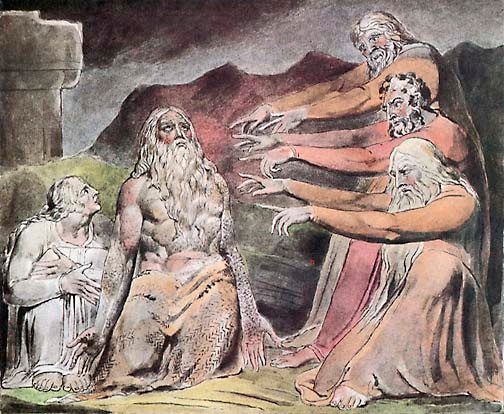
After all, the history of the West is the story of the heroic individual – Prometheus, Milton’s Satan, Hester Prynne, Martin Luther King. Although we don’t envy Job’s suffering or Oedipus’s fate, we sure as hell don’t admire their mealy-mouthed counsellors and chorus.

"Job" by William Blake

“Job” by William Blake

The world is too much with us late and soon, but it’s sweeping past much more quickly than it did in Wordsworth’s day. Video games, smart phones, tablets, the pinging of emails, the flashings of voicemails, the dizzying editing of movies all feed the fragmentation of attention to the detriment of the rich introspection that only deep silence can accommodate. Even college football games transpire in huddleless supersonic speeds. In this year’s Orange Bowl the announcers couldn’t keep up with the frenetic pace that seemed better suited to a professional basketball game than it did to football.

Perhaps an alternate, innovative 21st Century school might provide students with the best that has been thought and said and discovered with time to reflect on what they have learned. They certainly don’t need me to show them how to incorporate technology into their inquiries.

But as citizens, they certainly need to know our Constitution, the scientific method, the patterns that history provides, how art can provide beauty and mirror a culture’s preoccupations. To accomplish this education, it just might be necessary for an adult to tell a child what the adult knows about chemistry, the Russian revolution, or Irish history’s influence on the novels of James Joyce.  Certainly, we can enhance this instruction through computer-generated multi-media presentations and deepen students experience through projects; however, in high school we need to teach them a little about a lot, and you can’t beat lectures (and reading) for providing a lot of information in s short amount of time.  Just ask Tony Wagner.

William RogersRush_Hour_b

Sweet Home South Carolina

wooly mammoth can't bare to look at Eve offering Adam the apple

The wooly mammoth can’t bare to look at Eve offering Adam the apple

It’s been a memorable year for South Carolina’s state government. Nikki Haley has staunchly blocked the expansion of Medicaid to help spur the shiftless into seeking gainful employment, so rather than leeching our tax dollars to deal with their health and dental problems, the poor can suffer the wages of their sloth. If their unemployable children suffer as well, so be it.

Call it “natural selection at work.”

shot in SC by NY Times

photo shot in SC by NY Times

Oops, check that. It appears that some of our legislators don’t believe in natural selection.

First, Senator Mike Fair R-Greenville took issue with the following clause in new state science standards and had it removed:

Conceptual Understanding: Biological evolution occurs primarily when natural selection acts on the genetic variation in a population and changes the distribution of traits in that in that population over multiple generations.

Sez the Senator: “To teach natural selection is the answer to origins is wrong. I don’t have a problem with teaching theories. I don’t think it should be taught as fact.”

Not to be outdone, Kevin Byrant R-Anderson essentially derailed a bill that would have designated the Carolina Wooly Mammoth as the official state fossil¹ by adding an amendment to the bill that adds this modifying clause  ” [. . .] Carolina mammoth, which was created on the Sixth Day with the other beasts of the field.”

You’ve got to wonder given their non-evolving protective fur, if both the wooly mammoth and polar bear were thrilled to see the Fall given the 72 degree F. temperature that allowed our grand sire and his mate to loll around paradise naked.


¹It seems as if our representatives spend a great deal of time designating state shit:  State horse: Marsh Tacky; State grass: Indian grass; State language: English; State spider: Carolina wolf spider; State insect: Carolina mantid; State popular music: beach music; State snack food: boiled peanuts; State STD: gonorreah . . .

Carolina Mantid

Carolina Mantid

In other noteworthy legislative events, only a mere 15 years after legalizing interracial marriage, the state looks as if it’s no longer going to go after retirement home canasta clubs. Senator Tom Davis R-Beaufort introduced a bill that would legalize card playing in the Palmetto State:

“Davis, an attorney, said he developed the bill after state police warned a manager at Sun City Hilton Head last May that the bridge and canasta social clubs advertised for residents violated state law. That prompted management of the 14,000-resident retiree community to remove all signs and tell the clubs they could no longer play in community game rooms.”  – The Columbus Republic

At this rate of progressive progress, our dying great grandchildren may one day be able to legally use medical marijuana!

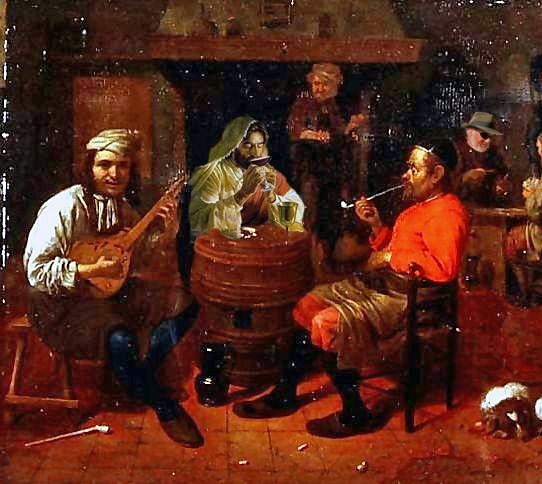
Partying with the Nazarene

Jesus -Tavern-Interior-With-Mandolin-Player

About a dozen or so years ago after returning from home a mole removal/biopsy procedure, I received a visitation from the muse of country music – let’s call her Twangella. The poem – as they say = wrote itself.

Click the arrow for sound:

Drunk me some wine with Jesus

at this here wedding in Galilee.

He saved the bestest for second

and provided it all for free.

So I quit my job on the shrimp boat

to follow him eternally.

No longer bound by them blue laws

enforced by the Pharisee.

And we had us some good times,

Till them Pharisee done him in.

Ain’t got no use for the religious right

After I seen what they done to him.

So when Saul/Paul stole the show

I just sorta drifted away,

Cause he never done quite understood

what Jesus was trying to say.

Paul was more like them Pharisee,

dissing this, cussing that,

giving the women a real hard time,

gay-bashing and all like that.

So I drink at home most nights now

trying to do some good,

offering the beggars a little snort

whilst praying for a robin hood.

Drunk me some wine with Jesus.

It was the bestest day I ever seen.

Drunk me some wine with Jesus,

partying with the Nazarene.

Jesus the wine-bibber, the whore’s buddy, a lot more uptight about money exchange than sins of the flesh. Actually doing a little jig in the Gospel of Thomas. A reformer. To hell with this harsh desert mentality, he preached. While he’s witnessing a throng preparing to stone an adulteress, half a world away in Tahiti naked girls with their parents’ blessings are chanting come-ons as they dance in a conga line past boys’ huts. Family values.

The Krushtones + The Sand Dollar Social Club = Federico Fellini

shapeimage_2

The Sound Track

One of the most pleasurable rites of spring celebrated in the Lowcountry each year occurs at the Sand Dollar Social Club on Folly Beach when the Krushtones take the stage for their annual April gig.

[Cue country preacher]: We’re talking glorification, brothers and sisters, talking bout light!

Krush-tones: (krùsh’- tõns) n. a band that features high-Watt[s] drumming; a bodacious bottom; a searing, eloquent guitar; and a latter day Jerry Lee Lewis on keyboards.

Joyous!

I swear, even if they were a mediocre band, the Krushtones’ taste is so exquisite I’d pay to hear the song sets. Al Green/Talking Heads, the Beatles, Stones, Chuck Berry. But mediocre they ain’t. They exude this palatable vibe of happiness that spreads in concentric circles as if a pearl has been dropped into a pool of sound.

Make you want to dance and holler hallelujah!

24742_407551362867_205748902867_5143575_8340625_n

The Venue

The Sand Dollar itself is difficult to categorize. As a private social club, it offers all of the exclusiveness of a subway station. One dollar secures you a year’s membership, but you can’t actually enter the club until 24 hours after your card has been issued. A typical Friday and Saturday night offers free live music, canned beer for a buck*, and and an eclectic clientele that, depending on the vibe the night you happen to be there, ranges from Felliniesque to Lynchian.

Bikers comprise a large contingent of the revelers, parking their Harleys (I don’t think I’ve ever seen a BMW) perilously close together out front like a chorus line of internally combustive Rockettes. I dread the day some reeling rummy trips and sets them crashing domino style one after the other. Years ago, before the bikers arrived, I had parked my VW minibus just in front of the designated space. When JB and I left for home, I was horrified to see at least twenty Harleys lined up about six inches from my back bumper and another car looming about a foot from my front bumper. Luckily, the fellow pictured below, a regular, helped me successfully to negotiate the scores of gear shifts, wheel turns, and progressions/reversals that liberated me from that straitened space.

*In 2014, a Bud will cost you $1.50

2

Joining the bikers as a discernible group are the long-in-the-tooth dead-end hedonists, who can be subdivided into old hippies and old shaggers. These sybarites, who hated each other in high school (the former letting their freak flag[s] fly, the latter sliding sockless feet into their Bass Weejuns) have mellowed over the years and appreciate each other in their shared ethos of self-medication and the never ending but increasingly difficult quest of getting laid.

jim-bell-and-sissy-jamesavatar_3454

A calico combination of others rounds out the squad – attractive, young preppies; South of Broad slummers; working folk shooting pool; the occasional bombastic prophet-of-doom blogger.

Lynchian vis-a-vis Felliniesque

What’s the distinction, you may wonder, between these two cinematic adjectives denoting surrealism?

fellini 2

Although baroque, Fellini’s surrealism tends towards the comic/satiric. His Satyricon, for example, counterbalances sensuous shots with grotesque images of Late Empire overindulgence. Carnivalesque might be an appropriate approximation.

lynch

Lynch’s surrealism is darker, a world of evil where the hideous co-mingle with grotesquely bland clichés of Americana, a la the image of above, where the sinister red-clad midget sits beside someone who looks like he may be employed as a hardware store clerk in a Norman Rockwell painting or the son of the couple depicted in Grant Wood’s American Gothic. Kafkalite-ish.

american-gothic-large4

If I had to choose between the hellish dilemma of spending eternity in a Fellini film or a Lynch film, I’d definitely opt for the former. Underneath all of the grotesqueness of Fellini lies a positive procreative impulse. Take “The Widow of Ephesus” segment of The Satyricon, for example, where a woman who has decided to starve herself in her husband’s tomb is seduced by a soldier guarding crucified corpses.

Now that’s what I call pro life.

Lynch, on the other hand, is anti-life. Not that his films aren’t hugely enjoyable and laugh-out-loud funny. Nevertheless, like the parents in Eraserhead, procreation begets monstrosity. You don’t want to bring a child into David Lynch’s world.

In short, a Felliniesque evening at the Sand Dollar is more pleasurable Lynchian evening,

Friday, 9 April 2010

I’m not making this up. During the Krushtones’ first set, I witnessed the departure of one of Charleston’s wealthiest septuagenarians and his seeing-eye trophy wife. She, a blonde, a head taller and thirty years younger, held his hand mommy-like as she led him through the throng. As they were leaving, three female dwarves dressed to the nines flowed past them and took their place at the corner of the stage. I repeat, I’m not making this up.

Lynchian or Felliniesque?

If Johnny Mac had been playing that night, a man deeply in love with the sound of his own guitar, or Jeannie Wiggins, trapped in the wrong gender, thumping serviceable rock to her adoring groupies, the karma might have darkened the brain chemistry that ultimately determines the existential nature of my world. However, with the Krushtones on stage, beaming, jumping, singing “Lady Madonna,” the positive vibration was infectious. Even the stern-faced bouncer who looks like the promotional US Marine of recruitment commercials cracked a smile.

Too bad the Krushtones were too young to play at Altamont.

24742_407552142867_205748902867_5143603_4958261_n

The 5 Greatest Rock-n-Roll Covers of All Time

BigMamaTwoWillie Mae “Big Mama Thornton” by Nick Young

A couple of weeks ago when I was luxuriating in vast open freedom of spring break, the musician Howard Dlugasch and I sat at the bar at the newly opened Jack of Cups Saloon (nee Brew Pub) on Folly discussing the difficulties local musicians face in performing original compositions at bar gigs. “No,” he said, “They don’t want to hear originals. They all want to hear covers. They all want to hear Journey.”

Howard Dlugasch

Howard Dlugasch

Howard’s lament got me thinking about covers themselves, and I began cataloging what I consider the greatest covers of all time, a Herculean task if you stop to think about it.  I immediately jettisoned jazz, decided to limit my purview to rock and folk. After racking my brain, I decided to limit my list to five, and certainly many will disagree with the following choices.

Before I announce my top five, though, I ought to provide the criteria I used in the construction of this pantheon.

1) The original song had to be significant in both its music and content.  By content I mean both the degree of significance of the lyrics’ poetic purpose and the poetic quality of the lyrics themselves.  Alas, this criterion eliminates Hendrix’s great cover of “Wild Thing.”

2)  The cover of the song had to make the song, as Ezra Pound would say, new.

3) The musicianship had to be first class.

Rather than attempting to rank the covers from “grooviest” to least “groovy,”¹ I’ve copped out by presenting the 5 Greatest Covers of all time in chronological order from oldest cover to most recent.

¹I retrieved these vintage terms from the Teen Beat files located in the adolescent wing of my memory museum.

  • Elvis Presley’s cover of Big Mama Thornton’s recording of Jerry Leiber and Mike Stoller’s “Hound Dog”  Thornton’s 1953 recording is killer, backed by badass bass and drumming and some imitative barking.  Hit the arrow for a 20 secondish listen:

elvis-presley-songs-hound-dog

Before Presley, others had recorded the song, and some critics claim that Presley was actually covering a Bob Wills cover or a Freddie Bell and the Bellboys cover. Nevertheless, Presley was aware of and liked the Thornton original, and so I contend he’s covering the original, not a covering a cover.  At any rate, Elvis and his producer Steve Sholes have twanged the tune to rockabilly with some aggressive drum rolling.

  • Next comes the Animals cover of the traditional folk song “Rising Sun Blues,” a song whose roots go to 18th Century England and a popular genre called “the Unfortunate Rake.” Immigrants  transported the song across the Atlantic and transplanted the setting to New Orleans.  Some contend the song’s narrator is a woman turned whore after being abandoned by a rake, which is the scenario Dylan employs in his cover, a recording that precedes the Animals’. The earliest recorded version is by Clarence “Tom” Ashley in 1934, which tells the tale from a male perspective.  Here’s a snippet from an early ’60’s version by Ashley and the great Doc Watson.  Note the featured lyrics are much different from the Animals version.

 the_animals

Ashley/Watson:  

The Animals:

Electric guitarist Hilton Valentine’s minor key arpeggio and Alan Price’s organ transform the song into what the critic Dave Marsh called “the first rock folk hit.”

  • Jimi Hendrix’s 1968 recording of Bob Dylan’s 1967 release “All Along the Watchtower.”

jimi-hendrix

Dylan:

Hendrix: 

Now, that’s what I call making it new.

  • The Doors 1970 live version of Bo Diddley’s “Who Do You Love”  This selection is perhaps the most controversial.  However, I’m going with it.  Listen.

images

Bo Diddley:

The Doors: 

  • Also, perhaps, controversial, I rank Patti Smith’s 2007 cover of Nirvana’s 1991 “Smells like Teen Spirit” in the top five.  Here Smith substitutes banjos and fiddles for electric guitars and replaces Cobain’s solo with a poem that elevates the song from an anthem of teen angst to some sort of post apocalyptic nightmare.

6a0120a7b5f86a970b015437e241f9970c-800wi

Nirvana:  

Patti Smith:  

Well, there you go.  Would love to hear some comments.  Obviously, I also stayed away from soul music because rating covers there would be almost as hard as jazz.  Also, I’ve dissed Janis, whose cover of “Piece of My Heart” should probably bump Morrison and Smith off this list.

Vulgarity as Poetry

Freud-benefits-sup_1952707b

Let’s say you’re browsing Twitter and run across a sponsored post by John Bolton, the former UN Ambassador, one of the architects of the second Iraq war, that invasion launched by Bush and Company to purge non-existent weapons of mass destruction from Saddam’s non-existent stockpiles because, despite Iraq’s not having an air force or a navy that could deploy those non-existent weapons of mass destruction, Saddam posed a “present and growing danger.”

And let’s say that rather than financing this ruinously expensive, absolutely unnecessary war through raising taxes, the Bush Administration introduced legislation that slashed taxes, which depleted Clinton’s 280 billion surplus that cratered into a 1.2 trillion deficit under Bush.

And, finally, let’s say that besides virtually bankrupting our nation, this absolutely unnecessary war resulted in 4.488 American deaths, 500,000 Iraqi deaths.

Oh, yeah, the John-Bolton-sponsored post on Twitter that triggered the above screed:

“Barack Obama. Worst president ever? Vote here.”

Obviously, my first three paragraphs exceed Twitter’s 140-character limit; plus, let’s face it, the explanation is tediously verbose and doesn’t even address the outrageous hubris that Bolton exhibits, this man who has made a mistake so grievous that he ought to have blinded himself Oedipus-like and be tapping his staff across the Arabian Desert in an attempt at expiation.

How, you ask, can anyone successfully address the outrageousness of Bolton’s question in the constricted medium of Twitter?

Here’s how:

Andrew Otis Weiss ‏‪@ThatWeissGuy‬ Mar 21
.‪@AmbJohnBolton Go back to selling oatmeal and diabetes meds, you blood splattered fuck (emphasis mine).

Colonel Kurtz, what do you have to say about Andrew Otis Weiss’s response to Bolton’s tweet?

Yes, it is genius, a perfect putdown, more graphic than even a photoshopped picture. Weiss has melded sound, sense, and image into a barbarous haiku: you blood-splattered fuck.

The introductory “you,”  accusatory, echoing that expletive for disgust we emit when coming upon fresh roadkill -eww – the adjective “blood-splattered” with its connotations of careless butchery, the onomatopoetic splat, the thudding consonance of the terminal D-sounds  (plus the word turd imbedded in splattered subliminally adding shit into the  mix).

But then the clincher, the noun fuck.  No, not dickdick won’t do – no, not prickprick won’t do – the vowels too short, too effete – but fuck – the abyss.  You blood-splattered fuck, you casual slaughterer of half a million human beings.

Bravo, Andrew Otis Weiss, def poet of the absolutely perfect insult!

Skulls-at-Sang-prison-Dc-Cam-pic-600x

First Sentences, First Impressions

Ishmael

We’ve all been told of the importance of first impressions, which are particularly crucial when trying to publish a piece of fiction. Stephen Corey, former editor of the Georgia Review, once told me that if a story didn’t grab him by sentence three he chunked it into the rejection pile. He said he received approximately 300 manuscripts a month, which meant that to get a story into that quarterly publication, you were going against 1200 other combatants.

I suspect with novels the pressure isn’t quite as intense; nevertheless, certainly a rollicking good first sentence has to be advantageous.

Take Jay McInerney’s first from Bright Lights, Big City, a sentence that falls beneath a chapter title that reads “It’s Six A.M. Do You Know Where You Are”

 You’re not the kind of guy who would be at a place like this at this time in the morning.

It certainly hooked me, as I found myself all-coked-up in “either the Heartbreak or Lizard Lounge” – my second person narrator wasn’t sure which – “talking to a girl with a shaved head.”

Of course, some writers don’t opt for the old in medias res commencement but take us way back in time, as Thomas Sterne does with Tristan Shandy’s contemplatiion of the act of his procreation:

I wish either my father or my mother, or indeed both of them, as they were in  duty both equally bound to it, had duly considered how much depended upon what they were then doing;—that not only the production of a rational Being was concerned in it, but that possibly the happy formation and temperature of his body, perhaps his genius and the very cast of his mind;— and, for aught they knew to the contrary, even the fortunes of his whole house might take their turn from the humours and dispositions that were then uppermost;—Had they duly weighed and considered all this, and  proceeded accordingly,—I am verily persuaded that I should have made a quite different figure in the world, from that in which the reader is likely to see me.

Others attempt to establish mood:

During the whole of a dull, dark, and soundless day in the autumn of the year, when the clouds hung oppressively low in the heavens, I had been passing alone, on horseback, through a singularly dreary tract of country; and at length found myself, as the shades of the evening drew on, within view of the melancholy House of Usher.

Or to encapsulate theme like this:

It is a truth universally acknowledged, that a single man in possession of a good fortune, must be in want of a good wife.

Or this:

It was the best of times, it was the worst of times, it was the age of wisdom, it was the age of foolishness, it was the epoch of belief, it was the epoch of incredulity, it was the season of Light, it was the season of Darkness, it was the spring of hope, it was the winter of despair, we had everything before us, we had nothing before us, we were all going direct to Heaven, we were all going direct the other way — in short, the period was so far like the present period, that some of its noisiest authorities insisted on its being received, for good or for evil, in the superlative degree of comparison only.

Nor does the quality of first sentence, I might add, signify the over all quality of the work as a whole.  Certainly Joyce’s first sentence of Portrait of the Artist as a Young Man – “Once upon a time and a very good time it was there wasa moocow coming down along the road and this moocow that was down along the road met a nicens little boy named baby tuckoo. . . .” is more arresting than the first sentence of Ulysses –  “Stately, plump Buck Mulligan came from the stairhead, bearing a bowl of lather on which a mirror and a razor lay crossed.” – but few would rank Portrait over Ulysses in overall quality.  And certainly, George Eliot’s first sentence of Middlemarch – “Miss Brooke had that kind of beauty which seems to be thrown into relief by poor dress.” – though interesting, doesn’t even begin to signal the grandeur that is to follow.

Well, you wonder, what is the greatest of all first sentences written in English?  “Call me Ishmael?”  Or “A throng of bearded men, in sad-colored garments and gray, steeple-crowned hats, intermixed with women, some wearing hoods, and others bareheaded, was assembled in front of a wooden edifice, the door of which was heavily timbered with oak, and studded with iron spikes?”

No, by my reckoning, the greatest first sentence of any novel anywhere came from the typewriter of Nabokov.

Lolita, light of my life, fire of my loins. My sin, my soul. Lo-lee-ta: the tip of the tongue taking a trip of three steps down the palate to tap, at three, on the teeth. Lo. Lee. Ta.

After reading that, would not be compelled to read on?

Vladimir Nabokov

Vladimir Nabokov