The Struggle Itself

Each weekday morning when Judy’s getting her 96-straight hours of EPOCH at Roper, I pull into the Doughty Street Parking Lot around 7,  just when the hospital staff switches from day to night shift. As I cross Doughty on foot, Judy’s morning paper in hand, I work against the oncoming pedestrian traffic of off-duty nurses, technicians, engineers, many in their uniforms. Nurses in their navy blue combinations and high-priced athletic shoes seem especially happy.  I see them walking in groups of three, smiling, chatting, heading to their cars. They work 3 day-12 hour shifts in a fulfilling profession; nevertheless they’re delighted at the moment to be free.

(Now, what do they do? Devour a delicious breakfast and slurp down a bloody mary before drifting off in front of the Today Show?)

Going with my flow, the on-coming staff marches in, but, even though they seem relatively eager to start work, their affect isn’t nearly as upbeat as their departing colleagues. Then again, we aint talking all doctors and nurses here. Some of these people’s jobs don’t seem fulfilling at all, like those men awkwardly manipulating box-stacked carts into narrow elevators, like those cafeteria workers breathing for hours the odor of hospital food, like the crew out front dealing with valet parking.

Their minutes probably crawl by.

MC Escher: Convex and Concave

MC Escher: Convex and Concave

Of course, I’m on the way to work myself to shift through dozens of emails before advisory, and if I’m brave enough, to peek at the day’s school calendar, an absurd, way-too-busy color-coded chart of lines and rectangles that look as if they could be the work of MC Escher. We ride a rotating schedule – either Week A or Week B — and when I arrive at work on a Friday morning, people often greet me with the salutation “Happy Friday” or comment sunnily “it’s Friday.” Some time during the day I’ll receive an email inviting me to a “happy hour” in some conveniently located spirit-stocked decompression chamber.

TGIF!

Mythically speaking, labor is one of Adam’s curses, punishment for his uxoriousness, his casting his lot with Eve instead of Yahweh, which brought death into the world and all our woe, e.g. work — in Adam’s case tilling “cursed ground” that produces “thorns and thistles” — in my case dealing with an educational agenda that might be likened to a jewel box of tangled necklaces — academics, sports, service, chapels, assemblies, advisories, peer reviews, study halls. Or think of circus clowns, not leaving a car one after another after another, but entering a car one after another after another.

Actually, I interpret the Eden myth as a story about the shift from hunting/gathering to agriculture, the shift from running around half naked to the natural pulse of the earth’s heartbeat to our settling down to the soul-crushing repetitiveness of the punch clock.  Thus, the knowledge of good and evil becomes the knowledge of how to cultivate plants from seeds, which many scholars believe was a discovery made by women, the gatherers of edible plants. And, of course, settled communities brought us the establishment of property and its evil twin poverty.  I maintain that Amazonian tribespeople untouched by Western civilization live more meaningful lives than the average American who watches five hours of TV a day.

There’s a cool Philip Larkin poem about what a bitch work is called “Toads.” It goes like this:

Toads

Why should I let the toad work

Squat on my life?

Can’t I use my wit as a pitchfork

and drive the brute off?


Six days of the week it soils

With its sickening poison-

Just for paying a few bills!

That’s out of proportion.


Lots of folk live on their wits:

Lecturers, lispers,

Losels, loblolly-men, louts-

They don’t end as paupers;


Lots of folk live up lanes

With fires in a bucket,

Eat windfalls and tinned sardines-

They seem to like it.


Their nippers have got bare feet,

Their unspeakable wives

Are skinny as whippets-and yet

No one actually starves.


Ah, were I courageous enough

To shout Stuff your pension!

But I know, all too well, that’s the stuff

That dreams are made on:


For something sufficiently toad-like

Squats in me, too;

Its hunkers are heavy as hard luck,

And cold as snow,


And will never allow me to blarney

My way to getting

The fame and the girl and the money

All at one sitting.


I don’t say, one bodies the other

One’s spiritual truth;

But I do say it’s hard to lose either,

When you have both.


I’m with you, Philip. After listening to my litany yesterday about how frustrating teaching has become in the age of technology,  a colleague asked me why didn’t I retire.  A reasonable question given the frustrations I had just catalogued – parents having access to the grades I post on the website, shooting me emails that proliferate like mushrooms while I’m bouncing from meetings to covering detentions or contacting the help desk because the projection wire in one of the rooms where I teach doesn’t work.

Why don’t I retire?  Because I don’t want to. I eventually get bored in the summers if I’m not traveling or working on a project. I like interacting with students, instructing them about the bane of unnecessary linking verbs and the sloppiness of the “naked this” — not to mention the fun introducing them to the Wife of Bath or riding with them up the Congo with Marlow as we steam towards Mistah Kurtz.

It’s like what Camus says in “The Myth of Sisyphus.” –

I leave Sisyphus at the foot of the mountain! One always finds one’s burden again. But Sisyphus teaches the higher fidelity that negates the gods and raises rocks. He too concludes that all is well. This universe henceforth without a master seems to him neither sterile nor futile. Each atom of that stone, each mineral flake of that night filled mountain, in itself forms a world. The struggle itself toward the heights is enough to fill a man’s heart. One must imagine Sisyphus happy.

Sisyphus-e1298413740742

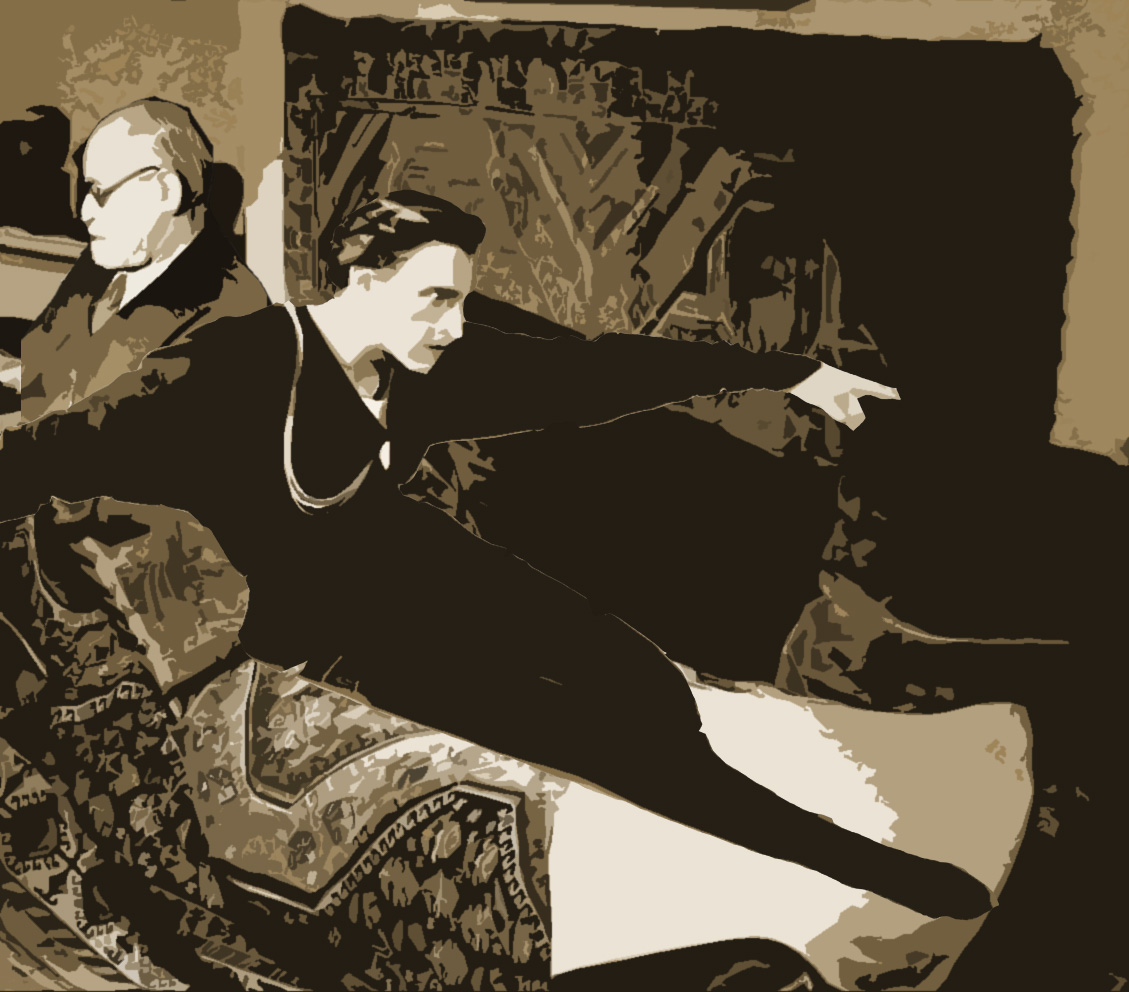
Freud, Jung, Hamlet, and Joyce

A Finger Puppet Play in One Act

freud pyschoanalyzes Hamlet


Scene One : The castle at Elsinore.

Enter Hamlet moping

Hamlet: O, would this too, too solid flesh melt

and resolve itself into a dew.

O, how weary stale and flat seem to me

All the uses of this world. Fie on it. Fie!


Goddamn it! What a rogue and peasant slave am I!


The night sky that wheels above us,

That brave o’er hanging firmament,

That majestic roof fretted with golden fire,

Why it appearth no other thing to me

than a foul and pestilent congregation of vapors.


O, to be or not to be that is the question.

O, to sweat and groan under a weary life.


Fie on it. Fie.

But soft! Methinks

I hear that most pernicious woman

whose name is frailty.


Enter Gertrude:


Gertrude: Hamlet, O Hamlet.

Hamlet: Yes, mother.

Gertrude. O Hamlet, cast thy nighted color off and

let me giveth thee a sponge bath.

Hamlet: O mother, you know I have that appointment

Today with Dr. Freud.

Gertrude: I had forgot. Cancel it, love.

Hamlet: You knoweth what a procrastinator

I be. I shall go to the appointment.

Gertrude: Well giveth your mother a little kiss,

my love, before thou leavest.


Scene Two: Dr. Freud’s Offices.

Freud and James Joyce engaging in “the talking cure.”

Freud: Keep Going, Mr. Joyce. Get it Out

Joyce: Well, you know or don’t you kennet or haven’t I told you every telling has a taling and that’s the he and the she of it. Look, look, the dusk is growing!

Freud: Very well then, Mr. Joyce I’ll see you next time.

Joyce: By the way, Doc, to say that a great genius is half-mad, while recognizing his artistic prowess, is worth as much as saying that he was rheumatic, or that he suffered from diabetes. Madness, in fact, is a medical expression to which a balanced critic should pay no more heed than he would to the accusation of heresy brought by the theologian, or to the accusation of immorality brought by the public prosecutor. Good Day

exit Joyce

Freud: His Inflated ego is furthered pathologized by anal expulsiveness. What is that last book of his Finnegan’s Wake by a vast shit explosion? Anna!

Enter Anna Freud.

Anna: Yes, Father?

Freud: Whose next?

Anna. He calls himself Hamlet, Hamlet the Dane.


Scene Three: Hamlet and Freud’s session

(Hamlet lying on the psychiatric couch)

Freud: Enough about your mother. Tell me about this step father of yours.

Hamlet: O villain, villain, smiling, damned villain! Bloody, bawdy villain!

Remorseless, treacherous, lecherous, kindless villain!

Freud: So I take it you do not like this man.

Hamlet: I should have fatted all the region kites

With this slave’s offal.

Freud: My son, it’s quite clear that you suffer from an Oedipal complex, that you are fixated in the phallic stage.   Our work is done here. That will be 500 marks.

Hamlet: You joketh. That’s it? I want another opinion.

Freud: Very well. Anna!  Bring in Dr. Jung

Enter Jung.

Freud: Dr. Jung, this young man wants to kill his father.

Hamlet: Stepfather!

Freud: To kill his father so he can be with alone with his mother, which obviously denotes the Oedipal complex.

Jung: I’ve been thinking, Herr Mentor, that you over-emphasize the sexual component in mental illness. I have a slightly different take.

Freud: I dare you! How dare you! Contradict me!

They fight.

Scene Four: Hamlet alone on the Battlement.

Hamlet:

I have heard the mermaids singing, each to each.

I do not think that they will sing to me.

I have seen them riding seaward on the waves

Combing the white hair of the waves blown back

When the wind blows the water white and black.


We have lingered in the chambers of the sea

By sea-girls wreathed with seaweed red and brown

Till human voices wake us, and we drown.

The rest is silence.

Enter Joyce doing a jig

Joyce: If others have their will Ann hath a way. By cock, she was to blame. She put the comether on him, sweet and twentysix. The greyeyed goddess who bends over the boy Adonis, stooping to conquer, as prologue to the swelling act, is a boldfaced Stratford wench who tumbles in a cornfield a lover younger than herself.

End here. Us then. Finn, again! Take. Bussoftlhee, mememormee! Till thousandsthee. Lps. The keys to. Given! A way a lone a last a loved a long the

Exeunt.

The End.

The Post Labor Day Wardrobe Blues


Labor Day, brother,

put them white pants away.

I reiterate: Labor Day;

put them white shoes away.

Nobody told that blazing sun up there,

but the etiquette polices get the final say.


Way past Labor Day,

shred that seersucker, fool.

The calendar say September,

so ditch them white bucks, too.

No matter what the thermometer say,

We talking ’bout society rules!


Science book say white jacket repel the heat

help to keep your arm pit dry.

Science book say dark clothes sorbs the heat

and make your poor body fry.

But the science also say they ain’t

no heaven to go to when you die.


Up in heaven, it always the month of May

Up in heaven it always the month of May

You can wear that white robe without no snooty dismay.


Gots to get to heaven to ‘scape global warmin’

Needs to get to heaven to ‘scape global warmin’

It be almost Christmas and the skeeters still be swarmin’


Oh, do Lawd, it Labor Day,

time to put them white clothes away.

Done be Labor Day,


gotta put them white clothes away.

Time to don you some wool

and pray for the Judgment Day

Yo dub poet hisself

The Robotics of Pledging Allegiance

The K-12 independent Episcopal/African Anglican institution* where I teach celebrates the beginning of each school year with an outdoor all-school assembly.

It’s quite a confluence – Lower School teachers shepherd their little ones in lines, the Middle School bursts from Tyler Hall in a hormonal scrum, Upper School students meander down the steps to join the other two divisions beneath canopies of shade-providing oaks. Faculty members should, I suppose, hang with the grades they teach, but these well-behaved, considerate boys and girls need little supervision. I generally roam among each division until the show actually commences when I reposition myself as far back as discretion allows.

In Episcopal/African Anglican fashion, the ceremony begins with a processional led by a cross-bearing acolyte followed by the Chaplin, the Head of School, the Head of Admissions, sixteen flag-bearing students, and a bag-piping Latin-teaching devotee of Lucretius bringing up the rear.

Then follows a prayer, words of welcome, and introductions of the flag-bearers, natives or citizens of the countries of the flags they awkwardly wield. The last introduced is a US citizen, and one of the aforementioned dignitaries leads the assembled in the Pledge of Allegiance, words I haven’t recited since Lyndon Johnson was president.

kids-saying-pledge1To me, pledging allegiance to anything, especially when you’re too young and too ignorant historically to understand the words smacks of insecurity, if not paranoia, and is in a sense insulting. The Moore/Birdsong son-producing combine never demanded that Harrison and Ned and Mother and Father place their hands upon their hearts and swear fealty to the clan — it was a given that we all loved one another and wouldn’t endanger the family unit in any kind of serious malfeasance.

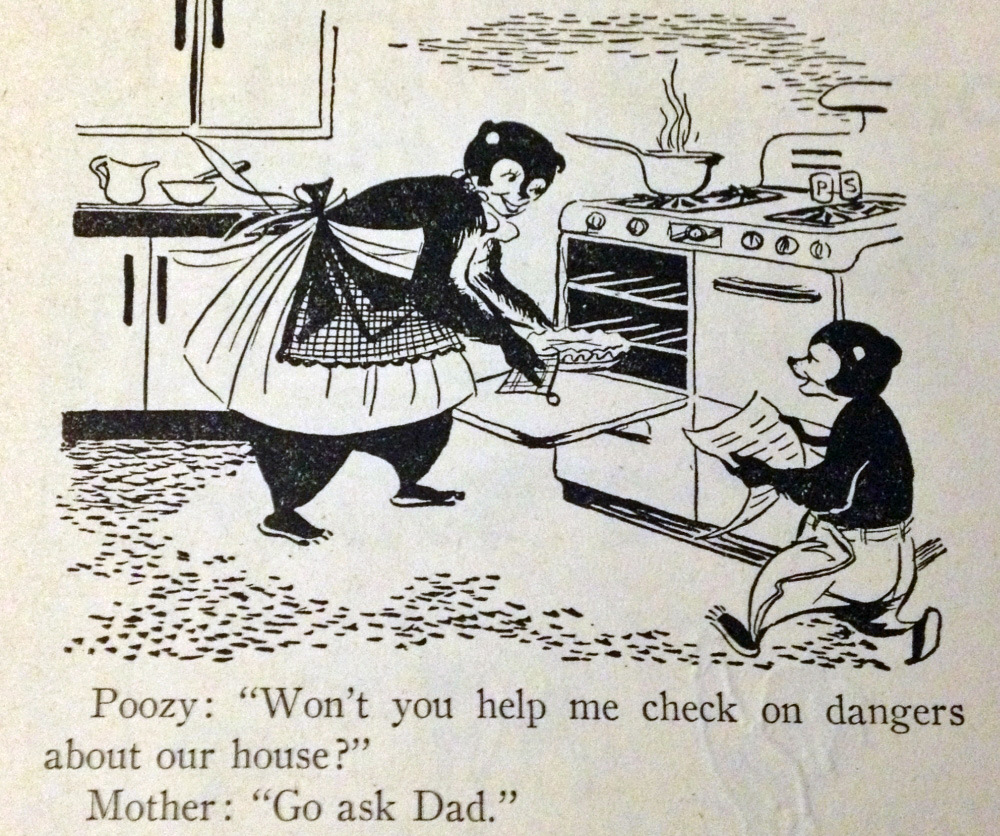
a cartoon from a '50's edition of Highlights for Children magazine

a cartoon from a ’50’s edition of Highlights for Children magazine

Furthermore, the words of the Pledge simply aren’t true. For example, I first recited them in a segregated school, and when I went for my smallpox vaccination, I flipped through Highlights magazines in an all-white waiting room (blacks had their own waiting rooms in the fashion of veterinarian clinics that separate dogs and cats).

So much for liberty and justice for all.

Not to mention that the Pledge itself violates the separation of church and state that the Constitution decrees — one nation under God, indivisible. I can also argue, as some Texans do in spasms of Obama-hating frenzy, that damn right it’s divisible, like in 1860’s, for example.

Having children place their hands on their hearts to solemnly swear to bullshit is unhealthy.

How about a compromise? How about changing a word here and there to make the Pledge less paranoid, less mendacious? Here’s a immodest proposal:

I pay homage to the ideals of the Constitution of the United States of America — liberty and justice. We are one nation of melded immigrants who treasure our freedoms of speech, religion, and assembly and will remain mindful of them as we live our lives in this great nation of ours.

Just an idea.

Wanna hear a really creepy idea?  What if they made you pledge allegiance to the flag of the state of South Carolina?


*Not unlike some of our parents, the Episcopal Church in South Carolina and some of its parishes are going through an ugly divorce.


A Reluctant Grammarian Goes Over to the Dark Side

imagesBecause I was dream-ridden, impractical and enjoyed reading, I majored in English without giving future employment a nanosecond’s consideration. Not adept at linear thinking (or delayed gratification), I floated day-to-day through the eight seasons of my undergraduate career bullshitting, wooing, drinking, reefering, eating cafeteria food, listening to and talking about music, reading, writing papers, and studying (not necessarily in that order).

Something would come up or happen or not.

No way did I ever envision myself as a future high or middle school teacher. I recall my pre-undergraduate days, not with nostalgia, but with a feeling of good-riddance, like Japanese Californians might look back on their internment during WW2.

Ironically, my English class in the 8th grade was what I dreaded most each day: constructing mobile-like diagrams of stilted workbook sentences or splashing misspelled words between prim blue lines as I stacked one atop the other five mechanically engineered paragraphs.

Sometimes I foolishly envied my teachers because I thought they didn’t suffer the anxiety I did (they seemed to have their shit together), but no way did I ever even remotely consider expending

hours . . .

days . . .

years . . .

decades . . .

in concrete-block enclosures forcing kids to read the Fireside Poets.

Nevertheless, I am an English teacher, which means, alas, people who don’t know me well think I might judge them on the standardization of their grammar, whether spoken or written. I try to reassure them that I digs the vernacular, that they can feel free to split infinitives, confuse lie with lay, end sentences with prepositions. It’s all good/well with me.

I could [not] care less (unless they confuse number with amount [petty] or use literally to mean figuratively [deadly]).*

Nevertheless, me, myself and I-and-I hesitate to violate grammatical rules in written language, even though I know the best prose sounds as if like someone’s talking to you.

See what I mean? Grammar books teach that one in written language should not introduce a clause (as in the sentence above) with the preposition “like,” but you sound like some stilted schoolmarm if you use “as if,” not to mention, one. In fact, I violate the subordinate pronoun rule in the last clause of the last sentence of paragraph 3 – like Japanese Californians might look back on their internment during WW2.

Truth be told, I had to spend some time getting that clause right. I’d prefer a singular antecedent – a Japanese Californian – but I didn’t want the clutter of singular gender specific pronouns like his and her  – however, I also didn’t want to drop the pronoun altogether as in like a Japanese Californian might look back on internment because the rhythm wasn’t quite right. After a bit of praying and fasting, I ended up opting for a plural antecedent Californians so I could correctly use “their.”

In fact, I’m almost at the point of endorsing plural neuter pronouns like they and their as a practical, ear-pleasing alternatives to cluttering sentences with hises and herses.

Compare this cliché with its politically correct alternatives:

A measure of a man is his

A measure of a wo/man is his or her

A measure of a person is his of her [or his/her]

A measure of a person is their

I’m thinking the last one might be best. It doesn’t suggest that women are subsets of men, it doesn’t bring attention to the differences between the two, and it doesn’t clutter/ruin the rhythm of the sentence. Obviously, it’s grammatically wrong, but to most people it doesn’t sound wrong.

After all, the construction “I’m a good ventriloquist, ain’t I” makes more grammatical sense than “I’m a good ventriloquist, aren’t I?”

After all, I are a ventriloquist extraordinaire.

*”I contradict myself?  So I contradict myself.  A foolish consistency is the hobgoblin of little minds,” sez Ralph Waldo.

Hieronymus Bosch Deals with Cancer


Hieronymus Bosch - Triptych of Garden of Earthly Delights _detail 13_


Which cell first rebelled,

fueled the insurrection

taking over the town?

Bosch-born monsters breed,

ruttish rumpfed bladders on legs

scurrying across the canvas,

an obscene carnival, clots of chaos everywhere.

Dey run amok fuck-up go cruzy clump

disrupt – sisrupt – pile-up

piles of corpses

mangled tangled

elbows, torsos,

heads, mouths

frozen open, rictus,

Dachau, Austerlitz

anus world, a world of shit.

* * *

But here comes the chemo,

scouring, healing poison –

not no cavalry, not no Marines,

but bleach, lye,

molten lava pumping,

spreading o’er the obscene canvas

obliterating blight,

like hell fire, consuming those

misbegotten cankered creatures,

restoring order, an earlier order,

purging, drowning,

cooling,

covering,

creating rich soil

for fresh garden growth

a world of . . .

Cliffs of Fall, Frightful

Not surprisingly, Robin Williams’ death has ignited a war of words between those who believe that suicide is a selfish act of cowardice and those who believe that it is a regrettable symptom of mental illness — that the suicide is in essence innocent of his own murder by reason of insanity.

Among the former is Shepard Smith who observed on Fox News:

You could love three little things [Williams’ children] so much, watch them grow, they’re in their mid-20s, and they’re inspiring you, and exciting you, and they fill you up with the kind of joy you could never have known.’

‘And yet, something inside you is so horrible or you’re such a coward or whatever the reason that you decide that you have to end it. Robin Williams, at 63, did that today.’

What do you have to say to that, Gerard Manley Hopkins?

O the mind, mind has mountains; cliffs of fall

Frightful, sheer, no-man-fathomed. Hold them cheap

May who ne’er hung there. Nor does long our small

Durance deal with that steep or deep. Here! creep,

Wretch, under a comfort serves in a whirlwind: all

Life death does end and each day dies with sleep.

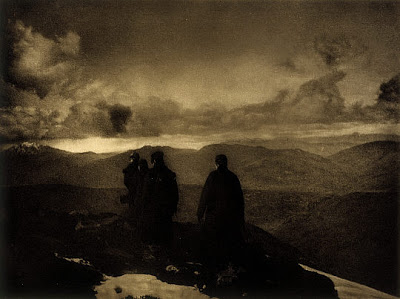
"The Dark Mountains" by James Craig Annan (1864 - 1946)

“The Dark Mountains” by James Craig Annan (1864 – 1946)

Obviously, Shep Smith “ne’er hung there,” and though Matt Walsh, self-professed “professional sayer of truths” claims to have “struggled with [depression] his entire life,” he’s obviously “ne’er hung there” either:

So I’m just like you, then, because I can’t stomach the thought of [suicide]. I’ve seen it in the neighborhoods where I’ve lived and the schools that I’ve attended. I’ve seen it in my family. I’ve known adults and kids who’ve done it. I’ve seen it on the news and read about it in books, but I can’t comprehend it. The complete, total, absolute rejection of life. The final refusal to see the worth in anything, or the beauty, or the reason, or the point, or the hope. The willingness to saddle your family with the pain and misery and anger that will now plague them for the rest of their lives.

It’s a tragic choice, truly, but it is a choice, and we have to remember that. Your suicide doesn’t happen to you; it doesn’t attack you like cancer or descend upon you like a tornado. It is a decision made by an individual. A bad decision. Always a bad decision.

Hmmmmm.

Of cuff I button at my wrist. The presser, the cutter,

The wringer, the mangle. The needle, the union,

The treadle, the bobbin. The code. The infamous blaze


At the Triangle Factory in nineteen-eleven.

One hundred and forty-six died in the flames

On the ninth floor, no hydrants, no fire escapes—


The witness in a building across the street

Who watched how a young man helped a girl to step

Up to the windowsill, then held her out


Away from the masonry wall and let her drop.

And then another. As if he were helping them up

To enter a streetcar, and not eternity.


A third before he dropped her put her arms

Around his neck and kissed him. Then he held

Her into space, and dropped her. Almost at once


He stepped to the sill himself, his jacket flared

And fluttered up from his shirt as he came down,

Air filling up the legs of his gray trousers—


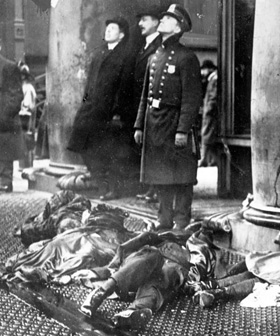
Triangle Factory Fire

Triangle Factory Fire

Obviously, depression is an existential, individual disease that manifests itself in different individuals in different degrees. I’m assuming that Mr. Walsh hasn’t suffered Gerard-Manley-Hopkins or David-Foster-Wallace-grade depression, endured those hideous nightmares that plague the sufferer, who pulls down the comforter to discover the rotting corpse of his mother, nightmares that slaughter sleep, which further exhausts the sufferer, who now shuffles blank eyed through a bleak day where nothing – no thing – will bring him joy nor alleviate his excruciating pain.

Yes, suicide is a horrible act, an act that plagues family and friends with sorrow and perhaps guilt; however, if someone’s psyche is a Triangle Factory on fire, I can understand and forgive his or her leaping.


Robin Williams, Maria Bamford, and Shamanism

Last night CNN’s Errol Barnett and Larry King pondered why someone like Robin Williams, a man whom they claimed had everything — genius, riches, awards galore – would take his own life.

King went on to paraphrase EA Robinson’s famous poem “Richard Cory,” the one Simon and Garfunkel put to music; only King misidentified Richard Cory as “Mr. Blackwell” and embellished with extra info like “he had parties on every Halloween.”

Here, look at it yourself. (And also enjoy the dulcet tones of Judy Birdsong yakking on the phone in the background)

Here’s the poem “Richard Cory”

Whenever Richard Cory went downtown,

We people on the pavement looked at him;

He was a gentleman from sole to crown,

Clean-favored, and imperially slim


And he was always quietly arrayed.

And he was always human when he talked;

But still he fluttered pulses when he said,

“Good morning,” and he glittered when he walked.


And he was rich — yes, richer than a king —

And admirably schooled in every grace:

In fine, we thought that he was everything

To make us wish that we were in his place.


So on we worked, and waited for the light,

And went without the meat, and cursed the bread;

And Richard Cory, on calm summer night

Went home and put s bullet through his head.

Here is Errol Barnett extolling the nuanced wisdom of Larry King.

Now, dear reader/viewer, take a look at Robin Williams’s first appearance on Johnny Carson.

Nancy C Andreasen’s article “Secrets of the Creative Brain” in the July/August Atlantic explores the connection between creativity and mental illness.  According to her 15-year study of participants of the Iowa Writer’s Workshop that included the likes of Kurt Vonnegut, Richard Yates, John Cheever, “and 27 other well-known writers,”  Andreasen writes that her “writer subjects came to my office and spent three or four hours pouring out the stories of their struggles with mood disorder — mostly depression, but occasionally bipolar disorder.  A full 80% percent of them had some kind of mood disturbance, compared with just 30% of the control group.”

Although Williams never acknowledged that he suffered from bipolar disorder, his manic highs certainly seem to suggest that a BPD diagnosis is reasonable, and if we can imagine lows that counterbalance the highs on display in the clip above, those those lows would be Marianas-Tench-like, bottomless.

Coincidently, just last week I caught the comedienne Maria Bamford being interviewed on NPR describing a visit she received from a Whole Foods aficionado while Bamford was in a mental hospital.  Bamford, who’s famous for channeling voices, echoed the all-knowing tone of a Californian new ager as she impersonated the visitor.

Visitor: Look, Maria, you need to, like, get into nature.

Maria:  You mean like Virginia Woolf and the river?

old pictures 004Even before yesterday’s dismal news, I wondered in a different culture if Williams might turn out to be a shaman, and watching Bamford’s most recent special (see trailer below), it’s almost as if she’s possessed, not by demons, but by a number of different personalities.  Here’s Joseph Campbell explaining the difference between a Shaman and a priest:

There’s a major difference, as I see it, between a shaman and a priest. A priest is a functionary of a social sort. The society worships certain deities in a certain way, and the priest becomes ordained as a functionary to carry out that ritual. The deity to whom he is devoted is a deity that was there before he came along. But the shaman’s powers are symbolized in his own familiars, deities of his own personal experience. His authority comes out of a psychological experience, not a social ordination.

To become a shaman or shamanka (the term for a female shaman), one must undergo a psychological crisis.

Here’s anthropologist Douglas Mackar’s description of the shaman state:

The most basic aspect of how we are Shamans is the experience of the trance state.
 All creation occurs in a trance state. In trance, your old attitudes can’t disrupt creation and evolution. It’s only when you release from that trance state that you fall back into your old mind state. It’s always a temptation to go back to the familiar. True change- transformation- is incorporating new knowledge into your psyche and holding it there long enough for it to become a permanent part of your thinking. (Douglas Mackar)

Of course, the 20th and 21st Century LA was Williams’s and Bamford’s milieu, and I don’t mean to imply that they literally were sha-people, only that they share some similarities, and a trance state is not a bad way to describe some of their comic performances.

And also we shouldn’t conflate Williams with Richard Cory.  Cory “glittered when he walked” and Williams bounced around whatever room he was in like an Indian rubber ball.

His suicide didn’t surprise me.

Mamas, Don’t Let Your Sons Grow Up to Be Poets or House Painters

Thanks to a steady intake of fumes from solvents, house painters suffer a greater susceptibility to alcoholism than any workers except for maybe poets.[1]

You think you got it rough, surveyor, roofer, house painter, Mr. Sisyphus?

Dig this poetic whining:

A line will take us hours maybe;

Yet if it does not seem a moment’s thought,

Our stitching and unstitching has been naught.

Better go down upon your marrow-bones

And scrub a kitchen pavement, or break stones

Like an old pauper, in all kinds of weather;

For to articulate sweet sounds together

Is to work harder than all these, and yet

Be thought an idler by the noisy set

Of bankers, schoolmasters, and clergymen

The martyrs call the world.’

Not to mention that you also have to teach college to pay your bills.

The horror! The horror!

Yet, you could — and I do — argue that house painting is more dangerous to your health than banging out villanelles.

the good life

For example yesterday was, in the words of a house painter acquaintance, “paycheck Friday,” which brought him to the bar at Chico Feo with more than enough cash to tie one on. HP — as I will call him —  is a rather handsome but unkempt 40-year-old who sports shoulder-length brown hair, a greying beard, and a number of eclectic tattoos, including the dog Odie of Garfield fame, tongue out, panting on his left bicep. HP hangs with Gregory, a gentlemanly toper who also sports shoulder-length hair and a Whitmanesque beard.

Bespattered with paint and suffering from a case of psoriasis on his arms and legs worthy of an illustration in a medical encyclopedia, HP took a seat a couple of stools to my right. In between sat at my pals Jim Crow and John Harvey Rogers. Across the bar from us were a young, wholesome couple from Asheville who happened to have been married by a former student of mine.

joker club

Anyway, somehow the conversation turned to the Wild Wild Joker, Charleston’s most famous but now defunct strip club. Before I go any further, I guess I should admit that I once visited the Joker in the late ’70’s when I was being groomed for management in a company that sold safety equipment. Part of the job entailed entertaining out-of-town customers, many of whom, not surprisingly, would rather take in a strip show than a Chekhov play. Anyway, I have a vague memory of the joint. It had a stage, booths, tables, and women who walked around offering to let you buy them a bottle of $100 champagne.

As it turns out, HP worked as a DJ at the Joker as a 22-year old.

“DJ?” I asked. “You spun records there?

“No, I would introduce the acts, do some bouncing.”

“MC, not DJ,” I wondered.

A smile suddenly brightened HP’s face. “If there wasn’t a lady present,” he said. “I could tell you a great story about one night when me and the girls and the manager and bouncer stayed up till eight in the morning partying at the Joker.”

I gently chided him, informing him in so many words just how insultingly sexist his statement was because the “she” he referred to was a grown woman and probably as interested in a tale of Chaucerian bawdry as we.

I asked him if I could record the story with my phone, and he said no. Who could blame him? Maybe this story would rival the one I recently heard about a pal who had worked his way through college picking up bodies for a funeral home, and who had, when tripping on acid in the funeral home’s morgue, accidently shot an old-lady-viewing-ready corpse in the face with a .22.

“Okay,” HP said, “I’ll tell it.

We all leaned toward him as he lowered his voice. “That night I’m talking about. We did lines off the bodies of the girls.”

He wore the grin of a former athlete reminiscing about a touchdown of yore. Just sat there grinning.

“And?” I said.

“That’s it.”

“That’s it? That’s the story?”

“That’s the story.”

The End

[1] http://www.ncbi.nlm.nih.gov/pmc/articles/PMC1012122/

Cancer, Camaraderie, and Clichés

Unless you’re atypically morbid, like David Sedaris, who whiles away his time in airports “wondering which of the many people around me will die first, and of what,” chances are you’ve exiled the thought of your own mortality to the deepest, remotest outpost in the penal colony of your consciousness. And nothing screams mortality like a bald, cadaverous middle-aged woman sporting a pink baseball cap and a tee that reads “I Got Chemo Brain. What’s Your Excuse.”   Encountering her on a sidewalk, you might nod a quick greeting, or if she were preoccupied, avert your eyes.

That is, unless you — or someone very close to you — have/has been diagnosed with cancer. In that case, this plucky woman is a cognoscente, a knower, a fellow sufferer, a sister, so you look her in the eye, smile your most winning smile, and say hello.

Since my wife Judy’s diagnosis of lymphoma, we’ve by necessity been hanging out with cancer patients — at Roper’s/St Francis’s West Ashley Cancer Center, on the fifth floor of the old downtown Roper, and at an adjacent building where nurses administer white-blood-cell-enhancing injections on Sunday mornings to folks undergoing chemo.

Our first visit takes place on a day so bleak weatherwise that I expect to see the words “Directed by Ingmar Bergman” projected on the bank of dark gray clouds squatting over the harbor. There’s a flash flood warning until eleven, and the rain is steady but not torrential at the moment.

We arrive, take the elevator to the fifth floor (what is it about cancer and fifth floors?) to find at least a dozen people waiting for their injections. What strikes me foremost is how cheerful these folks seem to be. At first, the office is so crowded that we stand out in the hall and have a conversation with a robust-seeming but patchily bald thirty-something who is  (cliche #1) battling relapsed colon cancer, a disease first diagnosed when he was overseas on active duty. Obviously, he’s been dealt an unlucky genetic hand; his brother is also battling cancer, a lymphoma. He gives us the name of an author and book about some miraculous diet.

caneAs people exit, we make our way inside and have a seat. I’m across from a large man in his seventies wearing suspenders and holding a hand-carved cane in the shape of an egret in the big paw of his hand. This man’s head looks like a giant flesh-colored bowling ball, and he doesn’t have any eyebrows. As it turns out, he lives in the town of my birth, Summerville, and commissioned some local artisan to carve the cane for him. He says with a smile that his wife was supposed to come with him, but her head was under the covers when he left. “So I’m going to get some breakfast,” he says good-naturedly. “She can get her own breakfast.”

And then there is the smiling, petite, and ever so fragile-seeming older woman who looks as if she might weigh all of her eighty pounds. She’s wearing a baseball cap and speaks in a cheerful, clipped Northern cadence.

She knows things we as yet don’t know and serves as a wonderful role model. She’s come here alone with her (cliche #2) head held high, and seems perfectly happy.

Oh, these cliches! They’re impossible to avoid. When people ask, we say we’re optimistic but (cliche #3) taking it one day at a time, which, if you stop to think of it, is how we should live whether we’re suffering from cancer or just won the Powerball Jackpot. When I walk Saisy now, I take note of what I might have missed before, the smell of lighter fluid, the sight of pelicans in an unbalanced vee overhead, the sounds of squealing little girls dabbling in the waves.