A Guided Tour of Last Night’s Insomnia

Insomnia by ~diablozz

Insomnia by ~diablozz

On the Sunday night before the Monday morning of my return, given that I had missed seven consecutive days of school, I could have predicted that when I lay me down to sleep in my half-empty bed, I would suffer a potent spell of insomnia.

My wife and I had been on a medical junket to Houston, Texas, where she received a PET scan, an MRI, an extra-scheduled brain MRI, and subsequent “lumbar puncture” (née spinal tap). Add to that existential dread the students’ missed work, the now screwed-up syllabi, my dislike of grog-producing sleep aids, and insomnia was, as Richard Nixon once said, a foregone conclusion.

When that switch goes off in my head and those darkened corridors become suddenly illuminated and I’m instantaneously wide, wide awake, I don my imaginary Sigmund Freud mask with its glasses, white beard, and cigar. A re-visitation and evaluation of recent dreams is in order.

Dream 1: During my absence the government has constructed a road that runs through the marsh and river that are in essence my back yard. So long serenity; hail ceaseless traffic. [Interpretation: cancer invasion].

road-in-marsh

Dream 2: I’m at a family reunion where my mother and father are among the quick, and some female baby relative cousin is screaming her head off — no one can quiet her — so I pick her up to see what I can do and discover that feces is flowing lava-like from her dripping diaper onto a Persian rug, so I hand her off to my mother and grab rags and paper towels and try to sop up the diarrheic outpouring. [Interpretation: cancer has shitted on our lives].

Dream 3: I’m in some exotic location in the South Seas where a swimming pool overlooks the most pacific of Pacific seascapes. I’m having a conversation with two of my former students, Allen and Willy Hutcheson, and Allen is telling me about his life when I detect some commotion in the pool. I look down and see a dead Macaw lying at the bottom, which I know will upset Willy because he is an ornithologist, but then there’s this terrible thrashing, and low and behold, an exotically neon-hued very alive crocodile has replaced the dead parrot. [Interpretation: sigh].

croc-in-pool

Okay, perhaps a different mental activity might be in order.

This is probably stupid, but when I have these spates of insomnia, I create overly metric nonsense verse, stupid adult versions of nursery rhymes, and the following is what I came up with last night, and I share it, not because it is any good at all, or even particularly clever, but because of where it leads us next.

Dr. John and I

shared a piece of apple pie

baked by that angel grandma

Chloe of Senegal

who is as scrawny

as the doctor is brawny,

though if I weren’t

bound by rhyme

I might opine

that big-bellied would be better

to describe a waistline so unfettered.
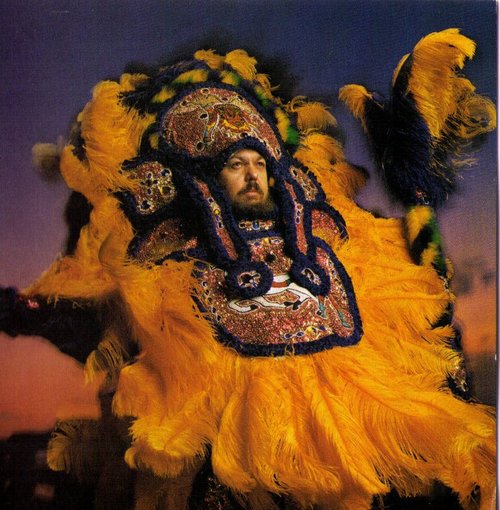
The Great Dr. John, aka Mac Rebennack

The Great Dr. John, aka Mac Rebennack

This exercise leads me to think about English, that hybrid language with its blunt Anglo-Saxon roots, supple Norse syntax, and treasure trove of French words. We’re talking here the assimilation, not of immigrants, but of invaders, yet Anglo-Saxon girls married Vikings, their offspring married Normans, who ate poultry instead of chicken, the combination of the three languages creating such a wealth of ways to express ourselves.

Scrawny, brawny – a potent spell of insomnia . . .

[scrawny – probably from Old Norse skrælna to shrival]

[brawny – from Old French braon fleshy or muscular part, buttock]

[potent – from Latin potentem powerful]

[spell – from Old English gespelia – a substitute, shift work, continuous stretch]

[spell – from Proto German spellam “report, tale, fable. ” From c. 1200 as “an utterance, something said, a statement, remark”; meaning “set of words with supposed magical or occult powers, incantation, charm, first recorded 1570s; hence any means or cause of enchantment.” (Oxford Dictionary of Folklore via Online Etymology Dictionary)

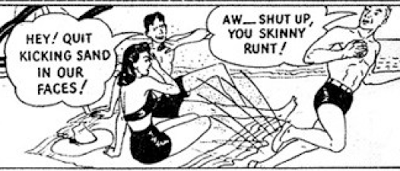
I think of the ad in Back of the Boy’s Life magazines I read when I was a Cub Scout, the ad with the 98 pound weakling sharing a beach blanket his a buxom companion, their outing spoiled by having sand kicked in their faces.

“Hey, you pathetic emaciated excuse for a hominid,” ejaculates the muscular ruffian.

“Hey, you scrawny bitch,” spews the rock-hard bully.
shapeimage_2

And these thoughts of assimilation lead me to think of how many Muslims I saw in Houston, all the women in hijabs, both at the Galleria Mall and at MD Anderson, one woman sitting in the hospital in a black niqab but also wearing a mask beneath the veil to ward off infection, and then there was the Iraqi veteran who had worked as a translator for the US Army and who was now working as a concierge at the Wyndam Suites, and also we met with a former student and his Pakistani wife, their marriage being the first non-arranged union in the history of her family, and she told Judy and me that even as a coed at the University of Georgia her curfew at her home in the summertime was seven p.m. and, oh boy, a yawn, a good sign, my body hinting to just breathe, and maybe the mind will empty if I pay attention to inhalation and exhalation, if I just let go and allow the swirls of grey behind my eyelids to take whatever shape whatever.

The Pros and Cons of Traveling Alone

Guest blogging from my younger son the linguist, an argument for why traveling abroad solo is the way to go.

kingofnowhere's avatarKing of nowhere

img_0672 Lana in Tuscheti, Georgia

Every time I get ready to go on a trip, people inevitably ask me, “Who are you traveling with?” I tell them that I’m going alone. Their foreheads usually wrinkle, and a look of pity settles on their faces. “Oh,” they say.

I always clarify, “I only travel alone; I never let anyone go with me. You meet more people that way.”

Then they usually say something like, “That makes sense,” in a skeptical tone of voice.

I know. I get it. it’s scary to travel by yourself. It can be difficult (though many worthwhile things are). People often make excuses or don’t think they’re brave enough to do it.  Women always tell me, “Well, you’re a guy—it’s easier and safer for you.” And I’m sure they’re right, but I’ve met plenty of travelers carrying two X chromosomes, and none of them got raped OR murdered.

View original post 1,211 more words

Negril, Jamaica, Meets Houston’s Galleria

post_display_cropped_open-uri20131213-887-4127i6

Seven Mile Beach, Negril, Jamaica

I can’t precisely tell you the last time I had stepped into a mall. I suspect it had been at least twenty years. I remember taking my sons to the Citadel Mall Christmas shopping for their mother, Judy Birdsong, when they were ten or so, but nothing after that comes to mind.

Frankly, malls give me the heebie-jeebies. If I need to go shopping off-line, despite the horror-show parking situation, I drive downtown to King Street in Charleston, SC, fifteen miles from where I live. Even though we’re dealing with some of the same stores, King Street doesn’t throw me into a state of deep depression. The capitalistic concentration isn’t quite as claustrophobic, not as stultifying. So the other day when the other Judy Birdsong, our Texas friend who shares the same name with my wife,* was giving us a tour of her hometown Houston and asked if we’d like to visit Houston’s mega mall, the Galleria, we demurred, which delighted the Houston Judy because “malls are just not [her] thing.”


*It’s a complicated but interesting story you can read about here.


I can, however, tell you the last time I was in Negril, Jamaica; it was June of 1986. It was Judy Birdsong’s and my second visit to that funky north shore village, and we were shocked how much it had changed in the three short years we’d been there. What hadn’t changed, however, were the swarms of street entrepreneurs, eager to trade money or sell you a carved coconut head or some ganga, mon,

couples-swept-away-negril

Constantly being besieged by and saying no to very pushy people is exhausting. You try, of course, to avoid eye-contact, which means you stare straight ahead and miss out on peripheral pleasures. Finally, someone at our hotel shared the secret of street-hawker repulsion. You simple say, “Winston’s my man. He’s taking care of me.” You see, Winston is a common name in Jamaica. Any number of hawkers are named Winston, so when you say Winston has you covered, they immediately cease their spiels.

Please note that the very first sentence of this post uses the past perfect tense “had stepped” because, despite a lifetime of dissipation, I do remember the very last time I stepped into a mall. It was yesterday. It was the Galleria. The hard drive of of my MacBook Pro had followed Lady Chablis into the dark realm of non-existence on 8 September 2016. The closest Apple Store to our airbnb was located at, you guessed it, the Galleria, so we ubered over, and the nice people at the Apple Store repaired it while we strolled around the mall.

lady-chablis-microphone-650

RIP Lady Chablis

Perhaps it’s the fact that on-line shopping is driving these businesses out of business, but now several of the establishments position very attractive women outside their doors who rather aggressively engage you by handing out samples of lotions, etc. Lined up in their miniskirts, these women brought to mind the way old movies portrayed red light districts. Though no one actually shouted at me, “Hey, sailor,” I was being solicited literally right and left.

So I started behaving like I was in Negril, staring straight ahead, frowningly shaking my head no until I heard a young woman say, “Hey, wait a minute. It’s not about a sample.” So we stopped. Her smile was at least 100 watts. “I bet I can guess where you’re from,” she said.

“Okay,” I said.

“You’re from Australia.”

Judy and I both laughed, shook our heads no.

“Where’re you from?”

“Charleston, SC.”

“Great. What brings you to Houston?”

“Cancer treatment,” Judy said.

The smiled dimmed to about 10 watts. “I’m so sorry,” she said.

“Thanks.”

“Here’s some samples. They’re all natural. Come back if you like them.”

“Thanks.”

Anyway, it seemed, except for the sales staff, we were the only Anglos in the Galleria, and it also seemed that Muslims and Asians outnumbered Latinos. I don’t know if this distribution has to do with the demographics of Houston or that Anglos do their shopping on-line or these newer immigrants enjoy basking in the seeming prosperity a mall exudes.

I just wish there had been an equivalent of “Winston has me covered” I could have used there.

galleria-houston-300x350

The Galleria, Houston Texas


The Other Judy Birdsong

Snazell, Sarah, 1965-1999; Doppelganger

Snazell, Sarah; Doppelganger; Brecknock Museum and Art Gallery; http://www.artuk.org/artworks/doppelganger-178168

Several years ago, sometime after the turn of the last century,[1] my wife Judy Birdsong received an invitation to a party in Houston.  Judy replied to the email, stating that the cookout sounded lovely, but she was in Charleston, SC, so doubted that she was the targeted Judy Birdsong.

A bit later, she received another invitation, this one to a PTA meeting, and once again, Judy of Charleston replied to to let the sender know she was barking up the wrong aviary.

Then, more exotically, Judy received a host of emails from Ireland, again addressed to the Houston Judy Birdsong.

As it turns out, the Judy Birdsong of Houston is the daughter of an Irish immigrant mother and Lebanese immigrant father, and one of her 70 odd Irish cousins – no, it must have been a great uncle – was commemorating his 60th year as a priest so the clan was meeting somewhere in the Old Sod to celebrate a memorial mass he was officiating.

Of course, Roman Catholicism = Guilt, so the Houston Judy emailed the Charleston Judy a message of abject apology for all the trouble she’d put her doppelgänger through, and, of course, my Judy, the Charleston Judy, said, no, no, no — it was fun!

Thus began the relationship of the two Judy Birdsongs.  In their subsequent email correspondence, they discovered, among other things, both were the mothers of sons, worked as counselors in schools, were married to fantastic husbands, . . ..[2]

Throughout these erroneous emails, the Judy Birdsongs learned bits and pieces about each other’s lives, would ask how things were going, and in essence, become e-pen-pals.

Then the email tables switched.  The Charleston Judy Birdsong discovered that she must go through a severe regiment of EPOCH chemotherapy, went wig shopping, and emailed herself some jpegs of various wigs that ended up in the mailbox of the Houston Judy Birdsong.

Statements of encouragement and promises of prayers came from Houston.

Judy went into remission, celebrated her older son’s wedding, sent the other Judy photos.

Unfortunately, Judy’s cancer came back, and via the Caring Bridge website, last week the Charleston Judy received following message from Houston Judy on hearing we were headed to the MD Anderson Cancer Center:

Judy Birdsong Moore- our Judy Birdsong story continues. You have been on my mind every single day and today I finally logged in to get an update on you. Holy Moly…..you are coming to Houston? Sweet friend, if you feel up to it (and I will follow your wishes) I would LOVE to come and see you! The 2 Judy Birdsong’s can finally meet! You can’t ask for a better place than MD Anderson….they do amazing things. Please, please give me an update when you are here. After all these years of communicating, I think it’s time for us to meet! Positive thoughts and prayers from me to you. I am back at school too and just dropped off my youngest at UT. All is well here. And HOUSTON is a wonderful place (Hot and humid but I’m sure not as beautiful as Folly).

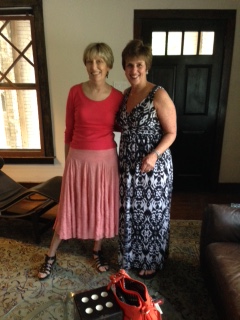
So on Labor Day a knock on the door of our Airbnb apartment produced – you’ve guessed it – Judy Birdsong, who took us on a sight-seeing tour of Houston and to lunch where we could chow down on authentic Tex-Mex, and it was as if we’d known her our entire lives, the conversation as free and natural as it is among soul brothers and sisters.

IMG_0086

All in all, no matter the problems that arise – and they will, they will – the world is a marvelous place full of good, compassionate people, and Judy and I feel so very fortunate to have so many people praying, sending thoughts, and caring for us.

It’s very humbling.

Postscript: Alas, my Judy died on Mother’s Day of 2017, but our 40 years of love will live on as long as my boys and I breathe.


[1] Forgive the pretention, but I just love the mustiness of the phrase.

[2] Actually, I made up the husbands thing to complete my propensity to adhere to the time honored tradition of series of three.  A priest, a rabbi, and an atheist walk into a crack house . . .

Adventures at Houston’s MD Anderson Cancer Center

md-anderson-logo

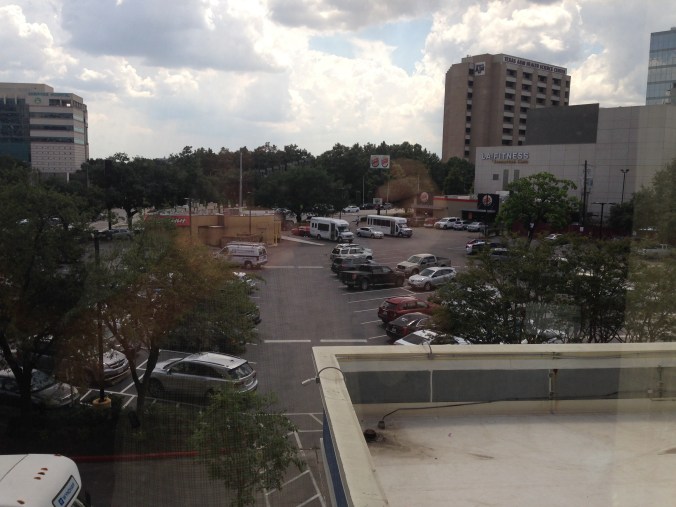
We’re staying on the fringes of a section of sprawling Houston called “the Medical Center,” our neighborhood a disjointed hodgepodge of highrises, some aesthetically interesting, others not so much so.

2016-08-31 14.33.48

View from our hotel window

However, we’re not visiting Houston to take in its architectural wonders; we’re here seeing medical wonders. Today Judy has an appointment with T-cell lymphoma guru Dr. Michelle A. Fanale, at the MD Anderson Cancer Center, one of the best in the nation. The series of buildings that constitute the Anderson complex is extensive, impressively massive, each adorned with the red-slashed cancer logo.

Our hotel, Wyndham Suites, is a mere 15-minute walk, so we hoof it through the blistering heat, sweat streaming from under my fedora. Judy has wisely ditched the wig, opting instead for a pastel aqua green headscarf that makes look like a lovely lean tropical Muslim.[1]

2016-09-01 12.46.23

As we drop into Anderson Café for breakfast, I practice my hobby of late, trying to ascertain who has cancer and who doesn’t. It’s harder than you might think. In the misnamed café (think cafeteria) I see no scarf-wearing or hatted women and only one ashen-faced fellow with the telltale baseball cap, though many people seem to have locomotion issues, and more than a few suffer severe obesity.

Once we’ve dumped our trash, we board the B elevators and shoot up to the Lymphoma/Myeloma center and have a seat and wait until Patricia, a smiling 50-something African American invites us into her office to process Judy’s admission. Patricia’s absolutely delightful, chatty, sincerely interested in us. As she goes over scads of information while Judy electronically signs permission after permission, I ask her if she’s a native Texan.

She theatrically bats her eyes. “Yes sir. Do you detect a hint of a drawl?”

She’s never been to Charleston but has been to North Carolina, where her Marine son was stationed. His wife’s from Virginia Beach, so she has been “to that beach.”

“I’m hoping you have some grandchildren,” I say.

Her eyes light up as she broadly smiles. “Eight,” And she was recently with all eight in Gatlinburg, which “was just breathtaking.”

The absolutely best news is that because Judy has met her deductible, 100% will be covered by our insurance.

“That’s the one good thing about having cancer,” Judy says.

We return to the seating area and another woman, a Latina, comes up and introduces herself as a sort of concierge. I mention that rumor has it that there’s a bar in the hospital, and she happily informs me that it’s true and that she’s glad to see I have my priorities right. She hands us her card and is off.

Once Judy has her vitals recorded, we enter the examination room where I continue to grade essays electronically. We meet our head physician’s nurse and someone shadowing her. Both are young, black, friendly but businesslike.

A brisk knock and a nurse practitioner enters, a husky young man around forty or so whom I deduce is Hawaiian because of his appearance and the fact that he greets people with “aloha.”

He has Judy give an oral history from the original discovery of the original tumor in July 2014, up through the reoccurrence in March of this year, all the way to last Thursday’s biopsy. These are painful recollections, especially the last five months.

Our next visitor is physician who has Judy sign forms giving permission to use her “fluids and tissues” for research. She’s probably about our age, short and rotund with curly black dyed hair.

“Forgive me if you can’t understand my English,” she says. “It’s Egyptian English.”

We assure her we can perfectly understand her. She asks Judy if she’s Lebanese, says she looks Lebanese, and goes on to add that even though Egypt has 7000 years of civilization, the Lebanese are more forward thinking. “They’re open,’ she says, “more progressive” – she rolls her r’s. “Now they’re just killing each other.” I mention that I hear it’s worse now that Mubarak’s gone.

“Yes,” she says. “It would be nice to have Mubarak back. It’s hard to run a country. You need to know what you’re doing.”

I mention Mr. Trump, and she smiles without comment and after a few minutes leaves us once again alone., assuring us that Dr. Fanale is a genius and that full recovery is possible. “You have to be strong,” she says. “I just had heart failure last week, and look at me. I’m strong.”

More essay grading.

Finally, Dr. Fanale arrives with a clipboard and an offered hand. She explains to us that because we don’t have a baseline PET scan to compare the latest growth that we need to have tests run tomorrow and from there decide to continue the present course of treatment (ICE with a future allo stem cell transplant) or not. She mentions several alternate options running off a list of polysyllabic drugs. She strongly suggests we have the theoretical stem cell at Anderson because they do hundreds a year and have specific knowledge of T-cell lymphoma reactions, which may differ from other cancer patient’s reactions.

“Well, I was just told you are a genius,”  Judy tells Dr. Fantale.

“I don’t know if I’m a genius,” she replies, “but I am an experienced expert in T-cell lymphomas.”

* * *

We’ll meet her again on Wednesday and discuss the results of the tests and treatment strategies.

I won’t say I left the joint upbeat, but it’s gratifying to know that several other options exist other than the one Judy has been following.  It also occurred to me that at least at MD Anderson immigration seemed to be working just fine.

Now, it’s time to snag Uber, hightail it to Kroger’s, stock up on some beer, and suffer through the Gamecock opener.


[1] As anyone who has traveled with us knows (right Beth Hudson Clifton), Judy has an aversion to taking taxis, so don’t blame me for making her walk half a mile to seek cancer treatment.


“The Progressive Shifting of the Social”

shapeimage_2

On Saturday nights in the little living rooms of my youth, my family huddled around our black and white television to watch Sheriff Matt Dillion engage in gunplay so civilized that it seemed as if the Marquis of Queensberry presided over Matt’s confrontations with that neverending stream of cold-blooded killers. In each episode, the two antagonists would politely pace like duelists to settle questions of good and evil according to who possessed the better reflexes and aim.

Would the avatar of law-and-order prevail over the sadistic child slayer, or would the sociopath triumph and therefore enjoy the freedom to continue his chosen lifestyle of plunder and mayhem?

If we weren’t watching television, we listened to my mother and father tell the tales of their youth, the old man regaling us with Depression era stories of Spring Street when the Jenkins Orphanage band was in full swing. We learned about some woebegone junkie called Paregoric Annie who haunted my great-grandfather’s pharmacy on the Corner of Spring and Ashley. She periodically visited peninsula drugstores begging for opiates, which Great Grandaddy generously donated, like the rest of his competitors, on a rotating basis. Despite the entertainment Charleston’s two channels provided, the old oral Southern tradition remained dominant.

Jenkins Orphanage Band, date unknown

Jenkins Orphanage Band, date unknown

The public school I attended generally reinforced these prejudices. Our South Carolina History text blamed the “War Between the States” on unfair tariffs and sympathetically portrayed the rise of the Klan as a sort of necessary reaction to the injustices of Reconstruction.

Thus, the inculcation of culture was passed from generation to generation without very much outside influence.

The times, however, have changed, as Dylan prophesied they would a half a century ago.

shapeimage_3

As any adolescent psychiatrist worth her weight in Adderall knows, once a child reaches middle school, his peers influence him much more than his parents. The same might be said of the media with college-aged kids, young adults, and couples with young children – media influence them more than traditional family mores.

Grandaddy’s biblically based view of homosexuality gives way to Oprah’s open-mindedness. What my mother once derisively termed “shacking up” is more and a more a sanctioned step on the pathway to matrimony.

Our choices are directed less and less by traditional knowledge and more and more by elements captured here and there in the media [:] How to eat properly, how to stay young and healthy, how to bring up children [. . .] The present governs our relationship with the past. We keep only that part of the past that is convenient for us, only what is not in flagrant contradiction to modern values, personal taste, conscience. No collective rule has value in itself any longer if it is not expressly recognized by the will of the individual.

Gilles Lipovetsky: The Empire of Fashion

I’m not arguing that abandoning the deep roots of tradition for the ephemeral cartoon bubbles of sitcom morality is necessarily a great thing, nor does Lipovetsky:

A preference for provisional arrangements is winning out over fidelity, superficial commitment over motivation based on belief. We are embarked on an interminable process of desacralization and desubstantialization of meaning that defines the reign of consummate fashion. This is how the gods die, not in a nihilist demoralization of the West and anguish over the loss of values, but in small jolts of meaning. Not in the morosity of Europe, but in the euphoria of fleeting ideas and actions. Not in passive disillusionment, but in hyperanimation and temporary highs. There is no point in weeping over “the Death of God” : God is getting a technicolor, fast-forward funeral. Far from engendering a will to nothingness, the death of God carries the desire for the new and its excitement to extremes.

What I will argue is that among America’s youth that the old ways are not their ways, and ubiquity of internet access bodes poorly for the traditional Republican Party as the majority of their constituency shuffles off to their appointments in Samara.  Also, changes are afoot on the Democratic side as the young Sanders’ Brocialists push the Democratic ever more leftward.

Or as Springsteen put it in “Independence Day,”

Because there’s just different people coming down here now and they see things in different ways
And soon everything we’ve known will just be swept away.


On Going Deaf

ear-trumpet

In the early ’60’s, as preadolescents (alas there were no “tweens” back then), we’d play a game in which our 11-year-old-selves would pose questions that featured awful binary alternatives: “Which would you rather do: slide down a razor blade into a pool of carbolic acid or kiss [insert name][1]?

Sometimes someone might pose a less silly question like “Would you rather be blind or deaf?” We’d seriously contemplate the awful alternatives, argue back and forth, weigh the good cons versus the bad cons.

Now that I’m practically deaf, I can assure you blindness is preferable. The sounds “deaf” and “death” are indistinguishable to someone losing her hearing.  Once it is altogether gone, you’re trapped in a silent wilderness of mirrors.

Bedrich Smetana

Bedrich Smetana

In September of 1874, the Czech composer Bedrock Smetana’s ears started ringing.  It worsened, crescendoed, went from high-pitched shriek to ocean roar, which eventually led to total trapped-in-a-mirror deafness, a sort of horrible relief.

Here he describes the process in a letter.

That ringing in my head! That noise! … that is worst of all. Deafness would be a relatively decent condition, if only all was quiet in my head. But the greatest torture is caused me by the almost continuous internal noise which goes on in my head and sometimes rises to a thunderous crashing. This dark turmoil is pierced by the shrieking of voices, from strident whistles to ghastly shrieks as though furies and demons were bearing down on me in furious rage.

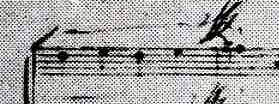
In his late autobiographical composition String Quartet NO. 1 (aka “From My Life”), Smetana dramatizes this phenomenon with a sudden intrusion of a high E into the melody late in the 4th movement a couple a minutes before the end.

Here is the musical notation in his own hand:

Smetana_Quartet_I259

Listen.  Can you hear it? :

* * *

Even though my paternal great aunts suffered hearing loss — Aunt Polly was known to blast drapery rippling farts that she seemed unaware of — I prefer to blame my disability on Bruce Springsteen.  On 1 August 1978 we saw the Boss from the first row at Gaillard Auditorium in Charleston, a terrific concert from the first chords of the Bobby Fuller Four cover of “I Fought the Law” to the encore cover of Gary US Bonds “Quarter to Three.”  However, after the show and for two days afterwards I suffered a milder case of Smetana-like ringing in my ears accompanied by ear-canal itching.

Eventually, however, the ringing and itching stopped, but alas, ever since then my hearing has been in a state of decline.

* * *

In the late summer 2004, when I was visiting for the last time my ALS-stricken bosom friend[2] Tom Evatt, I couldn’t make out some of his whispery rasp, so I nodded stupidly as if I could understand what he was saying.

As I leaned towards him, his face darkened into displeasure.

“What did I just say?”

“Um, I’m not quite sure.”

“GET A HEARING AID!”

That was the first time I was caught out, and I can’t tell you how bad I felt deceiving Tom, but now it’s been another dozen years, and I often find myself nodding stupidly as I attempt to become a lip reader.  The good news, I guess, is that for 6 grand I might be able to get some help via a hearing aid, and the time has come for me to check out that possibility. Otherwise, I fear that among this generation of my students, my legacy will be that of the old deaf coot you could insult right in front of his face, and he would smile and sagely nod his head.

So then I can retire and become the old man in Hemingway’s “A Clean Well-Lighted Place”:

It was very late and everyone had left the cafe Chico-Feo except an old man who sat in the shadow the leaves of the tree made against the electric light. In the day time the street was dusty, but at night the dew settled the dust and the old man liked to sit late because he was deaf and now at night it was quiet and he felt the difference. The two waiters inside the cafe knew that the old man was a little drunk, and while he was a good client they knew that if he became too drunk he would leave without paying, so they kept watch on him.

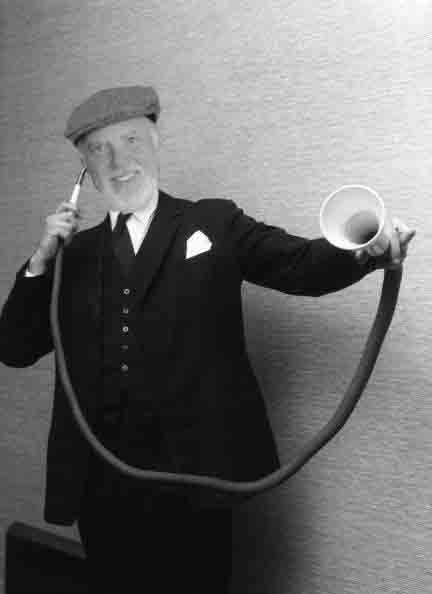
11th January 1963: A man demonstrating a long distance ear trumpet, at an exhibition of custom-made 19th century hearing aids in London. It is one of the many 19th Century hearing aids owned by Amplivox-Ultratone, and was originally made by F.C. & C.V. Rein & Sons. (Photo by John Franklin/BIPs/Getty Images)

[1] E.g., Phyllis Diller’s daughter Loquacia Quasimodo

[2] Wait along enough and antiquated clichés can come again to life.

The Past’s Future


Fritz Lang's Metropolis

Fritz Lang’s Metropolis

In the early Sixties, my maternal grandparents stayed in a subdivided Victorian house, the upstairs having been split into two apartments, the bottom story uninhabited and warehousing a portion of some wealthy family’s estate: furniture, rugs, an extensive library. We’re talking hundreds and hundreds of books. In the side yard there was a well.  You could remove the cinder block and then the plywood and look down at your reflection in water.

Although not an adventurous child, somehow I gained entrance into those off-limit rooms downstairs, the furniture sheeted, the air stale. I’d sneak down there and explore. After repeated visitations and investigating some of the books I could reach on the lower shelves, I started secretly “borrowing” individual volumes of the Complete Works of Edgar Alan Poe.

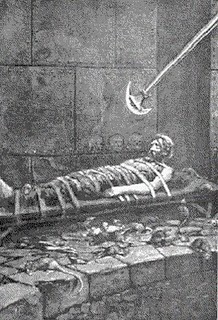
Each slender volume, bound in red, featured sheer paper sandwiching occasional engravings of ravens, subterranean crypts, rats gnawing on ropes of a prisoner contemplating a pendulum. I’d take one volume at a time, terrified I’d get caught. Into the forbidden first-story space I’d sneak, carefully replace last week’s purloined octavo, surreptitiously flip through other volumes, and choose another based solely on the luridness of the illustrations. I was only nine or so, so most of the prose lay beyond my reckoning, but I could manage lots of the poetry and some of the stories (“The Tell Tale Heart,” for example). Unable to distinguish bathos from profundity, I became completely enamored of the singsong silliness of “The Raven,” devoting several stanzas to memory. “Annabelle Lee” could bring tears to my eyes. Something sinister lay beneath those works, so the whole enterprise smacked of trafficking in pornography – though pornography would not have been in my early Sixties vocabulary.

I’d smuggle the forbidden text and read it surreptitiously in bed because I knew my parents/ grandparents wouldn’t approve of my trespassing and borrowing without asking. I liked the musty smell of the books, the way the pages whispered when I turned them, the way the illustrations lay perversely beneath diaphanous paper. Despite the buxom space sirens who cavorted on the covers of pulpy paperbacks, Sixties sci-fi couldn’t compete with the deep purple sublimations of diseased consciousness that I found in Poe.

As a child, the musty past interested me much more than the disinfected future.

pit-pendulum.bmp-2


* * *

In those days, at my grandparents’ apartment, in the afternoons, we’d watch The Micky Mouse Club and Flash Gordon reruns. Flash Gordon appealed to me, not because it was futuristic, but because it was old-fashioned, serials my mother had watched as a redheaded girl at matinees during the Great Depression, the stories more or less Medieval, Ming the Merciless versus Buster Crabbe of the hyacinthine locks, a hero who could probably trace his lineage back to Perseus.

Occasionally, on the Mouse Club, we’d visit Tommowland for a glimpse at the wonders that the future might hold – if there was going to be a future. With Kruschev banging his shoe on the table at the UN and third grade atomic detonation drills, you weren’t so sure. Nevertheless, we would sometimes wonder what it would be like to live in the year 2000, calculating our ages when that distant day would arrive with its flying automobiles and uniform-like clothing.

The Future circa 1955

The Future circa 1955

Accurately imagining the future is not an easy task. I’ve written elsewhere about Huxley and Orwell and their relative prowess at prognostication. On the cinematic side, Fritz Lang and Kubrick deserve a nod. However, in my limited exposure to old-fashioned sci-fi and its forays into the future, I can’t recall anyone predicting the vast availability of information we now enjoy, which strikes me as the most meaningful aspect of the difference between yesteryear and now.

For example, if I were a bit wealthier, for a mere $6500 I could purchase that edition of Poe’s Complete Works I described above. Here’s a description:

New York. George D. Sproul Company. 1902. Lavishly bound in Publisher’s Deluxe custom, 3/4 burgundy crushed morocco and marbled boards. Gilt-tooled spine compartments with fleural motifs.Gilt-tooled raised bands. Marbled endsheets. t.e.g. 8vo. 5.5″ x *.25″. The Monticello Edition. This Edition Limited to only 1000 numbered sets of which this is #330. Illustrated throughout with delightful, tissue-guarded monochrome plates Editied by renowned Poe scholar James A. Harrison, the Monticello Edition of Poe’s Works is one of the scarcest of early compilations, with no complete set appearing at auction in more than thirty years.The 17 Volumes are comprised of: (truncated).

The wonder of it all! My cobwebbed memories come to life, a few keystrokes away! Yes, the volumes were red (okay, burgundy crushed morocco) and, yes, illustrated with tissue-guarded monochrome plates. (Looking for suitable illustrations for this topic, I discovered these volumes in a Google search after I had begun this post – the very volumes that I had treasured as a boy). In a sense, the past is at my fingertips because I can conjure its images.

In 2016, if I have a hankering to view a complete set of Flash Gordon serials, I can have Dale Arden and Ming the Merciless streaming through my computer in virtually no time. World classics of the public domain await plundering – in Latin for the scholar, SparkNotes for the slacker.

O, my baby boomer brothers and sisters, the future is now! Water pours automatically as your hand nears the faucet head; toilets flush, somehow knowing you’ve finished. I can talk to my son in real time and watch him sip a beer in Nuremberg as I languish six hours behind in the States awaiting our own cocktail hour. Somehow, the triumph of capitalism has enabled us to get stuff for free – whether it be the Aeneid or Skype.

Yet, the past still strikes me as more seductive, more fecund, as the future both expands and shrinks us, offering us worlds of information and entertainment, but distracting us from the glories of the natural world, the sunlight illuminating in steps your bedroom wall as you lie there not wanting to get up.

15598853

A Wordly Wise Wedding Feast


Kashmir Malevich's "The Wedding"

Kashmir Malevich’s “The Wedding”


Appetizer

Not surprisingly, Wordly Wise, the vocabulary series we use at my school, tilts big time towards those words brought over to England from France by William the Conqueror and his various cousins, i.e., words of Latinate origin. This imbalance, of course, makes perfect sense given the College Board’s predilection for polysyllabic words and that our students will be spending not an inconsiderable amount of their adult lives chattering away at upper tier cocktail parties.

Obviously, softening “cowardly” to “pusillanimous” at a St. Cecilia Ball might be judicious, especially considering the status of the target of the aspersion, and it’s not as if all failures-of-nerve are created equal. Throwing down your weapon and turning tail at the command charge is not the same as wincing your way through a racist joke without protest.

P-EN10-1211407The problem with Latinate diction, though, is that it often comes off as stuffy, to use an Anglo Saxon word, or pretentious, to use a Latinate synonym. You might even say – I’m sure someone has – that Latin appeals to the cranium/head, Anglo-Saxon to the viscera/gut.

Anyway, if you’re a new English teacher at our school, one of your many chores is to do Wordly Wise exercises, and at the beginning of a school year, if you’re an enterprising new teacher and headed from Charleston, SC, to Rhode Island to attend a friend’s wedding, you might decide to bring Wordly Wise along in your carry-on to bang out some exercises while you wait for boarding, wait during your layover at Baltimore, fly over the Northeast corridor, etc.

This scenario describes my new English colleague Emily Neilson’s weekend. Emily did bring her Wordly Wise along, she did do the exercises, but she also wrote a letter to her students describing the weekend’s adventures and in doing so used every word in Chapter 1 of the Book 8 Edition of Wordly Wise!

The piece is downright inspired, brilliant, a tour de force, yes!so I pleaded with her to let me share it with you, which she graciously has.

(By the way, if any of my former students are reading this, I encourage you mentally to circle any Wordly Wise words you come across and see if you still remember them.)

Emily, take it away:

Emily Neilson

Emily Neilson

Entree

Musings, Off-and-Onhand: Worldy Wise Essay, Edition I

Good morning, my little English ensemble, vibrant with curiosity and intellect and Joie de vivre. As I sat at the gate of the Providence Airport yesterday watching the phalanxes of folks line up to board flight after flight, I worked on my Wordly Wise homework. Yes, people, don’t ring the tocsins and become rambunctious, refractory parolees all because you have learned that teachers must also endure the tribulations of homework. It is of tertiary importance in this moment, but it is true that the Sunday Scaries are known by all — old and young, men and boys, women and girls, large and small, short and tall — what a swamp of lyrical empathy, a paregoric that should assuage us somewhat from feeling totally disconsolate. And if you do indeed set out to break the trajectory of my story, I will corral you back with the figurative lariat I own as a teacher. I am the maestro – or is it maestra? – within this classroom, this cornucopia of learning. Anyways, there I sat at the gate, oscillating between my Wordly Wise and my phone, and I thought how you might enjoy a story from my weekend, and so I began to indite right there, at gate 19, in Providence, at 11:12 am, telling you about my weekend – a meteoric one – spent in the hinterlands of New England, witnessing the nuptials of my friend.

As you might know by now, one of my favorite maxims is to “throw kindness like it is confetti.” I am equable in that belief, steadfast in my semi-dogmatic notion that kindness is the thing that helps us mortals hold up the cosmos.

I, however, also believe that sometimes kindness is not the cure-all, and sometimes situations call for more acetic approaches and attitudes. So there I was on my flight starting the descent to Baltimore early Saturday morning when I felt a rogue hand creep onto my knee. The rogue hand was attached to the man seated beside me, and I wondered, what was he thinking? That I was an effete sort of gal? That my effeminate ensemble afforded him an itinerary for his hand to explore my knee? That when I asked him earlier, “Is that seat taken?” I had intimated some wish for his hand’s current oscillations or for some clandestine maneuvers later to come? That I, a woman, rode some kind of tame, precious, subdued palfrey? No, sir! I opt for the wild mustangs roving the Staked Plains, unbridled, beneath the biggest skies, because I am one of those wild mustangs! Desist your tactile infraction! What a stupid, insipid attempt to cultivate romance! Was I disconsolate, you wonder? Would I be his collateral in the enterprise? Some kind of feminine lien that he could use and abuse and lose? Would I devolve in my integrity and sense of self? What, no! Students, listen to me: I was vibrant in my fusillade, impeaching this scoundrel for his manual traipsing. I repelled his advance; I felt refractory to every ounce of this meretricious loser. I needed my mace, either to spray in his eyeballs, making them rheumy, or to club over his head and dash out his brains like the Roman Heroes do in scenes atop ancient, marble friezes. I refrained from asphyxiating him, but my counterattack had plenty of those motifs to do the figurative trick. I might not be a professor emeritus, but I am smart enough to believe that there’s a good kind of love out there to keep me from temporizing for such airborne garbage!

I wish to spend no more time on such filth, trenchant as I may sound now, and perhaps sometime down the road we will exhume the story and laugh about it together — I assure you we won’t have to exhume him. Or will we …

What I do wish to tell you is this: that in Little Compton, Rhode Island on Saturday afternoon, a svelte bride married a svelte groom, beneath ray upon ray of light that streamed through the big windows of a white church, sitting beneath a blue sky. But that’s not right because the sky wasn’t just made of blue that Saturday, but out of sapphire, topaz, turquoise, indigo. It was the firmament of heaven, overarching everyone who has ever lived and ever will. It was made out of carbon, oxygen, hydrogen, nitrogen. It was made from the Big Bang which blew all those bits at the very beginning into a trajectory which would eventually lead to him and her, and to you and me. It was a regular stone transformed into a small opulence and held, tiredly, in the hand of the lapidary who had stooped for hours at his wheel, chipping and chipping away to unleash a beauty he knew possible all along. Or maybe it was in another hand, in the quivering hand of a maestro as he holds on to the last notes in their last moments before cutting all that cornucopic, symphonic sound, creating a vast, sudden, and evanescent silence.

But in the late afternoon light on a Saturday in Little Compton, Rhode Island beneath one blue, blue, blue August sky, evanescent also means this: as the minister spoke to the couple and the congregation about love’s many forms, the man standing before the altar reached out through the air, almost imperceptibly, and without taking his eyes off the minister, and sought to find the hand of the woman beside him; and she, at the very same moment and without taking her eyes off the minister and also almost imperceptibly, let go a hand from her bouquet and reached out to hold onto his.


 Photo Credit: Jessie Small


Photo Credit: Jessie Small


Schadenfreude: A Confession

Carl_Spitzweg_-_Der_arme_Poet_Neue_Pinakothek copy

Yesterday, at the school where I work, I took a prognosticative multiple-choice test formulated to determine high school students’ strengths. I’m 63, familiar with the Delphic inscription Know Thyself, so I think I can accurately say that my strengths lie in dependability and my main weaknesses in impatience and impulsiveness – “the awful daring of a moment’s surrender” as tight-assed TS Eliot put it.[1]

However, as I clicked my way through the 70-odd questions, it slowly dawned on me that I’m not a particularly compassionate person when it comes to inconveniencing myself to actually help people. Oh, I don’t mind sending a check, but if I had the choice between writing ten thousand times in longhand I’m not a compassionate person of or spending a day with Habitat for Humanity helping to build a house for the poor, I’d opt for the writer’s cramp.

In the test I took, this question came up more than once: do you like helping people? I answered sometimes virtually every time. Of course, it’s certainly gratifying rescuing a toddler caught in a riptide (which I’ve done) but not so much joining an intervention for one of your junkie relatives. The bottom line is that, no, I don’t particularly enjoy helping people if it inconveniences me, so the test was effective in that it made me realize that in reality I’m  not all that compassionate, which I sort of considered myself to be.   Sure, I enjoyed helping the guidance department test the test, but I really had no choice. It was part of my job.

As coincidence would have it, to reinforce that self-assessment, four Team USA Olympian swimmers made a bad decision down there in Rio,. Of course, virtually every bad decision is the culmination of a series of bad decisions. E.g., lying about the robbery was a bad decision, necessitated in the mind of Lochte because someone had vandalized a restroom, which was a bad decision, precipitated by staying at a disco until 5 a.m., which was a bad decision, no doubt aided-and-abetted by the consumption of torrents of intoxicants, which was a bad decision, that over-indulgence a habit arrived at early on in their hotshot days as revered student athletes and not abandoned over the course of decades, bad decisions, ad nauseam.

A truly compassionate person, the Buddhist that I used to pretend to be, would feel compassion for the swimmers. He might recall some really stupid antics committed in the throes of drunkenness from his checkered past instead of schadenfreude.

Unfortunately, what one feels is what one feels. Let the great ax fall where it may.


[1] E.g., sending an angry email at 3 a.m., dropping down the cliff face of a wave you should know you can’t handle in a hurricane swell.