Fragments from a Southern Gothic Childhood

Fragment 1

I’m two or three swinging in a backyard swing and am attacked by an angry rooster. (Escaped cock fighter? Demented sufferer from bird fever?). I pump my legs to swing higher to escape the onslaught, though, of course, gravity sweeps me down across and up through the pecking zone. I’m screaming at the top of my little lungs. Mr. Long, a neighbor, runs over to my rescue.

Fragment 2

I’m six or seven. My mother, grandmother, and Aunt Vee (who is only six years older than I) are traveling by car through rural Dorchester County to visit my Great Aunt Creesie, my paternal grandfather’s sister. My grandfather, whom we call Kiki (short for his Christian name Kistler) is not along. According to Mama, Kiki hasn’t been “right” since a Greyhound bus door smashed closed on his head and fractured his skull. By being “not right,” they mean that Kiki gets mean as hell when drunk and spends his days under voluntary house arrest holed up in his room listening to the radio and playing his ukulele. (You can read about one of my visits to see him here).

Mama explains as she drives past corn fields that Aunt Creesie is “very poor” and that her son Trim is retarded — the word in those days preferable to the less scientific but often used “half wit.” She tells me that Trim is an epileptic and could have a seizure while we are there.

spursWe eventually arrive at Aunt Creesie’s unpainted shack. Beautiful oaks surround the house, but not a blade of grass grows from the dirt yard, which is crawling with hens and a couple of roosters. Aunt Vee informs me that roosters have spurs on their legs and that they can attack. I’m, of course, terrified. The spurs look downright lethal.

Inside the house the most conspicuous piece of furniture is a player piano on which are arranged gaudy, orange-colored pitchers and vases. Trim shambles in, a bear of a man whose mouth is always open and twitches.

He sounds like this:  

I don’t want to go outside and play as instructed. Rooster-phobia. But I do. The roosters don’t attack.

Later, I poo poo in an outhouse, my tiny butt positioned over the hole. I have no memory of wiping.

Fragment 3

I’m thirteen or fourteen and visiting with Mama, Daddy, and my brother David our Great Aunt Ruby, my mother’s mother’s sister. There is also an aunt Pearl, and my grandmother’s name is Hazelwood, but all of her people call her Saisy.

Aunt Pearl lives on Warren Street near Condon’s Department store in a downstairs apartment. She lives with her daughter Zilla, who is one of the founders of the New Republican Party in South Carolina. She is a Bircher, claims Lucille Ball is a communist, and entertains us with comic books depicting Kruschev banging his shoe promising to bury us. Not only has Zilla never married; she’s never been on a date.

Sallman JesusThe house, which reminds me of a train — one room lined up after another — is Jesus haunted. Warner Sallman’s painting of Jesus (see left) hangs over the bricked in fireplace in the living room. Arts and crafts from vacation summer Bible school are displayed all over the place.

On this particular visit, there’s an inflatable man sitting on the sofa. David and I start smacking him as if he were one of those bottom heavy clowns you punch that falls over but returns to the upright position for more punishment.

We’re told to stop. As it turns out, Zilla is afraid of being raped. If she has to go out at night, she rides with the inflatable man next to her.

Sardonically, my father reassures Zilla that she needs not fear being raped.

 * * *

My own children have enjoyed essentially Gothic-less childhoods. No visits from Daddy’s aunt, my Great Aunt Lou, tipsy on sherry, telling us about the time that her in-law Sarah locked herself in a bedroom with a gun threatening to kill herself, then opened the door, put the gun to her temple, and fired.

“I don’t think she knew it was loaded,” Aunt Lou said with a twinkle in her eye. “I’ve never seen a person with a more surprised look on her face when the gun went off.”

My boys do, however, eat some holiday dinners with their Great Aunt Vee, who was once diagnosed as schizophrenic because she thought she was Queen Nefertiti.

So their childhoods haven’t been completely deprived.

Folly Beach, East Coast Macondo

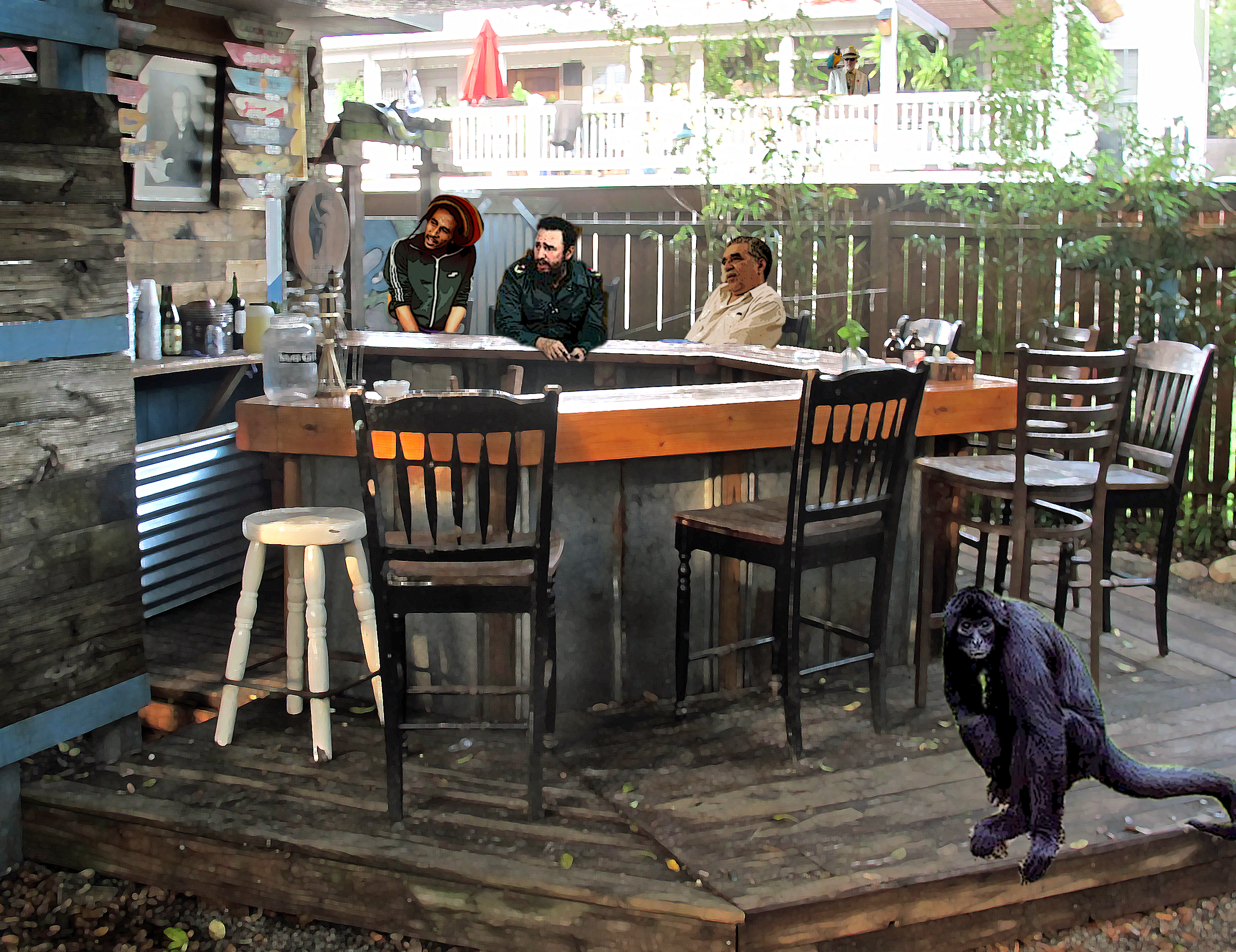
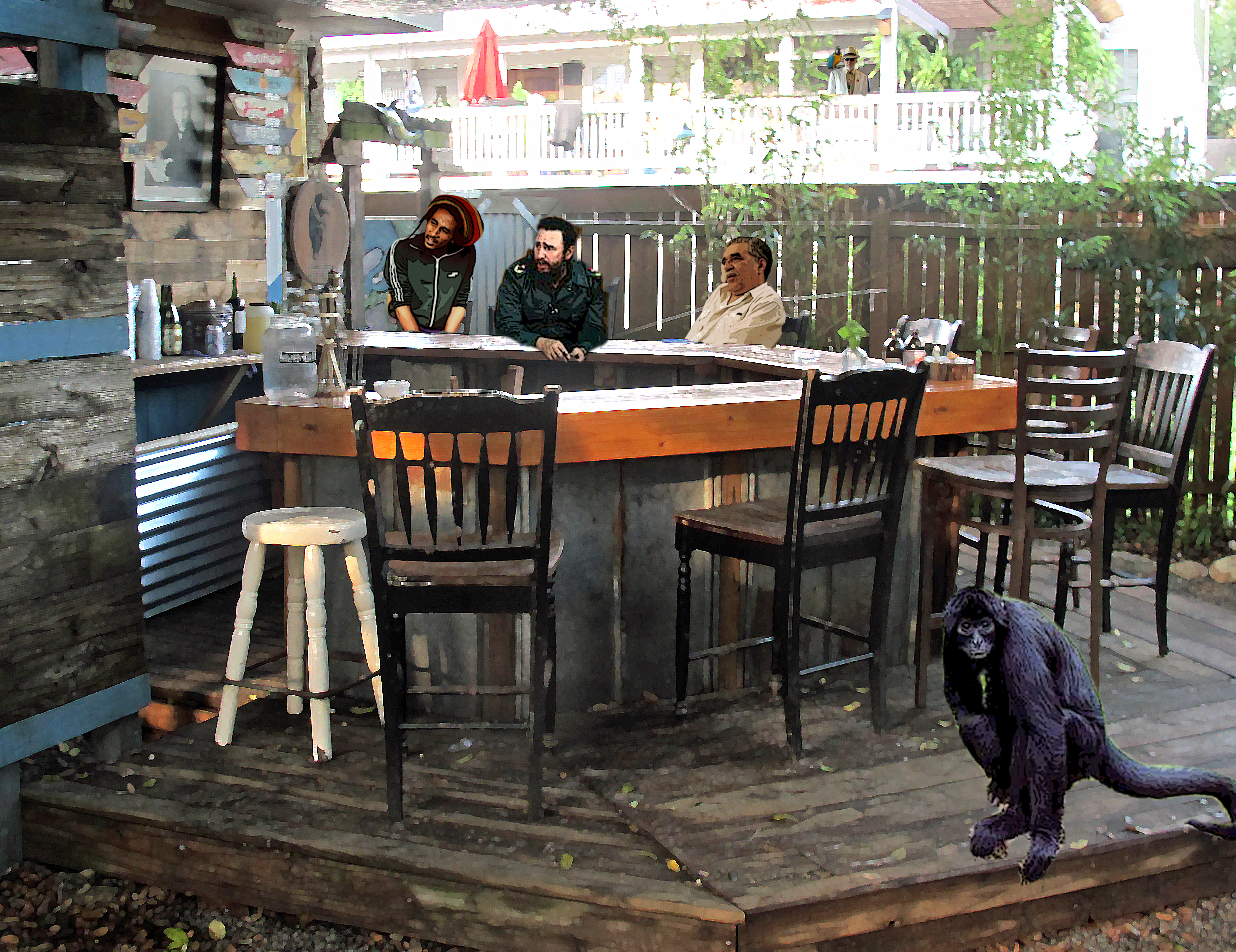
chico feo in the morning 1.0

Chico Feo in the Morning, original art by Wesley Moore

A decade ago, sick of the blood-sucking capitalists at the MLA changing their research paper guidelines every other year, I decided to create my own how-to guide, something I could run off and hand out to students but also update whenever some OCD sufferer at the Modern Language Association decided that placing periods after abbreviations was so last century.

I decided that rather than writing a dry, clinical exposition, I would make this how-to-guide a narrative featuring two fictional Porter-Gaud students, Bennington Rhodes and Robert “Flip” Burger. Bennington, a good student but not particularly interested in literature, goes about the process systematically whereas poor Flip waits to the night before due dates, which, as the omniscient narrator points out, is not the way to go. Not only could I provide students with a handy guide, but I could also mock their fads and peccadilloes.

Here’s a snippet to show you what I’m talking about, the protagonist Bennington going through the process of selecting a novel for his research paper project:

macondoEven though White Noise looks interesting, Bennington is going ahead to see about Chronicle of a Death Foretold while he’s at it. He types in “garcia marquez literary criticism bibliography,” and presto, right away the number one hit is applicable: “Garcia Marquez – Criticism.” Once again this site yields a plethora of potential sources including one of those handy Harold Bloom anthologies. Although he’s leaning toward White Noise, a painting on the Garcia Marquez site catches his eye. It’s called “Macondo” and features a Latina sleeping with her hair in her hands next to two oranges that are about to be scaled by a trio of ants on a dish next to her bed.

To save time, Bennington logs onto the Porter-Gaud Library page and discovers to his delight, that not only does the library own White Noise and Chronicle of a Death Foretold, but also that both books are available. He punches the call letters into his cell phone and heads to the library before the bell rings. As he passes the back entrance to the S&T building, he sees his friends playing hackysack. One of these, Robert Burger (aka Flip) is going to wait until the last minute and choose on a whim Henry James’s The Ambassadors because he’s heard of Henry James and thinks being an ambassador would be a great job because you have diplomatic immunity and can park anywhere you like. Not until it’s too late he discovers his error as he attempts to read the fourth sentence of that novel:

“The principle I have just mentioned as operating had been, with the most newly disembarked of the two men, wholly instinctive–the fruit of a sharp sense that, delightful as it would be to find himself looking, after so much separation, into his comrade’s face, his business would be a trifle bungled should he simply arrange or this countenance to present itself to the nearing steamer as the first “note,” of Europe. “(9)

Not only is the novel virtually unreadable, the criticism might as well be rendered in Sanskrit for all of the sense it makes to Flip. Even Pink Monkey and Spark Notes summaries are way over his head. If only he had taken his sage teacher’s advice and devoted the time to select a book more to his liking!

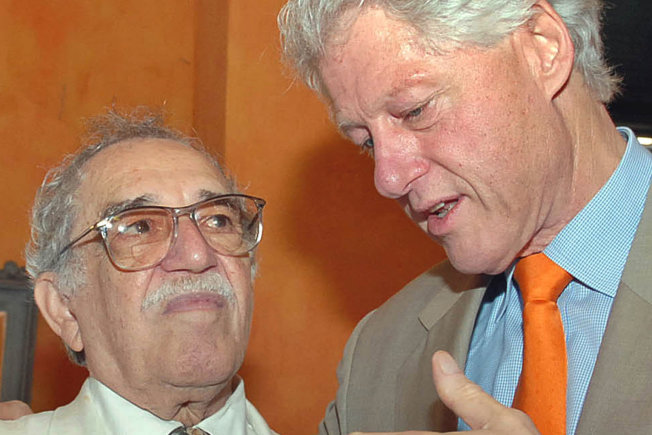
Gabo and Clinton

Gabo and Clinton

As part of the process, I decided to have Bennington compose a high school research essay on Chronicle, which, of course, meant I actually had to do a bit of research.  I discovered a fascinating piece from Salon by Gabriel Garcia-Marquez about his first meeting Bill Clinton at a dinner party at William Styron’s on Cape Cod that also featured Carlos Fuentes.

When [Carlos and I] talked about Latin America in general, we realized that
[Clinton] was much more interested than we had supposed, although he
lacked some essential background. When the conversation seemed to
stiffen a bit, we asked him what his favorite movie was, and he
answered “High Noon,” by Fred Zinneman, whom he had recently
honored in London. When we asked him what he was reading, he
 sighed and mentioned a book on the economic wars of the future,
author and title unknown to me.

“Better to read ‘Don Quixote,’” I said to him. “Everything’s
in there.” Now, the ‘Quixote’ is a book that is not read nearly
as much as is claimed, although very few will admit to not having
read it. With two or three quotes, Clinton showed that he knew it
very well indeed. Responding, he asked us what our favorite books
were. Styron said his was Huckleberry Finn.

I would have said Oedipus Rex, which has been my bed table
book for the last 20 years, but I named The Count of Monte
Cristo,”mainly for reasons of technique, which I had some
trouble explaining.

Clinton said his was the Meditations of Marcus Aurelius, and Carlos Fuentes stuck loyally to Absalom, Absalom,
Faulkner’s stellar novel, no question, although others would
choose  Light in August purely personal reasons. Clinton,
in homage to Faulkner, got to his feet and, pacing around the
table, recited from memory Benji’s monologue, the most thrilling
passage, and perhaps the most hermetic, from  The Sound and the
Fury.

Faulkner got us to talking about the affinities between
Caribbean writers and the cluster of great Southern novelists in
the United States. It made much more sense to us to think of the
Caribbean not as a geographical region surrounded by its sea but
as a much wider historical and cultural belt stretching from the
north of Brazil to the Mississippi Basin.

Mark Twain, William Faulkner, John Steinbeck and so many
others would then be just as Caribbean as Jorge Amado and Derek
Walcott. Clinton, born and raised in Arkansas, a Southern state,
applauded the notion and professed himself happy to be a
Caribbean.

* * *

As I was sipping on an “All -Day IPA” at Chico Feo in those amiable days before the pandemic, a polite young couple plopped down next to me at the bar. The male was unusually clean cut for the clientele, with short well-kempt hair and sporting some subdued ink on his right arm. His lovely companion spoke with a slight accent, so I asked her where she hailed from.

“Colombia.”

“Ah ha,” I said, “the homeland of the great Gabo – Gabriel Garcia-Marquez!”

“He is dead, you know,” she said with a rueful smile.

So we shot the mierda about the great man’s canon, of which she was very familiar, and that wonderful little magical village Macondo, Gabo’s Yoknapatawpha County, and I mentioned that even though Ronald Reagan wouldn’t give Gabo a visa to visit the US , he and Bill Clinton ended up being drinking buddies. I mentioned Gabo’s comment about Southerners and Caribbean folk sharing folkways and attitudes.

Given that probably most people associate Colombia with drug cartels, I suspect it was nice for her to hear praise for her homeland, and suddenly it occurred to me that Gabo was right, that the eastside of Folly was Mercondo-like. I have Folly friends with a parrot who tortures their dogs by mimicking both the owners’ accents, asking the dogs if they’d like to go for a walk, and then the parrot does a dead-on sound effect of a screen door creaking open. Magical realism right here in the Lowcountry.

“Especially this place,” she said, talking about Chico Feo. It reminds me of home.”

No roof, beers sold out of coolers, the aroma of curried goat wafting from the kitchen inside, free music, day and night . . .

Oh me oh my oh, Chico Feo.

I shook hands with them both and waved good-bye

My Colombia sister

My Colombia sister


True Detective: Existential Nihilism for the Masses

In his 1996 novel Infinite Jest, David Foster Wallace has a seventh grader, Hal Incandenza, write an essay contrasting Hawaii Five-O and Hill Street Blues, an essay that ponders the evolution of American television heroes.

Remarkably observant, young Incandenza underscores sociological differences in the programs. For example, Five-O’s Steve McGarrett has the luxury of working on “one case per week” in an office that resembles “the libraries of the landed gentry, hushed behind two heavy doors and wainscoted in thick, tropical oak.” On the other hand, Hill Street’s Frank Furillo, a precinct captain, juggles several cases at once in the chaotic confines of a cluttered cubicle-crammed station house teeming with clashing personalities. Essentially, “McGarrett is not weighed down by administrative State-Police-Chief chores, or by females, or friends, or emotions, or any sorts of conflicting demands on his attention” whereas Furillo “is beset by petty distractions on all sides [. . .] with suspects and snitches and investigating officers and angry community leaders and victims’ families all clamoring for redress.”

Colbert Root in his Summer of Jest, a handy on-line scene-by-scene summary and analysis of the novel, recaps the essay for us:

Where McGarrett exemplifies the modern man of action, Hal argues, Furillo typifies a man of postmodern “reaction.” Both protagonists are heroes of their own show’s culture, but both are also ill-equipped for the other’s world. McGarrett, as the modern man of action, is single-minded, acting to “refashion a truth the audience already knows into an object of law, justice, modern heroism.” Contrariwise, Furillo succeeds because he is cast within a large system; he excels at being a cog in a very large and bureaucratic machine [. . .] That Furillo comes after McGarrett as a typical US protagonist reflects a shift in US cultural preferences. Audiences, Hal says, want the stoic bureaucrat. His successes and shortfalls more closely align with their own. But, Hal ponders, what comes next? What hero will succeed Furillo?

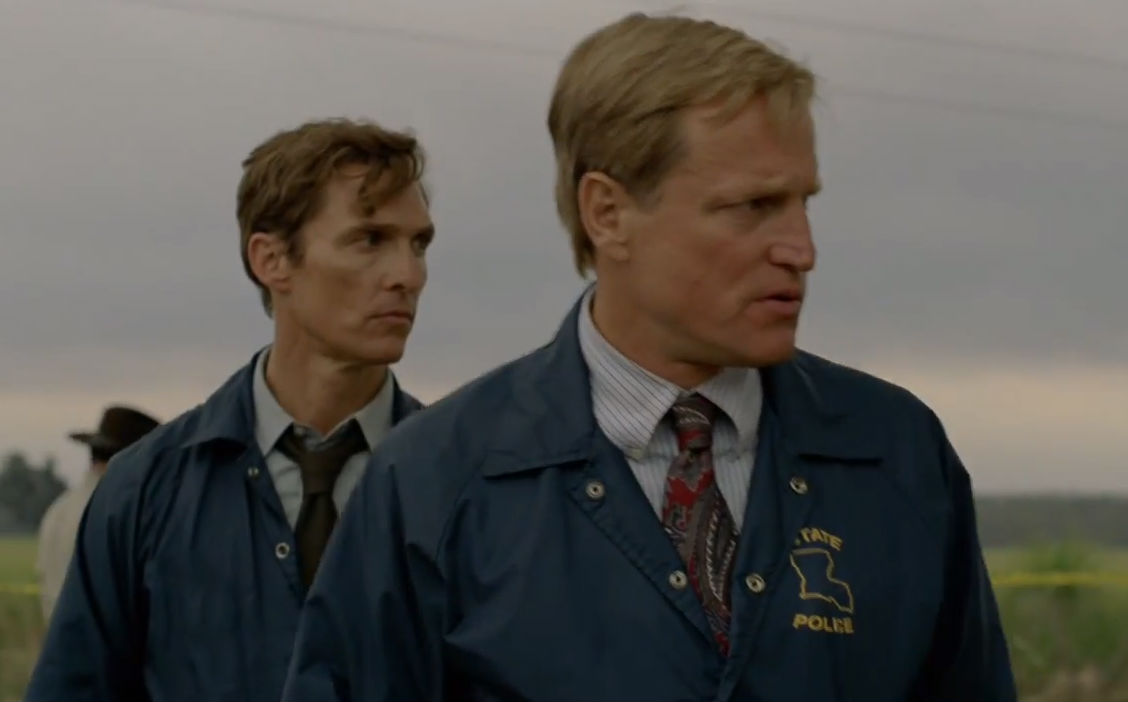
from left Rust (McConaughey) and Marty (Harrlesson)

from left Rust (McConaughey) and Marty (Harrlesson)

Well, if we look to the current HBO crime drama True Detective, the answer is Rust Cohle (played by Matthew McConaughey), a nihilistic metaphysician, an agoraphobic detective who considers human consciousness “a tragic misstep in evolution” that enables us “to labor under the illusion of having a self” when we’re merely “accretions[s] of sensory experience and feeling, programmed with total assurance that we are each somebody, when in fact everybody is nobody.”

This cat makes Sam Spade, Philip Marlowe, and Mike Hammer seem downright dewy in comparison. His partner Marty Hart (played by Woody Harrelson) considers Rust “the Michael Jordan of being a son-of-a-bitch,” and when Rust says shit like, “It’s all one ghetto, man, a giant gutter in outer space,” Marty virtually begs him to shut up. You see, despite having kinky handcuffed sex outside of his marriage, Marty is a family man, a Christian who holds essentially a Medieval view of the cosmos, a belief that divine reward or punishment keeps folks (though obviously not himself) in line. Rust responds, as you might expect, with scorn:

If the only thing keeping a person decent is the expectation of divine reward then, brother, that person is a piece of shit. And I’d like to get as many of them out in the open as possible. You gotta get together and tell yourself stories that violate every law of the universe just to get through the goddamn day? What’s that say about your reality?

Set in the semi-industrialized backwoods of Louisiana, the narrative features superb characterization and brilliant acting as the two detectives try to solve a series of grisly ritualistic murders. So many symbolic crosses (e.g., aerial shots of perpendicular lines of trees) sneak into the story I can’t help but wonder if its creator, Louisiana fiction writer Nic Pizzolatto, is making some sort of statement.

Whatever the case, Rust is not the fellow you want your sons to grow up to be. He’s a bit of a throwback, a cross between Dostoyevsky’s Underground Man and a Zen Buddhist.

He’s also about as fascinating a character as television has ever produced.

A Pat Conroy Family Reunion of Sorts

An acquaintance, the poet Cathy Smith Bowers, once told me something that should be obvious but had never occurred to me: The adrenal glands of children who grow up in chaotic households pump Vesuvian eruptions of the hormone epinephrine when their parents (or their parents’ boyfriends/girlfriends) hurl invectives and/or furniture at each other.

In plainer English, growing up in fucked-up households tends to fuck you up, not only mentally, but physically as well — as if there is a difference anyway.

Cathy Smith Bowers

Cathy Smith Bowers

Cathy went on to say that once these children leave the war zones of their childhoods, they often develop a need for high levels of adrenaline and a hankering for jangled nerves, for that elevated heart rate, that feeling of excitement, and, of course, there’s nothing like a little snort of cocaine to replicate that bodily high, and nothing like a drug habit to create chaos, and thus, to bring the family melodrama back full circle.

Cathy, like many of us, is no stranger to the toll of growing up in an unhappy home. Here’s her poem “The Boxers” that makes manifest her point:

When my father, after twenty years, came home

to die, circling, circling, like an animal

we believed extinct, it was my crazy aunt

who took him in, who told later

how the taxi had dumped him

bleached and whimpering on her porch.

And she who had not lived with him

thought his sons and daughters cruel

not to come when he began to call our names.

He died, and soon after, a package in brown wrapping

arrived at my address. My sister, who did not

attend the funeral, kept urging me to open it

and I kept saying I would, soon. Every day

when I came home from work, there it was

sitting at my back door, the remnants

of my father’s life—years in the mill

spinning and doffing, then drinking into morning

as he railed at the walls, the cotton

still clinging to his fists. Weeks had passed

when finally my sister and I, after two stiff bourbons,

began to rip the paper, slowly in strips

like archaeologists unclothing a mummy.

And all that was there were a few plaid flannels,

the jacket to a leisure suit, and a pair of boxers,

white and baggy, Rorschached in urine—a smaller size,

my sister said, than the way she remembered him.

Then she offered to drop the things at the Salvation Army

store she passed on her way home. In July

we went shopping for swim suits and I could

see her in the curtained stall across from mine.

She was pulling her slip over her head when I saw

she was wearing them, her thighs like the pale stems

of mushrooms emerging from the boxers’ billowy

legs, whiter, softer now, washed clean. I still

can’t say why my sister, that day in the Salvation

Army store, glanced up, as I’ve imagined,

to see if anyone was watching

before she slipped those boxers from the soiled heap

of our father’s clothes. Nor why

I took so long to open that package, both wanting

and fearing whatever lay inside. Like a child

huddled by the campfire who cries out in terror

at the story someone just told

and, still weeping, begs for it again.

“The Boxers” by Cathy Smith Bowers, from The Love that Ended Yesterday in Texas. © Texas Tech University Press, 1992. Reprinted with permission. (buy now)

* * *

When we look to literature for examples of dysfunctional American families, we immediately think of Faulkner’s Compsons, any number of Tennessee Williams’ people, the Tyrones of Eugene O’Neill’s A Long Day’s Journey into the Night, and the tortured families who inhabit the pages of Pat Conroy’s novels.

Our friend Megan Conroy sometimes stays with us for a few days in July when she travels from California to visit her famous father, stepmother, and aunts and uncles at Fripp Island. Unfortunately, this year she couldn’t make it up to Charleston, so she invited us down to Fripp to her father’s beach house.

back yard

back yard

Situated on a lagoon, the Conroy beach house is the antithesis of gothic — open and airy and looking out onto a backyard where practically tame deer feed. When we arrived, Megan greeted us and introduced her uncle Mike, who bears a remarkable resemblance to his older brother and who can give him a run for his money as a raconteur. Also there were Mike’s wife Jeannie, his sister Kathy, Megan’s sisters Jessica and Melissa, their husbands, and a host of grandchildren too numerous to name.

Pat and his wife the novelist Cassandra King arrived after a midday dinner of fired chicken, macaroni and cheese, red rice, cantaloupe, and coleslaw. The older folk traded stories in typical Southern fashion in the open family room while younger members of the clan watched Germany battle Algeria in another space.

Rather than what you might expect, hanging out with Pat Conroy on that day was more like hanging out with Sam Clemens than Eugene O’Neill.

A few excerpts:

Pat: [My arch-conservative ex-father-in-law] makes Rush Limbaugh look like Chairman Mao.

Megan: I didn’t want a fancy wedding dress until I tried one on.   I didn’t want a veil until I tried one on. When they told me don’t you want to take off your veil after the ceremony, I said, “No, when do you ever get to wear a veil?”

Pat: That dress cost a million dollars. Cassandra, remember when you opened the closet door and found it standing up by itself? Horrifying!

***

In other words, the Conroys seemed like one big happy family and that at least the youngest have broken the dysfunctional cycle of self-generated misery that dysfunction tends to generate, which is remarkable given the scorched earth of the Great Santini’s children’s childhoods. To wit an excerpt from Pat’s memoir The Death of Santini:

When I was thirty years old, my novel The Great Santini was published, and there were many things in that book I was afraid to write or feared that no one would believe. But this year I turned sixty-five, the official starting date of old age and the beginning count down to my inevitable death. I’ve come to realize that I still carry the bruised freight of that childhood every day. I can’t run away, hide, or pretend it never happened. I wear it on my back like the carapace of a tortoise, except my shell burdens and does not protect. It weighs me down and fills me with dread.

The Conroy children were all casualties of war, conscripts in a battle we didn’t sign up for on the bloodied envelope of our birth certificates. I grew up to become the family evangelist; Michael, the vessel of anxiety; Kathy, who missed her childhood by going to sleep at six every night; Jim, who is called the dark one; Tim, the sweetest one – and can barely stand to be around any of us; and Tom, our lost and never-to-be found brother. My personal tragedy lies with my sister, Carol Ann, the poet I grew up with and adored…

I’ve got to try and make sense of it one last time, a final circling of the block, a reckoning, another dive into the caves of the coral reef where the morays wait in ambush, one more night flight into the immortal darkness to study that house of pain one final time. Then I’ll be finished with you, Mom and Dad. I’ll leave you in peace and not bother you again. And I’ll pray that your stormy spirits find peace in the house of the Lord. But I must examine the wreckage one last time.

Yet they appeared to me one big happy family!

from left to right Pat's feet, his sister Kathy, wife Cassandra, brother Mike and sister-i-law Jeannie

from left to right Pat’s feet, his sister Kathy, Cassandra King, brother Mike and sister-in-law Jeannie


Fútbol, Football, WWI, and Me

I’m sincerely glad to see that so many of my compatriots are giddily suffering the delirium associated with World Cup fever.

I’ve witnessed hordes of them on television, men and women, boys and girls, painted like patriotic Comanches, flag-draped, chanting USA-USA-USA. I’ve seen my countrymen go apeshit over a USA goal, and after Portugal’s last minute score, I’ve seen them wear the horror-stricken dazed looks of family members gathered at an airport after a plane crash.

undistraught fansweeping americanPerhaps, the number of North American fútbol fans will increase through extended exposure to the balletic-Bataan-death scramble of a soccer match, learn to appreciate 90-plus minutes of virtually non-stop action, understand the arduous difficulty of netting a goal, and so will become more tolerant of low scores and tied matches.

Let me hand the mike over to my pal Charlie Geer who offers this unflattering description of the other American football:

Visitors to the US should understand that American ‘football’ is a game in which ‘foot’ and ‘ball’ have very little interaction with each other. This is but one of the many mysteries surrounding the popular American sport, which requires (metric) tons of equipment, dozens upon dozens of players and coaches, innumerable false starts and sudden stops, as well as an unending stream of television advertisements to move a ball from one end of a field to another. Because of the beastly amount of time and crap required, a team that successfully moves the ball from one end of the field to the other is awarded not one point, but six. Some Americans, it seems, like their scores the way they like their houses, their cars, and the egos of their professional blowhards: overinflated.

Of course, ideally, one can appreciate both, as, in fact, Charlie does, though unfortunately in the guise of a Florida Gator fan.

Another thing, however, that distinguishes fútbol from football is that the latter is essentially a North American peculiarity whereas fútbol enjoys world-wide popularity. In American football, we don’t even have a professional North American championship game between the Canadian Gray Cup and USA Super Bowl champions, no epic battle between the Miami Dolphins and Edmonton Eskimos, much less a world wide championship.

On the other hand, in international fútbol, any number of nationalistic matches can take place, for example, games pitting Koreans versus Venezuelans, Algerians versus Finns, or, good old fashioned shootouts like the upcoming match between France and Germany.

Which brings me to my final point: the 2014 World Cup tournament coincides with the Centennial of WWI, a conflict I never quite understood the origins of, despite my university education. Take it away Mr. Dylan:

Oh the First World War, boys,

It closed out its fate.

The reason for fighting

I never got straight.

The best that I can tell the assassination of an Arch Duke sparked unstable, combustible European nationalism into a horror show to end all horror shows, which, of course, didn’t end up being the case at all. But what has struck me watching several of these games is the frenzied nationalism that is apparent as the camera cuts to public squares around the globe.  Negative social critic that I am, I find all of the flag waving and screeching sort of creepy, unsettling, especially given the above-mentioned coincidence.

The truth be known, I have never been much of a patriot. Perhaps my lack of patriotism stems from hearing as a young boy the unreconstructed rantings of great-grandfathers or my coming of age during the Viet Nam War or the general misanthropy that makes me a non-lover of my fellow man. After all. most people I encounter happen to be fellow Americans, and I hate it when we change the name of French fries to freedom fries or when Waffle House stops selling Belgian waffles on game day. (They’ll take away my high-gravity Belgian beer when they pry the can away away from my stiff dead fingers).

On the positive side, perhaps Konrad Lorenz was correct, that sport provides a substitute for humans’ innate drive to wage war, and the World Cup affords a vicarious opportunity to channel that animus into non-destructive avenues.

At any rate, today I plan to venture from the bobby-trapped carapace of the Moore/Birdsong compound (beware the Burmese tiger pit, solicitors, the Malay man-catcher, Jehovah Witnesses) to enjoy the game at my favorite watering hole, Chico Feo, where I’ll try my best to pull for Clarence Thomas’s team.

Why Discovering Noah’s Ark Might Not Be Such a Good Thing

L Dumond: Noah's Ark by a Waterfall

L Dumond: “Noah’s Ark by a Waterfall”

Today I ran across yet another article describing an intrepid literalist’s quixotic quest to discover proof that Noah’s voyage was historic rather than mythic. Of course, from my point of view (post-post Enlightenment Modernistic Existential Groucho-Marxian) scouring Mount Ararat for splinters from Noah’s Ark makes about as much sense as sending deep sea divers into the South Pacific in an attempt to recover Captain Ahab’s ivory leg.

The article features protagonist Porcher Taylor, “a professor of paralegal studies in the School of Professional and Continuing Studies at the University of Richmond.”

Space.com provides details:

“The cognitive genesis of my journey began in 1973, some 41 years ago, in my junior year as a cadet at West Point.” [Taylor] told Space.com. Back then, Taylor came across “credible rumors” ricocheting off the walls of the academy that a CIA spy satellite had accidentally imaged “what appeared to be the bow of a ship sticking up out of the ice cap on Mt. Ararat,” Taylor said.

(As it turns out, I, too, was an undergraduate in 1973, some 41 years ago, but, of course, no CIA rumors ever ricocheted in my circles because, as many of you know, “Rasta don’t work for no CIA.”)

rasta don't work for no cia

At any rate, in addition to immersing himself in the esotericism of paralegal studies, Taylor has devoted much time and energy in a crusade to declassify “five 1949 US Air Force aerial photos of Mt. Ararat.” In addition, “thanks to Taylor’s invitations,” a number of experts over the years have “performed analyses of the satellite imagery” of the site. This analysis, Taylor says, has “thankfully tempered my zeal as an amateur.” The image of what Taylor contends are the remains of Noah’s Ark is now known as “Ararat Anomaly.”

As it turns out, Taylor is only one of a long line of literalists seeking scientific proof of the Ark’s existence. According to The Daily Mail in April of 2010 (some four years ago), Yeung Wing-cheung, one of a “15-strong team of fundamental Christians exploring the Turkish mountain” declared of the wood he had supposedly discovered on Ararat, “It’s not 100 percent it’s Noah’s Ark, but we think that 99.9 per cent that it is.”

Now, I’m not going to waste your or my valuable time debunking the ridiculous concept that a post-agrarian Middle Easterner gathered a male and female of all the animals on the globe; however, I am going to suggest something that these literalists seem incapable of grasping: If the Noah narrative is literally true, then the deity they worship makes Hitler and Stalin seem benign in comparison, and proof that the Noah story is literally true would do grave damage to the concept that “God is Love.”

For if we actually look at Genesis 6.6-7, we learn that a disconcertedly un-omniscient, unstable Lord “was sorry that He had made man on the earth, and He was grieved in His Heart. So the Lord said, ‘I will destroy man whom I have created from the face of the earth, both man and beast, creeping thing and birds of the air, [not to mention innocent infants and adorable puppies], for I am sorry I made them.'”

Of course, he has a change of heart and tasks Noah with the [forgive me] Herculean labor of building the vessel. Nevertheless, he dooms the rest of his creation to a horrific death, a decimation that goes beyond your typical “ethnic cleansing.”

How do you reconcile that with “God is Love?”

So I say let’s call a myth a myth and let sleeping arks lie.

Detail from Gustave Dore's "Noah's Flood"

Detail from Gustave Dore’s “Noah’s Flood”


Tess of the Baskervilles: A Literary Mash-Up

The novel opens with a mini mystery– Philip Marlowe and Colonel Kurtz speculate on the owner of an alligator wallet left in their office by an unknown visitor. Wowing Kurtz with his extraordinary common sense, Marlowe opens the wallet and looks at the drivers license to discover that the wallet belongs to DH Lawrence, which provides a convenient entree into the history of British pornography.

Entering the office and opening a laptop, Lawrence plays for Marlowe and Kurtz an 18 1/2 minute porno film that features an unknown actor portraying Richard Nixon. Playing the role of Rosemary Woods in the film is the tragically beautiful porn star Tess Baskervilles, who mysteriously disappeared without a trace four years ago.

Lawrence maintains the film was shot within the last year because the director has carelessly left on the bedside table an anachronistic copy of Hillary Clinton’s recently published memoir Hard Choices. Slowing down and stopping the action, Lawrence zooms in to Tess’s right ear, which because of a childhood dog attack, has a jagged lobe. “See, it is she,” he stiltedly says. Oddly enough, throughout the film the only stitch of clothing the actress wears in one red Chuck Taylor Converse All-Star hightop.

Agreeing to take the case, Marlowe and Kurtz quickly discover that Charles G Koch and David H Koch, the billionaire Republican political operatives, were the producers of the film and the screenplay was written by Peggy Noonan, the first Bush’s head speechwriter, the author of the famous “ten-thousand points of light” slogan and the less famous line “Oh, Dickie, lick me,” from the Nixon/Woods porno vehicle starring Baskervilles and the mystery actor portraying Nixon.

Once in Washington, DC, where the film was shot, Kurtz discovers a state of emergency as someone has released scores of filthy pigeons in Battery Kemble Park. Kurtz meets potential suspects of the release in the park, two aides of Senator Ted Cruz, and decapitates them, placing their heads on stakes to demonstrate that he is “beyond their petty, lying morality.”

A series of mysteries transpire in rapid fire succession. Condoleezza Rice is seen skulking around the grounds of 3067 Whitehaven St NW, the home of Bill and Hillary Clinton; Kurtz spies a lonely figure keeping watch on the Clinton mansion; and after being threatened with blackmail by Marlowe, Robert Koch reveals that the porn film was directed by David Mamet.

Doing his best to unravel these threads of the mystery, Kurtz dispatches a camera drone to discover the lonely figure is none other than Marlowe himself.

Marlowe has discovered through his observations a mysterious woman being secreted in and out of the Clinton’s house, whom he suspects is none other than Lady Gaga, nee Tess Baskervilles. The Kochs, Cruzes, Mamets, and Noonans have only been pawns in the Clintons’ machinations — both Bill and Hillary have been Tess’s lovers, and unknown to the right-wingers, it was Slick Willie himself disguised by his eerily accurate Nixon make-up who played Rosemary Woods’s lover in the 18 1/2 minute porno film.

In a dramatic final scene, Kurtz and Watson use the Obama’s dog Sunny to track down Tess/Gaga using the scent of the sister shoe of the red Converse sneaker worn in the film.

Despite state-of-the-art burglar alarms and secret service agents, Marlowe and Kurtz gain entrance into the Clintons’ house where they discover Tess Baskerville/Gaga in bed with Condoleezza Rice.

They snap photos and threaten to sell them to the tabloids unless Condoleezza apologizes for her role in the Iraq debacle, which she hesitantly does by admitting “mistakes were made.” They then confront the Clintons who are upstairs scrutinizing poll data. Bill and Hillary brush off the two detectives maintaining the whole fiasco was a vast rightwing conspiracy and rattle off the names Koch, Mamet, Cruz, Noonan to prove their point.

Back in LA, Marlowe ties up a few loose ends with DH Lawrence while Kurtz writes a high-strung novelization of the porno film, an account that throbs with eloquence.

fin

If you enjoyed this write-up, be on the lookout for the next exciting product from Mash-up Lit, The Hound of the D’Urbervilles.

Sound, Sense, Shakespeare, and Arts Education

Last Monday night I attended a rehearsal of Romeo and Juliet at the Threshold Repertory Theater. My friend Paul O’Brien, chairman of the Threshold’s board, invited me to the rehearsal to hear Chris Marino, a director and Shakespeare expert from Chicago, give a workshop on playing Shakespeare. Paul had worked with Chris before on a production of Hamlet, so I jumped at the chance.

Christopher Marino

Christopher Marino

When I arrived, the rehearsal was already underway. Romeo, Mercutio, and Benvolio were sitting in folding chairs with highlighted scripts in their hands as Chris Marino stood before them looking the part of director.   A tall man in his forties, he wears his almost shoulder-long dark-hair parted in the middle, Oscar Wilde style, and also sports an Elizabethan-worthy goatee.

The three actors were working on 1.4, the scene after the masquerade ball when drunken Mercutio gives his famous Queen Mab speech. Chris stopped the scene and provided a quick ten-or-so-minute lecture on blank verse. It occurred to not-so-perceptive me that some — if not most — of the cast may not have performed Shakespeare before or even know what blank verse is. They’re actors, after all, not academics.

Chris explained that blank verse is unrhymed iambic pentameter – in other words, each line contains five iambs, a succession of alternating unaccented and accented syllables as in “the CAT will MEW and DOG will HAVE his DAY.” He explained that English is essentially iambic and meter provides help in memorizing lines, especially for those Elizabethan actors who put on “eleven performances of ten different plays in two weeks.”

Then Chris said something I’d never considered: when Shakespeare violates the iambic scheme, the offbeat signals something amiss, and the actors should take heed and ponder what’s the matter. For example, in the opening prologue, the line “From AN | cient GRUDGE | BREAK to | NEW MUT | ti NY” violates the unstressed stressed pattern as it describes and echoes the breakdown of law and order that Verona suffers because of the Montagues’ and Capulets’ on-going feud. This echoing of sound and sense is what makes poetry poetry — it creates the magic that renders airy words into palatable images.

Chris was brilliant in his explication of how the sounds of words contribute to their meaning. Throughout the session, he constantly prodded the actors and actresses to reach deep into their psyches to mine emotions that corresponded to their characters’ situations, using the words of the text as guideposts.

For example, in this particular production, the director has decided to use the often cut prologue that begins 2.1

Now old desire doth in his deathbed lie,

And young affection gapes to be his heir.

That fair for which love groaned for and would die

With tender Juliet matched, is now not fair.

Now Romeo is beloved and loves again,

Alike bewitchèd by the charm of looks,

But to his foe supposed he must complain,

And she steal love’s sweet bait from fearful hooks.

Being held a foe, he may not have access

To breathe such vows as lovers use to swear.

And she as much in love, her means much less

To meet her new beloved anywhere.

But passion lends them power, time means, to meet,

Tempering extremities with extreme sweet.

After musing why Shakespeare might have added this seemingly unnecessary plot summary, Chris prompted the actress who was to speak the lines in the play to consider who might say something like this, in other words, prompted her to think of the sonnet not as a mere public service announcement but as the words of a flesh-and-blood human being with ideas and prejudices. Through Socratic questioning, he prompted her to analyze the speech’s diction, which prompted the actress to detect some bias in favor of Juliet’s family, the Capulets. Juliet is called “tender,” and the speaker subtly points out Romeo’s fickleness with the phrase “and loves again” — after all just a few hours ago he had considered himself hopelessly in love with Rosaline. Thus, the actress was transformed from a spokesperson into a character, a cousin of Juliet’s perhaps.

This delving into what it means to be human is a hallmark of the art of acting and one of the reasons art education is crucial for our schools.   Yes, we need to know how to read and write and to add and subtract, and, of course, science, especially when even at this late date, our state legislators demand that South Carolina’s citizenry be reminded that our state fossil, the wooly mammoth, was created on the 6th day.

Nevertheless, in this age of materialism, the arts are absolutely crucial as well. Music, painting, sculpture, and acting provide us with insights into what it means to be human and vehicles for expression that bring to light and air the communal essence of our very own beings.

I envy those actors in Romeo and Juliet who must channel their individual souls to breathe life into words printed on a page, who help us see the old and young playing out the age old drama of life as we live it.

So I raise my bloody mary to the arts.

45


The Screaming Js Address Same Sex Marriage at Our Lady of the Chico Feo

Proponents of traditional marriage have suffered legal setback after setback in the last couple of years as the populace has undergone a sea change in its opinion of whether or not people of the same sex should enjoy the emotional and legal benefits of marriage.

As a high school English teacher, I’ve witnessed this shift towards tolerance toward homosexuality firsthand. As recently as the early 90’s, gay students (and even non-athletic males) suffered taunts — some muttered, others clearly voiced — about their presumed orientation.   The word “gay” was often used as a pejorative term, as in that song or that shirt is “so gay.” However, nowadays, I never hear “gay” used pejoratively, and even more positively, gay students are treated with respect (at least in the halls and classrooms). This spring, I assigned an essay that prompted students to find an op-ed piece with which they disagreed, to analyze its reasoning, and to rebut its arguments. Out of 37 students, three students (two boys and a girl) chose to defend same sex marriage.

Not surprisingly, opponents are up in arms. The National Organization for Marriage is planning a march on Washington next week to show the nation they have not given up what they consider a holy war. Of course, many of these folks base their arguments on Judeo-Christian scripture, which they claim corresponds with natural law.

Take it away Bishop Morlino of Madison, WI:

Marriage is, and can only ever be, a unique relationship solely between one man and one woman, regardless of the decision of a judge or any vote. This is not based on any private sectarian viewpoint, but on the natural moral law that is universally binding on all peoples, at all times, and inscribed into our human nature, as man and woman from the beginning of creation. It behooves us to safeguard the sacred ecology of all nature, especially of our human.

Huh? Not based on “any private sectarian viewpoint” but “on natural moral law?” Obviously, the Most Reverend slept through his anthropology classes and skipped those OT passages written in the heyday of polygamy. Furthermore, his argument ignores evolution with the idea of “natural law inscribed into our human nature.” All in all, it’s preposterous.

Then, there are the whiners. Here is Doug Mainwaring playing the persecution card. (I would like to point out to him that if he thinks what he describes is persecution, he ought to read a history of the Inquisition). He writes

No tactic of the powers opposing Judeo-Christian mores has proven more effective than political correctness. Why? Non-adherents are threatened with social isolation and anaclitic depression. Thus, the peer pressure that dominates middle schools, high schools, and college campuses retains all its horrifying power [ my emphasis] to intimidate American adults, causing multitudes to suppress free inquiry.


A sufferer of the4 "horrifying power" of political correctness

The horror of politically correct torture


Good old fashioned torture from the Inquisition

Good old fashioned torture from the Inquisition


At any rate, in Late Empire America hedonism trumps unscientific dogma any day of the week. I’ll give the Screaming Js on the final word on the subject. They preached this sermon last Sunday night at Our Lady of the Chico Feo.


Review of Art Garfunkel at the Circular Congregational Church

If at this late date in human history, you need any more proof in the viability of existentialism as a philosophy, dig these antithetical assessments of Art Garfunkel’s current tour from the Ticketmaster site:

The good:

Show was amazing!! Art has a voice that radiates energy & music into an outstanding performance! He is also a truly humble artist who is attentive to the audience & performs for everyone’s enjoyment, including his own. Truly a masterpiece in the music world.

The bad:

 Art’s voice is shot. I liked hearing the old songs, but Art could not reach the high notes. Spent way too much time on poems. concert was just over an hour, did not feel I got my money’s worth.

The ugly:

What a HUGE dissappointment (sic). I can’t believe that his promoters/family would actually allow him to tour and charge to hear him try to sing. It felt like I was at a BAD Karoke (sic) show. It was like to going to see Baryshnikov or a famous dancer at one time, hobble all over the stage. I saw Donovon (sic), James Taylor, and Melanie within the last few years and they sounded wonderful. I would not recommend this show to anyone.

Last night I caught the Charleston incarnation of the tour at the Circular Congregational Church. Billed as an intimate evening with Art Garfunkel, the show featured Mr. Garfunkel reading prose poems, singing songs accompanied by guitarist Tab Laven, reminiscing, and answering questions from audience members. And intimate it was. As I made my way to my second row pew, I snapped this photo of the set list which was lying on the sound board at the back of the sanctuary.

set list 7 June 2014

set list 7 June 2014


In the first prose poem, which he read from the back of an envelope, Garfunkel acknowledged his vocal problems and intimated anxiety about the quality of his performance. Three years ago Mr. Garfunkel had to cancel a series of concert dates with Paul Simon and has recently undergone surgery to remedy vocal chord paresis. This clever stratagem of acknowledging his medical problem established the concert as a work-in-progress, what he later called a “workshop performance.”

Even without the paresis, given that he’s 73, you would expect some diminishment of Mr. Garfunkel’s vocal range (dig Billie Holliday at 44 in her last recordings). However, I can attest that Garfunkel’s voice is not “shot.” True, it might be described as a bit “reedy,” and it lacks the angelic resonance it possessed when he sang with Simon; however, he did hit the high notes and to see him physically struggle to do so and to hear him succeed were uplifting (pun unintended). The songs were beautiful.

(If the second reviewer above thinks Garfunkel’s voice is shot, he dare not go to a Dylan concert).

Perhaps heroic is too strong a word, but the performance was brave, and throughout he projected a demeanor of humility and good humor. For example, as he read from his prose poems, he’d mockingly pull out an invisible pencil and pretend he were editing some phrase.   The show, especially the vocals, brought to mind Dylan Thomas’s admonition to “rage, rage against the dying of the light.” Interestingly, in one of his poems, Mr. Garfunkel echoed a phrase from Thomas’s “My Craft and Sullen Art” but misidentified it as a line from Yeats, which is appropriate in its own way, given Yeats’ struggle in old age with the “dying of the light.”

An aged man is but a paltry thing,

A tattered coat upon a stick, unless

Soul clap its hands and sing, and louder sing

For every tatter in its mortal dress . . .

Mr. Garfunkel’s vocal cards may be a bit tattered, but let me assure you, his soul is in fine fettle, and for me the performance was worth every penny.

a church bulletin

a church bulletin