The Shelf Life of Euphemisms

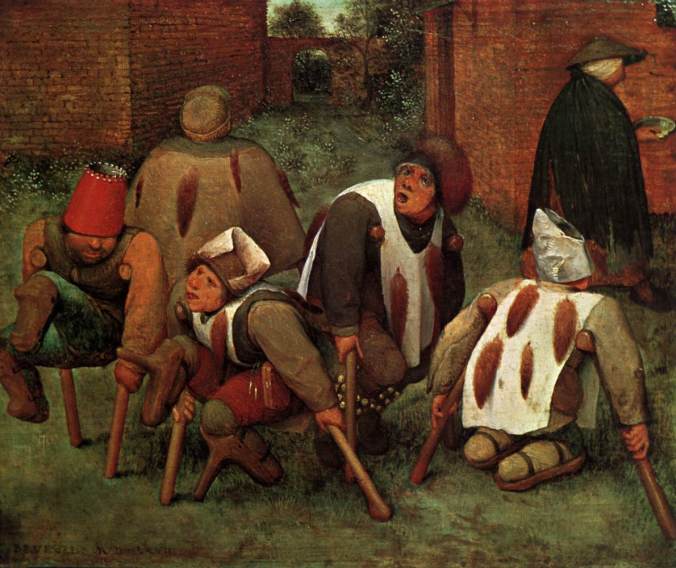
Breughel The Beggars

It’s just a matter of time before officially mandated euphemisms, words like handicapped, for instance, acquire the connotative stench of the word they were chosen to replace, in this case crippled.  The linguist Steven Pinker calls the phenomenon “Euphemism Treadmill.”

Back to ambulatory disabilities. In the Seventies, well-meaning advocates declared the word crippled cruel and decided the word handicapped was more humane. They insisted that handicapped replace crippled, airbrushing, as it were, an unpleasant sound associated with a sad state – withered limbs, club feet, braced legs, thick-souled shoes.1

When you picture a cripple, what do you see?

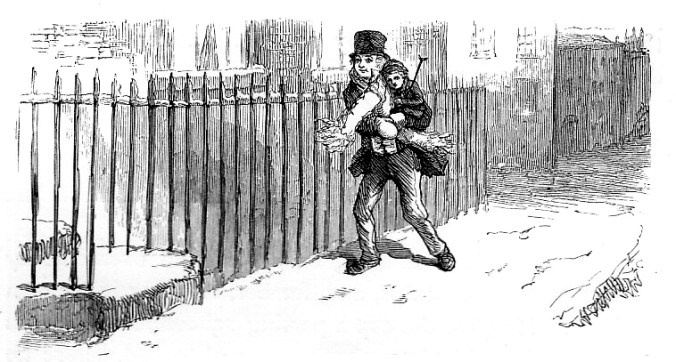
I see a ratty Victorian coat draped across the shoulders of a stooped Dickensian character with a cane.

Now close your eyes and picture a handicapped person.

For me, he or she is wheelchair bound.  However, unlike crippled, the word handicapped covers a much wider range of maladies; it’s not limited to problematic arms legs or or spines.  Elmer Fudd and Sylvester the Cat have speech handicaps, for example.

The word crippled is crisp, a trochee, the double p-sounds limping. It comes to us from two words of German origin, crypel and crēopel related to the word creep.

Handicapped is less specific, more metamorphic, having originated, not in the distant mists of Anglo-Saxon barbarity but in the 17th Century describing strange pastime called “hand in cap.”

Here’s the OED’s account:

Mid 17th century: from the phrase hand in cap; originally a pastime in which one person claimed an article belonging to another and offered something in exchange, any difference in value being decided by an umpire. All three deposited forfeit money in a cap; the two opponents showed their agreement or disagreement with the valuation by bringing out their hands either full or empty. If both were the same, the umpire took the forfeit money; if not it went to the person who accepted the valuation. The term handicap race was applied (late 18th century) to a horse race in which an umpire decided the weight to be carried by each horse, the owners showing acceptance or dissent in a similar way: hence in the late 19th century handicap came to mean the extra weight given to the superior horse.

Handicapped spread from racetracks to golf courses and enjoys in the arena of sport non-pejorative connotations. It suggests the possibility of success despite a disadvantage, yet it, too, has fallen out of favor. Disabled person is now preferred over handicapped.

Would you rather be crippled or handicapped or disabled? No doubt one day disabled too will fall out of favor for some new attempt to soften the sense of the situation.

This phenomenon of euphemisms falling out of favor has a long history.

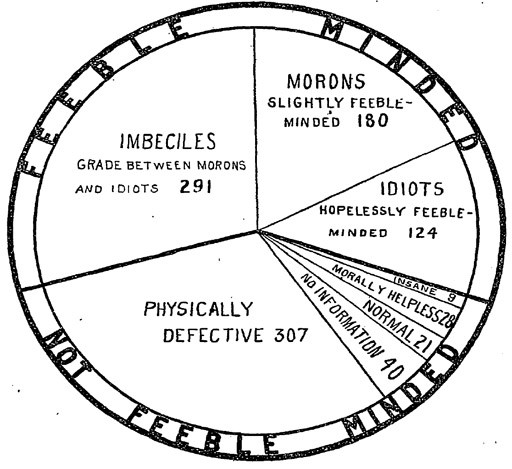
Take these deposed onetime legitimate descriptors of levels mental incapability.

Idiot, imbecile, moron.

For example, the blog Medium provides this succinct explanation of what these no longer clinical terms once meant.

1910, the Association of Medical Officers of American Institutions for Idiotic and Feeble-Minded Persons adopted three classifications of people we know today as intellectually disabled, as defined by a newly invented way to measure intelligence we now call the IQ test. “Morons” were the most intelligent — they had IQs between 50 and 70. “Imbeciles” with IQs between 25 and 50 were the second level. Those below 25 would remain “idiots.”

Of course, the problem with these terms is that people started insultingly applying them to non-imbeciles, non-idiots, non-morons, so I can see why changing them made some sense. For example, HR McMaster, Trump’s former national security advisor, called his boss “an idiot,” as had White House chief of staff John Kelly, according to the Washington Post. Ousted Secretary of State Rex Tillerson called Trump a “moron.” Although others have called Trump an imbecile – actress Sonam Kapoor, e.g., – I can’t find an example of one of his staff members employing the term. In addition, no one, to my knowledge, has called Trump “retarded,” (though Trump himself used that term to describe his former attorney general Jeff Sessions).

Maybe “mentally incapacitated” will survive. What an ineffective insult that term would make, a nerf insult, not suitable for a staccato attack during a road rage incident. “What the fuck you think you were doing, you fucking mentally incapacitated person, you?”
Although I would rather be handicapped than disabled, I’d prefer to be mentally incapacitated rather than imbecilic. I told my mother once after she chided me for using the word piss, that I’d bring in a jar of urine and a jar of piss, and if she could correctly label which was which, I’d never use the word piss ever again until the day I passed away or croaked.


[1]Yes, “air-brushing sounds” is indeed a mixed-metaphor. Cluck your tongues, you stepchildren of Freud!

The Considerable Talents of Danielle Howle

photo credit: Fleming Moore


In November of 2014, I published a post entitled South Carolina’s Musical Heritage where I imagined The Oxford American had chosen me to curate a cd of songs produced by natives of the Palmetto State.  I complained that a few of the songs in the Oxford Southern Music series were “a bit too archive-y” and that my cd would not suffer from that preciousness.  You could listen to my compilation without reaching for the fast forward button to skip some pocket-comb-and-tissue band from the 1930s inserted into the mix to establish the curator’s erudition.

Here’s what I came up with:

Maurice Williams and the Zodiacs’  “Stay”

The Swinging Medallions’ “Double Shot of My Baby’s Love”

The Marshall Tucker Band’s “Can’t You See”

Eartha Kitt’s “C’est Bon”

Dizzy Gillespie’s “Salt Peanuts “

James Brown’s “Doing It to Death”

The Drifters’ “There Goes My Baby”

Chubby Checker’s “Let’s Twist Again”

The Brotherhood Gospel Singers’ “Mary, Don’t Cry”

The Reverend Gary Davis’s “Prodigal Sun”

Hootie and the Blowfish[1]“Only Want to Be with You”

Julius Cobb’s “Great Big Change in Me”

Uncle Walt’s Band’s “Gimme Some Skin”

Alphonse Mouzon’s “Funky Snakefoot”

Blue Dogs’ “Walter”

Danielle Howle’s “Oh Swear”

Well, last night, I finally got to meet the last name on that list – not last because least but last because youngest.  Danielle Howle is truly a treasure.  She’s blessed with incredible chops; a gift for melody; a soul capable of alchemizing suffering into poignant but not sentimental art; a sharp, dry wit that makes her stage banter funnier than most of the stand-up acts I’ve seen recently.  Oh, yeah, and charisma.  Obviously, you can’t learn charisma, you can’t will charisma, you can’t ask the Lord Almighty to grant thee charisma.  You either got it or you don’t.  And she gots it in containership loads.

See for yourself as she and keyboardist Alex Goyette playing at the Listening Room at Summerville’s Homegrown Brewhouse:


To say I’m a fan is obviously an understatement.  Check her out whenever you can,  Also, her opening act George Alan Fox and Jesse Pritchard were also  killer.


I-and-I backstage with Danielle Photo Credit: Fleming Moore

[1]Not a big fan, but it would be churlish not to include them.

Deepening Shades


The death of friends, or death

Of every brilliant eye

That made a catch in the breath –

Seem but the clouds of the sky

When the horizon fades;

Or a bird’s sleepy cry

Among the deepening shades.

Yeats, “The Tower”


Cast a cold eye,

On Life, on Death.

Horseman, pass by!

Yeats’s Epitaph


Because I’m retiring at the end of this year, I’m often asked if I’m “counting down the days.”

Actually, I’m not.  When this semester ends, I’ll be not teaching at Porter-Gaud for the rest of my life.  Why rush that?

Instead, I’m relishing – or at least trying to relish – the last opportunity of teaching specific content: poems I love, vocabulary lessons I know by heart, characters who are more real to me than many of my acquaintances. For example, my main man from Heart of Darkness Charlie Marlow and I will part company in May. Every spring for thirty years he and I have hung out for two weeks or so. I’ll miss the sound of his voice, what he has to say about truth and lies, of savagery and civilization. Of course, I could look him up next year or the year after, but I know I never will. There’s no need for me to accompany him up the Congo River ever again.

Yesterday I taught Blake for the last time.  We read and discussed the Chimney Sweeper poems, “London,” and “The Poison Tree.” It suits me to be done with those poems; nevertheless, I savored intoning each syllable to the class and afterwards enjoyed exploring the poems’ meanings.

I was angry with my friend;

I told my wrath, my wrath did end.

I was angry with my foe:

I told it not, my wrath did grow.


And I watered it in fears,

Night & morning with my tears:

And I sunned it with smiles,

And with soft deceitful wiles.


And it grew both day and night.

Till it bore an apple bright.

And my foe beheld it shine,

And he knew that it was mine.


And into my garden stole,

When the night had veiled the pole;

In the morning glad I see;

My foe outstretched beneath the tree.


I tried as best I could to convey how these rhythmic, rhyming words capture the toxicity of repression and deceit and how the consciousness of the speaker of the poem is not universal, i.e., that his consciousness is not ours nor ours his.  We talked about existentialism and how the theory of existentialism ties into Wordsworth’s perception that reality arises — is concocted — from “eye, and ear, — both what they half create, /And what perceive.”  I cited Hamlet’s observation that “Nothing is neither good or bad but thinking makes it so” and his claim that he “could be bound in a nutshell” yet think himself “king of infinite space,” that is, if he didn’t have “bad dreams.”

The speaker of “The Poison Tree” is pleased that his foe is dead, so, according to his reckoning, “God’s in His heaven, and all’s right with the world.” After all, the speaker has invested a lot of energy cultivating the poison apple.  His joy in his neighbor’s demise contradicts traditional religious and secular moral teaching and perhaps is off-putting to many readers; nevertheless, it makes sense that he expresses his thoughts in jaunty, happy rhythms.

After all, as Pope says, “The sound must seem an echo of the sense.”

In these dwindling last weeks, I’ll also bid adieu to Blake, Byron, Shelley, Keats, Tennyson, Browning, Conrad, Yeats, Joyce, Eliot, and Auden as they sing their swan songs. After that, I’ll be free to “embrace the trivial days and ram them with the sun,” to paddle out in glassy surf while my colleagues are taking roll or telling some boy to tuck in his shirt.   I’ll be free to read what I choose, to make some new literary friends.  It’s about time I got acquainted with Swann and his daddy Marcel Proust.

Until then, I hope to savor each and every class period rather than looking ahead and counting them down like Advent calendar squares, or a prison sentence, or the way I count down the essays left to be graded or the report card comments left to be composed.

Yes, I am looking forward to not grading essays and writing report card comments. I have three sets left to finish before 8:00 a.m. Wednesday.

Protestant Carnival


Alas, even though Folly Beach is the Edge of America, even though it’s the mostest bohemianest spot in South Carolina, it is, nevertheless, Protestant.  You gotta have Lent to have a good carnival.  At a Protestant Mardi Gras parade, like on Folly Beach, they ain’t no nudity, so the closest thang we got what I’d call Dionysian is the purple headed chick on stilts on this here video.

All the same Bontemps, y’all.


The Ballad of Old Buck Roberts


For years and years he lived right here

in a tent on the edge of Folly.

He brewed his beer and wrote his poems

in the shade of a stunted loblolly.


He played at working construction,

could drive a nail I guess,

but what Buck was really good at

was downing his Inverness.


He’d have a drop in the morning,

he’d have a drop at noon,

he’d have a drop at midnight,

‘neath the light of a winter moon.


The cold on Folly ain’t that bad

(unless you stay in a tent),

but Buck would hum all through the night,

shivering but still content,


content because his poems would clack

from that old Underwood,

clack-clack-clacking, like a woodpecker,

on the edge of the stunted wood.


The VA doctors warned him

to change his lifestyle soon,

but Buck was a stubborn cuss.

He loved the light of the moon.


They found him dead inside a shed

on the side of Folly Road,

and in his hand he held a poem,

the last one he ever wrote:


            Drunk me some wine with Jesus [it read]

            At this here wedding in Galilee.

            He saved the bestest for second

            And provided it all for free.


            So I quit my job on the shrimp boat

            To follow Him eternally,

            No longer bound by them blue laws

            Enforced by the Pharisee.


            And we had us some real good times

            Till them Pharisees done Him in.

            Ain’t got no use for the religious right

            After I seen what they done to Him.


            Then when Saul Paul stole the show

            I sort of drifted away.

            Cause he never quite did understood

            What Jesus was trying to say.


            Paul was like a Pharisee,

            Cussing this, cussing that,

            Giving the wimmins a real hard time,

            Gay bashing and all like that.


            So I stay at home most nights now

            Trying to do some good,

            Offering beggars a little snort

            Whilst praying for a Robin Hood.


            Drunk me some wine with Jesus,

            It was the bestest day I ever seen.

            Drunk me some wine with Jesus,

            Partying with the Nazarene.


I can think of worse things

to have in your hand when dead

across the bridge on Folly Road

inside an old tool shed.


Reefer Madness

A member of the SC Medical Association and Attorney General Alan Wilson experimenting on a marijuana user

Alas, I find it necessary yet again to haul down from the attic James Petigru’s way-too-often quoted description of my native state:

South Carolina is too small for a republic and too large for an insane asylum.

What prompts today’s revival of Petigru’s apt observation is Attorney General Alan Wilson’s idiotic proclamation that marijuana is “the most dangerous drug” in America, edging out, it would appear, crystal meth, cocaine, crack, heroin, and [drum roll] aspirin.

[1]


Here are some 2017 numbers from the CDC:

According to the Centers for Disease Control, using data available for analysis on September 5, 2018, there were a reported 70,652 deaths attributed to drug overdose in the US for the year ending December 2017. Some deaths were still under investigation. The CDC projects that the total for 2017 will be 72,222.

Of these:

Opioids were detected in 47,863 reported deaths, and are predicted to be involved in 49,031 deaths.

Synthetic opioids, excluding methadone, were detected in 28,644 reported deaths, and are predicted to be involved in 28,644 deaths.

Heroin was detected in 15,585 reported deaths, and is predicted to be involved in 15,941 deaths.

Natural and semi-synthetic opioids were detected in 14,553 reported deaths, and are predicted to be involved in 14,940 deaths.

Cocaine was detected in 14,065 reported deaths, and is predicted to be involved in 14,612 deaths.

Psychostimulants with abuse potential were detected in 10,420 reported deaths, and are predicted to be involved in 10,703 deaths.

Methadone was detected in 3,209 reported deaths, and is predicted to be involved in 3,286 deaths.

Here’s what the House of Lords Select Committee on Science and Technology has to say about marijuana:

Tetrahydrocannabinol is a very safe drug. Laboratory animals (rats, mice, dogs, monkeys) can tolerate doses of up to 1,000 mg/kg (milligrams per kilogram). This would be equivalent to a 70 kg person swallowing 70 grams of the drug—about 5,000 times more than is required to produce a high. Despite the widespread illicit use of cannabis there are very few if any instances of people dying from an overdose. In Britain, official government statistics listed five deaths from cannabis in the period 1993-1995 but on closer examination these proved to have been deaths due to inhalation of vomit that could not be directly attributed to cannabis (House of Lords Report, 1998). By comparison with other commonly used recreational drugs these statistics are impressive.”

What prompted Wilson’s injudicious misrepresentation of the facts was not a call for the legalization of marijuana in South Carolina but merely the introduction of legislation “that would allow patient’s to obtain it with a doctor’s prescription.”

More from Wilson’s press conference:

[Users employ] words like stoned, high, wasted, baked, fried, cooked, chonged, cheeched, dope-faced, blazed, blitzed, blunted, blasted, danked, stupid, wrecked — and that’s only half the words they use,” Wilson said. “Are these consistent with something that describes a medicine?”

Now that’s what I call scientific!

The truth of the matter is that your chances of croaking, bellying-up, kicking the bucket, cashing in chips, joining the invisible choir, buying the farm, and shuffling off the mortal coil are infinitely greater from a perfectly legal prescription of OxyContin than it would be from medical marijuana.

I’m in no way advocating the use of marijuana but merely pointing out the inanity of our public officials, how the Republican Party ignores science in formulating policies.

Speaking of gateway drugs, I’ll leave you with this:


On the Slave Ship Lollipop

I used to stuff my face with candy

when I was a little boy,

couldn’t cop enough Mary Janes,

would kill for an Almond Joy.


Then I graduated to the Real Thing – Coke.

I was popping five cans a day,

plopping nickels and dimes upon the counter

under caffeine and sugar’s sway.


Now I’m hooked on heroin,

am little more than a thug.

Wish I’d known then what I know now –

that sugar is the gateway drug.


[1]According to a recent study, “Taking a daily aspirin is far more dangerous than was thought, causing more than 3,000 deaths a year.


On Angels and the Afterlife

I realize that most Late Empire Americans don’t literally believe in angels – celestial beings that predate the Earth’s creation, minions of the Creator, avian humanoids who play harps and warble hosannas.

Of course, some Christians literally believe the story of Gabriel’s Annunciation, literally believe insemination had come via the Holy Spirit, a Dove delivering via ear the Holy DNA, and I sincerely envy them.

I love the concept of Angels, thrill to see them aloft in Renaissance paintings, violating anachronistic Newtonian laws. When I was with Judy Birdsong at her bedside in her very last moments, I chanted, “May flights of angels sing thee to thy rest” over and over until it was over.

Nevertheless, questions arise: how are angels spawned, or begot, or ushered into being?  Fully formed with pubic hair?  Perfect fingernails never in need of clipping?

Or do angels grow like children, appearing post-fetal in an opening lotus bloom via asexual birth?

Do they, without lacking mothers and fathers, learn to fly via instinct?

You’d think angels would be the happiest of happy beings, winged Bodhisattvas, egoless, ennui an impossibility.

Not in Paradise Lost. Angels have not only personalities but hierarchal social status.

Nor do they seem all that happy in 15th Century painter Jean Fouquet’s Madonna and Child.

I’m not arrogant to declare there”s not an afterlife.  In fact, I’m a fan of the concept.  However, if there is an existence beyond this Vale of Tears, I bet it’s not all that anthropomorphic.

In other words, unimaginable, to which I can only say, “Praise God.”


Excess


Sometimes I fantasize capping* otherwise innocent people who use the word awesome to describe piss-ant phenomena like the grooviness of their athletic shoes, the merely competent performances of tweens at recitals, or even the ho-hum occurrence of a flight being on time.

“Awesome, dude!”

The word, as you may have forgotten, used to be reserved for extraordinary occurrences like a volcano rising from the sea or the aurora borealis strobing above a winter horizon. For whatever reason, awesome’s sibling awful has remained immune to hyperbolic overuse.  I guess it makes sense that human beings wouldn’t want to jack up merely unfortunate events into the realm of tragedy the way we do mundane matters into the realm of apotheosis.

     Hmm, these tomatoes are rather tasteless.

     Oh my God, dude!  That’s awful!

This Late Empire compulsion towards hyperbole is stripping language of meaning, which bodes poorly for a culture with really serious problems that demand precise articulation of nuanced parameters.**

*With a low-caliber derringer that would merely result in a ‘flesh wound.’  After all, I do practice Buddhism.

** I’m talking, apocalyptic tsunamic horrorshow problems like athletes taking steroids and traffic backups on Bees Ferry Road.

ओं मणिपद्मे हूं

Think of how many times lately you’ve heard the word ‘hilarious’ to describe something that wasn’t even all that amusing.  Almost always the superhyperbolification is delivered in a deadpan voice that might be rendered “THAT is hilarious.”

For example, I recently shared with colleagues the Bataan Death March frustrations I suffered a few years ago when I drove my schizophrenic aunt from her facility to a lawyer’s office in Summerville.  Our mission was to sign some papers disentangling the gordian knot of my late uncle’s estate in which he left half of his house to his live-in girlfriend’s three Tweetle-dee-dum daughters while the deceased live-in girlfriend had left a third of her house to him.

OMG!  TMI!

At any rate, it was to be a long day that included rushing to the bank between classes to lend the estate two grand to buy off the ravenous daughters; picking up said schizophrenic aunt from said facility on Dorchester Road; picking up aged mother from Tennessee Williams Estates; driving to the lawyer’s for the melancholy transactions; driving to the CVS so S.A. could pick up toiletries; dropping her back off at the facility but then returning to my place of employment to attend a “milestone dinner” where I would sit and eat and chitchat at a table with the parents of 8th graders anxious about the transition from adjacent buildings, i.e., from the Middle to the Upper Schools; and finally leaving there for my book club, normally an enjoyable experience, though this night’s topic of discussion was Eugene O’Neil’s The Iceman Cometh, a play that is about upbeat as Chopin’s “Funeral Dirge.”

All in all, I was to spend fifteen hours away from the shelter of my home and the bosom of my family, not exactly a tour in Afghanistan, but irksome nevertheless.

When I went to pick-up my aunt – let’s call her Blanche – she was sitting on the front porch of the facility with a couple of wheelchair bound residents.   I beckoned her to the car, but she hollered that I would have to sign her out.  “Let me park then,”  I said, getting ready to shift from neutral to reverse.

“No,” she said.  “It’ll only take a second.”

Here, she was exaggerating.  It took at least two minutes, more than enough time for my car to roll down an incline and smash into another car parked along the curb.

As I surveyed the damage, Blanche suggested we leave the scene, but, of course, I went back in and tracked down the owner of the car, exchanged insurance information, and then behind schedule, finally began the dismal journey down Dorchester Road in the rain.

All in all, things went smoothly at the Lawyer’s, though I was a bit distracted wondering how much the wreck would add to the two grand I had bestowed on the estate.

On the way back, Blanche asked me what I thought about Obama, and I gave her my 3.5-star review, but then she said, and I quote directly, “Obamacare terrifies me.”

Let’s say I wasn’t in a good mood, let’s say that I blamed Blanche for my accident because if it hadn’t been for her I wouldn’t have been at her facility on a Tuesday afternoon, and if she hadn’t suggested that I leave the car running in front of the facility, I would have found a parking place and avoided the accident.

“For Christ’s sake, Blanche,”  I said in exasperation.  “Has it not occurred to you that you haven’t had a job in forty years?  When’s the last time you’ve written a check to anyone?  Who do you think pays for the roof over your head, your meals, your prescriptions?  Good God, woman!”

I shared with my colleagues – who, like you, were suffering through this account – that I felt like stopping the car and literally throwing Blanche out onto the street.

“THAT is hilarious,”  one of them said.

The truth is that we need hyperbole to spice up our mundane existences, and throughout the above narrative, I have had to strike through inclinations to inflate (and left in the gordian knot metaphor); nevertheless, I do wish that we would not use the same degree of astonishment when describing this:

“awesome”

and this:

An Ode to Bartenders

From left to right, Hank, Charlie, Greg, and Jen

To my mind, the most important component of a great bar is a great bartender.  I’d rather be enjoying a cocktail in in a seedy dive with a personable bartender than drinking in splendor at the Castell Rooftop Lounge with an aloof one. Of course, it’s in the best interest of a bartender to be friendly, given that he or she obviously would like to be tipped, and it goes without saying that bartenders should be attentive, efficient, and if you’re a regular, reaching for what they know you drink as you climb upon your stool at the bar. However, the very best bartenders end up being something more than just a friendly face; they become confidants.

One of the all time great bartenders I’ve encountered is Steve Smoak, who used to work at Rue de Jean on John Street.  When the joint was packed, you’d see Steve busting his ass.  It was as if he were dancing, pouring to a rhythm.  In those inside smoking days of yore, one time I saw him with a drink in his left hand slide past a customer, light her cigarette with his right hand, and deliver the drink in his left hand to another customer two stools down — all in one fluid motion.

It was literally entertaining to watch, almost like one-man ballroom dancing

If Rue was really crowded, and Steve saw me stuck behind a throng, he’d step out from behind the bar and deliver my Jameson’s.  Perhaps the biggest favor he ever did was talking me out of resigning from my job.  After listening carefully to my tale of woe one week night, he said, “Wes, I’ve talked to lots of your former students.  Don’t be a fool and quit over something like this. Swallow your pride.  It’s not worth quitting over.”

Even though Judy Birdsong, my late wife, had given me permission to quit, I did swallow my pride, took Steve’s good advice, and continued my career..

Steve Smoak

Chico Feo is my go-to hangout because of the bartenders, Hank, Greg, Jen, Kelly, and Phillip, and I miss those who have left for greener pastures, like Jude and Charlie.

I’d rank Charlie right there with Steve Smoak as far as greatness goes.  During Judy’s long illness, Charlie offered a sympathetic ear and later dating advice when I began seeing Caroline.[1]  He had become a sort of confidante.


Alas, Charlie left Chico for a downtown peninsula gig in a basement bar associated with the restaurant One Broad Street.  I’d been missing my man, so last Wednesday, Caroline and I stopped in to see him during Cotillion.

The place is friendly, cozy, well appointed, and rumor has it the pizzas are the best in town – and cheap. However, its most valuable asset is Charlie, a master bartender and a helluva a guy – intelligent, articulate, easy going.  Going downtown can be irritating with traffic and parking, but hanging out with Charlie makes it well worth the hassle, and as it turned out, an empty parking place was waiting for a customer right at the front door.

img_3506

From left to right, Charlie, Amy, Caroline

So check it out.  Tell Charlie Wesley sent you.


[1]I hadn’t been on a date since November of 1976.

Escape

Marcel Robert: La Fin de l’Hiver

A few years ago, I received an email from a stranger requesting to “interview” me in conjunction with her School of the Arts project on The Catcher in the Rye.  As it turned out, the interview ended up being a survey of written questions that I answered electronically.

    Q.   How old was I when I first read Salinger’s novel?

    A.   Old/young enough to have had my complexion likened to a pepperoni pizza.

    Q. My initial reaction to the book?

    A. Respectful underwhelment.*

     Q. Did I identify with Holden?

     A. Yes, we shared a nostalgia for childhood in a darkening world.

     Q. Have I ever taught Catcher?

     A. No, but it has appeared on my reading lists.

      Q. How do I feel about censorship?

      A. Liberal to a degree: yes, you may read Lolita; no, you may not read Justine.

      Q. What do I think is  theme of The Catcher in the Rye?

      A. Adolescence is a particularly hard time for idealists who have begun to realize the

           Himalayan heights of the bullshit they must conquer in order to succeed in the adult

           world.


*In tribute to my two sons’ degrees in German, the “w” in “underwhelment” is pronounced like a “v.”

The student’s query/project struck me as quaint.  Certainly, hapless Holden’s naive attempt to efface the “fuck you” some churl has scratched into the wall of his sister’s elementary school no longer outrages parents of the Late Empire who blandly witness each January the obscene decadence of Super Bowl Halftime Extravaganzas.  After all, the novel is a year older than I, so Holden (if he was fifteen in the year of Catcher’s publication) would have been born in 1936 and if not dead subsisting now off of Social Security and Medicare, a wizened old man in a wheelchair, his orange hunting hat cocked at a jaunty angle in some subsidized assistant living facility.

Last I heard of Catcher causing commotion was twenty  years ago.  This account comes from The Post and Courier.

Perhaps because Mr. Bagwell had pilfered from my former high school’s library and because I had grown up just down the street from him, I felt chagrined enough to send him the following correspondence (signed with my return address):

Answers: 1.D  2. E  3. F  4. A  5. G  6. I  7. C  8. J  9. H  10.  B

At any rate, the student’s interview request prompted me to do some digging into what texts have now replaced Catcher in the Late Empire as catalysts for censorship, those books in 2011 that rile parents into pitching protests, so I googled “most challenged books,” and lo and behold, there in the top 10 was Catcher, along with that other adolescent mind-warper, To Kill a Mockingbird.

No, I was wrong.  Some Late Empire parents still see Holden as a threat; this confused boy still scares shitless certain curtained consciousnesses that seek to shelter their darlings from the muck and mess of the ever looming out there.

The degradation of childhood in the Late Empire is a curious phenomenon.  In some ways it ends way too soon (sex at fourteen) and lasts way too late (under-employed and living with mom at thirty-four).  Books are considered more dangerous than movies, an unclothed human body much more offensive than graphic violence.  However, I truly believe there is little to fear in a good book because it portrays life as it is lived.  Virtually no one gets horny reading the sexually explicit passages from The Color Purple (nor, for that matter, desires to become a homosexual penguin after finishing And Tango Makes Three).

Of course, in the beginning, puritans considered any novel dangerous because novels dealt with worldly matters, tempting readers, especially vulnerable young ladies, from God’s Holy Word into the profane and vulgar concoctions of scribblers who entertained rather than edified.  I don’t know about you, but essentially, my early reading was all about escape.  I’d rip through every Hardy Boys cardboard bound adventure I could get my hands on wishing I lived in a town blessed with abandoned mills, haunted houses, and inept criminals.  Television in those days consisted of two stations that played soap operas in the mornings and afternoons of scorching summer days so reading novels offered a way to slip through the looking glass into jungles where apemen swung through the trees with scantily clad English girls clinging to their backs.

Eventually, I graduated to biographies, books about dinosaurs and deep space, classics like Tom Sawyer and The Count of Monte Cristo, yet even reading those non-controversial tomes posed the danger of a sedentary, cloistered lifestyle that spurned the Wordsworthian glories of nature’s here and now.  In other words, through books you could abandon your own precious life for the abstractions of the printed page, curl up in the bed of one of the houses houses below, and become deathly pale.

Marcel Robert: La Fin de l’Hiver

Of course, nowadays, computers have replaced books as the vehicles for escape, and now, thanks to cell phones, it’s not unusual to see someone walking on the beach oblivious to the plunging pelican as the beachcomber stares downward manipulating the screen of that tiny computer.  Even though books may have blinded Milton, they are easier on the eyes than this infernal monitor you’re staring at.