Ode to Oblivion
“Form is emptiness, emptiness form”
The Heart Sutra
The sum of nothing,
vacuity cubed,
silence so profound,
saints and sages
stuff their ears
with cotton.
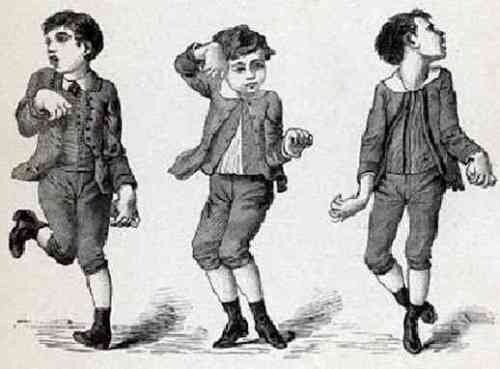
I’m squandering this glorious autumn Sabbath Sunday up in my drafty garret researching medical maladies.[1] I have discovered, to my great relief, that somehow I avoided coming down with St. Vitus Dance, also known as Sydenham’s chorea, which is a by-product of rheumatic fever, a disease that laid me up for three months when I was five. Sydenham chorea came to be known as St. Vitus Dance because its victims develop spasmodic involuntary herky-jerky movements involving arms, legs, fingers, heads, and tongues. If you want to vicariously feel what it’s like, pull out the ol’ phonograph, un-sleeve your Wilson Pickett’s Greatest Hits album, turn the speed up to 78 rpm, guide the stylus to the last song on the B-side, “Land of a Thousand Dances,” and let the music guide you.
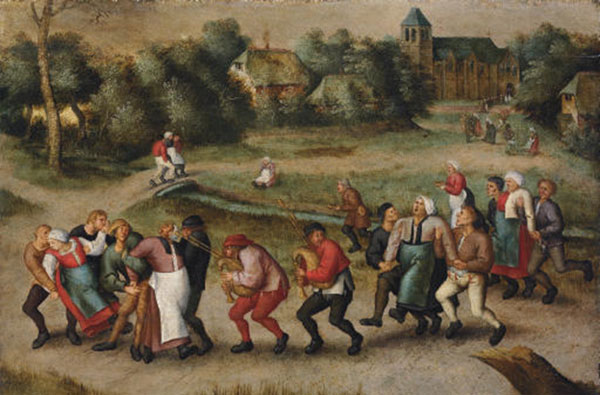
It seems, however, that during the Middle Ages, a manic compulsion, also known as St. Vitus’s Dance, swept through Europe. To quote John Waller in his A Time to Dance, a Time to Die: The Extraordinary Story of the Dancing Plague of 1518:
It started with just a few people dancing outdoors in the summer heat. Arms flailing, bodies swaying and clothes soaked with sweat, they danced through the night and into the next day. Seldom stopping to eat or drink, and seemingly oblivious to mounting fatigue and the pain of bruised feet, they were still going days later. By the time the authorities intervened, hundreds more were dancing in the same frenetic fashion.
So, this is a different type of St. Vitus dance from the post-streptococcus, post-rheumatic-fever variety. Blogger Jen Messier offers a review of theories as to whether it was “a real illness or social phenomenon,” which includes the possibility it may have been a by-product of Ergot poisoning (aka St. Anthony’s Fire), or a freaked-out response of super-stressed people facing the bubonic plague and malnutrition, or, her favorite theory, the dancers were religious cultists feigning illness so they could get around quarantine rules forbidding dancing.
Some of these enthusiasts literally danced themselves to death, especially in what has become known as “the Dancing Plague of 1518,” which took place in Strasbourg. Again, John Waller: “the dancing mania underscores the power of cultural context to shape the way in which psychological suffering is expressed.”
Mass hysteria, anti-quarantine shenanigans, cultists crashing school board meetings overcome with uncontrollable anger manifesting itself in herky-jerky movements, arms flailing, fingers jabbing, mouths –to borrow Ezra Pound’s memorable phrase – “arse belching.”
Yes, seems like old times.

[1] By the way, the windows are open, and I can see from my vantage point sun glinting on pine needles and the soft swaying of magnolia boughs just beyond the iMac screen, so I ain’t completely cut off from nature.

Last Friday, I attended homecoming at the high school where I had taught for thirty-four years. The stadium wasn’t crowded, which suited Caroline and me, given the pandemic. We stood on the perimeter of the field chatting with a couple of moms behind a fence near the goal line when a sudden din distracted us. A swarm of middle schoolers scuttled past with phones held aloft.
Some celebrity, it seemed, had entered the stadium. I figured it must be Kris Middleton, an NBA all-star alum. The squealing commotion reminded me of Beatlemania, and it surprised me that Middleton’s presence would generate so much enthusiasm. The scrum, which had swarmed past a moment ago, now stumbled en masse slowly in the opposite direction with a tall, unsmiling beefy black man in its center.
As it turned out, he was Bryce Hall’s bodyguard.
Bryce Hall was in the house! The Bryce Hall![1]
His coming [archaic usage warning] was telegraphed via Tik-Tok, his arrival announced on Tic-Tok. Eventually, the melee settled down on our end of the field, and for a half hour or so, Bryce roamed the homefield sidelines of the stadium. I think he left before halftime, prior to the coronation of the homecoming queen.[2]
As it turns out, Bryce is a Tik-Tok and YouTube celebrity with umpteen-K followers.[3] When I got home, I ascended the stairs to my drafty garret and conjured on my desktop commuter a ten-minute video of Bryce and his pals and a then subjected myself to a couple of his Tic-Toks.
Look, I have nothing against Bryce – he seems amiable enough – but over the course of that YouTube video, I decided that if I were in my early twenties, these wanna-be cats wouldn’t be hanging out in my seedy apartments. They be vacuous, mon, overly ironic in the boring contemporary unwitty way that un-spleenful cynics are ironic, as a force of habit, not conviction, trafficking in cynicism lite, if you will. In the video, they bragged about quantities of Ks and performed cannonballs in a pool overlooking a canyon. I didn’t dislike them but found them boring and wondered how such unremarkable fellows could garner so much adulation, not to mention, I’m assuming, hundreds of thousands of dollars.
***
In 1977, I read a just-released book by Christopher Lasch called Cultural Narcissism, which received megatons of media attention after President Carter read it and accused the nation of suffering from a “moral malaise.”
I have no idea what happened to my copy, so I can’t quote directly, but I clearly remember Lasch’s writing about the narcissistic individuals’ compulsion to appear on national television during football games, the desire of having CBS’s cameras focusing on them, zooming in, flashing their images around the world live (hence the attention-grabbing frat-boy war paint in Gainesville and in Green Bay middle-aged men dressed up like cheese). Lasch argued that being on live TV authenticated their being, underscored their reality.
The same thing might be said for people seeking proximity to celebrity. If you’re near a celebrity, sharing the same space, your status rises, the large number of “likes” the celebrity photo generates on your social media platforms validates your existence.
The more the merrier.
I see a similar phenomenon on Twitter, people groveling for followers, some going so far as announcing publicly mere minutes after loved ones have died how “broken they are” so they can amass “likes” and sympathetic comments.
What’s odd, though, is that one of my stepdaughter’s sleepover friends told me that “no one likes” Bryce, that, in fact, everyone hates him, though she herself admitted to being part of the mob that tried to get as close to him as possible.
It’s as if that in late capitalism that self-worth is a commodity that must be amassed, counted, verified, and broadcast.
In fact, I’m guilty of it as well.

[1] Whoever that is.
[2] This raises the question: did the opposing team’s teens from Pinewood Prep know of Bryce’s presence? And if they, did they come over to our side to bask in his glow?
[3] Given my status as “tattered coat upon a stick,” you can bet your very last bitcoin I ain’t bothering to look it up.

Listen, when I was young, I was reckless. Just ask my dead mother who in a Biloxi, Mississippi beach cottage circa 1956 scraped me screaming off a hardwood floor after I had leapt Lone-Ranger-like from the top of my chest-of-drawers onto a rocking horse that catapulted me face first splat.
Ask Joey Brown, whose Toyota I totaled in Hilton Head on a roundabout in August of 1976.
Or ask Jacob T. Williams II who two years later rode shotgun as I drove my MG Midget down a capital city sidewalk and made an ill-fated left down steps into a parking garage whose bottom floor housed the Campus Police of the University of South Carolina.[1]
Given that regrettable history, you might think I’d grant slack to others who foolishly throw caution to the salt breeze of Folly Beach, yet, this afternoon, as I walked home from Chico Feo on East Erie, my tongue cluck-clucked as I espied[2] a family of conservative-looking folks[3] barreling past in a golf cart with a grandmother teetering on the back seat clutching a squirming child no more than six months old.
Yes, that’s foolish, I was foolish, but is it any of my business?
No, it’s not. They, though Darwinianly dense, weren’t endangering anyone but themselves (and their progeny), The odds were pretty good they’d get where they were going without a distracted texter, blind-as-a-bat octogenarian, or meth-crazed speed demon smashing into them.[4]
No, it’s none of my business.
On the other hand, reckless people who refuse to get vaccinated or wear masks indoors in close quarters are everyone’s business. Their refusal, whether prompted by political lobotomization, laziness, and/or unscientific paranoia, has allowed the virus to mutate.[5]. The needless continuance of contagion dampens sparks, snuffs out fun. Twice now, my 50th highschool reunion has been postponed – that and 1 out of 500 Americans has died of COVID according to the Washington Post.
So, c’mon people now, smile on your brother [and sister].
Everybody get together and get a vaccine right now.[6]
Right now.
Right how.
Because if you roll the dice often enough, you gonna come up snake eyes.
Here’s Rickie Lee doing “The Horses”

[1] This little lark cost me a reckless driving conviction, 200 dollars, and six points off my license, not to mention a significant elevation of my insurance rates, but as Rickie Lee Jones so eloquently put it in her best song “The Horses,” “when I was young, I was a wild, wild one.”
[2] You know any writer who uses the verb “espied” has one foot in the ditch of dementia.
[3] And I don’t mean by “conservative” MAGA-hat-wearing gun-toting cretins but regular-looking Jesus-believing white Southerners.
[4] However, two blocks west of where I saw the golf cart stands a marker commemorating the spot where someone named Mark Riedel was killed by someone who ran a stop sign.
[5] The bad good news is that it seems that COVID has taken out a disproportionate number of rightwing radio personalities, which is okay with me.
[6] Of course, the odds of a vaccine holdout reading this blog are less than the University of South Carolina Gamecocks going undefeated this season.
Hello, Hoodoo readers. Today I’m honored to introduce guest blogger Edward Lee-Edward Edwards IV, the distinguished Henry James Professor of Locution at Vanderbilt University. Professor Edwards holds many provocative viewpoints that no doubt would shock (and perhaps dismay you) if you could only figure out what in the hell he’s trying to get at.
So, without any further ado . . .
A Confession
I need to phrase delicately the following to soften (i.e., to obscure) with carefully selected Latinate diction and syntax rife with interruptive asides, to soften, as I say, the impact of an opinion that I hold that is anathema to Christian charity, i.e., to common human decency.
To wit: whenever I run across an account (which happens more frequently than you might imagine) of an illiberal rightwing radio personality[1] who had broadcast misinformation about the Covid-19 virus, e.g., that masks and vaccinations are ineffective, that vaccinations result in sci-fi-grade side effects such as epidermal magnification, or that other non-approved veterinary drugs such as Ivermectin can successfully treat the malady, and discover, as I read these accounts, that the said radio personality has succumbed to Covid, instead of dismay, a warm, pleasant feeling of schadenfreude washes over me until I realize that, oh no, dullards will perceive the deceased radio personality’s flaunting of COVID protocols and then dying of the disease as ironic when in fact his contracting the disease is just what one would expect, i.e., the antithesis of irony!
Edward Lee-Edward Edwards IV
Way Yonder East in the Land of Tora Bora
Yesterday, the former President of the United States of America, Donald J. Trump, issued a proclamation decrying the removal of a statue in Richmond, Virginia, of the famed Confederate General Robert Edward Lee.[2] After lauding the statue’s aesthetic attributes and lamenting its being “cut into three pieces […] prior to its complete desecration,” the former President muses that “[i]f only we had Robert E. Lee to command our troops in Afghanistan, that disaster would have ended in a complete and total victory many years ago. What an embarrassment we are suffering because we don’t have the genius of a Robert E. Lee!”
I won’t beleaguer my readers with an interminable recapitulation of the abject failure of Western Invaders’ attempts over the centuries (commencing with Alexander the Great) to subdue the Afghan people or to argue that perhaps the removal of the statue had more to do with Great Uncle General Lee’s status as slaveowner and insurrectionist than it did with his military genius nor point out that Trump’s claim that Lee was indeed a military genius is, in fact, not universally shared by historians[3], but rather, I’d like to acknowledge the amusement Trump’s statement provided me as I visualized the Army of Northern Virginia clashing with the Taliban in Tora Bora or in the streets of Kabul.
At any rate, few pleasures are possible for a man of my advanced age, gout-ridden, suffering from vertigo, etc., so I doff my hat to President Trump for the that wry smile that creased my age-etched visage.
ELEEIV
So that’s it for today. Kudos and thanks to Professor Edwards. We’d love to invite you back sometime. You certainly have a way with words!
WLM3
[1] I concede “illiberal rightwing radio host” may be a tautology, i.e., redundant, like the explanation in this footnote itself.
[2] For the sake of full disclosure, General Lee was a great-great-great-uncle of mine, i.e., I’m a distant relative.
[3] There is, however, a consensus among historians that Lee was the losing general in the Civil War.

Here’s what I’m not going to write about today:
Not about the Murdaughs of Colleton County whose family drama has entered the terrain of Greek tragedy, a once proud House suffering a Faulknerian fall akin to the Compsons’ collapse.
The Murdaugh saga commenced with drunken redheaded USC junior Paul Murdaugh crashing his boat and killing a passenger, followed by his and mother’s murder, their bodies discovered by father/husband Alex at the family hunting lodge. This weekend as Alex changed a tire on a country road, a bullet allegedly fired from a truck grazed his head. On Labor Day, he checked himself into rehab after resigning from his law firm amid accusations of missing millions. We’re talking two mini-series worth of real life Southern gothic mayhem that out-Outer-Banks Outer Banks.
Have at it, Netflix screenwriters. I’ve got better things not to do.
Not about Fletcher Henderson, underappreciated, who transformed Dixieland into Swing, led a big band that employed the likes of Louis Armstrong, Roy Eldridge, Coleman Hawkins, a band that provided the soundtracks for the Harlem Renaissance and Terrytoon animated shorts.
Not about Gandy Goose cartoons, an LSD substitute for tots, Gandy and pal Sour Puss bopping along, the jazz soundscape providing syncopation for the herky jerky action of the animation, often dream sequences with metamorphoses galore. BTW, Gandy Goose and Sour Puss sound as if they could be a Jamaican Dance Hall duo a la Yellowman and Fathead.
Not about Dub Shaman Scratch Perry, Reggae producer extraordinaire, mentor to Bob Marley, Scratch ping-ponging in the studio from synthesizer to guitar to drums in a creative dance that makes music rather than the music making the dance. An incredibly important figure in 20th century music that virtually no one has heard of.
Not about cherubic grandson Julian Levi Moore who just celebrated his two-month birthday.
So, that’s it. What are you not writing about today?

For whatever reason, the ol’ cerebral jukebox this morning had the 1966 novelty hit “Winchester Cathedral” playing in my head. Chances are you’ve never heard this New Vaudeville Band tune even though it won the Grammy for Best Contemporary R and R song that year (despite not being a rock-n-roll song). It features someone named John Carter singing through cupped hands a la Rudy Vallée singing though a megaphone.[1] On December 6th it displaced the Supremes’ “You Keep Me Hangin’ On” as the number one song in the US. Believe me, I’d much rather have “You Keep Me Hangin’ On” stuck on replay on the ol’ cerebral jukebox. “Winchester Cathedral” is inane, irritating, obviously catchy, or otherwise it wouldn’t be lying dormant in my unconscious for fifty-five years.
The tune got me thinking about one-hit wonders, those special songs that for whatever reason memed[2] their way into becoming mega hits, songs like “The Monster Mash,” “Snoopy and the Red Baron,” “Loving You Has Made Me Bananas.”[3] However, not all one-hit wonders are novelty songs. In fact, some of my favorite pop songs are one-hit wonders. Here be my top five, not necessarily in order of preference.
“96 Tears” (? and the Mysterians)

“96 Tears” might be the grandaddy of all garage band hits, and some say (according to Wikipedia) that it played a role in the genesis of punk rock. I don’t know about that, but Springsteen has covered it, which speaks volumes. It also came out in 1966, and I’ve never gotten tired of it.
“Double Shot of My Baby’s Love” (The Swinging Medallions)
Although written by Don Smith and Cyril Vetter and first recorded by Dick Holler and the Holidays in 1963, it’s the South Carolina Beach Band The Swingin’ Medallions who made it a hit in – yes, you’ve guessed it – in 1966. Damn, what an infectious, party hoot, and ladies and gentlemen, I actually heard Springsteen cover it live in 2008 at the North Charleston Coliseum. In fact, the Boss opened the show with it, hollering something like “How’ bout some Beach Music?”
“A Whiter Shade of Pale” (Procol Harem)
This moody, somewhat surreal, 1967 song provided an apt soundtrack for my doomed infatuation with fellow freshman Francine Light. I can see her now, standing across the cafeteria in her green tartan skirt and matching knee socks. O, woe was me!
“Walk Away Renée” (The Left Banke)
When I began this little project, I had no idea that four of these favs were recorded with in a year of each other. This sad love song made it to number 5 on US Billboard Hot 100 chart. Despite its lush orchestration, flute, and harpsichord, I still sort dig it after all these years, not so much for its music but because of the memories it evokes.
“Wipe Out” (The Sufaris)
This is for my money the quintessential surf song, released in 1963 and covered by every garage band in my hometown of Summerville, SC, including The Marijuana Brass, an instrumental brass band modeled on Herb Albert.
A couple of observations. Three of the five feature organs (a harpsichord doesn’t count) and all were recorded about the same time during my junior high days. Of course, there have been subsequent one-hit wonders I’ve enjoyed like “Play That Funky Music, White Boy.” Oh, yeah, and “Tighten Up” by Archie Bell and “Sweet Soul Music” by Arthur Conley beat the hell out of my top five, but I don’t care.
Maybe hormonal imbalance played a role. Anyway, this exercise has effectively effaced “Winchester Cathedral” from its seemingly never-ending loop, and for that I’m very thankful.
[1] Chances are you’ve also never heard of Rudy Vallée, Chances are, however, you’ve heard of Frank Sinatra, who covered it on his 1966 album That’s Life. Go figure.
[2] Verb, to meme, to catch on culturally, from the noun meme, an element of culture “selected” by the masses because of its contagious appeal. (Forgive me, Richard Hawkins).
[3] “Loving You Has Made Me Bananas begins with these immortal words:
Your red scarf matches your eyes.
You closed your cover before striking.
Father has the shipfitter’s blues.
Loving you has made me bananas.
The very best Christmas present I ever received from an in-law is Nanci Griffith’s masterpiece Other Voices, Other Rooms, a collection of covers from songwriters who influenced Griffith’s own music making. My sister-in-law Linda Birdsong gave it to me in 1994, saying she thought I’d enjoy it. Understatement of the century Clinton years.
I ended up purchasing ten or so more CDs to check out the work of some of the featured songwriters, which include Kate Wolf, Vince Bell, Townes Van Zandt, Frank Christian, Bob Dylan, John Prine, Ralph McTell, Tom Paxton, Woody Guthrie, Janis Ian, Gordon Lightfoot, Jerry Jeff Walker, and Malvina Reynolds and Harry Belafonte, just to name fourteen.
The magic begins with a cover of Kate Wolf’s “Across the Great Divide,” an incredibly beautiful composition that embodies concretely the passage of time in both terrestrial and temporal images.
Here are the first three verses, but I encourage to go to YouTube (who won’t allow me to embed a link) and check out a live version:
I’ve been walkin’ in my sleep
Countin’ troubles ‘stead of countin’ sheep
Where the years went I can’t say
I just turned around and they’ve gone away
I’ve been siftin’ through the layers
Of dusty books and faded papers
They tell a story I used to know
And it was one that happened so long ago
Although they’re all excellent, the next song that blows me away is the third cut, Townes Van Zandt’s “Tecumseh Valley,” a duet Nanci performs with the great Arlo Guthrie.
Other personnel featured on the album include Dylan himself, who plays harmonica on “Boots of Spanish Leather” and Guy Clark on the Woody Guthrie’s “Do-Re-Mi.” Also, Emmylou Harris and Iris Dement are sprinkled about, and the final cut “Wimoweh” features Odetta, the Indigo Girls, John Prine, James Hooker, Holly and Barry Tashian, John Gorka, Dave Mallet, Jim Rooney, and Nanci’s father Marlin Griffith.
Demonstrating just how much of life is fraught with loss and longing, the overall mood is melancholic with “From Clare to Here” (featuring Peter Cummin), Jerry Jeff’s “Morning Song for Sally,” Michael Burton’s “Night Rider’s Lament,” and “Speed of the Sound of Loneliness” (featuring John Prine who wrote the song).
Of course, Nanci produced an admirable body of work herself, and she’s certainly going to be missed. From everything I’ve read about her, she was a lovely person, generous, intelligent, somewhat scholarly.
Sad, sad, sad.

As a new grandfather, I’ve been riffling through the poetic jukebox of my memory trying to find a poem that embodies this profound visceral love I feel for this squiggling, big-headed creature I’ve seen in videos and while facetiming.
No luck. I can only recall poems about children, like Linda Pastan’s minor masterpiece “To a Daughter Leaving Home”:
When I taught you
at eight to ride
a bicycle, loping along
beside you
as you wobbled away
on two round wheels,
my own mouth rounding
in surprise when you pulled
ahead down the curved
path of the park,
I kept waiting
for the thud
of your crash as I
sprinted to catch up,
while you grew
smaller, more breakable
with distance,
pumping, pumping
for your life, screaming
with laughter,
the hair flapping
behind you like a
handkerchief waving
goodbye.
And Peter Meinke’s “E-Mail from Tokyo,” which begins with this epigram from Philip Larkin:
They fuck you up, your mum and dad
They may not mean to, but they do.
And ends with these two stanzas:
I know what memory and poetry need: storm moon
dolphin eye strings of images strung like those kites
across a summer sky years ago the wind snapping
letters toward the sun Kiss me Dear one Stay safe Write soon
but in the end we can only cry your names sending
them skyward fragile and flammable affirming that
you’re ours (poor babies): Perrie Peter Gretchen and at
last thanking you for tomorrow’s letter Timothy
Since I couldn’t recall a grandchild poem from my memory, I turned to the internet and discovered, not surprisingly, grandchildren galore have been celebrated in verse, most of it along the lines of this:
I bought two new books for you today my sweet boy.
The Wizard of Oz and The Jungle Book should bring joy.
I’m very proud of how wonderfully you read.
As an English scholar, I know you will succeed.
[groan]
So, unfortunately, I must rely on my own threadbare wit to try to express this feeling, which, of course, lends itself to cliché because it “wells up” and “warms” and “heartens.”
I’ve seen other grandparents in its throes, flashing photos, and found their enchantment genetically understandable, if a tad bit too precious, but here I am experiencing that very rapture, a love I’m incapable of embodying in images or syllables, in iambs or trochees.
All I can say is it’s really something.
Slap her down again, pa
Slap her down again
Make her tell us more, pa
Tell us where she’s been
We don’t want our neighbors
Talkin’ ’bout our kin
Slap her down again, pa
Slap her down again
as covered by Arthur Godfrey in a 1947 recording
The above mid-century snippet certainly demonstrates that times have changed. It’s hard to imagine anyone outside a Montana militia camp or Pentecostal rattlesnake farm who would adhere to the childrearing principles practiced by the vengeful patriarch of the song (spurred on, it would seem, by a brother who suffers a case of sibling rivalry that makes Edmund’s hatred of Edgar in Lear seem like mere disgruntlement). The song also projects a Taliban-like sexism in its relegation of females into the realm of property.
Of course, the lyrics are meant to be humorous, but it’s hard to imagine their not offending a large number of North American citizens of both sexes.
The word sadistic comes to mind.
No, we middle class denizens of the Late Empire no longer treat our children as property, nor beat them with belts nor switch them with switches, which is all to the good. However, elevating them to the status of major deity might not be such a hot idea either. If judging from some of the Facebook posts of the current generation of DNA replicators and actual 3-D encounters with their offspring, a number of millennial parents seem to be transforming childrearing into some sort of strange counter-intuitive fetish in which the power of household management is ceded to tiny monomaniacs whose accumulated world wisdom would not fill one dimple of a thimble.
Father to 5-year-old-daughter: Anastasia, tell Mr. Wesley where you went today.
Anastasia: [sullen silence, no eye contact]
Mr. Wesley: Yeah, Helen. I’m just dying to know where you went today.
Father [frowning]: Helen?
Mr. Wesley: Yeah, as in Helen Keller.
Anastasia [frowning]: Why did he call me Helen, Daddy?
Father: [squatting to accomplish eye-level conversation]. Because you didn’t answer Mr. Wesley, honey, so he was pretending that you were Helen Keller, a very accomplished person. Helen Keller was a famous girl, who well, had some obstacles to overcome. She couldn’t hear, so she didn’t know how to talk, but a wonderful woman named Anne Sullivan worked with Helen and taught her how not only to talk, but to write, and Helen Keller became a world-renowned writer –
Mr. Wesley: And she lived happily ever after even though she was blind as well.
Anastasia [tugging at parent]:
Father: Um, nice seeing you, Wesley. Say goodbye to Mr. Wesley.
Anastasia: [sullen silence, no eye contact]
My late wife Just Birdsong inherited a book from her mother Emily entitled Our Darlings’ ABCs, which sort of blew my very-difficult-to-blow mind.
A pretty book of A B C’s
The tiny folk is sure to please;
So here it is in colors bright,
With every letter placed in right,
And more than this, a rhyme as well
That will some Bible story tell,
To help the children learn with ease
The puzzling list of A B C’s.
Sounds innocuous enough, right? Well, it doesn’t take us long – the B’s in fact – to discover that childrearers around the turn of the previous century (the book appeared 40 years before Godrey’s recording of “Slap Her Down Again”) were a bit more brutal back in the day. Here are the facing pages for B.
As one who like Elisha has “no hair on the top of his head,” I find the children’s taunt of “Go up, thou bald head” hurtful in the extreme and agree with the author’s observation “How unkind to speak of his head in that way.” Certainly, Elisha’s wish to punish the children is understandable, and God knows, they certainly will never commit that unkindness again because “God heard and sent two large bears out of the woods. The bears were very fierce, and they soon tore forty-two of the children in pieces.”
Nighty night. Sweet dreams, sugarplum.
As I was perusing the alphabet and encountering Bible stories with which I was not familiar (e.g., how Moses told his people “to hasten away from Korah’s home” before “the ground opened up and swallowed Korah”). I couldn’t help but think of the ABC book I have written and how it reflects the kinder, gentler world of 2012.
Or [have you ever] barbered* a barbarian?*
*You can read the entire primer here and my complete guide to childrearing here.
We both use the same method, alliteration and assonance – “bad bald back” and “barbered barbarian” and offer illustrations to complement our lessons, though my primer is a tad bit less didactic.
As in most cases, the Middle Way is better – too much rod = brutish child and too much parental kowtowing = loutish child.
Anyway, I doubt if many millennials are reading goodnight stories from the O.T.
Well, enough. Good night, and may God bless!