Over the years, my friend (and one-time collaborator) Dr. Paul O’Brien has guest-lectured for my classes in various capacities, e.g., to introduce Beowulf or Hamlet or the genre of poetry. In the poetry intro, he begins by reciting “Who Goes with Fergus” in his rich baritone but then admits he doesn’t exactly know what it means:
Who will go drive with Fergus now,
And pierce the deep wood’s woven shade,
And dance upon the level shore?
Young man, lift up your russet brow,
And lift your tender eyelids, maid,
And brood on hopes and fear no more.
And no more turn aside and brood
Upon love’s bitter mystery;
For Fergus rules the brazen cars,
And rules the shadows of the wood,
And the white breast of the dim sea
And all disheveled wandering stars.
But he does know that he loves the way it sounds, its imagery.
He goes on to tell the students that poetry can be “your companion, your friend.”
In this context, I’ve found Yeats’ “To a Friend’s Whose Work Has Come to Nothing” a comfort on days like today when I’m down:
Now all the truth is out,
Be secret and take defeat
From any brazen throat,
For how can you compete,
Being honor bred, with one
Who were it proved he lies
Were neither shamed in his own
Nor in his neighbors’ eyes;
Bred to a harder thing
Than Triumph, turn away
And like a laughing string
Whereon mad fingers play
Amid a place of stone,
Be secret and exult,
Because of all things known
That is most difficult.
However, this phenomenon of literary friendship is not only limited to poetry; I count Frank Bascombe, the narrator of Richard Ford’s trilogy, a pal, and every time I finish one of the Bascombe novels it’s like saying good-bye to someone I’ll miss hanging out with. I’ll miss Frank’s voice. (Though rumor has it Frank survived Hurricane Sandy and will tell us about it in a new short story).
I’ve recently run across a new companion, J.I.M. Stewart, whose Eight Modern Writers is the final volume of The Oxford History of English Literature, published in 1963. Now you might expect – or should I say one might expect – a critical volume sporting such a title to be as dry as unbuttered melba toast; however, reading Stewart is like listening to an erudite uncle with a whiskey in his hand and a barb in his throat.
Here he is one Yeats, the featured poet above:
Yeats has too vigorous a dramatic sense to make any kind of grateful stroll out of old age’s necessary descent from Helicon to the Academy, or to accompany it with pleasant murmuring of years that bring the philosophic mind. Rather he is going to be carried down kicking, and his masters are going to find a rebellious pupil:
I mock Plotinus’ thought
And cry in Plato’s teeth
And here is Stewart chiding the master:
[In “Under Ben Bulben”] there are no such things, we want to tell him, as “Base-born products of base beds.”
And one more on reading the first part of Joyce’s Ulysses:
Indeed, it’s as if we’re locked inside of Dedalus’s mind, and although an interesting place, we sometimes find ourselves beating our fists wishing to get out.
As it turns out, Stewart (1906- 1994) was a novelist himself, and in a less serious pursuit wrote over 50 detective novels under the pseudonym Michael Innes.
At any rate, I’m very happy to be spending this week in his company.
If at this late date in human history, you need any more proof in the viability of existentialism as a philosophy, dig these antithetical assessments of Art Garfunkel’s current tour from the Ticketmaster site:
The good:
Show was amazing!! Art has a voice that radiates energy & music into an outstanding performance! He is also a truly humble artist who is attentive to the audience & performs for everyone’s enjoyment, including his own. Truly a masterpiece in the music world.
The bad:
Art’s voice is shot. I liked hearing the old songs, but Art could not reach the high notes. Spent way too much time on poems. concert was just over an hour, did not feel I got my money’s worth.
The ugly:
What a HUGE dissappointment (sic). I can’t believe that his promoters/family would actually allow him to tour and charge to hear him try to sing. It felt like I was at a BAD Karoke (sic) show. It was like to going to see Baryshnikov or a famous dancer at one time, hobble all over the stage. I saw Donovon (sic), James Taylor, and Melanie within the last few years and they sounded wonderful. I would not recommend this show to anyone.
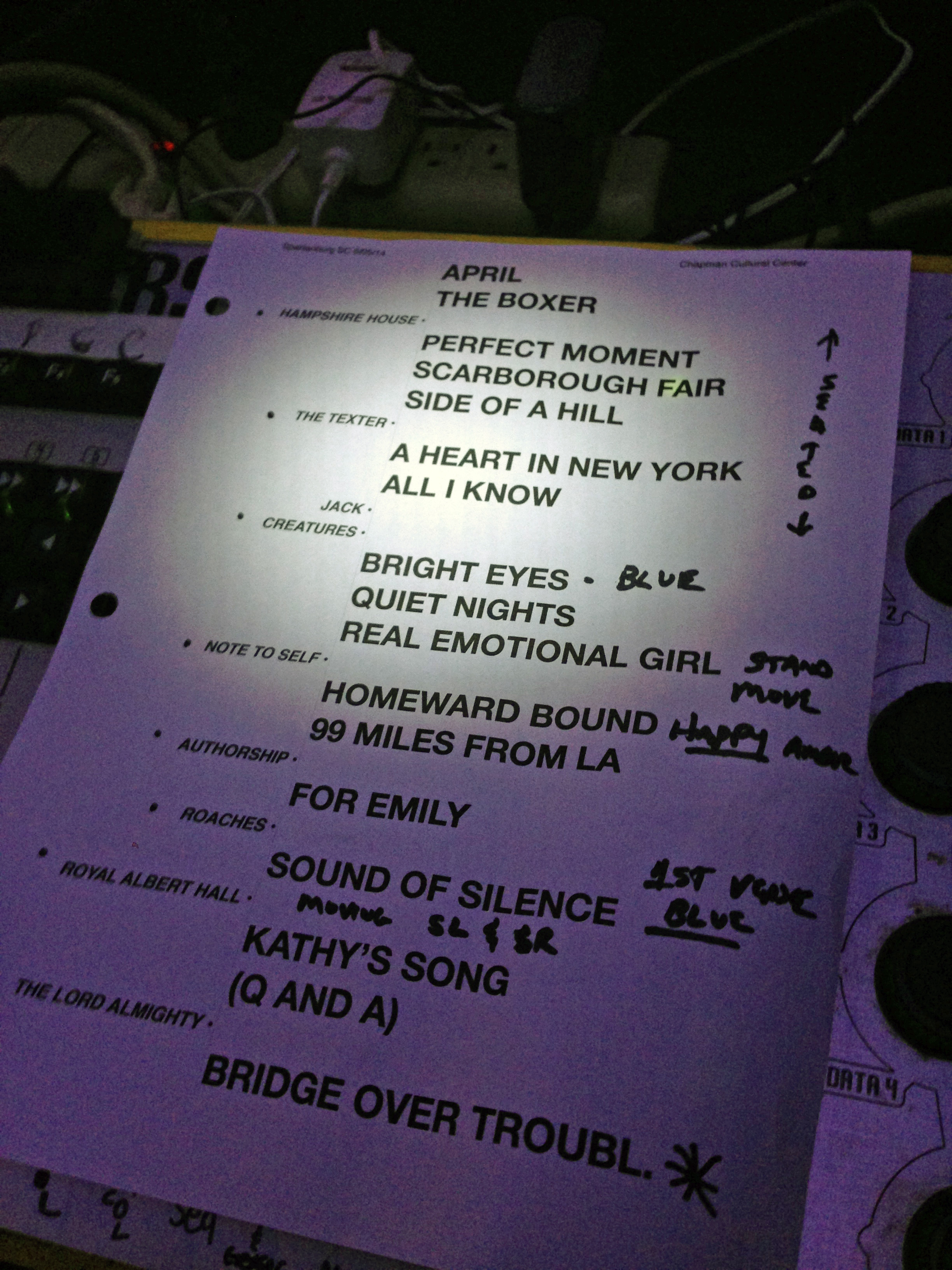
Last night I caught the Charleston incarnation of the tour at the Circular Congregational Church. Billed as an intimate evening with Art Garfunkel, the show featured Mr. Garfunkel reading prose poems, singing songs accompanied by guitarist Tab Laven, reminiscing, and answering questions from audience members. And intimate it was. As I made my way to my second row pew, I snapped this photo of the set list which was lying on the sound board at the back of the sanctuary.
set list 7 June 2014
In the first prose poem, which he read from the back of an envelope, Garfunkel acknowledged his vocal problems and intimated anxiety about the quality of his performance. Three years ago Mr. Garfunkel had to cancel a series of concert dates with Paul Simon and has recently undergone surgery to remedy vocal chord paresis. This clever stratagem of acknowledging his medical problem established the concert as a work-in-progress, what he later called a “workshop performance.”
Even without the paresis, given that he’s 73, you would expect some diminishment of Mr. Garfunkel’s vocal range (dig Billie Holliday at 44 in her last recordings). However, I can attest that Garfunkel’s voice is not “shot.” True, it might be described as a bit “reedy,” and it lacks the angelic resonance it possessed when he sang with Simon; however, he did hit the high notes and to see him physically struggle to do so and to hear him succeed were uplifting (pun unintended). The songs were beautiful.
(If the second reviewer above thinks Garfunkel’s voice is shot, he dare not go to a Dylan concert).
Perhaps heroic is too strong a word, but the performance was brave, and throughout he projected a demeanor of humility and good humor. For example, as he read from his prose poems, he’d mockingly pull out an invisible pencil and pretend he were editing some phrase. The show, especially the vocals, brought to mind Dylan Thomas’s admonition to “rage, rage against the dying of the light.” Interestingly, in one of his poems, Mr. Garfunkel echoed a phrase from Thomas’s “My Craft and Sullen Art” but misidentified it as a line from Yeats, which is appropriate in its own way, given Yeats’ struggle in old age with the “dying of the light.”
An aged man is but a paltry thing,
A tattered coat upon a stick, unless
Soul clap its hands and sing, and louder sing
For every tatter in its mortal dress . . .
Mr. Garfunkel’s vocal cards may be a bit tattered, but let me assure you, his soul is in fine fettle, and for me the performance was worth every penny.
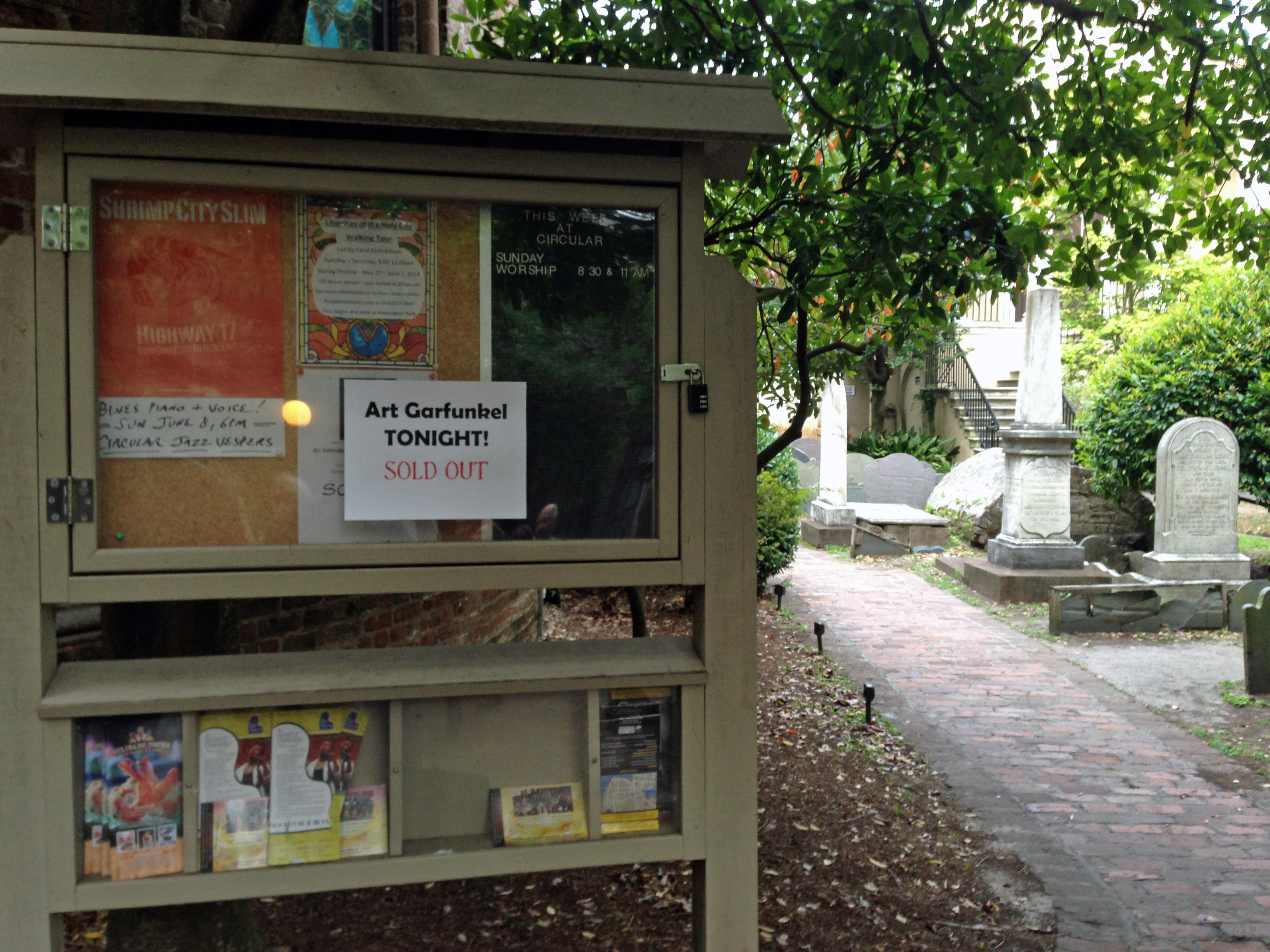
a church bulletin
I had not heard of a “trigger warning” until I read the New York Times article of 17 May 2014, but I must say the phenomenon doesn’t surprise me because twice in six years as an English Department chair, I have had parents complain about required reading, not because of graphic sex or violence, but because children might find the dénouements of A Hand Maid’s Tale (rising seniors) and Of Mice and Men (rising 8th graders) depressing. “Why,” the mother of the senior whined, “with so many uplifting books out there, do you have to choose such a depressing one?”
In my email I patiently explained that “unlike most movies, great literature provides students with a realistic portrait of the world and endows them with the vicarious experience that comes with experiencing the struggles, triumphs, and, yes, defeats of its characters.” Or, in other words, life is a bitch, a tale told by an idiot, full of sound and fury, signifying nothing. We all die, almost all of us unpleasantly, our last breaths rattling out as our bodies spew the contents of our bladders and colons in a Dantean horror blast of shit and piss, so experiencing these bummer experiences secondhand might provide us with a wee bit of inoculation.
By the way, the previous sentence should have, according to many college students across the country, been preceded by a trigger warning in case a reader had witnessed a loved one’s dying and suffer from reading the sentence post traumatic stress. A warning like this: “If you have ever witnessed the cessation of life, please don’t read the following sentence because it graphically describes said cessation.”
Students at several universities are demanding that professors attach trigger warnings to their syllabi to protect the hypersensitive from abstract re-exposure to rape, suicide, violence, foul language, misogyny, drug overdoses, traffic accidents, flat tires, unpleasant smelling locker rooms, Barry Manilow concerts . . .
The first five of the above catalogue suggest that we might have to bid adieu to Mr. Faulkner, not to mention Master Will himself. The Times article actually begins with a Rutgers’ student’s complaint that The Great Gatsby needs a warning because “a variety of scenes that reference gory, abusive and misogynistic violence.”
Plus, Tom cries like a baby when he sees a box of dog biscuits.
Although I don’t think my cantankerousness is robust enough to earn me the title of curmudgeon, I do, like everybody else, have my pet peeves. With any luck, however, as old age increasingly enfeebles me and the Charleston area accumulates more visitors and residents so that I am exposed to more and more Late Empire Americans, I may end up producing enough bile to earn the designation of curmudgeon and join the ranks of my beloved WC Fields, HL Mencken, and Winston Churchill.
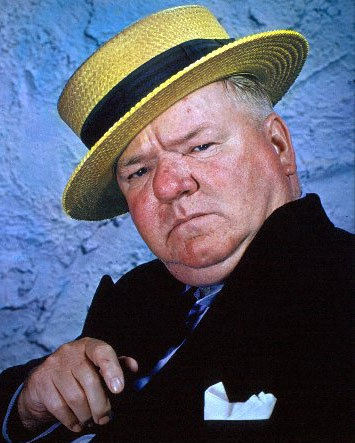
WC Fields
To be a curmudgeon, I think you once had to be an idealist, an idealist who got taken, taken by a lover, a con artist, a pastor, or merely to summer camp against your will.
Also, Curmudgeons tend to be physically unattractive (see above list) since very attractive people have a much easier path in life. They get out of more speeding tickets, have more audience members pulling for them in game shows, enjoy more frequent admiring looks from strangers, etc. Of course, if you happen to be good-looking and long to be a curmudgeon, don’t despair. Old age will undoubtedly ameliorate that problem as these two before and after photos of Ginger Rogers demonstrate.
In my case , I can’t blame falling short of curmudgeonry on rugged good looks or athletic prowess. No, I blame my wife Judy Birdsong for holding me down, providing me with love and care (not to mention family money) so that I’ve lived a prosperous, fulfilling life doing more or less as I please. It’s really hard to hate the world while you’re gazing out over a gorgeous river view
Now, if she had run off with the produce man at Piggly Wiggly or suffered from a shopping disorder or developed a penchant for crystal meth, I no doubt by this time be bitter enough to make Andy Rooney look like Mr. Rodgers.
Yet, I do have the potential. Just this afternoon as I rode my bike to the abandoned Coast Guard Station at the end of the island (sounds like a Hardy Boys’ adventure site), rather than enjoying the scenery, I found myself grumbling over a number of irritants from which a competent Buddhist would detach himself.
In fact, when I got home I compiled a list of my9 most cherished irrational hatreds, and I thought I’d share them with you because, as they say, disgruntlement enjoys company. The list begins concretely but becomes more abstract as we hit home.
#9 – Golf cartson city streets, especially golf carts driven my attractive couples with black labs. I encountered 5 golf carts on my 6 mile ride, one of which I had to pass because it was going so slowly. I dunno, there’s something smug about puttering around on one of those goddamn things. I don’t mind the old crone who feeds the islands’ feral animals using one because she’s got to be at least 90 and probably is unable to operate an automobile, but the rest of you, get a blanking bicycle.
#8 Hummers – These monstrosities, the anti-golf carts, roar self-indulgence, scream fuck the planet, exude a menacing militarism that give drivers of Mini-Coopers like me the heebie-jeebies. Plus when they park next you, you need a periscope to back-up safely into traffic.
#7 Leaf blowers – gardening’s equivalent of the Hummer, these infernal replacers of the rake create a Dresden-scaled bombing assault on the ear drums of anyone a hundred yards away. Plus, they simply blow leaves into gutters or the woods without properly recycling them, robbing future generations of the pleasant aroma of burning leaves in autumn (and the occasional exciting newspaper story of someone’s house burning down).
#6 – Bottle rockets – These goddamn irritants ought to be illegal. Wait, on Folly they are illegal. Nevertheless, for hours on end on holidays, they’ll scream their way upward and pop their pops, sprinkle their colored fire, and terrify dogs, frogs, marsh birds, minks, otters, deer, and schizophrenics.
#5 –The sound and smell of dentists’ drills doing their work.
#4 – The idea that the greater the number of people praying for something, the more likely God will grant the prayers. For one thing, God is a monarch (that’s why he’s called Lord) not a little-d democrat. When little Bentley flips his three-wheeler and breaks his neck, I doubt if lighting up the switchboard of God’s consciousness is going to make a difference if Bentley recovers or not. It’s really not giving God too much credit, is it? I say pray, but pray for wisdom, guidance, “thy-will-be-done.”
#3 – Forcing people to use euphemisms. Hey, people, words that describe unpleasant phenomena take on negative connotations, and no matter how many euphemisms you come up with to replace those tainted words, their shelf-life of political correctness is going to be short. Already, I’m getting dirty looks whenever I describe my flip phone as “a special needs phone.”
#2 – Patriotic bumper stickers. This irritant seems to be less of a problem now that Obama is president. For whatever reason, I don’t see as many “Proud to Be an American” stickers brandished on the bumpers of pick-ups, but guess what, Daddy-O, if you had been born in Iran, you’d be proud to be an Iranian.
#1 – Numbered lists on the Internet like the 10 worst Movies no one should have to ever sit through again and my 9 most cherished irrational hatreds. That’s a meme that’s got to go. Use your imagination you hit-starved bloggers!
Well, dear readers, there you have it, my stab at curmudgeonry.
When I first started teaching at my current school, I was 32, and the mamas of the Upper School students looked matronly to me. Now 30 years later, the students’ mamas look like jail bait, and those very first students I taught look matronly.
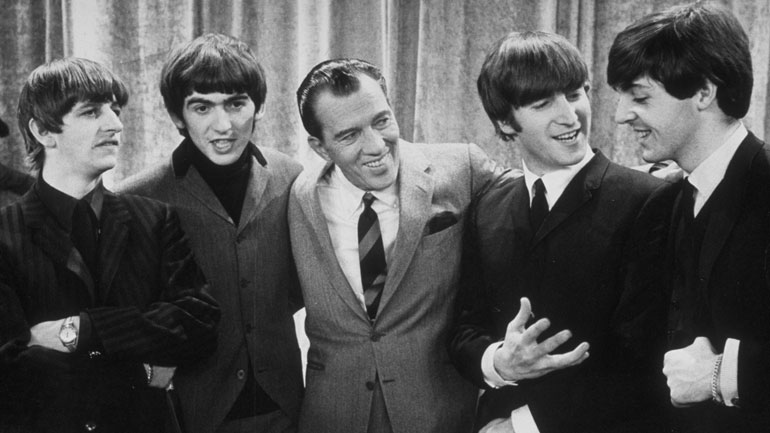
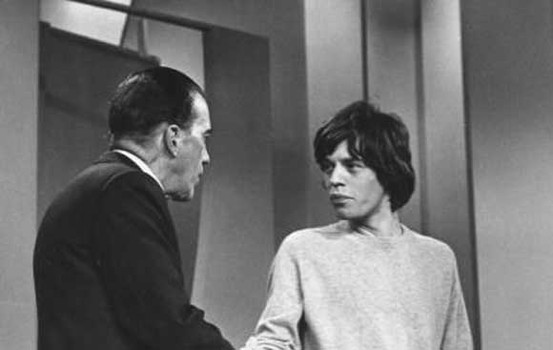
Yes, it was half-a-century ago that George, John, Paul and Ringo slinked onto the stage of the Ed Sullivan Show to launch the British Invasion, a significant cultural event, not so much because of the lasting impact of bands like The Dave Clark Five or the Mersey Beats or Herman’s Hermits, but because bands like the Stones and the Animals reintroduced American listeners to R & B and the blues by covering the likes of Slim Harpo, Jimmy Reed, and John Lee Hooker.
Also, 2014 marks the 50th anniversary of the Rolling Stones first LP. The half-century commemoration of these cultural milestones has spurred John Covach of the Huffington Post to wonder if, “Five decades later and after proving themselves one of the most popular and durable rock bands of all time, are the Stones once again taking a backseat to the Liverpool mop-tops?” [gag]
Comparing the Beatles and Stones is a time-honored tradition among my generation, and, of course, existentially, people fall into either camp according to their predilections. Some might prefer the catchy tunes and wider sonic range of the Beatles to the Stones’ grittier R & B-based sound and vice versa.
And, of course, who’s better depends on the criteria by which we judge. Well, I have spent this rainy Saturday afternoon following the great English critic Matthew Arnold’s dictum that the critic must embrace “disinterestedness [. . .] by keeping aloof from what is called ‘the practical view of life.'”
So I compiled a list of the Beatles’ 12 albums and the first 12 of the Stones in two columns for easy cross-referencing. I’ve included original hit songs from the albums and have omitted all covers. In fact, many of the Stones’ first hits were covers, so you could argue that this listing favors the Beatles because who over the age of ten would prefer “I Wanna Hold Your Hand” to “Time Is on My Side?” (Click here for my post 5 Best Covers of All Time”).
Scrolling down, we can see the difficulty in coming to any definitive judgment because some of the Beatles’ albums released in a year are better than Stone albums [e.g. Sgt Pepper’s versus Their Satanic Majesty’s Request (a slaughter)], but some Stones’ albums are better than Beatles” albums (e.g., Out of Our Heads versus Beatles for Sale).
Please Please Me(’63) The Rolling Stones(’64)
“I Saw Her Standing There” “Tell Me”
“Love Me Do”
With the Beatles(’63) 12 x 5 (’64)
“It Won’t Be Long” “Good Times, Bad Times”
“All My Loving”
A Hard Day’s Night(’64) Rolling Stones, Now! (’65)
“A Hard Day’s Night” “Heart of Stone”
“I Should Have Known Better” “Off the Hook”
“Tell Me Why”
“Can’t Buy Me Love”
Beatles for Sale (’64) Out of Our Heads (’65)
“I’ll Follow the Sun” “The Last Time” “Play with Fire”
“Eight Days a Week” “Satisfaction” “The Spider and the Fly”
Help! (’65) December’s Children(’65)
“Help!” “Get Off My Cloud”
“You’ve Got to Hide Your Love Away” “I’m Free”
“Ticket to Ride” “As Tears Go By”
Rubber Soul (’65) Aftermath (’66)
“Michelle” “Paint It Black” “Stupid Girl”
“Norwegian Wood” “Under My Thumb”
Revolver (’66) Between the Buttons(’66)
“Eleanor Rigby” “Let’s Spend the Night Together”
“Yellow Submarine” “Ruby Tuesday”
“Good Day Sunshine”
Sgt. Pepper’s (’67) Their Satanic Majesty’s Request (’67)
White Album (’68) Beggars’ Banquet (’68)
Yellow Submarine(’69) Let It Bleed(’69)
Abbey Road(’69) Sticky Fingers(’71)
Let It Be (’69 released ’70) Exile on Main Street(’72)
Once you hit the late ’60s and Early ’70’s it’s really almost impossible to judge between two masterpieces like the White Album and Let It Bleed.
So let’s just call it a tie.
That said, I think the early Stones stand the test of time better than the early Beatles, but neither in the mid-Sixties can hold a candle to Otis Redding, Wilson Pickett, or James Brown. As Mick Jagger himself said, “Why would you listen to us doing ‘King Bee’ when you can listen to Slim Harpo do “King Bee.”
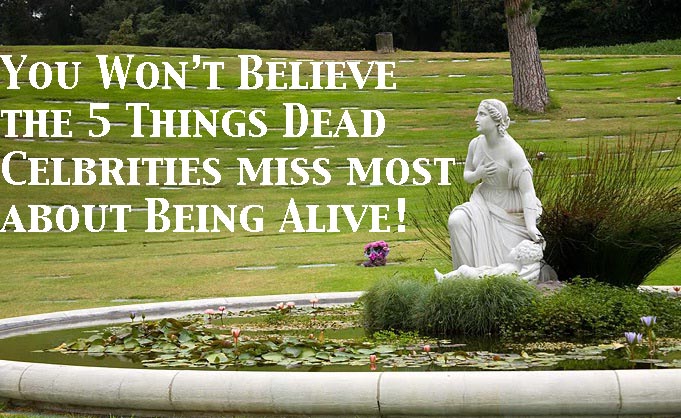
Madame Sosostris, famous clairvoyant and medium, has been for over forty years interviewing dead celebrities via séances and asking them what they most miss about being alive.
As I was squandering precious moments of the twilight of my existence marveling at how happy and well-fed my Facebook friends seem to be, I suffered this epiphany: the American English vernacular is steeped in violent expressions with positive connotations. That violence permeates our language shouldn’t be surprising given that mass shootings have become a monthly occurrence, as routine as severe thunder storms. However, the fact that violent diction projects positivity seems, at least on the surface, perverse.
I have long realized how much the foes of drug use, like youth ministers, rely on the argot of the drug scene, like when they cop some Grace or score a convert or pull CS Lewis from their lit stash, but for whatever reason, the predominance of violent expression, especially when extolling a performance, had never blasted its way into my consciousness, which is strange since I overuse the word killer all the time, as in Frederick Seidel is a killer poet who obliterates his readers with his brilliant use of language.
What sparked this illumination concerning the positive connotations of violent words was a post from a friend of mine, a sweet, gentle, funny, articulate soul who wrote:
Man, Mad Men and Hannibal both really crushed their season finales.
Crushed is a great sounding word, the sibilant volition of rushed lengthened and hardened by the hard initial C-sound. In a social media forum crushed sounds better than “really masterfully executed their season finales.” Though I suspect that if you had learned English from Rosetta Stone, you might take crushed in the above Mad Men/Hannibal context to mean that the shows mangled their finales, wrecked or ruined them, especially since episode is the direct object of crushed.
But, of course, crushed here means the opposite, that the episodes were triumphant cliff hangers, huge successes, like when you destroy your exam by acing it.
These ruminations on language reminded me of an essay by James Hillman where he mused on the harshness/violence of sexual English compared with the much gentler, more loving elocutions of the East.
Listen to the marvelous language of foreign erotica: jade stalk, palace gates, ambrosia! Compare these with cock, prick, dick, nuts, balls; with suck, jerk, blow, yank; and with gash, bush, frog, slit, clit, hole. A Chinese plum is to be deliciously enjoyed; our cherries are to be taken, popped, or broken. (The Blue Fire 179)
America, land of the free, land of the mass shooting, land of the perverse.
Warning! This post deals with depravity – violence, vulgar language, sadism – in a word evil. Please don’t read if you’re squeamish.
The most terrifying book I’ve ever read is the clunkily titled Final Truth: The Autobiography of Mass Murderer/Serial Killer Donald “Pee Wee” Gaskins as Told to Wilton Earle.
Unless you’re a sadist, please don’t go out and buy this book. Gaskins takes perverse pleasure in graphically describing torturing, dismembering, murdering, and disposing of the bodies of acquaintances (“serious murders”) and hitchhikers (“coastal killings”). It’s awful stuff, stomach-turning. I would have quit reading it myself except that I’m almost positive I was picked up hitchhiking by Pee Wee Gaskins in the summer of 1971.
Mugshot of Donald “Pee Wee” Gaskins
As the title promises, you get the story from Pee Wee’s mouth, and certainly some linguist somewhere is parsing Pee Wee’s diction and syntax for some study on the speech patterns of South Carolina crackers. In addition to butchering his victims, Pee Wee also slaughters English, yet he has a way with words and takes pleasure in creating colorful, vulgar metaphors and similes.
It’s as if Huck Finn’s pappy’s telling you the story of his life.
on his second wife: [. . .] every time I was around that girl my balls and pecker felt like a nest full of hornets was buzzing around and stinging and trying to shoot out.
on sex with a contortionist: she loved to fuck while twisted up into all kinds of other pretzel shapes.
on his first successful escape: I knew my chances of escaping was skinny as a coon-dick toothpick
You get the picture.
Perhaps the book’s only redeeming quality is that it might offer psychologists some insight into what drives a human being to murder time and again, person after person. Certainly despite Pee Wee’s semi-positive summation of his childhood — “My childhood weren’t all that bad all the time. I certainly weren’t in no way what you could ever call abused” — other descriptions belie that assessment:
Next thing I knew, they [Pee Wee and Marsh’s stepfathers] was dragging Marsh and me to the barn. They stripped Marsh first — roped his ankles together and threw rope over a joist and strung him-up upside down, then his mama commenced to paddling him with a pine slat. Soon his ass was bleeding, and then she told his step daddy to whup him with his belt [. . .] Then it was my turn to be strung up naked. I felt the pine board splitting my butt; then my step-daddy stropped me with his belt like I hadn’t never been stropped before.
And here’s Pee Wee’s explanation to the periodic mental condition that drove him to murder :
But no matter how things went, good or bad, I always felt something bothersome was astirring inside me. It was like I had this ball of plumber’s lead rolling around in my guts. Most time it lay quiet, just weighting me down. Other times, it growed bigger and hotter, like it was going to explode. Every once in a while I dreamed (I still do) that it blowed me apart and there was all these millions of little pieces and parts of me running around and flying around trying to find each other and put me back together.
* * *
I don’t remember how we — my brother David and I — ended up in the middle of the back seat on that beat-up old Buick. Did one of the boys get out and let us in? Did we crawl over the boy? We were seventeen and fourteen, and the boy maybe seven, but he had a cigarette in his mouth and a beer in his hand.
“Where y’all going?” The driver asked.
“Folly Beach,” I said.
“We’ll take you there then.”
He was a very short man chauffeuring a carload of Cub Scout-aged juvenile delinquents. There were four of them, all younger than David and I, all smoking, all drinking cans of Old Milwaukee.
For forty something minutes en route from Summerville, we had been stuck hitching on the side of St Andrews Boulevard across the street from a typewriter repair shop . It was David’s first time hitchhiking. Sure, the car looked sketchy, but we were desperate.
Once we were settled in the back seat, the seven-year-old next to me got out the empty casing of a Bic pen, loaded it with a spitball, and shot the driver in the back of the neck. He whirled around and stubbed the glowing orange tip of his cigarette into the boy’s arm, which immediately brought forth a yowl, tears, and a cacophony of spiteful laughter from the rest of the crew.
It was weird enough to witness a seven-year-old with a beer and cigarette in hand crying, but as I slouched down in my seat, I noticed that the driver had three spitballs lodged in the creases of the back of his neck.
The boys asked the driver to tell them about the [racial epithet] he had killed last week, but he wasn’t forthcoming. Then they asked him how many men he had killed in total. I assumed they were merely trying to frighten us. Throughout the twenty-minute trip, the boys liberally jettisoned trash, including empty beer cans from the moving car. I was hoping — how I was hoping — that a police car might pull us over but no such luck. Needless to say, their language was filthy.
But true to his word, the driver took us all the way to Folly. In those days, before the Holiday Inn obstructed the view, you could see the ocean itself as you crossed the bridges, and what a welcome sight it was. I told the driver to please let us out in front of the police station, that my daddy was chief of police, and he did, and then two of the boys tossed empty beer cans at us, and the car pulled away in a cloud of smoke.
Happily, we ran into some friends from Summerville at the Washout so didn’t have to hitch home; however, I can’t say that I learned my lesson and continued to hitch until I purchased my first car at age 25, thanks to Ralph Birdsong, my soon-to-be father in law. [You can read about a subsequent and in many ways scarier hitchhike encounter here].
So, I more or less thought about the incident as time spent in a Flannery O’Connor story until Judy purchased for me as a whim Pee Wee’s autobiography from the dollar bin at a Mount Pleasant book store and I read that Pee Wee used to take his nephews and their friends down to the beach occasionally but would “never do no murders on them trips” because you couldn’t trust kids not to blab.
I can’t say for absolutely sure it was Pee Wee, but I do know this: there was evil in that car. You could sense it; it was palpable.