The Tale of Two First Grades

Being shy and having been sequestered for three months by rheumatic fever, for me at first public school proved challenging. We lived on Laurel Street back then, across from the playground, and during my convalescence, I was confined to a wheelchair. If being in a wheelchair wasn’t bad enough, I also suffered the affliction of being red-headed, so in a town of only three-thousand or so residents, even children I didn’t know would approach me, once I was ambulatory again, and say, “Hey, aren’t you the crippled kid who was in the wheelchair?”

After my recovery, I attended Miss Marion’s kindergarten, whose students were all middle-class and, of course, white. I don’t remember anyone ever even misbehaving, though once when we were told to stay off the swings because of a previous rain storm, Bert Pearce fell backwards out of one and landed butt-first in a puddle of water. He had to spend an hour or so in the bathroom in his underwear while Miss Marion dried his pants, a fate to me that made confinement to a wheelchair seem like a ride in Flash Gordon’s rocket ship in comparison.[1]

In fact, the only negative experience I remember from kindergarten is pouring Coca-Cola in my Davy Crockett thermos, only to discover at lunch time that carbonation – or something having to do with the Coke – had broken the glass inlay of the thermos.[2]  

This is the one I owned.

I entered Summerville Elementary in the fall of 1960, and my mother accompanied me to class on the first day where we met Mrs. Wiggins and the rest of my classmates, who were more economically diverse than my kindergarten peers.[3] I remember one boy whose single mother didn’t have a car and walked with him to school and back the first couple of days. They lived literally on the other side of the tracks, so it was quite a trek. My mother, a kind soul, somehow got wind ­­– perhaps we passed them on the way to school – and started offering them transportation until the school bus situation was straightened out. I recall that his smallpox vaccination had gone spectacularly wrong – he suffered an enlarged stomach-turning eruption on his arm. I also remember they had a handmade sign in their dirt yard advertising fish bait worms for sale. 

I may have the world’s worst sense of direction.[4] On the second day of school, I got lost among the swirling hordes of screechers and stood in line on the steps of the wrong entrance. Once I entered the hallway and couldn’t find my class, I was terrified, as if l’d entered a Twilight Zone episode. I don’t exactly remember how it got straightened out, but it did, but afterwards I emerged with a palpable dislike for school. I much preferred my shared bedroom at home to the light green concrete walls of Miss Wiggins’ classroom with our bubble-headed self-portraits displayed on bulletin boards. The boy who rode to school with us had scribbled slashes of purple crayon for his self-portrait, but it was displayed with all the rest with his name printed under it.

As it happened, in December, our family, which then only consisted of my younger brother David, my parents, and me, moved to Aurora, Colorado, where my father attended some sort of training program associated with his civil service job. We moved into a tiny three-room apartment in an establishment called The Big Bear Motel, located on Colfax, a busy four-lane highway. Although the school was only four or so blocks away, I would have had to cross on foot those lanes of heavy traffic headed to Lowry Air Force base, so Mama drove me to school in the mornings and picked me up in the afternoons.

My brother David (on the right) and I at the Big Bear Motel
The Big Bear, now known as the Aurora Motel

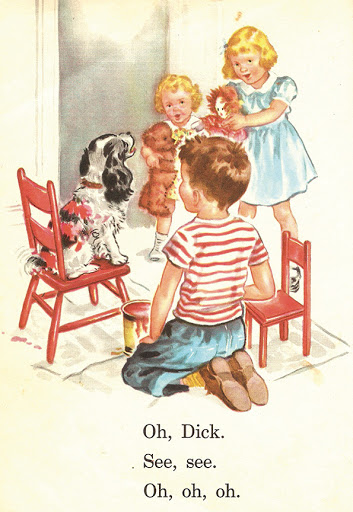
Unlike Summerville Elementary, Aurora’s primary school, Crawford Elementary, employed two first grade teachers per class.  I remember on my first day being introduced to the students and placed into one of the reading groups that sat in a circle and read out loud while the other teacher drilled the rest of the students in some other activity. They had divided the class into three reading groups based on skills and named them after birds – the Eagles, the Blue Birds, and the Crows.[5]  Perhaps because of my scruffy appearance (the only pair of shoes I owned were cowboy boots), my Southern accent, and that South Carolina ranked somewhere like 48th state-wise in education, they assigned me to the Crows. However, once it was my turn to read and I could fluidly decode the “oh-oh-ohs” and “look-look-looks” of the text, they immediately promoted me to the Eagles.

I loved living in Colorado in the winter with its mountains and snow. Unlike in Summerville, we ventured on family outings most weekends, visiting Buffalo Bill’s grave on top of Lookout Mountain and the mining town of Central City where we saw Face on the Barroom Floor, a painting rendered on the floor of the Teller House Bar. As the story goes, the artist, Hendron Davis, had been fired by the Central City Opera Association in 1936. He wanted to leave his mark on the town and asked permission of the bar owner to paint the portrait portrayed in the poem. They refused, but aided by an employee, he sneaked in after midnight and painted a woman’s face on the wooden floor of the saloon.

Another drink, and with chalk in hand, the vagabond began,

To sketch a face that well might buy the soul of any man.

Then, as he placed another lock upon that shapely head,

With a fearful shriek, he leaped and fell across the picture — dead!

The Face on the Barroom Floor

But I digress. School for me in Aurora was great, both socially and academically. I gained a great deal of confidence and was eager to return to Summerville, now considering myself, if not a man of the world, a first-grader of the world.

Only a couple of weeks remained in the school year when we made it back to Summerville, and Mrs. Muckenfuss, the principal, explained to my mother it didn’t make much sense for me to return to class, but my mother insisted, and I did, very full of myself until I realized that I was the only one who couldn’t do long addition. I had no idea what carrying numbers to the next column was all about. Summerville Elementary was more advanced than Aurora Elementary! 

No doubt the excellence of Summerville’s public schools has played an important role in its exponential growth. Now according to Wikipedia, Summerville is the seventh largest city of South Carolin (though, after reading a couple of articles on my hometown and one article on one of its famous citizens, I wouldn’t bet my mortgage on it). At any rate, I’m thankful for the education I got at Summerville Elementary, for teachers like Mrs. Wiggins, Mrs. Jordon, Mrs. Montz, Miss McCue, and Mrs. Altman. 


[1] By the way, the spacecraft spewed fiery combustion in the void of outer space. 

[2] The Moore and Blanton families’ addiction to Coca-Cola is legendary. In her adulthood, my Aunt Virginia lugged a 2-liter bottle with her everywhere. 

[3] Back then, there were no public kindergartens, so we who had attended private kindergartens enjoyed a great academic advantage because we already knew our ABCs and could perform single digit arithmetic.

[4] After my niece’s Hanahan High graduation ceremony held at the North Charleston Coliseum, it literally took me over an hour to find my car, and I was able to do only because the parking lot was virtually empty when I ran across it.

[5] Actually, I don’t remember what birds designated what level of accomplishment. 

Stuck Inside of Peoria’s Suburbs with the Arden Forest Blues Again


Dear Abby, 
 
My girlfriend disses me 
when I put “thee” 
in my confessional poetry. 
 
“So Seventeenth Century,” 
she says, “the antithesis of hip, old-fashioned, out of time.”
 
which triggers 
            Bill Wyman’s bass line
                        in the juke box of my mind.
 
You’re out of touch my baby,
My poor old-fashioned baby,
I said baby, baby, baby, you’re out of time.
 
“No way you can publish this rubbish,”
she says, “too loosey goosey, sugar britches.
 
“Try not rhyming every other word. 
The syllables should interlock
like a choo-choo train,
and go chug-chug-chug-chugging,
in a straight line,
 
not go staggering 
               all over the page, 
like a sentimental drunk 
                smashed on Toostie Roll wine.”
 
Otherwise, she’s sweet as pie, my girlfriend,
and treats me nice. 
 
Any advice?
 
 
Signed,
 
Stuck Inside of Peoria’s Suburbs with the Arden Forest Blues Again
 
Dear Stuck,
 
A wise man once wrote:
 
A poem should be palpable and mute   
As a globed fruit,

Dumb
As old medallions to the thumb,

Silent as the sleeve-worn stone
Of casement ledges where the moss has grown—

A poem should be wordless   
As the flight of birds.
 
So, yeah, your GF has a point.


The Killing Off of Innocence: Dropping Acid in the Wilds of Summerville

From James Fenimore Cooper through Toni Morrison, American Literature features themes that appear again and again in different guises. 

One theme is interracial bosom friendship, which is much more common in American literature than in American life.  Before the Revolution, Natty Bumppo and Chingachgook roam the wilderness of the eastern seaboard battling bloodthirsty tribes and rescuing damsels. Later, Ishmael and Queequeg circumnavigate the seven seas in pursuit of the great white whale while Huck and Jim drift down the Mississippi encountering scalawags at every bend of the river. And let’s not forget about the Lone Ranger and Tonto thundering forever westward on the backs of Silver and Scout. 

Adventure!

Tall tales constitute another motif in the American canon in exaggerated heroes like Paul Bunyan and Pecos Bill. Occasionally, more serious works incorporate characteristics of tall tales, as in Faulkner’s magnificent story “The Bear” where Sam Fathers, an ancient native American, teaches young white Ike McCaslin the ways of the woods.  Each year, the generations of Jefferson’s menfolk have hunted for Old Ben, a seemingly immortal bear of mythic proportions.  Old Ben remains unvanquished until the hunters encounter and half tame a wild airedale mix that might well give Cerberus, the Hound of Hades, a dog-whipping. Alas, Ben’s killing, so long sought after, depresses his pursuers, marks the end of an era, because Ben himself had become synonymous with the wilderness.  The old days are done. Farewell, country store; hail Walmart.

Indeed, the wilderness itself represents the most constant motif in American literature, and even as early as The Leatherstocking Tales, it is beginning to vanish, “the doomed wilderness whose edges were being constantly and punily gnawed at by men with axes and plows who feared it because it was wilderness.”[1]


As children growing up in Summerville, South Carolina, we Twin Oaks kids enjoyed acres and acres of woods where we built forts, played cowboys and Indians, and acquired chiggers. Of course, those woods were also doomed, their trees eventually felled, replaced by ranch-styled three-bedroom houses with lawns of centipede and Bermuda. 

Along with Salisbury Acres and the Tea Farm, Twin Oaks was one of the earliest settlements subdivisions, and as other housing developments sprung up, more and more of the woods within and surrounding Summerville disappeared. By the time I was in high school, much of it was gone, except for a large tract of undeveloped land behind Newington Plantation, an old phosphorous or sand-mining site we called “the Clay Pits.”  

The “Clay Pits” with its ponds and crisscrossing dirt roads provided a refuge for crazy mixed-up kids seeking a secluded spot for, as we called it back then, “making out”[2] or adventures as we rode motorcycles back and forth on the rutted dirt roads and camped out among the loblolly pines. Although we didn’t realize it, our carefree days were receding as rapidly as the woods in and around Summerville.

In fact, it was on one of these campouts in the Clay Pits that I first dropped LSD. It was the night of my 18th birthday, and let me assure you, a good time was not had by all. That December night marked the end of my childhood. It was not an adventure that Tom Sawyer might enjoy, but a misadventure, a depressing sequence of hapless events more suited for a documentary on social decline than a celebration of youthful exuberance. 

To protect the guilty, I’ll change the names in “Dear Abby” fashion. There were “Farley,” “Micky,” “Marty,” and “Ian.” Farley had acquired four hits of the same variety of acid and one hit of something called “Czechoslovakian Cherry,” which I unfortunately ingested. 

After an hour or so, everyone but me had gotten off and was oohing and aahing at phantasms invisible while I shivered forlornly in the cold. Farley suggested we take a drive within the Clay Pit confines, which would at least provide some warmth, and it was during that drive that I first started feeling the effects. While the Hollies’ hit “He Ain’t Heavy, He’s My Brother” – a song I didn’t particularly like – was playing on the radio, an electrical rush of sensation shivered up my spine.

Back at the campsite, suddenly I found myself in the throes of harrowing hallucinations and felt overwhelmed, only to discover that my girlfriend and her best friend had sneaked out of their houses and ridden their bikes to the campsite. Under normal circumstances, I’d be delighted, but my girlfriend’s appearance filled me with dread that her mother would discover her disappearance and track us down somehow. At one point as we lay on my sleeping bag, it felt as if a gigantic boulder was crushing me. 

Eventually, the boulder lifted, my girlfriend and her friend pedaled off, and my paranoia abated. At one point Ian said to me, “Look, Micky looks just like Moses,” and sure enough, there Micky stood with a long white beard and wearing a long white robe.

The last phase of an LSD trip, a physiological event that for me negates whatever fun you might have had, is crashing, coming down off the drug. They said back then that LSD contained strychnine, which was responsible for the bodily trauma that crashing produced, but as it turns out, that’s an urban myth. Whatever the cause, when the sun came up on the first day of my nineteenth year, I was one miserable, guilt ridden human being, racked by remorse and bodily aches and pains.

Farley drove me home. When I arrived at the house, everyone but my father had gone to church. He was lying in bed smoking cigarettes as I slipped into my room, then headed to our one bathroom equipped with a tub. Lying there guilt-ridden in lukewarm water accompanied by a bit of floating pine straw, feeling as woebegone as I had ever felt, I heard my father’s voice booming from his bedroom.

“Rusty, what did you do with my wingtips?”

This really pissed me off.  Rusty wore desert boots, not wingtips, in fact wouldn’t be caught dead in a pair of wingtips and didn’t wear the same size shoe as his father.

“Rusty, what did you do with my wingtips?”

Oh, to be able to hop on that raft with Huck and Jim or to sign onto a whaling voyage (albeit a doomed one) with Ishmael and Queequeg or to track a mythic bear through the wilds of Yoknapatawpha County with Ike and Sam!

Oh, to be anywhere else besides 201 Lenwood Drive with Wesley and Wesley.


[1] William Faulkner, “The Bear.”

[2] Some called the activity “parking,” but none of us, to my recollection, ever called it “petting” or “canoodling,” the last being a word I never heard until adulthood. One night, my former school bus passenger-turned-police-officer Pike Limehouse shooed my girlfriend and me from the Clay Pits, an embarrassing encounter if there ever was one. By the way, have you ever noticed that in ‘50s horror films, teens making out tend to be the monsters’ first victims, a tribute to the puritanism that is also a major American literary motif. 

In Hawthorne, unlike Thoreau, the Wilderness is manifest darkness, the abode of witches and Old Scratch himself, the New England equivalent of the Clay Pits.

Ah-One, Ah-Two

Ah-One, Ah-Two

How can we know the dancer from the dance?

WB Yeats, “Among School Children”

What is it, this incessant need,
to dribble ink upon a page
in musty old forms best abandoned,
better suited to an earlier age?

Yet – [sigh] – here I am once again,
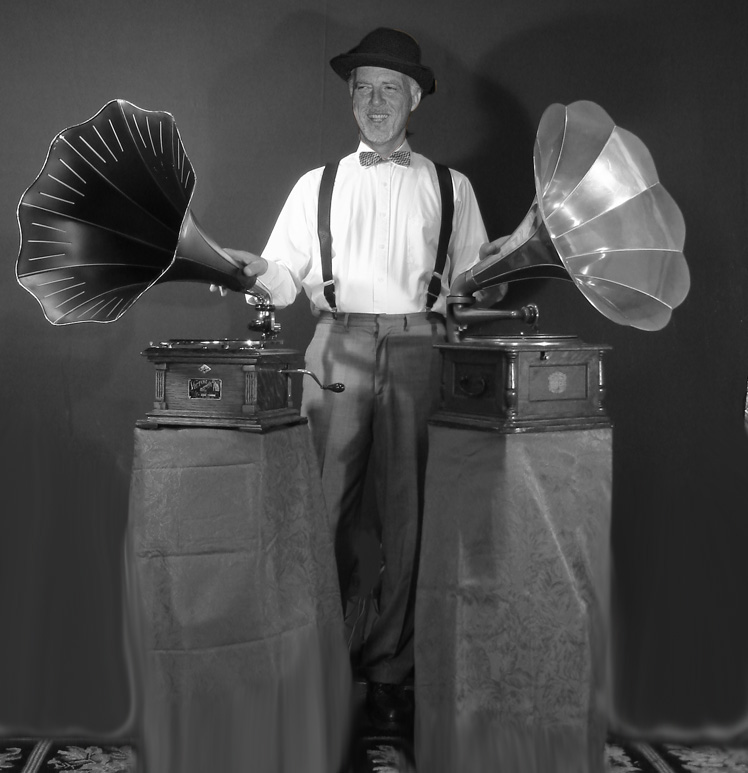
cranking up the old gramophone,
herding trochees two by two,
like a cotillion chaperone

attempting to teach the Cha Cha Cha
to kids who think they know it all,
who vamp in front of mirrors at home
pretending brooms are microphones.

A Malcontented Blogger Turns His Back on Aggression: Roman Empire/Super Bowl Edition

If ever an event exists that epitomizes Late Empire decadence, it’s the Super Bowl, the trashy teenage illegitimate daughter of Walt Disney and Joan Rivers.

First, there’s the obscenity of the salaries of these gladiators who essentially entertain us through ritualistic war, a string of overhyped “battles,” each becoming less memorable as the Roman numerals march on into Super Bowl oblivion.  Admittedly, it can be fun to watch these impressive specimens of predatory machismo smash into one another, sidestep tackles, propel perfect spirals, and make acrobatic diving fingertip grabs (though their inability to master the snap count can become tedious).[1] Nevertheless, you can’t help but wonder if the over-compensation for these essentially physical skills is indicative of some sort of skewed cultural atavism that harkens back to Spartacus.  Why, for example, does the secondary coach of the Baltimore Ravens, whoever he is, earn considerably more per annum than Pulitzer winning novelist Richard Ford?  Not to mention Deion Sanders[2] whose career earnings undoubtedly dwarf Cormac McCarthy’s, Toni Morrison’s, and Philip Roth’s combined?

Can you guess which house belongs to Deion Sanders and which to Robert Frost?

Second, there’s the Roman circus of the halftime show, which began innocently enough in the late Sixties with marching bands, but now features antediluvian rockers like Steve Tyler and the Who or commercial hiphoppers like the Black-Eyed Peas.  These performances nearly always end up flat (Prince and Springsteen being exceptions) and occasionally can be painful to watch (Grandpa Jagger frenetically cavorting back and forth across the stage as if it were strewn with red hot coals).[3]  I’m far too lazy to research the cost of these extravaganzas, but I suspect we could coax the Dalai Lama to meditate on the artificial turf at halftime for free, which would be more entertaining than 90% of the halftime shows I’ve suffered through.

Brittany Spears passing gas at the 2008 spectacle

What, may you ask, binds together all of these facets of this undeclared national holiday – the verbal jostling of the interminable lead-ins (Terry Bradshaw bickering with Howie Long) – the game itself, the outsized attempt at halftime entertainment, the pratfalls of the commercials?

Aggression, that’s what.  Aggression is what separates the winners from the losers, those who pay sticker price from those who browbeat the salesperson into surrender, those who claw their way to the top from those who rely on honor and integrity to guide their lives, those who bury their helmets into the runner’s chest from those who wanly attempt an arm tackle.

Aggression is what fuels capitalism, and sports is a wonderful training ground for aggression, from the bestial grunting of tennis players returning volleys to the narcissistic celebratory endzone fandangoes of wide receivers.  These gladiators are worshipped in their high schools and wooed by head coaches who during recruiting banter with mothers they would never actually associate with otherwise. No wonder most professional football players possess Caligula-sized egos. These mannish boys have clawed their way to fame and fortune (the latter thanks in part to their labor unions).  

Who can blame them for copping the Conan the Barbarian look?

Mike Roemer Photography Inc

[1] When I played junior varsity football for the mighty Summerville Green Wave, we were so collectively stupid that we could only go on “hut one.”

[2] I had the misfortune to share an elevator with Deion once, who exuded all of the warmth of a Secret Service agent as he avoided eye contact with the children asking for his autograph.

[3] To be fair, I saw the Stones in 2019, and they were terrific. The Supper Bowl performance was an aberration.

From the Journal of Percival Reginal Ignatius Morehouse

[Editor’s note: Dr. Morehouse is the esteemed editor of Latinate Locutions for the Habitually Silent.]

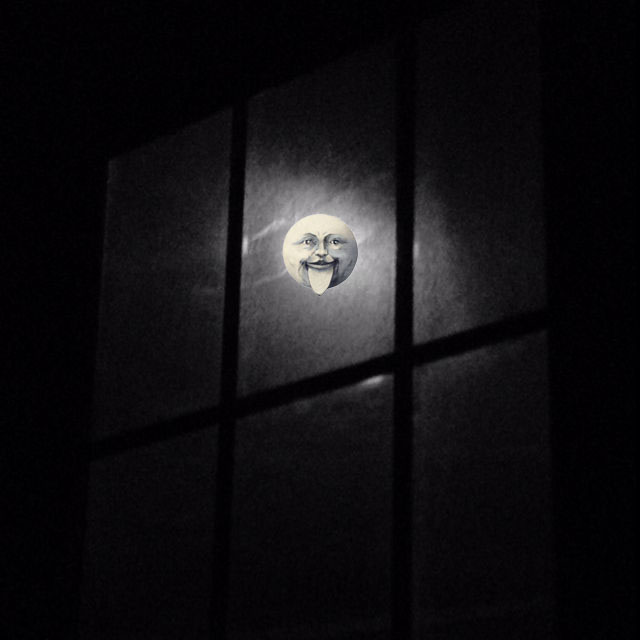
Perhaps what occurred last Friday is the result of the moon’s and the sun’s elliptical longitudes differing by 180 degrees, for in the wee hours, having been prompted from my recumbent position in the arms of Morpheus by a corporal need for vesical relief, I noticed from the bathroom window that the lunar hemisphere facing me was completely sunlit, appearing as a circular disc illuminating the night sky.

You know, it’s possible that these geriatric spouses’ curtailed narratives possess smidgens of veracity. No, I didn’t bay at the full moon, nor did thick fur suddenly pullulate from my epidermis in a lupine metamorphosis; however, the synapses of my cerebral cortex did misfire – if that’s the word –  into a subversive ideation, a completely impractical plan of action, as if the Imp of the Perverse had commandeered my common sense. 

Or as Ovid might say, Habeo cilium barbam supra Fundamentum meum.

A few hours after Dawn had painted the eastern sky with her rosy digits, I descended the stairs to find my consort standing before a pile of dishes  an accumulation of platters in that domestic space where meals are prepared.

“Beloved,” I said, “how would you like to engage in an impractical odyssey that would have us motor from the Holy City to her sister city Savannah for lunch and then turn around and drive home in time to retrieve Haselden from the halls of academe?”

A smile of enchantment beamed from that face capable of launching a thousand ships, a face so beautiful it might prompt Mrs. Menelaus herself to google “plastic surgeons.”

Consort vis-a-vis Rossetti’s Helen (aka Mrs. Menelaus )

Still smiling, she queried, “But do we have time?”

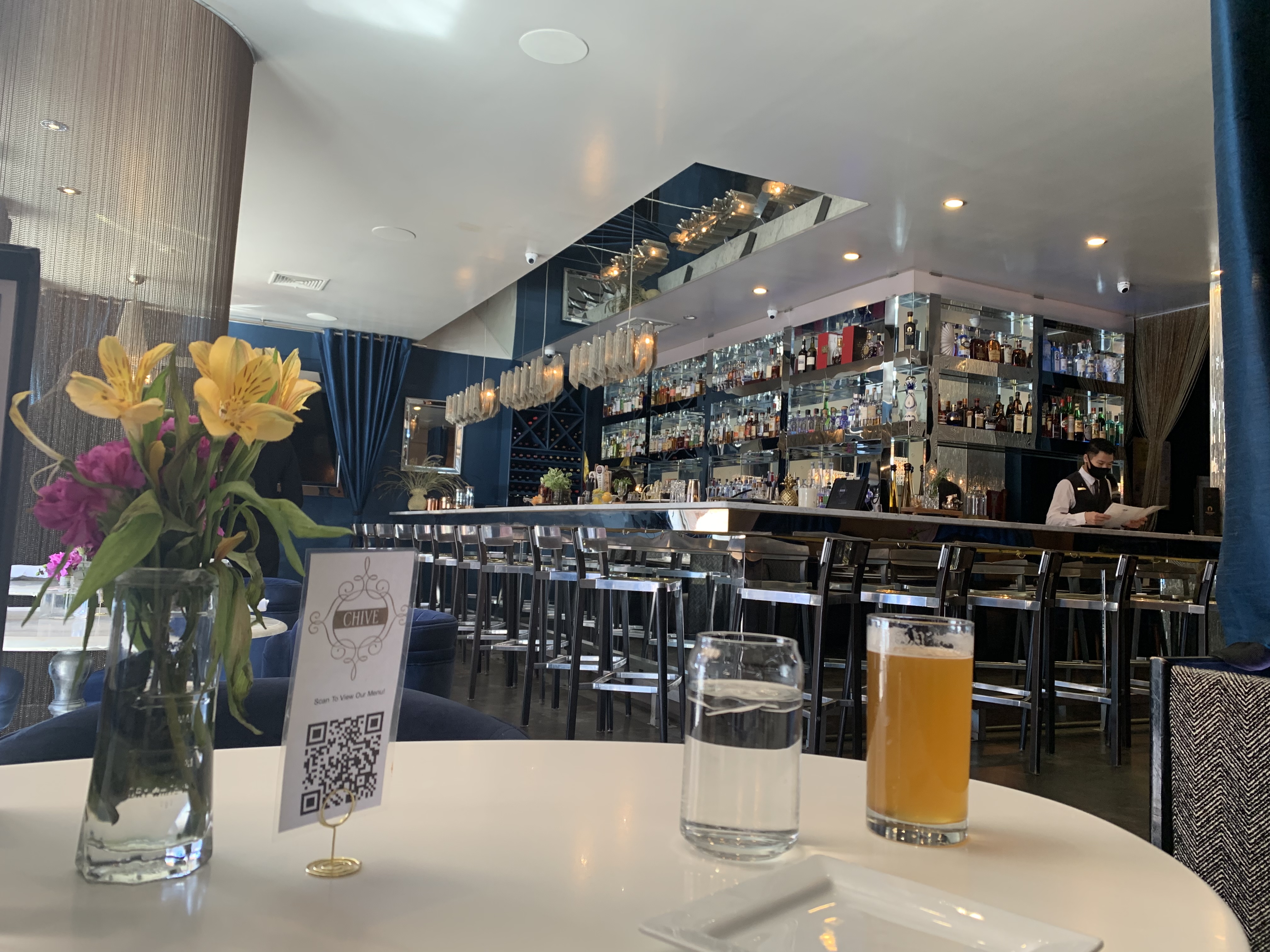
“Yes, my darling,” I replied. “I have officiated a marriage of science and serendipity. If we depart in thirty minutes, we can arrive at Chive Seabar & Lounge on Broughton Street at eleven when it opens, enjoy a repast of an hour-and-a-half, and then drive home and arrive at Haselden’s educational institution by 2:30 post meridian.”

Savannah, Georgia

By nine, we were in transit, headed south on Highway 17S, motoring past the three Rs: the Red Top Community, Rantowles, and Ravenel, the last hamlet infamous for its severe enforcement of municipal strictures governing vehicular speed. On we progressed through Jacksonboro, past the quaint Edisto Motel, and that notorious naval launch site that has been christened with the unfortunate appellation of “Cuckold’s Landing.” 

After what NASCAR aficionados term a “pitstop”* (where I encountered the abomination below), we merged onto I-95, and in a mere hour found ourselves traversing the Savannah River and into the city itself.

*No, I do not suffer from a lisp.


Exactly at 10:55, our cellular amanuensis Siri informed us that “the destination is on your left,” and much to our astonishment, a parking space devoid of vehicle presented itself for the taking.

Even though what happened next might mislead the reader to consider the narrative a fictional account, just as my consort and I reached the door of Chive Seabar & Lounge, a masked woman of Asian heritage somersaulted the sign from closed to open, unsheathed the deadbolt and ushered us in to a corner table. 

Otherwise, the restaurant was devoid of customers.

We ordered mussels in a yellow curry festooned with onions and pickled cucumbers, skewered scallops, and a mushroom salad, which in honor of Mr. Biden’s election, we shared socialistically. 

Each dish was a savory culinary concoction of toothsomeness. And though castigated in verse for his winged acceleration, Time’s airborne Pegasus-propelled transport did not seem in a haste-post-haste mode, so the luncheon progressed in a comfortable sequence of leisurely elapsing.

By 12:30 PM, after the remuneration of the computation of the meal’s reckoning had transpired, we had exited, were ensconced in our automobile, and retracing the trip in reverse order.

The only glitch in an otherwise splendid sojourn was that we arrived at Haselden’s educational institution forty-five minutes early, although, truth be told, that miscalculation afforded us a premiere position in the vehicular parade known as – pardon the vulgarity – “the pick-up line,” but then again, our prolonged  idleness also presented me with the opportunity to chide the English Department Chairman for refusing my suggestion of adding Tristram Shandy to the 6th grade reading list.

At any rate, it was a full day, and I am now more than ready to close the leaves of this journal and retreat once again into Morpheus’s narcotic embrace.

8:45 PM, 29 January 2021.

Woody Guthrie, Chimney Sweeps, and Taxation

I’m not requiring Woody and Pete to wear masks because they’re dead

When Jennifer Lopez hit the first note of Woody Guthrie’s “This Land Is Your Land” during the Inauguration,  I wondered if she would include those two stanzas my elementary school music teacher omitted when we sang it in the early 60s. It was during the folk revival, and for some odd reason Guthrie’s song had acquired a sort of Kumbaya campfire wholesomeness.[1]

J-Lo did leave out the stanzas, but then again “This Land” had been fused into a medley with “America the Beautiful,” and the negative omitted lyrics don’t mesh well with the latter song, essentially a paean celebrating America’s beauty and God’s bestowal of grace.

Here are the oft-omitted stanzas of Guthrie’s song.

In the fifth stanza, the wayfaring narrator –  presumably Guthrie himself – encounters

[. . .]  a high wall there that tried to stop me
A sign was painted said: Private Property,
But on the back side it didn’t say nothing —
God blessed America for me.
This land was made for you and me.[2]

In addition, this verse didn’t make the cut:

One bright sunny morning in the shadow of the steeple
By the Relief Office I saw my people —
As they stood hungry, I stood there wondering if
God blessed America for me.
This land was made for you and me.

The latter stanza brings to mind stanza from William Blake’s “London”:

How the Chimney-sweepers cry

Every blackning Church appalls, 

And the hapless Soldiers sigh

Runs in blood down Palace walls.[3]


(Allow me here a quick aside: note the difference between song lyrics and poetry, how the former lacks the evocative rhythm and the compression of the latter. So, no Bennington, you may not bring song lyrics instead of poem. With song lyrics all you’ll talk about meaning when I want you to demonstrate how rhythm, rhyme, imagery, symbolism, diction, etc. underscore the meaning).


Guthrie and Blake both, two centuries apart, complain about disparities of wealth and point out religion’s failure to redress wrongs.

And let’s face it.  Wealth in the US is not evenly distributed, and the disparity between rich and poor is widening.

For example, the wealthiest 1% possess ~ 40% of the nation’s wealth, the bottom 80% own ~ 7%.

I’m too lazy to perform computations to determine how much money Jeff Bezos rakes in a week compared to the total income I earned in 34 years of teaching nor the even deeper disparity between Jeff’s income and a minimum wage employee’s.

On the other hand, no one forced me to major in English or to drop out of graduate school. My meager gifts and temperament don’t calculate into untold riches. I don’t begrudge Bezos’s success. He is highly intelligent, hardworking, and ruthless when it comes to business – advantageous qualities for one seeking to amass billions. 

What gripes me (and should the rest of us 99%ers, even Confederate flag-waving militiamen) is that billionaires like Donald Trump can get away with paying $750 in income taxes in a given year. Don’t we have evidence enough that massive tax cuts for the super wealthy don’t result in a trickling down of their wealth but instead create massive budget deficits, deficits that Republicans don’t care about until the second they’re out of power?

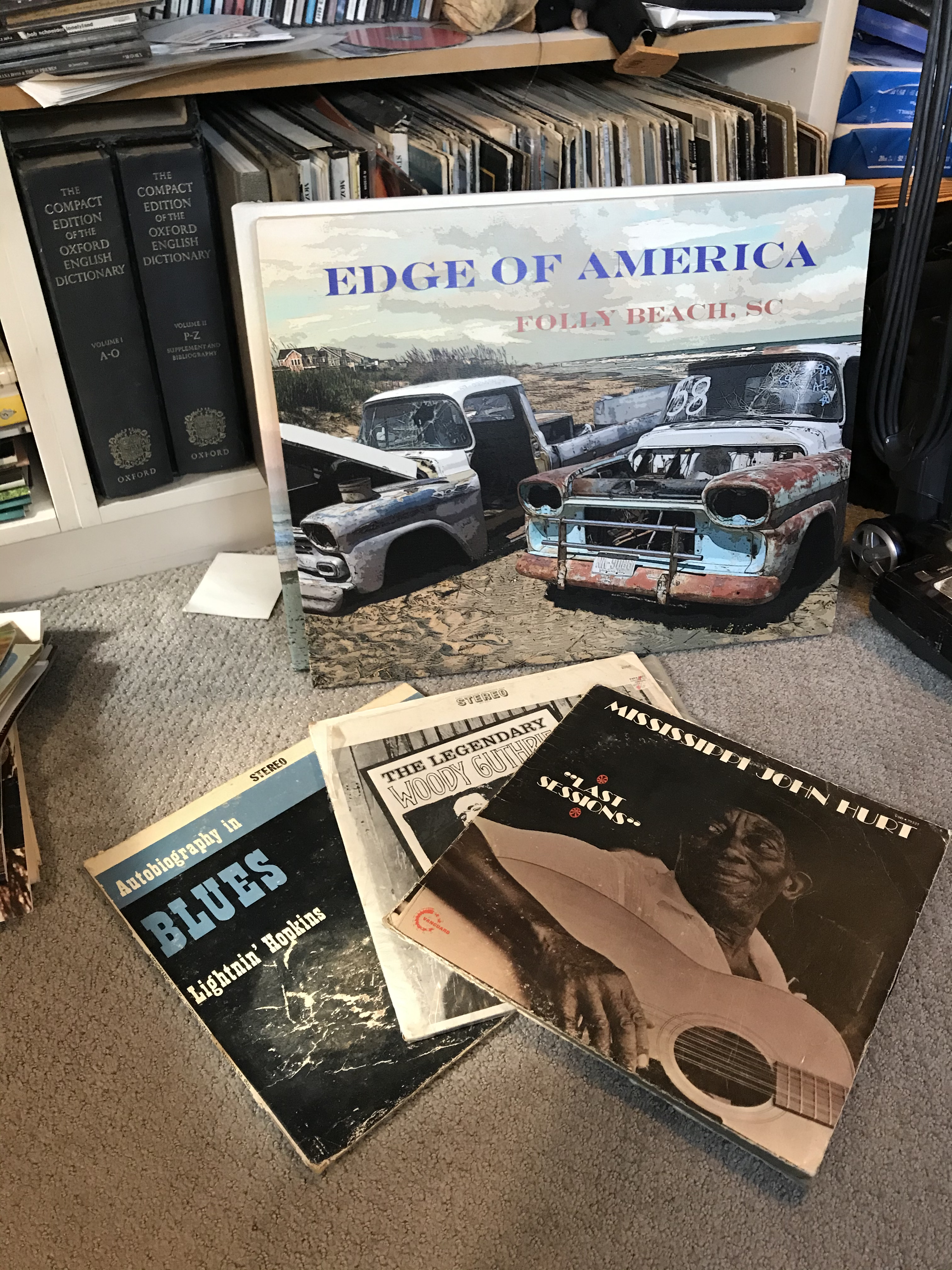
Well, it’s a new day and all that jazz. The times, they may be a changing. However, given the narrow margins of Democratic control of Congress and the on-going gerrymandering of districts by Republican dominated state legislatures, I wouldn’t bet even one of my vintage folk LPs on any significant changes transpiring.

Speaking of capitalism, that fake painting produced by the author is for sale

But then again, if Trump breaks away from the GOP and starts a third party that recruits crazies like Laura Boebert and Marjorie Taylor Greene to run for House and Senate seats against establishment Republicans and Democrats, that could result in a more European-like US economy.

It’ll be interesting to see what happens.

I’ll leave you with this Guthrie ditty:

This song was written in New York City
Of rich men, preachers and slaves
Yes, if Jesus was to preach like he preached in Galillee,
They would lay Jesus Christ in his grave.

Hear that, Franklin Graham?


[1] Driving my stepdaughter to school this morning with Springsteen’s “Born in the USA” playing, I mentioned that it was a highly misunderstood song because people mistook the oft repeated line “Born in the USA” as jingoistic crowing rather than an indictment of the narrator’s mistreatment as a war veteran even though he had, not only been born in the US, but also fought for the US. 

“It doesn’t sound very positive to me,” she said. 

[2] Native Americans have taken issue with the inclusion of Guthrie’s song in the ceremonies because it ignores that “this land [that] belongs to you and me” was stolen from them, though I would give Guthrie a break here in that the lyrics suggest that the land belongs to everyone equally and somewhat calls into the legitimacy of  private ownership itself. After all, he was com-MU-nist.

[3] I’ve presented Blake’s stanza as it was published, i.e., with random capitals and missing apostrophes. Give me an S, give me an I, give me a C. 

Poolroom except from “Today, Oh Boy”

Here’s a very short excerpt from my novel-in-progress, Today, Oh Boy.[1]

An accident in the chemistry lab the period before lunch at Summerville High School on a Monday in October of 1970 has required that the entire student body be released early. Ollie Wyborn, a brainy, super rational, and dutiful transplant from the north who has yet become acclimated to the ways of the South, is on an errand to fetch poolroom hotdogs for three girls who have offered to give him a ride home. Ollie has a crush on one of the girls, Jill Birdsong. For weeks he’s been trying to summon the courage to ask to the homecoming dance, though he’s never been on a date and doesn’t know how to dance.


Like his parents, Ollie is a Doubting Thomas. To him, fire and brimstone are natural phenomena, not the elements of an infernal furnace. Yet when Ollie steps into the smoky gloom of the pool hall, he finds himself thinking of illustrations he’s seen of Hell. It smells weird in here, sour and sweet, body odor mixed with fryer grease, stale beer, and cigarette smoke.  Some of these people look damaged. Now he understands why girls won’t come inside.

There’s a cacophony of too-loud raucous voices with those strange vowel-rich inflections –  Whatyousaybo, a greeting sounding more like Swahili than English. An older man with sergeant stripes on his uniform talks to and rocks a pinball machine plastered with curvaceous cartoon women. Lights blink on and off – ding ding ding ding ding.  The metal ball rolls up the incline but now down again.  Flippers flip.  Up the incline and down again. Beneath the ding, ding ding ding dinging, the din of clacking pool balls, laughter, blended conversations. Recorded music blares from a jukebox, a familiar song spelling out a girl’s name: G-L-O-R-I-A. Someone hollers “Rack!,” and a young black boy around ten or so, scurries past Ollie with a wooden triangle in is hand.

About fifteen red swivel stools line a bar/lunch counter, every stool occupied by a male. There’s that old, grizzled character with a white cane and seeing-eye German shepherd, the Old Blind Man Ollie’s seen a couple of times at football games. Next to him in paint-splattered overalls sits a middle-aged fellow with a cigarette dangling from his mouth moving up and down as he talks. Others, all strangers, push their way between the stools to get a server’s attention.

Ollie might as well be in Mozambique as far as knowing the etiquette involved with ordering. There doesn’t seem to be a pattern. Only two people taking and cooking orders for twenty.  They should have a line where customers receive numbers like in a deli instead of this dog-eat-dog, survival of the fittest. Ollie spots four guys wearing SHS shop overalls sitting adjacent to one another, so he decides to lean between two of them to place his order.

Who this is here sticking his head here?  Gotdamn round ol’ timey hippie glasses.

“Excuse me, excuse me.”

Ain’t his turn sumbitch. Gotdamn round ol’ timey hippie glasses.

Ollie tries to make eye contact with the older server.  Why the dimness?  Behind the bar a tin sign in fading red capital letters warns NO PROFANITY. There are carved coconut head monkey faces staring vacant-eyed from shelves next to a large jar of rubberized eggs suspended in a murky solution, also prints of dogs smoking cigarettes and playing poker.

“Well, X-cuse you,” a shop boy growls.

“Sorry, but it’s crowded in here.”

“Kiss my ass, Yankee.”

Circumspection.  Circum = around; spec = to look, as in spectacles.

Looking down the bar, Ollie sees a perhaps more convenient place to order, not as close to the door.

He thinks maybe he could dance to this song.  G-L-O-R- eye-eye-eye-eye A!

  J-I-Double L   B-I-R-D-S-O-N-G    

 Jukebox:     Knock on my door

                        Come in my room

                        Make me feel alright . . . 


[1] You can read other excerpts here and here.

A Truth of Blood

“Eurydice” by Alain Le Junter

A Truth of Blood

What harm? Men die — externally —
It is a truth — of Blood —
But we — are dying in Drama —
And Drama — is never dead —
Emily Dickinson

The dream done, my eyes open,
it hurt to be awake.

Outside my bedroom window
faint predawn light seeping
through the dark fabric of the sky.

My late wife had been alive just now,
in the dream her death merely a dream.

I had held her in my arms,
explaining to her that I had dreamed she’d died,
but she hadn’t, no, she was smiling,
warm, lying next to me in bed,

so lifelike, so palpable,
I thought as I lay there afterwards
that her spirit had come to me.

I closed my eyes and fell asleep again,
and, as if in a new episode of the ongoing series of my sleep,
she reappeared, sitting in a chair in an unfamiliar room.

Not smiling now, possessing the wisdom of the dead,
she explained in her soft Georgia accent
that we were out of synch,
that our ages no longer matched,
and it was true, she was young again,
in her twenties, but I was old and stiff.

[poof]

I rose from bed,
and looked down upon sleeping Caroline,
lying there beautiful, a breathing angel,
her hair luxuriant, disheveled, cascading
over the pillow that she embraced,
like a lover in a Leonard Cohen song.

The light strong now,
the sky outside the window bright blue,
my dead wife, like Eurydice,
tumbled back into black oblivion.

I struggled into my corduroys,
puddled on the floor next to the bed,
and tiptoed out, quietly opening
and closing the bedroom door.

Descending the stairs,
I shook my head, waved my arms,
to buck myself back
into the land of the living.

Time to brew a pot of coffee
and retrieve the morning paper,
which lay where flung,
next to a clump of lantana,
the newspaper sheathed in plastic,
protected from the dew,
which had evaporated, had disappeared
into the seeming emptiness of air.

A Tale of Two Cars and of Two Moons

The first car I learned to drive was a bottom-of-the-line four-cylinder 1964 Ford Falcon station wagon that lacked seatbelts and a radio and instead of carpet was equipped with some sort of plasticine flooring reminiscent of linoleum. Of course, given my parents’ frugality, it had a standard transmission, three gears and reverse on the steering column, the antithesis of sporty.

1964 Ford Falcon Stationwagon

In fact, I was responsible for this car’s demise. One afternoon, my friend Gordon Wilson, desperate to see his West Ashley girlfriend, cajoled me to ask my parents for the car on a school night, and, alas, they consented, Gordon was in a king-hell hurry, so I, not wanting to get a speeding ticket, handed him the keys. In a ridiculous short period of time, we made it to his girlfriend’s house, where I made myself scarce, and it was dark by the time we headed home on Highway 61, the so-called River Road that ran from my hometown Summerville, South Carolina, to Charleston past Middleton and Magnolia plantations and Drayton Hall.

Gordon also drove on the way back, and as we sped around a turn on 61, Gordon suddenly cursed, slammed on breaks, and I looked up to see something dark looming in the middle of the road.  We skidded, an awful whoomph ensued, followed by the nauseating sound of crunching metal and shattering glass.

When I came to – I don’t know how long I was out  – I saw radiator steam rising from the crumpled hood and realized that the roof had caved in on Gordon’s side. He was bleeding but essentially okay. When we got out of the car, we discovered a mule lying on its side, still breathing but with labored, wheezy respiration. Weeping, Gordon stood over the doomed animal saying over and over, “You poor thing. You poor thing. You poor thing.” 

I, on the other hand, was lamenting, not so much the plight of the mule, but the death of my car. I dreaded relaying the news to my parents, who would chastise me for letting Gordon drive, a fear that came to be a reality.

As it turned out, however, the mule had escaped from the stables of Middleton Plantation and was not, as I had feared, the property of some impoverished farmer. Of course, Middleton was at fault – the mule wasn’t equipped with reflectors – but my parents, not being litigious, merely received insurance money equal to the Falcon’s worth, which wasn’t much.

Nevertheless, in a rash act perhaps prompted by a midlife crisis, my father replaced our family car with a brand-new chocolate brown 1971 Triumph Spitfire with four-on-the-floor and a radio, not exactly the most practical vehicle for a family of six.[1]

1917 Triumph Spitfire

This was a great boon for me, whose previous car, the now deceased Falcon, had been the butt of unkind ridicule from friends whose more prosperous parents tooled around in Buicks and Oldsmobiles. 

Fastforward a couple of months to May. Gordon and I and two friends I’ll call Tom and Ron were participating in school sponsored parties celebrating the Class of ‘71’s graduation from Summerville High. The four of us were on the way to Givhans State Park for a party, the top of my Spitfire was down, and Tom and Ron were sitting up in the back compartment a la beauty queens or mayors in a parade.[2]

We passed a school bus, and either Tom or Ron said, “Wouldn’t it be funny if we mooned that bus.” I was so naïve I didn’t know what mooning meant, and before I realized what was happening, they had lowered their pants were displaying their skinny white butts to the bus behind us.

We thought better of going to Givhans, ending up at the poolroom the way we almost always did. I went home, took a nap, awoke, and started listening to records in my bedroom. 

Around five or so, my brother David came in – maybe with my neighbor Paul Yost – besides themselves.

“Did you hear what happened?” 

“No what?”

“Ron Roe and Tom Doe got arrested for indecent exposure!”

I thought to myself, “Wow, it must be addictive, twice in the same day,” not realizing that the arrest was the consequence of the earlier incident in which I had played a part. Although innocent – I hadn’t spurred them to expose themselves or even condoned it – I was terrified that I too would be arrested. 

As it turned out, neither Gordon nor I were, though virtually everyone but my parents eventually learned we had been involved.

Rumors ran rampant – one woman asked me if I was the boy driving the car that had run the school bus off the road. Now that I think of it, I’m really amazed my mother never found out  because she eventually heard of the incident and asked me if Tom and Ron were, as she put it, “homosexuals.”

I can’t recall how their legal liability played out, but both went on to enjoy prosperous careers, so the misadventure did not do them any lasting harm – though I can’t speak to what mental damage the children on the bus may have suffered.


[1] Going to church, my mother might drive with my brother David and I next to one another in the passenger seat and with my younger brother Fleming and sister Sue Ellen crammed in the back compartment. Believe it or not, we drove all the way to Holden Beach, North Carolina in this configuration, including luggage and a surfboard.

2] In fact, Glenn Farrar and I, armed with peashooters, drove Julie Simmons, a candidate for Homecoming Queen, in the Homecoming parade. Whenever miscreants pelting us with peas from their shooters, which was a parade tradition, Glenn and I returned fire, much to Julie’s chagrin.