The Insomniac’s Ball

Click the grey arrow above for sound.

       As when an old film jumps in the projector,

       You will be wading a dun hallway, rounding

        A newel . . .

                             Richard Wilbur :   “Walking to Sleep”

1

The tick tock clanging of a mail slot

is followed by a thud.  At this ungodly hour?

A hand-written invitation lies at your feet.

The Insomniac’s Ball.  Wednesday morning, one to five,

entertainment provided by Stan Kenton’s Big Band

reproduced mono on hi-fi.  Regrets Only.

How do they know that you are one of them,

whoever they are?  How do they know that at three a.m.

you tend to be tapping out trochees on a headboard?

 2

The building isn’t as nice as you’d hoped.  You rise to the third floor

caged in an elevator, the only passenger.  The hall’s

somewhat seedy, the carpet worn, its roses faded.

You have been given the coded knock.  The first six notes of the 2nd movement

of Beethoven’s Ninth.  KNOCK knock, KNOCK knock, KNOCK knock.

The creaking door opening sounds like Bela Lugosi’s coffin

as eyes adjust to a mazelike apartment, crowded but eerily quiet.

The Stan Kenton LP is scratched, the other guests preoccupied,

unfriendly, drifting through the rented rooms.

3

You peek through a door down the hall

and meet the stare of your dead grandfather,

the one whose room you used to tiptoe past,

a medicinal darkness reeking

of the Great Depression.  As you escape, his memories

trail you like a shadow down the hall darkening

the passing stream of old folks, great aunts and former teachers,

rouged and wrinkled, mumbling to themselves,

some in bedroom slippers, others in stilettos.

4

The library’s quite impressive. A ladder runs along a rail

to reach the volumes way over your head: a textbook

in Sanskrit on Chinese mathematics you must master

to pass that class you’ve completely forgotten about!

a course you need for graduation!

You climb to the top reaching, but then look down

dizzyingly into a snakepit, concentric circles

spiraling with antlike companions from your youth,

descending, swirling, like bloody water down a drain . . .

5

There is a shrine for your departed lovers.  On display

the beds where you once slept preserve the imprint of bodies.

Perhaps a long golden hair lies on the dented pillow,

but you’re not allowed to go beyond the red velvet ropes.

Where are they now – you wonder – what are they doing,

are they even alive, were they ever alive? You’re so

sleepy anything seems possible –

slants of light, cathedral tunes, leaden feet, riveted lips.

Couples waltz by mouthing one-two-three; one-two-three; one-two-three.

6

The oncoming day stretches out like a desert,

like the Bataan Death March, like life plus forty.

Thoughts of daytime responsibilities start to ricochet like billiard balls

without transition cold sheets, institutional whiteness, the ICU –

physicians and nurses whispering about your condition:

BEEP beep, BEEP  beep,  BEEP  beep . . .

You ride the rented hearse of sleep home

to twisted sheets, to creeping light, to the bedside’s time bomb’s

tick tock tick tock tick . . .
As Others See Us

O wad some Power the giftie gie us
To see oursels as ithers see us! – Robert Burns “To a Louse”

In January and February of 2000, David Foster Wallace, hailed by AO Scott as the best mind of his generation, rode along with John McCain and Company on the Straight Talk Express as he campaigned in South Carolina for the 2000 Republican nomination.  In his essay “Up Simba,” DFW offers his analysis of the campaign and occasional descriptions of our countryside, architecture, and denizens.  Here’s a description of a trip down I-26 from Spartanburg to Charleston:

Coming back up the Bullshit 1’s starboard side, no laptops are in play and no windowshades pulled, and the cleanest set of windows is just past the fridge, and outside surely the sun is someplace up there but the February vista still seems lightless. The central-SC countryside looks blasted, lynched, the skies the color of low-grade steel, the land all dead sod and broomsedge, with scrub oak and pine leaning at angles, and you can almost hear the mosquitoes breathing in their baggy eggs awaiting spring. Winter down here is damp, both chilly and muggy, and Jay alternates the heater with the AC as various different people bitch about being hot or cold. Scraggly cabbage palms start mixing with the pine as you get farther south, and the mix of conifer and palm is dissonant in a bad-dream sort of way. A certain percentage of the passing trees are dead and hung with kudzu and a particular kind of Spanish moss that resembles a kind of drier-lint from hell, but in a very nice way. Eighteen-wheelers and weird tall pickups are the buses’ only company, and the pickups are rusted and all have gunracks and frightening bumper stickers; some of them toot their horns in support. BSl’s windows are high enough that you can see right into the big rigs’ cabs. The highway itself is colorless and the sides of it look chewed on, and there’s litter, and the median strip is dead grass with a whole lot of different tiretracks and skidmarks striping the sod for dozens of miles, as if from the mother of all multivehicle pileups sometime in I-26’s past. Everything looks dead and not happy about it. Birds fly in circles with no place to go. There are also some weird smooth-barked luminous trees that might be pecan; no one seems to know. The techs keep their shades pulled even though they have no laptops. You can tell it’s spooky down here in the summer, all moss and steam and dogs with visible ribs and everybody sweating through their hat. None of the media ever look out the window. Everyone’s used to being in motion all the time. Location is mentioned only on phones: the journalists and producers are always on their cellphones trying to reach somebody else’s cellphone and saying “South Carolina—where are you.” The other constant in most cell-calls on a moving bus is “I’m losing you, can you hear me, should I call back.” A distinctive thing about the field producers is that they all pull their cellphones’ antennae all the way out with their teeth; journalists use their fingers, or else they have headset phones, which they talk on while they type.

If you think that was a bit negative, here’s a peek at the Lobby of the Carolina Ice Palace from his perspective:

Express hauled out this morning at 0738h., and now here McCain is at 0822 almost running back and forth on the raised stage in a Carolina Ice Palace lobby so off-the-charts hideous that the press all pass up the free pastry. (The lobby’s lined with red and blue rubber—yes, rubber—and 20 feet up a green iron spiral staircase is an open mezzanine with fencing of mustard-colored pipe from which hang long purple banners for the Lowcountry Youth Hockey Association, and you can hear the rink’s organ someplace inside and a symphony of twitters and boings from an enormous video arcade just down the bright-orange hall, and on either side of the THM stage are huge monitors composed of nine identical screens arrayed 3 x 3, and the monitor on the left has nine identical McCain faces talking but the one on the right has just one big McCain face cut into nine separate squares, and every ft2of the nauseous lobby is occupied by wildly supportive South Carolinians, and it’s 95º at least, and the whole thing is so sensuously assaultive that all the media except Jim C. and the techs turn around and listen facing away, most drinking more than one cup of coffee at once).

These descriptions brought to mind Robert Burns poem “To a Louse” :

Ha! whaur ye gaun, ye crowlin ferlie?
Your impudence protects you sairly;
I canna say but ye strunt rarely,
Owre gauze and lace;
Tho’, faith! I fear ye dine but sparely
On sic a place.

Ye ugly, creepin, blastit wonner,
Detested, shunn’d by saunt an’ sinner,
How daur ye set your fit upon her-
Sae fine a lady?
Gae somewhere else and seek your dinner
On some poor body.

Swith! in some beggar’s haffet squattle;
There ye may creep, and sprawl, and sprattle,
Wi’ ither kindred, jumping cattle,
In shoals and nations;
Whaur horn nor bane ne’er daur unsettle
Your thick plantations.

Now haud you there, ye’re out o’ sight,
Below the fatt’rels, snug and tight;
Na, faith ye yet! ye’ll no be right,
Till ye’ve got on it-
The verra tapmost, tow’rin height
O’ Miss’ bonnet.

My sooth! right bauld ye set your nose out,
As plump an’ grey as ony groset:
O for some rank, mercurial rozet,
Or fell, red smeddum,
I’d gie you sic a hearty dose o’t,
Wad dress your droddum.

I wad na been surpris’d to spy
You on an auld wife’s flainen toy;
Or aiblins some bit dubbie boy,
On’s wyliecoat;
But Miss’ fine Lunardi! fye!
How daur ye do’t?

O Jeany, dinna toss your head,
An’ set your beauties a’ abread!
Ye little ken what cursed speed
The blastie’s makin:
Thae winks an’ finger-ends, I dread,
Are notice takin.

O wad some Power the giftie gie us
To see oursels as ithers see us!
It wad frae mony a blunder free us,
An’ foolish notion:
What airs in dress an’ gait wad lea’e us,
An’ ev’n devotion!

Elegy

Click the grey arrow above for sound.

As a child her favorite color

was black,

an omen I guess.

I remember her in

Ms Mason’s art class

crouching over a sketch pad,

her hair hanging

in thick clustered tendrils.


Now, near the end of her death march

she steps carefully across

the stage at graduation,

a victim of chemical warfare,

bald and bony and ashen,

smiling bravely at the

harsh flash of the

commemorative camera.


Who would have thought

her frail form could

muster such majesty?

That such a young girl

could model for her elders

how one might die,

bravely, beneath the buzzing

of early June’s whispered promises?

Elegy for the Brew Pub

As the last few hours of my solstice break leak away (an unpleasant analogy hovers just beneath the level of consciousness), I’m faced with the unthinkable.  My favorite drinking spot, the bar where I grade my essays on Saturday and Sunday afternoons is closing tomorrow. Think Bret Harte’s “The Outcasts of Poker Flat,” Jack London’s “To Build a Fire,”  Nevil Shute’s On the Beach.  I feel hopeless, lost, and abandoned; set adrift on a leaky raft as my former cruise ship heaves it bow before the plunge.

What will become of my beloved bartenders?  The regulars, those connoisseurs of craft beers? Those other regulars, lovable losers like me?

Oh, I know there’re other bars on Folly.  That’s like telling Romeo, “Hey, Bub, there’s other chicks,”  or Dante, “Florence ain’t the only city state in Italy.”

Watch it and weep!

On Nervous Breakdowns

Back in boyhood I’d occasionally hear my parents in hushed tones discussing so-and-so’s nervous breakdown, a mysterious condition that baffled me.  I sensed through those half-heard conversations a nervous breakdown didn’t entail the wild spasmodic movements I had seen in a documentary about Huntington’s Chorea, but rather a nervous breakdown’s pathology resulted in some sort of behavioral outrageousness that brought to mind the phrase “at the end of your rope.”

It wasn’t until I saw John Huston’s film of Tennessee Williams’s The Night of the Iguana that I got a clearer picture of just what a nervous breakdown might look like:

Here’s Daniel K. Hall-Flavin, MD of the Mayo Clinic’s website’s explanation:

The term “nervous breakdown” is sometimes used to describe a stressful situation in which someone becomes temporarily unable to function normally in day-to-day life. It’s commonly understood to occur when life’s demands become physically and emotionally overwhelming. The term was commonly used in the past to cover a variety of mental disorders; it’s used less often today.

Victims of nervous breakdowns tend to be high strung.  The term comes from archery.  A high strung’s person’s nervous system’s akin to a bow whose string’s high tension tends to shorten the life of the bow, which explodes at some point in the hand of the archer.

Richard Burton’s character in Night of the Iguana, Reverend Dr. T. Lawrence Shannon, certainly seems in the following clip to qualify as high strung.  His definition of statutory rape is especially noteworthy.

Interestingly, as Night of the Iguana was being shot,

Diazepam (Valium) was approved for use in 1963. … Chemist Leo Sternbach made the discovery that led to Valium while working for Hoffmann-La Roche. Sternbach had created an entirely new class of tranquilizers named benzodiazepines, which were safer and more effective than previous treatments such as barbiturates, opiates, alcohol and herbs. His other breakthroughs would include the sleeping pills Dalmane and Mogadon, Klonopin for epileptic seizures and Arfonad, for limiting bleeding during brain surgery. (49)

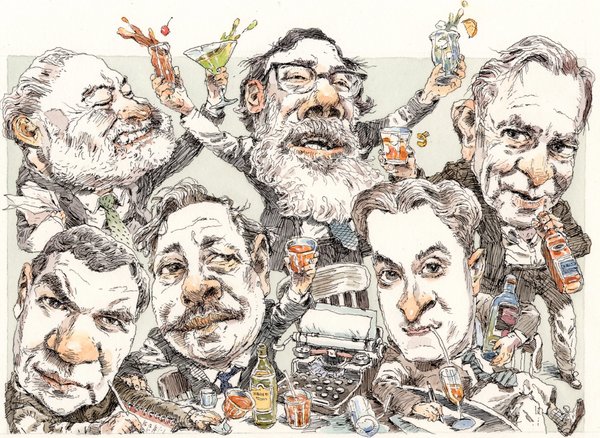
Of course, creative types like Tennessee Williams are notorious for being high strung, if not bipolar, and have sought self-medication via demon rum and other numbing agents, which almost invariably lead to more stress. In fact, this morning’s NY Times has a book review on a study of Williams, Hemingway, Cheever, Fitzgerald,  John Berryman, and Raymond Carver as rummies, a book I intend to check out.

1229-bks-Osborne-cover-articleLarge

illustration by John Cuneo

The 12-Step people claim that there can be no cure for substance abuse except through a religious belief of some sort, whether it be as stringent as Hasidim Judaism or as vague as Steve Earle’s “I know there’s a God, and He ain’t me.”

Alas, however, the path to Enlightenment is much longer than that trip to the liquor cabinet.

The Bluegrass Blues

Click the grey arrow above for sound.


Banjos make me blue.  There’s

pain in that frenetic pickin’

fueled by moonshine and misfortune,


pain that goes all the way back to Ireland,

black potatoes and fickle lasses,

the death of lovers or worse.


Fiddling can get downright dolorous, too,

that high lonesome keening,

the breakneck pace


the manic flipside of poverty.

Saturday night

shouting on the hills of glory


but returning to the shack

to find the chickens dead

and Pretty Polly’s tearstained letter.

***

Picture Shelley plucking a banjo,

Shelley in one of those silk

two-toned cowboy shirts


singing through his nose

about how the saddest songs

end up being the sweetest,


a fiddle taking up the strain,

a quick, pained grin to the audience

as he nods his head to the music.

shelley other view

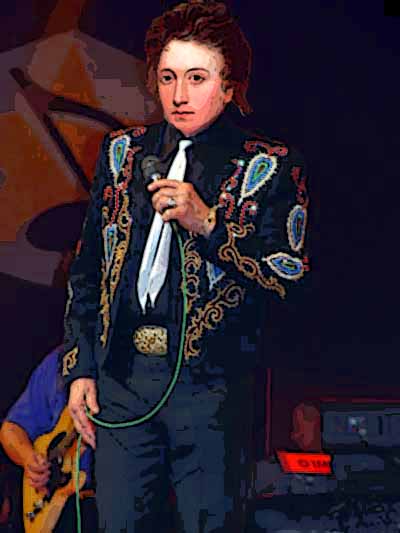
A Hank Williams Villanelle

Click the grey arrow above for sound.

I say, ‘do like I say, not like I do’ –

“Sneaking Up Early on Miller Time.”

Now there’s a country title for you.


If you want to ‘scape what I been through –

same ol’, same ol, time after time –

I say, ‘do like I say and not like I do.’


Swap out that pint of Ol’ Crow for Betty Sue.

“Sinning Don’t Cause the Sun to Shine” –

now there’s a country title for you


courtesy of Mr. Honky Tonk Blues,

Mr. Living Hundred Proof, Mr. Vodka and Lime.

I say, ‘do like I say, not like I do,’


or you’re bound the coming days to rue.

“Being Alive Ain’t No Capital Crime” –

now there’s a country title for you.


Keep up that doping, and you’ll end up screwed,

dying in the backseat before your time.

I say, “Do Like I Say, Not Like I Do’ –

Now there’s a country song for you.

 Image

The Cancan Do Man

Click the grey arrow above for sound.

Get my cannabis from Canada,
not Cancun, like you might think.
Canonized saints in white lab coats
cure the shit in absinthe, baby.

I can cancel out a credit card
quicker than RD Foxx can say
cock-a-doodle-do, a bone fide
can do type of dude.

Can you dance the cancan, baby?
Like the poster in your apartment?
You know, a little dab’ll do you.
You know that, I know that.

Yes, I can’t take no for an answer.
I been hurt, hurt, hurt, yes I been –
Why can’t you see that I can do?
Can do, babydoll, not a problem.

Gonna pick myself right up off
the canvas of unrequited love,
do the “Shadowbox” with my badself
on a moonless midnight in December.

A can do type of fooooool.
Did I mention my Canadian doobies?
That I’m a Cancer, have eaten a Toucan?
That’s right, baby, big bright beak and all.

Image

Rousseau’s The Dream

Rousseau's The Dream

Naked, reclining on a couch,
comfortable, self-satisfied,

braids, two tentacles
hanging in high humidity.

The surrounding flora as lush
as green as innocence.

Blue lotuses thrive on dry land,
the moon a mint in a pale jade smudge of sky.

But one of the lions is crouching and looking alarmed
at our intrusion into her world.

The other cocks her head to the lilt of the piper’s song:
tall and tanned and young and lovely –

Wait, is that the piper’s cousin hanging from the vine,
half a chromosome once removed?

The Fall is spreading out in concentric circles:
a beak plucks its first worm, the elephant raises its trunk,

the suddenly shy snake slinks away to brood,
the lions’ stomachs are beginning to growl.

The Darwinian dance is commencing;
It’s time we slowly took our leave.