Miller
Coors
PBR
Heineken
Guinness
Dos Equis
Sierra Nevada
Ranger IPA
Your Friend’s/Neighbor’s Home Brew**
*If you drink two six-packs in the course of three hours.
**Okay, I wouldn’t exactly call it popular.
Well, this isn’t exactly news, but to say that Dick Cheney lacks empathy is to say Christopher Walken isn’t warm and fuzzy or that no one is likely to confuse Michelle Obama with Ann Coulter. Sunday on Meet the Press, Cheney couldn’t even bring himself to express remorse over the well-documented torturing of innocents when he was in charge post 9/11. I’ll hand the metaphoric mike over to Andrew Sullivan:
He was then asked about the 26 people whom the CIA admits were tortured by mistake. One of them was even frozen to death. A sane and rational and decent human being, who presided over the program that did this, might say: “The decision to torture was an extremely agonizing one, but I still believe defensible. But of course the torture of innocent people is horrifying. I deeply regret the chaos and amateurism of the program in its early phases.”
So what did Cheney actually say? When confronted with the instance of Rahman Gul, the individual tortured to death, Todd asked what the US owed these torture victims. Cheney actually said this:
The problem I have is with all the folks we did release who ended up on the battlefield … I have no problem [with torturing innocent people] as long as we achieved our objective.
Cheney makes Orwell’s Big Brother seem like a straight-shooter by comparison. He calls “water boarding” and “rectal hydration” “enhanced interrogation.”
On Meet the Press, reeking of hubris, he exhibited the same stiff-bodied surety he displayed when assuring the American people that Saddam had weapons of mass destruction and that we’d be greeted as liberators. As my main man Hamlet is wont to say round about Act 3, Scene 4, line 82: “O shame where is thy blush?”
Well, obviously, Dick Cheney has no shame, and my fantasy of his being prosecuted is about as likely to happen as the Carolina Panthers winning this year’s Super Bowl or Hunter S Thompson and Warren Zevon rising from the dead to perform some rectal hydration enhanced interrogation on Cheney himself.
What’s that word W liked so much? Oh yeah, evildoer.
In my book, Bob Dylan should win the Noble Prize for literature, and before you scholarly snobs start tsk-tsking that Dylan is a mere folk-singer-rock-star- minstrel, not a poet, let me share with you these gems from past Noble-winning poets.
In this world all the flow’rs wither,
The sweet songs of the birds are brief;
I dream of summers that will last
Always!
from “In This World” by Sully Prudhomme
Keep dreaming, Sully. You’ve been dead for 107 years. Here’s another:
The vase where this verbena is dying
was cracked by a blow from a fan.
It must have barely brushed it,
for it made no sound.
Evening sunshine never
Solace to my window bears,
Morning sunshine elsewhere fares;-
Here are shadows ever.
from “A Sigh” by Bjørnstjerne Bjørnson
No doubt it loses something in translation.
When I bring to you colored toys, my child,
I understand why there is such a play of colors on clouds, on water,
and why flowers are painted in tints
—when I give colored toys to you, my child.
from “Colored Toys” by Rabindranath Tagore
We can’t blame a bad translation on that one; it was originally written in English.
Ah but not the bottle, not the chicken,
Would I touch, however fine and tender;
Nothing but herself, but Fraulein Anna!
Her I’d set upon the pony, clasping
Both my arms around her, and would gallop
All along the street, along the village,
Up the hill, and stop at Friedli’s hostel –
Then we would be married in the autumn.”
from “Puberty” by Carl Spitteler
Compare the above with this:
Darkness at the break of noon
Shadows even the silver spoon
The handmade blade, the child’s balloon
Eclipses both the sun and moon
To understand you know too soon, there is no sense in trying
or this:
Then take me disappearin’ through the smoke rings of my mind
Down the foggy ruins of time, far past the frozen leaves
The haunted, frightened trees, out to the windy beach
Far from the twisted reach of crazy sorrow
Yes, to dance beneath the diamond sky with one hand waving free
Silhouetted by the sea, circled by the circus sands
With all memory and fate driven deep beneath the waves
Let me forget about today until tomorrow.
or this:
When Ruthie says come see her
In her honky-tonk lagoon
Where I can watch her waltz for free
’Neath her Panamanian moon
An’ I say, “Aw come on now
You must know about my debutante”
An’ she says, “Your debutante just knows what you need
But I know what you want”
or this:
It was Rock-a-day Johnny singin’, “Tell Your Ma, Tell Your Pa
Our Love’s A-gonna Grow Ooh-wah, Ooh-wah”
I rest my case!
Oh, for those quaint days of yore when the worst your uptight cinematic town had to fear was a motorcycle gang led by Marlon Brando cutting doughnuts on Main Street, shattering the plate glass windows of hardware stores. [TRAILER HERE]
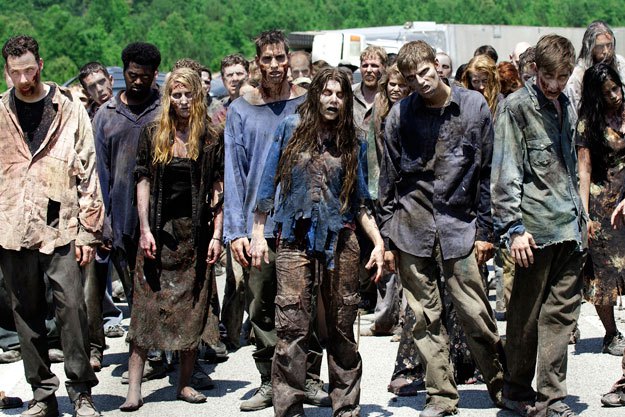
Nowadays, it’s brain-eating zombies upsetting the ambiance of the townships of Televisionland, shuffling like Roman Legions down Martin Luther King Boulevard, crossing the tracks, headed toward gated communities guarded by underpaid military retirees in police uniforms.
For whatever reason, we First World consumers crave catastrophe, whether we’re curling up on the sofa with Cormac McCarthy’s The Road, programming our DVRs to record the latest episode of The Walking Dead, or listening to the dulcet intonations of NPR announcers bringing us up to date on Ebola and ISIS.
Horror is all the rage in Late Empire America. Walking your rescue dog past young Bentley’s house, you can hear heavy gunfire and explosions emanating from his manipulations of a video console. Hmm, sounds like he’s playing Mortal Kombat Armageddon, or is it World of Welfare: Let’s Kill the Bloodsuckers?
All of this got me to wondering when the West quit writing utopias a la Thomas More and started portraying the future world as a nightmare. Of course, my go-to unscholarly source is Wikipedia, and it anoints Jonathan Swift’s Gulliver Travel’s as the first dystopian “literature “– though Oedipus Rex might lay some claim to being the first with its plague-ridden Thebes ruled by a tainted king whose sexual misdeeds make the Clinton/Lewinski dalliance seem downright wholesome in comparison. But Oedipus Rex predates empire, and I suppose you must have an empire, a nation state, or a fucked-up planet to qualify as a dystopian society. My colleague Aaron Lipka tells me the civilization must be a fallen one. I’d add that God has to be Dead.
“Well this stuff will probably kill you/ Let’s do another line.”
Tom Waits, “Heart Attack and Vine”
On Dummyline Road east of Slidell,
I’m standing at the counter of a dirt-floor,
concrete-block shit-hole of a juke joint
doing shots of shine
with my main man Alphonse DuMar.
There’s a black bluesman sitting on a stool
in the corner blowing bad harp,
and by bad, I mean not-good, shitty, shrieking.
I wish he’d shut the fuck up.
I’m the only white cat in this joint,
the proverbial peanut in the Hershey bar,
as we used to say back in the day
before the PC Police put the nix on colorful language.
The shine burns going down, sears my esophagus.
I shout up to Mr. DuMar,
who stands six-four-and played tight end for Tulane.
“The body ain’t no temple,”
I holler over the harp.
“It’s more like a nation,
with little white blood cell armies
that attack invading viruses,
and if you abuse a territory,
like your esophagus,
it might revolt, attack your capital ass,
rising up in a cancerous insurrection.”
Alphonse shakes his big black shaved head.
“Don’t be talking no shit like that in here, mon.”
Just then, like an answered prayer,
the harp ceases its screech.
Vowel rich intermingled speech instead.
In my head that song by the Box Tops clicks on.
Lonely days are gone
I’m a goin’ home
My baby, she wrote me a letter
Problem is I ain’t got no baby —
or no home for that matter.
Been sleeping in my van for the past six months.
It’s parked outside next to a portable sign on wheels,
one of them signs with removable letters,
a sign that says
PHAS 2
WED NITE CRA FIS
Some thieving teenager named Willie Horton
maybe made off with the W and H.
“This shine burning a hole in my gut,” I say,
and Alphonse say, “Then just one more.”
The shine is poured,
the glasses raised,
and I brace myself for a slug of fire.
I don’t even hear the pistol go off
but feel the shot rip through my gut,
and scrunch over and howl
like Lee Harvey Oswald
on that day in Dallas.
I’ve been digging around the internet trying to discover the linguistic answer to why so many females (and increasing numbers of males) end declarative sentences with an interrogative lilt. You know, no matter what they say, even when it’s a universally accepted fact, their voices rise at the end of sentences as if they’re asking a question.
Kim Jong-un is a North Korean dictator?
Kim Jong-un has a bad haircut?
Kim Jong-un isn’t blessed with a self-deprecating sense-of-humor?
For whatever reason, this linguistic affectation bugs the hell out of me. I know, I certainly have more pressing concerns — shit like spousal cancer, maternal dementia, my dog Saisy’s insufferable halitosis — but goddamn it, I’m sick and tired of hearing far flung NPR correspondents say “the critical mass of a bare mass sphere of plutonium-239 is 8-10kg? as if they’re asking, “Do you think breast-feeding at a rodeo is tackier than breast-feeding at a Miss Utah beauty pageant?”
I started my quixotic linguistic NetQuest by typing into Google “interrogative lilt” and garnered lots of hits. My first stop was Answer.com, a website where you can pose a question and have site visitors provide possible answers. Whoever asked the question gets to choose what she considers the best answer and then some sort of arbiter at the site sifts through the received answers and selects what he/she/it deems worthy of mentioning. It’s sort of like Wikipedia except that the responders aren’t even knowledgeable amateurs but uninformed web addicts with way too much time on their hands, in other words, cranks like me. It’s about as scientific as a History Channel feature on Noah’s Ark, but, anyway, here’s Answers.com best guess:
[The interrogative lilt] is mildly irritating. I think it is an attention getting (sic) device. People do it who are used to being ignored. Asking a question often gets an answer; the listener’s ears perk up. That is why it is annoying because you perk your ears up for nothing.
Second on the Interrogative Lilt hierarchy of Google search hits was endnote 221 on page 367 of Grant McCracken’s Transformations Identity Construction in Contemporary Culture. From what I can glean, McCracken writes about how consumers construct new identities through acquisitions, like newbie surfers peroxiding their hair and stocking up on Rusty tee shirts and Reef footwear (though he doesn’t use that example).
Anyway, I don’t know the context of the endnote, but it reads, “The Interrogative Lilt turns statements into questions, listeners into authorities, and it helps mark and construct power difference between two conversational partners.” This statement is not all that different from the Answer.com supposition – but the endnote also provides two other ways to describe the interrogative lilt – “uptalk” and High Rising Terminal (HRT), which is official linguistic terminology.
These two terms allowed me to expand my search, and I discovered that what I’m going to continue to call the interrogative lilt (IL) is a hot topic that spawns wide-ranging responses. Many people see the predominance of women ILers as a signal of insecurity. Linguist Robin Lakoff first noticed the phenomenon in 1975 in Australia and attributes the effect to the speaker’s seeking affirmation.
There’s a notable study by William and Mary sociologist Thomas Linneman that analyzes Jeopardy contestants’’ use of IL. According to Bloomberg Business Week’s Caroline Winter, “In total, [Linneman] found that contestants answered 37 percent of the 5,473 given questions using upstalk. In terms of gender, the findings, published in 2013, exposed an unexpected correlation: Successful women were more likely to use uptalk than less successful women, whereas the reverse was true for men.” Linneman dismisses the notion that IL’s only function is to indicate uncertainty but contends that it’s meant to compensate for success.
Mark Liberman who publishes the blog Language Log cites new studies that “show that people who use uptalk are not insecure wallflowers but powerful speakers who like getting their own way: teachers, talk-show hosts, politicians and facetious shop assistants.”
Of course, what do I know, but my theory is that people use IL because they think it sounds cool, or they unconsciously parrot it because people they consider cool talk that way.
I ran across a couple of Brit sites (the Guardian and BBC) that claim the trend started in Australia. One theory is that it became the cool-speak of the Australian surf sub culture and migrated to California where it morphed into Valley Girl Speak and then spread via the media via Moon Zappa and Clueless. This theory resonates with me. I remember West Ashley surfers I hung with in the early ’70’s affecting this whiny faux-Californian cool-speak.
Anyway, it seems that every generation develops verbal ticks, the “you-knows” of my youth morphing into “likes” and now the interrogative lilt. Is “uptalk” here to stay or will it give way to some new, even more irritating affectation?
The best news I’ve heard in a long while is that 3 Academic Magnet parents “filed a defamation lawsuit claiming characterizations of the team’s controversial postgame watermelon ritual damaged their [unnamed] sons’ reputations.”
The Academic Magnet is public charter school located in Charleston, South Carolina, where American Civil War began. Although a public school, blacks at Academic make up only 2,3% of the school’s population. According to a report issued by the school’s principal Judith Peterson, after the second game of the season, team members bought a watermelon from a roadside stand, and after they won the game, the team broke open the watermelon, cheered as a team, and ate the melon. To quote Principal Peterson, “as teams sometimes believe in superstition, the boys bought a watermelon for the next game, which the team also won.” Thus, the team concluded that pregame purchasing and postgame smashing of watermelons resulted in victory.
After defeating Military Magnet, a predominantly black school, the Academic Magnetic team returned to campus and, again quoting Principal Peterson, “ran with the melon into the AMHS Courtyard and threw the melon to the ground.”
[Note to Academic High School Teachers and Coaches. Perhaps you might want to introduce students to the logical fallacy post hoc; ergo, propter hoc.].
This self investigation does not include troubling details included in other reports, particularly by the City Paper (hence their being named in the lawsuit) that the students painted faces that could be construed as “caricatures” on the watermelons and made “grunting sounds” and wrote “Bonds Wilson” on one of the watermelons. Bonds Wilson was a historic black high school that once stood at the present site of Academic Magnet.
To quote Wikipedia, Protesters against African Americans frequently, among other things, hold up watermelons;[2] racist imagery of President Barack Obama consuming watermelon has been the subject of viral emails circulated by political opponents. After his election, watermelon-themed imagery of Obama has continued to be created and endorsed.
The coaches were aware of the ritual but didn’t associate smashing watermelons after defeating predominately black teams with racism. An African American player on the team characterized the “grunting noises” as “football noises.” Principal Peterson referred to them as “chants.”
[Note to Academic High School History teachers: introduce a chapter in American History on racism and racial stereotypes].
Why do I say the law suit is good news, you wonder? Because it will make one hell of a movie, that’s why — Inherit the Wind meets Friday Night Lights. I’d cast Ned Beatty as Coach Walpole and Glenn Close as Superintendent McGinley. Plus, what a boon for watermelon growers in the Lowcountry as melon after melon would need to be busted in take after take. The growers may need the help since the Magnet has put a stop to “smashing a watermelon, cheering together, and eating pieces of the melon.”
You have to wonder if the reputation of the tiny sleepy hungover hamlet of Folly Beach, SC, will ever recover from last Saturday’s shocking assault at Snapper Jack’s. In case you’re just emerging from a coma and haven’t heard the news, Amber Fortson of Little River is outraged because Barbra Green 59, allegedly mistook Amber’s five-month-old son for a doll and “punched her baby in the face,” committing in the words of Mrs. Fortson, “a random act of stupidity.”
You can read the Post and Courier’s account HERE.
The day had started so promisingly for the Forstons who took little Baby Doe Fortson* “to Folly so their son could participate in a modeling tryout at the Tides Hotel” because Amber “just want[ed] him to develop confidence.”
Mrs. Fortson hopes, to quote Post and Courier staff writer Dave Munday, that “being punched in the face by a stranger doesn’t undermine that goal. Her doctor [obviously not a practicing psychoanalyst] told her children that young usually forget about such traumatic events.”
I’m not so sure. It wouldn’t surprise me if the poor boy starts blinking up a storm well into his toddler years whenever a scowling, slack-faced red-headed stranger approaches him.
At any rate, this unfortunate incident has not only reddened the little one’s nose, but has also given a black eye to the tiny seaside hamlet I call home. For example, in the Comments Section, Sean Kennedy of UF School of Law writes, “I absolutely hate Folly. So many scumbags, drifters and rednecks infest Folly Beach.” Judy Auld Byrd, a graduate of Roper Hospital School of Nursing, adds, “Folly has always been a scary place to visit.”
Gil Luckytohaveallgirls White probably had the most poetic comment: “This city is nuking futs.”
Lee Bonifay of Trabuco Canyon California (bad news travels fast) writes that Folly “has turned into a giant human toilet. This is sad bc (sic) when I grew up surfing there, all the locals were close-knit and respectful. You use crappy bait….you catch crappy fish…..perfect example of what Folly has become.”
This comment started the equivalent of an on-line shouting between Mr. Bonifay and someone called Erik Swartz of Snug Harbor Design. Bonifay supports his toilet analogy with some fairly convincing anecdotal evidence:
Just came back to visit in Sept and stayed down there for ONE NIGHT. Saw three fights, one drunk guy get arrested for drunk and disorderly for standing outside Snapper Jacks screaming and cussing at the football game he was watching through the window…AND saw another guy drive his truck head on into a ditch..wasted drunk….and that was ONE DAY!!!! I understand your desire to defend it if you live there. BUT, you OBVIOUSLY can’t see the forest for all the trees. Try leaving for a little while (ya know…get OUTSIDE the bubble) and you’ll see what it has become.
All of this Folly bashing ignores the most interesting aspects of the incident. What prompted Barbra Green to punch the baby? What does she have against dolls? Why does she feel no remorse? Perhaps barren, she resented the fuss everyone was making over what Amber calls “her little man.” Or perhaps Green actually mistook the baby for a little man, a midget, and thought he shouldn’t be standing on a man’s lap “laughing, smiling, and dancing to the music.”
We’ll probably never know because Ms. Green, out on $25,262 bail, “did not immediately return a phone message asking for comment.”
*Mrs.Fortson asked that the baby’s name not be published to avoid “future embarrassment.”
“Well, I try not to hope for too much [. . .] It puts pressure on the future at my age. If you know what I mean. Sometimes a hope’ll slip in when I’m not paying attention [. . .] That I’ll die before my wife does, for instance. Or something about my kids. It’s pretty indistinct.”
Frank Bascombe from Richard Ford’s Let Me Be Frank With You
It’s a bleak morning, the day before Thanksgiving. Last night on the side porch when I sensed a drop in temp, I boldly predicted that our tubby foppish weatherman Bill Walsh was wrong. The chill in the air meant that high pressure was pushing the dismal, life-negating, leaden, dripping sky turds out to sea and that we’d awake to blue skies and the possibility of the Moore/Birdsong nuclear family foursome enjoying a beer at my favorite meeting place, the open air bar known as Chico Feo, home of the $2 PBR, the $3 All Day IPA, home of homeless, Greg and Odie.
But I was wrong, and Bill was right. Today dawned — if you can even call it that — as bleak as ever — with low dark clouds scudding in the same direction as the river and a wind so strong it’s sloshing the water in the birdbath.
Despite the mournful weather, I’ve been enjoying the company of a very old friend, Frank Bascombe, the protagonist of what now are known as the “Frank Bascombe books” — The Sportswriter, Independence Day, The Lay of the Land, and Let Me Be Frank With You, the last a surprise gift from Judy Birdsong.
Although the phrase “Frank Bascombe Books” might suggest to the uninitiated tales of detection or spydom, these novels follow the quotidian life-journey of a once-promising fiction writer who turned to the easier craft of sportswriting but even abandoned that for the even easier money of real estate sales, at which he excelled. Their author, Richard Ford, like his protagonist, for a while worked as sportswriter, but praise be to whatever he didn’t give up fiction-writing for real estate. The second book in the Bascombe series, Independence Day, got him a Pulitzer and a Faulkner Pen award.
Now, in this latest book, a collection of four interrelated stories, Frank is 68, retired, and living in post-Sandy Haddam, New Jersey, a city name that conjures in the echo chamber of my juke-box-like mind Wallace Stevens’ great lines:
O thin men of Haddam,
Why do you imagine golden birds?
Do you not see the blackbird
Walks around the feet
Of the women about you?
Frank Bascombe has taken Stevens’ advice about jettisoning the wanna-be for the what-is. He seeks to see things as they are, un-misted by sentiment. Here he is in the last story “The Death of Others” talking about simplifying his life:
Indeed for months now — and this may seem strange at my late moment in life (sixty-eight) — I’ve been trying to jettison as many friends as I can, and am frankly surprised more people don’t do it as a simple and practical means of achieving well-earned, late-in-the-game clarity. Lived life, especially once you hit adulthood, is always a matter of superfluity leading on to less-ness. Only (in my view) it’s a less-ness that’s as good as anything that’s happened before — plus it’s a lot easier.
In addition to paring down friendships, Frank is also eliminating certain words and phrases from his vocabulary, words that he believes “should no longer be usable – in speech or any form.” He continues, “Life’s a matter of gradual subtraction” and “a reserve of fewer, better words could help, I think, by setting an example for clearer thinking.”
Here are some of the words and phrases on the chopping block:
poop
friggin’
We’re pregnant
What’s the takeaway
awesome
no problem (as a substitute for thank-you)
soft landing
sibs
hydrate (when it means drink)
reach out
It’s been quite a pleasure growing old with Frank, who in The Sportswriter at 38 tried to overcome the death of his son Ralph by willing away irony but succumbed to what he calls dreaminess and the temptations of extra-marital embraces, which wrecks his marriage and to a lesser extent his writing career.
I’d call him a practical existentialist,* a nephew of good ol’ Binx Bolling from The Moviegoer. What I really love about Frank, though, is his voice, his way with words, how he expresses what I sometimes think so much better than I ever could, for example this description of a mealy-mouthed preacher — “Fike’s morning devotionals all have the tickle-your-funny-bone, cloyingly Christian pseudo-irreverence calculated to make God Almighty as just one of the boys” or this description of searing pain: “my neck had started zapping me, and I’d begun feeling the first burning-needles-prickle-stabs in the soles of my feet, sensations that now [. . .] had travelled all the way up my groinal nexus and begun shooting Apache Arrows into my poor helpless rectum.”
Alas, I’m afraid this book may be the last we hear from Frank, another notable subtraction from the subtractions that old age brings.
If so, so long, pal. It’s been great knowing you.
*I don’t look in mirrors anymore. It’s cheaper than surgery.
For some teaching is a calling – my colleagues Ralph Nordland and Chuck McCarver come to mind. To them, it’s as if teaching is a vocation in the religious sense. These individuals devote their lives in almost monastic fashion to educating young people, in Ralph and Chuck’s cases, educating young people about the profundities and intricacies of history, a subject they revere almost religiously.
These dedicated teachers approach the academic year like generals mapping out a campaign. No improvisation for these masters. Each precisely planned class (to abruptly shift metaphors from the martial to the aesthetic) creates a distinct picture but also serves as a mosaic piece that occupies a place in an arrangement of other pieces that collectively form a “bigger picture” – in Ralph and Chuck’s cases, portraits of civilizations. We’re talking here – if you’ll allow one last metaphor shift — – motifs, tapestries.*
Not coincidently, these teachers demand much, receive much in return, and are almost universally revered by their students.
Another teacher of this ilk was the late James Gasque, a legend at Dreher High School and Heathwood Hall in Columbia.
*I wish I could blame my inability to sustain a metaphor on over-exposure to the attention-span obliterating frenetics of Sesame Street, but that was before my day.
* * *
Still other teachers enter the profession because they love children as a species. They think science or math is cool but don’t live and breathe their chosen subjects the way the “called” teachers do.
Still others — like me — stumble into teaching because they haven’t planned their lives out well, and, in my case, as HL Mencken said, “all that’s required of an English teacher is that he can read and write.”
Plus, you get the summers off.
* * *
Who in his right mind would spend the majority of his life in high school? I hated it when I was a student at Summerville High: the hierarchies of popularity, the drab concrete walls plastered with bright propagandist posters, the jock friendly administration that suspended you when exercised your First Amendment rights by wearing a black armband to protest a stupid war. The principals, vice-principals, coaches considered non-conformity a personal affront.
In my case, I majored in English in college because I enjoyed reading and especially poetry. I remember being in kindergarten and checking out old editions of Mother Goose from Summerville’s Timrod Library. I read the rhymes out loud, despite suffering from a speech impediment that rendered s-sounds lispingly and prevented me from pronouncing L-and-R sounds. Hick-o-wee, dick-o-wee, dock.
At any rate, I ended up being a teacher thanks to a series of fortuitous accidents. Engaged to be married and having dropped out of grad school with 27 hours, I was unemployed and responded to an ad in the paper to teach at community college even though I lacked both of the requirements it demanded, a Masters degree and teaching experience. The ad said to contact Ed Bush, English Coordinator.
So I did, not by sending him a letter or resume but by showing up on campus, standing in a drop-ad line with students, and being hired on the spot, sans resume, sans transcript. As they say, timing is everything.
Years later Ed Bush, who was close friends with the English Chair at my current school, suggested me as a replacement for someone who had been fired. I didn’t realize that the Chair himself had been forced to resign, but thanks to the compassion of the incoming chair (she felt bad for the departing chair who wanted me), I was hired.
Despite my lack of credentials and high school experience, I had published a couple of short stories, and as it turns out, being a working writer is advantageous in teaching writing, so all in all, it’s worked out all right, despite my lack of dedication, my not particularly liking children any more than I do adults or old people, despite my inability to shovel propagandist bullshit (like consoling the losing team by telling them everyone is a winner) or my inability to buy into the latest pedagogical methodology. Yawn.
Anyway, if every teacher were super dedicated, the kids would have 10 hours of homework a day, which might lead to an armed insurrection, or in the case of independent schools, a mass exit for less Spartan education.
So I raise my glass to the average teacher, the Joe or Joanna who does the best she can without sacrificing the rest of her life — romantic relationships, outside hobbies, lazy Sunday afternoons — for the sake of the hormonally unbalanced. After all, it ain’t the best paying job; plus society holds you to a higher standard in your personal behavior than it does doctors, lawyers, and Congressmen.