This summer I’m compiling a “Reader” for the British Literature survey I teach. We figure since we have a millennium-and-a-half of material in the public domain, why not compile our own texts and give them to students “for keeps” so they can annotate passages and eventually carry the books with them to college (if any be so foolish as to major in English).
My man G. Chaucer by far is the most time-consuming to download and format because of footnotes and marginal glosses, but I’ve had fun adding archaic words to my vocabulary, and I’ve started including some Chaucerian locutions in casual conversations.
For example, “How was Chico Feo, Ned?”
“Great. Greg was there, but he was really drunk.”
“Fordrunken, was he?”
Here’s another: Shamefastness. Any idea of what that might mean?[1]
Lee Bright as Bottom
Anyway, I took a break yesterday to take in a bit of the televised flag debate, and, of course, the stealer of the show — the thef of the feste – was Lee Bright, whose surname strikes me as inapt, given as a thinker he seems so [forgive me] inept. I suspect poor Lee is all too familiar with sardonic puns on his name, and only a churl like I-and-I would stoop to such.
Chaucer might say of Senator Bright, “He [knows] not Cato, for his wit [is] rude,” or to put it much more crudely, we might borrow Thersistes’s description of Agamemnon from Shakespeare’s Troilus and Cressida: Bright “has not so much brain as ear-wax.”
It appears that Bright’s education is limited to Dorman High School, from which he received a diploma in 1988, but this lack of learning didn’t disqualify him from serving on the school board or being on the Board of Visitors at the Southeastern Baptist Theological Seminary or from thinking he knows what a high school biology curriculum ought to look like. Not that a college degree insures success or demonstrates intellectual curiosity. Yeats and Faulkner lacked one, and George W Bush sported two, one from Yale, the other from Harvard. Nantheless, as Chaucer might say, based on yesterday’s speech, Bright makes W look like Cicero.
Although the speech was supposed to address whether the Confederate flag should continue to fly on the State House grounds, it ended up an inchoate rant, a poisonous, disjointed catalogue of disparate issues expressed in hopelessly entangled syntax. He began by saying he heard President Obama singing “a religious hymn” then bemoaned in an emotion-choked voice that he had seen the White House “lit in the abomination colors.” He urged the “Church to rise up.” Claimed that our nation was founded on “Judeo-Christian principles” and “was under assault by men in black robes who were not elected by you.” He then sputtered that he “would like to see the folks working as, in the positions of dealing with, the marriage certificates not to have to betray their faith or compromise their faith in order to subject themselves to the tyranny of five judges.” He admitted that the Governor had called the special session to deal with “the flag that sits out front” but urged the body instead “to deal with the national sin that we face today.”
“And to sanctify deviant behavior from five judges,” he continued, but left the phrases airborne (and me wondering just what deviant behavior the judges had been engaging in) to shift to the exhortation that “it’s time we made our stand in church.” Then in a voice choked with emotion, in a sort of half sob he said, “We can rally together and talk about a flag all we want, but the Devil is taking over this land, and we’re not stopping him.” Then he warned, “If the state’s got to get out of the business of marriage, then let’s get out of the business of marriage because we cannot succumb to what’s being done to the future of this nation.” He offered a concession by admitting that Christ has taught us to “love the homosexual” but that he also “teaches us to stand in the gap against sin” and that “we cannot respect this sin in South Carolina.” He ended the oration by describing the government of the United States of America “a tyrannical government.”
Perhaps some might agree with John, the cuckolded carpenter and champion of anti-intellectualism in the “Miller’s Tale”:
Has it already been three years since Folly Beach’s infamous 4th of July fiasco? You know, when busloads of “patriotic” vulgarians descended Attila-the-Hun-like on 10th Street East to stage a Jersey-shore-like shitshow, trashing the strand, tussling with police, resisting arrest, chanting USA! USA! USA!
Fortunately, I was up in Baltimore sampling Natty-Bos at the One-Eyed Cat and missed the carnage, but as all Lowcountry residents know, after the 10th Street Conflagration of 2012, Folly Beach City Council outlawed alcohol on the beach, which sent shivers of dread up and down the curved spines of dedicated hedonists from Awendaw to Edisto, from South Battery to Pimlico.
OMG, what’s next? No smoking on the beach, “a no shirt, no service” sign at Bert’s, the renaming of Arctic Avenue to Ronald Reagan Boulevard?
Well, I’m happy to report that despite the alcohol ban Folly remains Folly, a safe haven for sybarites of all stripes, for grannies with tattooed palm trees rising in wrinkles from their bikini bottoms, for aspiring white hip hop stars weighing in at 204 kb[1], or for those methadone clinic alums taking it one day at a time. In other words, for my fellow misfits, my out-of-step brothers and sisters.
Yesterday, for example, Judy Birdsong and I rode bikes down to Chico Feo to check out their annual 4th of July hotdog eating contest. As a matter of fact, yesterday was a historic day in the annals of hotdog eating contests. Legendary frankfurter swallower Joey Chestnut, the King of the Hotdog Inhalers, was upset up at Coney Island by Matt “the Megatoad” Stonie to end 8 straight years of triumph.
They sure do things in a hurry up North. Here’s a hotdog eating contest on Folly Time:
Now that’s what a call gentility and an affirmation of the wisdom of ragwatercat’s brilliant socio-cultural study Dealing with Yankees for Dummies.
Actually, I don’t find hotdog eating contests all that captivating, especially the Folly variety, which has all of the excitement of televised fishing. No, I’d rather stake that corner of the bar where the breezes always blow and watch a true master at work, Charlie, the best bartender in the Charleston area now that Steve Smoak has hung up his bar rag.
Groove on, Master, groove on to the dulcet tones of the Screaming J’s.
.[1] Damn right, I’ve gone metric; that’s 450 lbs. for you Medieval measurers
David Brooks, whom I like personally from his television and radio appearances, but with whom I rarely agree, has a thought-provoking but quixotic op-ed piece in yesterday’s Times.
Brooks begins with a blunt statement of fact: “Christianity is in decline in the United States.” He goes on to point out that its “gravest setbacks are in the realm of values,” particularly in the realm of sexual permissiveness. Premarital sex is virtually universal, out-of-wedlock pregnancy no longer a cause for shame, adultery considered a trivial misstep, etc.
On the homosexual side, not only does gay love dare speak its name, but it shouts it out, Martha-Reeves-and-the-Vandellas style. Gay lovers have stepped from the shadows of alleyways and stroll openly holding hands on the sunny side of our streets, their streets, and to that, most of us — and least the people I hang with — shout Hallelujah!
Of course, others disagree. Brooks quotes Rod Dreher, author of How Dante Can Save Your Life, who suggests that it is “time for Christians to strategically retreat into their own communities, where they [can] keep ‘the light of faith burning through the surrounding cultural darkness.’” Dreher adds, “We have to accept that we really are living in a culturally post-Christian nation. The fundamental norms Christians have long been able to depend on no longer exist.”
Of course, Christianity is complicated. Jesus himself never considered himself a Christian. After all, on the night before his execution, he was celebrating Passover.
Although Christianity and Islam have incorporated elements of Judaism, they aren’t syncretic in the sense that they don’t see Yahweh, Jesus, or Allah as cultural masks for a universal deity that transcends tribal affiliations. In other words, fundamentalists in these religions mistake their myths for history, and this literalism has been [gross understatement alert] problematic (cf. the Inquisition).
Science is the enemy of literalism. Obviously, Noah would have a hard time rounding up penguins in Mesopotamia. Less obviously, scholars agree that Judaism was originally a polytheistic religion and that there is virtually no archeological evidence of an Egyptian captivity. On the Christian side, N.F. Gier writes in God, Reason, and the Evangelicals:
There is no record of Caesar Augustus’ decree that “all the world should be enrolled” (Lk. 2:1). The Romans kept extremely detailed records of such events. Not only is Luke’s census not in these records, it goes against all that we know of Roman economic history. Roman documents show that taxation was done by the various governors at the provincial level.[1]
So some people, naively in my view, tend reject the mythic truth of Judaism and Christianity when they dogmatically argue that the bible is literally true. Millennials especially have little patience with ancient edicts that restrict their behavior. They dismiss it all as “a big bunch of bullshit.”
Enter genetics. I believe that the great shift in US citizens’ acceptance of homosexuality lies in its not being a choice but a biological imperative. Commonsense tells us that we don’t choose our sexual orientations. No one remembers that special day during puberty when she decided to opt for boys instead of girls. So it follows that if people are hard-wired to love certain sexes, why not allow people of both sexual persuasions to make lifelong commitments? Doing less seems uncharitable, and in one sense, un-Christian.
Brooks urges Christians to abandon their “decades-long culture war that has been fought over issues arising from the sexual revolution” and to “consider a different culture war, one just as central to [their] faith and far more powerful in its persuasive witness.”
Here’s his alternative:
The defining face of social conservatism could be this: Those are the people who go into underprivileged areas and form organizations to help nurture stable families. Those are the people who build community institutions in places where they are sparse. Those are the people who can help us think about how economic joblessness and spiritual poverty reinforce each other. Those are the people who converse with us about the transcendent in everyday life.
In other words, he urges the religious right to become missionaries in their own culture. I love the idea, but alas, as many of the commentators on the piece point out, this solution ain’t going to happen.
After all, Nikki Haley, Bobby Jindal, and Rick Perry attend Christian-themed prayer rallies but in the name of ideology refuse to expand Medicaid in their states, essentially preventing their indigent populations from receiving healthcare.
But, yes, Mr. Brooks, I agree. A cultural war that “is s more Albert Schweitzer and Dorothy Day than Jerry Falwell and Franklin Graham, more Salvation Army than Moral Majority” is a concept devoutly to be wished.
[1] I fault the copy editor for that inelegant sentence, which could have been cast: “Roman documents show that various governors at the provincial level levied taxes.”
For whatever reason, I’ve attended very few weddings in the course of my lifetime. As a child, I only remember one, and hick that I am, the very first rehearsal dinner I attended was my own. It may indeed have been the first time I ever sat down at a table with place cards, and I was totally ignorant of rituals involved – toasting, for example – which seemed to go on as long as the Pleistocene Age. In his toast, my father quoted Nipsey Russell’s criteria for the perfect woman: “deaf, dumb, over-sexed, and owning a liquor store.”
It was a long night.
Of course, I have gone to several weddings since and served as a groomsman in one, but until yesterday, I had never attended a Jewish wedding, and this one happened to be the wedding of my older son.
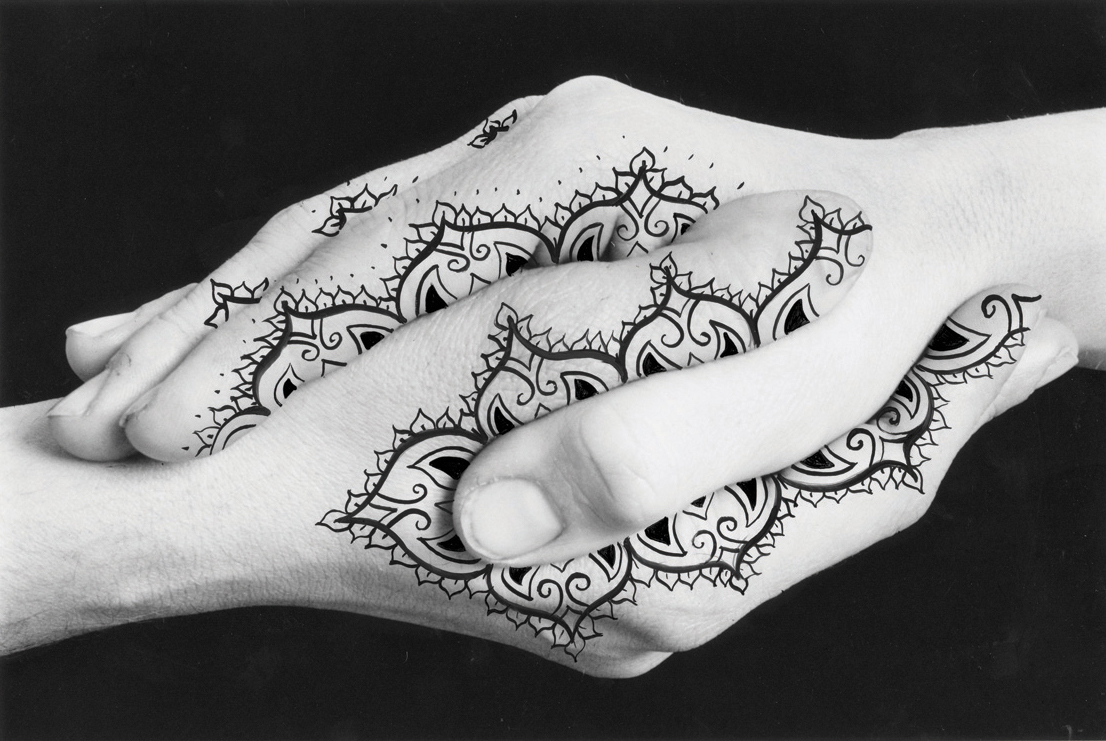
The ceremony took place at the Monaco Hotel, in Washington, DC, that city of “northern charm and southern efficacy,” to quote President Kennedy.[1] However, in this case, the setting was perfect. The hotel is right across the street from the Chinatown Metro exit. (DC’s Chinatown, by the way, boasts the highest density of Mexican restaurants this side of San Antonio). Anyway, you could hop on a train and hit the museums, which younger, single, available son Ned and I did to catch the Iranian artist Shirin Neshat‘s exhibit at the Hirshhorn. Her photographs and films create an aura of beautiful strangeness and remind you just how different and alike human beings can be, and, of course, there is nothing more universal than marriage ceremonies.
photograph by Shirin Neshat
More, importantly, you could walk from the hotel to the rehearsal dinner at 600 F Street and avoid cab/Uber fares, not to mention vehicular manslaughter. It amazes me that in 2015 that the bride’s parents still pay for the wedding and the groom’s parents pay for the rehearsal dinner, but in this case, doing so saved the Birdsong-Moores from putting a second mortgage on their house or my having to sell my prized collection of very well-used — snap, crackle, pop — LPs dating back to the early ‘60’s .
If I do say so myself, the dinner went off well, the Lebanese food was excellent, and we ran out of alcohol just about when we were supposed to be out of there.
Like I said, I’ve only been to two rehearsals before, my own and one of a friend. Judy Birdsong and I had a no-frills, bagpipe-less ceremony that my father-in-law clocked at 23 minutes. My friend’s rehearsal was much longer, but I think that was attributable to the bedroom-slipper sporting wedding director’s being in the first stages of Alzheimer’s.
A Jewish wedding is more complicated, though. At the rehearsal, Taryn and Harrison pantomimed circling around each other, first Taryn circling Harrison, then Harrison circling Taryn — sort of like a cross between flamenco dancers and prizefighters — and then they interlocked arms and circled as a pair. It was very beautiful. Then her brother Logan went over and pantomimed picking something up and reading from it, and we practiced processing and recessing a couple of times, and that was it.
Rabbis seem much more involved in weddings than Protestant ministers, or this one, the excellent Arnold Saltzman, was. Short, slightly stooped, smiling that comfortable smile that those who have made peace with metaphysics do, he looked as if he had stepped out of central casting. As it turns out, he is a big deal, has composed four symphonies and an opera and was an internationally sought-after cantor until a virus did in his vocal chords. Relaxed, he made slight jokes, even during the ceremony. When I thanked him at the rehearsal for performing the service on his Sabbath, he waved his hand dismissively and said, “This is about love.”
wedding day
The day of the wedding dawned with drizzle, which eventually turned into a downpour, but for me, who had nothing much to do except practice reading a poem and memorizing my toast, it was a non-issue. The bridesmaids and groomsmen weren’t so lucky. At noon, they were off on a five-hour photo shoot in various locations around the capital.
Judy had an appointment with a make-up person at eleven-thirty and came back to the room with fake eyelashes and a Buster-Keaton-thick coat of pancake make-up. She went back to lighten it a bit, but the woman knew what she was doing because over the course of the day it faded, and by the time of the ceremony, she looked less like Joan Rivers and more like herself. Here’s a picture of her ordering at a Mexican Restaurant in Chinatown a couple of hours later.
The family pictures were taken in the lobby at 4:45, and then we went to a room for the “signage.” Rabbi Saltzman produced a certificate of marriage and had witnesses read prayers and sign documents. Judy and Taryn’s mother, Susan, also read a prayer. There’s a board, suitable for framing, written in Hebrew and English on the left-hand side and with art the bride and groom choose on the right-hand side. This board is what brother Logan had been holding in pantomime during the rehearsal.
* * *
Finally, it was time.
We walked down the hall and waited just outside the Paris Ballroom. Inside, a stringed quartet had been playing Jewish folk music. The wedding director opened the double doors, the quartet started playing again, and the groomsmen processed followed by Judy, Harrison, and me locked arm in arm, followed by the bridesmaids, and then by Taryn and her parents, Chris and Susan, locked arm-in-arm. I prefer this ritual to the Christian procedure where the groom appears from seemingly nowhere at the altar and the bride comes in escorted by only her father.
Of course, a room full of loved ones made the proceedings more emotional than the rehearsal. Parents sit in a row that would be behind the altar in a Christian ceremony, so we had a really intimate view of the proceedings. The bride and groom did their circling, the Rabbi prayed, talked, chanted; then father Chris and I were summoned to read, he a passage from the “Song of Songs” and I from the ee cummins poem “I Carry Your Heart”:
here is the deepest secret nobody knows
(here is the root of the root and the bud of the bud
and the sky of the sky of a tree called life; which grows
higher than soul can hope or mind can hide)
and this is the wonder that’s keeping the stars apart
Like the poem, the service was beautiful. The board came out, brother Logan and mother Susan read from it. The Rabbi spoke and sang, rings were produced. First Taryn, then Harrison, read letters to each other explaining why each had fallen in love. Vows were exchanged, Harrison smashed a glass with his foot — Mazel Tov! — and they were married, man and wife without kissing. Then before recessing, they turned beaming and faced each side of the audience who flanked them rather than being arranged in rows behind.
Another nice touch is that when we the parents processed, we did so so abreast, arm-in-arm, a now joined family ourselves, the Birdsong-Moore-Antigones or the Antigone-Birdsong-Moores.
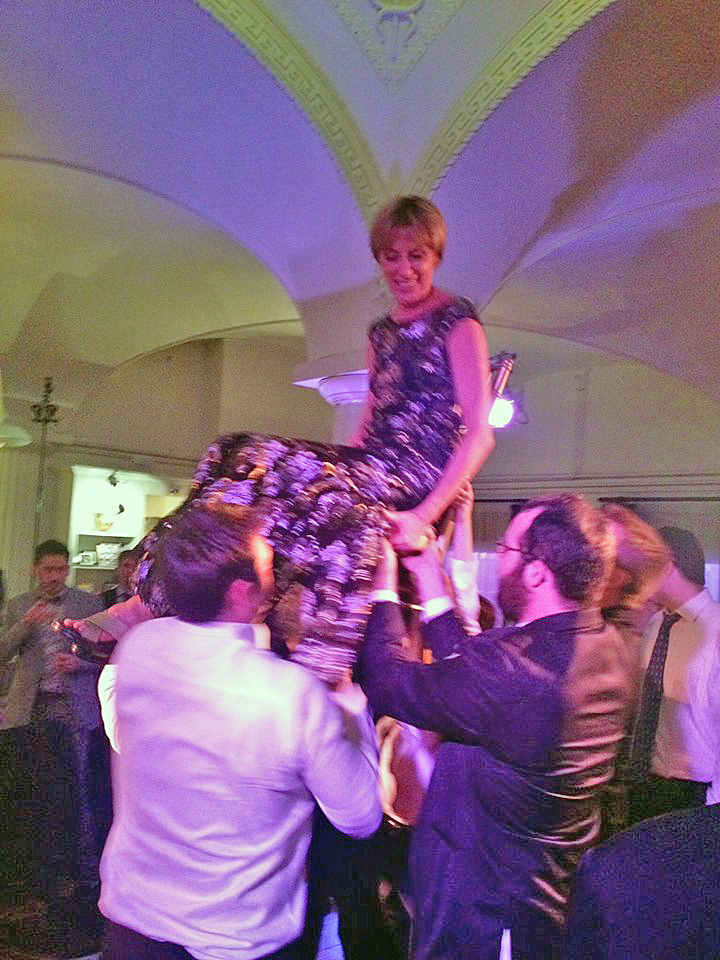
This post has gone on long enough, so I’ll skip the delightful reception, the delicious dinner, the toasts – though I have to mention the hoisting in chairs, which, is actually a lot of fun in a carnival ride type of way.
Being surrounded by people I love was so wonderful, my brothers and sister and nephews and nieces and their spouses, my in-laws, old friends I’ve known longer than Judy, the friends I’ve met since our marriage or during my career, new friends I met at the ceremony. How nice every single one of Taryn’s friends were with their warm smiles, handshakes, and hugs.
We danced the rest of the night away doing the Wa-Wa-tusi like Bela Lugosi.
I’ll leave you with the final line of my toast:
“I look forward to the birth of our first granddaughter, Wesleyanna Susan Christine Birdsong Antigone Moore – be fruitful and multiply!”
[1] Hat tip to Richard O’Prey for turning me on the phrase.
We’ve fled the heat, humidity, and high drama of Charleston to celebrate the marriage of our elder son, Harrison, in DC. In fact, I’ve just put the finishing touches on a couple of toasts I’ll be delivering, one at the rehearsal party and one at the reception dinner.
Not surprisingly, wedding traditions vary north and south of the Mason-Dixon line. Traditionally, wedding receptions down south didn’t include a sit-down dinner. Mine certainly didn’t. It was held at a swanky club atop a high rise in Decatur, Georgia, but the guests stood as they munched on heavy hors d’oeuvres and sipped champagne. No one raised a glass in a communal toast. That had been done the night before at the rehearsal dinner.
My first sit-down postnuptial dinner caught me by surprise. A transplant from Chicago’s sister had married, and when Judy Birdsong and I sauntered into the reception at the Country Club of Charleston, we figured the festivities would last forty-five minutes or so, and this was back in the day of baby-sitters. Nevertheless, it was lovely and lavish and no doubt very expensive. Perhaps that’s why Southerners didn’t throw big sit-down shindigs after weddings – we were too poor.
At any rate, my first toast will be of the welcoming variety, and I’ll save the heavy Faulknerian bombast for the wedding reception. In the meantime, I’ve been gadding about the District checking out the U Street Corridor where we’ve rented an apartment (tomorrow we transfer lodgings to the Monaco Hotel where the ceremony will take place).
Scrub It Off!
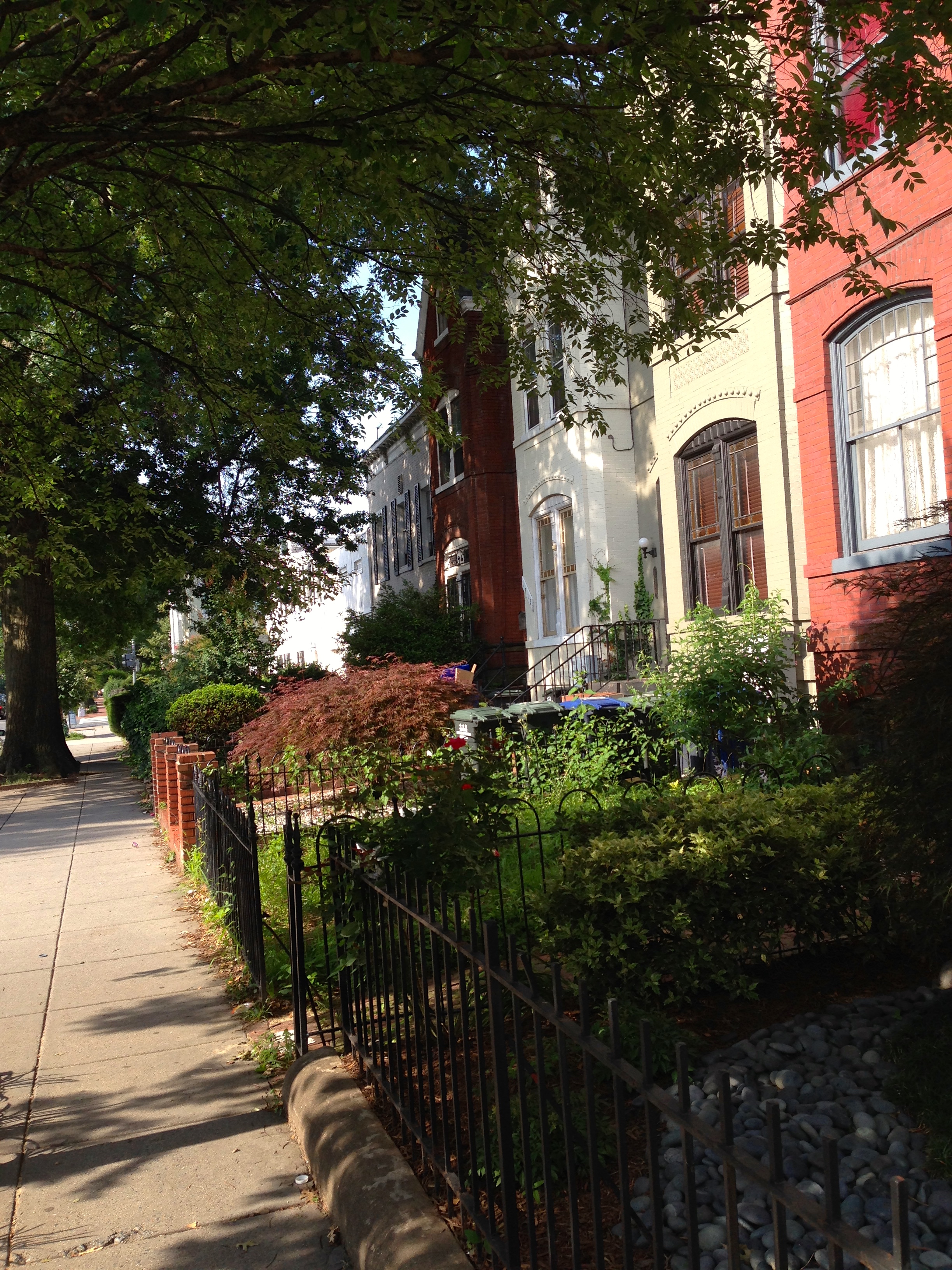
The U-Street Corridor is DC’s version of Harlem, dubbed as the “Black Broadway” by Pearl Bailey back in the day, and our apartment is located on the same block as Duke Ellington’s boyhood home. Of course, there are no Confederate flags flying here, but I did notice this perhaps problematic display on the façade of the famous eatery Ben’s Chili Bowl.
Of course, in keeping with the tradition of Birdsong frugality, we’ve been riding the Metro instead of taking cabs, and what has struck me about that experience is the incredible interiority of the commuters as they stare into their cell phones or into space as they listen to music through their ear buds. It’s as if they’ve pulled the blinds on the outside world. Need I mention that in general people are not as friendly up here?
Obviously, it’s been a horrible week in Charleston, and the Confederate flag is an embarrassment, but one thing I’m not embarrassed about is hailing from the South. We’re an odd bunch for sure, but we know how to tell a story, draw out a vowel, and boil us up some peanuts. Imagine American music without the South – imagine American culture without the South.
All I can say is praise be for blacks and crackers, hillbillies and debutantes.
When I was growing up in South Carolina in the ‘50s and ‘60s, the Confederate Battle flag represented for me “the Lost Cause,” that noble, heroic, and tragic conflict fought to ensure that states had the right to govern themselves. My home state had led the way and seceded from the Union rather than suffer the indignity of having others – foreigners from New York or Ohio — impose their views and tariffs upon its sovereignty.
States Rights as the War’s rationale had been preached to me by my father and reinforced in the South Carolina history courses I took in the third and eighth grades. Those textbooks claimed that economic sanctions, not slavery, had ignited the tinderbox, and although a few bad apples taint every barrel, the vast majority of slaveowners were benign ladies and gentleman who loved Mammy and Uncle Remus. And if you doubted these truths, you could watch Gone with the Wind to see for yourself how positively symbiotic the relationship between whites and blacks had been.
So when the South Carolina began to celebrate the War’s centennial, 9-year-old-me was happy to see the Battle Flag hoisted upon the dome of the Capitol beneath Old Glory and our distinctive state flag with its palmetto and crescent moon. It didn’t occur to me that the Confederate flag’s presence had anything to do with the Civil Rights movement, and even it it had, I probably wouldn’t have cared. After all, wasn’t the Civil Rights movement a replay of the war, outsiders imposing their wills on us?
Flash forward a half a century, and guess what, I’ve learned a thing or two. For example, I’ve read the Declarations of Secession of the Confederate states. Here’ are the first two paragraphs of Mississippi’s:
In the momentous step, which our State has taken of dissolving its connection with the government of which we so long formed a part, it is but just that we should declare the prominent reasons which have induced our course.
Our position is thoroughly identified with the institution of slavery – the greatest material interest of the world. Its labor supplies the product, which constitutes by far the largest and most important portions of commerce of the earth. These products are peculiar to the climate verging on the tropical regions, and by an imperious law of nature, none but the black race can bear exposure to the tropical sun. These products have become necessities of the world, and a blow at slavery is a blow at commerce and civilization. That blow has been long aimed at the institution, and was at the point of reaching its consummation. There was no choice left us but submission to the mandates of abolition, or a dissolution of the Union, whose principles had been subverted to work out our ruin.
So much for trade tariffs being the cause of the war, and if indeed, slavery is the reason the South seceded, then doesn’t it follow that the Lost Cause was evil? Here’s Robert E Lee on the subject:
So far from engaging in a war to perpetuate slavery, I am rejoiced that slavery is abolished. I believe it will be greatly for the interests of the South. So fully am I satisfied of this, as regards Virginia especially, that I would cheerfully have lost all I have lost by the war, and have suffered all I have suffered, to have this object attained.
As someone who teaches literature, I’ve also learned a thing or two about symbols, that they must be interpreted within their contexts — white Moby Dick doesn’t symbolize purity. e.g. It follows that symbols’ meanings change as their historical contexts change.
Throughout its history, the swastika represented life, sun, power, strength and good luck. In the early 20th century, it was still considered a positive symbol. During World War I, it was found on shoulder patches of members of the American 45th Division and the Finnish air force. Only after the Nazi period did its connotation change.
In the USA, you have the existential right to maintain that the original symbolism of the swastika is its true meaning, but if you decide to wear one as a lapel pin, you’re likely to be frowned upon.
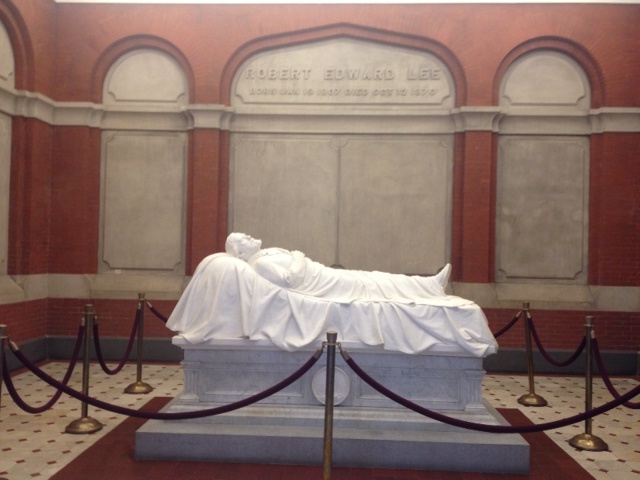
Now when I see the Battle Flag, I think of Lester Maddox or George Wallace or Dylann Roof, not of Robert E Lee. As Allan Gurganus put it in a NY Times editorial in 1996, “the forces of hatred have co-opted [the flag].” Or to quote my friend and former student David Connor Jones, “I find it odd that all my erudite southern friends who still defend the flag do not have the decal on their cars, much less fly it at their homes. Why do you think that is?”
In another editorial appearing in the Roanoke Times last July, David Cox, former rector of RE Lee Memorial Church in Lexington, writes about Washington and Lee University’s removal of Confederate flags from its chapel:
Confederate battle flags, or their replicas, surrounded the statue [of Robert E Lee] from 1930 until last week, when the university removed them. To me, their absence pays more homage to the memory of its most famous president than their presence. Judging from the thousands of his letters I’ve read in exploring his faith, for all his deeds, heritage and acclaim (and animosity) accorded him, Robert Edward Lee was at heart a humble soul striving to do his duty to his God and his country. Those flags didn’t fit the person who came to Lexington in 1865.
He also adds, “Someone wrote me of a woman asking Lee what to do with an old battle flag. Lee supposedly responded, ‘Fold it up and put it away.’ Though I’ve not verified the account, it is consistent with his letters and acts of his last years. He was always looking ahead.”
Let’s follow General Lee’s example and remove the flag from the State House grounds so we can turn our attention to more meaty matters — like gun control.
A former housemate of mine, James Paul Rice, has a historical novel coming out next year based on the 1822 Denmark Vesey uprising. Being a native of the Lowcountry of South Carolina, I was somewhat familiar with Denmark Vesey, but he came absolutely alive for me as I read Mr. Rice’s novel in manuscript. Several pivotal scenes from the novel are set at the Emanuel African Methodist Episcopal Church, which Vesey helped to found in 1816.
It is at this church that last night’s horrific mass murders took place. The alleged murderer, Dylann (sic) Root, can be seen in a photograph wearing a jacket with two white supremacist patches, one from South Africa and the other from Rhodesia. Is it possible that the Vesey connection played a role in Root’s selection of settings? After all, he’s from Columbia, which has a number of more conveniently located AME churches. Why drive all the way down to Charleston? Did Root choose Emanuel because of its historical significance? Its connection with not only Vesey but with the Civil Rights movement? Did he know that Dr. King had preached there?
I can’t help but think of Cass Mastern’s “spider web” theory from Robert Penn Warren’s All the King’s Men – his theory about the karmic connections of events through time:
[Mastern] learned that the world is like an enormous spider web and if you touch it however lightly, at any point, the vibration ripples to the remotest perimeter and the drowsy spider feels the tingle and is drowsy no more but springs out to fling the gossamer coils about you who have touched the web and then inject the black, numbing poison under your hide. It does not matter whether or not you meant to brush the web of things. Your happy foot or your gay wing may have brushed it ever so lightly, but what happens always happens and there is the spider, bearded black and with his great faceted eyes glittering like mirrors in the sun, or like God’s eye, and the fangs dripping.
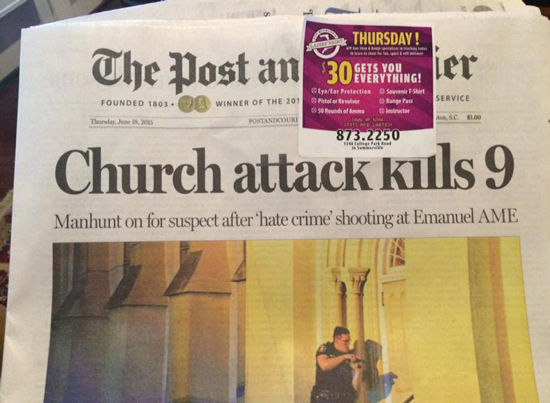
Of course, I’m merely speculating, and it doesn’t ultimately matter. Nine God-fearing people are dead because of the pigmentation of their skin. Another young white male starved for attention has gotten it in the worst way. The Confederate battle flag is flying on our State House grounds at full staff as I type this and will continue to fly for another generation or two. In the foreseeable future, assault weapons will still be easier to obtain than driver’s permits. In fact, the awful headline in this morning’s Charleston paper was somewhat obscured by an advertising sticker from a gun shop. Intemperate souls will suggest that the worshippers should have been packing heat, and if that’s what it’s come to here, that grandmothers cannot go to church unarmed, then “American” can no longer be used as an adjective for civilization.
No, let me end with another quote from All the King’s Men:
After a great blow, or crisis, after the first shock and then after the nerves have stopped screaming and twitching, you settle down to the new condition of things and feel that all possibility of change has been used up. You adjust yourself, and are sure that the new equilibrium is for eternity. . . But if anything is certain it is that no story is ever over, for the story which we think is over is only a chapter in a story which will not be over, and it isn’t the game that is over, it is just an inning, and that game has a lot more than nine innings. When the game stops it will be called on account of darkness. But it is a long day.
My girlfriend and I have recently booked an all-inclusive vacation package to the Realm of Hyperliteracy.
She’s 47 – hardly a girl – but she is not, strictly speaking, my partner because we do not cohabitate, and certainly the descriptor paramour stresses too much the sexual component, which though important, is not the central focus of our relationship.
I wish I could call her my fiancée, but the truth of the matter is that she is a widow twelve years my senior, and remarrying would not be financially prudent because of certain stipulations in her insanely possessive late husband’s will.
Perhaps in the Realm of Hyperliteracy, I shall discover the perfect word to describe an exclusive sexual partner with whom one does not reside. In this case, one envies the German language’s facility to create multiple compounds. In German, one can have a steadysexmatewhodwellsapart, but in contemporary American English, one is stuck with inaccuracies like “girlfriend,” or worse, vulgarities like “main squeeze.”
As you may know, the Realm of Hyperliteracy is the brainchild of Sir Oglethorpe FitzSybil, who in the foothills of the Austrian Alps has established the perfect vacation spot for extroverted bibliophiles who crave conversational partners who express themselves precisely, men and women who recognize that singular antecedents demand singular pronouns, men and women with whom one can communicate without fear of their not knowing the definition of agitprop or schadenfreude, men and women who have read Flaubert’s Salammbô as well as his Madame Bovary.
In short, men and women who find the splitting of infinitives infinitely irritating.
The brochures have made it exceedingly clear that each visitor has been carefully screened – and endured a comprehensive exam – to insure that he (forgive the colloquialism) passes muster.
Felicity (not her real name) is taking me to Realm of Hyperliteracy to celebrate my thirty-fifth birthday. As you remember, it was exactly at three-score-and-five that Dante Alighieri awakened in that dark wood and began his journey through hell, purgatory, and paradise. Although rarely celebrated as a significant birthday in the States — one never hears “Sakes, sakes alive/ Reginald is turning thirty-five” — one could argue that since it’s half of the biblical allotment of seventy years, the thirty-fifth anniversary of one’s nativity is truly a momentous milestone.
I’ve decided in the tradition of Boswell and Johnson to keep a journal of my travels so that in my later years I can recall accurately the events. Photographic equipment of all types, even cellular telephones, is strictly forbidden. Visitors are limited to one carry-on sized bag. When one books, he provides his measurements, and the wardrobes of rooms are stocked with clothing that patrons are required to wear during their stay. Need I mention that computers are verboten as well?
Day 1
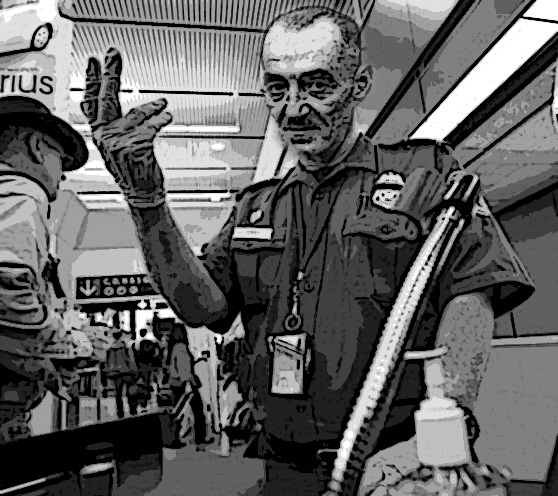
I wish I could say that our grand launch is going smoothly, but alas, that would be a prevarication. The passage through security was especially vexing because I had not been informed that the TSA had relaxed their security guidelines; therefore, I had unnecessarily segregated my liquids into plastic bags, and when I began removing my belt and shoes, a very unpleasant man in a uniform who was a dead ringer for Oskar Dirlewanger growled menacingly at me. He projected a heightened sense of expediency, which turned out to be completely unnecessary because we ended up sitting in the plane for a seeming eternity before our taking off.
More vexing is– I use the appellation loosely – the gentleman sitting to my left (I have ceded the window seat to Felicity). Before I feigned a nap, this contemporary Kowalski jabbered non-stop for hours detailing his numerous trips abroad, a monologue rife with indelicacies of phraseology. No, I have never visited a “tittie bar” in Amsterdam nor “had me a wheat beer in Dusseldorf.” If I had a Euro for every time he has punctuated his sentences with “you know,” I could have flown first class instead.
Even more vexing still, I’ve made the mistake of sharing with Felicity the introduction reproduced above, and she erroneously argues that the verb in the second sentence of the last paragraph should be are instead of is, i.e., the sentence should read, according to her, “Photographic equipment of all types, even cellular telephones, are strictly forbidden.” Despite that “equipment” is obviously the subject — no one says the “the equipment are in working order“– she argues that the aggregate of plurals after the subject, “types” and “telephones,” supersedes the singular subject and poetic license demands the less sonically jarring plural “are.”
“But I am not a poet,” I said somewhat hotly.
Unfortunately, she kept on, and I regrettably ejaculated in frustration the interjection “balderdash” at which she turned her head to the window and cried herself to sleep.
As I record these words in my journal, the gentleman to my left is snoring like a draft horse.
Day 2
Perhaps, it is the jet lag or a hangover from the malodorous mood of the flight over, but I find the gated grounds and cluster of buildings of the Realm of Hyperliteracy to be less grand than the photographs of the brochures suggested. “Potemkin village” is perhaps hyperbolic in its censure; however, there is something, let us say, Disneyesque about the ersatz bricks that form the manor’s façade.
Furthermore, even though the hotel boasts fifty rooms, very few people – a mere nine, including yours truly and his companion – are staying here. Except for a young bohemian, whose profusion of tattoos would be the envy of Flannery O’Connor’s O.E. Parker and the bohemian’s paramour, a gum-smacker who looks as if she selected the shade of blue of her dyed hair from a Sherwin-Williams paint palette, the rest of the hotel patrons have reached, at the very least, their eighth decade.
It’s as if they’ve been bused in from that depressing poem of Philip Larkin’s.
Furthermore, we’re not allowed to leave the grounds, meaning that all meals must be taken at the hotel.
However, there is something about which to look forward. During the evening cocktail party – attendance mandatory – they’re going to stock our closets with clothes, now that the one or two outfits we packed in our carry-ons have been, shall we say, exhausted.
Well, we’re off to the cocktail party. I shan’t go into the so-called “make-up sex” Felicity and I facilitated, but let us merely convey that it was very satisfactory.
Day 3
What hours, O what black hoürs we have spent
This night! what sights you, heart, saw; ways you went!
I fear that anyone reading my depiction in this journal of the events of last night will dismiss them as the ravings of a madman or consider them the product of some gothic fiction writer’s over-stimulated imagination, some imitator of Poe’s lurid attempt to out-Monk-Lewis Monk Lewis.
It began with the cocktail party, hosted by none other than Oglethorpe himself. He looks as if he’s stepped right out of, as they say, central casting, a pudgier cross between Christopher Lee and Basil Rathbone; in other words, he’s tall with slicked-back hair, a patrician English accent, and a hawkish nose.
One of the lamentable aspects of extreme old age is that the process seems to efface the individuality of its victim. I could hardly distinguish the two women and the two men from each another. They, to-a-thing, each had white hair, or some white hair and age-spotted scalps, wrinkled faces, necks, hands. Even more vexing, they all were as deaf as cinder blocks. Indeed, I couldn’t believe they had passed the perquisite exam that lies at the heart of Realm of Hyperliteracy’s application process. The multiple-choice section was exhaustive and the free response essay questions ridiculously esoteric.
So Felicity and I found ourselves forced to chat with the Bohemian and his consort who claim their names are Ataturk and Absinthe, obvious noms-de-guerre.
Both also claim to be on a tenure track at NYU. In their speech, they attempt to approximate the patois of the so-called Beat Poets, whom they revere. In other words, they consider themselves “hep cats” who find “strict grammatical formalism a mere product of class bias,” and when I admitted that I could not share his and her enthusiasm for Ginsberg and his ilk, Absinthe traced in the air with her fingers the geometric outline of a square.
After a couple of watery scotches, Oglethorpe instructed that we return to our rooms and dress for dinner.
Indeed, the closets had been stocked, and indeed the garments fit well – my tuxedo was Orlon but sufficiently tailored – but whoever provided our attire had failed to provide undergarments, and when Felicity went to retrieve a brassiere and the lower undergarment from the bag she had packed, we discovered a note on the dresser informing our clothes have been removed to the laundry.
Every single gown was diaphanous, as sheer as a provocative negligee, and I prayed to that non-presence that Emily Dickinson described in her first letter to Thomas Wentworth Higginson as “a vacancy” that the two crones with whom we must dine that evening had been provided with less revealing attire.
Of course, not attending dinner was not an option. As soon as the bell chimed to come downstairs, the listening devices I had not noticed turned into speakers blasting Barry Manilow at ear-piercing decibels.
But, no, the crones, they too! They too were dressed diaphanously!
When we gathered at the table, I glanced at the female octogenarians the way one feels impelled to glance at highway carnage but quickly glanced away. Suddenly, for the first time I could truly appreciate the “Wife of Bath’s Tale.” On the other hand, there were Felicity and Absinthe, leaving not nearly enough to the imagination. It occurred to me that younger women did enjoy certain advantages that age had robbed their older sisters of. [Note to self, recast sentence without offending ending preposition].
I was seated next to Ataturk, who winked at me and said, “Oglethorpe” with the initial O vowel shortened to an “ah”
“Yes? Oglethorpe.”
“Ogle – Thorpe. O-g-l-e-thorpe.”
I felt like a fool for not thinking of it myself.
I’ve always preferred Henry James to Hemingway, but I’m finding that the latter’s stripped down style might be preferable here for the sake of journalistic expediency. I have clandestinely composed these notes in the wee hours. I must manage to get to sleep. After breakfast there’s a reading . . .
Day 4
An all day reading in German of Kafka’s The Kastle with surtitles projected in English on a sheet hung from the ceiling.
Day 5
I’m at the end of my rope. Rope! A rope, my kingdom for a rope! Certainly, Solzhenitsyn could not have endured this! That hook-nosed son-of-a-bitch! I’m gonna kills his ass. None of the maids speak English. There’s gotta be a way out. Tunneling? Maybe Ataturk will join my cabal, a cabal of two, tea for two, and two for tea.
Day 6
Ata sez the gates are electrificated. Saw a bird fly into it and get fried. Felicity has abandoned me and sleeps now with Oglethorpe. Same deal with Abby and Ata. The old folks have died off, one a day. Ata sez we be good as dead. No way we getting outta here to write reviews of this horrorshow holiday.
Day 7
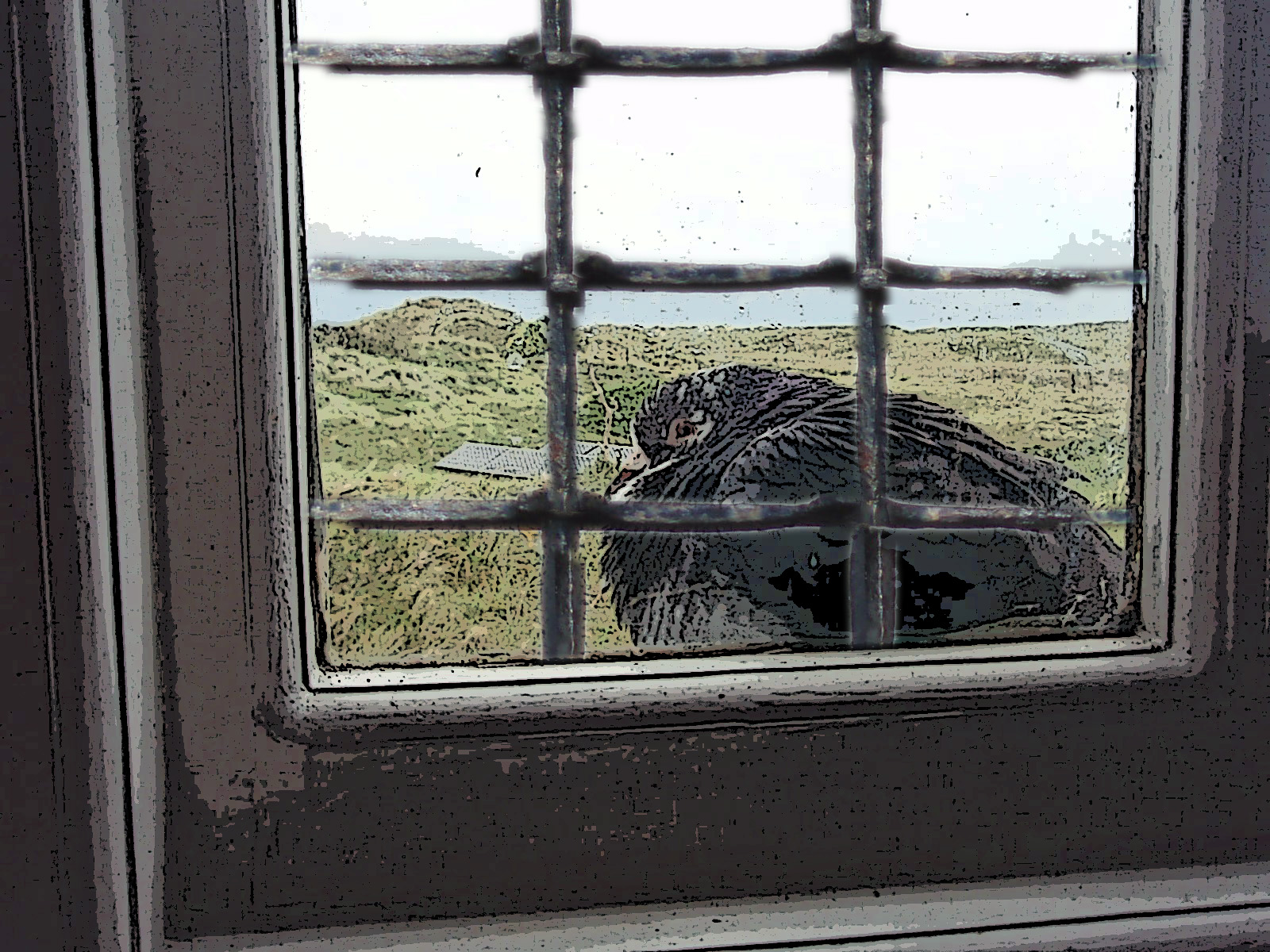
A carrier pigeon has landed on the sill of my barred window. Is it a vision or a waking dream?
I’ve just sailed through the uncorrected proofs of long-title-lover Elijah Wald’s latest, Dylan Goes Electric: Newport, Seeger, Dylan, and the Night that Split the Sixties. The book is slated for publication on 15 July 2015, almost fifty years to the day after Dylan shocked the Newport Folk Festival by going electric, and I encourage anyone interested in popular music to check it out.
Wald’s previous books include Robert Johnson and the Invention of the Blues and How the Beatles Destroyed Rock ’n’ Roll: An Alternative History of Popular Music. A musician himself, Wald possesses that rare ability to weave meticulous research into engaging narratives propelled by conversational but polished prose. It’s as if someone with an advanced degree in history and musicology who witnessed the events first hand is talking to you.
Wald begins his chronicle in 1949 with the story of Pete Seeger, yet another one of Harvard’s incredibly successful dropouts. We follow Seeger through the ‘40s and ‘50s as he becomes both an archivist of traditional music and a creator of original “folk songs” like “The Hammer Song (If I Had a Hammer)” and “Where Have All the Flowers Gone.” The folk scene of the 50s and early 60s was no love fest, or as Wald puts it, “[The] tendencies and cliques of the American folk scene [. . .] were endlessly tangled, but Seeger served as a guide for virtually everyone, whether they considered themselves traditionalists, revivalists, agitators, or potential pop stars.” Nevertheless, even Seeger himself received criticism from the most rigid of folk purists for associating himself with the Weavers whose polished performances weren’t authentic enough for their tastes.
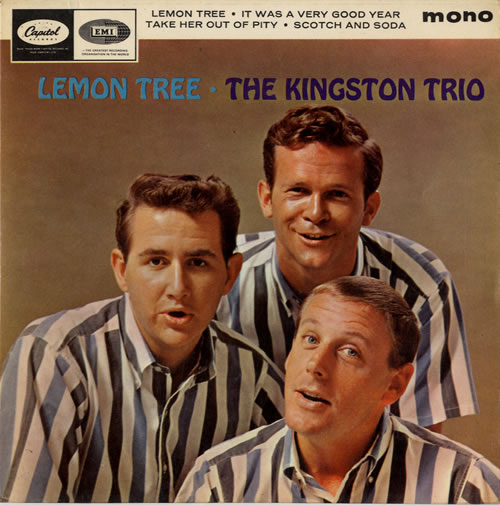
This static between the rawness of down-home renditions by performers like Doc Watson and the dulcet harmonies of groups like the Kingston Trio (arrayed in matching outfits) crackles throughout those decades, and Wald does an excellent job of providing a historical context, especially in his depiction of the Red Scare. Wald concludes the first chapter with Seeger’s sentencing in 1961 for contempt of Congress when he refuses to name names of associates with connections to the Communist Party.
The next few chapters detail the familiar but time-obscured transformation of Hibbing-bred Bobby Zimmerman into that self-created icon we call Bob Dylan (whose fanciful verbal autobiography had him hoboing his way across the continent). Wald provides some clarification for those early days, noting that unlike many adolescents who were ignorant of rock ’n’ roll’s R&B roots, Bobby Zimmerman through late night radio broadcasts, especially Frank “Gatemouth” Page’s No Name Jive, discovered the likes of Muddy Waters and Howlin’ Wolf. Wald notes, “Dylan was getting the music direct from its southern source and valued it in part because it was secret knowledge.” Again, we see tension between the authenticity of artists like John Lee Hooker and the co-opting of roots music by white performers like Elvis and Buddy Holly. That Dylan was enamored of R&B before he became a folk singer is well-known but worth repeating, given his eventual embrace of rock ’n’ roll.
In the chapters chronicling Dylan’s hero-worship of Woody Guthrie, his move to New York, his ascent, and eventual coronation as once and future king, we see the continuation of the motif of contention among the folk music community, and at the Newport Folk Festivals of the early-to-mid 60s, these rifts widen into chasms. Wald does a masterful job of relating the events of the festivals, cataloging in detail the eclectic mix of performers that range from obscure yodelers, rock icons like Chuck Berry, blues masters like Lightening Hopkins and John Hurt, Bluegrass legends Bill Monroe and Ralph Stanley, folk interpreters including the Weavers, Joan Baez, and Judy Collins. How fortunate those aficionados who could attend the workshops, scheduled but informal get-togethers where a group of performers swapped songs and provided instruction. Dig this, at the ’64 festival:
“[R]elatively small contingents gathered to hear successive guitar and banjo workshops that included Muddy Waters, Robert Pete Williams, the Hawaiian guitarist Nolan Mahoe, and [Doc] Watson, and then Mike Seeger again with Ralph Stanley, Frank Profit, and Elizabeth Cotton. Meanwhile, over two-thousand people were watching Mike’s half-brother Pete host a topical songs workshop, and although it began with older artists from Ireland, Cuba, and the United States, most of the audience was there for the who’s who of Broadside writers Len Chandler, Phil Ochs, Tom Paxton, Malvina Reynolds, Hedy West, and Dylan.
Among the diverse crowds, we again see animosity of roots music devotees towards college-aged pop fans, and with the British Invasion of the Beatles, Stones, and Animals, folk music had in fact begun its decline in popularity. Of course, the culmination of the schism occurred on Sunday night, 25 July 1965, when Dylan, as Wald title puts it, goes electric.
Wald’s meticulous detailing of previous festivals makes it crystal clear that Newport was no stranger to amplified music. At the ’65 festival, “[t]here were more amplifiers in evidence [. . .], and they were recognized as a sign of change, but few people considered them as a sign of sacrilege.” The Paul Butterfield blues Band played an electric (and by all reports electrifying) set Saturday as an illustration of the amplified Chicago Blues made famous by Muddy Waters. This performance was part of a sonic history of the folk music presented as a lecture by Alan Lomax, and indicative of the animus inherent in the various authenticity camps, Lomax, a stickler for authenticity, and Alan Grossman, a developer of musical acts (and Dylan’s manager), broke into a a clownish bout of fisticuffs over Grossman’s objections to what he considered Lomax’s disrespectful intro of the Butterfield Band. Wald’s depiction of this incident – a sort of kaleidoscopic presentation from various, sometimes conflicting, witnesses’ perspectives – is alone worth the price of purchase. Here’s a snippet:
Lomax tried to push Grossman aside, or maybe it was Grossman who pushed Lomax. Either way, in seconds the portly prophet of tradition and the portly purveyor of mammon — “two big bears,” in Maria Muldaur’s description — were throwing inept punches and rolling in the dust.
Of course, all of the various in-fighting that Wald writes about leads up to Dylan’s performance that Sunday night. Because of the not so simple existential fact that except for edited film, all we have to go on is a jumble of individual perspectives from various people sitting in different locations with different attitudes towards Dylan and with memories perhaps corrupted by the passage of time. Wald provides us with a sort of cubist painting, sharing with us a host of individual takes, including a present-tense rendering of the film. He suggests that Dylan’s decision to go electric was impulsive. Perhaps it was a reaction to Lomax’s less than glowing introduction of the Butterfield Band whose guitarist Mike Bloomfield had worked on Highway 61 Revisited and its electric hit “Like a Rolling Stone.”
The make-up of the band also suggests a hasty decision. It consisted of a hodgepodge of musicians, some of whom were unfamiliar with the tunes. The drummer Sam Lay had heard “Like a Rolling Stone” on the radio but didn’t know who Bob Dylan was. Almost all agree the volume was ear-splitting, especially Bloomfield’s guitar, and the performance uneven (a charitable assessment) with much time wasted on stage tuning up, struggling with the tempo, getting started. According to Wald, the bassist Jerome Arnold played essentially one note throughout much of the performance. Dylan, who had grown accustomed to being idolized, heard perhaps his first boos since high school, though the boos were mixed with cheers. The proportions of boos to cheers (60/40? 50/50? 40/60?) seemed to depend on where you were sitting.
Pete Seeger
Most upset by the debacle of Dylan’s performance was Pete Seeger who is reported by some to have sought shelter in his car or by others to have run around screaming to turn down the sound, and Wald forever puts to rest the apocryphal story of an ax-wielding Seeger eager to sever the cables.
Wald manages to place the reader in the visceral world of that concert, no mean trick, and wisely avoids ever attempting to psychoanalyze Dylan, who as we all know by now is a restless soul who changes the tunes of his classics when the mood suits him. As an extra added treat, Wald slips into his prose without quotation marks phrases from Dylan’s lyrics, as in the following from the last chapter’s first sentence, “For many people the story of Newport 1965 is simple: Bob Dylan was being born, and anyone who didn’t welcome the change was busy dying.” I think we can all agree — or at least almost all of us can agree — Dylan’s genius could never be constrained within the confines of folk. I don’t know about you, but I prefer Highway 61 to Freewheeling.
Note: As I said, I read the uncorrected proofs so the book is bound to be even better than my version. It’s heavily noted, has a bibliography, and although my copy lacked an index, one will appear in the final edition. As far as errors, I only ran across a couple of typos, except for the phrase, which I hope someone catches — “the nameless protagonist of Albert Camus’s Stranger.” The protagonist’s name is Meursault.












 You Do Hoodoo