The Age Old Anvil of Sorrow

broken

When things get bad for me, I tend to turn to literature in the paradoxical quest to both temporarily forget my personal troubles and to delve deeply into someone else’s. Obviously, great literature universalizes the human condition and reminds us that violence, disease, and sorrow have always been with us and will always be with us.

“Blood will have blood,”[1] like Macbeth says, as if commenting on this morning’s headlines.

His Russian cousin, Ivan Ilyich comes to realize that disease preys on the undeserving just as often as on the righteous (even on the exerciser, the non-smoker).

Meanwhile, despairing Manley Hopkins’ anguished “cries heave, herds-long; huddle in a main, a chief/Woe wórld-sorrow; on an áge-old anvil wince and sing.”

No, to cop out with a cliché – I am not sorrow’s first rodeo. Antigone, Isolde, Hamlet, Emma Bovary, and Alyosha Karamazov have all been there (in despair), done that (grieved) – as have their creators.

antigone4

* * *

The Brothers Karamazov, which I finished yesterday, was June’s project, and Joseph Franks’ 5-volume biography of Dostoyevsky is July’s. The Brothers K offers all the vicarious sorrow anyone could ever desire – childhood abandonment, sexual exploitation, sexual betrayal, filial betrayal, insanity, alcoholism, adolescent angst, dark nights of the soul, and, of course, buckets of blood.

Dostoyevsky

Dostoyevsky

So far, Fyodor Mikhailovich Dostoyevsky’s life hasn’t been much happier. I’m only on page 70 (of 932), and already Fyodor’s mother has died of a lingering mysterious illness, he’s been sent off to a military academy he detests, and now his father has died, most likely murdered by his serfs, and Fyodor has a number of younger siblings who are now orphaned.

Dostoyevsky was a man of his convictions and held to them even when they were unpopular. Throughout his life, from coming to the aid of bullied cadets at the military academy, to reaching out and aiding the peasantry, he practiced what he preached. Or as David Foster Wallace puts it in his essay “Joseph Frank’s Dostoyevsky”:

For me, the really striking, inspiring thing about Dostoyevsky isn’t just he was a genius; he was also brave. He never stopped worrying about his literary reputation, but he also never stopped promulgating unfashionable stuff in which he believed. And he did this not by ignoring (now, a.k.a.” transcending” or “subverting”) the unfriendly cultural circumstances in which he was writing, but by confronting them, engaging them, specifically and by name.

This, DFW maintains, certainly isn’t the case nowadays:

But Frank’s Dostoyevsky would point out (or more like hop up and down and shake his fist and fly at us and shout) that if this is so [i.e., our intelligentsia abjures ideological passion], it’s at least partly because we have abandoned the field. That we’ve abandoned it to fundamentalists whose pitiless rigidity and eagerness to judge show that they’re clueless about the “Christian values” they would impose on others. To rightist militias and conspiracy theorists whose paranoia about the government supposes the government to be just way more organized and efficient than it really is. And, in academia and the arts, to the increasingly absurd and dogmatic Political Correctness movement, whose obsession with the mere forms of utterance and discourse show too well how effete and aestheticized our best liberal instincts have become, how removed from what’s really important – motive, feeling, belief.

In other words, our current condition is one of fragmentation. Both major national political parties are splintering, and the gulf between them ideologically is like light years. Congressional districts twist and turn across maps like wakes from drunken boats. Although you might think that our digital interconnectivity might bring us closer together, it seems to me it isolates us, as we sit at the bar ignoring our friend as we stare down at the screen cultivating some personal obsession. In other words, we suffer from what Dostoyevsky might call radical individuality: I perceive the universe from my perspective; therefore, I must be the center of the universe. Other lives don’t matter as much – white, black, Muslim, Christian, Jew, infidel.

nc12

This attitude of isolation, of course, is a recipe for unhappiness; just ask the diva who demands eleven red roses in a blue vase every time she books a suite facing east in a luxury hotel where some tiny little infraction is going to throw her into a tizzy.

She suffers from disconnection, different but in some ways not unlike the radicalized homegrown terrorist or the arsenal-amassing militiaman or the divorced, underemployed middle-ager attaching the hose to his exhaust pipe.

[cue Barbra Streisand’s “People”]

Here is Alyosha Karamazov after the funeral of little Ilusha addressing Ilyusha’s friends at the end of the novel:

And whatever happens to us later in life, if we don’t meet for twenty years afterwards, let us always remember how we buried the poor boy at whom we once threw stones, do you remember, by the bridge? and afterwards we all grew so fond of him. He was a fine boy, a kindhearted, brave boy, he felt for his father’s honour and resented the cruel insult to him and stood up for him. And so in the first place, we will remember him, boys, all our lives. And even if we are occupied with most important things, if we attain to honour or fall into great misfortune — still let us remember how good it was once here, when we were all together, united by a good and kind feeling which made us, for the time we were loving that poor boy, better perhaps than we are. My little doves let me call you so, for you are very like them, those pretty blue birds, at this minute as I look at your good dear faces.

[. . .]

I say this in case we become bad,” Alyosha went on, “but there’s no reason why we should become bad, is there, boys? Let us be, first and above all, kind, then honest and then let us never forget each other! I say that again. I give you my word for my part that I’ll never forget one of you. Every face looking at me now I shall remember even for thirty years. Just now Kolya said to Kartashov that we did not care to know whether he exists or not. But I cannot forget that Kartashov exists and that he is not blushing now as he did when he discovered the founders of Troy, but is looking at me with his jolly, kind, dear little eyes. Boys, my dear boys, let us all be generous and brave like Ilusha, clever, brave and generous like Kolya (though he will be ever so much cleverer when he is grown up), and let us all be as modest, as clever and sweet as Kartashov. But why am I talking about those two? You are all dear to me, boys; from this day forth, I have a place in my heart for you all, and I beg you to keep a place in your hearts for me! Well, and who has united us in this kind, good feeling which we shall remember and intend to remember all our lives? Who, if not Ilusha, the good boy, the dear boy, precious to us for ever! Let us never forget him. May his memory live for ever in our hearts from this time forth!”

Love.

Unknown


[1] Especially when purchasing an assault rifle is easier than buying a tube of cortisone cream.
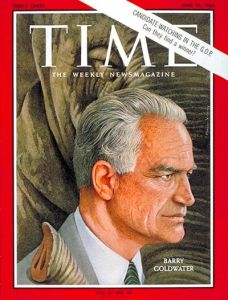
Hillary, Barry, and Me

1101630614_400Like Hillary Clinton, I, too, worked for Barry Goldwater in the ’64 election, although I was only 12. Growing up in Summerville, South Carolina, I had inherited this tiny hamlet’s folkways, which is just another way of saying I was a racist, although a relatively benign one. In Summerville, not only could you encounter a “whites only” sign above the laundromat, but also patients in doctors’ offices were segregated into separate waiting areas, like dogs and cats waiting to see a vet.


My parents did not hate black folk – we were taught not to use the n-word and loved our “maid” Alice like an aunt – but my folks deemed “colored people,” as they called them, inherently inferior.[1] Obviously, given that he had voted against the Civil Rights Bill, Barry Goldwater was their man, so our 1964 Ford Falcon station wagon sported an Au(H20) bumper sticker because we wanted “a choice not an echo” and “in our hearts” we knew “he was right.”

The fledging Dorchester County Republican Party had rented the defunct movie theater as Goldwater headquarters where they distributed buttons and bumper stickers, and on a couple of Saturdays played the old Fay Wray King Kong movie for an admission fee of ten cents. Among other nominal duties, my job at the theater was to climb a ladder and position letters on the marquee outside. This theater didn’t have a balcony, and even if it did, I doubt if black children would have wanted to donate their pennies to the Goldwater cause. Once, when I took a short cut through one of their communities on my bike (which also sported a Goldwater sticker), I was pelted with rocks, a valuable lesson that freedom of speech can be dangerous.

Well, obviously, Goldwater lost, and I was heartbroken, but attitudes were slowly changing in Summerville. For one thing, the public basketball courts became integrated, even before the school became fully so. I played three-on-three half-court b-ball there after school and on Saturdays. The black kids had different rules – you didn’t take the ball back past the foul line if you got a defensive rebound – but we all got along well, and I got to be friends with these boys before they became my classmates when Summerville’s black and white schools finally merged in 1969. I remember passing a bottle of Boone’s Farm to my pal Mookie at my friend Adam’s one night as we took turns taking swigs. This action would have enraged my father if he could have seen it, even though he was Alice’s children’s Santa Claus, even when we couldn’t afford it.

And so, like Hillary, I switched political sides, I started cancelling my father’s vote out — my very first one cast for McGovern — and politics became a topic best not broached at the dinner table, along with race, and a host of other potentially explosive issues.

It’s hard to believe it’s been fifty years, and although things are much better now, obviously, white supremacy is still alive in darkened, un-Christian anti-intellectual cesspools, and I suspect I won’t see that change in my lifetime. But things do change; people do change sides. It will be interesting to see how many South Carolinians do in this election – if not completely change sides, go for the libertarian candidate.


[1] Alice, for example, called me “Mr. Rusty.”

You can't see it, but there's a Goldwater sticker on the back bumper

You can’t see it, but there’s a Goldwater sticker on the back bumper

The Podiatrist of Avon Quote Challenge


The Podiatrist of Stratford

The Podiatrist of Stratford

Okay, literary scholars, let’s see first if you can identify the play from which these misquotations appear and then rewrite them correctly:


A chiropractor, a chiropractor, my real estate for a chiropractor!


Alas, poor Sheldon. I knew him, Lenny. His stand-up slayed.


Because you’re such a goody-goody, does that mean they’ll be no more cannabis and cocktails? (A piece of cake!)


I ain’t used to getting bitch slapped. (Very obscure)


It is a plot narrated by a mentally challenged person, full of blaring leaf blowers and road rage, adding up to jack shit.


Reciting inaudible paeans to a godless, barren universe. (Fairly obscure)


What’s in a brand? Chanel No. 5 by any other brand name, would still be aromatically effective.


The bad shit you do sticks post-mortem, the good disappears in the crematorium.

On Our Nation’s 240th Birthday

Robert Fowler

Robert Fowler

In the 1980’s, my pal Robert Fowler had a radio comedy show on SC Public Radio that aired on Saturday mornings called The Hog Breeders’ Gazette . I remember fondly one 4th of July program that featured a parody of a school assembly celebrating the founding of our great nation.

One of the contributions to the mock school assembly was a brilliant piece of doggerel that portrayed western expansion as nothing more than undesirables, miscreants, getting booted out of a series of towns forever westward until they reached the Pacific Ocean. I wish I could replicate it for you, but the cassette upon which I recorded it has been lost, and even if it hadn’t been lost, I have no machine upon which to play it, from which to transcribe those rollicking rhythms and clever rhymes.

Alas!

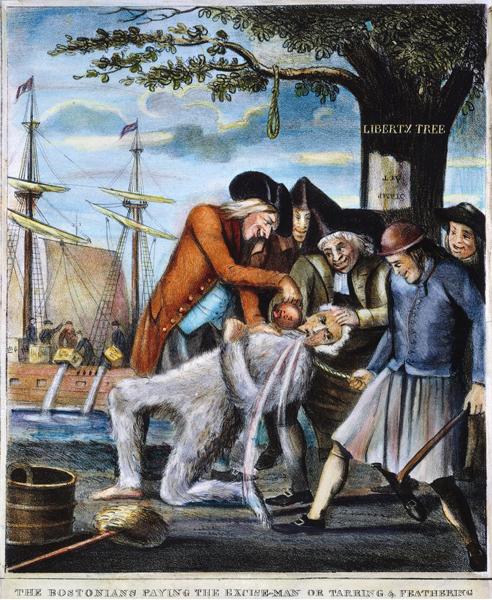
Anyway, the piece eloquently poked fun at the concept of American Exceptionalism, the idea that the United States is the New Jerusalem ordained by the Creator of the Universe as a shining city on a hill to provide the planet with a safe haven for individuals to live their lives in the open spaces that freedom provides. Fowler’s poem portrayed the early populace of these United States, not as idealists seeking religious sanctuary, but as the dregs of Europe, losers, crooks, neer-do-wells so out of synch with their original cultures that they’d risk the wild, treacherous stormy ride across the Atlantic in a desperate attempt to escape. These were the scalawags that inhabit The Adventures of Huckleberry Finn, candidates for tarring and feathering, ungovernable, uneducated white people willing to do about anything to line their own pockets.

dawe-taxman-1774-adjustment

Obviously, the truth lies somewhere in between. I suspect for every desperado there have been ten Irish or Vietnamese mothers sincerely seeking the honest opportunity of hard work and upward mobility, but the truth of the matter is that we are a difficult bunch to govern as the recent occupation of the Malheur National Wildlife Refuge suggests.

Of course, we Americans have been indoctrinated to believe that our government’s fortunate birth in the Age of Enlightenment with its skeptical and rational check-and-balances insures stability, but now, given arcane and undemocratic rules of the Senate, it seems as if these checks-and-balances might result in paralysis, stagnation. In the current climate, we can’t even get that body to convene to fill a Supreme Court vacancy.

And so, at least for now, both major political parties seem to be fracturing, heroin overdoses are all the rage among the middle class, victims of middle school bullying with shoulder-chips the size of Sisyphus’s boulder have easy access to automatic weaponry — but — and this is a very big but – there’s no more vibrant, alive, musically diverse, more interesting place on the planet, and I submit, we have immigration to thank for that and are very fortunate overall to call the United States home.

So happy 4th of July, dear readers.


Peeking Inside of Famous Writers’ Bedrooms

opening bedroom

I’ve only visited three famous writers’ domiciles – Yeats’ Tower, Thor Ballylee, in County Galway (1979); Shakespeare’s birth house in Warwickshire (1995); and a home Frost lived in on a side of a road somewhere in New Hampshire (2007).

It felt like calling on the dead – the houses restored, sort of Disneyesque, way too un-lived in.

A while back, a friend posted on her FaceBook page a photograph of Walt Whitman’s bedroom back in the day. Alas, the image somehow conjured the Muse of PhotoShopping, Plagiaria. Alas, I say, because no way I have the artistic talent to pull off the idea Plagiaria whispered in my ear.

Anyway, let’s take a peek into the Barbaric Yapper’s bedroom.

Whitman's bedroom

Whitman’s bedroom

(More about the bedroom later)

My idea, which I am bestowing to any 3-D artist out there, is to use the concept of a bedroom as a representation of an author’s interior life, his or her unconscious as it were, each installation with a window looking out (hence not an attic) onto the world the artist perceived – dingy Dublin brownstones for Mr. James Joyce/Lucy-in-the-Sky butterflies flitting just outside the window of Miss Emily Dickinson.

Ernest-Hemingway-9334498-1-402-2

Take Ernesto Hemingway, par example.

ernest-hemingway21

His mother called him Ernestine and dressed him like a girl.

dress

Here’s a crude approximation of Hemingway’s unconscious installed in EA Poe’s dorm room at UVA:

hemingway collage

Obviously, an actual artist could do better, perhaps creating a doll-house, each room devoted to a different writer from a different era, vestiges of influence sprinkled about, La Commedia on Eliot’s bedside table next to an overloaded ashtray of unfiltered Pall Malls.

Art On Pall Mall

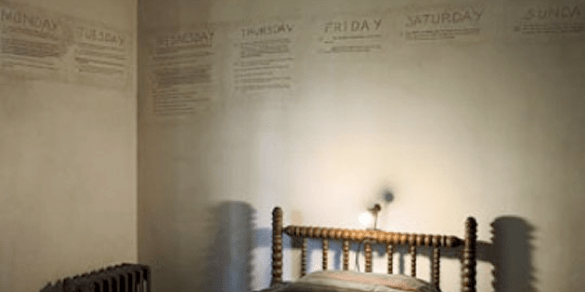
At any rate, what strikes me about the actual bedrooms of these writers, except for Whitman’s, is how spartan they are. For example, here’s where Yeats slept at Thor Ballylee:

TPG392639 Bedroom with the bed of W. B. Yeats (b/w photo) by .; Thoor Ballylee, County Galway, Ireland; (add.info.: William Butler Yeats (1865-1938) Irish poet and dramatist; bed made by a local carpenter;);  out of copyright

Barely a step up from Thoreau’s:

Thoreau's Walden Pond bedroom

Thoreau’s Walden Pond bedroom

Of course, there are exceptions. Truman Capote lay him down to sleep here:

03truman_capote_rect540

And Virginia Woolf in this swanky boudoir:

The interior of Virginia Woolf's bedroom at Monks House, East Sussex

Flannery O’Connor’s bedroom looks like just what you would expect:

tumblr_m1wsflYTvV1qzh8wko1_500

And, finally, the bedroom where this barely published poet/fiction writer/blogger tosses and turns:

bedroom 3-2

At any rate, we all can be thankful that we’re not the inhabitant of this bedroom:

Marcel Proust on his death bed

Marcel Proust on his death-bed

Good night, sweet Marcel, and Happy 4th of July to the rest of you!

A Rahsaan Roland Kirk Rescue

maxresdefault

Let’s say it’s the summer of 1976 and you’re a lost soul, maybe in the throes of a nervous breakdown[1], an impoverished graduate student who washes dishes Monday through Saturday and buses tables from 9 to 1 on Sundays.

You’re so poor you can’t scrape enough scratch to purchase textbooks, so you check them out of a university library that is mostly subterranean, even though you enter through its reflective glass facade on ground level.  The library is, in the words of TS Eliot, an “objective correlative” of your failure as a human being, a painful reminder of your stupidity, sloth, poverty, and cowardice and provokes what back then was called the heebie-jeebies but now is known as a panic attack.

In other words, your problems are elitist. You’ve had acquaintances killed in Viet Nam, your father’s generation fought in WW2, but to you, renewing a library book is the equivalent of identifying your next of kin. It’s pathetic – but not worthy of pity – no, this level of mental weakness deserves derision, mockery, or at the very least, tsk-tsking, sad head shaking.

Anyway, that’s how you feel. You feel ashamed and lost.

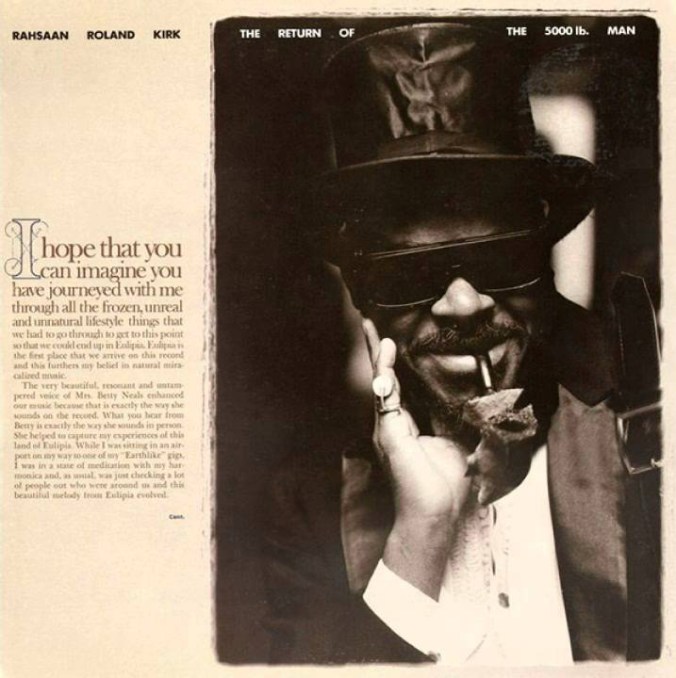
And that’s when you become re-acquainted with Rahsaan Roland Kirk, whose album The Return of the 5000 Lb. Man is like a floating device flung from a blind, half-paralyzed lifeguard.

landscape-1464713250-rahsaan-roland-kirk-gilles-petardRahsaan’s recent problems are more profound than yours. Blind from early childhood, he’s recently suffered a stroke that has left one side of his body partially paralyzed, so he’s had his tenor saxophone modified so he can play with one hand. Kirk was famous for playing more than one instrument at once, two saxes and a nose flute, but obviously, those days are done, yet, good God, you’d never guess that the tenor solos on 5000 Lb. Man are coming from the horn of a one-armed man.

Side A begins with a song called “Theme of the Eulipians,” begins with sound effects, faint whistling, footsteps, muted conversation, and then a beautiful melancholy harmonica tune and a tinkling piano over which someone named Betty Neals recites a poem – but, hey, this is a blog, not a book of essays; listen for yourself.


So you’re awash in a sea of melodic jazz until this:


This improvisation diminuendos into a swinging interchange between bass and piano.


The main melody returns, and surely it sounds like the songs ending, but it’s not; we get this framing coda:


You’ve been temporarily saved by a song, a warm song, and you aren’t about to forget it.

You can listen to the entire thing here, but better yet, go buy it:


[1] For a full-bodied definition of this mental malady, click here.

Ants and the Karamazovs

the author fleeing from an ant attack

the author fleeing from an ant attack

I’ve spent June with the Karamazovs.   In the literary category of most-fucked-up families, the Karamazovs rank right up there with Faulkner’s Compson clan and the mother-and-son team of Mr. and Mrs. Oedipus Rex.[1]   With the Karamazovs, we’re talking a toxic Freudian stew of father/son rivalry; religious/existential angst; vigils over putrid, decaying corpses; parricide – you name it.

paperbackFlipping through the yellowed pages of my 1957 paperback, I’ve been hanging out in monasteries, crumbling estates, filthy hovels, roadhouses, and prisons. Dostoyevsky’s celebration of suffering dwarfs whatever current troubles the reader tends to be enduring – in my case defending our household from an invasion of sugar ants (Monomorium pharaonis).
That’s right sugar ants, or, if you prefer, pharaoh ants, hordes of them, hundreds, if not thousands, marching dutifully in single file until they make the vertical descent from windowsill to counter top where they break up and swarm into earthbound clouds of tiny six-legged locusts.

If Dostoyevsky’s world is God-haunted, our bathroom is Darwin-haunted, man-versus-beast, and am I ever outnumbered, pitted against a very insidious, well-adapted enemy equipped with three types of pheromones, remarkable navigation skills, nesting strategies that subdivide colonies into non-competitive satellite campuses. To make matters worse, the colonies of these ants contain many queens, making it more difficult to eradicate a colony.

Monomorium pharonis with sugar crystal

Monomorium pharonis with sugar crystal

Sugar ants are tiny, a mere 2mm, about the size of a gnat. I first noticed them in the sink, feasting on a careless dropped dollop of toothpaste, so I guess you could say my carelessness caused the invasion.[2] Anyway, dispatching this first wave was as easy as retrieving tissue and wiping the intruders away. “Ha! Let that be a lesson,” I thought.

What I didn’t realize is that these fallen scouts had left a well-marked trail of pheromones pointing out to kinsmen the path to my sink. My next strategy was to spray the counters with peroxide, which instantaneously dispatched the unwanted immigrants, and I thought the puddles might act as a moat to dissuade others from visiting, but then again, I was mistaken.

The third strategy was successful. I mixed some Borax powder with fig preserves, placed the concoction on a piece of cardboard, and laid it on the counter. Man, what a cluster feast. It looked as if they were drunk, hundreds of them, inert, seemingly stuck, but still others were marching in single file, going and coming beneath the windowsill and through the screen.

That night I was shocked to discover that except for a few dead non-souls stuck in the preserves, that they were all gone, and the morning after no one returned, and now it’s been two days, so I am on the verge of declaring victory. Praise be for that slow acting poison borax, which the workers took home to their queens, who ingested it and with those royal deaths, the colony ended.

So now I can return in triumph to the Brothers Karamazovs — Dmitri, Ivan, Alyosha — and to the illegitimate Smerdyakov, whose stunted, dim-witted mother Lizaveta Papa Fyodor had his way with, impregnating her with the offspring that one day would put an end to him. In other words, return to a world far less organized, wholesome, and, dare I say, moral than the ant colony I destroyed.


[1] AKA the House of Cadmus.

[2] Or as Dmitri Karamazov might say, “”We’re all cruel, we’re all monsters, we all make men weep, and mothers, and babes at the breast, but of all, let it be settled here, now, of all I’m the lowest reptile.”
Karamazov-Banner

Mind-Forged Manacles

shapeimage_2

C’est l’Ennui!—l’oeil chargé d’un pleur involontaire,
Il rêve d’échafauds en fumant son houka.
Tu le connais, lecteur, ce monstre délicat,
—Hypocrite lecteur,—mon semblable,—mon frère!*

Baudelaire “Au Lecteur”

In our culture of hyper-stimulation, silence has become the rarest of commodities. In the evening of an overcast, humid, post-solstice sabbath, a siren swirls off in the distance while some unseen high-pitched mechanical blower/sandblaster/particle-collider keens like an instrument of torture.

To me, a native of the Lowcountry, summer’s official beginning is a sad occasion. The best weather is already behind us. The drip drip drip of days will winnow with less and less daylight as the ambitious resolutions of early June melt in the heat like wax sculptures – the hot tub not repaired, the school work delayed, the evenings, mornings, afternoons dissipating inevitability into oblivion.


*It’s the soul-stunting boredom – an involuntary tear in the eye.
Smoking the houka, he dreams
of gallows. Reader, you know this exquisite malady.
You, hypocrite reader – my soulmate – my brother!

very loosely translated by I-and-I (who assures you it sounds great in French)

Ennui, by Askerov

Ennui, by Askerov

O, woe is me!

Even though I have access to an array of Robert Altman films I can stream instantly via Netflix, Nashville is not available; the beach that is exactly .32 miles away is teeming with vulgarians, the gorgeous vista behind our house muted by the cloud cover.

Bill Clinton, you can’t even begin to feel my pain!

clintonfrown460

Perhaps, the decadent, entitled, whining dissatisfaction sampled above stems from my disinclination to seek out silence. The East has provided us with techniques to subdue what zen masters call “the monkey mind,” i.e., the brain’s tendency to flash from idea to longing to memory the way a spider monkey slashes from tree to tree to tree.

spider monkey (Ateles geoffroyi)

spider monkey (Ateles geoffroyi)

One of the many beauties of Buddhism is that it provides its practitioners a regimen of exercises that transforms the mind – to switch metaphors – from murky strom-tossed waters into a glassy pool that reflects things as they are. Buddhism relies on self (not supernatural) reliance in the paradoxical quest to annihilate ego.

“If you understand real practice, then archery or other activities can be zen. If you don’t understand how to practice archery in its true sense, then even though you practice very hard, what you acquire is just technique. It won’t help you through and through. Perhaps you can hit the mark without trying, but without a bow and arrow you cannot do anything. If you understand the point of practice, then even without a bow and arrow the archery will help you. How you get that kind of power or ability is only through right practice.”
― Shunryu Suzuki, Not Always So: Practicing the True Spirit of Zen

Jeff League: Bonsai Tree with Blossoms

Jeff League: Bonsai Tree with Blossoms

Oh, but if right practice were only that easy! The changes are oh so slow. After all, according to Buddhist teachings, it’s a regimen that may take lifetimes rather than weeks to perfect.

Plus, the Faustian temptations – the webs (worldwide/ otherwise) that stretch out to snare us. Why assume the half lotus when I can watch reruns of What’s My Line? on YouTube or channel surf with a television monitor that provides images that seem more wonderful than the flora and fauna outside my window?

Not to mention the restive hardwired desires for sustenance and sex.

Nevertheless, as the adage goes, charity begins at home, and right practice is ultimately a matter of self will. In fact, Marlowe’s Doctor Faustus offers a superb example of the dangers expressed at the beginning of this post – the tendency to shrug off the profound for the superficial, to squander precious moments in fruitless distractions. Remember, Faustus sold his soul to achieve greater knowledge, to understand how the cosmos functioned, yet soon enough started wasting his powers in trivialities, e.g., playing magical tricks on his adversaries and conjuring illusions like Helen of Troy, the face that launched a thousand ships/And toppled the topless towers of Ilium.
The 16th century equivalent of computer porn.

5 D. Fausti Buhlschaft mit Helena aus Graecia

Of course, the mind itself consists of the most delicate of chemical balances. What we so naively consider our substantial selves is an illusion conjured by a delicate mixture of amino acids, monoamines, acetylchlorine, nitric acids, etc.

A hit of illicit acid or a doctor prescribed dose of Prednisone can transform the seemingly substantial you from Jekyll to Hyde, begging the metaphysical/existential question who or what am I?*

Certainly, successful meditation must alter our brain chemistry in some mysterious way that leads to serenity. Here’s an anecdote from Ram Dass (aka Richard Albert) on the subject:


*Note to former students: Cf. Raskolnikov, Harry Haller, Stephen Dedalus, Oedipus, Hamlet, Othello, Emma Bovary, Milkman, Willy Logan, Merseault, Elizabeth Bennet, Raskolinkov, Mr. Kurtz, Dorothea Brooke . . .

In 1967 when I first came to India, I brought with me a supply of LSD, hoping to find someone who might understand more about these substances than we did in the West.

When I had met Maharajji (Neem Karoli Baba), after some days the thought had crossed my mind that he would be a perfect person to ask. The next day after having that thought, I was called to him and he asked me immediately, “Do you have a question?”

Of course, being before him was such a powerful experience that I had completely forgotten the question I had had in my mind the night before. So I looked stupid and said, “No, Maharajji, I have no question.”He appeared irritated and said, “Where is the medicine?”

I was confused but Bhagavan Dass suggested, ” Maybe he means the LSD.” I asked and Maharajji nodded. The bottle of LSD was in the car and I was sent to fetch it. When I returned I emptied the vial of pills into my hand. In addition to the LSD there were a number of other pills for this and that–diarrhea, fever, a sleeping pill, and so forth. He asked about each of these.

He asked if they gave powers. I didn’t understand at the time and thought that by “powers” perhaps he meant physical strength. I said, “No.” Later, of course, I came to understand that the word he had used, “siddhis,” means psychic powers. Then he held out his hand for the LSD. I put one pill on his palm. Each of these pills was about three hundred micrograms of very pure LSD–a solid dose for an adult. He beckoned for more, so I put a second pill in his hand–six hundred micrograms. Again he beckoned and I added yet another, making the total dosage nine hundred micrograms–certainly not a dose for beginners. Then he threw all the pills into his mouth. My reaction was one of shock mixed with fascination of a social scientist eager to see what would happen.

He allowed me to stay for an hour– and nothing happened. Nothing whatsoever.

Although we must cast a skeptical eye on anecdotal evidence, logic itself suggests that we at least give meditation a try, even if it yields something less than guru-dom. If it can help us shed delusions and rediscover wonder in the everyday, why not take the plunge? Meditation is religion neutral – the Southern Baptist and Shite Muslim (they have more in common than you might imagine) can practice meditation in honor of their respective deities.

It has in my negligible experience helped me to focus outside of myself to discover a certain interrelatedness, and the twenty minutes it costs can be scheduled between texting and checking emails – sometime during the evanescent day’s decline into darkness.
Just try to make sure you’re somewhere quiet.

photograph by Judy Birdsong

photograph by Judy Birdsong

Mere Facebook, an Apologia

Not surprisingly, academic naysayers galore bemoan the rise of social media in general and Facebook in particular, claiming a host of pernicious consequences resulting from people spending an inordinate amount of time on their computers, reducing our magical three-dimensional world to an impoverished digital approximation.  These sociologists complain that Facebook junkies stare at gifs of waterfalls rather than hiking down a trail to see one in person, post “happy birthday” on Nana’s wall rather than driving to the nursing home to plant a real kiss on her wizened cheek, or worse, spew typos in cliché-ridden porn tropes while engaging in virtual Facebook Messenger sex.

What r u wherein?

In addition, those carping Cassandras of the Ivy Towers prophesize ultimate unhappiness for inveterate clickers because Facebook usage promotes barren competition as sedentary souls compare their lives with others’.  They vie to amass “the most likes ever” while ruing that rather than sailing to the Bahamas on that glistening Yacht with Brittany and Madison, they’re stuck in their cookie-cutter so-called luxury apartment with nothing else going on on a depressing Sunday afternoon.

Okay, point. Here’s what my Facebook friend Francine Foxworth had for breakfast this morning: Vegan Vanilla Waffles with Vanilla Maple.

Vegan+Vanilla+Waffles+with+Vanilla+Maple+Cashew+Cream+|+Edible+Perspective

Whereas this is what I had

No_65_Spam

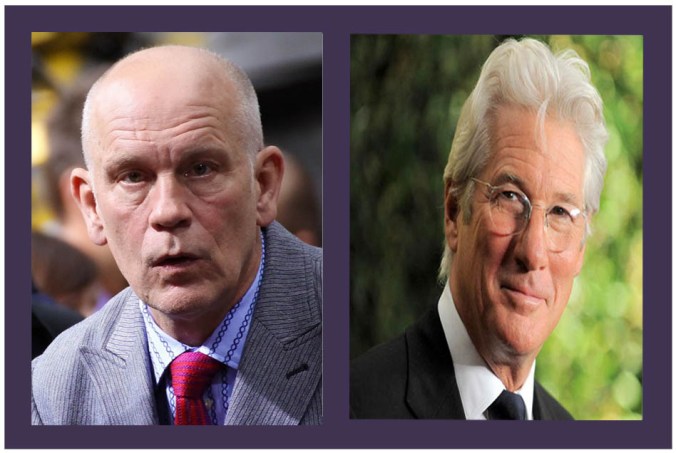
Anyway, these academics claim that Facebook tends to further isolate yourself from others who see the world differently, i.e., it entraps you in a Fox-News-like echo chamber in which you’re bombarded with links to uncritical blog posts that claim that Bernie Sanders is winning the Democratic nomination or the Sandy Hook massacre was staged by the CIA or that women actually prefer bald men like John Malkovich to thick-haired hubba-hubbas like Richard Gere.

gere

In other words, reality can be distorted.

Yeah, but, I believe that even if some of these negative theories are true, the pleasures that Facebook bestows by far counterbalance any negatives.

For example, virtually everyone who changes her profile picture is deemed “gorgeous” by at least one person.

So Pretty!

So Pretty!

All newborns are “beautiful” or precious”

So precious!

So precious!

Plus – and this is really great –Facebook’s  transformed the relative pronoun “this” into a powerful force of good or evil depending on its context.

This man:

600full-wink-martindale

This:

tumblr_lrycgjdDL71qbp3zyo1_r1_1280


So, I say keep on posting, keep on peeking, keep on crowing. Believe in yourself.

betty boop facebook


Five Reasons I Feel So Effing Fortunate

  1. There’s no way I’m going to die from Huntington’s Chorea.
  2. The Atlanta Braves are not going to lose a playoff game this year.
  3. Unless something unbelievable happens, I won’t have to endure an image of Chris Christie raising his right hand to take the oath of office.
  4. The statute of limitations has run out on lots and lots of my crimes and misdemeanors.
  5. I can beat the computer at chess, if I set the preferences to the me-vs-Willow-Palin setting.


moore Willow