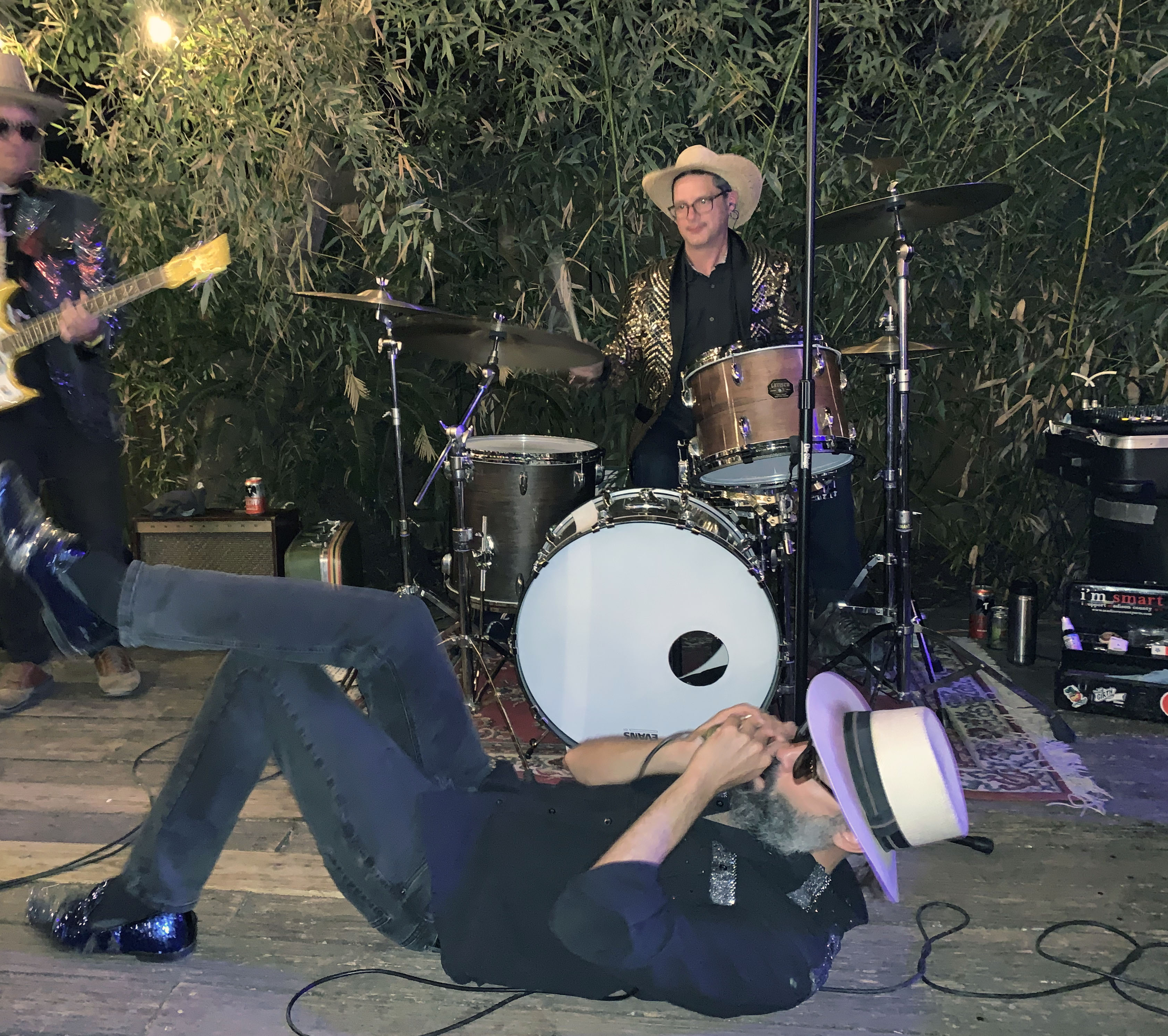
Last night I had the privilege to read a portion of my poem “Disorder Above Key West” accompanied by the immensely talented musician and painter Nathan Stephenson.
The Back Roads to Tallahassee
Took the back roads to Tallahassee to avoid the monotony of mile markers, dead armadillos, and exit signs. Took the back roads, took my time.
Didn’t make it quick enough to see him die, but my step-mama filled me in, sucking on a Marlboro like a man, “A horrible death, a horrible death,” she said,
over and over, shaking her head. I didn’t know what to say. “Too bad.” “He fought it hard,” she said, “screamed ‘Get that Gotdamn light out of my face,’
then up and passed.” She’d took a picture and showed it to me. Looked like all dead people look – his eyes froze, his mouth froze open like a fish.
No, my daddy and me didn’t get along, the house not big enough to hold the two of us. Like in that Springsteen song. We’d cuss each other
and sometimes come to blows. Of course, me, 35, half his age, been able whip him for a while. He sure whipped me back then before, cracking a buckled belt.
Can’t quite pity the poor dead bastard, laying there waxy with his hair slicked back in that Sears and Roebuck suit, striped tie, his mouth glued closed, his eyes glued shut.
His daddy beat him, and that daddy beat that daddy before that. I ain’t got no offspring, but got my own business, mind my own business,
so I have the time to take my time, to take the back roads, to avoid traffic, to miss all them 18-wheelers in a hurry to reach them warehouses they can’t abide.
I’ve never cared for rock songs with lush orchestral arrangements, cellos and violins sugar-coating the three or four chords that make up the melody. Take the Stones’ “As Tears Go By,” for example, overwrought in every way, the lyrics lamenting unspecified dissatisfaction, the strings transporting the speaker’s melancholy to the suburbs of tragedy, Schmaltzville, where eyes mist over at the slightest sentimentality: puppy dogs, Grandmas, Eugene Fields’s bathetic “Little Boy Blue.”[1]
This is what I’m talking about:
snippet from “As Tears Go By”
Hey, crybaby singerboy, take a hint from Frederick Henry, read some Lucretius, grab an umbrella, and head to a pub.[2]
Compare “As Tears Go By” with this ditty from the same album, December’s Children.
snippet of “Get Off My Cloud”
Now, that’s more like it.
And speaking of the Stones, man oh man, after the psychedelic silliness of Their Satanic Majesties Request, hearing the six successive opening G chords of “Honky Tonk Women” was like welcoming home a long-lost prodigal cousin returning deprogrammed from some sort of Scientology-like hypno-indoctrination.
beginning of “Honky Tonk Women”
To quote that Big Mama Thornton of Modernist literature, Sweet Molly Bloom, “Yes!”
Anyway, I really dig garage bands, Sam the Sham, ? & the Mysterians, the Kingsmen, the Human Beinz, etcetera.
Forgive my Western predilection to have to rank things. It’s sort of stupid really, but that said, in my not-all-that humble opinion, the greatest garage album of all time – and this may surprise you – is Patti Smith’s first release, Horses – a masterpiece whose subtitle could be “TS Eliot meets the Troggs.”
For example, here’s a snippet from the first song of the flipside, “Kimberly.”
snippet of Kimberly
You “Waste Land” junkies out there no doubt caught the echoic allusion to bats with baby faces and violet skies.
Horses is Modernist garage band, flashing with fragmented musical and literary allusions that imbue its songs with concentrated meaning and ultimately create a constellation of images revolving around alienation.
In other words, it’s a work of art.
The masterpiece cut of this masterpiece album is the 9:42 penultimate song “Land,” which, to my ear, has the greatest transition in all of rock-n-roll. Check it out. (The transition occurs at 1.11 minutes.)
the beginning of “Land”
The boy was in the hallway drinking a glass of tea From the other end of the hallway a rhythm was generating Another boy was sliding up the hallway He merged perfectly with the hallway, He merged perfectly, the mirror in the hallway
The boy looked at Johnny, Johnny wanted to run, but the movie kept moving as planned The boy took Johnny, he pushed him against the locker, He drove it in, he drove it home, he drove it deep in Johnny The boy disappeared, Johnny fell on his knees, started crashing his head against the locker, started crashing his head against the locker, started laughing hysterically
When suddenly Johnny gets the feeling he’s being surrounded by horses, horses, horses, horses coming in in all directions white shining silver studs with their nose in flames, He saw horses, horses, horses, horses, horses, horses, horses, horses. Do you know how to pony like bony maroney Do you know how to twist, well it goes like this, it goes like this Baby mash potato, do the alligator, do the alligator
What follows is eight minutes of stream-of-consciousness as Johnny’s brain transitions from sentience to eternal silence.
Now that’s what I call transcending a sub-genre. It’s simultaneously raw and polished, gritty and eloquent, Rimbaud and Wicked Wilson Pickett playing pingpong backstage in a dance hall.
[1] I’m being unfair to the Stones, “As Tears Go By” isn’t nearly as bad as “Little Boy Blue.”
[2] Here’s Henry describing leaving the corpse of his wife in A Farewell to Arms.
“But after I had got them out and shut the door and turned off the light it wasn’t any good. It was like saying good-bye to a statue. After a while, I went out and left the hospital and walked back to the hotel in the rain.”
I’m rereading Saul Bellow’s Humboldt’s Gift, a roman a clef fictionalizing Bellow’s relationship with bipolar poet Delmore Schwartz, pictured below, looking as if a couple of bong hits of sativa might do him some good, you know, take the edge off.
Delmore Schwartz
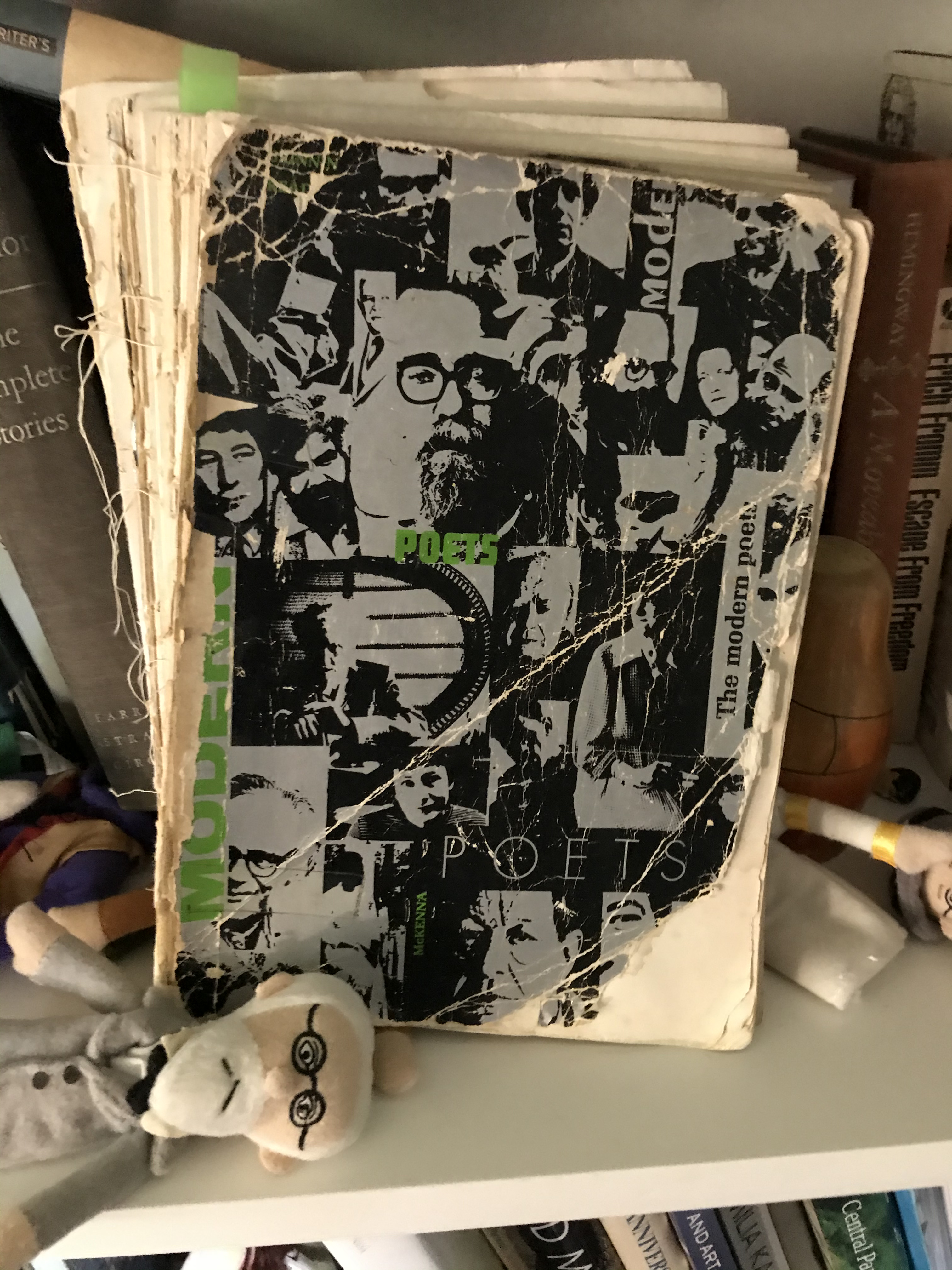
I copped the photo from the text of The Modern Poets, an undergraduate poetry anthology from my sophomore year at the University of South Carolina.[1] My professor, Thomas L. Johnson, was an excellent teacher and poet, a gentle, patient man whose love for verse was as pervasive as the cigarette smoke that wafted through college classrooms back in 1972.[2] Before then, I knew next to nothing about contemporary poetry because we didn’t cover much of it in high school. I remember reading The Spoon River Anthology (which was published in 1915), a few of the typically anthologized Frost poems, a page or two of E.E. Cummings, some Edna St. Vincent Millay, and a smattering of Yeats.
No Beats, no William Carlos Williams, no Wallace Stevens.
As the contemporary poetry course progressed, it occurred to me that mid-century to late-century poets suffered higher rates of suicide per capita than any other occupation outside of the Kamikaze corps. Every other poet we studied either drank himself to death or ended her own life. This impression, of course, might have been an aberration based on a disproportionate sampling of neurotics[3] covered in the survey. For example, if Seamus Heaney and John Ciardi had been substituted for John Berryman and Theodore Roethke, my impression might have been different.
In the table of contents, I placed a check next to the poets we covered. Here’s a partial list:
John Berryman – jumped from a bridge into the icy Mississippi River the year before I began the course.
James Dickey – drank prodigiously throughout his life, which led to erratic behavior. (Click here for an account of my semester with Dickey).
Randall Jarrell – struck by a car after being treated for mental illness after a suicide attempt.[4]
Robert Lowell – spent decades checking in and out of mental hospitals.
Sylvia Plath – committed suicide at thirty-one after a life fraught with mental breakdowns.
Theodore Roethke – victimized by two nervous breakdowns, one in the 1930s and another in 1944, “and they became increasingly more frequent in the ensuing decade; by 1958, he was attending therapy sessions six times a week.” (Poetry Foundation).
Delmore Schwartz – suffered from mental illness, alcoholism, died in a flophouse where his body wasn’t discovered for three days.
Anne Sexton – committed suicide via carbon monoxide poisoning.
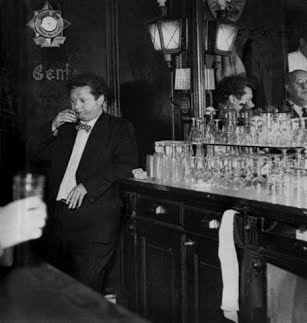
Dylan Thomas – died of alcoholic poisoning at the Chelsea Hotel in 1953.
Dylan Thomas at the White Horse Tavern in NYC
I’m sure there must be studies galore that attempt to explain this phenomenon. I’ve read a memoir by one of Berryman’s wives, Eileen Simpson, which documented Berryman’s relationships with Schwartz, Lowell, and Jarrell, so maybe there was a bit of birds-of-a-feather going on. Anyway, my first exposure to contemporary poetry convinced me that versifying was hazardous to your health.
Again, perhaps I shouldn’t generalize. Several of the poets we studied seemed mentally healthy, even happy. For example, here’s a poem by one of the sanest writers I’ve ever read, Richard Wilbur, composed shortly after he ran across Delmore Schwartz’s obituary, which Wilbur considered too cursory.
To an American Poet, Just Dead
In the Boston Sunday Herald just three lines Of no-point type for you who used to sing The praises of imaginary wines, And died, or so I’m told, of the real thing.
Also gone, but a lot less forgotten Are an eminent cut-rate druggist, a lover of Giving, A lender, and various brokers: gone from this rotten Taxable world to a higher standard of living.
It is out in the comfy suburbs I read you are dead, And the soupy summer is settling, full of the yawns Of Sunday fathers loitering late in bed, And the sshhh of sprays on all the little lawns.
Will the sprays weep wide for you their chaplet tears? For you will the deep-freeze units melt and mourn? For you will Studebakers shred their gears And sound from each garage a muted horn?
They won’t. In summer sunk and stupefied The suburbs deepen in their sleep of death. And though they sleep the sounder since you died It’s just as well that now you save your breath.
At any rate, when I taught at Porter-Gaud, through its visiting writing program, I met, dined, and drank with several highly successful poets who seemed, not only not unhappy, but also not all that eccentric – Peter Meinke, Starkey Flythe, Jr., Billy Collins, Chris Forhan, Elizabeth Spires, Cathy Smith Bowers, James Longenbach, Jennifer Grotz, and Alan Shapiro – to name nine.
From left to right, Aaron Lehman, Wesley Moore, Pulitzer Poetry finalist Alan Shapiro, Childs Smith
Then again, I attended a Robert Lowell reading in 1974, and he seemed perfectly equanimous, though of course, we didn’t go out for drinks afterward.
At any rate, I’m enjoying hanging out with Delmore Schwartz’s fictionalized counterpart Von Humboldt Fleisher. In his case, it’s a pleasure crawling in bed with a tortured genius, especially with one so learned. If manic-depression is occurring on a page rather than in three-dimensions, it can be a gas.
[1] The course was actually called Contemporary Poetry, which would be a better title for an anthology that spans from Frost and Pound to James Tate. After all, strictly speaking, Shakespeare is a “modern” as opposed to “ancient” poet. Most of the poets in the anthology were born in the Thirties. Virtually all, if not all, are now dead.
[2] I received a generous B for my slapdash efforts and a C on the original poems I submitted in lieu of a research paper, crap I dashed off in three or four days. In 1987, Mr. Johnson and I ended up in an anthology of James Dickey’s former students’ poems, and I bumped into him at a get together celebrating the publication of the book. We both recognized each other and had an amiable chat.
[4] In a letter to Elizabeth Bishop about a week after Jarrell’s death, Robert Lowell wrote, “There’s a small chance [that Jarrell’s death] was an accident. . . [but] I think it was suicide, and so does everyone else, who knew him well.”
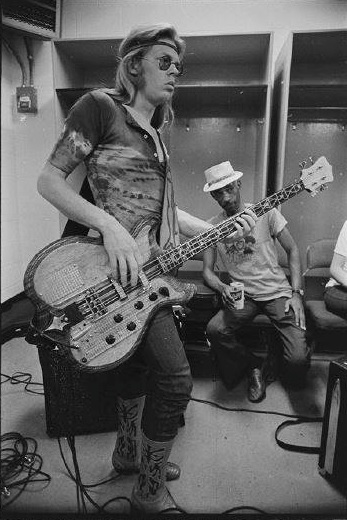
Hey, you’re probably too young to remember when Jack Casady, the bassist for the Jefferson Airplane, admitted that, like President Ford’s son Jack, he, too, had experimented with marijuana.
These twin bombshells dropped in October of 1975. President’s Ford’s “shaggy-haired, free-spirited son’s”[1]admission created quite a brouhaha, making the front pages of the New York Times and Washington Post.
ALEXANDRIA, VA – AUGUST 9: (NO U.S. TABLOID SALES) President Gerald R. Ford (R) and First Lady Betty Ford (L) pose with three of their four children (L-R) Steven Ford, John “Jack” Ford (not looking all that shaggy-haired), and Susan Ford in the family home on August 9, 1974 in Alexandria, Virginia. Ford stepped into office as president that afternoon, after the resignation and departure of ex-President Richard M. Nixon. (Photo by David Hume Kennerly/Getty Images)
Good ol’ Jack just celebrated his 80th birthday 13 April 2024
Of course, the Airplane’s bassist’s tongue was firmly in his cheek when he followed up Jack Ford’s confession with his own. After all, Jack Casady had laid down the bass licks on the Airplane’s 1967 hit “White Rabbit,” which ends with this exhortation – “Feed your head, feed your head, feed your head!”
Needless to say,[2] people had been fueling their crania via cannabis long before the double Jacks discovered its mind-altering qualities, as this soporific sentence from Wikipedia attests[3]:
The oldest archeological evidence for the burning of cannabis was found in Romanian kurgans dated 3,500 BC, and scholars suggest that the drug was first used in ritual ceremonies by Proto-Indo-European tribes living in the Pontic-Caspian steppe during the Chalcolithic period, a custom they eventually spread throughout western Eurasia during the Indo-European migrations.
Not surprisingly, it was the French, the inventors of un baiser avec la langue[4], who introduced marijuana to the West. Jacques-Joseph Moreau experimented with and wrote about cannabis during his travels to North Africa and the Middle East in the late 1830s.
In 1842, an Irish physician William Brooke O’Shaughnessy copped some quantity in Bengal and brought it back with him to Britain. Later, Charles Baudelaire got a hold of some hashish and extolled its effects. The red-eyed munchie-afflicted genie was out of the bottle.
Baudelaire demonstrating why it’s preferable to wear shades when you’re stoned. At least with shades, people might guess you’re stoned rather than seeing for sure that you are.
I won’t bore you with the history of its criminalization/ decriminalization. Even in South Carolina, which is about as progressive as electric shock therapy, a medicinal marijuana bill made it out of committee last week in a 9-5 vote. Now, it’s headed to the full Senate. At this rate, who knows, recreational legalization might take place by the centennial of the two Jacks’ admissions in 2175!
I should add, however, that the argument about whether cannabis is a gateway drug is still in dispute, despite the appearance of Wesley Moore’s score-settling poem published over a decade ago.
On the Slave Ship Lollipop
I used to stuff my face with candy when I was a little boy, couldn’t cop enough Mary Janes, would kill for an Almond Joy.
Then I graduated to the Real Thing – Coke. I was popping five cans a day, plopping nickels and dimes upon the counter under caffeine and sugar’s sway.
Now I’m hooked on heroin, am little more than a thug. Wish I’d known then what I know now – that sugar is the gateway drug.
[1] This hipster description comes to us from Business Insider’s website.
[2] EB White would disapprove of this transition, but he’s dead, and I don’t care.
[3] Don’t even attempt to read the senetence if you’re stoned.
[4] Or as it was known in my hometown of Summerville, SC, “swapping spit.”
What a blast we had digging on Pleasure Chest, an absolutely great show band with an eclectic repertoire of killer covers. We’re talking Booker T, Jimmy Reed, Ray Charles, Erma Thomas, and, drum roll, the Buckinghams. Time won’t let me, no it won’t and by the way, time ain’t on my side, no it ain’t.
If you know anything about language, you can tell immediately that the English adjective smug is of Anglo-Saxon origin. It’s short – one syllable – but certainly not sweet. After all, smug rhymes with ugh, that imitative sound of a cough that over time evolved into an interjection of disgust, the involuntary mouthing you might make when running across roadkill or this photograph.
[As in the case of Melville’s detailed explanations of various aspects of cetology in Moby Dick, an impatient reader is advised to skip the next two paragraphs and pick up the prose following the book image below.]
In English, smug first appeared in the 1550s and meant “trim, neat, spruce, smart.” Smug and smock are the immigrant offspring of Middle Low German smücken, “to dress,” as in “to creep or slip into.”[1] You smücken into a smock. Smücken itself comes from Low German smuk, which means “pretty,” even though it’s a homophone for the Yiddish word schmuck, which means dick, as in penis or schlong.
I can’t speculate on why the Low German word for pretty sounds so ugly or how it morphed into the Yiddish word for penis, which over time came to mean “a contemptible person.” I would hazard to say, however, that smug people are generally schmucks.
Ugh, smug Matt Gaetz is a dick, an entitled asshole[2], the type of insecure Lothario who carves notches in his bedpost (i. e., flashes photos of sexual conquests to acquaintances from his cell phone), the type of scuzzball whose success stems from being the scion of a wealthy shitwad who made a fortune providing hospice care, the type of chuff who frat-boyed his way from prep school to Congress exuding entitlement like a princeling dipped in AxL. Obviously, anyone who behaves with such reckless abandon has never faced any real consequences for his misdeeds.
And perhaps he’ll sidestep repercussions this time as well. After all, he’s hired Harlan Hill (pictured below) as his spokesperson.
But I wouldn’t bet on it.
[Full Disclosure: over the years, some have accused me of smugness just because of my relaxed demeanor, because I’m trim, neat, and smart, but they are wrong. I’m just snazzy, that’s all[3]].
Sonnet, my ass, you call this piece of shit A sonnet? Right, a sonnet, oh yeah, sure, sure. To write a sonnet you must be a man or woman of wit – It must be one-hundred percent pure, Cast in iambic pentameter – tick TOCK, tick TOCK – None of this slapdash fill-in-the-blank-piss- ass diarrhetic irregularity. Think clock: Tick TOCK, not TOCK tick, man. It’s got to fit The pattern. Then at the end – swoosh – you swerve the focus, attempt to solve the problem, knit a perfect combination of well-chosen words into a thought that ought to be uplifting Or ironic or aphoristic or clever or droll. You see, that’s a way a sonnet is supposed to roll.
It was my first son’s first birthday After his mother’s Mother’s Day death. I had never Ubered downtown before That windy rain-drenched Wednesday, But I would be drinking, drinking, aiding and abetting Zoloft’s numbing affectless effects.
A warehouse converted into a restaurant, Bricks, tables, a mirror-backed bar, Water dripping from the brim of my fedora, “A Jameson’s on the rocks, please.” Twenty minutes later, the rain still coming down in sheets, She came in drenched and sat down next to me as planned.
Later, we moved to a table, and I shared my guilt, What I had not done in those awful last hours. Shaking her head, she took my hand — Perhaps she took my hand — but I know for sure Word for word what she said — too sacred to share — Seeds of love sown that windswept Wednesday.














 You Do Hoodoo