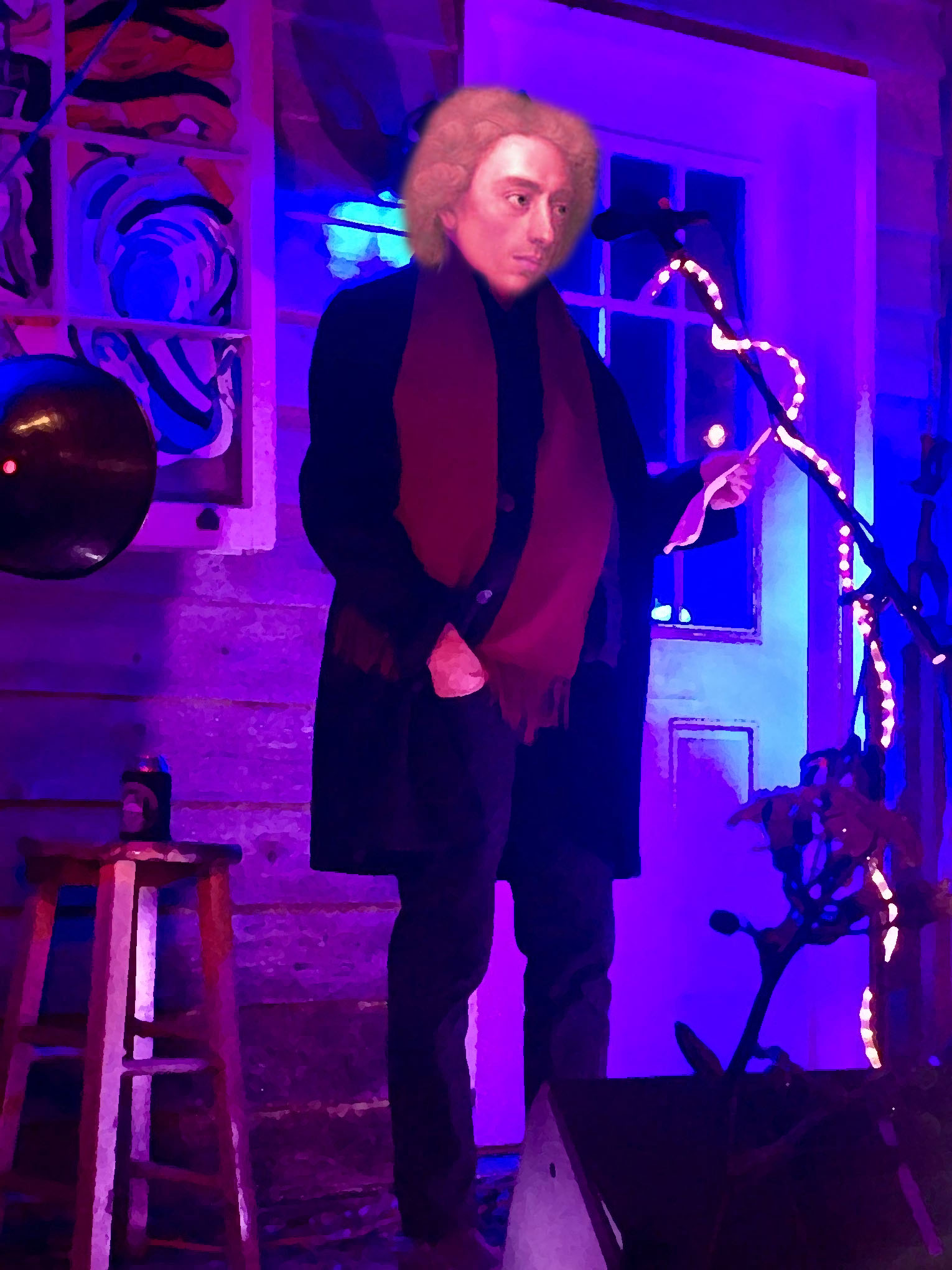
What harm? Men die — externally — It is a truth — of Blood — But we — are dying in Drama — And Drama — is never dead — Emily Dickinson
The dream done, my eyes open, it hurt to be awake.
Outside my bedroom window faint predawn light seeping through the dark fabric of the sky.
My late wife had been alive just now, in the dream her death merely a dream.
I had held her in my arms, explaining to her that I had dreamed she’d died, but she hadn’t, no, she was smiling, warm, lying next to me in bed,
so lifelike, so palpable, I thought as I lay there afterwards that her spirit had come to me.
I closed my eyes and fell asleep again, and, as if in a new episode of the ongoing series of my sleep, she reappeared, sitting in a chair in an unfamiliar room.
Not smiling now, possessing the wisdom of the dead, she explained in her soft Georgia accent that we were out of synch, that our ages no longer matched, and it was true, she was young again, in her twenties, but I was old and stiff.
[poof]
I rose from bed, and looked down upon sleeping Caroline, lying there beautiful, a breathing angel, her hair luxuriant, disheveled, cascading over the pillow that she embraced, like a lover in a Leonard Cohen song.
The light strong now, the sky outside the window bright blue, my dead wife, like Eurydice, tumbled back into black oblivion.
I struggled into my corduroys, puddled on the floor next to the bed, and tiptoed out, quietly opening and closing the bedroom door.
Descending the stairs, I shook my head, waved my arms, to buck myself back into the land of the living.
Time to brew a pot of coffee and retrieve the morning paper, which lay where flung, next to a clump of lantana, the newspaper sheathed in plastic, protected from the dew, which had evaporated, had disappeared into the seeming emptiness of air.
Seasonal affective disorder (SAD) is a type of depression that’s related to changes in seasons — SAD begins and ends at about the same times every year. If you’re like most people with SAD, your symptoms start in the fall and continue into the winter months, sapping your energy and making you feel moody.
roundel: an eleven-line poem consisting of three stanzas – a quatrain, tercet, quatrain. The opening line becomes a refrain of the fourth and 11th lines. It is an English variation of the roundeau introduced by Algernon Charles Swinburne.*
Rhyme scheme: abaa bab abaa
The S.A.D. Roundel Rag
Snide winter suns don’t heat on their blustery ride; flashily indiscrete, snide winter suns don’t heat.
Winter suns glide, bold but effete, expansive as they slide
over the edge into the deep. No matter how you search for the bright side, that lackluster light spells defeat – snide winter suns don’t heat.
*When in his thirty-eighth year, William Butler Yeats’s sister informed him that Swinburne had died, Yeats declared, “Now I am king of the cats.”
I hadn’t planned to read last night but was coaxed on stage where I belched my poem “Drunk Me Some Wine with Jesus” to a somewhat inattentive audience who were [cue backwoods evangelical voice] more in-TENT on gluttony and idle chatter than they was in hearing that our Lord was a wine-bibber and a comm-U-nist.
And who could blame them?
Here’s the text of the poem:
Drunk me some wine with Jesus
At this here wedding in Galilee.
He saved the bestest for second
And provided it all for free.

So I quit my job on the shrimp boat
To follow him eternally,
No longer bound by then blue laws
enforced by the Pharisee.

And we had us some good times
Till then Pharisees done him in.
Ain't got no use for the religious right
After I seen what they done to him.

So when Paul Saul stole the show,
I sort of drifted away
Because he never quite understood
What Jesus was trying to say.

He was more like a Pharisee,
Dissing this, cussing that
Giving the womens a real hard time,
Gay-bashing and all like that.

So I drink at home most nights now
Trying to do some good,
offering the beggars a little snort
Whilst praying for a Robin Hood.

Drunk me some wine with Jesus.
I was the besets day I'd ever seen.
Drunk me some wine with Jesus,
Partying with the Nazarene.

By the way, the poem is sort of a riff on Ezra Pound's
"Ballad of the Goodly Fere."

Ballad of the Goodly Fere

Simon Zelotes speaking after the Crucifixion

Ha’ we lost the goodliest fere o’ all
 For the priests and the gallows tree?
 Aye lover he was of brawny men,
 O’ ships and the open sea.

 When they came wi’ a host to take Our Man
 His smile was good to see,
 “First let these go!” quo’ our Goodly Fere,
 “Or I’ll see ye damned,” says he.

 Aye he sent us out through the crossed high spears
 And the scorn of his laugh rang free,
 “Why took ye not me when I walked about
 Alone in the town?” says he.

 Oh we drank his “Hale” in the good red wine
 When we last made company,
 No capon priest was the Goodly Fere
 But a man o’ men was he.

 I ha’ seen him drive a hundred men
 Wi’ a bundle o’ cords swung free,
 That they took the high and holy house
 For their pawn and treasury.

 They’ll no’ get him a’ in a book I think
 Though they write it cunningly;
 No mouse of the scrolls was the Goodly Fere
 But aye loved the open sea.

 If they think they ha’ snared our Goodly Fere
 They are fools to the last degree.
 “I’ll go to the feast,” quo’ our Goodly Fere,
 “Though I go to the gallows tree.”

 “Ye ha’ seen me heal the lame and blind,
 And wake the dead,” says he,
 “Ye shall see one thing to master all:
 ’Tis how a brave man dies on the tree.”

 A son of God was the Goodly Fere
 That bade us his brothers be.
 I ha’ seen him cow a thousand men.
 I have seen him upon the tree.

 He cried no cry when they drave the nails
 And the blood gushed hot and free,
 The hounds of the crimson sky gave tongue
 But never a cry cried he.

 I ha’ seen him cow a thousand men
 On the hills o’ Galilee,
 They whined as he walked out calm between,
 Wi’ his eyes like the grey o’ the sea,

 Like the sea that brooks no voyaging
 With the winds unleashed and free,
 Like the sea that he cowed at Genseret
 Wi’ twey words spoke’ suddently.

 A master of men was the Goodly Fere,
 A mate of the wind and sea,
 If they think they ha’ slain our Goodly Fere
 They are fools eternally.

 I ha’ seen him eat o’ the honey-comb
Sin' they nailed him to the tree.
Corky Cain, Washed-Up Surfer Sings of Dead-End Hedonism
sick with desire And fastened to a dying animal
William Butler Yeats, “Sailing to Byzantium”
My bleached blonde hair has disappeared, leaving a freckled scalp in its stead. Two black bags bulge beneath my eyes, All rheumy and rimmed with red.
They say sagacity is recompense. (I’d settle for a dollop of common sense). Hey, little lady, could you spare me a smile? (Or at least a wink instead of a wince?)
No, when it comes to wisdom, I’m an old lecher banging on a drum, cruising the boulevards looking for love in the suburban sprawl of Byzantium.
Playing the fool, the pantaloon, howling for hours at the hollow moon, waking in the morning with a broke down head, knowing that never will be all too soon.
Old friend, Willy B, sing me a song that will drown out the barbarous gong of the death knell clanging in my brain you, the king of love gone wrong.
Up there, the sweet plain girls would possess the incandescent beauty of immortality, removed from the stress of status, smiling, gliding, singing, free at last to be above it all.
But let’s face it. Wallace Stevens had it right. Mystical death is the mother of beauty. Our non-sentient bodies must feed the root of willows bending over our forgotten flesh, now boughs where birds nest and trill and feed their hatchlings.
I’m really not a fan of slam poetry, but I thought I’d give it a try anyway, something to do to while away the interregnum.
Look up at your TV screens, it’s a turd, it’s a pain, it’s Donald Trump, reality TV star President who has lowered the bar on truth, justice, the American way, a fat-ass Superman wannabe, who can’t stand up straight, much less fly, doesn’t care if we live or die, calls the pandemic a gimmick, has updated the leech with bleach, this snake oil salesman extraordinaire (who claims to be a billionaire, but is drowning in debt way over his head while flooding the nation in blood red ink). Think, he can’t even drink a glass of water with one hand, shuffles down that ramp like a senile Diogenes without a lamp, spreading the seeds of dishonesty, a living embodiment of depravity, in a gaslit nation in need of a vacation. His. It’s way past time to concede.