Invisible Friendships: Voices

Over the years, my friend (and one-time collaborator) Dr. Paul O’Brien has guest-lectured for my classes in various capacities, e.g., to introduce Beowulf or Hamlet or the genre of poetry. In the poetry intro, he begins by reciting “Who Goes with Fergus” in his rich baritone but then admits he doesn’t exactly know what it means:

 Who will go drive with Fergus now,

And pierce the deep wood’s woven shade,

And dance upon the level shore?

Young man, lift up your russet brow,

And lift your tender eyelids, maid,

And brood on hopes and fear no more.


And no more turn aside and brood

Upon love’s bitter mystery;

For Fergus rules the brazen cars,

And rules the shadows of the wood,

And the white breast of the dim sea

And all disheveled wandering stars.

But he does know that he loves the way it sounds, its imagery.

He goes on to tell the students that poetry can be “your companion, your friend.”

In this context, I’ve found Yeats’ “To a Friend’s Whose Work Has Come to Nothing” a comfort on days like today when I’m down:

 Now all the truth is out,

Be secret and take defeat

From any brazen throat,

For how can you compete,

Being honor bred, with one

Who were it proved he lies

Were neither shamed in his own

Nor in his neighbors’ eyes;

Bred to a harder thing

Than Triumph, turn away

And like a laughing string

Whereon mad fingers play

Amid a place of stone,

Be secret and exult,

Because of all things known

That is most difficult.

However, this phenomenon of literary friendship is not only limited to poetry; I count Frank Bascombe, the narrator of Richard Ford’s trilogy, a pal, and every time I finish one of the Bascombe novels it’s like saying good-bye to someone I’ll miss hanging out with. I’ll miss Frank’s voice. (Though rumor has it Frank survived Hurricane Sandy and will tell us about it in a new short story).

I’ve recently run across a new companion, J.I.M. Stewart, whose Eight Modern Writers is the final volume of The Oxford History of English Literature, published in 1963.   Now you might expect – or should I say one might expect – a critical volume sporting such a title to be as dry as unbuttered melba toast; however, reading Stewart is like listening to an erudite uncle with a whiskey in his hand and a barb in his throat.

Here he is one Yeats, the featured poet above:

Yeats has too vigorous a dramatic sense to make any kind of grateful stroll out of old age’s necessary descent from Helicon to the Academy, or to accompany it with pleasant murmuring of years that bring the philosophic mind. Rather he is going to be carried down kicking, and his masters are going to find a rebellious pupil:

I mock Plotinus’ thought

And cry in Plato’s teeth

And here is Stewart chiding the master:

 [In “Under Ben Bulben”] there are no such things, we want to tell him, as “Base-born products of base beds.”

And one more on reading the first part of Joyce’s Ulysses:

Indeed, it’s as if we’re locked inside of Dedalus’s mind, and although an interesting place, we sometimes find ourselves beating our fists wishing to get out.

As it turns out, Stewart (1906- 1994) was a novelist himself, and in a less serious pursuit wrote over 50 detective novels under the pseudonym Michael Innes.

At any rate, I’m very happy to be spending this week in his company.


James Innes Michael Stewart

James Innes Michael Stewart
 

Selfie

When I first started teaching at my current school, I was 32, and the mamas of the Upper School students looked matronly to me.  Now 30 years later, the students’ mamas look like jail bait, and those very first students I taught look matronly.

Which begs the question, what do I look like?

Click arrow above for sound.

Selfie

For every tatter in its mortal dress . . . 

Now, when the man in the mirror stares back,

it’s not my father I see,

but old WH Auden himself,

that mask of overindulgence,

pocked and puckered,

eyes rheumy, cross-hatched with red,

the tattered, bruised bags beneath

stuffed with hobo rags – used t-shirts,

yellowed boxers – plus a half pint of rot gut —

artifacts of excess, of bad habits

embraced like brothers,

boon companions for many a year.

WH Auden

WH Auden


Nassau Street Dub

Here’s the dub version of “Nassau Street Song,” copyrighted in 1987 by University of South Carolina Press

Click the arrow above for sound.


Mad Luke went down to the shanty town

To find the mon dat stole he wife.

With whiskey on he pantin’ breath

And wit he brother switch blade knife.


He be so mad he blood do scald

And tears gush out he bloodshot eyes.

He curse de two dat cause de strife

Still hoping’ dat it be a lie.


But in he heart he know it true –

He seen de looks dat she be given’.

He see dat mon a-hangin’ round.

He heard the wimmins whispering.


So he run down the street a-wailin’

Swearin’ he gwine put den underground.

De other folk look out dey door

To see what make dat devil sound.


When he get back to he own house

He kick de lock door open wide.

And there in bed be he own wife

With another mon by her side.


They rumble in dat shanty house.

Luke cut de mon, den cut he wife.

Dat bedroom be all colored red

Dat just last month been painted white.


De police siren scream through town

and lights was flashing everywhere.

And when the police squad show up,

Dey shocked to find that Luke still there.


Dey put den two under de ground.

They took mad Luke to the prison farm,

And now them two can’t cause no strife,

And now mad Luke can’t cause no harm.

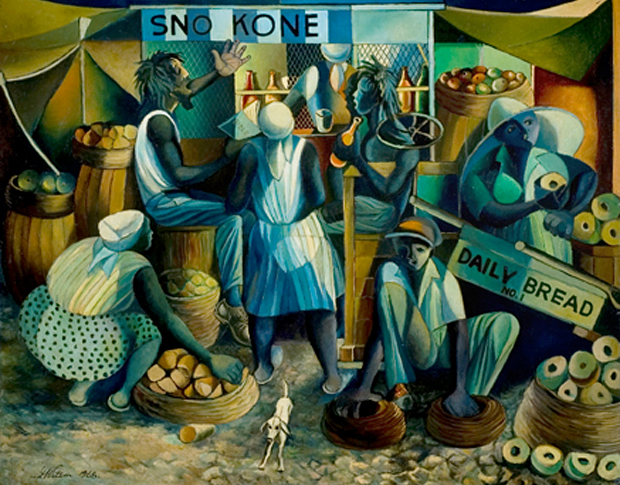
Osmond Watson, "City Life"

Osmond Watson, “City Life”

Senator Hutto Versus the Baphoons

Bravo to Senator Brad Hutton D-Orangeburg who filibustered the baphoons who want to punish the College of Charleston for choosing Fun Home for summer reading.

Senator, this dub poem is dedicated to you.

Click arrow for sound (a must)

South Carolina legislature ain’t got no culture

State legislature ain’t got no culture

Bunch of baphoons, mon

fools, mon

Hutto sat upon de rock

and watch baphhon go by

sat upon de rock

and watch de babhoon go by

He say,

“Gwine fillabuster

them ignorant bible-thumpers

gwine say over and over

till my throat gone sore:

gwine say

“‘Hey, Senator Fair,

Senator Grooms,

Listen, you cracker ass baphoon,

you sanctimonious

psalm-singing

son of a bitch

burner of de witch

arse-belching vulagarian,

self-anointed librarian            –

Hey, you, leave de the College alone!”‘

Wes Moore, dub poet/sun god

Wes Moore, dub poet/sun god

Follow on Twitter @ragwatercat

On The Road to Kiawah

Click great arrow for sound


Pick pocketed, mon

lot by lot,

field by field.


Pappy dirt gone forever, now,

sold for

dat ready cash, you know,

back in the day,

cash dat dwindle away

bit by bit,

drop by drop,

dollar by dollar


disappearing

like water from a leaky

bucket


a-plunk

plunk

plunk


No, not a drop left, now, no.

So dat is dat,

De bucket dry,

Me pockets empty

here in the shade of a shed

across from a field of condo

on the road to Kiawah.

il_fullxfull.115055579


Shakespeare-on-Speed: Titus Andronicus

Hello, college student. I can’t believe that slave-driver of a professor of yours has assigned Titus Andronicus. Smart move coming here. Believe me, after reading this summary of the plot, you’ll be praising Jesus you didn’t give the text a try. In fact, the plot is so conjunkificated with murder and mayhem, you might not even get through this easy-to-read amped up version.

Note, I’ve modernized and shortened the names of the characters. Before taking a test or writing a paper, you gotta check out Wikipedia for the real deal on what these fools actually went by back in the day.

Okay, let’s get this over with.

Protagonist Titus sacrifices the eldest son of Tammy, Queen of the Goths, to avenge the deaths of his own sons killed during a 10-year campaign against her people. Titus turns down offer of becoming emperor (bad, if not tragic mistake) and supports the previous emperor’s son Satch’s claim to the throne, much to Satch’s younger brother’s Bass’s chagrin. Satch promises to marry Titus’s daughter, Lavinia, even though she’s engaged to aforementioned younger brother Bass.

You following? Bass done been double-dissed.

Titus’s surviving (but not for long) sons Quinn, Martin and Matt point out to stubborn daddy that Roman Law sez Bass gots first dibs on Lavina, but Titus don’t dig backtalk from offspring and accuses the boys of treason. In the subsequent ensuing scuffle, Titus slays his own boy Matt, which prompts Satch to denounce the crazy-ass Andronicus clan.  So he marries Tammy, whose lover, the moor Aaron makes Iago look like Al Roper in evil comparison.

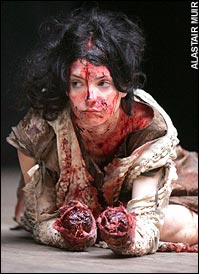
12-titus-andronicus-lavinia-mutilated-shakespeares-gloves-titus-andronicus-2006-dir-lucy-baileyAnyway, Tammy talks new hubby-to-be to pardon little brother Bass and the entire Andronicus family.  You’ll see why shortly.

Next day, on a royal hunt Aaron convinces Tammy’s sons Demmy and Ron to kill Bass so they can rape Lavinia. “Sho nuff,” they say, do the deed, dump poor Bass’s body in a pit, drag Lavinia into the woods, rape her, then lop off her tongue and hands so she can’t squeal orally or in writing. Aaron then forges a letter that frames two-thirds of Titus’s surviving sons, Martin and Quinn, for Bass’s murder, so of course, Satch arrests their asses.

Got it?

Okay, Titus’s brother Marcus finds mutilated Lavinia and takes her to Titus, who’s still reeling from the accusations leveled at Martin and Quinn. Enter Aaron the Moor with an alleged message from Satch saying that he’ll spare M & Q if Titus or brother Marcus or remaining son Luke cuts of one of their hands and sends it to Satch. Titus volunteers and lets Aaron hack off his left hand.

What was he thinking? Who knows?

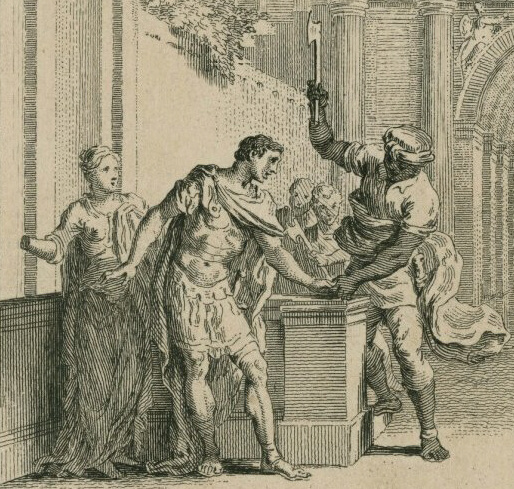
Aaron hacking off Titus's hand

Aaron hacking off Titus’s hand

Is this making sense? You see, it’s all about vengeance.

Guess what?  Aaron double crosses Titus. A messenger delivers to Titus the severed heads of his sons Martin and Quinn along with his own severed left hand.

Finally, Titus has had enough, time for revenge. He sends last son Luke off to raise and army among their previous enemies the Goths.

Resourceful Lavinia picks up a stick with her mouth and using that orifice and her two stumps writes the names of assailants Demmy and Ron in the dirt.

Tammy (who seems as adept as Sarah Palin in hiding pregnancies) gives birth to a bi-racial child. Aaron kills the midwife and nurse (after all, cutting off tongues and hands is no guarantee of silence) and flees with his baby, only to get nabbed by Luke with his Goth army in tow.  Luke threatens to hang the baby unless Aaron sings, which he does, like a canary magpie, tells all of the above in blank verse.

Aaron and his newborn baby

Aaron and his newborn baby

Meanwhile, back in the Imperial City, Titus pulls a Hamlet and feigns insanity, sort of.

Thinking Titus is insane and might buy a staged visitation of spirits, Tammy, Ron, and Demmy dress up like allegorical manifestations of Revenge, Murder, and Rape and tell Titus they’ll grant him revenge if he talks son Luke out of attacking Rome. Tammy splits, but Titus talks Demmy and Ron into hanging around.

Bad move, boys.

He slits their throats, grinds their bones, and bakes their heads into a cake.

Okay, ready?

Next day Titus throws a feast and asks Satch if a father should kill her daughter if she has been raped. “Of course,” Satch says, so Titus kills what’s left of Lavinia.

When Satch calls for Ron and Demmy, Titus informs him that they’re in the cake mother Tammy’s munching on.

Titus kills Tammy, Satch kills Titus, Luke kills Satch, is crowned emperor, orders Tammy’s body to be thrown to the wild beasts that hang out outside Rome’s city limits, and sentences unrepentant Aaron to be buried up to chest to starve and/or die of thirst.

Aaron rues not being able to live longer because he feels as if he hasn’t done enough evil in his life.

Theme:  bad karma breeds bad karma/violence sells.

Serving Tammy sons baked in a soufflé

Serving Tammy sons baked in a soufflé

Celebrating Shakespeare’s 461th Birthday

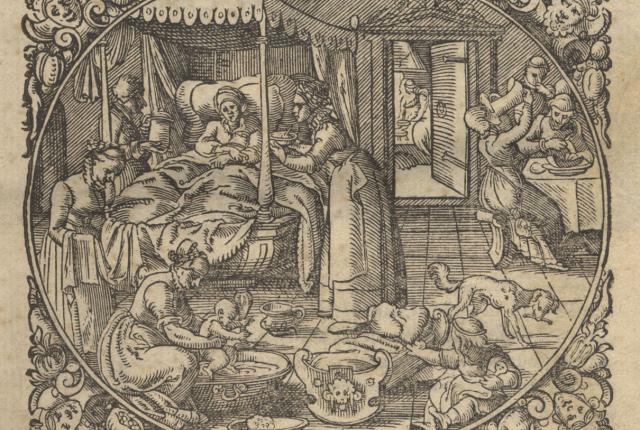
Throughout 23 April 2025, the 461th birthday of William Shakespeare, I imagined his actual birth, picturing in my mind’s eye the room where the event occurred.  There would have been a midwife there and perhaps some of Mary Arden Shakespeare’s lady friends who might witness the appearance of his bald dome, the final push, the slap and scream – perhaps punctuated in crescendoing iambs.  He would have been immediately swaddled.

birth12

Not-necessarily-accurate internet sources claim that an Elizabethan birth room would have been decorated with the finest “hangings” the family possessed, and I don’t doubt this superstitious possibility given I know 21st Century football fans who wear the same totemistic socks every Saturday during a win streak. After all, the chances of an infant surviving until puberty weren’t promising.

For example, here’s a list of John and Mary Arden Shakespeare’s children:

Joan b. 1558 d. 1558.

Margaret b. 1562 d. 1563

William b. 1564  d.1616

Gilbert b. 1566  d. 1612

Joan Shakespeare Hart b. 1569 d. 1646

Richard b. 1564 d. 1613

Edmund b. 1580 d. 1607

William himself (often away from Stratford in London) only fathered three children (two of them twins) and lost his only son at the age of 11.

Elizabethan Birth

No wonder they farmed infants off-site to (I would lie to imagine) buxom nursemaids.  Don’t want too get too attached to something with the life expectancy of a gerbil.

But Will did make it, made it real big, as Eric Burdon said of Bo Diddley, so in celebration of Sweet William’s nativity (as the ladies supposedly called him). I thought I’d share with you a few rather non-famous but killer quotes from the plays.

  • “Chanting faint hymns to a cold, distant moon.”   Theseus to Hermia in 1.1 of A Midsummer’s Night Dream, answering her question of what would become of her if she refused the hand of Demetrius, whom her father demands she marries. Updated Urban Dictionary paraphrase: your ass gonna end up in a nunnery.
  • “I’ll lug the guts in the neighbor room.  Mother, have a good night.”  Hamlet to Gertrude in her closet as he disposes of the corpse of Polonious, whom he has slain and who has been lying in a pool of blood for about twenty minutes while the Prince has been royally reaming the Queen.  That “have-a-good-night” ranks right up there with “Aside from that, Mrs. Lincoln, how did you enjoy the play?”  A couple of scenes later Hamlet answers King Claudius’s demand to know where the body has been hidden with this:  “But indeed, if you find him not within/this month, you shall nose him as you go up the stairs into the lobby.”
  • “Here’s Agamemnon, an honest fellow enough and one /that loves quails; but he has not so much brain as/earwax.”  Thersites in a soliloquy commenting on Agamemnon’s lack of intelligence in 5.1 of Troilus and Cressida.. This scene has some utterly delicious insults. Earlier Thersites had informed Patrroclus that  word on the street was that he was Achilles’ “masculine whore” and lays this curse on Patroclus:

Now, the rotten diseases
of the south, the guts-griping, ruptures, catarrhs,
loads o’ gravel i’ the back, lethargies, cold
palsies, raw eyes, dirt-rotten livers, wheezing
lungs, bladders full of imposthume, sciaticas,
limekilns i’ the palm, incurable bone-ache, and the
rivelled fee-simple of the tetter, take and take
again such preposterous discoveries!

Patroculus counters with “[. . . ] you ruinous butt, you whoreson/indistinguishable cur, no.”

But is bested by Thersites with this venomous tirade:

No! why art thou then exasperate, thou idle
immaterial skein of sleave-silk, thou green sarcenet
flap for a sore eye, thou tassel of a prodigal’s
purse, thou? Ah, how the poor world is pestered
with such waterflies, diminutives of nature!

O my stars!

So let us praise that mid-wife, that plump wet nurse, Will’s immune system/good luck and/or God for the Bard’s survival, for what a gift to all us that birthday boy was!

Oh, yeah, he also died on the 23rd of April.

Bridled Joy

Click arrow above for sound


The Caribbean wind

has miraculously

displaced

a strand

from the slab

of George Will’s

toupee.


It dances a samba aloft,

like a kite string, aquiver.


Snapped open, his laptop gongs

its corporate fanfare

glowing into life.


Yahoo Sports!

Click. Click.

NL Scores

Cubbies 7, White Sox 6.


The thin crease of his lips

parts with an inaudible yes!

He takes a celebratory sip

and catches the eye of the waiter.

george will 1.0

follow me on Twitter @ragwatercat

Partying with the Nazarene

Jesus -Tavern-Interior-With-Mandolin-Player

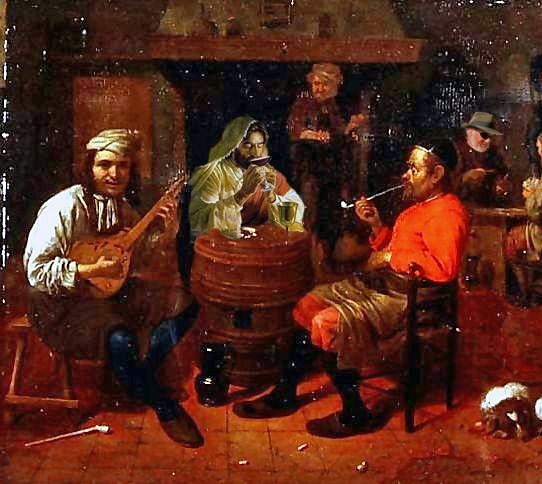
About a dozen or so years ago after returning from home a mole removal/biopsy procedure, I received a visitation from the muse of country music – let’s call her Twangella. The poem – as they say = wrote itself.

Click the arrow for sound:

Drunk me some wine with Jesus

at this here wedding in Galilee.

He saved the bestest for second

and provided it all for free.

So I quit my job on the shrimp boat

to follow him eternally.

No longer bound by them blue laws

enforced by the Pharisee.

And we had us some good times,

Till them Pharisee done him in.

Ain’t got no use for the religious right

After I seen what they done to him.

So when Saul/Paul stole the show

I just sorta drifted away,

Cause he never done quite understood

what Jesus was trying to say.

Paul was more like them Pharisee,

dissing this, cussing that,

giving the women a real hard time,

gay-bashing and all like that.

So I drink at home most nights now

trying to do some good,

offering the beggars a little snort

whilst praying for a robin hood.

Drunk me some wine with Jesus.

It was the bestest day I ever seen.

Drunk me some wine with Jesus,

partying with the Nazarene.

Jesus the wine-bibber, the whore’s buddy, a lot more uptight about money exchange than sins of the flesh. Actually doing a little jig in the Gospel of Thomas. A reformer. To hell with this harsh desert mentality, he preached. While he’s witnessing a throng preparing to stone an adulteress, half a world away in Tahiti naked girls with their parents’ blessings are chanting come-ons as they dance in a conga line past boys’ huts. Family values.

Ides of March Madness

prespaul

Actor and Def Poet Paul Edward O’Brien

As I was polishing the prose of yesterday’s post into a blinding sheen, I received an email from my former student and current friend, the actor and poet Paul O’Brien, with a link to this amusing layout of Shakespeare’s plays bracketed for an NCAA-like tournament to determine the very best of the best.

Shakespeare_MarchMadness_OneSheet-(3)

Shakespeare’s March Madness

Accompanying the link was Paul’s commentary on the above bracketing, a tour de force that echoes the idioms of sports commentators.  I asked Paul if he would be so kind as to drive over to Hoodoo studios here on Folly Island and record it for you, which, obviously, he did, because – presto – here it is!

Make sure you hit the grey arrow below so you can hear Paul’s performance as you read along.

O brother, we few, we happy few! Madness? I’ll say, mad as the sea and wind when both contend which is the mightier! Whose picks are these? Marlowe? Earl of Oxford? Some amateur wannabe? Where to begin? Okay, first in the Tragedy Region: there is no way that two powerhouse top seeds like Hamlet and Lear meet in the first round! No way. That really would be a tragedy. They don’t square off until the quarters. Hamlet would have to get by Othello, which would be tough, but that tenacious squad of Danes and their unselfish style of mutual murder and mayhem would carry the day for Elsinore. Yeah, Iago’s got mad skills, but let’s face it, he still hasn’t learned how to be a team player. MacB is bloody good, wicked good, but lacks solid ball control–he just doesn’t know when to stop sometimes, and Lear advances especially if Kent keeps up the tight defense. The quarter final match up between Hamlet and Lear would be close, but I’ll take Hamlet by a couplet at the buzzer. On to the History regionals. You want history, hey, Henry V–you’re history! You’re all pomp and circumstance and bluster in the middle, and you put on a good show, but you run out of steam in the fourth quarter, while your younger self has still got moves and knows how to take control and change the game at the right moment. Yea, sure, Falstaff doesn’t always come ready to play, but hey, you got Hotspur coming off the bench. Gimme a break! Henry IV wins and then beats the Romans, who really just don’t have their act together enough to go too deep in this tourney. As for Comedy, here’s some comedy: Twelfth Night over The Tempest. Are you crazy? Who’s gonna stop Prospero when he’s in the zone? Viola? The Duke? Malvolio? Malvolio?? Oberon and Titania are too much for Benedick and Beatrice bickering in the backcourt, but it doesn’t matter because Tempest is going to the final four. And here’s a problem alright: The Merchant of Venice over Troilus and Cressida. No way that’s happening. Achilles takes it to the hoop past Shylock every time. And Antonio just doesn’t match up well with Ajax in the post. Final Four: Troilus and Cressida v. The Tempest and Henry IV v. Hamlet. Finals: Hamlet v. The Tempest. Hamlet is the favorite, but they’ll all be dead by then, and The Tempest has magic going for it, which is pretty tough to beat. And won’t it be great to see Caliban cutting down the nets?

caliban 2