for Leonard Cohen
Like a tramp choir crying,
like a coat made out of lead,
ink spilled in water, a bird
beating about the cruel wires of a cage . . .
Bad Choices
In Nashville, Mississippi,
not far from the Rio Grande,
there lived a French Canadian trapper
named Hedrick Eckelmann.
He wrote a short novella
about the Second World War.
It ran ten-thousand pages;
he called it Less Is More.
He married a gal named Betty Sue,
who gave him two fine sons,
but she died a virgin at 44
cleaning one of his guns.
Terribly devastated,
he remarried within a week,
and lived happily ever after
until he choked on a steak
right outside of Nashville
in the heart of the Lone Star State,
right across the river from Canada.
Damn, he could’ve had a V-8.
I missed a bus in Baltimore, and with no place to stay, restless, desperate, running low, I thought I’d try to hitch a ride.
I should have known. Ain’t no decent man gonna pick up a hoary-headed hobo nowadays.
I stood on the shoulder, stuck out my thumb, squinting down the highway through the afternoon exhaust, hoping that some good Samaritan might stop.
Eight hours later, round about one or so, a jacked-up pick-up pulled over, one of them monster pick-ups, black, four-door, with a stunted back seat of sorts.
“Hop in, old man,” the driver snarled. “Let’s go. Ain’t got all night.”
I slung my bag into the bed, climbed my way way up, and slammed the door.
The passenger rolled up his window, the driver grabbed the wheel, put the pedal to the metal, war-hooped a holler, laid some rubber, and we was on our way.
The two of them wore their baseball caps backwards, nothing but kids, white, maybe twenty or so, but right off I could see their eyes lacked light, like they was lost.
(And I could’ve been sleeping in that depot waiting for the morrow).
“How much you plan pay us for this ride?” the driver drawled. “We ain’t no commies, ain’t got no use for no freeloaders.”
I told them I was bust broke, that if I had me some money, I wouldn’t be standing on the side of a highway at one a.m. in the morning.
The passenger punched me in the chest, slapped my face, and while I was wallowing, jacked my wallet.
The driver pulled over, hopped out, slung me to the ground, climbed back in, then drove off with my bag in the back rattling around in the bed of the truck.
That was a month ago. I’m back in Mayo now writing these so-called adventures on scraps of paper.
I keep them on my person, in the pocket where my wallet used to be, so on the day they find me dead, they’ll know a bit about me.
1
Our Saisy never really shook off that early abuse,
the beatings, starvation, the two-foot chain.
She’d wince when you went to pet her,
snap if you rubbed her head for too long.
As her rescue “foster mom” in Statesboro put it,
“That gal’s got her some food issues.”
Like stealing bread and hiding pieces ‘round the house,
gobbling down the rankest roadside carcass, knocking over
garbage cans, consuming their rotten whatever.
Afterwards, her Stygian, Technicolor diarrhea
would ruin our rugs.
2
Yet the rescuer’s daughter named her Joy
for that dervish dance when you’d grab a leash.
She’d rear and buck like a bronco, jump, hump her back,
swivel in a circle, smile like a very happy cartoon dog.
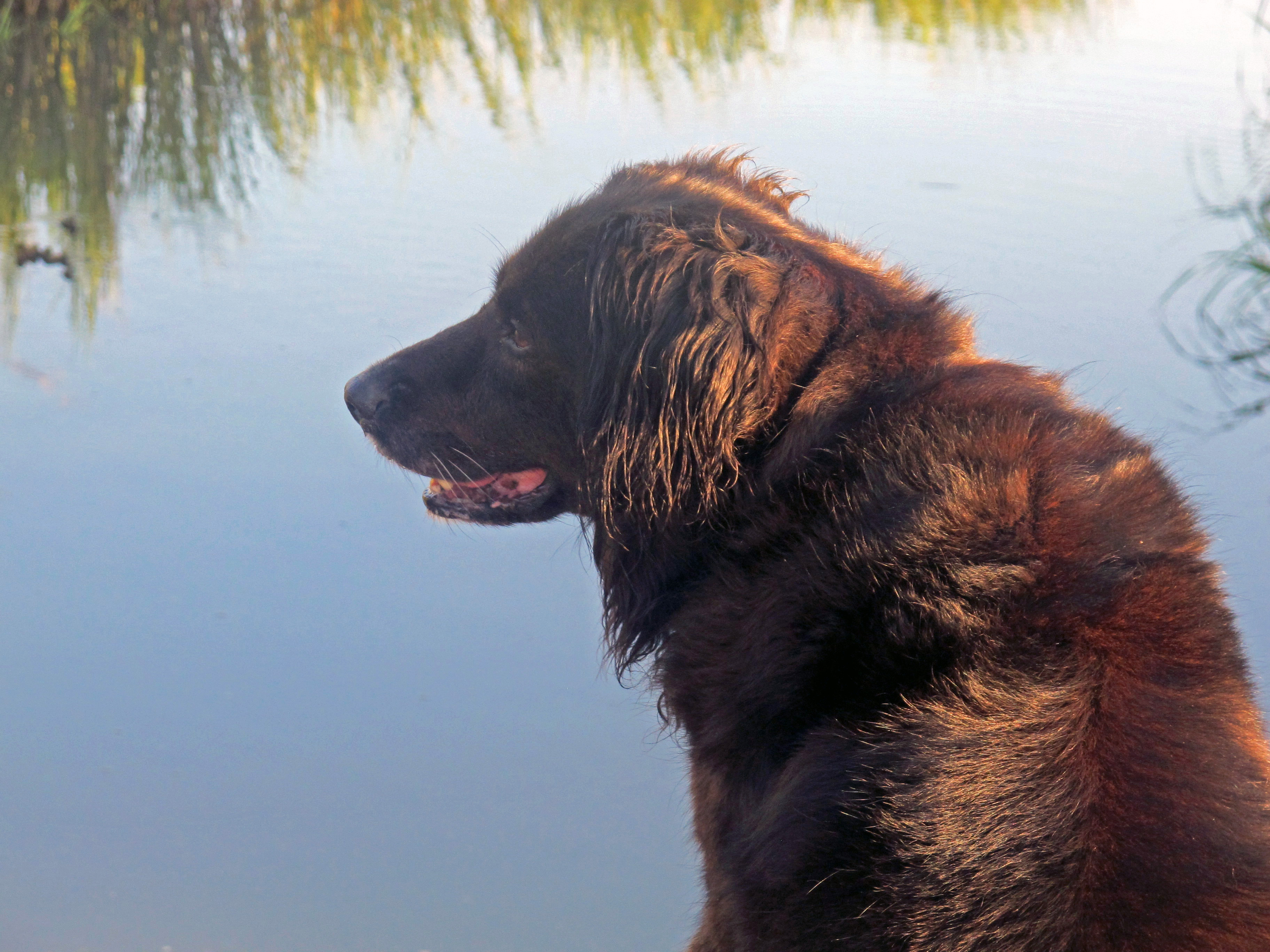
And what a beauty! that black slick fur, the brown undercoat,
distinctive of one of her breeds, the German Longhaired Pointer part.
On the beach or through the woods to the dock she’d strut,
a country beauty proud of her charms.
Indifferent to birds and squirrels, she hated cats,
despised UPS trucks. Her frantic bark was acquainted
with the dark — PTSD the vet once guessed.
3
That morning there would be no dance. She had died
in her sleep, and lay there on the rug peacefully unaware,
her eyes closed. She didn’t look dead, was barely cold,
but her teeth were clenched: no more biting, eating,
romping, barking, being. She hadn’t seemed sick,
was playful during her very last walk twelve hours ago.
To her it probably wouldn’t matter much, the vacancy
we feel when we return from work or a trip.
I can still see her, though, at the top of the stairs,
beginning that dance, nodding her head, smiling,
humping her back, clicking her nails on the wooden floor.
Miss Saisy
for Jack Miles
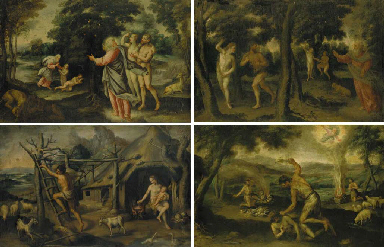
In the beginning, God talked to himself.
“Let there be light,” he said.
His words were simple, his
sentences declarative.
Let there be this and that,
and it was so.
Finally, he made “mankind,” a pair,
in his own image, male and female.
In those first days, he walked
in the garden in the cool of the day.
Barefooted, in the garden,
on breezy afternoons talking to Eve and Adam.
Those were the days before farming,
before thistles and thorns.
Those were the days before poetry,
and poetry, alas, begins with a curse:
And dust shalt thou eat
all the days of thy life.
And the beat goes on . . .
The grass divides as with a comb.
This week, during our summer break, the members of the mighty English Department where I teach have met voluntarily to fine tune our program.
Despite my having to abandon the funky barrier island where I reside and drive twenty minutes to the mainland, it’s really enjoyable to banter and swap stories with friends and colleagues who can pick up on obscure literary allusions.
Part of the fun is that we establish motifs, repeat at apt times absurdities that have come up, and one of the major motifs this week has been an anonymous student’s declaration after reading Walden that he or she “hates nature.” (By the way, we don’t name names – I only know whoever made this absurd statement as “a student”).
Of course, hating nature is hating the complex interconnectedness of atmosphere, water, vegetation, geology, animal life, etc. that has given rise to the consciousness of the nature-hater. It’s sort of like saying I hate ingestion or respiratory systems.
Nevertheless, we know what the student means. She/he doesn’t dig Thoreau, the great outdoors, would rather be inside in an air-conditioned space staring into some sort of screen.
And maybe, this American Lit student learned when reading Stephen Crane and Jack London that nature is absolutely indifferent to him or her.
So, there!
Anyway, yesterday, when riding my bike along Atlantic Avenue, I caught a whiff of a rotting carcass hidden from my view, and a nature-hating muse descended.
Random Thoughts
I detect death’s sour stench,
some small decomposing carcass,
oleander hidden, as I pedal past
into a stiff salty headwind.
Overhead in the same direction,
the broken V of five pelicans
flap – flap – flap – glide – flap,
and the stench is now behind me.
How sweet it would all seem
If Charlie Darwin hadn’t thrown
his monkey wrench into the works.
The pelicans splash like kamikazes.
It was you that broke the new wood.
Ezra Pound, “A Pact”
Old Ezra said to ditch the metronome
and use the musical phrase instead,
locked doors, keyholes, camisoles, not ideas.
Robert Lowell made it personal.
Mental illness was his muse,
his fingers trembling as the typewriter clacked.
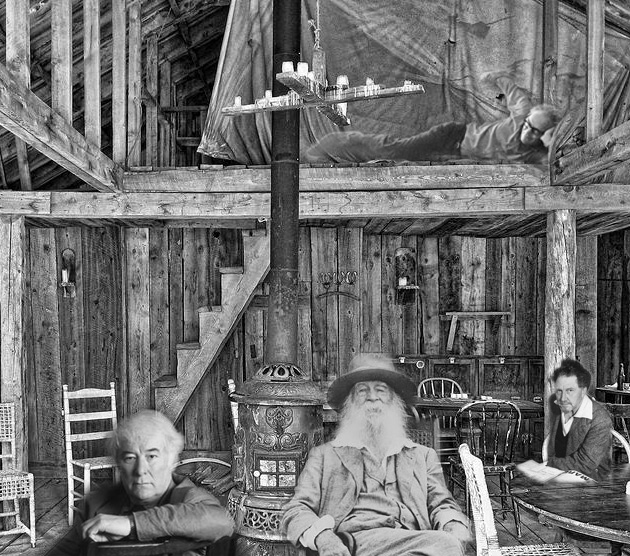
Seamus Heaney brought us down to earth,
his pen scratching old words across the page,
bogs, tors, spades, blackberries, frogs.
But Old Walt Whitman was the daddy of them all,
whirling his words like a hurricane,
snapping trees, flooding streets, derailing trains.

Alas, Lonnie sliding into second in Game 7 of the ’91 Series when he had a clear path home in a 0-0 tie.
Another ditty courtesy of my major muse, Insomnia, who brings us those dark hours when ghosts— in this case Lonnie Smith of the 1991 Atlanta Braves — crawl out of their shallow graves to grieve us.
A coon must be prowling round the water garden,
rattling gravel, or else frogs would be drowning out
the barking of that distant dog.
Sometimes with the windows open
I can hear the ocean, but not tonight —
just the whisper of insistent desperate yipping.
Here come the croaks — that’s better,
the hoarse sturm und drang of their desires
seem to trivialize mine.
When’s the last time I let out
a primal scream? Was it in the ’91 Series when
Lonnie Smith failed to round third and score?
Too bad I can’t slam shut my mind
like the lid of a laptop. Too bad Lonnie got deked.
Too bad that was then and now is now.