And yonder all before us lie Deserts of vast eternity. Thy beauty shall no more be found, Nor, in thy marble vault, shall sound My echoing song; . . .
Andrew Marvell
“Me, me, me me,” squeals the toddler, waving his arms.
“Watch me!” demands the nine-year-old wobbling off on his bike.
“Who me?” snarls the adolescent, feigning outrage.
“Will you marry me?” asks the suitor, dropping to one knee, reaching in his pocket for the diamond.
“I need some time and space for me,” says the wife frowning, her back turned, her arms folded across her chest.
‘Why me?” wonders the patient in the hospital gown as his oncologist points to the mass on the x-ray.
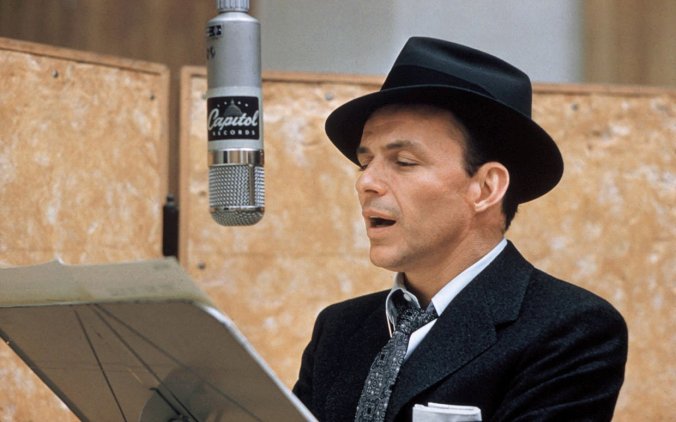
“I gotta be me,” croons fedora-sporting Sinatra, a fading memory, a voice very few living have heard live.
Some argue rather narrowly that world only exists in perception, i.e., that if there were no you, there wouldn’t be a world. Well, yes and no. If I had been killed in that horrific wreck on Hilton Head in 1976, the Braves still would have lost the ’91 Series – though for my sons non-Harrison and non-Ned, there would be no world.
Nevertheless, given that wherever we are is the center of the circle of perception – despite the fact that we’re mere dots on a map of blurred dots – each dot forms the center of our universes, 7 billion centers of 7 billion universes projecting outward from Europe, Asia, the Pacific, South America, the circles intersecting, forming collectively what is, or, rather, what seems to be.
As our world becomes more secular, the surety of eternal bliss dwindles among the populace. As in the pagan world of Beowulf, for many the only path to immortality is through fame, but which one of us would trade places with Frank Sinatra or Steve Jobs?
No, as one of Flannery O’Connor’s characters put it, “You can’t be any poorer than dead.”
Given that oblivion looms for so many of us, no wonder we seek attention, desire to be noticed. So we have our photograph taken next to the Mona Lisa. We publish blogs, post photographs of our evening meals on Facebook, purchase red Corvettes to counterbalance the drop in testosterone. We struggle to leave a mark, whether it be a novel of lasting value, a beautiful building, a cure, an estate.
All the while the invaluable moments dissipate unseen like heat waves from the floors of deserts.
Mike Theiss: Tumbleweed and Patterned, Cracked Desert Floor, and Nearby Mountains
The global village underscores our ultimate insignificance. Back in the mists of time, among the few of our tribal community, among the savannas or in the forests, we didn’t seek notoriety but subsumed ourselves in rituals. However, now, like the toddler, we seek attention to prove that we exist. Once we’ve been gone a hundred years most of us won’t leave a trace – except for whatever genetic tracings can be found in our descendants or any bones that might show up in an archeological dig or construction project.
The paradox is that despite endless silence that awaits us, what we really need here in time is silence. Time to think. Time to feel.
The latest controversy roiling the breasts of English majors at Yale is their being required to take a survey course called “Major English Poets,” a course of study that forces them to become familiar with the works of Chaucer, Spenser, Shakespeare, Donne in the first semester and Milton, Pope, Wordsworth, Eliot, and one other modern poet in the spring. Their beef, according the petition that they’ve delivered to the Department is that “a year spent around a seminar table where the literary contributions of women, people of color, and queer folk are absent actively harms all students, regardless of their identity.” [1]
I heartily disagree, and I’m going to quote at length one of the white men listed above, TS Eliot, from his essay “Tradition and the Individual Talent.”
To proceed to a more intelligible exposition of the relation of the poet to the past: he can neither take the past as a lump, an indiscriminate bolus, nor can he form himself wholly on one or two private admirations, nor can he form himself wholly upon one preferred period. The first course is inadmissible, the second is an important experience of youth, and the third is a pleasant and highly desirable supplement. The poet must be very conscious of the main current, which does not at all flow invariably through the most distinguished reputations. He must be quite aware of the obvious fact that art never improves, but that the material of art is never quite the same. He must be aware that the mind of Europe—the mind of his own country—a mind which he learns in time to be much more important than his own private mind—is a mind which changes, and that this change is a development which abandons nothing en route, which does not superannuate either Shakespeare, or Homer, or the rock drawing of the Magdalenian draughtsmen. That this development, refinement perhaps, complication certainly, is not, from the point of view of the artist, any improvement. Perhaps not even an improvement from the point of view of the psychologist or not to the extent which we imagine; perhaps only in the end based upon a complication in economics and machinery. But the difference between the present and the past is that the conscious present is an awareness of the past in a way and to an extent which the past’s awareness of itself cannot show.
And, yes, and that includes Alexander Pope, who may not be “fun” to read but who provides a nearly flawless mirror to the intellectual world of his century.
For people of color, “queer folk,” and women to have an understanding of the works of great artists and the historical contexts of those works strikes me as the opposite of harmful, especially given that I’m fairly sure Yale offers elective courses that feature other great poets like Derek Wolcott, Elizabeth Bishop, Langston Hughes, and Hart Crane. Chaucer, Spenser, Shakespeare, and Donne in a sense established the traditions of English poetry, the colloquial, rough-hewn verse of Chaucer and Donne pointing the way for the great Walt Whitman, the smoothness of Spenser no doubt influencing the verse of Christina Rossetti.
One student, Ariana Miele, in an op-ed piece for the Yale Daily News wrote, “We read Chaucer, but we are told to view his misogyny with an ‘objective’ lens.”
Certainly, the Middle Ages were misogynistic, and perhaps Chaucer was typical of his age, but he has also given us the Wife of Bath who offers this bit of wisdom to her fellow pilgrims:
By God, if women ever wrote some stories
As clerks have done in all their oratories,
They would have told of men more wickedness
Than all the sons of Adam could redress.
In other words, women in Medieval Europe did not have their voices heard.
Or this from Iago’s wife Emila from Othello explaining to chaste Desdemona why some women betray their husbands:
But I do think it is their husbands’ faults
If wives do fall: say that they slack their duties,
And pour our treasures into foreign laps,
Or else break out in peevish jealousies,
Throwing restraint upon us; or say they strike us,
Or scant our former having in despite;
Why, we have galls, and though we have some grace,
Yet have we some revenge. Let husbands know
Their wives have sense like them: they see and smell
And have their palates both for sweet and sour,
As husbands have. What is it that they do
When they change us for others? Is it sport?
I think it is: and doth affection breed it?
I think it doth: is’t frailty that thus errs?
It is so too: and have not we affections,
Desires for sport, and frailty, as men have?
Then let them use us well: else let them know,
The ills we do, their ills instruct us so.
I’ve often said that when parents start running a school, that school’s in trouble. When students start running a university, especially when they’re undergraduates, that university’s in big trouble.
[1] Is it possible to study post-colonialism without understanding colonialism? Might knowledge of pre-colonial and colonial art help students better understand colonialism and post-colonialism?
I don’t know why these lines from Wallace Stevens have always moved me so:
It was evening all afternoon.
It was snowing
And it was going to snow.
The blackbird sat
In the cedar-limbs.
The day before yesterday, a student at my school, a junior, a beautiful impatient boy, died.
Adolescents are more or less flat-liners when it comes to perspective. In my acne-ridden days, I remember all too well stupidly thinking all too much depended on something that might happen at 4th period, or not, or after school, or not. Breaking up equaled deserts of vast eternity.
Back then, I was eaten up with Romanticism, could not imagine the longer view that year piled upon year provides, could not imagine the joys of a post-adolescent life, of discovering an intellectual passion in college, of meeting and marrying a soul mate, of producing children, of singing lullabies to them:
When you wake, we’ll paddy-paddy cake
And ride the shining little pony.
Today, weather-wise, it was evening all morning and evening at noon and even evening early in the afternoon. Outside my classroom windows, at nine a.m. the dense cloud cover made the morning look like nightfall. It was so dark streetlights were illuminated.
I was teaching Wallace Stevens. The students seemed to get it. “It’s like a cubist painting,” one of them said. “Different perspectives.” They had momentarily forgotten.
The sages tell us that the knack of not thinking is the pathway to serenity, that we should focus on the here and now because the past and future are abstractions existing only in the present. Rather than obsessing about your worsening health, your culture’s decline, or the peril the planet faces as oceans rise and deserts expand, you should play it cool, like the lilies of the field.
Don’t fritter away your time worrying – they say — taste the sweetness of the apple upon your palette, appreciate the miracle of the buzzing fly battering against the brilliance of the windowpane.
Be present in the present.
However, to riff on/off Elizabeth Bishop, “The art of not thinking is difficult to master,” especially if you’re staring down the barrels of big time problems like bankruptcy, prison, or debilitating disease. Obviously, if creditors are leaving angry messages on your phone or your joints throb or you’re packing a suitcase for the Big House, it’s extremely difficult not to dwell on these much-more-than-inconveniences.
Yet, the sages are right: worry and fret don’t help the situation. They short-circuit your taste buds, blind you to the beauty of the world, the paragon of animals. Unrelenting worry can turn your life into a Gerard Manley Hopkins dark night of the soul:
Pitched past pitch of grief,
More pangs will, schooled at forepangs, wilder wring.
Hence, philosophies like stoicism, religions with afterlives, spiritual exercises like Zen meditation, and of course, drugs.
The problem with drugs, even though they offer the quickest respite, is that they wear off, leaving you possibly worse off than before, so you tend to turn to them more and more often, and the more and more you rely on them, the less and less effective they become. Eventually, if you manage to stay alive and out of jail, they stunt the amygdala, the pleasure center of the brain, and joy becomes increasingly difficult to experience.
But it’s not like you can become a stoic in a day or a Zen master with a week’s worth of sitting. Religions with afterlives can offer speedier relief, but generally, non-believers don’t opt for them until they hit the bottom of the abyss.
When I was a child, I was a crybaby. I’d cry when I lost my crayons at school, when my favorite team lost, when I thought about something sad that happened to my mother as a child. However, over the course of my life, through reading literary fiction, I developed a sort of stoicism. What I discovered in Thebes and Elsinore and Yoknapatawpha is that suffering is universal. To quote Rick from Casablanca, “It doesn’t take much to see that the problems of three little people don’t amount to a hill of beans in this crazy world.” In other words, suffering doesn’t make you special; it makes you human.
And, yes, in moderation, alcohol and drugs can help as well, help you relax after a hard day or get your serotonin levels back to normal so you don’t wake up at 3 a.m. and feel the fell of dark, not day.
Ultimately, treasure right now what one day will be gone without thinking of the fact that one day it will be gone.
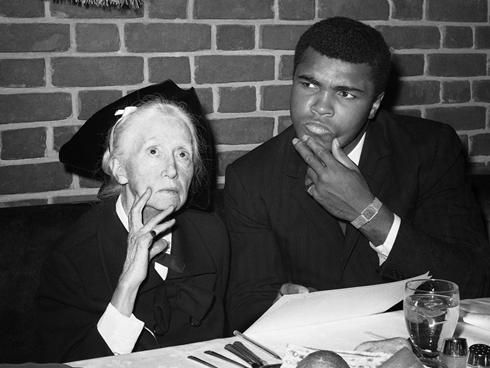
Writing free verse, Robert Frost once noted, is like playing tennis without a net, and although I disagree with that overly simplistic characterization, I do think when it comes to political verse satire, you’re better off possessing the talents of Ogden Nash over those of William Carlos Williams. In other words, you want the inherent attraction of traditional verse — standard meter, rhyme, alliteration, etc. In the realm of satire, sing-song trumps subtle sonic stitching; Muhammad Ali KOs Marianne Moore.
For example, this ain’t gonna hack it:
Nor will this:
One obvious problem in the current Presidential campaign is coming up with words that rhyme with the candidates’ names. This difficulty is especially pronounced for surnames with two syllables.
Sanders isn’t too bad – sanders/pander – but John Kasich and Hillary Clinton, ugh.
Kasich/ wasted.
Clinton/sent in.
Of course, with HRC, you can go with her first name, and bam, you get pillory, which offers many illustrative possibilities.
But let’s face it, as far as rhyme goes, the candidate with most promising last name is Trump, which offers a veritable plethora of pejorative rhymes:
bump/clump/dump/frump/grump/hump/ lump/mumps/ rump, sump, etc.
Cruz comes in second with dues/snooze/ flooze/abuse/news/, etc.
But then, even if you can get the rhymes going, you have to worry about meter.
Forget it.
What muse worth her whispering is going to descend and inspire you to write some shit about Carly Florina?
Years ago, I invited my former student, Paul Edward O’Brien, to introduce a unit on poetry to jaded high school seniors. It was springtime, and they were sick of school — sick of their childhoods. To most of them poetry was the language arts equivalent of a math problem.
Paul, an oncologist by profession and actor by avocation, majored in English at Harvard, taught freshman composition there during a sabbatical from med school, so he is a man of science and of letters. The old-fashioned word “dashing” does him justice, so I thought a swashbuckling evangelist for poetry might at least hold their attention. Maybe even convert one.
He began by quoting “Who Goes with Fergus” and explained how he fell in love with the poem without even having any idea what it meant. He told the students at one point that “Poetry can be your friend, your companion, help you in times of need.”
Indeed.
* * *
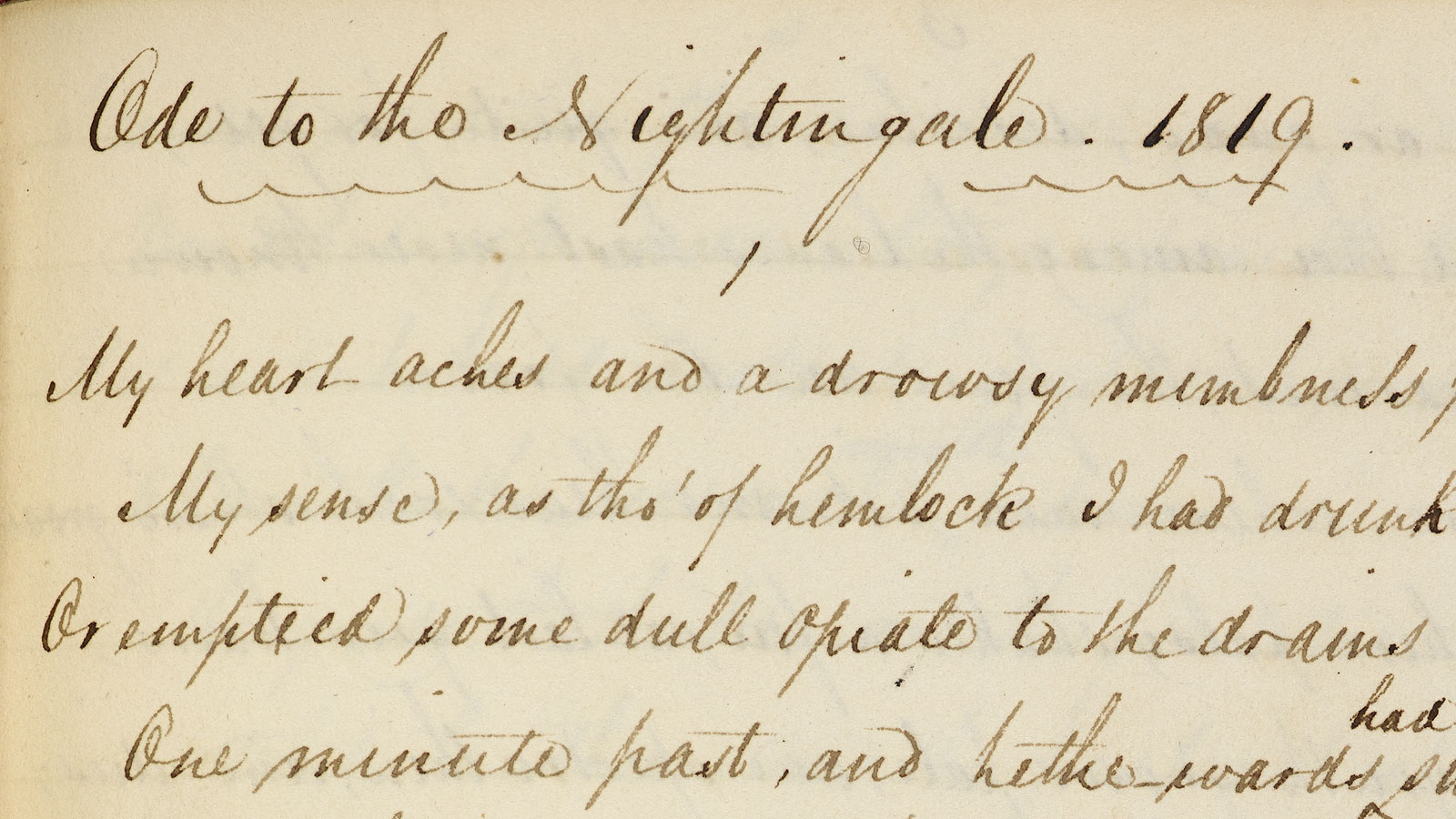
Last Monday, with about three-and-a-half hours of sleep and feeling something very close to despair, I stumbled into my first period class of sophomores to discuss John Keats’s “Ode to a Nightingale.” The poem had been slated for this day on my syllabus before I had received some very disturbing news, and it’s not necessarily a poem I would choose to teach right now given what is going on in my life.
I started the class by asking students to close their eyes and for three minutes and attempt to remember vividly a time when they’d been blown away by nature – overawed by a breath-taking vista or a ferocious thunderstorm or an encounter with a wild animal. I asked them to try to conjure images – sights, sounds, smells and then to capture those images with words.
Once I saw that all their eyes were shut, I closed mine as well and thought of last summer when my wife Judy and I sat at a picnic table on top of Mount Mansfield in Vermont.
. . . behind us clouds rush over the summit, revealing a patch of blue sky. A waterfall of light pours through the opening and cascades down the side of the summit, progressively devouring shadows. Actually, the light’s more like lava because a waterfall is always pouring forth, but this light is creeping, shimmering its way down, illuminating boulders and green growth . , ,
Instead of reading their responses, they shared them orally. One, nighttime in Oxford, England, green-green-green night grass and a profusion of stars. Another, atop a mountain with fog blanketing below, except for a rectangular opening, like a window, through which he could see the sloping vegetation below. A third, the sound of water rushing over river rocks during a night of utter solitude.
I asked them to articulate their emotional responses. Virtually everyone agreed egos tended to disappear in the face of their experiences. No one thought, “How cool that I’m experiencing these wonders,” but the wonders themselves took precedence over the perceiver.
I tied their experiences to Romanticism and explained in the ode Keats is trying to escape his anguish via nature and imagination.
We then turned to the poem itself, that beautiful meditation on death, suffering, attempted escape, the failure of the imagination, among other things.
I’ve given up having students read poems out loud in class; I read them myself for the sake of fluidity.
So I started the first stanza, and as I did, sunlight flickered across the page underscoring, as it were, the delicacy of the verse, the ephemera of poor Keats’s rapidly disappearing days. I tried to keep my voice steady.
My heart aches, and a drowsy numbness pains
My sense, as though of hemlock I had drunk,
Or emptied some dull opiate to the drains
One minute past, and Lethe-wards had sunk:
‘Tis not through envy of thy happy lot,
But being too happy in thine happiness,—
That thou, light-winged Dryad of the trees
In some melodious plot
Of beechen green, and shadows numberless,
Singest of summer in full-throated ease.
Keats was suffering from depression. His beloved brother Tom had died of TB the summer before, and TB’s first symptoms were beginning to manifest themselves in him.
I asked the students to identify the tone using the first line: “aches” “numbness,” “pain.”
“What is hemlock? I asked. “Opiate?” “Lethe?” “Dryad?”
I had trouble with the third stanza in that I feared if I might start to weep.
Fade far away, dissolve, and quite forget
What thou among the leaves hast never known,
The weariness, the fever, and the fret
Here, where men sit and hear each other groan;
Where palsy shakes a few, sad, last gray hairs,
Where youth grows pale, and spectre-thin, and dies;
Where but to think is to be full of sorrow
And leaden-eyed despairs,
Where Beauty cannot keep her lustrous eyes,
Or new Love pine at them beyond to-morrow.
The sunlight flickering shadows from the trees outside the window upon the words of the poem was quite beautiful.
John Austen’s Hamlet
“Dissolve.” I recited Hamlet’s first soliloquy. “O would this too too solid flesh melt/And dissolve itself into a dew. . .” I explained Hamlet’s sad situation, his father’s death his mother’s marrying his uncle within a month.
This is true misery, I said; Hamlet and Keats long for vaporization, demolecularization, surcease of sorrow, absolute disappearance.
We discussed the slowness of the lines – the caesuras – how those commas make the reader hesitate, to limp along with “the weariness, the fever, and the fret” . . . where palsy shakes a few, sad, last gray hairs.”
The sunlight flickering on the page. The sound of my own voice reading the words.
I was not alone. I had the students, of course, but also Hamlet, Keats, those old immortal friends, to help me get through those miserable moments. No, not alone, and paradoxically, I felt keenly alive, felt something like joy by the time it was time to let them go.











 You Do Hoodoo
