
Adjustments
My cigarette dangling dragon nostriled daddy
post war bared his teeth when he smiled.
“Go tell your father,” Mama would say,
“supper’s on the table.”
Wake him up, his fists would fly
dog paddling into the empty air.
Adjustments
My cigarette dangling dragon nostriled daddy
post war bared his teeth when he smiled.
“Go tell your father,” Mama would say,
“supper’s on the table.”
Wake him up, his fists would fly
dog paddling into the empty air.

Oh, the side-splitting counter-Darwinian hijinks those headline-capturing police blotter inebriates produce each week on the highways, byways and beaches of the Lowcountry![1]
Whether it be a wobbly motorist telling a cop “he’s had five beers plus one beer,” a naked bicyclist peddling towards a fast-food drive-thru, or a domestic dispute involving tire irons and trash can lids, the police blotter is sure to bring a winsome smile to even the crabbiest of malcontents.
Not too long ago, you had to riffle to the back of the City Paper, Folly Current, or Section 12B of the Post and Courier to discover who had tried to drive his car up the stairs leading to the Battery’s promenade or who had stuffed two bottles of champagne in his pants in a failed heist; however, in these latter days seeking out the absurd is almost too easy. For example, here is a screen capture from a recent Live 5 web posting:

Still, I prefer the paper, whose account of the Halloween mishaps of a luckless 21-year-old who drove his vehicle into Colonial Lake offers more details than Live-5’s recap. For example, in the paper we learn that divers were employed to see if another passenger was in the car, the one the 21-year-old claimed had been driving. Live-5 did, however, estimate the parameters of his intoxication, between .10 and .16.
I’m not one to talk, though. I once drove my MG Midget down the steps of a parking garage into Campus Police Headquarters, which resulted in a reckless driving ticket and six points off my license and a hefty increase in my insurance rates.
Too bad I didn’t pay more heed to those street preachers who haunted the streets of Columbia back in the day.
Street Preacher
A fire-breathing preacher named Mitch
From a street corner bellowed his pitch
He warned of the horrors of hell
Where one day I was bound to dwell,
That sanctimonious, psalm-singing son-of-a-bitch.
[1] Not to mention beneath bridges, inside the cabs of heavy construction equipment, and upon picnic tables.


Unfortunately, I suffer from insomnia. Unfortunately, some nights/a.m.s I try to deflect thoughts by constructing verse. Unfortunately, some nights/a.m.s the result might be a limerick.
For example:
Vulgar But Not Profane
A wayward nun from Bangkok, Maine
screamed hail marys whenever she came.
She had sex with her jailer
and cursed like a sailor,
but never took the Lord’s Name in vain.

Yeats and Maude Gonne by Anne Marie O’Driscoll
Half close your eyelids, loosen your hair,
And dream about the great and their pride;
They have spoken against you everywhere,
But weigh this song with the great and their pride;
I made it out of a mouthful of air,
Their children’s children shall say they have lied.
WB Yeats “He Thinks of Those Who Have Spoken Evil of His Beloved”
A by-product of breathing, that mouthful of air, exhalation tracking up through the trachea, plucking the vocal c[h]ords: vowels, consonants, syllables, words, words, words. Say outloud the title of this post – “screech me a poem, sugar britches.” Dissonant, sharp, as unlovely as the scraping of a rake on gravel, echoing Juliet’s lament as Romeo vacates their marriage bed:
It is the lark that sings so out of tune,
Straining harsh discords and unpleasing sharps.

Romeo and Juliet by Todd Peterson
Perhaps even more discordant is Gerard Manly Hopkins postlapsarian description of industrialization:
And all is seared with trade; bleared, smeared with toil;
And wears man’s smudge and shares man’s smell: the soil
Is bare now, nor can foot feel, being shod.
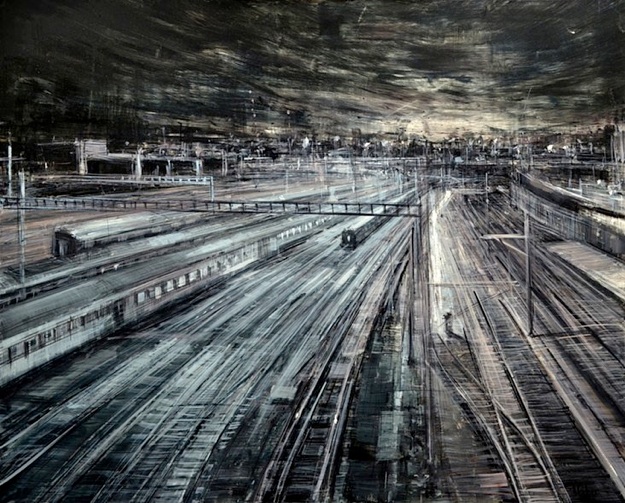
Train Tracks by Valerio D’Ospina
Who sez that poetry’s supposed to sound pretty?
Not Alexander Pope:
But when loud surges lash the sounding shore,
The hoarse, rough verse should like the torrent roar.
Nor that barbaric yawper Walt Whitman:
Nor him in the poor house tubercled by rum and the bad disorder.
Nor Ol’ Ez in St. Elizabeth’s Mental Hospital ranting his way to a Bolligen Prize:
the drift of lice, teething,
and above it the mouthing of orators,
the arse-belching of preachers.

Ezra Pound
Thanks to its Anglo-Saxon roots, English is well-suited to screech. However, thanks to its French invaders, our language can also coo. And don’t forget the ess-cee (sc) words of the Vikings with their skalds singing of skulls and skies and dragons’ scales.
English-speaking poets possess quite a synthesizer through which to sample sounds, orchestrating Anglo-Saxon, Norse, and French symphonically (Milton) or piping a simple Saxon tune in tetrameter (Anonymous).
Given global warmification/climatic alternation, the following worry may seem as trivial as the date of Alfred Tennyson’s death, but I wonder, given our beeping visual small screen secondhand exposure to actual sights and sounds, if off-the-cuff eloquence might become as rare as first edition Kafkas.
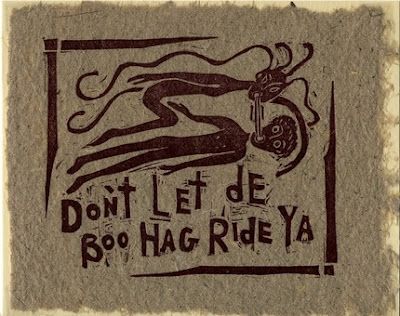
In my youth, among my compatriots, having a way with words held sway. I think of Jake the Snake Williams politely stringing together sonorous sentences to a Jehovah’s Witness in Richland Mall explaining why he wouldn’t take the tract, and the fellow smiling, nodding his head, and saying, “Brother, you got you an excellent rap.” Or Furman Langley lamenting in a Lowcountry gumbo of gullah-echo the legend of the Boo Hag.
The “like-like” syncopatations of youthful inarticulation and the ubiquitous interrogative lilt of their declarative sentences gives me pause?
I guess it all boils down to a matter of culture.
Bewildered, bewildering primate. Absinthe. Circumcision. Couplets.
Grudges., beliefs. The war of my childhood, Europe tearing at itself.
Scarification. Conceptual art. Classic celebrated scholarly papers
On the Trobriand Islanders, more fiction or poetry than science.
Absorbed or transmitted always invisibly in the air
From a digital Cloud. Visible and invisible in the funny papers . . .
from “Culture by Robert Pinsky

The Doggerel-Gone-It Impeachment Blues
The stench of wet coal, politicians . . .
Ezra Pound, “Canto XIV”
Johnson’s impeachment occurred so far back.
No one can remember the Tenure of Office Act.
Once upon a more recent time,
J Gordon Liddy committed a crime,
a burglary some have called third rate,
which led, of course, to Watergate.
Dick Nixon was forced to take the fall
(in those days Republicans sported balls),
which sadly isn’t the case today.
They had Goldwater; we have Graham.
Weak-willed Bill Clinton in the Oval Office
ran afoul of a couple of orifices,
creating quite a sordid mess,
alleged perjury, a stained blue dress.
Yet the Senate voted not to convict,
(though most agreed he was a prick).
So here we are again, forsooth,
dealing with presidential abuse:
The number of allegations should give us pause:
obstructing justice, violating the Emolument Clause,
withholding aid for dirt in a quid pro quo.
The days go past, the catalogue grows.
I say let’s subpoena those stories killed by the Enquirer
so we can extinguish this orange dumpster fire.
It’s time we got back to something like normal
With a Commander-in-Chief less hormonal.

photo courtesy of ©Lorne Gill/SNH
I love the taste of dirt,
rich muck beasts have rotted in,
decomposition reborn as whiskey,
peaty,
Celtic,
Scottish
grit.
Before the Fall
wrinkled lip, and sneer of cold command
I met a man at Mar-a-Lago
Who said, “Two cloud- scraping towers
Stand in Istanbul, I want you to know,
Built by me, a man of tremendous power
With hair the color of gilded gold.
No man can match my menacing glower
When you don’t do what you’ve been told,
Like Lindsey over there, watch him cower.
“I am the fucking president,” he bellowed.
“Lindsey, go fetch me a Diet Coke.”
To me: “I am the most stablest genius e-vah,
And ne-vah, ev-ah have been known to choke.
Here’s my mighty and matchless prediction.
I’ll carry all 50 states in the next election – ha!
Like the majority of North Americans, high school students don’t like poetry. When I teach my first lesson on poetry, I confront students with this fact, encourage them to be honest, to raise their hands if they don’t like poetry, and all but one or two hands tentatively rise.
I ask them why, and they reply “it’s hard” or “too abstract” or that “teachers read too much into it and that’s off putting.”
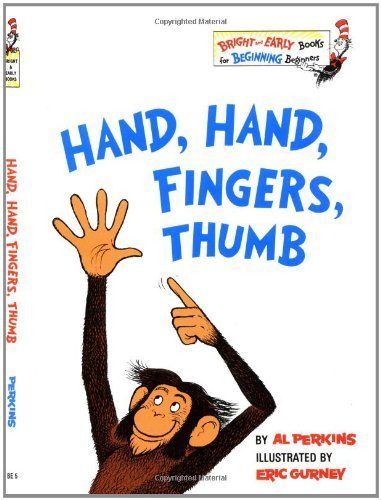
I say, “But you used to like it. You liked Dr. Seuss. See if you like this poem. Then I read them “Hand, Hand Fingers Thumb,” my older son Harrison’s favorite book when he was a preschooler.
Because the illustrations constitute an important facet to the poem’s overall effect, I’m going to provide a video and then read it myself to produce a very different vibe, the one I create in the classroom.
Okay, hit the arrow to get my rendition.
Usually, I receive a rousing round of applause, but then I ruin it for them. I say, “See, you enjoyed that, but you didn’t get its deeper meaning. Let me explain.
“The poem is actually an apocalyptic history of life on the planet that incorporates both Hebraic and Hellenic myths denoting the fall of man that culminates in a population explosion that eventually kills all primates on the planet.”
“What?” they say.
“Listen. At first the monkeys are happy in their prelapsarian state, enjoying music and each other’s company until
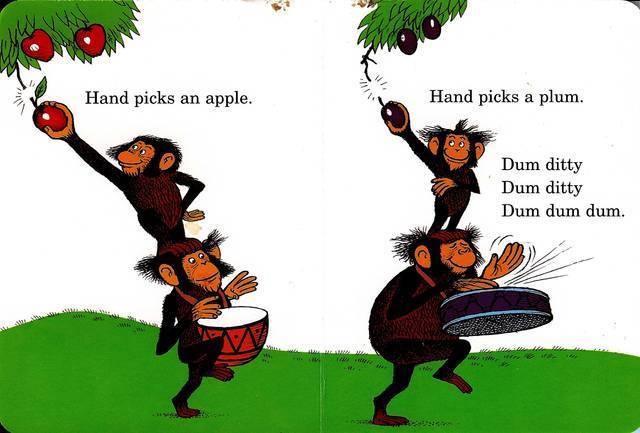
“Here the apple represents the Eden myth’s rendition of the Fall, and the plum represents the Greek concept of the worship of Dionysius, the Greek god of wine. Perkins is using what is called poetic license, substituting one purple fruit for another for the sake of rhyme.
“It’s no accident that in the very next stanza after the chorus, disease enters the rapidly fading paradise of the monkeys’ world.
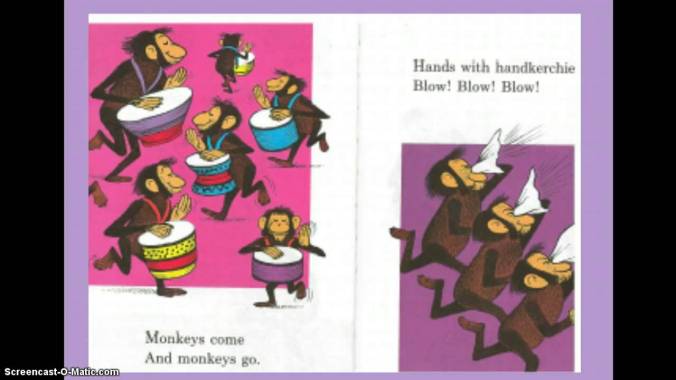
“As civilization advances, instrumentation becomes more sophisticated; banjos and fiddles augment the simple jungle drums at the beginning. An unabated and unsustainable population explosion ensues, choking the planet.
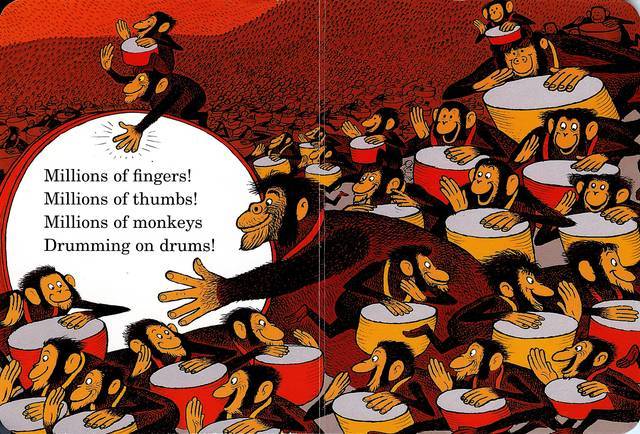
“Hence the diminuendo at the end
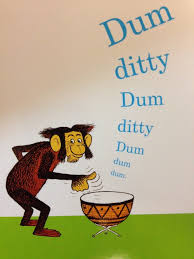
“This is an obvious allusion to TS Eliot’s “The Hollow Men,” its last lines stating that the world will end “not with a bang but a whimper.”
Some kids look generally puzzled, others sport wry smiles. I take my tongue out of my cheek and confess that what I just spewed was bullshit, that the poem exists to delight you with sound, rhythms and rhymes, and that a very important rule is that it’s much better to miss a symbol than to misinterpret one. That, in fact, most poems are the opposite of abstract, they’re concrete.
Archibald MacLeish

Mr. President can’t eat, can’t sleep,
gots rocks in his pillow,
his shit-creek canoe
taking on sewage.
Do Lawd!

sick with desire
And fastened to a dying animal
My ash blonde hair has disappeared,
leaving a freckled scalp in its stead.
Two black bags bulge beneath my eyes,
All rheumy and rimmed with red.
They say sagacity is recompense.
(I’d settle for a dollop of common sense).
Hey, little lady, could you spare me a smile?
(Or at least a wink instead of a wince?)
No, when it comes to wisdom,
I’m an old lecher banging on a drum,
cruising the boulevards looking for love
in the suburban sprawl of Byzantium.
Playing the fool, the pantaloon,
howling for hours at the hollow moon,
waking in the morning with a broke down head,
knowing that never will be all too soon.
Old friend, Willy B, sing me a song
that will drown out the barbarous gong
of the death knell clanging in my brain
you, the king of love gone wrong.

