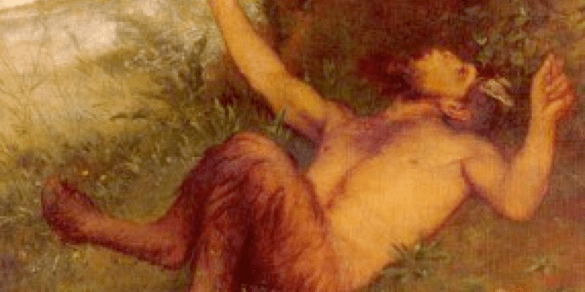
The Death and Resurrection of Pan

pan dead

Several springs ago, I wrote about the Death of Satan, ruing his demise, fretting that without the fetters of everlasting, agonizing imprisonment, Christianity offers no concrete constraints on human misbehavior, a simple, “I’m sorry, Jesus,” sufficing to cleanse a lifetime of sadism, bigotry, predation.

Poof!  Forgiven!
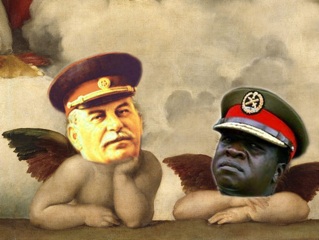
 

Sistine_Madonna_Group_of_Angels_Raphael_1440x1080

With Satan alive and well, imagine Josep and Idi facing the everlasting wrath of Jonathan Edwards’ or Father Arnall’s God!

First, Preacher Edwards:

Tis everlasting Wrath. It would be dreadful to suffer this Fierceness and Wrath of Almighty God one Moment; but you must suffer it to all Eternity: there will be no End to this exquisite horrible Mis- ery: When you look forward, you shall see a long Forever, a boundless Duration before you, which will swallow up your Thoughts, and amaze your Soul; and you will absolutely despair of ever hav- ing any Deliverance, any End, any Mitigation, any Rest at all; you will know certainly that you must wear out long Ages, Millions of Millions of Ages, in wrestling and conflicting with this almighty mer- ciless Vengeance; and then when you have so done, when so many Ages have actually been spent by you in this Manner, you will know that all is but a Point to what remains. So that our Punishment will indeed be infinite. Oh who can express what the State of a Soul in such Circumstances is! All that we can possibly say about it, gives but a very feeble faint Representation of it; ’tis inexpressible and in- conceivable: for who knows the Power of God’s Anger

Your turn Father Arnall.  Can you render “the faint representation” of eternity a little more concretely?

You have often seen the sand on the seashore. How fine are its tiny grains! And how many of those tiny little grains go to make up the small handful which a child grasps in its play. Now imagine a mountain of that sand, a million miles high, reaching from the earth to the farthest heavens, and a million miles broad, extending to remotest space, and a million miles in thickness; and imagine such an enormous mass of countless particles of sand multiplied as often as there are leaves in the forest, drops of water in the mighty ocean, feathers on birds, scales on fish, hairs on animals, atoms in the vast expanse of the air: and imagine that at the end of every million years a little bird came to that mountain and carried away in its beak a tiny grain of that sand. How many millions upon millions of centuries would pass before that bird had carried away even a square foot of that mountain, how many eons upon eons of ages before it had carried away all? Yet at the end of that immense stretch of time not even one instant of eternity could be said to have ended. At the end of all those billions and trillions of years eternity would have scarcely begun. And if that mountain rose again after it had been all carried away, and if the bird came again and carried it all away again grain by grain, and if it so rose and sank as many times as there are stars in the sky, atoms in the air, drops of water in the sea, leaves on the trees, feathers upon birds, scales upon fish, hairs upon animals, at the end of all those innumerable risings and sinkings of that immeasurably vast mountain not one single instant of eternity could be said to have ended; even then, at the end of such a period, after that eon of time the mere thought of which makes our very brain reel dizzily, eternity would scarcely have begun.

A whole long lot of misery, O my brothers and sisters!

***

When I posted “Satan Ist Tot,” it hadn’t dawned on me that Satan is Pan’s doppelgänger, hoofed and horned, half-human and half-bestial, our intermediary between the celestial and the cesspool, heaven and earth.

Perhaps one of the most curious events in the ancient world is Plutarch’s announcement of the death of Pan, which occurred during the reign of Tiberius (14-37 CE). Here’s Plutarch relating the story via Philip the Historian in On the Obsolescence of Oracles:

As for death among such beings, I have heard the words of a man who was not a fool nor an impostor. The father of Aemilianus the orator, to whom some of you have listened, was Epitherses, who lived in our town and was my teacher in grammar. He said that once upon a time in making a voyage to Italy he embarked on a ship carrying freight and many passengers. It was already evening when, near the Echinades Islands, the wind dropped, and the ship drifted near Paxi. Almost everybody was awake, and a good many had not finished their after-dinner wine. Suddenly from the island of Paxi was heard the voice of someone loudly calling Thamus, so that all were amazed. Thamus was an Egyptian pilot, Cnot known by name even to many on board. Twice he was called and made no reply, but the third time he answered; and the caller, raising his voice, said, ‘When you come opposite to Palodes, announce that Great Pan is dead.’ On hearing this, all, said Epitherses, were astounded and reasoned among themselves whether it were better to carry out the order or to refuse to meddle and let the matter go. Under the circumstances Thamus made up his mind that if there should be a breeze, he would sail past and keep quiet, but with no wind and a smooth sea about the place he would announce what he had heard. So, when he came opposite Palodes, and there was neither wind nor wave, Thamus from the stern, looking toward the land, said the words as he had heard them: ‘Great Pan is dead.’ Even before he had finished there was a great cry of lamentation, not of one person, but of many, mingled with exclamations of amazement. As many persons were on the vessel, the story was soon spread abroad in Rome, and Thamus was sent for by Tiberius Caesar. Tiberius became so convinced of the truth of the story that he caused an inquiry and investigation to be made about Pan; and the scholars, who were numerous at his court, conjectured that he was the son born of Hermes and Penelopê.”

Of course, the death of Pan coincides with the life of Jesus, and Christian philosophers have taken Plutarch’s pronouncement as the ending of the old order and the beginning of the new.

James Hillman (whose prose style I detest but whose anti-Buddhist ideas intrigue me) writes

When Pan is dead, then nature can be controlled by the will of the new God, man, modeled in the image of Prometheus or Hercules, creating from it and polluting in it without a troubled conscience.  (Hercules who cleaned up Pan’s natural world first, clubbing instinct with his willpower, does not stop to clear away the dismembered carcasses left to putrefy after his civilizing creative tasks.  He strides on to the next task, and ultimate madness).  As the human loses personal connection with personified nature and personified instinct, the image of Pan and the image of the devil merge. Pan never died, say many commentators on Plutarch; he was repressed. Therefore as suggested above, Pan still lives, and not merely in the literary imagination.  He lives in the repressed which returns, in the pathologies of instinct which assert themselves, as Roscher indicates, primarily in the nightmare and its associated erotic, demonic, and panic qualities.

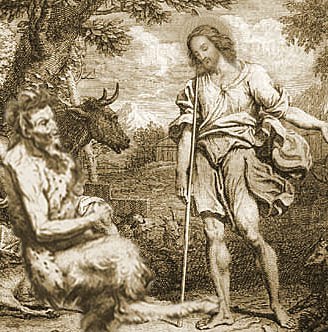
Perhaps, then, Satan hasn’t actually died but merely morphed back into his prototype, Pan.  They both have served as lords of the underworld, Satan in his hell, Pan in our unconsciousnesses.  Certainly, it’s difficult to imagine Jesus smiling and nodding his haloed head as he looks upon Jonathan Edwards’ and Father’s Arnall’s visions of eternal damnation.  After all, Jesus himself supposedly comes from the primordial ooze of Mary’s stock as well as from the stars.  Part of Pan no doubt dwelt in him as well.

It’s a shame, by my heretical reckoning, that the Gnostic Gospel of Thomas didn’t make the ecclesiastical cut.  In that quizzical compendium Jesus strikes me as being much more soulful.  For example, here he is in “Saying 70”:

Jesus said, “If you bring forth what is within you, what you
bring forth will save you. If you do not bring forth what is
within you, what you do not bring forth will destroy you.”

Here is Elaine Pagels, the Harrington Spear Paine Foundation Professor of Religion Princeton University:

The Gospel of Thomas also suggests that Jesus is aware of, and criticizing the views of the Kingdom of God as a time or a place that appear in the other gospels. Here Jesus says, “If those who lead you say to you, ‘look, the Kingdom is in the sky,’ then the birds will get there first. If they say ‘it’s in the ocean,’ then the fish will get there first. But the Kingdom of God is within you and outside of you. Once you come to know yourselves, you will become known. And you will know that it is you who are the children of the living father.”

O for a rapprochement between Jesus and Pan, lamb and goat, inside and out, here and now!
meltitsm copy

Paean to Thanksgiving

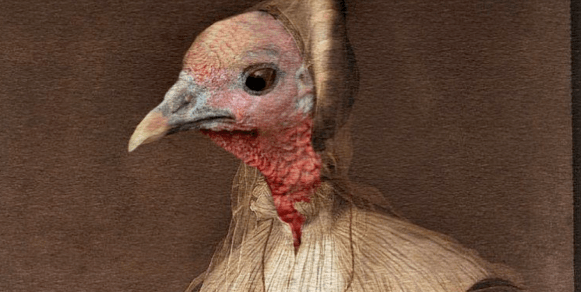
turkey with bonnet.png

Despite its rather depressing backstory,[1] Thanksgiving ranks as my favorite holiday.

This Thanksgiving won’t be as festive as most.  Ned’s in Germany, Harrison and Taryn will be in New York, and Brooks is flying to Seattle to spend time with her father.  However, Caroline and I will make the most of it, maybe take a road trip to check out some foliage, probably eat some turkey and trimmings with her great cook of a dad up in Awendaw.

Why Thanksgiving? Well, Easter doesn’t work if you don’t believe, and Christmas depresses me, especially since it’s more or less degenerated into an obscene potlatch whose blatant materialism obliterates the tropes of the nativity story – being born in a barn, lying in a manager, etc. – not to mention the adult Jesus’s warnings of the spiritual poverty that often accompanies wealth.

Certainly, inquisitive good little boys and girls of modest means must wonder why Santa showers rich-as-Nebuchadnezzar bully Trey Warbucks and his sister Sassy with presents whose cost eclipses the GNP of Gambia while the inquisitive good little boys of modest means end up with Chinese-manufactured trinkets that may not survive until New Year’s.

lavish xmasthreadbare xmas

You’re not obligated to buy anyone presents or unwrap any yourselves on Thanksgiving. The holiday is about food, family, and considering your state and contemplating the positive, which, psychologically, seems like a good idea.

***

I feel extremely fortunate to have met and married Judy Birdsong and to have begotten and reared two successful sons with her, to have found true love despite my grieving, and to have a sweet, intelligent, talented, creative stepdaughter who brightens every day.

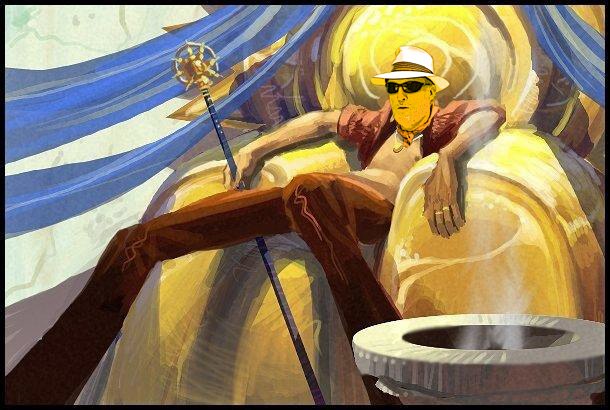
I feel fortunate to live in a country that allows me to express myself freely and to have taught at a school that allowed me to express myself freely (including publishing  this blog without censure).  I suspect the Powers-That-Was (and Continues-to Be) might not have dug my declaration of the death of Satan,  or my call to bring the missionaries home from abroad to minister to Republican operatives, or my declaring myself a sun god whose first edict is banning bikini tops on Folly Beach – oh, wait, that’s next week’s blog’s big announcement.

wes sungod

[Odd segue warning] I also feel incredibly thankful for Bob Dylan, despite his being somewhat of an asshole.  Over the years, I cannot think of any musician who has provided me with so much pleasure.  When I was a disaffected teenager, Bob supplied me with oxygen to breathe and a model to follow.  His lyrics – the imagery, sonic associations, themes – gave me strength somehow.  And let me add that I feel extremely fortunate to have caught his gig at the Orange Peel, a bar in Asheville, where Judy Birdsong and I got to stand within twenty feet of the master.

original_324989_tpaxf1ZbBIWboo4x4Kz5I5clf

I feel thankful for my host of friends, whom I’m not about to list for fear of omission, but you know who you are.

Let’s face it, there’s so much to be thankful for that I could fill 5,000 Gutenberg-Bible-sized journals with them.

For example, I’ve never had to give or receive the Heimlich maneuver.

4x5 Heimlich

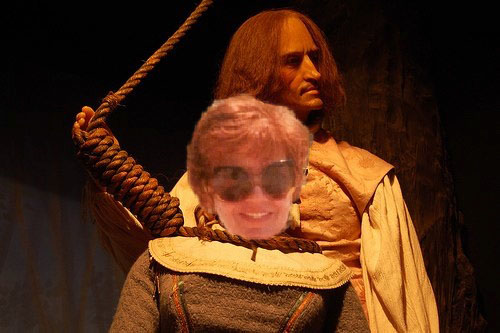
I’m thankful for not having my great-great-great-great-great-great-great-great-great grandmother’s being convicted of witchcraft.

hanging witch

I’m thankful for not being invited to Thanksgiving at John Currin’s.

currin_thanksgiving_2003


Come to think of it, that looks sort of fun.

At any rate, our blessings are indeed bountiful.  Happy Thanksgiving, dear readers!
And thank you for reading.  I really appreciate it!


[1] I.e., soon-to-be-exterminated natives helping land-grabbing religious fanatics survive the winter so they can begin the important business of drowning and hanging witches.


Hell Hath No Fury Like YA Authors Scorned

mourning bride

image by Violet D’Art via Flicker

As I was destroying my eyesight Wednesday simultaneously watching the Impeachment Hearing /Twitter feeds on the screen of my desktop computer, I ran across a linked tweet concerning a literary brouhaha originating at South Dakota’s Northern State University. A recent graduate named Brooke Nelson has provoked outrage from several Young Adult novelists for suggesting that a novel by best-selling YA author Sarah Dessen was too simplistic to qualify as mandatory reading.  As a junior, Ms Nelson had served on a committee to select a book all incoming freshman at Northern State University would be required to read. Several members on the committee, according to the Washington Post, “were pushing for a young adult novel by best-selling author Sarah Dessen.”

A quote in the local paper, the Aberdeen, ignited the ensuing furor: “[Dessen]’s fine for teen girls,” Brooke Nelson said, “ but definitely not up to the level of Common Read. So I became involved simply so I could stop them from ever choosing Sarah Dessen.”

Somehow Dessen caught wind of this slight diss.[1] Directly addressing Nelson by name, Dessen tweeted the following to her legion of followers:

Authors are real people. We put our heart and soul into the stories we write often because it is literally [my emphasis] how we survive in this world. I’m having a really hard time right now and this is just mean and cruel. I hope it made you feel good.

Let’s just say Nessen’s fans were not happy, including published YA authors Jodi Picoult and Roxane Gay.  Jennifer Weiner accused Nelson of being misogynistic:

“It’s hard to know what’s sadder: that Brooke Nelson has internalized misogyny to the extent that she can see nothing of worth in books beloved by “teen girls” but is presumably impressed with the merits of a book centered around video game culture that is beloved by teenage boys; that Nelson joined the committee not to champion a book or a genre but to keep a specific author’s work out of contention; that she bragged about her actions, as if she’s done some great service to literature, or that Nelson graduated with an English degree, is pursuing graduate work in English, and will someday be foisting her sexism and elitism on the next generation of readers.”

However, this comment ignores the question of whether the work possesses the complexity that required reading should possess. Are Nessen’s novels more profound than The Hand Maid’s Tale?  Are today’s in-coming freshman incapable of reading adult literature?  I was the English Department Chair of an independent school for six years and a teacher there for thirty-four, and I can assure you we never had a YA novel on our required summer reading list for the Upper School.

Here’s last year’s list, the last year I taught there:

9th grade  On the Beach by Neville Shute

10th grade: 1984 by George Orwell

11th grade: The Adventures of Huckleberry Finn by Mark Twain

12th grade The Hand Maid’s Tale by Margaret Atwood

AP Language and Composition: The Grapes of Wrath by John Steinbeck

AP Literature and Composition: Crime and Punishment by Fyodor Dostoyevsky

The majority of complaints from the YA authors cited in the Post story ignore the quality issue and focus on how Nelson’s quote marginalizes teenaged girls.  Here’s Jodi Picoult: “[Nelson’s quote] suggests stories about young women matter less. That they are not as worthy or literary as those about anything but young women. That their concerns and hopes and fears are secondary or frivolous.”

But Nelson didn’t say that novels about teenaged girls “matter less.”  She said that Nessen’s novels essentially didn’t “cut the mustard,” as we Boomers used to say.  I suspect that Nelson wouldn’t have any qualms with Sylvia Plath’s The Bell Jar or Josephine Humphrey’s Rich in Love being required reading.

Well, Nessen should be gratified because Nelson has found it necessary to suspend her social media accounts because of a barrage of incoming hatred.  And Northern State University has publicly apologized to Nessen.

It brings to mind Dylan’s line “at pettiness that plays so rough.”


[1] I consider it a “slight diss” because I believe that it’s not terribly insulting to suggest one’s work doesn’t rise to the level of mandatory reading for all incoming freshmen of a college.  In fact, although it’s considered a classic, I don’t think To Kill a Mockingbird rises to that level because of its black and white (no pun intended) portrayal of good and evil.  What I would consider a genuine diss is Carrie Courogen’s summation of Dessen’s work as “formulaic patronizing garbage of the lowest hanging fruit variety and deserves every criticism leveraged against her.” Courogen added in a subtweet “sarah dessen books are nicholas sparks but by a woman and even dumber and slightly less christian.”  I haven’t read any of Dessen’s books, so all I’ll say is that I can’t imagine they possess the ambiguity, complexity, and depth that would elevate them into the realm of serious art.

Show White, Bruno Bettelheim, and High School Seniors

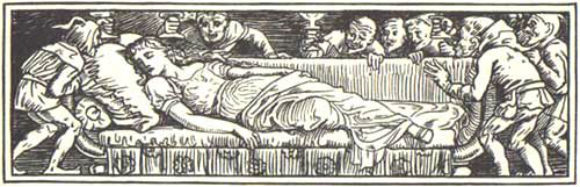
grimm-26

A few years ago, the principal at my school asked that the English Department develop elective courses to provide students with choices suited to their particular interests.

I came up with a course I called “Psychoanalytical Criticism, Modernism, and Paris in the 20’s.”

I spent the summer before its debut culling public-domain texts I could publish in a “reader,” a quite laborious undertaking —  almost overwhelming — but I managed to amass 376 pages of essays, short fiction, and poetry.  In addition,  I required students to purchase Hesse’s Steppenwolf and a copy of Hamlet.

I started with Freud, providing an overview of his theories,

then delved into fairy tales, using Bruno Bettelheim’s The Uses of Enchantment as a guide.

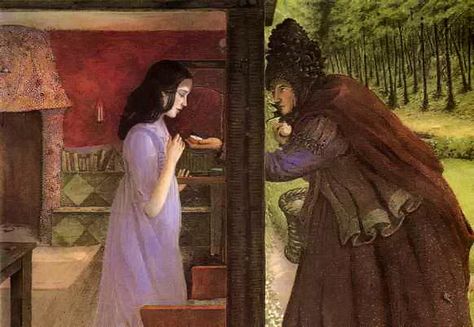
I began with “Snow White” because Bettelheim does an excellent job of synthesizing Freud’s stages of psychosexual development with the plot of the tale.

He writes

While, psychologically speaking, the parents create the child, it is the arrival of the child which causes these two people to become parents.  Thus, it is the child who creates parental problems, and with these come his own [. . .] As soon as the position of the child in the family becomes a problem to him and his parents, the process of the child’s struggle to escape the triadic existence has begun. With it, he enters the often desperately lonely course to find himself – a struggle in which others serve mainly as foils who facilitate or impede the process [. . .] In “Snow White it is the years Snow White spends with the dwarfs which stand for her time of troubles, of working through problems, her period of growth.[1]

Typically, fairy tales don’t deal with a child’s pre-oedipal history, and “Snow White” is no exception.

“Snow White” begins

Once upon a time in midwinter, when the snowflakes were falling like feathers from heaven, a queen sat sewing at her window, which had a frame of black ebony wood. As she sewed she looked up at the snow and pricked her finger with her needle. Three drops of blood fell into the snow. The red on the white looked so beautiful that she thought to herself, “If only I had a child as white as snow, as red as blood, and as black as the wood in this frame.” Soon afterward she had a little daughter who was as white as snow, as red as blood, and as black as ebony wood, and therefore they called her Little Snow-White. And as soon as the child was born, the queen died. A year later the king took himself another wife.

Bettelheim associates the drop of blood with menstruation, “a pre-condition for conception.”

Although her mother died in childbirth, and Snow White has a stepmother by age one, she doesn’t face problems until she starts to mature, and then her narcissistic stepmother takes notice.  Bettelheim points out that “[n]arcissism is very much a part of a young child’s make-up” and “a child must gradually learn to transcend this dangerous form of self-involvement.”

He adds that “all children are jealous, if not of their parents, then of the privileges the parents enjoy as adults [. . .] Since a narcissistic (step)mother is an unsuitable figure to relate to or identify with, Snow White, if she were a real child, could not help being jealous of her mother and all her advantages and powers [. . .] If a child cannot permit himself to feel his jealousy of a parent (this is very threatening to his security), he projects his feelings onto this parent.”  The child wants to be rid of this parent, which again, according to Bettelheim, is projected onto the parent, i.e., the child perceives the parent wants to get rid of her.

So, essentially, Snow White’s oedipal struggle is not repressed. The queen hires a hunter, a father figure, to murder Snow White in the forest, but “he fails to take a strong and definite stand,” not following the queen’s demand to murder her stepdaughter nor doing his moral duty of rescuing her. Rather, he abandons Snow White, expecting her to be killed by wild animals. “A weak father is as little use to Snow White as he was to Hansel and Gretel [. . .] It is such fathers who create unmanageable difficulties in a child or fail to help him solve them.”

Since Snow White is more beautiful than the queen, she has charged the hunter to bring back Snow White’s lungs and liver, which she cannibalizes, though, of course, she’s actually devouring the lungs and liver of an animal the hunter has slain.

Bettelheim:

The pubertal child is ambivalent in his wish to be much better than his parent of the same sex because the child fears that if this were actually so, the parent, still much more powerful, would take terrible revenge.  It is the child who fears destruction because of his imagined or real superiority, not the parent who wants to destroy.  The parent might suffer pangs of jealousy if he, in his turn, has not succeeded in identifying with his child in a positive way, because only then can he take vicarious pleasure in his child’s accomplishments.  It is essential that the parent identify strongly with his child of the same sex for the child’s identification with him to prove successful.”

Which, obviously, isn’t the case with Snow White. She ends up escaping her original home and stumbling across the dwarf’s dwelling in the forest. To satisfy her hunger, she takes a little bit from each of the dwarf’s plates, which Bettelheim suggests shows that she can control her “oral cravings.” She does the same with the dwarf’s beds, settling eventually in the seventh dwarf’s bed.  When these workaholics come home, the seventh dwarf “slept with his companions, one hour with each, until the night had passed.”  Bettelheim argues that “Work is the essence of [the dwarfs’ lives]; they know nothing of leisure or recreation [. . .]  and the price of living with them is conscientious work.”  He adds, “dwarfs are eminently male, but males who are stunted in their development [. . .] They are certainly not men in any sexual sense – their way of life, their interest material goods to the exclusion of love, suggest a pre-oedipal existence.”

Snow White’s sojourn with the dwarfs symbolizes the latency period, yet it is not a time free from dangers.  Her stepmother reappears in her life and tempts her three times, first with stay laces, suggesting that Snow White is now an adolescent.  Disguised as a peddler, the stepmother laces Snow White so tightly that she faints from a lack of oxygen.  Bettelheim argues that here the queen stands “for a parent who temporarily succeeds in maintaining his dominance by arresting his child’s development.”  Bettelheim posits this incident denotes Snow White’s becoming “overwhelmed by the conflict between her sexual desires and her anxiety about them.”

Indeed, vanity also plays into the queen’s second temptation, the poisoned combs that she places in Snow White’s hair.  The final temptation, of course, is the poisoned apple, which Bettelheim argues is a symbol for love and sex, harkening back to the Eden myth and the Judgement of Paris. The queen divides the apple in half, eating “the white part herself, while Snow White accepts the red, ‘poisonous half.’”  Bettelheim goes on to add, “Repeatedly we have been told of Snow White’s double nature: she is as white as snow and as red as blood – that is her being has both its asexual and its erotic aspect.

cc0dfe3e591acda29bb88d9c40fe304f--snow-queen-snow-white

“Eating the red (erotic) part of the apple is the end of Snow White’s innocence. The dwarfs, the companions of her latency existence, can no longer bring her back to life; Snow White has made her choice, which is as necessary as it is fateful. The redness of the apple evokes sexual associations like the three drops of blood which led to Snow White’s birth, and also menstruation, the event which marks the beginning of sexual maturity.”

He ends the essay by stating that the tale “teaches that just because one has reached physical maturity, one is by no means intellectually or emotionally ready for adulthood, as represented by marriage.”

“Like Snow White,” he writes, “each child in his development must repeat the history of man, real or imagined.  We are all expelled eventually from the original paradise of infancy, where all our wishes seemed to be fulfilled without any effort on our part. Learning about good and evil – gaining knowledge – seems to split our personality in two: the red chaos of unbridled emotions, the id; and the white purity of conscience, the superego.  As we grow up, we vacillate between being overcome by the turmoil of the first and the rigidity of the second (the tight lacing, and the immobility enforced by the coffin). Adulthood can be reached only when these inner contradictions are resolved and a new awakening of the mature ego is achieved, in which red and white coexist harmoniously.”

***

Depending on the student, these high school seniors either dismissed Bettelheim’s analysis or had their minds’ blown.  I emphasized that Freud was not what I would call a scientist, that his theories are not empirically based, but that they do offer sometimes extraordinary insight into the realm of the unconscious.  I stressed that it’s not necessary to buy into a paradigm to be able to employ it in interpretation, that whether you believe in Freud’s theories or not, being able to synthesize them into a coherent argument is good exercise.  Indeed, for their exam, I provided them the text of “Jack and the Beanstalk” and had them provide a Freudian interpretation.


[1] Bettelheim is no fan of Disney’s version.  “[A] bowdlerization,” he writes, “which unfortunately emphasizes the dwarfs, who failing to develop into mature humanity, are permanently arrested on a pre-oedipal level (dwarfs have no parents, nor so they marry or have children.”)

Peeking into Poets’ Bedrooms

bedroom head

I’ve only visited three famous writers’ domiciles  –  Yeats’ Tower, Thor Ballylee, in County Galway (1979); Shakespeare’s birth house in Warwickshire (1995);  and a home Frost lived in on a side of a road somewhere in New Hampshire (2007).

It felt like calling on the dead – the houses restored, sort of Disneyesque, way too un-lived in.

A while back, a friend posted on her FaceBook page a photograph of Walt Whitman’s bedroom back in the day. Alas, the image somehow conjured the Muse of PhotoShopping, Plagiaria.  Alas, I say, because no way I have the artistic talent to pull off the idea Plagiaria whispered in my ear.

Anyway, let’s take a peek into the Barbaric Yapper’s bedroom.

whitman's br

My idea, which I am bestowing to any 3-D artist out there, is to use the concept of a bedroom as a representation of an author’s interior life, his or her unconscious as it were, each installation with a window looking out (hence not an attic) onto the world the artist perceived – dingy Dublin brownstones for Mr. James Joyce/Lucy-in-the-Sky butterflies flitting just outside the window of Miss Emily Dickinson.

Ernest-Hemingway-9334498-1-402

Take Ernesto Hemingway, par example.

ernest-hemingway boxing

His mother called him Ernestine and dressed him like a girl.

dress

the unhairy one ~ 2 yrs

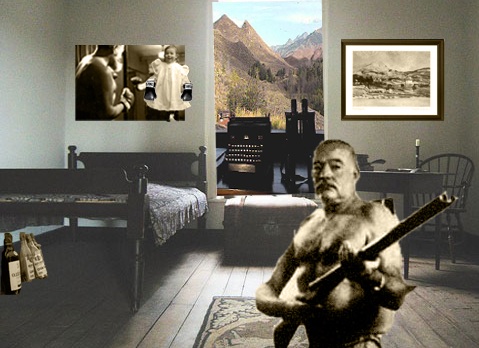
Here’s a crude approximation of Hemingway’s unconscious installed in EA Poe’s dorm room at UVA:

hemingway collage

Obviously, an actual artist could do better, perhaps creating a doll-house, each room devoted to a different writer from a different era, vestiges of influence sprinkled about, La Commedia on Eliot’s bedside table next to an overloaded ashtray of unfiltered Pall Malls.

Art On Pall Mall

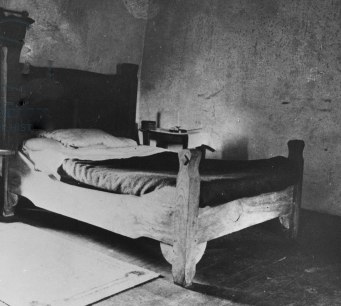
At any rate, what strikes me about the actual bedrooms of these writers, except for Whitman’s, is how spartan they are.  For example, here’s where Yeats slept at Thor Ballylee:

TPG392639

Barely a step up from Thoreau’s:

08thoureau_rect540-1

Of course, there are exceptions. Truman Capote lay him down to sleep here:

03truman_capote_rect540

And Virginia Woolf in this swanky boudoir:

The interior of Virginia Woolf's bedroom at Monks House, East Sussex

And, finally, the bedroom where this barely published poet tosses and turns:

bedroom 3

At any rate, we all can be thankful that we’re not the inhabitant of this bedroom:

proust-on-his-deathbed1

And sleep tight, Marcel!

Note:  This post originally appeared in Late Empire Ruminations 20 November 2012

Night and Day, Henry Versus EL James

james and James

No, I’m not one of those self-flagellating must-do-it martyrs who vow to finish every book they start, no matter how unpalatable.  Not finishing a bad book is as easy for me as zoning out during the welcoming comments at a Chamber of Commerce convention, or to keep the previous metaphor going, declining to finish an undercooked fat-choked pork sandwich.

No, I don’t have that mitigating principle to explain my finishing (it’s been several years now) EL James’ pant-fest, Fifty Shades of Grey (which I have handcuffed to a library carrel and urinated on here).

Certainly, anyone who read the above linked-to-post might find it improbable that such a severe and sarcastic critic would continue to squander the few, precious, and dwindling hours of his life’s eventide following the escapades of Anastasia Steele and Christopher Grey, characters as finely wrought as a pre-schooler’s drawing of an octopus; however, this critic did, albeit skimming through the novel’s latter emails, sex-scenes, and interior monologues with the concentration of a meth addict perusing Henry James’s The Ambassadors.*


*Indeed, I dedicate that one-paragraph 83-word sentence to the Master.

But finish it, I did, as I might a 32-ounce Slurpee, knowing that it was bad for me, didn’t even taste good, but that it went down easy.  However, I will give Ms. James’ high school English teacher this compliment: ol’ EL has gotten the bit about active voice/vibrant verbs.  I haven’t been exposed to so much clambering since the fall of Saigon.

wall02

3 April 1975

Whatever the reason – the active prose, its socio-historical late empire ramifications, the fairly well-choreographed sex scenes – I finished the damned thing, and I might add that Fifty Shades of Grey’s success demonstrates that the novel as a form is far from dead.  Future story tellers need not abandon first person narration and turn to screenplays to make their fortunes.

You go, fan fiction aficionados!

***

Nevertheless, I did finish Fifty Shades, but it left me famished for something beyond solid.  Yet, I wanted it to be very roughly analogous – Lolita perhaps – but then it hit me like a revelation – The Ambassadors, a novel about another naive American’s initiation into an exotic world.  Although universes apart in style, structure, and depth of characterization, Fifty Shades and The Ambassadors do share some shading in the Venn diagram of their thematic concerns.

Not to mention authors with matching surnames.

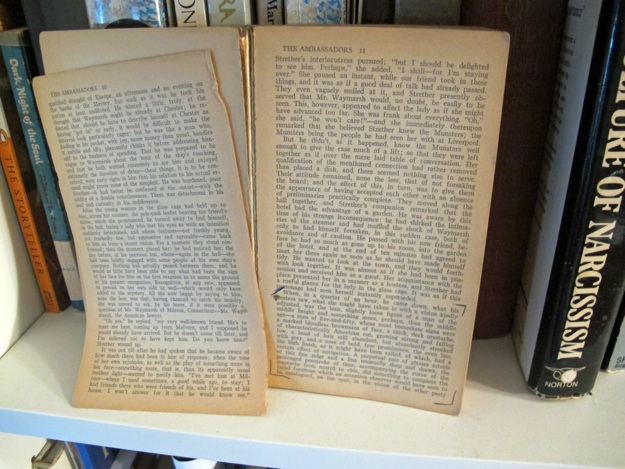
So I clambered up ascended the stairs to my drafty garret study to greedily snatch remove the 60-cent 1965 paperback that literally falls apart in my hands as I squint at negotiate its microscopic minuscule type.

ambassador page

Oh, my sweet Buddha, but we are in different universes.  Compare Henry’s description of our protagonist Lewis Lambert Strether to EL’s description of Christian Grey.

As they say, age before beauty.  Take it away, Mr. James:

[. . .] what his hostess saw, what she might have taken in with a vision kindly adjusted, was the lean, the slightly loose figure of a man of the middle height and something more perhaps than the middle age–a man of five-and-fifty, whose most immediate signs were a marked bloodless brownness of face, a thick dark moustache [sic], of characteristically American cut, growing strong and falling low, a head of hair still abundant but abundantly streaked with grey . . .

Your turn, Ms. James.

I surreptitiously gaze at him from beneath my lashes as he stands in line waiting to be served.  I could watch him all day . . . he’s tall, broad-shouldered, and slim, and the way those pants hang from his hips . . . Oh my.  Once or twice he runs his long, graceful fingers through his now dry but still disorderly hair.  Hmm . . . I’d like to do that.  The thought comes unbidden into my mind,**and my face flames.  I bite my lip and stare down at my hands again, not liking where the wayward thoughts are headed.

** a thought comes unbidden “into [her] mind”  – as opposed into her genitals?

Which one is talking?

“I’m always considering something else; something else, I mean, than the thing of the moment. The obsession of the other thing is the terror. I’m considering at present for instance something else than YOU.”

“I’ve never slept with anyone, never had sex in my bed, never flown a girl in Charlie Tango, never introduced a woman to my mother.  What are you doing to me?”

Which passage ends with “His eyes burn, their intensity takes my breath away?”***

*** Answers available at 1-900-144-5412 ($1.20 per minute fee)

***

So what’s my point?

Good question.  First of all, despite egregious flaws, the plot of 50 Shades of Grey carries you along (and it has as at least as many sex scenes as Slaughterhouse Five has death scenes). However, it’s definitely lower middle brow. (I was somewhat interested to see how the narrative would be translated onto the big screen but but not curious enough to bother to go see or rent it).  I figured that the viewer would be doomed to a thousand voiceovers and that moviegoers might perceive Anastasia as more pathological than the reader does if they didn’t hear her story in her own words.

Once, when a parent called to complain about A  Clockwork Orange’s being on our reading list after having seen Kubrick’s film, I had to explain that in the novel Alex’s quaint phrase “a malinky little tolchock to the gulliver” on screen is transformed into the objective depiction of a woman being clubbed to death.  Likewise, Anastasia’s “orgasm ripping through [her], a turbulent, passionate apogee that devours [her] whole” could come off on screen as trite pornography

Second, the tsunami success of Fifty Shades must tell us something about sex in the Late Empire.  One, women who thirty years ago might have discretely ordered the book and read it behind closed doors are now reading it on airplanes and discussing it at happy hours with their girlfriends.  Sex is a powerful obsession, an innate need, and it is probably impossible to sustain passion’s fire on a marriage bed dampened by the constant distractions and stresses of the working world – getting the kids ready for school, picking up something from Harris Teeter, opening that audit notice from the IRS.

If EL James were to follow the adventures of our heroes into the second decade of matrimony, she may very well be writing sentences like this:

My back to him, I feel his hand reach over and touch my well-worn tee shirt, and I clench, trying to stifle a yawn.  He rolls over me and his gray eyes are red-veined and floating in a puckered slough of discoloration.  Holy shit, he wants me, but I want him about as bad as I want a yeast infection.

EL James 50,000 Degrees of Ennui

I’ll leave you with this.  Check out the first and last pages of the outline of The Ambassadors that James submitted to his publishers.

60948_470135401182_24737751182_7338387_1460811_n

61376_470135726182_24737751182_7338390_8110878_n

What if Lenny Bruce or George Carlin Were Gen-Zers?

a-policeman-searches-comedian-lenny-bruce-after-bruces-arrest-for-allegedly-using-obscene-language-during-his-act-in-a-north-beach-nightclub-the-jazz-workshop-san-francisco-california

The meme “OK Boomer” is — forgive me — booming[1] on Twitter and TikTok as an expression of Generation Z’s frustration with the older generation’s outdated ideas and technological cluelessness.  It’s a mild insult, it seems to me, a sort of bored sigh of “whatever.” It says,  “You’re boring and inept and unfashionable.”  In other words, you’re outdated, out of it.

For some reason, more than a few snowflakey boomers have taken great offense at this rather mild rebuke. It could be worse, fellow boomers. It could be Lenny Bruce on steroids. It could be Fuck You, Boomers.  Imagine a Gen Y or Z  Lenny Bruce or George Carlin ripping into Mitt Romney and me.

Fuck you, you old crone/codger with varicose veins mapping your legs/porcupine needles of hair poking from your nostrils/cottage cheese masquerading as cleavage/your freckled baldpate resembling some dying planet in a third rate solar system.[2]  Speaking of dying planets, you’ve made a shithole disaster of this one, not to mention robbing us of a portion of our paychecks with Social Security deductions that could be putting a dent in the gargantuan student debt we’ve amassed (or are amassing or will amass) so you can sit around in your second home condos stuffing your fat faces watching Fox News’ anchors thumbing their noses at science while we slave away as baristas or unpaid interns with no health insurance. Shut the fuck up about our dependence on our cell phones.  It’s not like we’re bound to see anything of interest in the over-crowded infrastructurally decrepit cityscape/boring commercial suburban sprawl you’ve bequeathed us . . .

I’ll admit the above lacks pithiness.  It would be difficult to fit on a baseball cap.

By the way, the phrase “OK Boomer” has already been merchandized.

This from the New York Times:

Hundreds of “ok boomer” products are for sale through on-demand shopping sites like Redbubble and Spreadshirt, where many young people are selling “ok boomer” phone cases, bedsheets, stickers, pins and more.

This, of course,  means the phrase will be co-opted by a multinational corporation, which along with the petrol-chemical component of its conglomeration might also feature a manufacturing side business that transforms plastic sludge into OK Boomer Frisbees.

Remember the grunge craze, flannel shirts pre-faded, blue jeans pre-ripped?

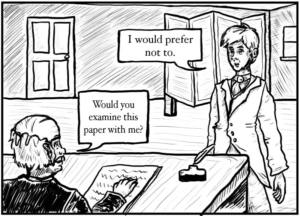
Ah, capitalism, ah Bartleby.

Bartleby2


[1] This lame Dad pun epitomizes the inherent essence of Boomer-unhipness.

[2] This gender balance can be a real pain in the posterior. It’s exhausting.

On Police Blotters and Street Preachers

3036413-GDKXVVDB-7

Oh, the side-splitting counter-Darwinian hijinks those headline-capturing police blotter inebriates produce each week on the highways, byways and beaches of the Lowcountry![1]

Whether it be a wobbly motorist telling a cop “he’s had five beers plus one beer,” a naked bicyclist peddling towards a fast-food drive-thru, or a domestic dispute involving tire irons and trash can lids, the police blotter is sure to bring a winsome smile to even the crabbiest of malcontents.

Not too long ago, you had to riffle to the back of the City PaperFolly Current, or Section 12B of the Post and Courier to discover who had tried to drive his car up the stairs leading to the Battery’s promenade or who had stuffed two bottles of champagne in his pants in a failed heist; however, in these latter days seeking out the absurd is almost too easy.  For example, here is a screen capture from a recent Live 5 web posting:

live5 1.0

Still, I prefer the paper, whose account of the Halloween mishaps of a luckless 21-year-old who drove his vehicle into Colonial Lake offers more details than Live-5’s recap.  For example, in the paper we learn that divers were employed to see if another passenger was in the car, the one the 21-year-old claimed had been driving.  Live-5 did, however, estimate the parameters of his intoxication, between .10 and .16.

I’m not one to talk, though. I once drove my MG Midget down the steps of a parking garage into Campus Police Headquarters, which resulted in a reckless driving ticket and six points off my license and a hefty increase in my insurance rates.

Too bad I didn’t pay more heed to those street preachers who haunted the streets of Columbia back in the day.

Street Preacher


A fire-breathing preacher named Mitch

From a street corner bellowed his pitch

He warned of the horrors of hell

Where one day I was bound to dwell,

That sanctimonious, psalm-singing son-of-a-bitch.


[1]  Not to mention beneath bridges, inside the cabs of heavy construction equipment, and upon picnic tables.

passed-out-drunk-toast


Halloween

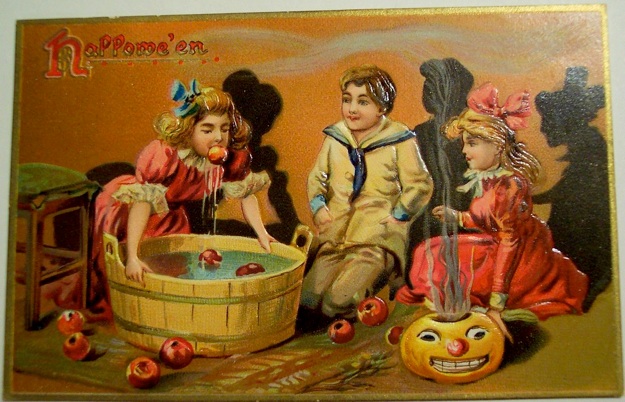
Hallowen


For this agnostic/ lapsed Buddhist dilettante, Halloween stands supreme among quasi religious holidays, towering over Christmas and Easter the way the skyscrapers of commerce on Wall Street dwarf Trinity Episcopal Church.

trinity wall street
Here’s the church; where’s the steeple?

People in the Lowcountry of South Carolina don’t decorate all that much for Halloween, a pumpkin on a porch maybe, but in suburban Atlanta a few years back I encountered some killer (literally) decorations, my favorite a mangled bike in the front lawn of a $800,000 house, a skeleton lying next to the bike, the helmet overturned not far from the skull.  Other celebrants had festooned their azaleas with spun cotton to counterfeit cobwebs; others had skeletons hanging from trees or cardboard black cats arching their backs with their hair on end, brandishing serious predatory dentistry. 

Dig store-bought monstrosity below.

half buried


Let’s face it, zombies trump archangels in contemporary America, the walking dead a more relatable metaphor for the populace than gravity defying beings of European descent levitating above cloud banks.

For me as a child, the joy of Christmas lay in expectation, the idea of playing with the electric train certainly more fun than actually watching it go around and around in its little circle ad nauseam until the transformer inevitably blew.

Plus, your parents never took you away on Halloween to visit great aunts and their spinster daughters, that looming visit casting shadows of dread over the toy strewn landscape of the living room.  We generally purchased from Poppelton’s Five and Dime our inexpensive flammable costumes, skeleton smocks and cheap plastic-coated masks or maybe a Zorro get-up.  I especially loved Halloween carnivals with their apple bobbing booths, candied apples, and haunted houses.

bobbing-for-apples-okay-image-1

However, my innate shyness always made trick-or-treating feel a bit uncomfortable.  Knowing what I know now, I might have chosen to dress up like a Book-of-Mormon-toting Evangelist or a Jehovah’s Witness and trade some tracts for some candy corn.

missionary-mormons1

Nevertheless, I certainly enjoyed the gluttonous aftermath of OD-ing on tiny Snickers and Mars bars and bartering less-loved goodies with my buddies. Oh, and to score some malted-milk-ball Whoppers was like copping cocaine, whatever that was.

Of course, as an adult, Halloween can be a drag if you live in a neighborhood where trick-or-treaters ring your doorbell every 42 seconds; however, it’s not a problem on Folly Beach, the barrier island where I live, where trick-or-treating is forbidden because of vacant vacation homes, unlighted streets, and the likelihood  of motorists being hepped up on something stronger than sugar.

So as the year shuffles off towards its hospice, let’s celebrate the macabre, the zombie apocalypse, an eternity spent in everlasting agony, and other terrifying possibilities.

Once there was a little boy who wouldn’t say his prayers,
and when he went to bed at night away up stairs,
his mammy heard him holler and his daddy heard him bawl,
and when they turned the covers down,
he wasn’t there at all!
They searched for him in the attic room
and cubby hole and press
and even up the chimney flu and every wheres, I guess,
but all they ever found of him was just his pants and round-abouts
and the goblins will get ya if ya don’t watch out!!

James Whitcomb Riley: “Little Orphan Annie”

childr6


My Own Little, Dystopia — Halloween Edition

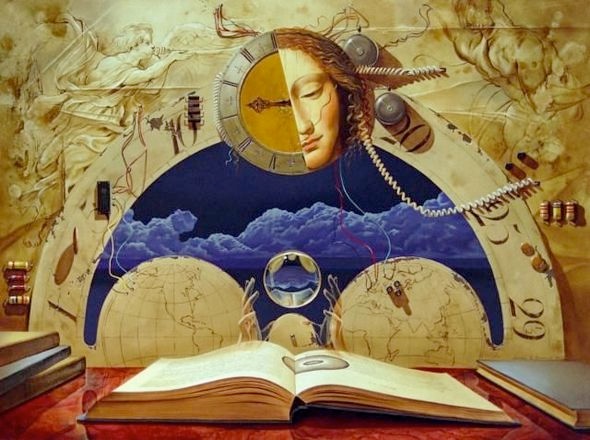
escher like

Real World 1

Adam’s curse: not death, but labor, the rudeness of the alarm, the digits glowing heartlessly: 5:55 AM.  Henry David Thoreau you ain’t:

We must learn to reawaken and keep ourselves awake, not by mechanical aids, but by an infinite expectation of the dawn*, which does not forsake us in our soundest sleep.

                                                                                Walden, Chapter 2


*emphasis mine

No, you’re of this ilk:

Little is to be expected of the day, if it can be called a day, to which we are not awakened by our Genius, but by the mechanical nudgings of some servitor [buzz or ring or melliferous radio voice]. That man who does not believe each day contains an earlier, more sacred, and auroral hour than he has yet profaned, has despaired life, and is pursuing a descending and darkening way.

TrafficJam

the darkening way

You’re, let’s say, a resource teacher for severely mentally disabled students in Mississippi or South Carolina.  Cutbacks mean you’re working 1.25 jobs, that your free periods are long gone, that you’re lucky if you manage 20 minutes for lunch.  Although mandated by federal law, meetings concerning disabled children’s IEPs are virtually impossible to coordinate.  Having the required individuals free at the same time  – classroom teachers, speech therapists, school psychologists, and principals – is like trying to solve a Rubik’s cube while riding a roller coaster.  They – whoever they are (the top 1%? K-Street lobbyists?  Smiling State legislators? The voters? All /none /a combination of the above?) – whoever they are literally expect you somehow to do the impossible.

No, for you, the dawn doesn’t “awaken infinite expectations.”

roller-coaster-4

Ronald Reagan’s Body Lies A Mouldering in the Grave

Somehow the nation has elected a sociopath as president who once supported choice and wrote checks to Democratic candidates but who know seems hellbent on accelerating global warning.  Despite the historical lessons that trickle down economics doesn’t work and deregulation can cause financial meltdowns a la 2008, he is gutting environmental regulations and, aided and abetted by Republicans in Congress, has passed a tax cut for the 1% that has created a gargantuan budget deficit.

Despite the Romanesque Super Bowl Halftime extravaganzas, we don’t have enough money to repair aging bridges, to hire fireman, much less to provide healthcare for our children.

The Real World 2

Meanwhile, back in Mississippi or South Carolina in a public school that possesses all the aesthetic warmth of a juvenile detention center, emails sprout in your in-box like the heads of a hydra – each expecting a prompt reply, each unanswered one burrowing into your brain like parasites, calcifying the neurons, overloading the circuitry, shutting it down – only to snap you awake at 3:41 A.M!

artistic-paintings-jeffrey-batchelor-20

Insomnia II by Jeffrey Batchelor

Where Have You Gone, Franz Kafka, a Lonely World . . .

Given the material richness of the USA, why are so many people so dissatisfied with contemporary American life?

Wordsworth posits one answer:

THE world is too much with us; late and soon,

Getting and spending, we lay waste our powers:

Little we see in Nature that is ours;

We have given our hearts away, a sordid boon!

We live in a world where increasingly our time is devoured by abstractions – meetings that go nowhere, data demanding input, those hydra-headed emails, texts from acquaintances that we glance at and ignore.

A sordid boon indeed.

Of course, Franz Kafka’s Gregor Samsa is the archetype of the harried worker, so caught up in the intricacies of his meaningless job that the first thing he thinks of when he discovers that he has been transformed into a giant insect is that it will be almost impossible to negotiate the public transportation that takes him to his office.  He, that “gigantic vermin,” should be this year’s top-selling Halloween costume.

metamorphosis2-img_assist_custom

Real World 3

Leave School at 4:10 . . . pick up Abigail from DayCare . . . run in Publix to pick up supper  . . .   grab bills from the mailbox . . . get Abigail started on her homework . . . cycle through the voicemails . . . empty the dishwasher . . . think for a second about your ex . . . start supper  . . .  glance at Wolf Blizter’s head flickering on the screen . . . say grace . . . start the bath water . . . read Abigail a bedtime story . . . put off paying the bills . .

Sleep, that knitteth up the raveled sleep of care . . .

I WAKE and feel the fell of dark, not day.

What hours, O what black hoürs we have spent

This night! what sights you, heart, saw; ways you went!

And more must, in yet longer light’s delay.

With witness I speak this. But where I say

Hours I mean years, mean life. And my lament

Is cries countless, cries like dead letters sent

To dearest him that lives alas! away.

I am gall, I am heartburn. God’s most deep decree

Bitter would have me taste: my taste was me;

Bones built in me, flesh filled, blood brimmed the curse.

Selfyeast of spirit a dull dough sours. I see

The lost are like this, and their scourge to be

As I am mine, their sweating selves; but worse.

                                                Gerard Manley Hopkins

[cue magical laughter]

Happy Halloween!

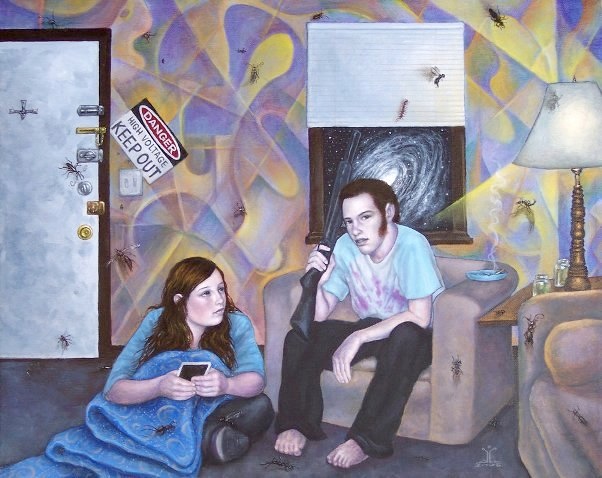
keep_out_

Keep Out, By Larkin