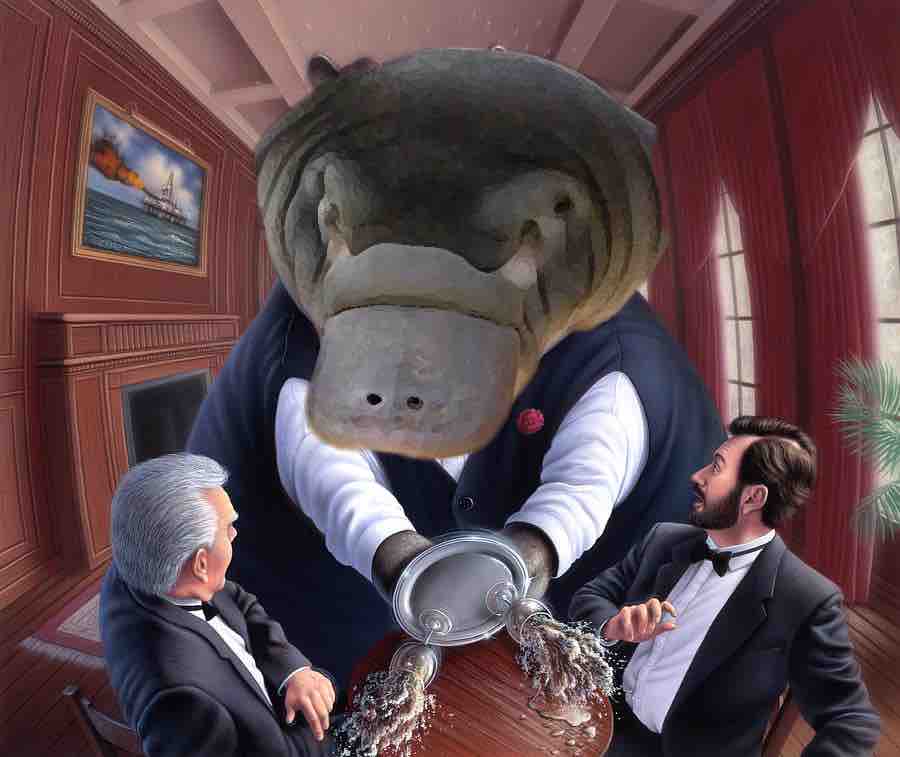
Darkness has Crept in at Midnight by James Christopher Hills
The Alex Murdaugh murder conviction saddens me, not because I think he’s innocent, but because I didn’t want it to be true, didn’t want to believe that the Sophoclean shit show the prosecution posited could be real, that a father could premeditatively gun down his son, splattering his brains, then utilizie a different weapon to gun down the mother of that son, shooting her five times, the final shot to the head.
[Cue Kurtz: the horror, the horror.]
I was chatting with a stranger at the bar at Chico Feo yesterday afternoon about the trial and about the ubiquity of surveillance. I mentioned that Siri, Apple’s arbitress[1] of data, sang like – if not a canary – like a soulless automaton out of Orwell, providing law enforcement with information about how many steps Alex had taken, how fast he was walking before and after the event. The black box of his Suburban also ratted him out, digitally informing SLED that his SUV had hit seventy on the bumpy dirt road on his way to the house of his Alzheimer’s ridden Mama in the dark of a night as black as any in Southern gothic literature.
It out Faulkners Faulkner.
The stranger had his own story about super-surveillance. I didn’t know this, but there are magnetic (for lack of a better word) homing devices that you can affix to someone’s car and track its movements just like they did in the Bond movie Goldfinger.
He had purchased several and affixed one to his then girlfriend’s car because he correctly feared that she was cheating on him. On the last day of their relationship, he drove to where her car was parked, discovered her as she was leaving an apartment complex, and thanked her for showing him what kind of person she really was.
Happily, no shots were fired. Even, at least in his telling, the recrimination was mild-mannered.
Anyway, in this case, even if his girlfriend didn’t possess a cellphone and drove an early model computerless automobile, she still would have been busted.
Let’s face it, Big Brother’s corporate siblings, his little brothers, our cell phones, automobiles, etc. are watching us, and we pay them to. Could the knowledge our every move is monitored move us to emend our sinful ways. After all, if we don’t slaughter our families, cheat on our lovers, or binge watch Monkees videos, we have nothing to worry about.
[1] Even though I consider myself “woke,” I like the sound of feminine suffixes, and, on another topic, realize that the personality that is Siri is not an employee but merely a voice strung together with ones and zeroes.
When prepping for my trip to “the Hostess City of the South” to hear T. Coraghessan Boyle read at the Savannah Book Festival, I searched high and low (literally) for my copy of his short story collection Greasy Lake to get him to autograph it. Oh, I own probably two-thirds of the thirty-one books he has published, but I especially wanted his signature on Greasy Lake because it is stained with my blood, now a brown smear after thirty-eight years of residence on page whatever.
It had been in my hand when I stood up in the back of a pick-up truck to tell the driver Larry Howland he needed to turn right, which he did suddenly, catapulting me Buster-Keaton-style out of bed of the pickup onto the hard pavement of Folly Beach’s Ashley Avenue.[1] When I stumbled to my feet, I was bleeding from my head and right hand. I must have picked the book off the pavement, thus the blood stain. Anyway, I couldn’t find Greasy Lake anywhere, not in my drafty garret, nor in the book-choked guest room where I keep my valuable volumes, like the one pictured below.
So, I took Water Music instead, Boyle’s first novel and a first edition to boot, probably a felicitous turn of luck for the heirs of the Moore Living Trust given that it will likely fetch a better price at the upcoming the estate sale, whenever that is – let’s hope not soon.
Anyway, I’m a huge fan, especially of his early short stories, manic riffs like this first paragraph from “Green Hell,” a parody of all those movies involving plane crashes and jungles:
There has been a collision (with birds, black flocks of them), an announcement from the pilot’s cabin, a moment of abeyed hysteria, and then a downward rush. The plane is nosing for the ground at 45-degree angle. Engines wheezing, spewing smoke and feathers. Lights flash, breathing apparatus drops and dangles. Our drinks become lariats, the glasses knives. Lunch (chicken croquettes, gravy, reconstituted potatoes, and imitation cranberry sauce) decorates our shirts and vests. Outside there is the shriek of the air over the wings; inside, the rock-dust rumble of grinding teeth, molar on molar. My face seems to be slipping over my head like a rubber mask. And then, horribly, the first trees become visible beyond the windows. We gasp once and then we’re down, skidding through the greenery, jolted from our seats, panicked, repentant, savage. Windows strain and pop like light bulbs. We lose our bowels. The plane grates through the trees, the shriek of branches like the keen of harpies along the fuselage, our bodies jarred, dashed and knocked like silver balls in a pinball machine, And then suddenly it’s over; we are stopped (think of a high diver meeting the board on the way down). I expect (have expected) flames.[2]
Boyle might resent this comparison, but his early stories remind me of the early Woody Allen movies, inventive, farcical, satiric, hilarious.
Here’s one last example from “The Big Garage,” an homage to Kafka, where the protagonist B. fills out an application to get an appointment to repair his Audi that has been towed to a Kastle-like nightmarish auto repair establishment:
B. Takes a seat beside the Cougar women and stares down at the form in his hand as if it were a loaded .44. He is dazed, still tingling from the vehemence of the secretary’s attack. The form is seven pages long. There are questions about employment, annual income, collateral, next of kin. Page 4 is devoted to physical inquiries: ever had measles? leprosy? irregularity? The next delves deeper: do feel people are out to get you? why do you hate your father? The form ends up with two pages of IQ stuff: if a farmer has 200 acres and devotes 1/16 of his land to soybeans, 5/8 to corn a 1/3 to sugar beets, how much does he have left for a drive-in movie? B. glances over at the Cougar woman. Her lower lip is thrust forward, a blackened stub of pencil twists in her fingers, an appointment form, scrawled over in pencil with circled red corrections, lies in her lap.
The Savannah reading, which was well attended, took place in a Lutheran church. Caroline and I had good seats/pews, but because of the acoustics of the church or the PA system or most likely my defective hearing, I had a hard time making out much of what he was reading, which I could tell was a fine performance, complete with acted out voices from several characters and emphatic gesturing.
Afterwards, we strode over to a square a block away where tents were set up for signings. We were about fourth in line, and once we shook hands, I mentioned that I used to teach “The Big Garage,” and as it turned out a student of his had made a film from it.[3] We had, what I would call a meaningful conversation. He said he really enjoys channeling disturbed male characters like in the story he had just read “because we’re all such saints.”[4]
Caroline asked if he minded if she took our photo, and he smilingly consented. And here we are, I gazing up like a beaming schoolchild in the presence of Micky Mantle.
[1] It’s one thing to trick fate, but to trick natural selection is especially gratifying. Although, to be truthful, I had already procreated, my older son Harrison being just over a year old and my younger son Ned at the time nestled in utero inside of luckily not-to-be-widowed-at-31 Judy Birdsong.
BTW, I have immortalized Larry, who in his fifties changed his name to Buck, with this BALLAD.
[2] I’ve always been a sucker for razzmatazz prose, like this sentence from James Wolcott: “An orange Elvis squirted from a can of Cheez Whiz, the Trump of The Apprentice bent the distortion field of Reality TV until it fit him like a girdle.”
[3] Here’s a link. Tap on media and look under the column FILM.
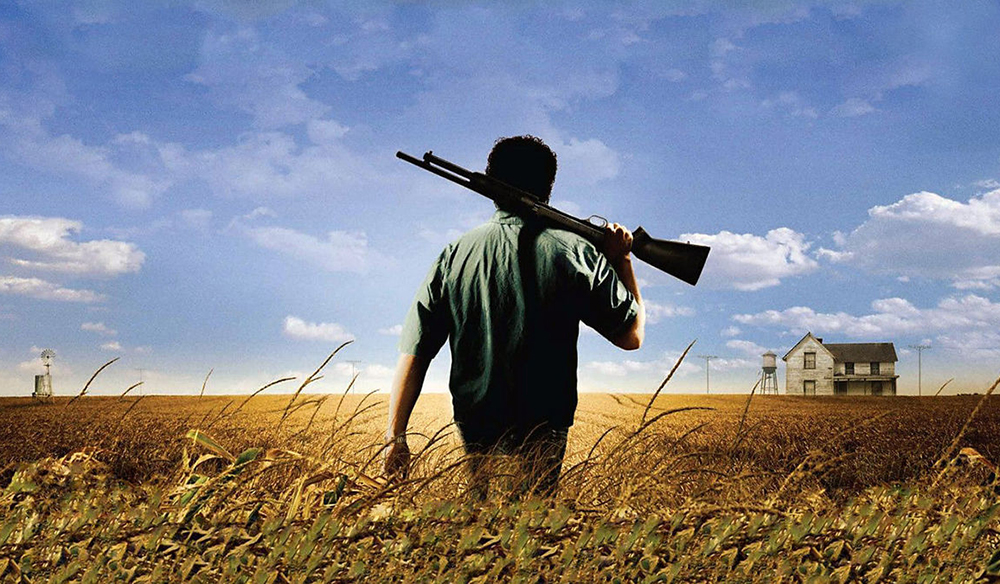
image via The Beat who copped it from Shotgun Stories
The Hyper Southern Gothic Murdaugh Saga


coming soon to a drive-in theater near you


Boating under the influence,
involuntary manslaughter
				way down south
					in the godforsaken backwater
							of Colleton Country, South Carolina,
				we have,
					in addition to addiction, a double homicide –
										alleged filicide –
	mother and son dispatched
	via assault weapon and shotgun,
				a botched faux murder/staged suicide,
						and earlier, in the abode of the accused,
							a housekeeper tumbling
								down steps to her death.
								.

		Did I mention
		insurance theft,
		crystal meth,
		financial skullduggery,
		abandoned mills,
		prescription pills?


It's as if William Faulkner
and Flannery O'Connor
joined forces with
Harold Robbins.

Add an ebon dash
of E.A. Poe
and presto:
you got the hyper Southern Gothic Murdaugh saga.
Here’s a video of my reading my original poem “St. James Infirmary iPhone Blues” on February 6 2023.
St James Infirmary iPhone Blues
Tapping a cane, Mr. Andre Beaujolais, with some hoodoo magic in his front pants pocket bopped down St. Charles on his way to see Miss Hattie Dupree, the one-time lover of McKinley Morganfield, better known as Muddy Waters, King of the Chicago Blues.
Those who got bad mojo go see Miss Hattie Dupree for the inside dope in the hope of counteracting shenanigans ¬– hexes, curses, drywet nurses, vexations, permutations, marital relations. genetic mutations, Haitian sensations, and genital truncations.
Mr. Andre Beaujolais was on his way to deliver a batch of John the Conkeroo juice to help some dude whose private conversations had been swiped by advertisers, enterprisers, franchisers, monopolizers, and merchandizers.
He’d been telling his gal about Blind Willie McTell, how the Dylan song by the same name was sung to the same tune as St James Infirmary Blues. Their moment of intimacy the next day mysteriously appeared in an ad for a book being peddled on the dude’s Facebook page.
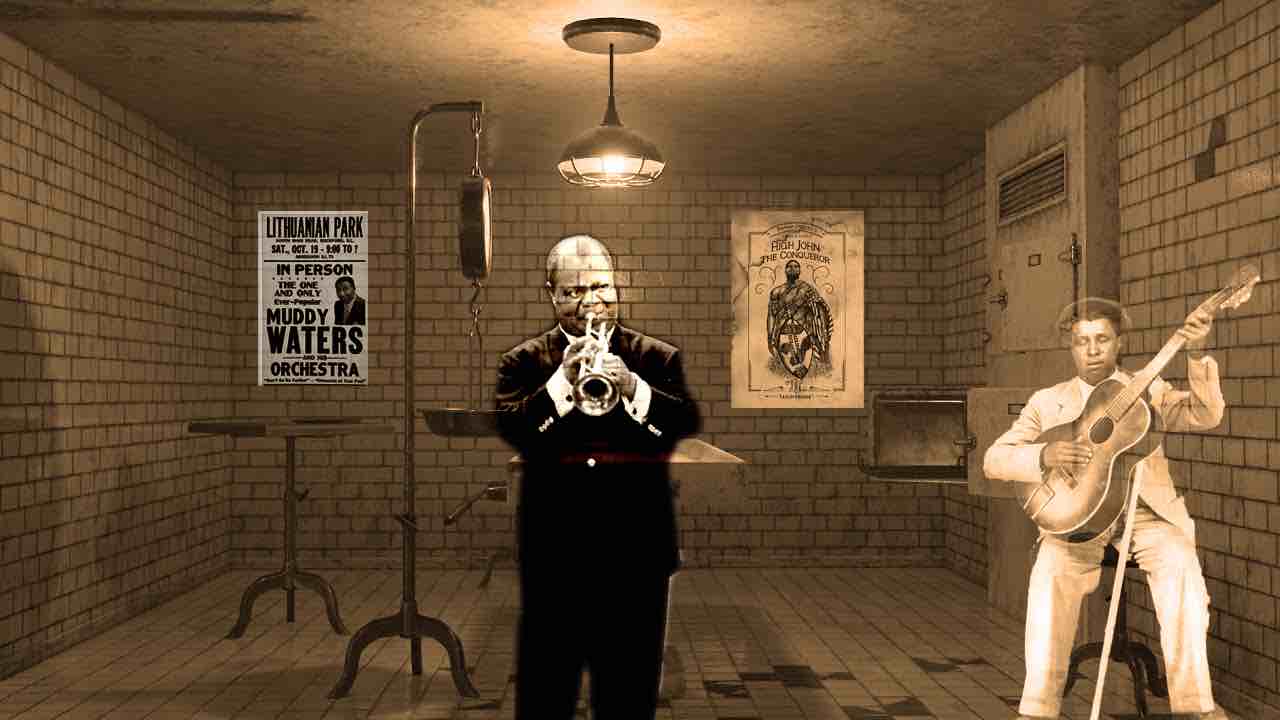
“I Went Down to the St, James Infirmary: Investigations in the shadowy world of early jazz-blues in the company of Blind Willie McTell, Louie Armstrong . . . where did this dang song come from anyway? “That title don’t trip off the tongue,” Mr. Beaujolais said when he heard the dude explain.
“Hand me your phone,” Andre said, then took off its cover, whupped out the Conkeroo juice, poured it all over the device, mumbled some mumbo jumbo. “Ta da! problem solved!” “Wait a minute, “the dude complained. My phone’s not working!” “No shit,” Mr. Andre replied. “That’ll be fifty dollars. I’ll accept ten fives.”
Yesterday my cousin Pamela Moore Allen posted the above photo of my father (on the right) and his brother David fighting on a street in Charleston, South Carolina, during the Great Depression.
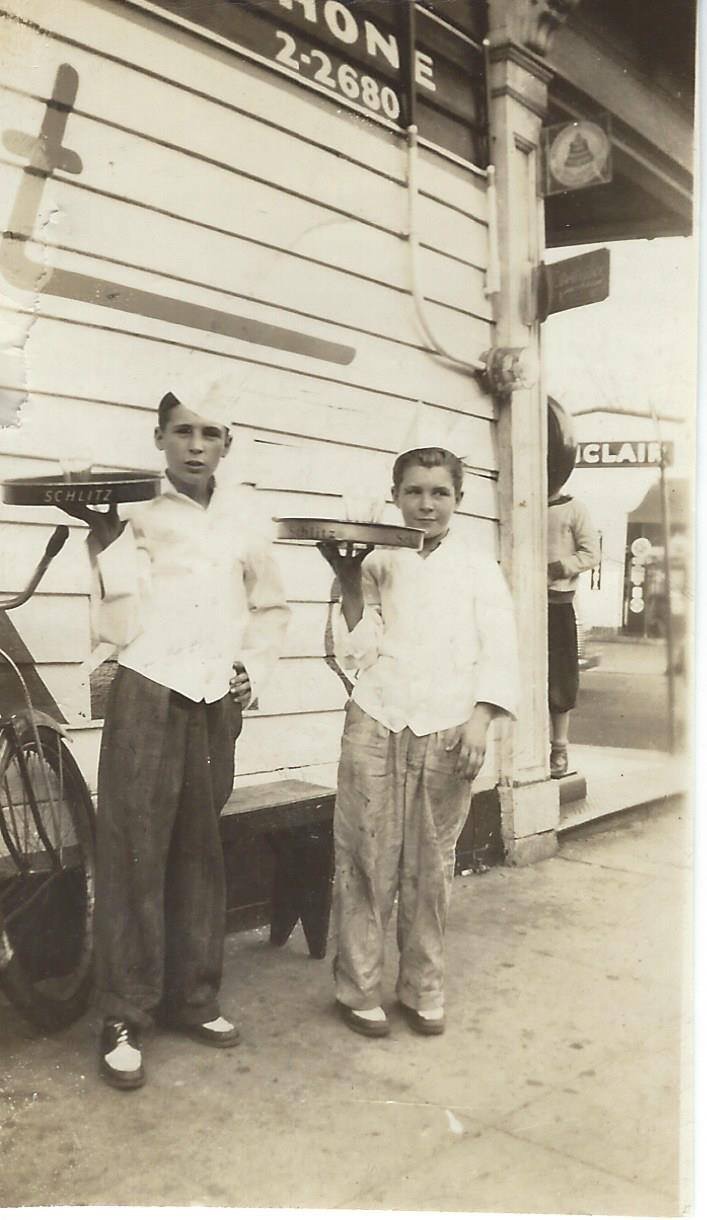
Here’s another photo standing outside their grandfather’s pharmacy where they worked as curb boys.
I posted the street-fight photo on the Facebook site “Charleston History Before 1945” and misidentified the location as Spring Street, where the pharmacy was located.[1]
A few sharp-eyed history buffs weren’t so sure about the location and began sleuthing.
Ray Benton, a Charleston lawyer, posted that in the early 60s he worked at a corner pharmacy that had an apartment upstairs. Lester Dempsey, another old-time Charlestonian, suggested the fight took place near Cannon Street and Rutledge.
Mary Thiedke Grady weighed in:
Look at the intersection of Spring and Rutledge looking west toward the bridge. The building currently occupied by Xiao Bao Biscuit was once upon a time a gas station and had a canopy. (The supports changed, but the canopy is still there.) Also look beyond to the other corner (northwest of Rutledge.) That building is tall enough, though the architecture isn’t quite the same. Given the proximity to the road, that first house could have been torn down and a second where the current house is located. (Ok, this part I think I’m fishing around with, and the argument doesn’t hold water.”)
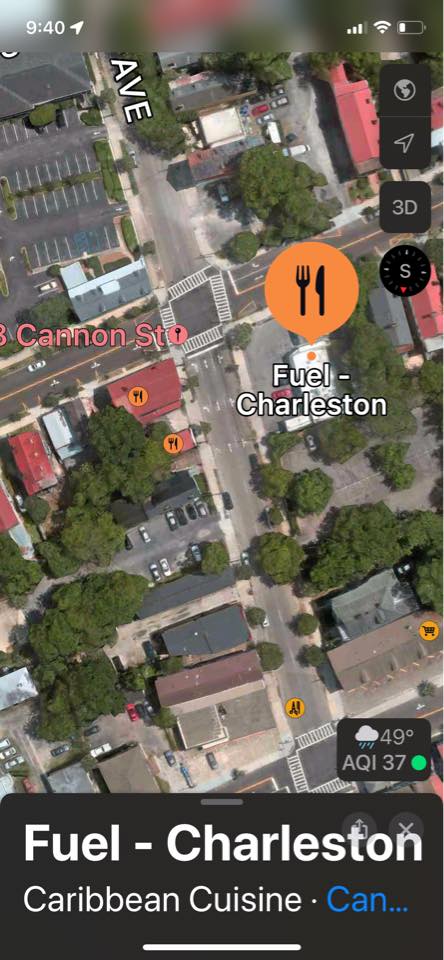
Lester Dempsey provided an aerial view:
And dig this, Rutledge Rivers Webb, Jr. took two photos after dropping off his kids at school this morning. He took them on Rutledge near Spring looking towards Cannon. The Texaco service station on the right in the original photo is now the restaurant Fuel.
Mystery solved.
Thanks to all who weighed in.
[1] They lived above the pharmacy on the second floor.
I first heard “St. James Infirmary Blues” covered by Eric Burdon and the Animals, and the song really moved me, the horror of it, having to encounter the corpse of your lover “stretched out on a long white table/ So cold, so stiff/ She was dead.” Throughout the years, the song really stuck with me.[1]
The other night, Caroline and I were at the Lowfife Bar on Folly, and somehow the topic of public domain tunes came up. I mentioned that Dylan had borrowed the melody of “St. James Infirmary Blues” for his masterpiece “Blind Willie McTell.” In fact, I sang two verses of the Burdon cover right there at the bar.
Well, the very next day, an ad showed up on my Facebook feed for this book, which I’m eager to read.
Anyway, we can probably chalk up the ad’s appearance to coincidence, but, man, could it be some bot was listening to us via our phone?
Then last night at the Soapbox open mic at Chico a banjo player covered the song. WTF?
So, this morning, during one of my undelightful stints of insomnia, I composed this piece of doggerel in my head, which I consider a more productive use of my time in the wee hours than contemplating politics, my health, the past, or the future.
(BTW, occasionally, a reader accuses me of cultural appropriation one of these paeans to Black culture, but my conscience is clear on that score.)
St James Infirmary iPhone Blues
Tapping a cane, Mr. Andre Beaujolais, with some hoodoo magic in his front pants pocket bopped down St. Charles on his way to see Miss Hattie Dupree, the one-time lover of McKinley Morganfield, better known as Muddy Waters, King of the Chicago Blues.
Those who got bad mojo go see Miss Hattie Dupree for the inside dope in the hope of counteracting shenanigans ¬– hexes, curses, wet nurses, vexations, permutations, marital relations. genetic mutations, Haitian sensations, and genital truncations.
Mr. Andre Beaujolais was on his way to deliver a batch of John the Conkeroo juice to help some dude whose private conversations had been swiped by advertisers, enterprisers, franchisers, monopolizers, and merchandizers.
He’d been telling his gal about Blind Willie McTell, how the Dylan song by the same name was sung to the same tune as St James Infirmary Blues. Their moment of intimacy the next day mysteriously appeared in an ad for a book being peddled on the dude’s Facebook page.
“I Went Down to the St, James Infirmary: Investigations in the shadowy world of early jazz-blues in the company of Bling Willie McTell, Louis Armstrong . . . where did this dang song come from anyway? “That title don’t trip off the tongue,” Mr. Beaujolais said when he heard the dude explain.
“Hand me your phone,” Andre say, then took off its cover, whupped out the Conkeroo juice, poured it over the device, mumbled some discrete mumbo jumbo. “Ta da! problem solved!” “Wait a minute, “the dude hollered. My phone’s quit working!” “No shit,” Mr. Andre replied. “That’ll be fifty dollars. I’ll accept ten fives.”
[1] In fact, I asked Gary Erwin to play it at Judy Birdsong’s memorial service, which he graciously did. BTW, Gary is an underappreciated Charleston treasure.
Folly Beach is in the throes of a political battle that wages real estate interests versus residents who would prefer Folly remain a community rather than become a resort destination.
Two competing collectives have formed, Saving Folly’s Future and the Folly United, which employs the shaka “hang loose” hand signal as its logo.[1]
I certainly understand real estate investors wanting to expand their net worth and protect their investments. However, I wish they’d make their case without resorting to misinformation.
My friend Chris Bizzell has taken the time to analyze some of the erroneous information from the flyer that Folly United recently distributed and from the Folly United web site.
First, Folly United argues that Folly Beach residences have grown 2% per year since 2015; however, even though the number of houses, i.e., residences have grown, the number of full-time residents has fallen, as shown in the chart below.
Chris provides the following analysis:
Based on the latest 2022 data from the US census, the current population of Folly Beach is 2,056. What was the peak population of Folly Beach?
The peak population of Folly Beach was in 2010, when its population was 2,617.
Folly Beach’s population is currently 21.4% smaller than it was in 2010 and 6.0% smaller since the year 2000.
In fact, Folly Beach’s growth is below average. 63% of similarly sized cities are growing faster since 2000. If the STR market is not capped, we can easily expect Folly’s full-time population to decrease further.
The flyer also contends that fewer short-term rentals will lead to higher crime rates because the properties are left empty.
Again Chris:
While studies do show that empty properties can lead to higher crime rates, this has nothing to do with STR levels. In fact, a new study shows that a proliferation of Airbnbs, or similar short-term rentals, in a neighborhood contributes to higher rates of crime in the area.
The study compiled 911 data from 2011-2018 determined that higher STR properties in a community does in fact lead to higher crime rates. A major finding in the report was that certain violent crimes, including fights, robberies, and reports of someone wielding a knife, tended to increase in a neighborhood a year or more after the number of Airbnbs increased. “What seems to be the problem is that Airbnb is taking households off the social network of the neighborhood and eroding its natural capacity to manage crime,” says O’Brien, who also studies criminology and criminal justice at Northeastern.
“What we’re seeing is evidence of a slower process, one that becomes significant over the years,” Babak Heydari (associate professor at Northeastern and author of the study) says. “It’s another support that changing the social fabric of the neighborhood is what’s undergirding these results.”
Folly United’s web site has a page entitled “Did You Know,” that ends with incredible bit of so-called information:
The STR commission discovered that STR had NO impact on the number of Long term rentals and no impact on population growth. INCONVENIENT FACTS that have repeatedly ignored.
C’mon, commonsense tells us that this couldn’t be true. As off-island owners transform their properties from long term to short term rentals the renters who called Folly home are replaced by vacationers.
Chris Bizzell:
As more properties are converted to STR’s, the supply of available housing open for long-term renters and homeowners shrinks. With housing in short supply, everyone ends up competing for the same tiny pool of rental properties and rents increase.
Researchers at Carnegie Mellon University found that Airbnb “mildly cannibalizes” the long-term rental supply. And in the cities they studied where Airbnb was popular, residents faced a more severe reduction in housing stock.
Research at the University of Arizona and University of Denver found that Airbnb is indeed making the real estate market more expensive. By enriching its hosts while making housing less affordable for others, Airbnb and other home-sharing platforms may be compromising public affordability for private wealth, the research suggests. “It’s going to increase the gap between the rich and the poor,” Wei says. “It’s going to make inequality a little worse.”
The study concluded: “STR’s have become a major alternative for real estate investment and have had a significant impact on housing affordability.”
We can learn by looking at what has happened in other vacation destinations.
In Colorado ski towns, the demand for short term rentals and the increase in supply of STR’s are growing at such a rate that it is displacing local residents of the towns they are supposed to serve.
Margaret Bowes, Colorado Association of Ski Towns executive director, says that the perfect solution to the crisis is still not within reach. “The trajectory of the number of properties becoming (short-term rentals) is not sustainable,” according to Bowes. She adds that at the current rate, no one working in the said communities will be able to live in them.
Look, like I said earlier, I understand that property owners, especially those who don’t live on the island, want to increase their wealth, and certainly, if you live in your Folly residence nine months out if the year, you should be able to rent it short term and that goes for adjacent properties. However, we’re not talking about eliminating short term rentals but capping them, creating a happy symbiosis between full time residents and vacationers.
But, please, don’t resort to cherry picking data and resorting to misinformation to make arguments.
Aloha.
[1] Cue George Orwell: “Yes, war is peace!” If Folly were united, there would be no issue, and nothing screams “hang loose” and the aloha spirit like frenetically placing signs in the yards of short-term rentals that read “Don’t Cap Folly’s Future,” as if Folly is sentient being that would prefer to have its few remaining lots clear cut for the construction of McMansions than maintain a verdant residential vibe.
In pains me to admit I have the fine motor skills of a duck-billed platypus. I’d hate to add up the total time I’ve squandered in supermarkets struggling to open those plastic bags you unspool from rollers in the produce department. When shoppers stroll by, they probably attribute my fumbling ineptitude to senescence – or perhaps to a stroke I’ve not fully recovered from – but truth be told, this disability has plagued me from my earliest years.
The humiliation began in kindergarten when Miss Marion hauled out some shoes and attempted to teach the class how to tie them. As my playmates looped and threaded, the laces kept slipping from my tiny fingers. Miss Marion had to come over and help me, and when I had finally accomplished the feat, the bow I had managed was so loosely constructed, the whirr of an oscillating fan unraveled it.[1]
Then there were those horrid two weeks after third grade when Mama made me go to Vacation Bible School at Summerville Baptist Church, a church we didn’t attend regularly, so many of the kids were strangers to me, especially the older ones. We were required to thread a knitting needle, which took me so long I had missed steps two and three and suffered verbal abuse from a tall dark-haired older kid. Thank Allah this was not a Muslim religious school because if it had been, my ineptitude in later painting the clay likeness of our Lord might have been mistaken for desecration.
I could go on with further examples, like my attempting to carve a likeness of the Statue of Liberty from a bar of soap in Cub Scouts or much later struggles in freeing prophylactics from their tiny plastic pods; however, for me the most embarrassing incident concerning my total lack of fine motor coordination occurred when my older son Harrison and I teamed to construct a Pinewood Derby racer from a block of wood.
As a boy, I would turn over such a project to my father, who would fashion the car at his workplace. Once he got home, I fetched newspapers so he could paint it in the carport.
See, I helped!
So, when Harrison and I tackled the job, I followed my father’s lead, in a way. I carved a very un-aerodynamic semblance of a car, but, in a more honest rendition of my old man’s methodology, I had Harrison sand and paint it. After I had attached the wheels, I wrote “Free Tibet” on the side of the car with White Out.
I had the good sense not to photograph this monstrosity.
The great race took place at the gym of the Isle of Palms rec center. Harrison and I arrived early and got in line to have our car inspected, which essentially meant weighing it. The lady in charge was very complimentary to Harrison, and as she handed to car over to me, she leaned over and whispered in my ear, “It’s so nice for a change to see a dad who let his child do all the work all by himself.”
I smiled and said, “Thank you.”
[1] The year was 1957 before such establishments were equipped with air-conditioning. I remember being in the first grade sitting in my reading circle in early September eagerly awaiting the fan to turn its puny breeze my way.