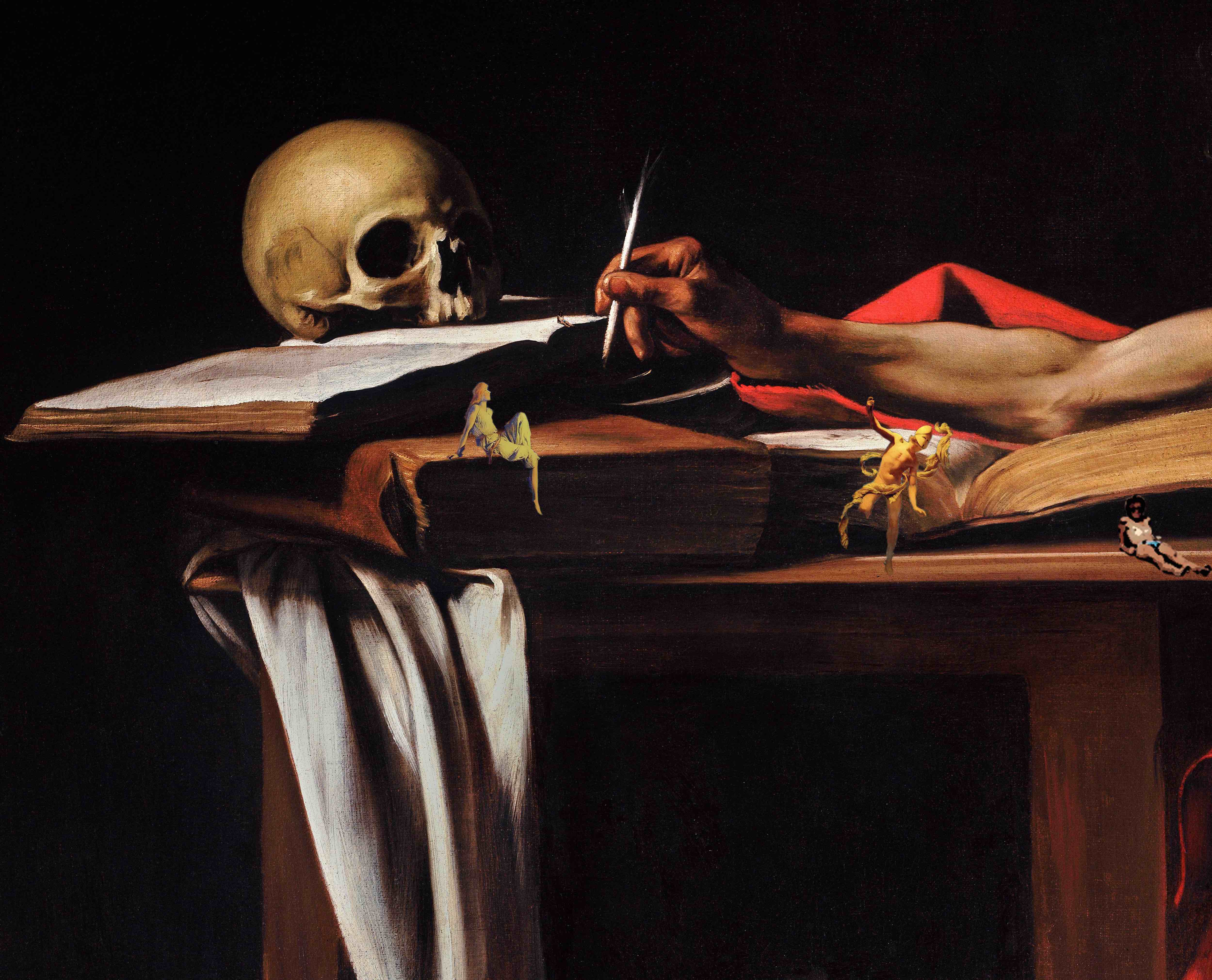
I read this morning in an actual newspaper printed on newsprint that some parent in Utah has successfully petitioned to have the Bible removed from elementary and middle school libraries in that most conservative of states. I guess, though, if you’re going to yank Judy Blume, ‘ol Moses ought to go down, too, writing all that shit about fratricide, genocide, incest. Add to that David’s offing Uriah to he could be with Bathsheba; Job’s getting whacked with woe by his Creator in a friendly bet with his prodigal son Satan; Jacobs’ sons attacking Hamor and Shechem, butchering every male of their enclave, looting livestock, dragging away the wives and children of their victims.[1]
I suspect that the usual vulgarians in Congress (a couple of whom are depicted above) will be howling in protest, perhaps not discerning that their putting parents in charge of schools has more than one ideological scenario. If they’re sincerely serious about eradicating the Woke Mind Virus, they should be ecstatic that the New Testament with its pacifistic, communistic, and inclusive messages won’t fall into the hands of impressionable young people trying to make sense of what TS Eliot called “the immense panorama of futility and anarchy that is contemporary history.”
Compare the MAGA ethos with the Beatitudes, delivered by Jesus after dividing private property (i.e., loaves and fishes) and redistributing them among the masses.
Talking about woke!
Blessed are the poor in spirit, for theirs is the kingdom of heaven. Blessed are those who mourn, for they will be comforted. Blessed are the meek, for they will inherit the earth. Blessed are those who hunger and thirst for righteousness, for they will be filled. Blessed are the merciful, for they will be shown mercy. Blessed are the pure in heart, for they will see God. Blessed are the peacemakers, for they will be called children of God. Blessed are those who are persecuted because of righteousness, for theirs is the kingdom of heaven.
I’m reminded of Woody Guthrie’s song “Jesus Christ,” sung to the tune of “Jesse James.”
This song was written in New York City Of rich men, preachers and slaves Yes, if Jesus was to preach like he preached in Galillee, They would lay Jesus Christ in his grave.
[1] The last item in that series happens to be Donald Trump’s favorite Bible story. For more, do yourself a favor and click on the link for BIBLE STUDY WITH DONALD TRUMP.
[Cue Alice Cooper] Now that for me school’s out forever, I have ditched academics, abandoned trying to explain sprung rhythm[1], deep-sixed Victorian bric-a-brac, and turned my attention to my first love, my av-av-av-ocation, anthropology.
For the last two weeks, between book signings and interviews,[2] I’ve been hanging out with Oscar Wilde, the great-great grandfather of Diana Ross/Lady Gaga, while pondering the relationship among peace, prosperity and decadence.
Wilde embraced the dark velvet decadence of Poe and Baudelaire, cocooning himself in aromatic rooms with lily-stuffed vases, handcrafted furniture, and arrases. His conversation, to quote Lucinda Williams, “was like a drug,” and he somehow managed to produce two minor masterpieces The Portrait of Dorian Gray and The Importance of Being Earnest in his downtime between partying and lecturing.
The Great British Empire had enjoyed peace and prosperity for so long that it seemed, as Oscar’s pal Willy B put it, “it would outlive all future days.” Far from the horrorshow in Africa and India and elsewhere, one lolling on a divan in Chelsea could focus one’s attention on decor even while mocking decorum.
However, World War I eventually turned people’s attention away from wallpaper design to spiritualism, as widows attempted to contact via seance their dead husbands and sons. In fact, Wilde’s own son Cyril would die in the trenches at the age of 29, fifteen years after his father’s checking out of this Vale of Tears Days Inn of Woe.
Hit it, Willy B:
We too had many pretty toys when young:
A law indifferent to blame or praise,
To bribe or threat; habits that made old wrong
Melt down, as it were wax in the sun’s rays;
Public opinion ripening for so long
We thought it would outlive all future days.
O what fine thought we had because we thought
That the worst rogues and rascals had died out.
All teeth were drawn, all ancient tricks unlearned,
And a great army but a showy thing;
What matter that no cannon had been turned
Into a ploughshare? Parliament and king
Thought that unless a little powder burned
The trumpeters might burst with trumpeting
And yet it lack all glory; and perchance
The guardsmen’s drowsy chargers would not prance.
Now days are dragon-ridden, the nightmare
Rides upon sleep: a drunken soldiery
Can leave the mother, murdered at her door,
To crawl in her own blood, and go scot-free;
The night can sweat with terror as before
We pieced our thoughts into philosophy,
And planned to bring the world under a rule,
Who are but weasels fighting in a hole.
WB Yeats “Nineteen-Hundred-and-Nineteen”
It was not an enemy’s bullet but the Book of Leviticus what eventually done Oscar in.
“If a man also lie with mankind, as he lieth with a woman, both of them have committed an abomination: they shall surely be put to death; their blood shall be upon them.”
20:13
Although increasingly, we outside the MAGA cult resemble the Greeks more than Victorians in our attitudes towards same sex relationships, we, like British Victorians, live in a homeland that has not been invaded by foreign armies for hundreds of years. Our wars are fought abroad, and not necessarily by our best and brightest.[3] We can choose not to enlist and focus our attention elsewhere, which in Late Empire America means pursuing the good life, a life of hedonism, of epicureanism, which is all fine and dandy (I confess having stashed away behind a custom-made maple cabinet one bottle of the limited Malt Master’s Edition of a Glenfiddich, a single malt double-cured in oak and sherry casks).
However, if my 1500+ acquaintances on Facebook provide an accurate sample of the bourgeoise, there seems to be a sort of insecure compulsion to woo-hoo about how wonderful their lives are, to snap photographs of luscious dishes (whether prepared at home or eaten out) or inviting beach vistas (perhaps with propped-up bare feet peeking up from the bottom of the photo). Typical captions read “not too shabby” or “life is good.” And every coed in America seems to have adopted the preening, narcissistic pose of Kim Kardashian.
This preening worries me because it smacks of pride, and if Oscar were given the second chances that our politicians claim as their due, he certainly might have embraced that other profound pleasure-seeker’s advice, Sir John Falstaff’s, about discretion’s being the better part of valor. Flaunting, which can create resentment and contempt, tempts fate. Some envious psychotic Trump cultist reads this post, finds out where I live, breaks into my house, takes an ax to my custom-made maple cabinet, and pours out my Glenfiddich before being taken down by our ninja dog KitKat.
By all means, let’s enjoy life but try not to be so smug about it, for O, my brothers and sisters, trouble’s brewing everywhere, in the Atlantic as glaciers melt and hurricanes incubate, in sub-Saharan Africa as bacteria mutate, in Russia where Putin is rattling nukes, in the Far East as Kim Jong II preens into the not-so-funhouse mirror of megalomania.
Happy summer, everyone!
[1] Sprung rhythm is associated with the poet Gerard Manley Hopkins: E.g.
O the mind, mind has mountains; cliffs of fall
Frightful, sheer, no-man-fathomed.
[2] I’ve been promoting my novel Today, Oh Boy, which you can buy HERE!
[3] Beau Biden was the first presidential offspring to serve in combat since Ike’s son John Eisenhower.
Facing the setting sun, I’m sitting at the northeast corner of the bar at Chico Feo, elevated by a bar stool and decking and looking down at a picnic table where White people in their early thirties chat. From this perspective, the attractive young blonde’s nose ring makes it look as if she has the sniffles, the metal of her nose ring glinting, looking like liquid.
Bobby Burns’ immortal words come to mind:
O wad some Pow’r the giftie gie us To see oursels as others see us!
But so what if from my angle it looks as if her nose is running? It’s not. The fellow sitting across from her sees a remarkably good-looking hipster with brilliant white teeth. She’s smiling and nodding her head, reaching for her Samurai Sling, her nose ring merely a nose ring.
No thanks, Bobby Burns. I don’t want to see myself as others see me – as sporty codger, vain old man, yellow-toothed toper, dead-end hedonist, whatever. The actual problem of being a septuagenarian is that people don’t see you at all – you’re invisible – which reminds me of a string of Washington Post crossword puzzle clues I encountered a couple of Sundays ago.
33 Across: Nurse’s remark, continuing at 61 across
Warren Moise and I experienced similar childhoods in that we grew up as White males in relatively small South Carolina towns in the Fifties and Sixties, both graduating from high schools that were integrated in the 1970-1971 school year.
Here’s a quote from the back cover of Warren’s excellent historical memoir The Class of ’71.[1]
When the Class of ’71 began first grade as young children in 1959, they lived in a totally segregated society. Except for some few prior student transfers and with limited other exceptions, the Black and White members of the Class of ’71 had never met, played music together, gone to church with one another, eaten food at the same lunch counters, or swum together in the same pools. All of that would change on the first day of their senior year.
In Summerville, South Carolina, where I lived, even physicians’ waiting rooms were segregated into White and Black sections. In fact, Bryan’s, the Black owned barbershop that I patronized, only cut White people’s hair. John F. Kennedy, Malcom X, Martin Luther King, and Robert Kennedy were assassinated within five years of one another when we were students. A cultural revolution was underway.
Again, to quote Warren:
Soul music, oxford shirts, and oxblood Wejuns penny loafers were disappearing from the streets of Gamecock City[2]every day, It was as if the 1960s were burning rubber in a Chevelle V-8 Super Sport on Highway 15 South leaving town toward Paxville. At the same moment, the 1970s were rollin’ into town on Highway 15 North inside a Volkswagen van painted with slogans of peace, love, and daisies.
Warren and I met our freshman year in Thornwell dorm the fall of 1971 at the University of South Carolina and became fast friends, deciding to room together in Tenement Nine on the Horseshoe the next year, which we did until Warren left college to pursue a musical career.[3]
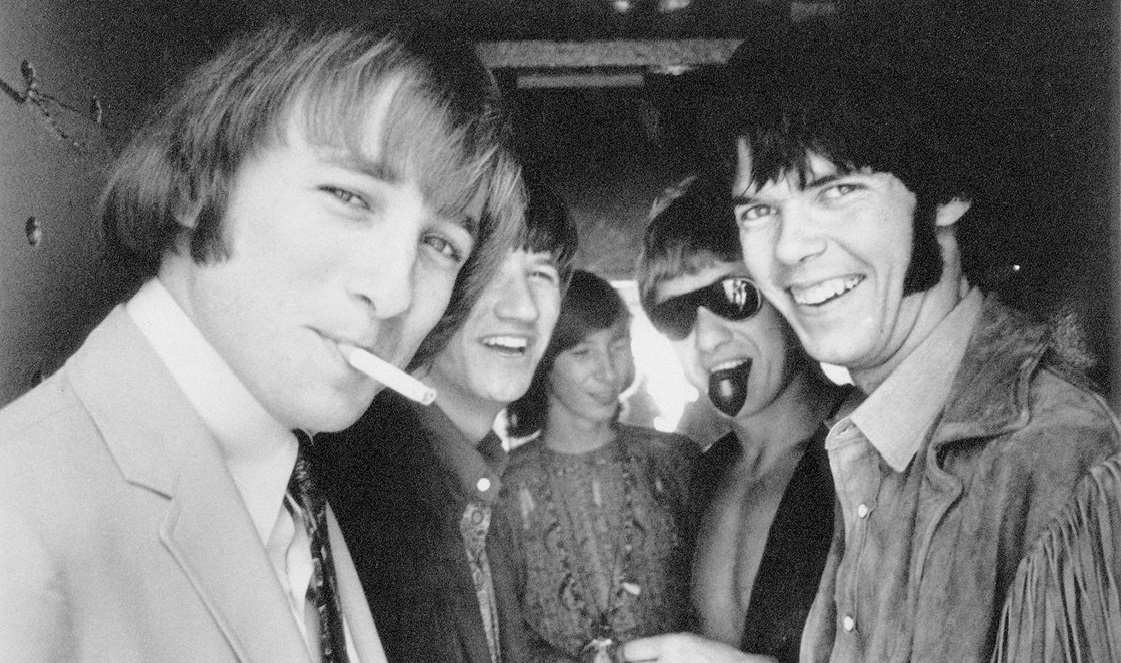
Warren and I circa 1972
We also shared houses when Warren returned to USC to earn his undergraduate degree in history in 1974 -1976. Unfortunately, we more or less lost contact after school. Oddly enough, fortyish years later we both ended up writing books about being in high school the same year. My novel Today, Oh Boy takes place during the course of one day, October 12, 1970, a month or two after Warren began his senior year at Edmunds high school.[4]
So, The Class of ’71 and Today, Oh Boy cover some of the same terrain, small towns transitioning from the Old to New South, the tumultuous raging of hormones, adolescent crushes, physical violence engendered by culture clashes.
In my not-all-that-humble opinion, they offer interesting perspectives from non-fictive and fictive landscapes in that pivotal school year that ended the Sixties and ushered in the Seventies.
We better stop Hey, what’s that sound? Everybody look, what’s going down?
from “For What It’s Worth,” lyrics by Stephen Stills
[1] I don’t know if there’s such a thing as a historical memoir. The Class of ’71 contains multitudes – it’s a history of Sumter County, a coming-of-age story, a judicial and political chronicle of desegregation, a sociological review of the cultural changes of the late Sixties, a profile of serial killer Pee Wee Gaskins. In short, it’s difficult to succinctly classify. Here’s some more expansive. You can purchase the book HERE. It’s a great read propelled by well-crafted prose.
[3] You can read the horror story of the roommate who replaced him HERE BTW, Warren’s musical career was successful. He’s a member of the Beach Music Hall of Fame, though he abandoned life on the road for a career in law.
[4] Actually, I decided to delay Summerville’s integration until the next year, which we novelists have the freedom to do. You can purchase Today, Oh Boy HERE.
I recently ran across a balding fellow, probably in his early forties, wearing a grey too-snug tee-shirt that read “Every Day Is a Good Day.” Of course, I get the subtext: life is miraculous on the cosmic impersonal plane – the nighttime sky, as Hamlet put it, a “brave o’erhanging firmament, [a] majestical roof fretted with golden fire,” not to mention down below “the beauty of the world, the paragon of animals.” We should be thankful for the chain of events that gave rise to a consciousness that allows us to appreciate and contemplate these wonders around us. The subtext of the subtext is that this wonderfulness is the handiwork of a benevolent deity. Every day is a good day because it’s a colorful shard in the ever-shifting kaleidoscope of a creator god’s abracadabra.
But, as we all know, a day’s goodness or badness depends on an individual’s experience during that 24-hour period. For example, at Chico Feo I just heard a horrific account of a traffic fatality that happened on Folly Beach last night. A car crammed with six drunks doing 65 in a 25-zone barreled into a golf cart driven, as the story was told to me, by a woman who had just gotten married that very day on the island.[1]
So, I might suggest, that the tee shirt’s message be edited: “For me, every day is a good day” instead.
And print this on the back.
A little Madness in the Spring Is wholesome even for the King, But God be with the Clown — Who ponders this tremendous scene — This whole Experiment of Green — As if it were his own!
Emily Dickinson
[1] The fellow who related the story said she was in her bridal gown.
Poverty is not all that terrible if you’re in college. After all, most students live in dormitories, and for my first two years of undergraduate school, the dorms I lived in were officially known as “The Tenements,” the oldest dorms on campus, picturesque but Spartan. And when I say Spartan, I mean tres austère – no air-conditioning in the summer; hand-searing radiators in the winter; merely two telephones in the hall, one for on campus communication, the other a pay phone you had to feed quarters during long distance calls. And perhaps the worst indignity of all, there were no stalls around the three toilets lined up in the flashback-inducing black-and-white diamond-tiled bathroom. Whenever nature called, the residents of Tenement 9 shielded themselves with open newspapers to create a modicum of privacy. No one, conversed, i.e., no one shot the shit while shitting.
OMG! TMI!
Even though I couldn’t afford it, I moved off-campus my junior year, and after a couple of nightmare rentals in the fall and winter of my senior year, my housemate Warren Moise, along with a host of other impoverished students, moved into the once genteel abode of 1830 Greene Street conveniently located on campus.[1] I’m fairly certain than none of us owned an automobile. SLED paid a visit our first week, and half the residents were carted off to jail for simple possession. Luckily, Warren, Jim, and I were off when police came a calling.
1830 Greene Street
Interestingly enough – and least for me – I had lunch with my Greene-Street housemate Warren Thursday and then encountered another Greene-Street housemate that afternoon when I was signing copies of my novel Today, Oh Boy in Summerville.[2] I hadn’t seen Jim Huff or his wife Jane in this century – in fact, not since the late 80s or early 90s. Jim had been lease-signer of 1830 Greene and therefore collected our $20 rent each month (there were eight of us) and utility money and money to buy kerosine for the enormous furnace that consumed fuel as rapidly as RJ McCarthy downed his 24-ounce cans of “the Bull,” aka Schlitz Malt Liquor. Every room except for the kitchen and the two bathrooms was utilized as a bedroom, including the living room and the conservatory where I slept, only assessable through Mr. McCarthy’s room.
Hail, affordable housing; farewell, privacy.
Jim Huff circa 1975
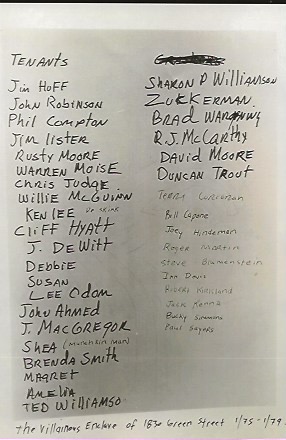
Here’s a list Jim compiled of the house’s residents, including girlfriends who spent multiple nights.
At the signing in Summerville, Jim gave me some photographs he had taken back in the day, which I so much appreciate. They demonstrate quite eloquently that whatever I may have gained in monetary wealth, I have equaled in girth, but lost in hair.
Anyway, it was great seeing Warren, Jim, and Jane, though I must admit that the photos have engendered a wee bit of melancholy.
[1] If you’re in the mood for some Night of the Hunternoir, click HERE and read about a couple of harrowing experiences we suffered before moving to Greene Street.
I’ve written on Hoodoo previously that I don’t blame young people for holding golden-agers, i.e., senior-citizens, i.e., their elders, i.e., old farts in contempt as we shuffle along taking tiny steps, fumbling for our checkbooks while striking up conversations with grocery store clerks, or poke along doing 45 in passing lanes, oblivious to the hustle and bustle of Late Empire capitalism.
Even I-and-I, a forgetful 70-year-old, have been known to disparage my fellow geriatrics when their egocentricity (or declining faculties) don’t take in account the needs of others. No doubt I get on young people’s nerves myself, an overly dressed gadfly Oscar Wilde wannabe nodding my head and droning on about myself on barstools and in dentist offices.
Yet here I am in my twilight the author of a little ol’ bagatelle of a YA novel written on a 12th-grade-plus reading level, and I’m shamelessly promoting it as if it’s the great American novel. Three newspaper articles have appeared that focus on my late life productivity[1], and I’ve also appeared on midday local television program talking about me, me, me, not exactly a fascinating subject.
Ultimately, it’s much ado about not much.
Yet it does give me something to do and to dread.
My sons and their significant others are coming to the book launch[2] (Harrison and Taryn from Chevy Chase, Ned and Ina from Nuremburg), Old and new friends will be there. Eugene Platt, who has recently published his collected poems Weaned on War will introduce me, an honor for sure. I see the launch as a sort of funeral I get to enjoy before I die.
However, I do want to set it down here that I’m a little ashamed of myself for all this hullabaloo. There’s something a little tawdry about it, a little needy.
Rather, I should
like a laughing string
Whereon mad fingers play
Amid a place of stone,
Be secret and exult
or better yet, as the young people say STFU.
Cheers!
[1] I’m also, to use a polite term, a digital collagist.
[2]Buxton Books, 120 King Street, 11 April 2023 6 PM rsvp@buxtonbooks.com