What a Dump!


kitchen-design-altrinchamaltrincham-road-wilmslow-northern-design-awards---friday-22nd-m4pgid2jI’ve lived in some spectacular dumps in my life, especially during my days as an undergraduate and graduate student.

For example, my bedroom in my first off-campus apartment was more or less the kitchen, the bed separated from WW2 vintage appliances by a breakfast bar. My housemate Stan had found the two-room apartment in late August in a subdivided two-story house on Henderson Street just up the hill from the Nursing Building that was under construction.

Actually, I had the premier sleeping spot because Stan’s bedroom was also the “living room,” the room you stepped into when you entered the apartment. Stan was the bassist in a band called Buddy Roe, and his post gig “friendships” offered me many opportunities to catch him and a companion in flagrante delicto as I returned from classes at the unholy hour of nine, ten, or eleven a.m., not to mention noon, or one, two, or three p.m.

I don’t know why we never figured out a sign on the door might have prevented my intrusions. Then again, a sign that read “Do Not Disturb” would more or less proclaim to the other occupants what was going on, but that still seems preferable to having your coitus interrupted.

Gas stoves, one in each room, provided the heat, and lighting those suckers for the first time proved a real adventure. One night I inadvertently destroyed Stan’s 300-plus LP collection. Need I mention that there were no sprinklers or fire escapes, that the wood was rotting, that the entire mold-ridden structure smelled like a cross between the River Styx and a long-enclosed attic?

where the Henderson Street house once stood

where the Henderson Street house once stood

Two years later, bulldozers would raze our Henderson Street house for a new university parking lot.

That year in my Milton class I met my next-to-be housemate, who enjoyed much nicer digs on Confederate Avenue. Mike not only was an excellent scholar, but he also owned furniture that looked downright bourgeois, so at the end of the spring semester, I returned to Summerville and put him in charge of finding us a place, which he did, seven miles from campus in a sturdy two-bedroom cottage nestled squeezed between two convenience stores on Fairfield Road, a four-lane highway.

Although the “space” was nice, as they say, getting to and from school meant riding city buses, and when the buses quit running at eleven, that meant hitchhiking or stumbling seven miles on foot through one sketchy urban area after another.

Praise Darwin, I survived.

Warren back in the day

Warren back in the day

That December, Mike left school suddenly after the first semester, so I teamed up with former sophomore roommate Warren Moise, and we moved into a miniscule mill house up North Main, even further away from school than Fairfield Road. The bad news was that the neighbors hated our long-haired asses. Once, in the wee hours when I was alone, someone banged meancingly on a side door of my bedroom that led outside.  I went out to investigate and heard someone whistling a tune. The Night of the Hunter meets Animal House. A couple of weeks later, a crew burglarized us, poured our food out onto the kitchen floor, and as a final, sociopathic touch, shat thereupon.*

We got the message.

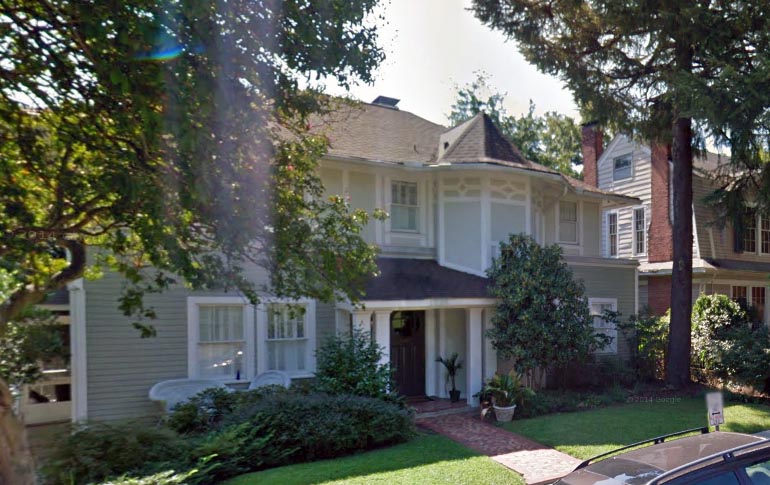
Coincidentally, my former next-door neighbor from Henderson Street, Jim, was recruiting people for a great house he had found just off campus, so Warren and I went in with six others and rented 1879 Green Street, a veritable mansion compared to my previous domiciles. (It was a good bit seedier than it appears in the photo below courtesy of Google maps). Of course, only three were supposed to live there, but we never got caught. The house did get busted in a citywide drug sweep our second night there, but I wasn’t at home so could save my pre-trial intervention card for a later date. I will say, however, the officers from SLED left the joint looking a lot like the burglars had the mill house.

The very best news was that in my third year on Greene Street, I met Judy Birdsong, who, of course, lived in a nice apartment on Deerwood Drive, so my days of dire poverty were coming to a fruitful end.

The good news is that living in dumps is sort of romantic when you’re young and don’t know any better — and as long as you’re the only vermin living there.

*Forgive me; I’ve been abridging and editing Chaucer


1867 Greene Street

1867 Greene Street

Enjoying Genocide at the Drive-in

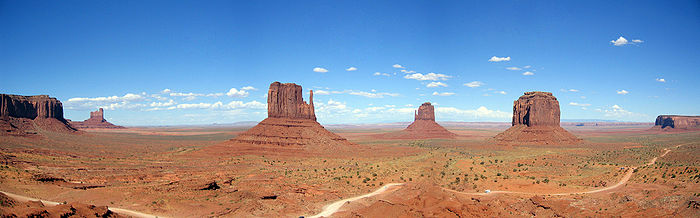
Apr_SheWoreAYellowRibbonLast night TMC broadcast the John Ford classic She Wore a Yellow Ribbon. This early Technicolor production relies heavily on the majestic vistas of Monument Valley located on the Arizona-Utah border. You might even go so far as to say the setting steals the show, more like the scenery chewing up the actors instead of vice versa.

The film came out in 1949, right about the time television started to invade postwar households. Ford and his cinematographer Winton Hoch, who won an Academy Award for the picture, make heavy use of long shots that exploit the incredible russet beauty of the landscape but also render the characters antlike in the grand scheme of it all. Seeing it on TV barely hacks it, even now with our current technology. Imagine what would be lost watching it back in the day on a black-and-white 16-inch screen Zenith.

1959-Zenith-16C20-17in

I remember first seeing the movie in the late 50’s with my parents, either at the North 52 or Flamingo Drive-in Theater. Until last night, all I recalled of the film was its invasive theme song and John Wayne’s character having conversations with his deceased wife at her graveside.

Those were the halcyon days before education when you could blithely curse the Arapaho, Cheyenne, and Kiawah for having the temerity to wander off their reservations. You could innocently celebrate the replication of their genocide as arrows whizzed, rifles thundered, and stuntmen tumbled from galloping horses.

large-3Going to Drive-ins offered working class families like mine a cheap night’s worth of entertainment. Kids under 12 got in free. My brother David and I would dress in our pajamas, Mama would pop popcorn at home, and we’d bring along our own Coca-Colas. Not only did we save money, but also my parents could chain smoke, which, along with the burning mosquito repellent, helped to diminish the chances of our contracting Malaria. Usually, David and I would conk out, so Mama and Daddy could engage in adult conversations without forking out money to a babysitter.

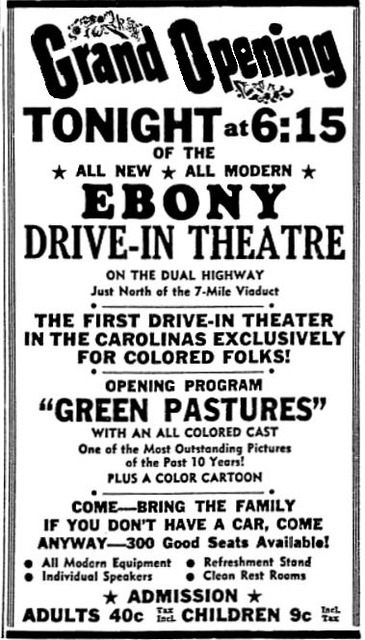
large-4The Flamingo had been originally called The Ebony and catered to, as the ad says, “Colored Folks,” but it only lasted less than a year. Its next incarnation was as the Bonny Drive-In, which was actually integrated, but this social experiment ended in less than a month. It reopened finally as the Flamingo and had by far the coolest sign, a neon-tubed flamingo that lit up in progressive sections over and over again on the back of the screen facing the highway.

West Ashley also had its drive-ins, the Magnolia, located at 1500 Savannah Highway, the present location of Rick Hendricks Chevrolet. There were others as well, the St Andrews Drive-In, also on Savannah Highway, the 4-Mile Drive-In on North Meeting Street Road, but I don’t remember them, nor do I recall the Sea-Breeze Drive-In on Coleman Boulevard in Mt. Pleasant. (You can read all about those lost treasures at this site, Special Feature: Charleston Area Drive-Ins).

I do, however, remember the Gateway, where we went as teenagers, not so much to watch movies but to risk our lives making out in back seats, because as anyone knows who has ever seen a B-horror flick at a Drive-in movie, teenagers necking in cars are the number one target of monsters, whether they be zombies, werewolves, or radioactive mutated reptiles.

Later the Gateway specialized in porn films, which no doubt led to more than one auto crash as drivers tooling across overpasses caught glimpses of the screen as they exited onto 52, which in those days was called “the Dual-Lane.”

Rumor has it that some of my high school acquaintances sneaked into area drive-ins by getting into surf bags and strapping themselves on surf racks on the top of VW buses. Of course, it wasn’t Coca-Colas they were smuggling inside.

I can’t say I pine for those long gone days  — in many ways they sucked . However,  I wouldn’t mind catching another John Ford film at a drive-in, though like last night, I’d be pulling for the Indians.

700px-Monumentvalley

Southern Gothic Memories, Canine Edition

I’m not aAgnolo-Bronzino--1503-1572-----Portrait-of-the-dwarf--Morgante%0D%0AItalia people person. For example, although I’m a teacher, I don’t especially like young people. Don’t get me wrong — I don’t dislike children the way WC Fields disliked children; I wouldn’t conk one on the head for laughs — but I don’t like them any better than I like twenty-somethings, middle-aged people, seniors, etc. If anything, as demographics go, I like very old cognizant people the best, octogenarians and above, widows and widowers, withered folk who have seen it all, suffered irredeemable losses, but who have managed to maintain twinkles in their eyes.

(By the way, these withered creatures both disgust and terrify high school students. For example, Chaucer’s “The Wife of Bath Tale,” which describes the wedding night of a young knight and a very aged crone, sends viewable shivers of disgust up sophomores’ spines. If you don’t want your teenager to smoke, don’t try to scare her with lung cancer — she can’t relate to a death that far in the future — instead show her a photograph of WH Auden or Keith Richards. Explain that cigarettes break down collagen and lead to wrinkles.)

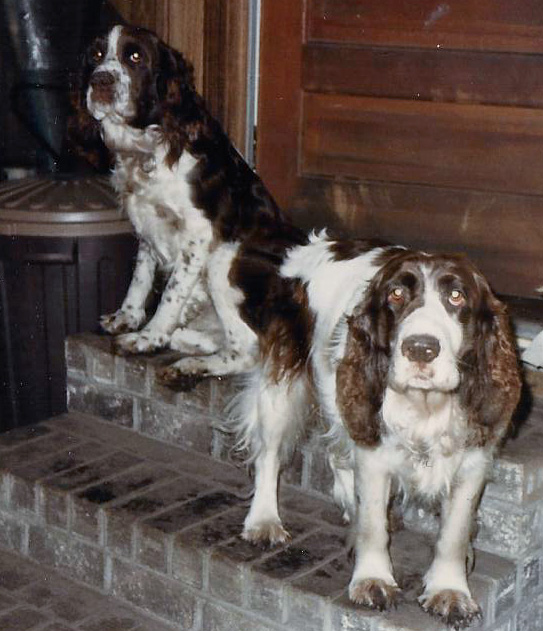
I feel the same way about dogs as I feel about people. I don’t like a dog just because it’s a dog, just because it’s a member of the species Canis familiaris, but I have loved certain individual dogs, especially ones that ended up living with me, even troubled ones, like psychopathic Jack (d. c.1990) and PTSD Saisy (d. 2014).
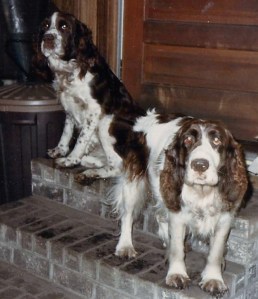
Jack and Sally  1986
Jack and Sally 1986

However, by far the best dog we ever owned was Bessie, an AKC-certified Golden retriever who was beautiful, loving, highly intelligent, and gentle.

To obtain Bessie, however, we had to venture into Flannery O’Connor territory, or if you prefer, a David Lynch movie, but before I start the narrative, I’d like to set a couple of things straight.

First, I’ve had the following account certified by fellow witness Judy Birdsong as basically accurate. In cases where our memories differ, I have deferred to her.

Second, I need also to stress that I have always sympathized with people with physical abnormalities. My father’s favorite work of literature was Cyrano de Bergerac, I identified with the protagonist of The Boy with Green Hair when I was a kid, and I consider Joseph Merrick, the Elephant Man, as one of the most admirable human beings who ever lived.

So don’t judge me goddamnit!

* * *

Once upon a time, our older ten-year-old son Harrison had been asking for a dog, so Judy decided to surprise him and younger brother Ned, seven, with a golden retriever puppy for Christmas. We were living in post-Hugo Isle of Palms, SC, in a patched-up Cap Cod house with a large dog-friendly fenced back yard, and unlike our previous dogs, the aforementioned blood-thirsty Jack and his severely overbred pin-headed mate Sally, Bessie was destined to be a house dog.

The only problem was that Judy couldn’t find any golden retrievers for sale. We’re talking pre-Internet 1994 when you had to blacken your hands flipping through newsprint to find pets for sale. And like in an old movie, the days of the calendar were fluttering in the winds of time, being ripped off one by one as Christmas approached. Each morning, Judy scoured the want-ads, but still, no golden retriever pups for sale.

Then almost right before it would be too late to have the puppy appear on Christmas Day – eureka – a well-written ad purporting expertise appeared. The ad stressed that these pups had not been overbred, a problem endemic to such a popular breed, as the ad writer put it. Six were left — but going fast — reddish-hued golden retriever pups for sale for 150 bucks a pop. The only negative was that you had to drive to rural Berkeley County somewhere in the vicinity of Macedonia, South Carolina, to check them out, and so on a Saturday, we dumped the boys off somewhere and made the trek.

Judy had, of course, called the breeder, who impressed her with his phone presence, his well-articulated knowledge of all things golden retriever. He offered details on ancestry, points of origin. She liked the idea of the pups being bred in the country. She envisioned the puppies’ mother running Lassie-like through fields of alfalfa beyond wooden-fences, a white-washed clapboard farmhouse way back from the rarely traveled road, an aproned June Lockhart in the kitchen flipping flapjacks.

* * *
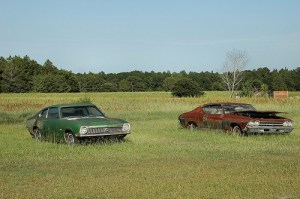
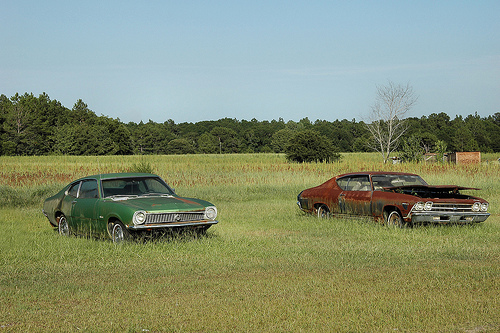
wilcox-county-ga-sibbie-road-abandoned-ford-mustang-chevrolet-chevy-chevelle-green-rusted-southern-gothic-americana-pictures-photo-copyright-brian-brown-vanishing-south-georgia-usa-2010The actual domicile was a largish non-mobile mobile home on a half-acre lot. I guess its owners would call it a manufactured house, but it didn’t look like a house but like a boxy trailer. In the weedy yard, two fossilized automobiles, one with yellowed newspapers inside stacked almost to the ceiling, the other leaning to its starboard side because of flat tires.

Happily, for me, I hadn’t envisioned what the homestead of our future puppy might look like, so I didn’t suffer the cognitive dissonance Judy had to endure. No, this wasn’t the set of Lassie; it was more like some David Lynch movie set in the rural South. Or, to wax literary, the homestead of the Lucynell Craters of Flannery O’Connor’s “The Life You Save May Be Your Own.” In other words, Judy’s would-be plantation had dysfunction written all over it.

After exchanging dubious glances, we clanged our way up the metal steps, and I knocked politely on the metal door, expecting a chorus of howling or barking or at least something.

Silence.

I knocked again, louder.

Not a peep.

I banged on the door, thinking of B drive-in movies featuring chainsaws.

And then I heard a sound a muffled voice, some clumping. Was someone coming or not? Finally the door opened.

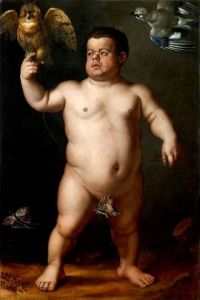
Standing there to greet us, propped on one aluminum crutch, stood a one-legged midget* in a Billy Pilgrim tee-shirt and cut-off denim shorts. He hadn’t lost his leg, but something had gone awry in utero; it hadn’t fully formed. I remember another embryonic non-formation going on with one of his hands, but Judy nixes this memory. She assures me that his disabilities were limited to being a “little person” with half a leg.


*I realize that some consider “midget” a pejorative term, but to me it seems less patronizing than “little people.” Plus I’ve had it with the never ending process of euphemizing euphemisms. Trust me, one day “little people” will become pejorative and the politically correct term will be “differently scaled humans.”

When I think of midgets, I think of the wonderful Land of Oz and squeaky “we-are-the-lolly-pop-kids” voices; however, this cat possessed that deep regionless baritone I associate with commercial voiceovers. He sounded like a radio announcer, and the walls of the living area of his minimally furnished house were lined with banks of computers at a time when computers weren’t ubiquitous household possessions.

He was unusually articulate; no wonder Judy had been impressed. Plus, he possessed the self-confidence of Sean Connery playing James Bond. Why hide the phocomelic limb with long pants pinned over the appendage? Shame seemed alien to him. The only negative I’ll lay on him was that he a sort of know-it-all, the way certain mechanically gifted people can be know-it-alls.
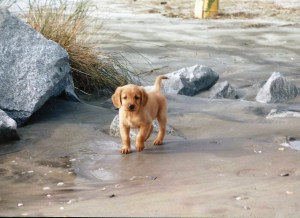
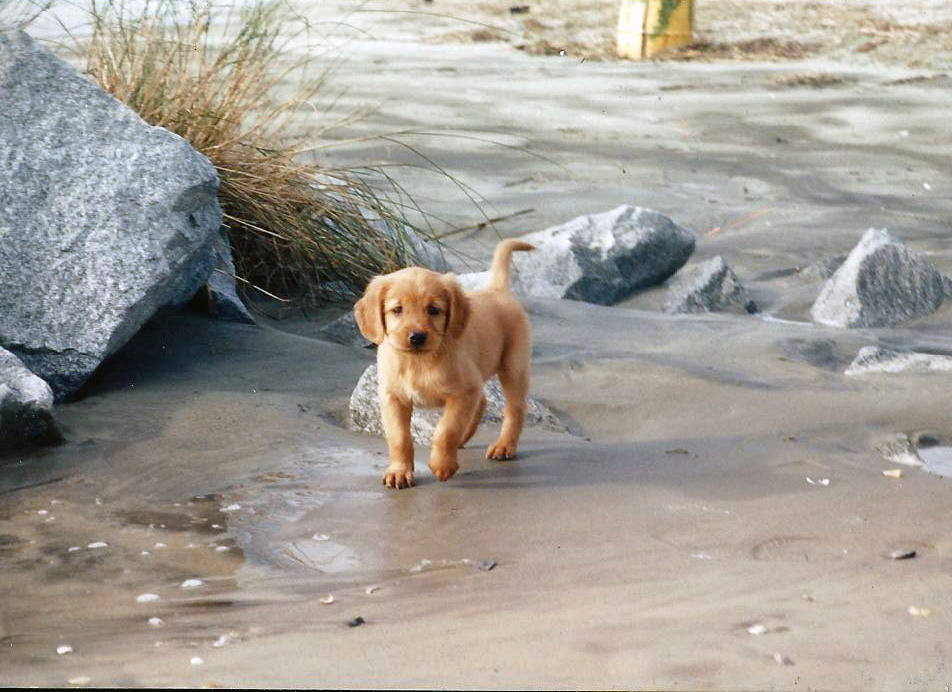
Bessie the Pup
Bessie the Pup

With him were two boys in their early teens, hardy and hale. We followed dad and sons to another room where the puppies were skidding around in a waterless kiddy pool. I remember urine in the pool; Judy doesn’t. We both agree the puppies were adorable — maybe four were left — and we chose the cutest and made arrangements to return to pick her up.

Money exchanged hands, and we said our good-byes. I decided not to mention the oddness of the encounter to Judy. How small-minded it seemed to me to even mention the disability. So what if the fellow from whom we had purchased our puppy was short and malformed? So what if we had spent a half hour in Flannery O’Connor/David Lynchville?

We returned to the car, I started the ignition, and Judy said, “That guy seemed soooooo familiar. Where do we know him from?

My mind screamed “WTF? You gotta be kidding me!!! What in the hell are you talking about?” but I merely said, as calmly as I could, “I’m fairly certain that I’ve never laid eyes on him.”

“No, think,’ she said. “Didn’t we know him in Columbia? I know we know him.”

Now things were really getting surreal.

“I’m absolutely certain I don’t know him. I’m certain I would remember him. He is one of the most singular individuals I’ve ever laid eyes on. Indeed, he might be the only midget I’ve ever talked to. Plus, he had only one leg. Trust me. I’d remember that. He’s not a very forgettable fellow.”

Judy’s still not convinced. However, we did end up running into him again at an outdoor concert later that spring, and as it turned out, Bessie didn’t turn out to be exactly genetically sound herself. She was born without knee sockets and needed an operation, but you couldn’t have asked for a better dog.

And how remarkable that her breeder could be so confident, so self-possessed. In that regard he stands head and shoulders above me.
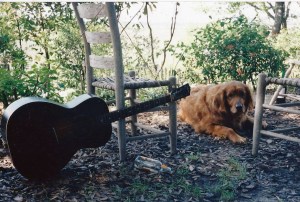
Bessie the Crone photograph by Jim Klein

Bessie the Crone photograph by Jim Klein

A Rural Funeral

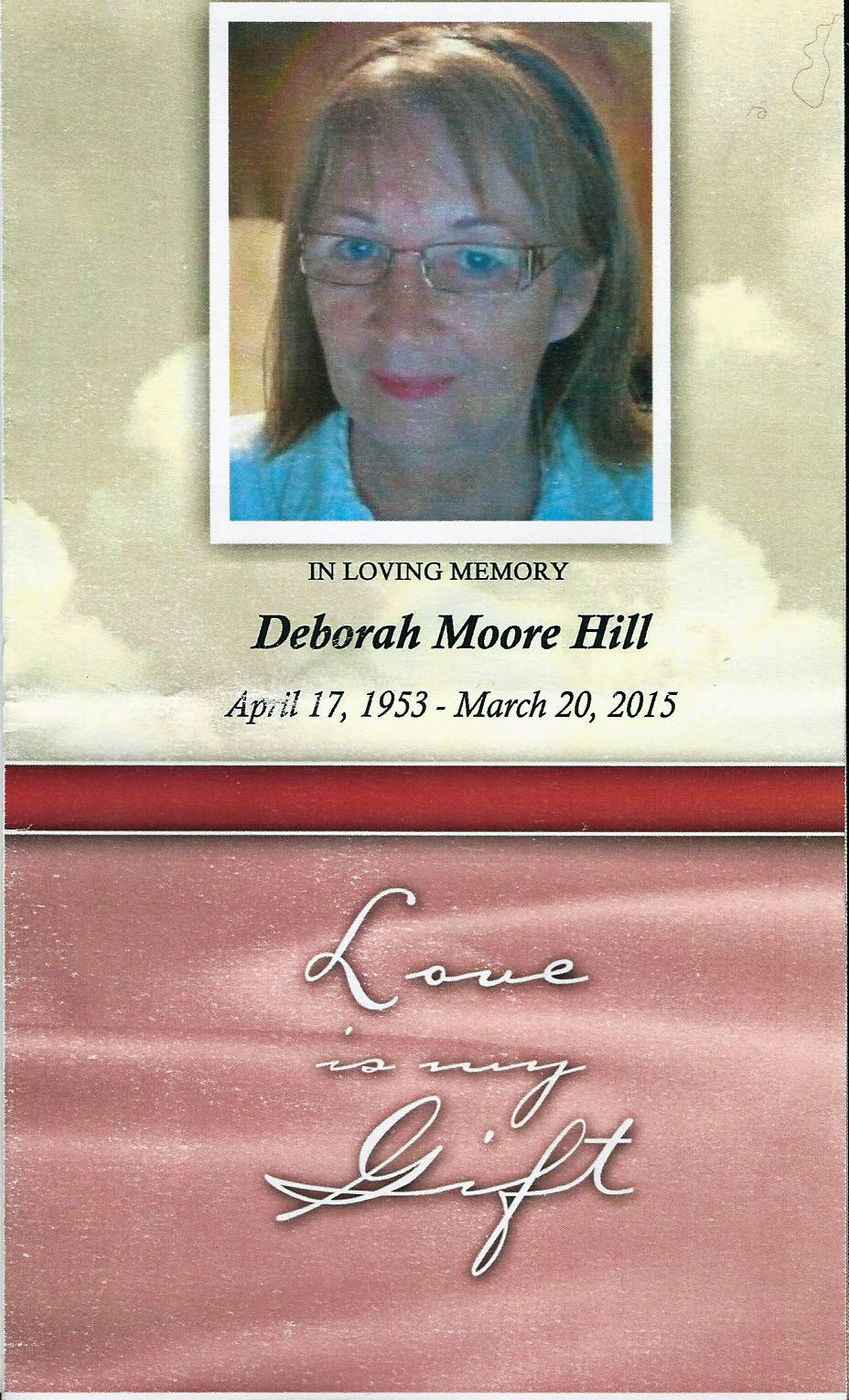
Funeral ProgramWhat they call Main Street in Jackson, South Carolina, isn’t what I would call a street — it’s more like a road running through farm fields, past a row of handsome houses standing on generous lots subdivided from what was once a pecan grove. The only businesses I saw: some type of mechanical repair shop with a hand-lettered sign and a defunct “Super Market.” There appear to be more churches in Jackson than businesses, at least on Main Street. We’re talking the Deep South, the Bible Belt, country music, V-8 engines, spiritual people.

I was at Jackson to attend the funeral of my first cousin Debbie, Uncle David’s second daughter, and although as a youngster I asked God to bless Elaine, Debbie, Pamela, and Scarlet each night as I recited “Now I Lay Me Down to Sleep,” we rarely got together in childhood and virtually never in adulthood, unless we were visiting the terminally ill or, like yesterday, laying a departed family member to rest.

For whatever reason, my branch of the Moore clan isn’t close — even my siblings and I don’t see each other often — so it isn’t surprising that I can count the memories of visiting my cousins on one hand. However, when we did get together, we had a blast playing pick-up sticks and softball or listening to German-born Aunt Maria play her accordion. We simply enjoyed being together because there’s something about blood, about seeing hints of your features stamped on someone else, knowing you have sprung from common roots.

Elaine Ackerman Moore

Elaine Ackerman Moore

Roots like our irascible great granddaddy Luther Moore (“I’m deaf and blind so there’s no need to come up and talk to me!”), our sweet great grandmama and great granddaddy Ackerman, whose daughter, our grandmother, the beautiful Elaine Ackerman Moore, died before we were born and for whom my father and Uncle David mourned for the rest of their lives.

Blood, like they say, is thick.

Perhaps the most memorable event of our cousinhood occurred when Mama sold Uncle David a pony my father had bought and tried to keep in our backyard in a subdivision not zoned for farm animals. This pony was the equine equivalent of Homer Jo Roberts, Summerville’s town bully, who once punched 24 different people one night at the Curve-In Pool (I was one of them) because, as he later said by way of apology, “ Whiskey and beer don’t mix.”

This pony kicked, bit, brayed. I doubt John Wayne would have the courage to put a saddle on him. More problematic was the pony’s penchant for busting out of the make-shift fencing Daddy had erected by nailing some 2x4s to trees in our backyard. This transformation of our backyard into a farm helped to solidify our status as not-ideal neighbors (we also had tied to a tree in the backyard a wingless Ryan PT-22 airplane that we had to crank once a week to keep the engine from freezing). Neighbors were particularly unhappy when the pony got out and trampled their flower beds or deposited unsought fertilizer on their lawns.

So, Uncle David to the rescue. He drove from Jackson to Summerville with a horse trailer and relieved us of the nightmare, or, if you will, night-pony, whose behavior seemed to have improved remarkably the next time I saw him in Jackson safely enclosed behind well-constructed fencing.

I learned at her funeral that my cousin Debbie was a devout animal lover and had left behind two beloved dogs, Smoky and the Bandit. I already knew of her generosity because when Daddy was dying, she took off work and stayed for days with Mama. While she was there, she fixed mama’s broken washing machine and rewired the utility room. Debbie was a first-rate mechanic who could repair anything, who could replace the floor of a trailer, who could hold her own working beside anybody.

However, until yesterday, I had no idea of the breadth and depth of Debbie’s generosity. I learned it through reminiscences delivered during the service by her nephews, a niece, and a co-worker. I learned of material gifts galore and also of the gift of time devoted to others, the gift of love bestowed.

For example, when one nephew had to sell his beloved yellow Camaro, Debbie insisted on buying it herself so she could, unknown to him, leave it to him upon her death. I learned of her extraordinary work ethic, her meticulousness, her courage in butting heads with authority figures (a Moore trait for sure), her stoicism in enduring with grace the ravages of cancer.

I also learned of her sense of humor, an attribute that she kept right up to the very end.

For example. during her last week on earth, she was helped out of bed into her wheelchair, donned a wig, and when the nurse came in, Debbie asked her what she had put in her IV bag.

“Nothing special, just the regular.”

“Well, look what it’s done,” Debbie said. “Whatever it was, It made all my hair grow back.”

What I learned most profoundly is how much I had missed by not really knowing Debbie. Watching her nephew Steven manfully deliver an eloquent, heartfelt eulogy, I felt love manifested palatably in that sanctuary. The entire funeral from start to finish underscored the power of love and faith (something I certainly lack). How moving to hear Debbie’s brother-in-law Jeff sing to the accompaniment of his own guitar a medley of “Amazing Grace” and “My Chains Are Gone.”

On the front of the program for Debbie’s funeral are the words “Love is my gift.” How fitting.

Those Rainy Days of Yore

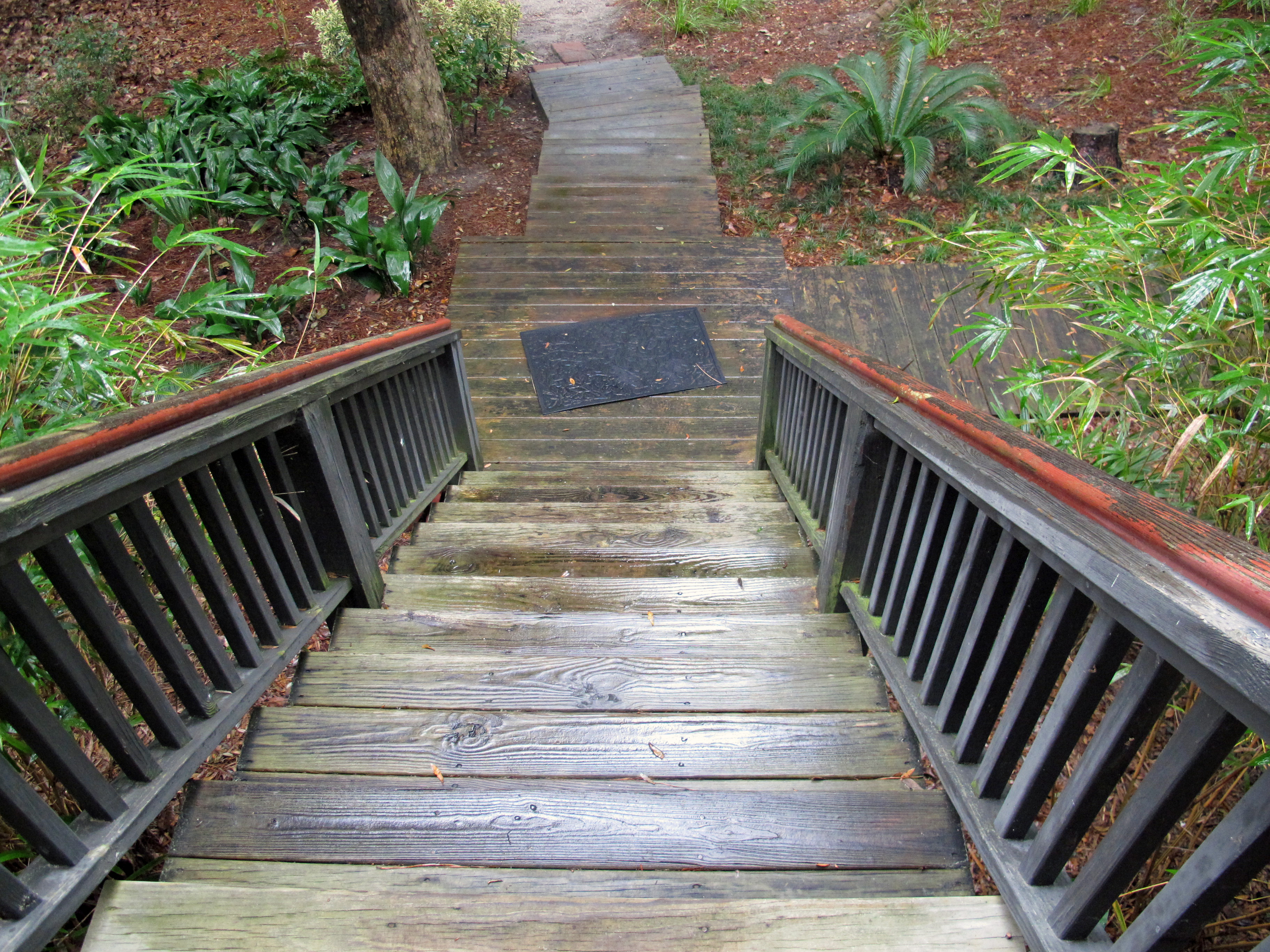
No way I'm descending these treacherous stairs leading from my house when the temperature is hovering a mere 5 degrees above freezing!

No way I’m descending these treacherous stairs leading from my house when the temperature is hovering a mere 5 degrees above freezing!

One of the peculiar aspects of living in the South that Northern transplants have to acclimate themselves to is our inability to cope with the slightest manifestation of winter precipitation — including rain. Here, in Charleston County, the schools are closed today, even though my outdoor thermometer reads 3 degrees (38F). True, it is raining, the highways are slick, but folks in Boston might just perceive the driving conditions as optimal.

Don’t get me wrong.  I’m okay hanging out at home. I can sit with a steaming cup of Jameson-laced coffee hot cocoa and grade my essays without interruption, or better yet, I can waste time by recalling the not-so-halcyon days of my youth and how we entertained ourselves on miserable rainy days like today.

Although I liked to read as a pre-and-early teen, I spent most days outside playing unsupervised with the neighborhood kids. We built forts or played whatever sport was in season — football in the fall, basketball or field hockey in the winter, and softball on summer evenings when the temperatures became bearable.

If the weather precluded playing sports outside, I often sought out an indoor sport substitute.

For example, on a rainy February day like today, I might break out my electric football game. For the uninitiated, these games consisted of a metal gridiron that vibrated and tiny plastic men – linemen, wide receivers, and quarterbacks with arms cocked – whose plastic foot flanges responded to the vibrations by putting the men in motion. Unfortunately, more often than not, the men moved in circular paths, making the spectacle seem less like a football game but more like a Greek tragedy where the plague-smitten citizens of Thebes nonsensically stumble blindly, bumping into one another, wheeling in senseless circles of crazed despair.

The football itself was a molded-spongy manmade cotton-like oval. You’d line the men up, your opponent would line his up, and then you’d hit the switch and set the Thebans to their inchoate ramblings. Not surprisingly, I could rarely find anyone willing to play with me, so I played myself, having one team be Clemson and the other be Michigan State or some other detested Northern powerhouse.

Oedipus as Electric Football Halfback

Oedipus as Electric Football Halfback

That electric football set ended up being destroyed by a brother in a well-deserved act of revenge I’d just as well forget about.

But then there was always auto racing.

One Christmas, seduced by commercials, I asked for a slot car set, which I received, and it would have been the ideal toy for a miserable rainy day; however, for whatever reason, we could never get the goddamn thing to work properly. The metal brushes beneath the cars never made contact, and if they did, one car was so much faster than the other, it was sort of like Usian Bolt racing Orson Wells. The attached video shows two cars actually flying through the air and landing successfully on the track, a feat I suspect took thousands of takes.

By far, my favorite rainy day sports substitute was a hockey game that required no electricity. You and your opponent operated sliding men with rods you pulled out and twirled to manipulate a puck. It was fun, if not very much like hockey.

All in all, I’m not sorry in retrospect these toys were mostly lousy, nor do I lament not having the realistic games like John Madden Football or Forza Motorsport 3 because that’s all I would have done for hours. No doubt my vocabulary and imagination would have suffered.

No, back then I had to turn to books to occupy my time indoors, and the Hardy Boys certainly allowed me the vicarious thrills of road racing:

Frank and Joe Hardy clutched the grips of their motorcycles and stared in horror at the oncoming car. It was careening from side to side on the narrow road . . .

[. . .]To their amazement, the reckless driver suddenly pulled his car hard to the right and turned into a side road on two wheels[. . . ]

[. . . ]The boys scrambled back onto their motorcycles and gunned them a bit to get past the intersecting road in a hurry [. . .]

On their right an embankment of tumbled rocks and boulders sloped steeply to the water below. From the opposite of the road rose a jagged cliff. The little traveled road was winding and just wide enough to pass.

“Boy, I ‘d hate to fall off the edge of this road,” Frank remarked. “It’s hundred-foot drop.”

“No shit, Sherlock,” Joe said smiling. “We’d sure be smashed to bits before we ever got to the bottom.”

Who needs kinesthetic stimulation when you’re hanging with Frank and Joe.

Hbtt1rev

My Most Cherished Mismemory Debunked

williams110502_1_250It appears that handsome, parabola-jawed NBC anchor Brian Williams has gotten himself into a fecal tonne of trouble by claiming he was on a helicopter shot down by insurgents in Iraq during Baby Bush’s war. In fact, Williams flew in a helicopter trailing the one that got shot down. His helicopter did land next to the downed chopper, and they were stuck in the desert for a couple of days getting blasted by a sandstorm so it ain’t exactly life he’s saying he was in one of the Twin Towers on September 11 or that he’s shot smack with William Burroughs.

Unlike many in the press with their pitchforks and torches, I don’t see why enhancing a personal story should disqualify Williams from sitting behind a desk and reading from a teleprompter text that other people have written about what has happened elsewhere — about that plane going down in a distant ocean, that aide worker’s beheading, that great grandmother’s going back to community college at 85 to learn keyboarding — events that he had nothing to do with and therefore couldn’t be exaggerating — that is, unless he is a congenital liar prone to extemporaneous embellishments of teleprompter text.

[Cue Williams with extemporaneous additions in italics]: An 85-year-old grandmother pregnant with quintuplets isn’t standing on her laurels as we see in this next segment.

I can see, though, why some military people and imbedded reporters might resent Williams’ false claims of bravado, and I do think his mealy-mouthed self-serving apology hasn’t done him any favors:

On this broadcast last week, in an effort to honor and thank a veteran who protected me and so many others following a ground-fire incident in the desert during the Iraq War, I made a mistake in recalling the events of 12 years ago. It didn’t take long to hear from some brave men and women in the air crews who were also in the desert. I want to apologize: I said I was traveling in an aircraft that was hit by RPG fire. I was instead in a following aircraft. We all landed and spent two harrowing nights in a sandstorm in the desert. This was a bungled attempt by me to thank one special veteran, and by extension: our brave military men and women — Veterans everywhere — those who have served while I did not. [my emphasis]I hope they know they have my greatest respect. And also now my apology.

According to Williams, the fiasco is merely a thank-you note gone cruzy (a word coined by a student of mine in the 80’s that means exactly what it sounds like it means).

Enough about Williams, though, let’s talk about someone more interesting — me. As my regular readers know, I touched upon the topic of “misremembering” just TWO POSTS ago and argued that it’s very possible to imagine having done something interesting and for that imagined event to migrate into the legitimate memory file in the metaphorical hard drive of the mind.

You’re absolutely, positively certain it happened and probably could pass a polygraph to that effect, but as it turns out, your memory is merely an illusion.

Terrified that I too might get called out on faux memories of my own, I’ve gone back and investigated several of my exotic remembrances, and while I find the vast majority to be true, I have also discovered that I’ve been misleading people for decades about a brush with a major celebrity that ends up being a brush with a very minor celebrity.  Of course, there’s nothing more sacred to a blogger than his credibility, so want to set the record straight.

So I’m going to offer that memory, explain how it got, to use Williams’ term, “conflated” with wishful thinking. Furthermore, I’m going to offer an apology that places the blame where it rightfully belongs.

Here goes.

note the catwalk between the buildings

note the catwalk between the buildings

It’s a sunny brisk December weekday in the late ’50’s, and Mama has let my brother David. my aunt Virginia, and me skip school to accompany her to Charleston to visit her Aunt Ruby who lives on Warren Street right down from Condon’s Department Store where Santa Claus sits in the middle of the catwalk that bridges the two Condon buildings across the street from each other.

After our Santa visit, we go down King to Woolworth’s for lunch and find seats at the counter and bask in that unique Woolworth lunch counter odor of mayonnaise mixed with fried food. As we sit there, a beautiful blonde with cherry lipstick swishes her way past us and takes a seat with her companion, a hatchet-faced man in a fedora.

Virginia, my aunt but only six years older than I, elbows me and asks, “Do you know who that is?”

“No,” I say, “but she sure is pretty.”

It’s Marilyn Monroe and Joe DiMaggio. Go ask them for their autographs.”

“I’m scared to.”

Virginia digs her fingernails into my skinny arm, penetrating to the bone, so I get up and ask the couple for their autograph.

“Why in the world would you want my autograph, sweetie pie?” the woman asks while her companion stares down at his menu.

“Well, aren’t you famous?”

The woman smiles wryly, reaches for a napkin and signs it, “Bambi Jones.”

I take it back and say, “It’s not Marilyn Monroe.”

Virginia grabs the flimsy napkin and peers angrily at it. “Oh yes it is,” she says. “That’s the name Marilyn uses to check into hotels so people won’t invade her privacy.”

So for years now, I’ve been telling people I bumped into Marilyn Monroe and Joe DiMaggio in a Woolworth’s.

Bambi Jones

Bambi Jones

However, after some digging, I have sadly discovered that Bambi Jones was not the faux nom Norma Jean/Marilyn used when traveling but the name of a platinum-haired stripper whom I guess could have been mistaken for Marilyn Monroe by a 13-year-old aunt desperate for some color in her otherwise dull, black-and-white existence.

Okay, now for my heartfelt apology:

First, I’d like to apologize for my mother’s liberal parenting. The skipping school and going to see Santa was all her idea, and, of course, if she had been a more conventional mom and made me go to school that day, I never would have found myself in the compromised position of being seven and asking a stripper for her autograph.

Furthermore, I’d like to apologize for Virginia’s mistaking Brandi for Marilyn, which is the genesis of my disseminating a falsehood that I’ve spread at family reunions, cocktail parties, and most notably at Woodstock where after taking a triple double hit of windowpane, I told and retold the story for 12 consecutive hours, thus depriving myself the pleasure of witnessing Ten Years After’s killer performance of “I’m Going Home” and costing me a half-dozen friends.

Furthermore, I do sincerely apologize for trying to make your life a little more interesting by putting you several degrees of separation closer Marilyn and the Joltin’ Joe, and I double apologize for now disillusioning you.

[cue muffled sob].

Aerial photo of me at Woodstock

Aerial photo of me at Woodstock


[What in Those Days Were Called] Village Idiots

I’ve come to distrust memories, which, if you want to get technical, are basically chemical/electric configurations warehoused somewhere, somehow in the brain. Over the course of my six decades, I have not always consumed the recommended daily allowance of vitamins.* I also plead guilty to attempting to blunt the pain of my existence by drinking more than the recommended daily allowance of malted beverages — a combination of behaviors that I suspect over the course of a lifetime might fray synapses, make brain chemicals go bad — might muddy memory, desire, dream, daydream.


*My mistyping of vitamins was auto-corrected to “citizens.”

For example, it seems that every time I tell a story, my wife Judy has a different, more prosaic memory of the events, like the tattoo on the palm of the hand of the panhandler not actually being on the palm of his hand but on his wrist.

When I’m telling the story, I’m sure I’m right — can see the swastika clearly slashing across the wrinkles of his palm — but I’ve been proven wrong so many times I’ve lost virtually all confidence in my recollection of events.

Today!This lack of confidence in the reality of my memories is more pronounced the further back I go. For example, did I dream this up, or was there in my hometown of Summerville, SC a [what in those days was called] colored man who travelled the streets in a mule-pulled buggy equipped with automobile tires? In my mind’s eye he’s wearing a slouching felt hat. But who knows? Maybe I’m confusing him with the image of Mississippi John Hurt on the album cover.

Then there was a [what in those days was called] retarded man whom everyone called Pepsi Cola, because he’d come up to you — in this case me, an 8-year-old — and ask you to buy him a Pepsi Cola. I think even though he was a grown man, he lived with his mother, so he didn’t roam around the town but might accompany her to the Piggly Wiggly where he’d wander off. You could tell he wasn’t “right” by his head bobbing and slurry annunciation and the repetitive, obsessive poverty of his diction.

But the absolute king of the Summerville town [what in those days were called] idiots was a man whose Christian and surname I’m not going to repeat for his family’s sake but whom everyone called Beakie.

Although he seemed much younger than my mother, she told me that they rode the same school bus and that he would try to impress the girls by sticking pencils so deep into his gums that they would embed and stick out.

In my junior high days, Beakie rode a bicycle back and forth along the sidewalks of Summerville, and he wore national guard fatigues — or was it that he only wore a national guard hat, the kind that Fidel Castro wore back in the day?

Anyway, what earned Beakie his notoriety was that he would trade firecrackers to naive newcomers to town for a pair of their underwear and a photograph of them. He would say, “I’ll give you 50 pack of firecracker for your drawers.” If successful in the transaction, he would tie the underwear (always tightie whities) behind his bike, place the photograph of the victim in the underwear, and pedal his bicycle all over town.

There was a band in town who actually played a version of “For Your Love” with these lyrics:

For your drawers, for your drawers,
I’ll give you 50 pack . . .

It sounds impossible, doesn’t it? Is my memory of Beakie coasting by on his bicycle dragging drawers and a polaroid of some sucker a legitimate memory or concoction?

Frankly, I have no idea.

The Parakeets’ Funeral

1957-Ford-Station-Wagons2In Summerville, South Carolina, way back in the early 1950’s, when my consciousness slowly awakened and started taking note, you couldn’t drive up to a gas station in your spanking brand new Ford station wagon and fill her up yourself. No, when you pulled up to the pumps, you were met by a worker in overalls who would not only provide you with fuel, but also check your oil, fan belt, and tire pressure. He would clean your windshield, take your cash, and bring you your change.

Where Highway 78 splits into West 5th North Street and Richardson Avenue, my mother’s parents owned such an establishment called the Nation Station and actually lived within its confines. When you entered the front door, you encountered a white-washed wooden counter and a cash register where my grandmother Hazel Hunt Blanton sat perched on a stool. Behind the counter a sheet-like curtain separated a space where tires were stacked, and beyond that was a door leading to three rooms, a hallway with steps, a “living room,” and a kitchen.

Those steps led steeply up to the bedroom — I only remember one – a cavernous barn-like space with a sink that stood out in the open. There my Scots-Irish grandfather Kistler, a bantam rooster of a man, ruddy as a crake, would apply frothy cream with a brush and shave himself with a straight razor that he would snap shut with authority when the ritual was over.

Red-Necked Crake

Red-Necked Crake

The sleeping arrangements were peculiar — a less decorous narrator might use a stronger word.   I don’t remember where my grandfather slept. My grandmother slept with my aunt Virginia, who was only six years older than me.*  A ratlike (redundant?) Chihuahua named Perfidia also shared the mother-and-daughter’s bed. Why they would name a dog the Spanish word for “faithlessness” is beyond me.  “Here, faithlessness!  Come faithlessness!”

I do know why “Fiddy” slept in the bed with them, however. It was for medical purposes: Chihuahuas were supposed to be good for asthma, which periodically plagued my grandmother, sometimes resulting in stays at brown-bricked Dorchester County Hospital. I can see her now, encased in an “oxygen curtain,” wheezing, gasping for breath.

In addition to Perfidia, my aunt kept two parakeets whose whistling provided a sonic counterpoint to Fiddy’s high-pitched yelping. They resided in a cage near one of the windows and spent the long, long, days of my fifth year pecking at bells and suet (and, of course, defecating).

One day, when Virginia got home from school, she discovered to her horror that both of the birds were drenched and behaving oddly. She went into a frenzy — and for good reason. My toddler brother David had given them a “bath” with a Black Flag insecticide sprayer. Of course, Virginia directed her inchoate rage at David rather than my grandmother who had left the poison within a toddler’s reach.

il_fullxfull.298559756We have no idea what David’s motives were. They could have been altruistic (the birdies looked like they needed a bath, though in that case mangy Fiddy seems a more rational target.) At any rate, I’m fairly certain David didn’t make the connection between spraying the insecticide and killing its recipients.

So I stood around and watched the birds have spasms amid the Euripidean howls from Hecuba Virginia.   There was nothing anyone could do. How much does a parakeet weigh? What antidote was there? Eventually, the spasms ceased. The soon-to-be uncolorful birds lay still on the newspaper lining the bottom of their cage.

No doubt the Station sold cigars because Virginia had used a cigar box for the birds’ coffin. Behind the Station (whose “front yard” was a slab of triangular concrete narrowing to the intersection of the two highways) was a small area with one fairly substantial tree. Beneath it Virginia dug a hole and buried the gauze-wrapped birds side-by-side like Abelard and Heloise.   Dirt thumped upon the lid of the cigar box, Virginia said a few words, and a marker was erected.

She told me that in a few months we could dig them up to see their skeletons, but thankfully, we never did.

My Uncle Jerry and Jack Delk in front of "The Nation Station" in the 1950's

My Uncle Jerry and Jack Delk in front of “The Nation Station” in the 1950’s


* Though grammatically incorrect, “me” sounds so much better then “I.”