Could We at Least Quit Calling These Radicals Conservatives?

bringthewarhome_revisionI came to age in a relatively quiet, orderly decade, the Sixties. I mean, of course, quiet, orderly compared to now. Back then, the anarchists, the ones who wanted to overthrow the Republic, were leftists (the SDS, Black Panthers, etc.).

You had your occasional violent protests, but you could go to class or Bible study without worrying about getting gunned down by some disaffected mama’s boy or redneck jihadist. No one really ever worried that these ‘60’s leftists could topple the Republic.

Nowadays, the anarchists are right-wingers whom the media call “conservatives,” and thanks to gerrymandering, forty or fifty of them have managed to get elected to Congress. Some of these fire-breathers make Abby Hoffman and Rennie Davis look like [archaic reference warning] Ward and June Cleaver.

If the “You, Lie!” Joe Wilsons don’t get their way, like, if they don’t succeed in defunding programs they despise like Planned Parenthood, they throw tantrums and do all they can to shut down the government, or, worse, have the nation default on its debt. It’s as if their vision of the world stops at the zigzagging borders of their benighted gerrymandered districts.

TEA Party Sign 00I repeat: the media refer to these ideological, emotion-driven anarchists as conservatives. Joe Wilson, who screamed “You Lie!” to the President of the United States in a State of the Union Address, is considered a conservative!

I sort of worry that Joe and his ilk, unlike Abby and Rennie, could conceivably topple the Republic, or at the very least, sabotage its economy. It appears that the Founding Father’s system doesn’t work nowadays, and a parliamentary system might be preferable. If an irrational minority can completely undermine a rational majority, we have big time, perhaps, insolvable problems, and because of gerrymandering, the chances of Freedom Caucus members being defeated in a general election are as unlikely as Miley Cyrus converting to Mormonism.

The members of the Freedom Caucus are not conservatives, but radicals, so could we please start calling them radicals.

That might be a tiny but meaningful first step.

Do Me a Favor and Ditch the Thesaurus

bookworm_thumbnail_cropActually, I’m probably one of the few English teachers who discourage students from mining Thesauruses for synonyms.[1]  Too often, I’ve found, students select unfamiliar words that don’t quite work in context.

He whimsically set the rodent trap with refrigerated smores.

I suggest students only resort to a Thesaurus if they know the perfect synonym – if it’s on the tip of a neuron connected to the tip of their tongues. In other words, if after racking your brain, you can’t quite conjure that perfect word, give in to the Thesaurus, but if you don’t find it there, only choose an alternative from your speaking vocabulary.

Oh, but for a writer, finding the perfect word is a nice an exquisite problem to have in the expansive, supple, exalted, vulgar language of English, a hybrid/mixed breed of German, Norse, and French.

[If you click here, you can watch I-and-I deliver a  3 minute, 56 second lecture on the history of English at the famous Folly Beach dive Chico Feo.]

In other words, English is a mutt – or to use an alternative French-based locution, the product of miscegenation – and that’s propitious/a good thing because it provides a wealth of diversity.

Of course, when it comes to selecting the right word, context is everything. French words tend to soften situations, words of Anglo-Saxon to tell it like it is.

Pity the serfs sweating blood in the moor; envy the bon vivants perspiring champagne at the Belgian spa.

It’s just a class thing – the French aristocrats perspired and urinated, the Anglo-Saxon peasants sweated and pissed. Back in the days of testosterone, my mother once overheard me saying “pissed off” and chastised/yelled at me for my use of vulgar language, and I told her that I’d bring in a jar of piss and one of urine and that if she could distinguish one from the other, I’d quit pissing altogether.

Piss is onomatopoetic – like whiz, tinkle – playful. Urine, not so much.

And then, you throw American English in the mix – and the choices become even more complicated as you try to determine/figure out if lonely or lonesome is the word that best fits the situation you’re attempting to capture/nail.

NOT: After the debacle in the park, Miss Brill felt for the first time the enormity of her lonesomeness.

BUT: The coyote’s howl deepened the lonesomeness of the desolate prairie.

So, if your hateful, bile-ridden uncle’s from London, he might be a misanthrope, if he’s from Boston, a curmudgeon, but if he’s from my home town Summerville, he’s nothing but a mean ol’ cuss.

You get to decide, but stick to the words you know, and when in doubt, aim low.

Class over. I have to go powder my nose.


[1] Forgive the quaint “mining Thesauruses,” but “clicking on a Thesaurus website” lacks that pedagogical, pretentious patina of dust.

Not-So-Pithy Adages


adages 1

A rara avis incarcerated in a penal colony of digits is more valuable than twice that in the lantana.

A factotum of all vocational occupations is conqueror of nil.

An observed container of H(OH) heated at 1000 never reaches effervescence.

Transferring pedagogical innovative stratagems to geriatric canines is not practicable.

Prematurely supine in soporific recumbence and prematurely engaged in diurnal responsibility facilitates prophylaxis, pecuniary abundance, and pansophism.

How to Talk Cool Like Zora Neale Hurston

zora-hatA while back, I posted a lament about a few endangered locutions of the Lowcountry of South Carolina, my native neck of the woods (and marshes, clay pits, swamps and beaches).

Some of the words I feared were kaput included swunny (as in I swear or I declare), reckon (as in I conjecture), right (as in it’s right hot), and whatchasaybo (as in hello, brother). The first three of these words my long dead grandmama used on a daily basis, but it’s been a coon’s age since I’ve heard somebody say, “I reckon it’s right hot.[1]

The homogenization of the language is, of course, inevitable, but do lawdy I hate to see these old words and phrases go. They add Tabasco to the day-to-day saltine of cliché after cliché – awesome, dude, this guy, that time, etc.

What brings all this to mind is that I just finished rereading Zora Neale Hurston’s Their Eyes Were Watching God for school, and I can’t think of another novel besides Huck Finn that makes such exquisite use of American vernacular, so I thought I’d share with you some of her locutions, no doubt rooted in the early 20th Century black vernacular of central Florida. Of course, I encourage you to start using these phrases in your daily dealings, especially with the Man.

Monstropolous – no definition needed here. Cf., Camille, Hugo, Katrina. In TEWWG, the sentence “The Monstropolous beast had left his bed” describes the hurricane that rips through “the Muck,” i.e., the Everglades, putting a tragic end to the idyllics.

Mouth-Almighty – a noun describing a know-it-all that won’t shut the fuck up[2].  You know, Donald Trump, Chris Matthews.

Protolapsis uh de cutinary linin“  – Oscar Scott uses this phrase to describe Jane’s second husband, Joe Stark, the mayor of Eatonville. Oscar says that “you kin feel the switch in his hand when he’s talking’ to yuh [ . .] Dat chastisin feelin’ he totes sorter gives you the protolapsis uh de cutinary linin,” i.e., an unsettling feeling in your stomach.

The go-long – a phrase suggesting a long lasting relationship in the Al Green sense of “Let’s Stay Together”: “You got me in the go-long,” Tea Cake says to Janie.

Combunction – I suspect this is a combination of combustion and gumption, a positive word denoting bad-assedness. In TEWWG, Tea Cake declares himself “ a son of Combunction.”

Cuttin’ the Monkey – from its context, I suspect cuttin’ the monkey means playing “the Sambo” for white folks, engaging in self-deprecating minstrelsy to curry favor with overlords. It’s a term of derision.

In TEWWG coon dick means bootleg whiskey, but according to the Urban Dictionary, it now is “a term used for yelling insults or obscenities at pedestrians from moving vehicles “ as in let’s “go coondicking after the movies” or “Brandon is one hell of a clever coondicker.” The Urban Dictionary does credit the term to Hurston’s novel and identifies its new denotation as having been coined in Kendall, NY, by a group of teenagers.

Tsk tsk.

Well, gotta go. Hope you enjoyed this monstropolous post from the original mouth-almighty, one crazy combunnctious curator of cool-sounding colloquial jive.

z-drum

[1] A coon’s age dates from the early 1800’s when folks considered raccoons to be long-lived animals.

[2] The consonant t-sounds and the three successive assonate u-sounds mandate the use of this phrase rather than the effete runs his or her mouth.

Coprophilia

04ae716c6996c460216f5229c0061626Coprophilia is a lovely sounding word, like mortician, cuspidor, fellatio, but, alas, denotes what most finger-wagging moralists would denounce as deviation, pathology, perversion.

Merriam-Webster, on the other hand, defines coprophilia matter-of-factly as “marked interest in excrement.” “Wolfman” Mozart and Jonathan Swift are two notables with whom we associate the word. If you’ve never read Swift’s “The Lady’s Dressing Room,” by all means do so. Click here.

I bring up this seldom used word because this afternoon as I was relaxing at Folly Beach’s most interesting outdoor square footage, Chico Feo, a lithe, attractive witty woman in her twenties upon exiting what Chaucer called a “privy” announced, “I like to describe my poop with movie titles.”

“Poop” was the word she used.

“For example,” she continued, “that was Children of Corn.”

I’m not making this up.

Tyler, the bartender said, “A River Runs through It.”

A bearded cat with a handlebar mustache: “Splash.”

The original woman: “The Nutty Professor.”

I would be proud for her to be the mother of my grandchildren.

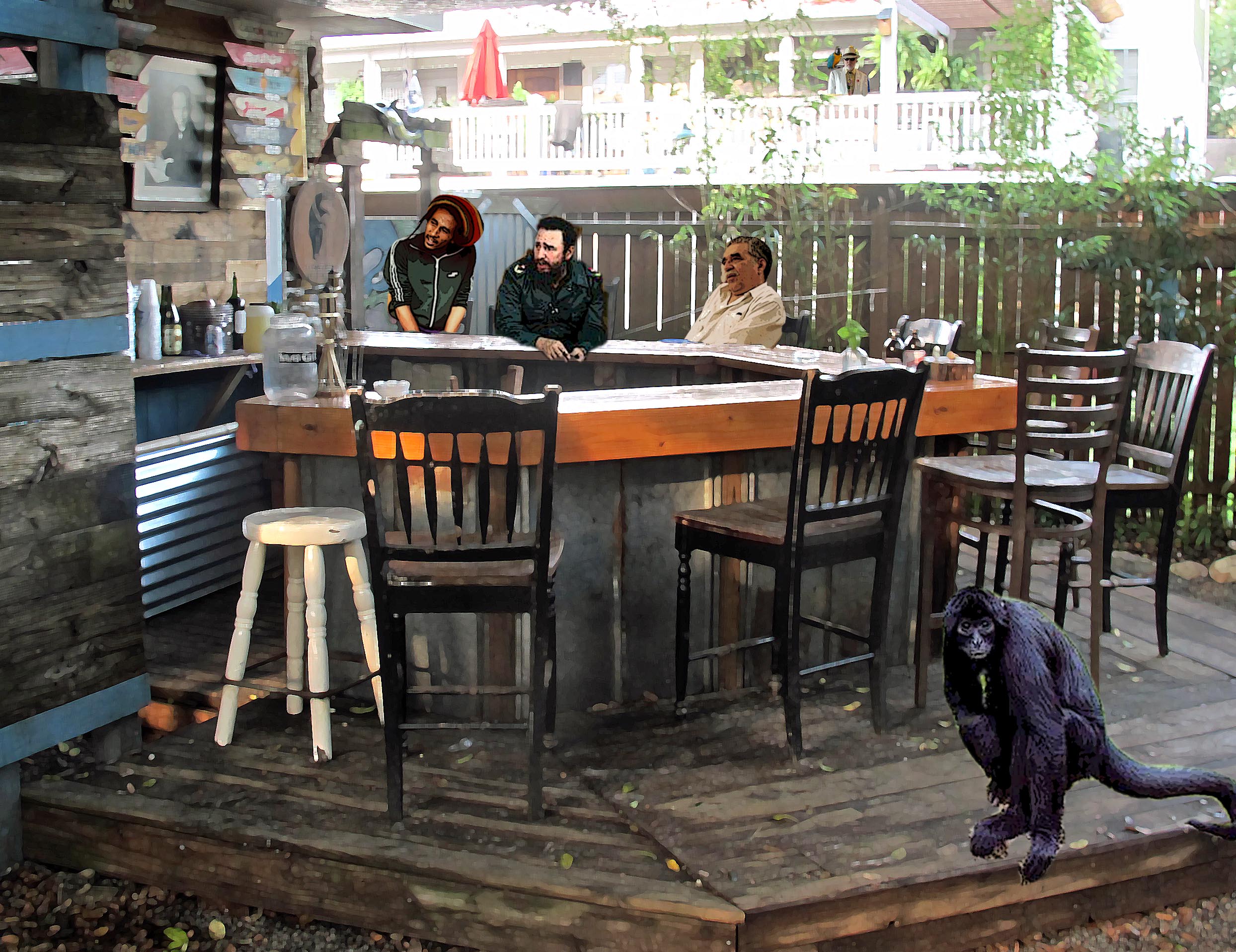
"Chico Feo in the Morning" a collage by Wesley Moore

“Chico Feo in the Morning” a collage by Wesley Moore

What If Mrs Malaprop and W Had a Baby?

Kitty Balay as Mrs. Malaprop

Kitty Balay as Mrs. Malaprop

Somehow I copped an undergraduate degree in English and earned 24 graduate hours without ever running across Mrs. Malaprop, one of the great comic characters of the English stage. Nope, I didn’t make her acquaintance until I started teaching high school, specifically Richard Sheridan’s The Rivals, a 1775 play.

It is from Mrs. Malaprop, a pompous fuddy-duddy moralistic widow, that we get the word malapropism, that delightful linguistic confusion that arises when someone stretches her vocabulary just a bit too far, confuses polysyllabic words, and makes a colossal ass out of herself.

Here is Mrs. M chastising her niece Lydia:

You thought, miss! I don’t know any business you have to think at all — thought does not become a young woman. But the point we would request is, that you will promise to forget this fellow — to illiterate him, I say, quite from your memory.

Through the course of the play, she reprehends true meaning, bemoans the slight affluence she has over her niece, can’t provide the perpendiculars of a murder.

Certainly, Archie Bunker can trace his line of descent through her:

“I ain’t a man of carnival instinctuals like you.”

“The hookeries and massageries…the whole world is turning into a regular Sodom and Glocca Morra.”

Off-the-boat Jews” (i.e., Orthodox).

Tim Moore portraying Kingfish Stevens

Tim Moore portraying Kingfish Stevens

Then there’s that earlier African American sitcom character, Mr. George “Kingfish” Stevens of The Amos ’n’ Andy show from the ’50’s who not only “resents the allegation’ but also “resents the alligator.”

Of course, malapropisms aren’t only the domain of fictional characters. Can you name the following real life malapropisms with their linguistically challenged flesh-and-blood originators, three of whom are politicians and two baseball hall-of-famers?

1. Republicans understand the bondage between a mother and a child.

2. Oftentimes we live in a processed world; you know, people focus on the process and not the results.

3. Alcoholics Unanimous

4. “The players returned to their respectable bases.

5. “Texas has a lot of electrical votes.”

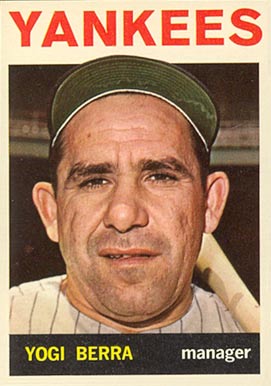
Oh, yeah, the answer to the question — what would you get if you crossed Mrs. Malaprop  with George W Bush — is the great and beloved Yogi Berra.

Now, thet answer to that question is what Yogi once called a very close game, i.e.,  “a cliff-dweller.

169688

Five Quick Tips That Will Immediately Make You a Better Writer

wesely tech guru1. Avoid the overly long parenthetical side note.

For example, the sentence:

Our book club (think alpha male with brilliant and beautiful and ridiculously well-read women dropping in from time to time to remind us that males and females often perceive the world differently) last night discussed Julian Barnes’s A Sense of an End, a novel that explores the misconceptions of an insecure man exploring his past and discovering that memory can be selective and unreliable — think Brian Williams meets J Alfred Prufrock

sucks.

Bet you forgot the subject is sentence.

2. Avoid the stilted, pretentious, anally-retentive compulsion to use the third person pronoun one when you want to provide a general example.

NOT: When one shops for crack cocaine, one should try to purchase the product through third party acquaintances who retrieve the crack and deliver it to one, which makes it less likely that one finds himself bleeding to death on a street in an unfriendly neighborhood of track houses.

BUT: Cop your crack from a buddy, not a dealer, or you might find yourself bleeding to death in some godforsaken lower lower middle class cul-de-sac located in Phosphate Acres.

If you find yourself incapable of committing to such shocking familiarity, you can eliminate both one and you:

Cop crack from an acquaintance, not a dealer, and avoid bleeding to death in some godforsaken lower middle class cul-de-sac located in Phosphate Acres.

Zangaki._0263._Chech_arab-23. Every time you proofread, look for nouns that could be more definitive.

For example, our English Department uses a vocabulary series called Wordly Wise. I still use my original 1985 copy for nostalgia’s sake, and believe or not, the publishers have seen fit to make various changes over the years, like dropping the word “buxom” (defined as “plump”) from its word lists.

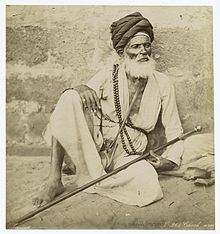
Here’s an original sentence from my 1985 edition : “The answer to the conundrum ‘Why did the Arab starve in the desert’ is ‘because he couldn’t use the sand which was there.’”

Here’s the edited 2015 version: “The answer to the conundrum ‘Why did the man starve in the desert’ is ‘because he couldn’t use the sand which was there.’”

The first one is much superior because you get a visual clue as to what the man looks like, his native costume, etc.

Plus, when did the word “Arab” become pejorative in and of itself?

4. Be precise using the relative pronouns “who,” which,” and “that.” For example, the sentences above use the pronoun “which” imprecisely. Both sentences regarding the conundrum should read “the sand that was there,” even though it fucks up the joke, a groaner anyway.

Here are the rules.

Use “who” instead of “that” for people.

NOT: He’s one of those Rolex-wearing Saudis that only flies first class.

But: He’s one of those Rolex-wearing Saudis who only flies first class.

Most people won’t notice, but the ones who do, do.

The choice between “that” and “which” is more subtle. Use “which” only when you’re adding superfluous info to the sentence, in other words, parenthetical, i.e., non crucial, information.

For example, I totaled a car Lamborghini that I had stolen from Prince Alwaleed Bin Talal Alsaud.

I totaled a Lamborghini this morning, which obviously got my day off to a less than stellar start.

5. Don’t write when you’re drunk or high on judiciously purchased crack, or if you do, proofread when sober.

Well, ladies and gentlemen, bulldogs and babies, there you have them: five quick tips that that will make you a better writer.

Oh Boy, Oh Boy, It’s the 21st Century!

After listening to the SOTU address the other night, I’ve decided that If I had the dictatorial power to outlaw any adjective in contemporary English usage, it would be 21st Century – as in 21st-century economy, 21st-century technology, 21st century classroom.

After all, we’re a decade and a half into the century, so, c’mon, let’s drop the term and simply say current economy, current technology, etc., or future economy, future technology. I’m certain no one will think you’re talking about the 5th century BCE when the conversation turns to contemporary pedagogical practices.

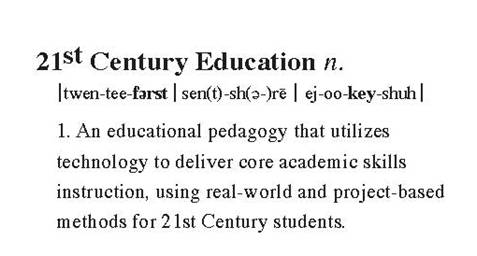
definitionAs a teacher, I hear the phrase 21st Century education or 21st century classroom virtually every day, thanks, I suspect, to Thomas Friedman,* whose bestseller The World Is Flat spawned scores of educational entrepreneurs seeking fortunes by informing parents and teachers in books and lectures that books and lectures are relics of the past.

21st education, they say, demands “new building blocks for learning in a complex world,” and for students “to survive and thrive” in “[this] complex and connected world,” teachers must ditch abaci, slide rules, TRS-80s, and equip classrooms with state of the art technology. We need to abandon lectures and tests and embrace project-based, collaborative learning so we can produce technologically literate capitalists who, though they might think the Ottoman Empire is an HBO mini-series, know how to collaborate and find answers to their questions in a rapidly changing, increasingly interdependent world.

You see, I got the rap down myself.

my classroom

my classroom

Don’t get me wrong, I’m not against technology. For example, in the accompanying photo of my classroom, you can see I use a table and chairs.

(Technology is, after all, defined as “the embodiment of a technique,” so strictly speaking chalk, slate blackboards, bobby pins, and bongs all fall under the category of technology).

Tables, invented by the Egyptians circa 3300 BCE, are not common in contemporary classrooms, unlike puzzle-like individual desks that interlock in threes for group work; nevertheless, I find that having students sitting in an oval facing one another facilitates polite discussions, as King Arthur himself realized, he being on the cutting edge of 6th century CE innovation.

Around the table we can tackle a subject in depth, learn from each other, disagree, counter argue, explain, and question without the distraction of open laptops and cell phone notifications. And, by the way, how do you efficiently provide students with all the information they need to fully understand a comprehensive subject without lecturing? How am I going to provide them with an overview of 18th Century British culture unless I explain empiricism, deism, coffeehouses, etc?  And by lecture, I mean Socratic lecturing, asking questions, soliciting opinions, not merely standing there behind a lecturn droning on about Juvenalian satire or neoclassic architecture.

As far as introducing students to technology, it seems to me that the authors of these books must not hang around many 21st century children. Whenever I have problem with hard or software, I can count a student coming quickly to my aid, and it has been my experience that sometimes they are even more adept than our IT department (which is excellent) in quickly finding a solution.

On the other hand, their vocabularies have shrunk appreciably since I started this gig in 1985, as have their attention spans, which I blame on quick-editing on Sesame Street and ear buds. (Click HERE on my invaluable guide to childrearing).

10.25-6Of course, this minor irritation of people echoing the 21st century cliché is bound to abate as we get further and further into the century. I suspect that the denizens of the American dystopia of 2075 will have stopped using 21st-century as an adjective, as they scrounge around the depleted planet exercising their 2nd Amendment rights because their grandparents voted for politicians who didn’t believe in science, but, alas, I won’t be around to enjoy not hearing it.


*The same Tom Friedman who from the Op-ed pages of the NY Times urged us to invade Iraq and depose Saddam because it would engender the spread of democracy across the Middle East. So much for his soothsaying.

Endangered Lowcountry SC Locutions

Last spring, I drove my 83-year-old Mama and her 83-old-friend Jean Thrower to the funeral home for Mary Boyle Limehouse’s visitation. Afterwards, I took them out to eat, and for some reason, they were talking about all the new cars on the road and how the auto industry must be booming. Perhaps this is something you notice in a small town like Summerville, South Carolina, because I hadn’t noticed that Charleston’s roads were suddenly teeming with the latest models. Anyway, during this conversation, Jean uttered a word I hadn’t heard in decades – swanny. “I swanny,” she said, “I’ve never seen so many new ca-ahs,”  i.e., cars.

Right then and there, I promised myself I was going to video her and Mama’s having a conversation about their childhoods so I could possess an auditory keepsake of their disappearing accents and locutions, and Mama convinced Jean to agree, but I never got around to it, and, of course, now it’s too late, because Mama’s on her deathbed, though Jean is still hale and hardy.

Yesterday, I heard another word you don’t hear much any more – commotion – as in “She doesn’t need all this commotion; what she needs is peace and quiet,” so I’ve decided to start a list of old Lowcountry Southernisms and provide a definition and a sentence that shows the words in context. Of course, because I’m lazy, I’m going about it in piecemeal fashion, adding them when I hear them, but here’s a start.

South Carolina Lowcountry Locutions

Bo-Gator – n., (pronounced bo-gatah) a male, often a term of affectionate greeting. You still hear people round here call males bo, but now, it’s more often bro, which flies in the face of most linguistic evolutions because the trend is usually towards simplification. My pal Steve Smoak, the bartender at Rue de Jean, still says, bo, but I haven’t heard anyone say bo gator since high school.

Commotion, n. irritating noise and activity. This word I doubt is a Southernism, but I don’t remember hearing a person “from off” using it, nor do I nowadays hear anyone using commotion all that often, which is too bad because it sounds like what it is.

Johns Island Dah circa  1950

Johns Island Dah circa
1950

Dah, n. African American nanny. Why so many people in Charleston developed a geechee brogue and why it’s dying out. When I first started teaching, some of my students fathers’ had the Charleston brogue, but their sons didn’t. Now you only hear the brogue in people over 65. “Doughnt-cha keep dat gay-ate open, fool.”

Near about (pronounced neahaboot), adv., almost or nearly as in “I neahraboot broke my back falling off that ladder.”

Reckon, v., suppose. I reckon he got what was coming to him.

Right, adv., somewhat to considerably. It’s right warm today.

Swanny – v., to declare, to aver. I swanny I never seen nothing like it.

Whatchasay, v., a expression of greeting, the elision of what-do-you-say, as in que pasa, what’s happening, etc. Often this greeting was followed by bo and was rendered whatchasaybo.   When my friend, Tim Miskell moved to Summerville from Croton-on-the-Hudson, he literally had no idea what people were saying. He said whatchasaybo sounded African to him, which, of course, it does. Like I said, some of us learned to talk from our dahs, though, I never had one, nor do I speak with the Charleston brogue.

Yonder, adv – in that direction.

Let’s see if I can come up with one paragraph that incorporates all of the above.

Whatchasaybo? You hear that commotion last night over yonder at the short term rental on Huron?  It was nearabout two AM, and I swanny it was loud enough to wake my dead dah. I reckoned I better go over and tell them I was about to sic the police on ’em.  Judy was right exhausted after her chemo; plus, we need to nip this shenanigans in the bud. So I pull on my pants and headed out the door. Before I got within twenty feet of their yard, one of the partiers started discharging what looked like an AK-47 into the air. Who knows, maybe they were celebrating an Afghan wedding or something. Anyway, catch you later, bo gator.  I’m headed down to Center Street to file me a complaint.