“No Joy in Mudville”

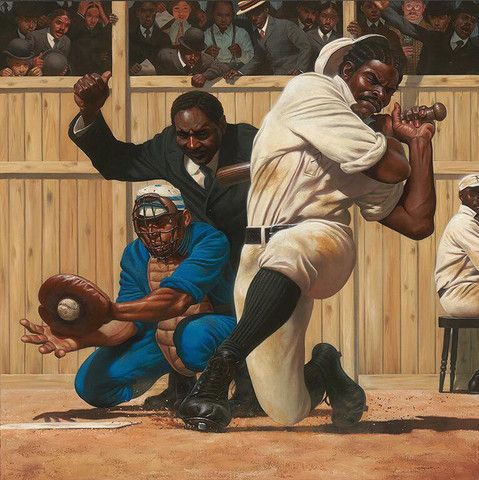
illustration by Kadir Nelson

When my wife Judy Birdsong received her death-sentence diagnosis of Peripheral T-Cell Lymphoma, I swore to myself that I’d never again let the outcome of a sporting event darken an otherwise sunny day. After all, just a few months before, I had allowed the season-ending injury to Gamecock running back Marcus Lattimore ruin an otherwise glorious afternoon in the mountain town of Saluda, North Carolina. Judy was healthy, bees were flitting among the flowers outside the loft we had rented, and the trees were, as Yeats put it, “in their autumn beauty,” a canopy of orange and gold beneath a deep blue cloudless sky. But there I was sullenly obsessing about a mere athletic event, a tribal association I have with a perpetually underperforming football team, peace and joy squandered, preempted by my agonizing over a goddamned sporting event.[1]

So I more or less gave up following sports, which given the cursed programs I pull for, including not only the hapless Gamecocks, but also the Atlanta sports franchises, was an act of wisdom. For me, “the thrill of victory” doesn’t compensate for the agony of defeat.” 

I followed the Atlanta Braves so religiously in the 90s that I would score the games at home as I watched them on TBS, my boys sitting watching with me as Judy puttered around peeking in every now and then. Eventually, it occurred to me that watching them wasn’t bringing me happiness but instigating anxiety. So I quit cold turkey.

Alas and alack! I’ve fallen off the wagon, have started following the Braves again! And the Gamecocks!

Friday night, instead of going to the Moonlight Drive-In with my wife Caroline and stepdaughter Brooks, I opted to stay at Folly to have my hopes dashed as the Braves squandered a two-run lead with poor base-running and relief pitching in a game had they won would have landed them in the World Series. They had triumphed the night before, which felt pretty good, but didn’t have me awakening in the middle of the night with a warm glow of serenity. 

In the wee hours of Saturday morning, however, my inner superintendent switched on the lights of my consciousness, and the first thing I thought of was the Braves’ defeat. There next to me lay Caroline, fast asleep, looking angelic with her glorious hair cascading from her pillow, and there I was dyspeptic, again allowing what should be a happy moment shadowed by the missteps of multimillionaires playing a game.

I say Fie on it! Fie I say! 


[1] By the way, the Gamecocks play Auburn Saturday, a team they haven’t beaten since 1933.

Doom and Gloom and the Amazon: Halloween Edition

illustration from the Library of Congress

Well, my son Ned who lives in Nuremburg and contracted the Coronavirus early in its planetary conquest, informs me that cases in Germany are again spiking, and sure enough, my phone flashed during last night’s woeful Braves game with the news President Emmanuel Macron has slapped a 9PM to 6AM curfew on the great cities of France. These Post-Christian Europeans with their rational approaches to contagion have been much more adept than we mega-church-building North Americans at containing the disease, so if the virus has returned with a vengeance to that venerable continent, you can bet we’re in store for a not very merry Christmas nor all that happy of a new year.

Add to that dolorous prediction, the reality that roughly half of the US population is going to suffer despair this autumn because their presidential choice will not be inaugurated on January 20th.  

For the Trump faithful, a Biden presidency will bring about the destruction of suburbia. The well-trimmed hedges and lawns of planned communities will soon be covered in the choking kudzu of socialism, with its artificially high minimum wage ushering in hordes of immigrant workers usurping the American way of life. No one will be safe to walk the sidewalks as the police will be defunded and public safety left in the hands of patriotic militias roaming hellscapes in a never-ending dystopian action movie.

For Biden supporters, a Trump presidency means the end of the American experiment as our democratic republic follows Russia, Hungary, and Turkey into the realm of authoritarian kleptocracy. All too soon, they fear, Trump’s visage will appear on Mt. Rushmore while Ivanka’s profile will replace FDR’s on our dimes.[1] A never ending torrent of his mean-spirited and mendacious tweets will corrupt our children with the Trumpian ethos of amorality, and no one will be allowed to protest because fascist militias will terrorize hellscapes in a never-ending dystopian action movie.[2]

Envy, O my brothers and sisters, the tribes of the Amazon. Here’s a snippet from Nobel Laureate Mario Vargas Llosas 1990 novella The Storyteller:

The great trauma that turned the Incas into a people of sleepwalkers and vassals hasn’t yet occurred [among the Amazonian tribes]. We’ve attacked them ferociously, but they’re not beaten. We know now what an atrocity bringing progress, trying to modernize a primitive people, is. Quite simply, it wipes them out. Let’s not commit this crime. Let’s leave them with their arrows, their feathers, their loincloths. When you approach them and observe them with respect, with a little fellow feeling, you realize it’s not right to call them barbarians or backward. Their culture is adequate for their environment and for the conditions they live in. And, what’s more, they have a deep and subtle knowledge of things that we’ve forgotten. The relationship between man and Nature, for instance. Man and the trees, the birds, the rivers, the earth, the sky. Man and God, as well. We don’t even know what the harmony that exists between man and those things can be, since we’ve shattered it forever.”

So, if once again, we find ourselves in lockdown, stuck at home in a quarantine, it might be a good idea to abandon our screens  – this blog included ­– and wander back into the three-dimensional world and pay a bit more attention to “Man and the trees, the birds, the rivers, the earth, the sky. Man and God, as well” as Llosa’s narrator Mascarita suggests.

Oh, yes, and to keep a wary eye out for those militias. 

photograph by Jason Chambers

[1] By the way, when is the last time you’ve meted out change on a counter to pay for something?

[2] Quick news quiz. Which of the five freedoms of the First Amendment was Judge Barrett unable to recall in yesterday’s Supreme Court Senate Hearing?

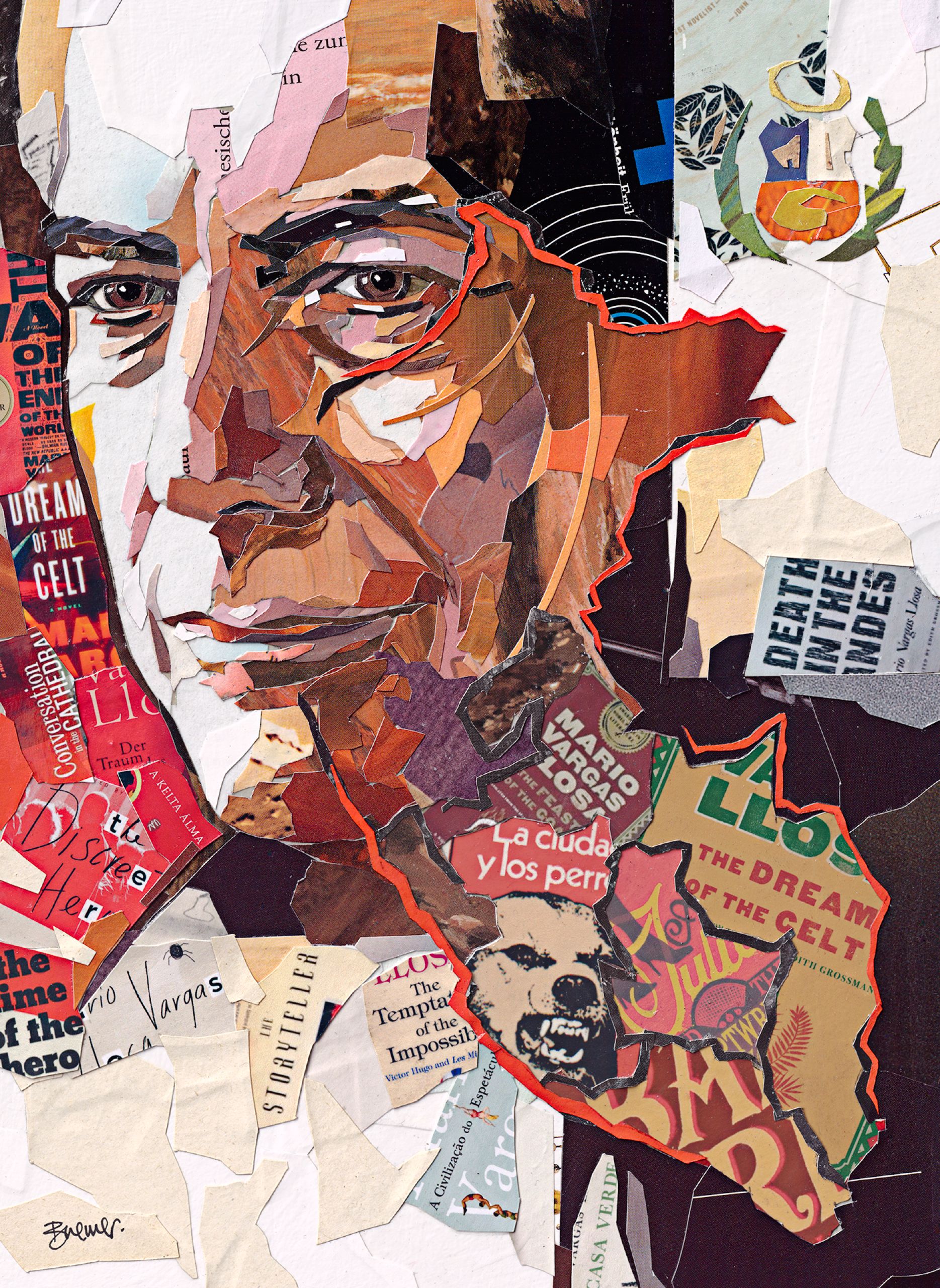
Illustration by Patrick Bremer via The New Yorker

Two Stanzas of Ottava Rima Written within Ear Shot of a Skateboard Park (a reading)

Two Stanzas of Ottava Rima Written in Earshot of a Skateboard Park

I said, ‘It’s certain there is no fine thing
Since Adam’s fall but needs much labouring.
WB Yeats

Willie B makes it seem so damned easy,
each iamb in it is appointed place,
but whenever I try it, I feel sleazy,
like a Wordsworth wannabe pissing in the lake.
Yet even to Yeats it didn’t come easy.
A line would take him hours. Better to “break
stones,” he whined, “in all kinds of weather”
than try “to articulate sweet sounds together.”

Form versus execution. I hear the clatter
of skateboarders’ failed attempts at competence.
They flip the board, fall off, curse, batter
their knees as they try to perform the tricks
they see on TV — as if mind over matter
weren’t a myth, as if practice makes perfect,
as if talent can be willed. I say
time to shut down this computer, call it a day.

Haikus Have Sprung (a reading)

Swarming Gnats

Haikus Have Sprung

For Caroline

swich licour

Sticky yellow pollen smirch
dusts the birdshit spotted hood
of our Toyota.

Swarming clouds of gnats
feast on soccer moms – swat!
Run, Ronnie, run, run!

A motorcycle
revs, backfires, revs,
mufferless, blasting.

Yet Another Nursery Rhyme from Ayn Rand’s A Child’s Apartment Complex of Verse

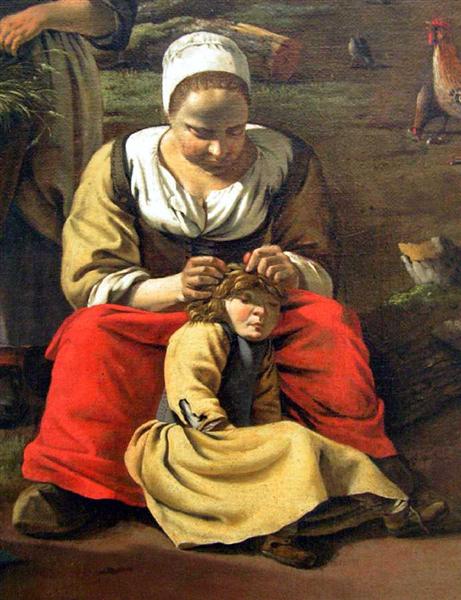
Delousing scene. Detail of a painting by Jan Siberechts, Farmyard

There’s no such thing as Santa Claus,
No such thing as God,
No such thing as Old King Cole,
No Wynken, no Blyken, no Nod.

There was an old woman, sure,
But she didn’t live in a shoe.
She didn’t practice contraception;
That part’s certainly true.

She had so many children
Her homelife was quite wretched
Because the Catholic Church insisted
She practice the rhythm method.

So now her children’s stomachs growl
Cramped in subsidized housing.
Instead of playing hide-and-go-seek,
They spend their days delousing.

There’s no such thing as Santa Claus,
No such thing as God,
No such thing as Old King Cole,
No Wynken, no Blyken, no Nod.

Things Come in Threes

Swallow Tail Butterfly among Lantana
click for sound

Until they think warm days will never cease.

John Keats, “To Autumn”

Like the faint semi-tragic scent of tea olive,
the epitome of ephemera, the butterfly flits
among lantana and disappears.

Hummingbirds hover; barred clouds bloom.
The retreating sun draws in its long shadows,
Then slowly dims the lights.

Bravo! Encore! Encore!
Four to six weeks the doctors said.
A sleepless night but then again the sun!

Too Much to Ask?

Of all the causes which conspire to blind.
Man’s erring judgement, and misguide the mind,
What the weak head with strongest bias rules,
Is PRIDE, the never-failing vice of fools.”

Alexander Pope, “An Essay on Criticism”

Is it really, really such an odious task
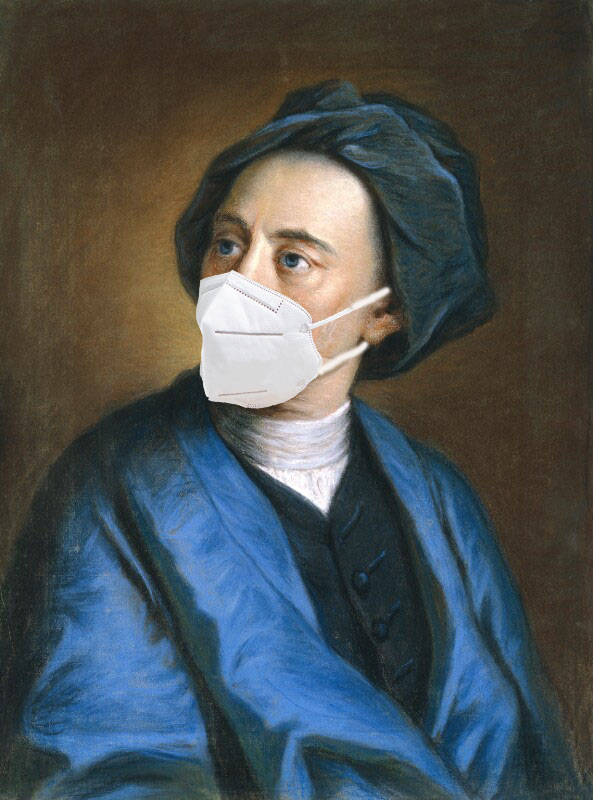
during a pandemic to put on a mask?

In the Trump White House, no mask is the rule,
Targeting the base, those Kool-Aid mainlining fools.

Masks remind voters of the invisible dread
That’s left more than 200,000 Americans dead.

What dat? Sistah Karma done come a-calling unexpected?
Kayleigh and Kellyanne done been infected?

Along with Thom Tillis, Hope Hicks, Mike Lee,
not to mention Donald J Trump and the First Lady?

Do Lawd! White House itself got more cases than New Zealand,
a country of just under five million people?

So is it really, really too much to ask
in a goddamn pandemic to put on a goddamn mask?

Irony and Karma, A Comedy Duo for the Ages

Bansky

Okay, as I write this, President Trump languishes at Walter Reed Hospital battling a virus he claims was a “hoax” and would “magically disappear.” Four years ago, he mocked Hillary Clinton’s locomotion and coughing as she suffered from a short-lived bout of pneumonia. 

Ironic? Karmic? Or both?

I like to think of karma and irony as a sort of comedy duo, a married couple, Karma, the female more powerful and profound, and Irony as male, wisecracking, cynical.  They travel hand-in-hand around and around the crumbling empire of post-Modernism, she acting, he reacting, she detached, he involved.  It’s a symbiotic relationship that can help educate us about the benefits and perils of good and bad behavior, so it’s helpful to be able to distinguish one from the other, to discern their similarities and differences.  

Trump Mocking Hillary’s Pneumonia

Irony, of course, is often misunderstood, mistaken for coincidence, as it is throughout the Alanis Morrisette song “Ironic.” 

[Irony’s] like rain on your wedding day
It’s a free ride when you’ve already paid . . . 

Of course, precipitation on your wedding day isn’t ironic, that is, unless it’s a destination wedding in the McMurdo Dry Valleys of Antarctica.[1] A free ride when you’ve already paid isn’t a free ride. The song “Ironic” isn’t ironic, which stupidly makes it sort of ironic. 

Bone fide irony is all about incongruence, the discrepancy between expectation and reality.

I sometimes run across the phrase “irony is dead” when a commentator is highlighting some blatant act of ignored hypocrisy. However, the failure of people to perceive the incongruences that create irony doesn’t mean that irony is dead; it merely demonstrates that irony is dead to them.[2]

Yes, Trump’s calling a disease that smites him a hoax is somewhat ironic, only somewhat because you might not be surprised that a foolish man who flips off science ends up regretting it. However, it is ultimately ironic because, unlike rain on a wedding day, getting ill from a virus you claim is a hoax is incongruent.

What’s not ironic is that Trump’s flaunting of safety protocols, like not wearing masks and eschewing social distancing, has resulted in his infection. That’s karmic. 

Karma,  कर्म in Sanskrit,  means action; karma’s all about cause and effect, as in the cliche “what goes around comes around.”  Is mocking Hillary’s illness the reason Trump’s now fallen ill?  Is it karmic? Only in the sense that it’s indicative of his modus operandi of defying human norms of decent behavior, of embracing a hubris that distorts his perceptions of reality, of cultivating a false sense of invulnerability. Actions such as these will eventually, as the vulgar say, “come and bite you in the ass.”

Irony is surprising; karma is not.


[1] Average rainfall a year 0.00 millimeters.

[2] I remember fondly Misahn Bootay’s response Donald Trump’s tweet proclaiming “The Democrat [health] plan would obliterate Obamacare” during the 2016 midterm elections:

“Not only is irony dead,” he tweeted, “but it’s grave has been dug up and it’s been dressed in gaudy finery and paraded through the streets like the decaying corpse of a medieval pope.”

Reactionary Conservativism and the Literary Arts

I wondered the other day is there’s even such a thing as “conservative poets” anymore.[1]

Well, it didn’t take me long to discover an anthology entitled The Conservative Poets: A Contemporary Anthology, edited by William Baer, who offers this estimation of the contemporary literary landscape:

Although it often seems that liberals and the radical Left have assumed complete hegemony over the arts, especially the literary arts, there exists a remnant of very talented American poets who create beautiful, serious, witty, moving, and diverse poetry from a conservative point of view. This unique anthology illustrates the wide range of these determined and sometimes defiant artists, who hope that their work will encourage more like-minded Americans to learn the poetic craft and pursue the literary endeavor.

By the way, Baer is a genuine scholar. Here’s his bio from Amazon:

WILLIAM BAER is the author of ten books, including ” ‘Borges’ and Other Sonnets”; “Fourteen on Form: Conversations with Poets”; “Luis de Camoes: Selected Sonnets”; and “Writing Metrical Poetry”. The Founding editor of “The Formalist: A Journal of Metrical Poetry” (1990-2004), he is currently the director of the Richard Wilbur Poetry Series, the poetry editor and film critic for “Crisis,” and a contributing editor to “Measure.”

Here’s a screenshot of the table of contents.

I tried to track down some of these poets, only to discover most had, to quote Richard Wilbur himself, “gone from this rotten/Taxable world to a standard of higher living.” The late Marion Montgomery’s “While Waiting: Lines for a Lady Suffragette, Standing on a Bus” certainly seems to adhere in some ways to an antifeminist’s view of what Montgomery might call the “fair sex.”

Ah, Lady. Ah. It is a stirring sight.

Franchisement by the gods is now complete.

You now have won the inalienable right

Of standing on your own two feet.

Alas, Montgomery checked out of this Motel 6 of Sorrow in the penultimate year of W’s second term, so it would not be accurate to name him as a conservative poet writing today.

Editor Baer in his preface admits that most of the anthologized poems’ conservatism lies in their traditional forms rather than politics, but adds, “Some, myself included, would even tend to see meter as a poetic representation of the provident order of God’s universe.”[2]

So I continued my search and found a website from 2016 called  Scholars & Writers for America. Beneath its banner this: “Given our choices in the presidential election, we believe that Donald J. Trump is the candidate most likely to restore the promise of America, and we urge you to support him as we do.”

Scrolling down my screen past names like Burton W Folsom, Jr., author of The Myth of the Robber Barons and Steve Mosher of the Population Research Institute looking for a poets or novelists, I discovered, to my delight, at the bottom of the screen, Thomas C McCollum, novelist.

Here’s the second paragraph of text from McCollum’s website, from an article by Louise Cook, the editor of Absolute Marbella Magazine:

If one were to view all aspects of Thomas McCollum’s professional and avocational life, one might be very tempted to call him a Renaissance man–albeit with a strong entrepreneurial bent. Wisely McCollum leaves all such pretentions to others, preferring the doing rather than the talking about.

What follows is a most-interesting-man-in-the-world litany: Can-Am racing, bull running in Pamplona [Spain she helpfully adds], man-eating crocodile hunting, a golf-addiction, insurance sales, original pen and ink drawings street-corner sales, med-school matriculation, med-school abandonment, medical laboratory founding, medical laboratory selling, retirement to Marbella, Spain, “to live out all the fantasies of his youth. He has camped, safaried, and traveled to every continent on earth.”[3]

McCollum has published four novels: Whipsocket, Tainted Blood, Palmer Lake, and Uncle Norm.

Here are the first and last sentences from Publisher Weekly’s review of Tainted Blood.

Readers willing to suspend disbelief beyond belief may find McCollum’s first novel an interesting medical thriller; others will be dismayed by characters manipulated by incredible plot contrivances.

McCollum makes the medical details microscopically authentic, but too many standard diatribes against government agencies, characters who speak polemic as often as they do dialogue and a conclusion that’s painfully anticlimactic render a hot topic tepid. (my italics)

Now compare that MSM review to this one for Uncle Norm from Christopher Feigum, Grammy Award winner and Metropolitan Opera Singer:

“Thomas McCollum has delivered a book of operatic proportions…a tale full of intrigue that tempts us to explore the what ifs of life and the possibility of encountering one profound love. Whether he is delighting pygmies with donuts or sharing his smuggled discoveries along the way, Uncle Norm is a warm, comical hero deeply connected to his fellow lost soul in the Congo, Ottobah Cuguano, and their shared faith in everlasting friendship. As they strive to break down racial barriers and transform the world, their adventures amaze the restless traveler in all of us. This timely piece is a declaration that we each have the choice to leave behind a better place than we found.”

Oh, yeah.  There is also this snippet from of all places, Publisher’s Weekly describing Tainted Blood:  “an interesting thriller…McCollum makes the adventure microscopically authentic.”   Hmmm.  “an interesting thriller . . . microscopically authentic.”  Where have I seen that before?

So anyway, if you happen to be a Trump supporter who feels somewhat culturally isolated, there are indeed “conservative” literary artists out there working today, maybe not on the analogous level of Jon Voight and Bruce Willis, but they are out there.


[1] I don’t mean conservative in the old-fashioned sense of embracing traditional values and being skeptical of innovation, like Alexander Pope, but in its contemporary sense of someone rejects the Enlightenment and institutions of liberal democracy.

[2] Yes!

Abraham to kill him —
Was distinctly told —
Isaac was an Urchin —
Abraham was old —

Not a hesitation —
Abraham complied —
Flattered by Obeisance
Tyranny demurred —

Isaac — to his children
Lived to tell the tale —
Moral — with a Mastiff
Manners may prevail.

[3] Maybe one day he’ll write a novel called Safariing in Anarctica.

After Life’s Fitful Fever

“Elegy: Blind Musician” by Mikhail Vasilevich (photoshopped by I-and-I)

. . . I need not rehearse
The rosebuds-theme of centuries of verse.

                                                                        Richard Wilbur, “A Late Aubade”

Although posthumous fame is essentially worthless to what Perry Mason and Hamilton Burger call the decedent,[1] humans tend to want to be remembered after their deaths, hence tombstones, epitaphs, and those memorial verses we find on obituary pages. As I have no doubt mentioned before, I actually enjoy reading the obituary page, even the obituaries of complete strangers. Perhaps it’s the poet in me who is interested in how the writer goes about compressing a life into the narrow confines of a column of newsprint.[2]  Generally, however, I skip the memorial verses, which are generally godawful jingles heavy on end rhyme.

For example, below you’ll find a bit of elegiac verse I copped from a publication called National Post. On its website, I found a page devoted to “Memorial Verses” with this option:

Choose a verse from the appropriate category. Alternatively you may want to copy and paste the verse into the place a notice order form. When placing a notice, please identify the verse by its number to your Classified Telesales Representative. You may also change any of the verses or write your own.

Conveniently, the editors have classified verses by relationships: “Mother, Sister, or Daughter; Father, Brother, or Son; Wife or Husband; Children; Friend or Kin; Armed Forces; Prayer Corner.”

Here’s the first choice listed for a mother.

A wonderful mother, woman and aide,
One who was better God never made;
A wonderful worker, so loyal and true,
One in a million, that mother was you.
Just in your judgment, always right;
Honest and liberal, ever upright;
Loved by your friends and all whom you knew
Our wonderful mother, that mother was you.

Of course, in my native state of South Carolina, not many would want to tar the woman who labored to bring them into the world with that vile word “liberal.” Last night during the debate between Nancy Mace and Joe Cunningham, the former used the word “democrat” and “liberal” as if they were synonymous with depravity.

Thank (in this case, given the diction of the verse) God that the purchaser has the option of changing the diction.

Just in your judgement, always right;

Honest and reactionary, ever upright. 

Indeed the alliteration in “right” and “reactionary” and “upright” is an auditory improvement. 

So it has occurred to me that in my retirement from teaching, I could make a few extra bucks composing memorial verses.

Let’s face it, almost anyone could do better than whoever wrote the above abomination.  I mean, the syntax of  “One who was better God never made” is so tortured it’s possibly in violation of the Geneva Convention.

Perhaps I could target sentimental agnostics and atheists who want their loved ones remembered, but less hyperbolically. 

Our mother has succumbed to a terminal disease,

A mother who taught us manners, to say “please”

And “thank you” and “may” instead of “can,”

Who raised us without the help of a man,

Our deadbeat dad who skipped town one night,

Forever disappearing in dishonorable flight.

Yet, Mom endured life’s hardships with stoic good grace,

An exemplary example for the human race.

Loved by her friends, her children, and pets,

We appreciate that she tried her very best.

Good night, deceased mother, may you rest in peace 

Safe in the cliché of death’s eternal sleep.

What do you think? Should I give it a try? Bill myself for the hours and then write it off my taxes? Anyway, if you’re in the market – fortune forbid – you know how to get in touch.


[1] This reminds me of a bit of dialogue from a WC Fields movie I ran across yesterday thanks to my pal Ballard Lesemann. A patron at a bar says to Fields, the bartender, “I understand you buried your wife a few years ago,” and Fields replies, “Yes, I had to. She was dead.”

[2] Unfortunately, I myself have become a somewhat prolific obituary writer, having composed posthumous bios for both my father and mother-in-law, my own parents, my maternal aunt and uncle, and for my beloved Judy Birdsong. The stylistic part is not easy. The memorialist needs to deftly insert introductory subordinate phrases and clauses to break the monotony of fact-filled declarative sentences.