Of course, I’m not amazed that Donald Trump is thoroughly corrupt (from the split ends of that plasticine confection he considers hair, to the soulless soles of his feet), nor am I amazed that millions of lost souls worship him as a Jim-Jones-like demigod, consumed as they are with envy and anger, the two least enjoyable of the deadly sins. What does amaze me is how the leaders of the Republican party, people who should know better – like Speaker of the House Mike Johnson, for example – kill off their better angels to keep in the not-so-good graces of this totally despicable Mammon-worshiping, porn-star bonking, delusional, self-pitying piece of shit.
Yesterday, seemingly seconds after Trump’s conviction, Speaker Johnson was assailing the verdict, Mitch McConnell claiming that the charges should never have been brought against him, and Elise Stefanik prevaricating that Biden’s corrupt Justice Department (who, by the way, is prosecuting Biden’s son) is to blame for the unjust prosecution of a presidential candidate for falsifying business records to conceal a payoff to a porn star he had sex with during the first month of his third son’s life.
I’ll concede that the so-called hush money trial is the least nefarious of Trump’s several indictments, not nearly as bad as illegally hoarding nuclear secrets in his bathroom, nor as bad as attempting to cajole Georgia’s secretary of state into stealing enough votes to overturn a legal election, and certainly not as bad as encouraging an insurrection in an attempt to disrupt the transition of power.
However, a jury of Trump’s peers, fellow New Yorkers – one of whom gets her news from Fox – convicted him after carefully weighing the evidence.
Yet, there’s no guarantee, given the inequities of the Electoral College, that Trump won’t be reelected, that he will once again raise his right hand and swear to uphold the Constitution so he can begin organizing his mass deportations, constructing detention camps, and putting into action his campaign of Putin-like retribution.
Having spent a portion of this gorgeous late May day in the cool sunshine of an alfresco cantina where shadows danced on the bar while I slurped down a mahi taco and a couple of session IPAs, I have turned my back on the blue skies overhead and retreated into my ill-lit drafty garret to listen to “Sad Eyed Lady of the Lowlands.” The song takes up the entire side of the second record of Blonde on Blonde. It’s an eleven minute and twenty-three second paean for a lover, perhaps Joan Baez, maybe ex-wife Sara[1]
I still love the song, despite no longer being a romantic in the Percy Byssshe Shelly sense, because the lyrics are so well-crafted that they can almost stand alone naked on a page without musical accompaniment.
Dylan is the master of the AAAAAAB rhyme scheme, a rarity both in poetry and song lyrics. Dig this:
Darkness at the break of noon Shadows even the silver spoon The handmade blade, the child’s balloon Eclipses both the sun and moon To understand you know too soon There is no sense in trying.[2]
“Sad Eyed Lady” consists of four quatrains with an AAAB rhyme scheme, with a chorus appearing after every second quatrain. (see below)
As I listened to the song on my iMac, I read the lyrics, and much to my delight, I discovered for the first time that in the last line of each quatrain, the penultimate word rhymes with the penultimate word of the previous quatrain.
With your mercury mouth in the missionary times And your eyes like smoke and your prayers like rhymes And your silver cross, and your voice like chimes Oh, who among them do they think could bury you?
With your pockets well protected at last And your streetcar visions which you place on the grass And your flesh like silk, and your face like glass Who among them do they think could carry you?
See and hear for yourself. (I’ve bolded the penultimate words).
With your mercury mouth in the missionary times And your eyes like smoke and your prayers like rhymes And your silver cross and your voice like chimes Oh, who do they think could bury you?
With your pockets well-protected at last And your streetcar visions which you place on the grass And your flesh like silk and your face like glass Who could they get to carry you?
Sad-eyed lady of the lowlands Where the sad-eyed prophet says that no man comes My warehouse eyes, my Arabian drums Should I put them by your gate
Or sad-eyed lady, should I wait?
With your sheets like metal and your belt like lace And your deck of cards missing the jack and the ace And your basement clothes and your hollow face Who among them did think he could outguess you?
With your silhouette when the sunlight dims Into your eyes where the moonlight swims And your matchbook songs and your gypsy hymns Who among them would try to impress you?
Sad-eyed lady of the lowlands Where the sad-eyed prophet says that no man comes My warehouse eyes, my Arabian drums Should I put them by your gate, Or sad-eyed lady, should I wait?
The kings of Tyrus, with their convict list Are waiting in line for their geranium kiss And you wouldn’t know it would have happened like this But who among them really wants just to kiss you?
With your childhood flames on your midnight rug And your Spanish manners and your mother’s drugs And your cowboy mouth and your curfew plugs Who among them do you think could resist you?
Sad-eyed lady of the lowlands Where the sad-eyed prophet says that no man comes My warehouse eyes, my Arabian drums Should I leave them by your gate, O sad-eyed lady, should I wait?
Oh, the farmers and the businessmen, they all did decide To show you where the dead angels are that they used to hide But why did they pick you to sympathize with their side? How could they ever mistake you?
They wished you’d accepted the blame for the farm But with the sea at your feet and the phony false alarm And with the child of the hoodlum wrapped up in your arms How could they ever have persuaded you?
Sad-eyed lady of the lowlands Where the sad-eyed prophet says that no man’s come My warehouse eyes, my Arabian drums Should I leave them by your gate, Or sad-eyed lady, should I wait?
With your sheet metal memory of Cannery Row And your magazine husband who one day just had to go And your gentleness now, which you just can’t help but show Who among them do you think would employ you?
Now you stand with your thief, you’re on his parole With your holy medallion in your fingertips now enfold And your saintlike face and your ghostlike soul Who among them could ever think he could destroy you?
Sad-eyed lady of the lowlands Where the sad-eyed prophet says that no man comes My warehouse eyes, my Arabian drums Should I leave them by your gate, Or sad-eyed lady, should I wait?
[1] I did have a galley-review of Elijah Wald’s Dylan Goes Electric appear on the massive Dylan site Hard Rain but no comments or emails were forthcoming from the future Nobel laureate.
[2] On the song “Sara<” he writes ” Stayin’ up for days in the Chelsea Hotel/ Writin’ “Sad-Eyed Lady of the Lowlands” for you.”
Like its older sibling A Visit from the Goon Squad, Jennifer Egan’s 2022 novel The Candy House consists of a series of interlinked short stories written in various voices featuring a host of characters we meet and reencounter at various unchronological stages of their lives. Its narrative structure is in a sense digitalized, modeled on various Internet modes such as Facebook, email, texting, and constructs a sort of narrative labyrinth of mirrors where the virtual is privileged over the corporeal.
Or to paraphrase the abstract of my son’s PhD dissertation[1], The Candy House (and other contemporary novels of its ilk) explore how new media technologies affect psychological and sociological structures and blur the boundaries “between history and fiction, physical and virtual spaces, as well as public and private notions of the self.”
The novel demonstrates that not only has the richness of raw “undigitalized” reality been diminished by our habit of staring into screens, but also that “authenticity” becomes incredibly problematic as we scroll through the filtered sunsets captured by our Facebook friends whose profile pictures have also been filtered.
A plot summary is virtually (pun intended) impossible. But here’s a stick figure drawing.
Miranda Kline, an anthropologist and the ex-wife of a famous record producer Lou Kline, writes a book called Patterns of Affinity that creates an algorithm that explains what makes people like and trust one another. Based on Kline’s theory, Bix Bouton creates a technology that allows humans to upload their consciousnesses to a cloud and starts a company called Mandala where you can pay to have your consciousness uploaded and then tap into it to relive your past. Also, you can pay to have access to anyone else’s consciousness who has agreed to buy a subscription to Collective Consciousness.[2]
As far as point-of-view is concerned, now even first person narrators can be omniscient. For instance, Lou Kline’s eldest daughter Charlene, after accessing Collective Consciousness, relates her father’s introduction to cannabis during an expedition into a forest, which took place when she was only six.
Other characters, often interrelated by kinship or friendship, find themselves attempting to experience authenticity. One character works at a startup where his job is to reduce possible events in fiction to algebraic equations, e.g. “(a (+ drink) x (action of throwing drink) = a (- drink) + i/2.”
Another chapter is narrated in the second person by a chip implanted in a spy’s brain to provide instructions during a dangerous mission:
Spread apart your toes and
gently reinsert the plug, now
magnetically fused to
your subject’s phone, into your
Universal Port.
Yet another chapter consists of texts featuring a medley of characters attempting to set up an interview with a famous fading movie star.
The Candy House is quite a tour de force.
I wonder, though – despite its brilliant polyphonic orchestration of narrators’ voices, its imaginative story telling techniques, and its construction of an all too real Brave New World – if the novel itself abstracts itself from the corporeal richness of the very best of literary fiction.
It’s a bit of a paradox: the fragmentation of its narrative mode, which reflects the shattered lives of its characters, makes reading the novel a mental exercise of sorts, something akin to solving a puzzle, which abstracts the reader from the characters. But then again, this may be Egan’s point: people have become, to riff on my main man Will Shakespeare, walking shadows, or better yet, walking holograms.
Here’s a character cloud created by someone who goes by u/astroloveuz on Reddit.
In the last twenty or so years, parents have been opting for phonetic spellings for their children’s names, which often increases the number of letters needed to convey the sound of the name. The other day in the obituaries I ran across a survivor, a grandchild, whose first name was Kennidee. (I’m not sure of the pronunciation: Is it Kennedy or Ken-a-DEE?). I’m assuming Kennidee’s a girl because these cutesy spellings almost invariably are assigned to female names – Ashlee, Emmalee, Brandee, etc. Also, sometimes parents invert the vowels E and A to create a sort of Celtic look, rendering Haley as Haeley, for example.
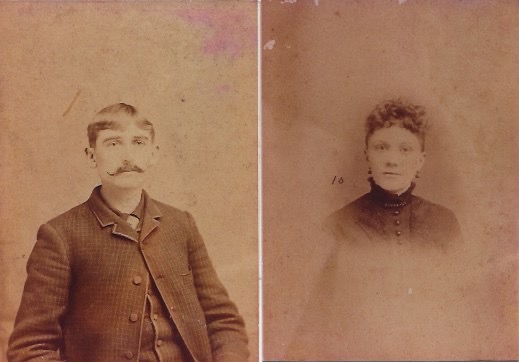
Obviously, it’s none of my business what parents name their progeny, and I’m not claiming that my family’s names are particularly stellar. My maternal great grandparents, David and Minnie Fairey Hunt, named their daughters Ruby and Pearl, and Aunt Ruby named her daughter Zilla. Sister Pearl christened one of her sons Fairey, so his name ended up being Fairey Goodman, which sounds like a character in a nursery rhyme fantasy.[1] My own grandmother, the younger sister of Ruby and Pearl, was named Hazelwood Ursula Hunt, a mouthful, if you ask me, which became even more of a mouthful after she wed Jerome Kistler Blanton and became Hazelwood Ursula Hunt Blanton.[2]
Lewis David Hunt, born 1863; Minnie Anna Fairey Hunt, born 1873
Given that I’m a fiction writer, I’m in the business of naming characters, and for me it’s a lot of fun because I try to imbue my characters’ names with symbolic meaning. For example, I tagged the protagonists of a break-up story Abby Huffington and Ashton Gray, she quick to take offense, he as drab as sackcloth. In Today, Oh Boy, the main character’s Rusty Boykin’s name weds incompetence and immaturity, and conveniently Boykin is a traditional South Carolina surname.
His foil and eventual friend’s name is Ollie Wyborn, a transplant from Minnesota with Nordic roots. Ollie is an intellectual, a questioner, so I chose Wyborn to suggest that Ollie possessed a philosophical bent.
Anyway, it must be nice to have a distinctive name. For example, if you google Wesley Moore you get hundreds of thousands of hits, from the current governor of Maryland to Wesley Charles Moore serving 30 years in Michigan for child molestation. Wes Moore is about as distinctive a name as John Smith when you get down to it.
But I’m not complaining. I grew up around the corner from a girl named April Lynn Paris.
[1] I have a copy of the Fairey family tree. The first American Fairey’s name was John, born in Ireland in 1720 and killed at the Battle of Hanging Rock in 1780 during the American Revolution. When I first visited Ireland, I told the proprietor of the B&B where we were staying that some of my ancestors came from Ireland, the Faireys, and he looked at me as if I were daft and said, “Now, there’s a name I’ve not heard of.”
[2] Grandmama Hazel wanted to name my mother Barbara Ursula, but the doctor talked her into shortening it to Bobbi Sue, a name my mother detested because she considered it way too country cute.
Like a shortwave radio attempting to tune into a remote overseas station, my threadbare synapses sometimes spit out static as I try to remember the point of story I’m trying to tell.
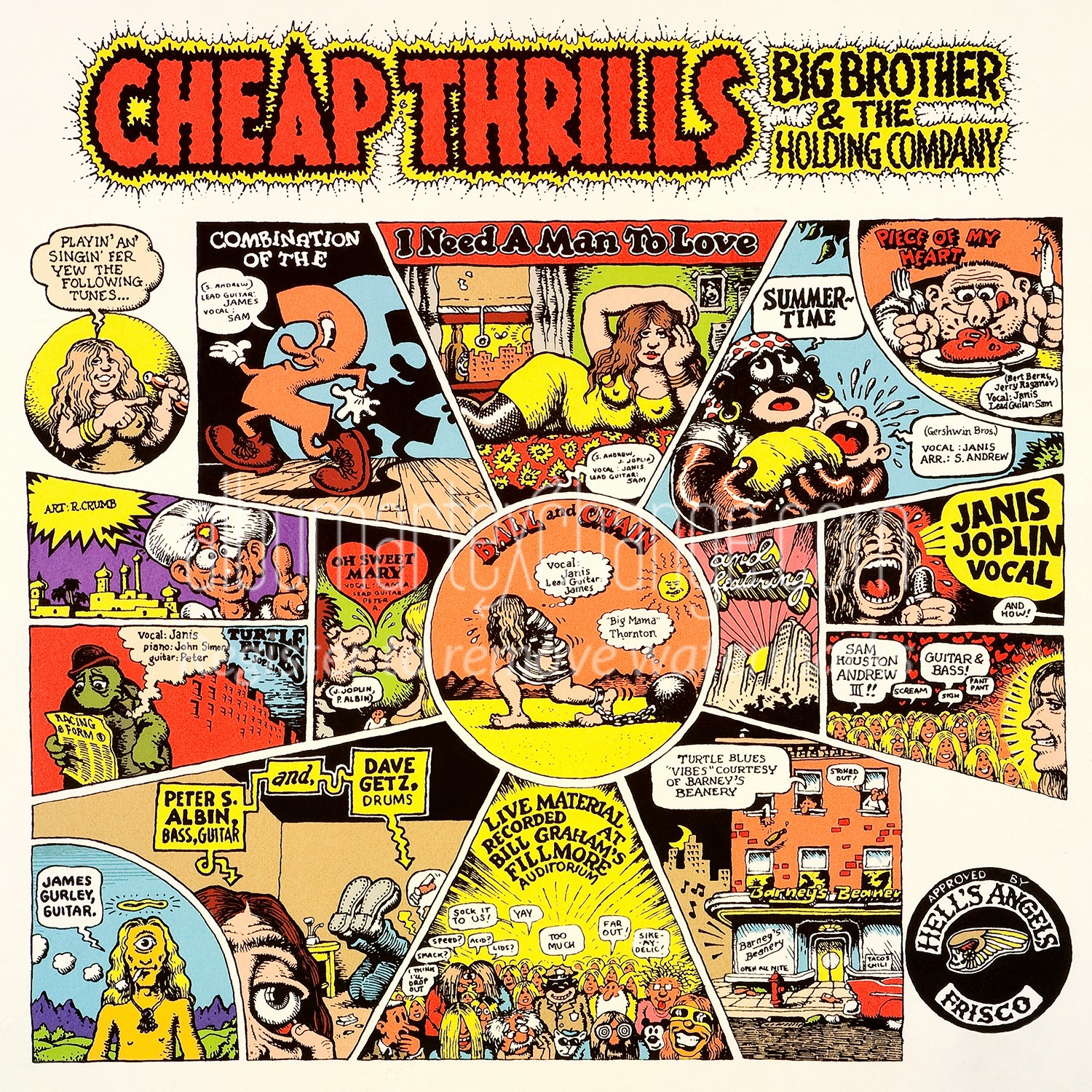
Maybe it’s the cannabis, maybe the onset of dementia, or to harken back to Big Brother and the Holding Company, “a combination of the two.”
For the uninitiated, “A Combination of the Two” is the opening track of Big Brother’s album Cheap Thrills featuring the incomparable Janis Joplin. I had always assumed that the song was a live recording, but as it turns out, the audience noise and Sam Andrew’s introduction of the band, “Four gentlemen and one great, great broad,” have been dubbed in to create the illusion of a live recording. Well, it certainly had me fooled for over a half century.
BTW, the great Robert Crumb did the cover art.
In my novel Today, OhBoy, as Will Waring is popping Cheap Thrills into his van’s 8-track tape player, he says out loud to himself, “Four gentleman and one great, great broad.” Recently, when Rodgers Nichols interviewed me on his podcast Cover to Cover, he mentioned the allusion, said as a former radio DJ he really appreciated it.[1]
Anyway, what was my point?
Oh, yeah, forgetfulness.
The name of the author is the first to go followed obediently by the title, the plot, the heartbreaking conclusion, the entire novel which suddenly becomes one you have never read, never even heard of,
as if, one by one, the memories you used to harbor decided to retire to the southern hemisphere of the brain, to a little fishing village where there are no phones.
Long ago you kissed the names of the nine Muses goodbye and watched the quadratic equation pack its bag, and even now as you memorize the order of the planets,
something else is slipping away, a state flower perhaps, the address of an uncle, the capital of Paraguay.
Whatever it is you are struggling to remember, it is not poised on the tip of your tongue, not even lurking in some obscure corner of your spleen.
It has floated away down a dark mythological river whose name begins with an L as far as you can recall, well on your own way to oblivion where you will join those who have even forgotten how to swim and how to ride a bicycle.
No wonder you rise in the middle of the night to look up the date of a famous battle in a book on war. No wonder the moon in the window seems to have drifted out of a love poem that you used to know by heart.
Today in Manhattan in a dingy 14th floor courthouse with inadequate heating, lawyers will present their opening arguments in Donald Trump’s first trial of 2024. He’s accused, of course, of falsifying business records to hide $130,000 paid to a porn actress so that the American people would not find out that he and she had engaged in adulterous sex during his first run for the presidency.
Pundits speculate that the prosecution’s first witness will be David Pecker.
David Pecker was then the publisher of the National Enquirer. When I was a child, I used to peek at the Enquirer at the magazine rack at Kramer’s Pharmacy in segregated Summerville, South Carolina. Back then, it published photographs of splattered suicides who had leapt from high rise windows and other violent images. I confess I’ve always had a morbid imagination.
This dark memory has engaged in the jukebox of my subconscious Peggy Lee’s rendition of “Is That All There Is,” a sad, decadent tune that sounds as if originated in a cabaret in Berlin during the Weimer Republic. I suspect that Tom Waits loves this song.
To exorcise the tune, I’ve gone to YouTube and discovered this wonderful video of Bette Midler covering the song. Here it is.
And also dig this: Tom and Bette doing a duet in which virtually every line of the song is a cliche.
A veteran who has interviewed over 800 authors, Rodger is a real pro. I’m fortune to have had the opportunity to discuss my novel “Today, Oh Boy” with him.
Years ago I saw Barbara Walters interview Jack Nicholson on one of her specials. The British actor Hugh Grant had just been busted for solicitation, so Barbara asked Jack why someone as goodlooking and famous and rich as Hugh Grant would require the services of prostitutes.
Jack donned his patented devilish grin and said, “Peculiarities. Peculiarities.”
Which brings us to Louis CK.
I first caught Louis on the Letterman Show back in the days of VCRs when I prerecorded Dave for civilized midmorning viewing. If I remember correctly, Louis didn’t do standup that night but walked over and took a seat next to Dave. Louis started riffing on the entitlement of whiny airline passengers who carp about minor inconveniences while soaring o’er the plains of Nebraska where wagon trains once rambled through “Injun” territory in months-long treks.
“You’re sitting in a seat in the air, for Christsakes!”
[c.f. Cormac McCarthy’s Blood Meridian.]
Earlier this evening, perched on a barstool at Chico Feo, I almost texted my wife Caroline, who is in New York City, to complain that my boredom was approaching John Berryman red alert levels:
Dream Song 14
Life, friends, is boring. We must not say so. After all, the sky flashes, the great sea yearns, we ourselves flash and yearn, and moreover my mother told me as a boy (repeatedly) ‘Ever to confess you’re bored means you have no
Inner Resources.’ I conclude now I have no inner resources, because I am heavy bored. Peoples bore me, literature bores me, especially great literature, Henry bores me, with his plights & gripes as bad as achilles,
Who loves people and valiant art, which bores me. And the tranquil hills, and gin, look like a drag and somehow a dog has taken itself and its tail considerably away into mountains or sea or sky, leaving behind: me, wag.
John Berryman
But I didn’t want to darkcloud any fun Caroline was having, and anyway, I got into a conversation with a travelling nurse named Elise who is doing preop duty for a couple of months at Roper Hospital where my late wife Judy Birdsong stayed every other two weeks getting 96 hours of continuous chemo during the first stint of her cancer. Yet, the thing is, I don’t have a negative feeling about Roper. I told Elise how I had come to appreciate the nurses there. They were absolutely wonderful. They knew/know life from a perspective of pain. They are brothers and sisters of mercy.
I asked her what she was reading. She said she didn’t enjoy reading, had never enjoyed reading, that she would rather “watch things,” so of course I told her I was novelist, which elicited headshaking and a rueful chuckle.
We continued to make small talk. I asked her superficial questions about her life, thinking I might create a character like her for a minor role in some future fiction, maybe a confidant. I appreciated her forthrightness.[1]
On my walk home, Bob Dylan’s “Just Like Tom Thumbs Blues” got stuck in my head, so I started singing it, walking along singing, checking out the afternoon’s fading, shimmering, almost nervous sunlight. When I-and-I am afflicted by these songs looping in my head, the only cure is to listen to the song as a form of exorcism.
Like Louis CK’s disgruntled flier, I had forgotten that I live in an age of miracles. Now I am sitting in front of my computer listening to Bob sing “Tom Thumb’s Blues” and reading the lyrics against the static background of the iconic Highway 61 Revisited album cover that – look – I’ve conjured from a Cloud and presented below.
But now I realize that for fifty years I have misheard the lyrics. For example, the first line isn’t “When you’re down in Wallace”; it’s “When you’re down in Juarez,” which makes a lot more since given that “Sweet Melinda speaks good English” and “the authorities just sit around and boasts.” In other words, the song is about being down and out in Mexico. I also mistook “Rue Morgue Avenue” for “Remark Avenue,” which I sort of like better. My favorite line from the song is “Well, I started off on burgundy but soon hit the harder stuff,” which I always thought was “hardest,” which definitely would be better, going from burgundy to heroin, instead of going from burgundy to Jim Beam.
Anyway, I’ve exiled my boredom to an ice floe in Antarctica. “It’s all good,” as the young people say after you’ve bumped into them and apologized.