Little Baby Blues: 1953 Edition

Little Baby Blues: 1953 Edition

On 14 December 1952, a rare snowy day in Summerville, South Carolina, Dr. Howard Snyder, aided and abbeted by forceps, yanked me from my mother’s womb into a world of relative woe.  The procedure flattened my head, which resulted in cephalohematoma, a condition in which blood pools under a newborn’s scalp. My father had to leave that afternoon to return to Clemson via a Greyhound bus.  When the lady sitting next to him asked why he looked so sad, he replied, “My wife just gave birth to a seven pound, eight ounce monkey.”  

As a child and teenager, I heard this anecdote on more than one occasion, which would elicit a cackle from my mother, who in so many words agreed that indeed I was a hideous newborn. However, she was quick to assure me that in a couple of weeks I was so beautiful that when she pushed my stroller around Colonial Lake, strangers stopped her to admire my beauty. 

I took solace in my mom’s stroller story as a child, not realizing that praising a baby’s looks is a common practice of adults when they run across almost any infant. On Facebook, I often encounter the red puffy yet wrinkled faces of newborns who are deemed “beautiful” or “adorable” by scores of friends of the parents. 

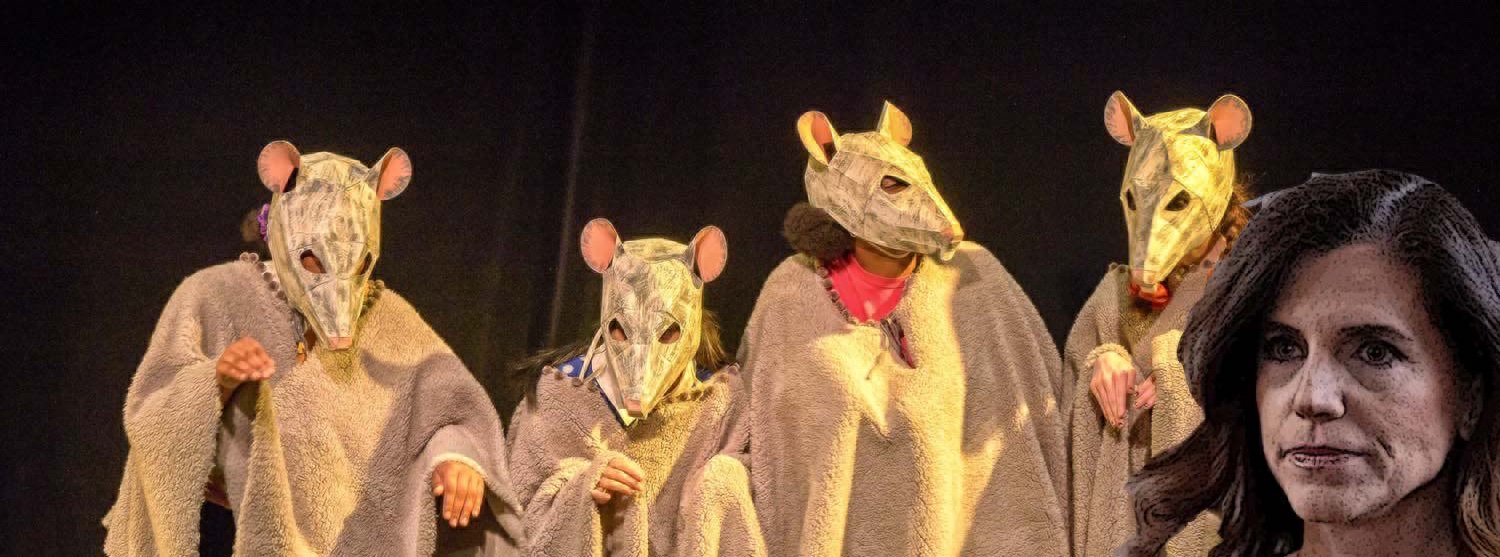
Meanwhile, elsewhere, Ethel and Julius Rosenberg sat in a courtroom being grilled by Roy Cohn, Donald Trump’s mentor.  My first full year, 1953, marked the feverous height of the Red Scare, back when the Russians were our enemies rather than our friends (or at least our President’s friend).[1] This collective commiephobia spread, appropriately enough, during an epidemic of polio. 

Trump and Cohn

In 1953, R&B had not made it to the mainstream, and rock-n-roll was in utero.  Every artist but one in Billboard’s top 30 singles of 1953 is white, mostly male crooners and female sopranos. Overly orchestrated instrumentals were also popular. The number one hit that year is “The Song from the Moulin Rouge” by Percy Faith and His Orchestra, a song so saccharine sounding that your ears might develop diabetes if you listen to more than twice. 

I’ve never heard of loads of these hitmakers like Pee Wee Hunt, Frank Chacksfield, Richard Hayman, Joni James. By far, the coolest song in that top 30 is from the one Black performer, South Carolina’s own Eartha Kitt, singing and purring “C’est si Bon” en francais.  She later was cast as Cat Woman in the Batman TV series. 

On the other hand, I have not only heard of but seen all of the top movies of ‘53, except for The Naked Spur. I’ve seen From Here to Eternity and Gentlemen Prefer Blondes at least twice, I’ve also watched Roman Holiday and Stalag 17.  Disney’s Peter Pan was one of my favorite movies in childhood, especially because the leader of the Lost Boys was, like me, a red head.

Nevertheless, despite the general awfulness of 1953, being born around then ended up being a propitious time to begin life’s journey. My parents, who had grown up during the Great Depression, wanted my siblings and me to have a better life than they suffered yet didn’t monitor our every move, allowing us to roam freely, unencumbered with water bottles or walkie talkies, the ’60’s equivalent cell phones. 

And by our adolescence in the mid ’60s, the music got ridiculously good, though we feared getting drafted and going to Nam, but by then the war was winding down and a draft lottery was in force. Compared today, college tuitions were dirt cheap. I could earn enough money in the summers to cover tuition.

However, I must say, for me at least, it’s a melancholy situation in my twilight years to witness the spectacle of lawlessness and corruption foisted on the Republic by Roy Cohn’s mentee, who obviously, as far as Machiavellianism is concerned, was an A+ student. 

C’est la vie, as Eartha might sing.

I’ll leave you with the number 1 hit of 1953.


[1] Fun facts to know as share: Roy Cohn, who in addition to being one of the prosecutors at the Rosenberg trial, also served as chief counsel for Joseph McCarthy’s witch hunts, a term Donald Trump appropriated during his first term to describe investigations targeting him for such acts of malfeasance like storing stolen classified documents in bathrooms and paying hush money to porn stars. 
Novels Vis-a-Vis Screenplays

Novels Vis-a-Vis Screenplays

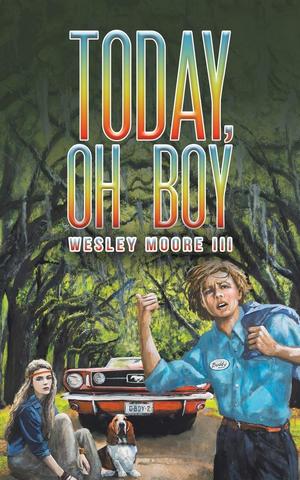
At the request of an actor who’s interested in pitching my novel Today, Oh Boy to producers he’s worked with, I’ve written an adaptation of the novel for the screen.[1] It’s not an official screenplay per se, but a roadmap for the actor to determine what scenes he will use to produce a short “teaser” reel consisting of would-be shots from the would-be movie. I have no idea how this is done. Via AI I suspect.  Anyway, with the final proofs from the novel to the right of my iMac’s screen and a blank Word document on the left, I began writing and cutting and pasting.

The good news is that originally, using present tense and employing crisp visual imagery, I consciously composed Today, Oh Boy to read like a movie progressing. For example, here’s the opening of the novel.

A mango-hued, pockmarked bulletin board hangs on a classroom wall of pale lime green concrete blocks, the bulletin board pencil-stabbed and compass point-gouged. Among the graffiti are the names of the star-crossed lovers: Sandy + Tripp. Tragic Tripp, whose body was found last week tangled in blackberry bushes along the banks of the Ashley River, his skull smashed after falling off Bacons Bridge.

S-A-N-D-Y + T-R-I-P-P.

Rusty Boykin, a skinny, freckled redhead sitting on the bulletin board row in Mrs. Laban’s homeroom, traces his index finger in the depression of Sandy’s name. He supposes it’s Tripp’s work – the letters inartistic, juvenile. Sandy hasn’t been to school since Tripp’s death, four class days ago, and now it’s Monday, and she’s still not here. She should be sitting right in front of Rusty, her honey-colored hair hanging like a curtain to her waist. 

How to adapt this for the screen?  One way, you could have Rusty tracing his finger in Sandy’s name and then suddenly cut to Tripp falling off the bridge, or you could begin with Tripp’s accident. What I did was to begin with Tripp’s last meeting with Sandy, a conversation through her open bedroom window, his leaving in a rage, jumping into his GTO, pealing off, and ultimately driving his car off the road at Bacons Bridge into the Ashley River.

Actually, Tripp’s death is what Hitchcock called a McGuffin, a misleading device that’s irrelevant to the overall narrative.  After all, Today, Oh Boy is a comedy. Its title comes from the Beatles’ song “A Day in the Life.”

I read the news today oh boy

About a lucky man who made the grade

And though the news was rather sad

Well I just had to laugh 

So, by having Tripp drive off the bridge rather than falling off the bridge, what I gain in cinematic excitement, I lose in the comic pairing of his first and last names. As it turns out, Tripp was a bully, a high school version of Trump.  At one point in the book, Alex Jensen, a junior at Summerville high, says to a friend Will, “Your last name is Trotter, you name your son Tripp, and he falls off a bridge to his death. What a surprise.”

In addition, the novel employs a great deal of what critics call “indirect discourse,” a device that allows a narrator to report what someone is thinking without using his exact words. For example, in the above excerpt, the sentence, “She should be sitting right in front of Rusty, her honey-colored hair hanging like a curtain to her waist” is rendered second-hand through Rusty’s consciousness. In a screenplay, you have to “show” rather than tell “tell,” which can lead to really awkward exposition, like you find in bad fiction like “The Most Dangerous Game”:

You’ve good eyes,” said Whitney, with a laugh,” and I’ve seen you pick off a moose moving in the brown fall bush at four hundred yards, but even you can’t see four miles or so through a moonless Caribbean night.”

That I couldn’t use direct narration or indirect discourse meant I had to omit some characters, like Camilla Creel, the impoverished girl who lives in an abandoned school bus with her mother and sister, and Weeza Waring, Will’s mother, who added several comic touches throughout the narrative.

So, overall, the script is much tidier than the novel, much more streamlined, yet not as rich in my attempt to capture the zeitgeist of Summerville, South Carolina in 1970, during integration, the beginning of the counterculture, and during an influx of Northerners moving to what at the time was a staid, conservative community.

Then again, I’m sure a professional screenwriter could do a much better job.


[1] By the way, it’s on sale at Amazon for a mere $10. 

“Go Away, Lindsey; You Bother Me.”

Let me say right off that I’m an avid admirer of WC Fields, who, in fact, is the inspiration for Colonel Duckenfield, the amiable but drunken calculus teacher in my novel Today, Oh Boy.[1]

Here he is in action:

Colonel Dukenfield has charged his minions with two in-class problems using the squeeze principle, so he has excused himself, ostensibly to use the restroom. A huge veined bulbous nose dominates his round, puffy, flushed face, though there’s still a gleam in his squinty blue eyes, especially when he’s talking to a pretty lady. His knees, though, are killing him, along with his corn-riddled toes stuffed into a pair of scuffed wingtips, the only dress shoes he owns. Once he reaches the faculty men’s room, he closes the door and takes out the pewter flask that bears his name and the name of his plane, the Flying Fortress, etched handsomely in ornate, old-fashioned cursive. He sloshes the Jameson’s whiskey around before taking a long, hard draw. Carefully, he screws the cap back on and places the flask in the right pocket of his blazer.

I mean, what’s not to love?

So I don’t intend any disrespect to Field’s surviving progeny (his great granddaughter’s wedding picture appeared in the Santa Cruz Sentinel in 2018) when I suggest that Lindsey Graham could be plausibly cast as an older Fields in a biopic once his political career is over, which may be sooner rather than later, given that he could get primaried on the one hand, and the country is on the road to economic and geopolitical ruin under our unhinged Dear Leader on the other.

What a great pairing of buffoons, Fields’ cinematic persona with Graham’s real life personality!

I know you might be thinking that Graham’s a little long in the tooth at 69 to embark on a new career; however, look at me at 72, getting ready to make a cameo in an upcoming short feature based on a chapter from Today, Oh Boy.[2]

So, Lindsey, see, it’s never too late to segue into something new. Look, man, you’re addicted to the limelight, and look, even if there’s not a Fields biopic on the horizon, maybe some enterprising filmmaker will buy the rights to Today, Oh Boy, and you can end up playing the Colonel himself.

As my wife Caroline says, “We can hope. We can dream.”


[1] You can read a review and purchase it here.

[2] I’ll be sitting at a bar, sipping a PBR, a role that I was born to play.

Failed Poems, Fake Art, and Commerce 

I subscribe to an internet entity called “Poem of the Day,” which provides me each a.m. with a dollop of verse to go along with a cup of whatever ground coffee is on sale at Harris Teeter on the previous Senior Citizen Discount Thursday.

This morning’s poem, Copyright © 2025 by Jessica Abughattas, has a title guaranteed to perk the interest of anyone interested in verse. It’s called “Failed Poems.” It’s one of those works where the title serves as the subject of the first sentence. To wit:

            Failed Poems

            will crawl out of the drain and try to kill you
            like some 80s horror flick.[1]

I like the poem, its witty catalogue of unpleasant analogies. Bad poems are like “a black widow creeping/from the mound of linens still warm from our bodies.”  They “steal your breath/ when you wake parched, hungover, emptied,” etc.

What really caught my attention, being a fake artist and all, were these lines describing another, much more successful fake artist:

Once, in Zurich, we were served rabbit paella at a party 
celebrating an exhibition of an artist from Venice Beach 
who used to be homeless but drinks $25 Erewhon smoothies and paints 
hundreds maybe thousands of happy faces with his feet. His canvasses 
go for $25,000. Toe paintings are better or at least significantly 
more profitable than failed poems.

This really hit home because the day before yesterday I got a text from a number I didn’t recognize with this message:

“Found some ‘fake’ art at goodwill today. I’m going to buy it as an investment.”

I responded, “Who in his right mind would give a masterpiece like that away?”

But to be honest, I did know. It was the fellow who won it at Chico Feo’s annual Canine Halloween Costume Contest. Harlan, the organizer, asked if I would donate a print, and I thought it was one of the better prizes, but as luck would have it, the winner is an actual artist who upon receiving it asked me if I’d seen any of his works.  

I hadn’t.

But I’ll also admit it would take a certain, rare art lover with a funkadelic sensibility maximus to want to hang the print above the mantle.

Anyway, the poet nails it when she whines about the unprofitability of writing poems vis-à-vis creating pictural art. In fact, believe it or not, despite receiving a rave review from Kirkus Reviews and having appeared on a local television show and several national podcasts, my novel Today, Oh Boy has provided me with less income than my fake paintings.[2]

Already this month, I’ve received two commissions and sold another print, not including the secondhand Good Will purchase. 

Anyway, I’d say that creating these canvases is more fun that writing fiction and certainly more fun that going over the “corrected proofs” of a manuscript that soon will be bound and sold in bookstores and online, which I have been doing of late.

I don’t  have a pub date yet for Long Ago Last Summer, but I’m guessing late spring or early summer.

PS. Speaking of commissions, Caroline and I have commissioned the unfake funkadelic artist Thom Piragnoli to create a sign for our driveway to alert visitors where our hidden house hides. 

You can check out Thom’s art at Chico Feo. The one above is called Galaxy Gals. Check out this LINK for more on Thom. 


[1] Rather than cutting and pasting the entire poem, I’ll provide a link because non-poetry lovers, i.e., 99.97% of people, would abandon this post for the greener pastures of a TikTok video. Here’s the LINK. You can read along while Jessica Abughattas reads it in a rather pleasant regionless accent.

[2] To be honest, this was not the case in 2023, the year Today, Oh Boy was published.

The Green Pastures of Retirement

Although I often whine about my chronic insomnia, in reality, it’s not a big deal because I’m retired.  Rarely do I have to be at a certain place at a designated time, so I can nap whenever I want, sometimes snatching a snooze as early as ten a.m., so it’s not like stumble about zombie-like all day, sleep deprived. 

In fact, it doesn’t make much evolutionary sense to be unconscious eight straight hours. I’ve read that our spear-toting pre-agrarian savannah-dwelling ancestors didn’t necessarily sleep through the predatory night, and during the Middle Ages, people engaged in a routine called “two sleeps,” turning in around nine or ten, slumbering for two or three hours, then awakening around one for what was known as “the watch,” a period in which they’d tend to tasks, socialize, and/or procreate.[1] Around two or three they’d again hit the literal hay (or if wealthy, a feather-stuffed mattress) and sleep until dawn or a bit later. 

However, I don’t want to give the impression that now that I no longer have to battle Folly Road traffic in the a.m. that I dawdle away the day doing crosswords, binging Netflix, or wasting time on the internet. This week, in fact, I’ve been especially busy going through the second proofs of my next book, engaging in a political protest, and most vexing of all, jumping through the electronic hoops of TurboTax. Being retired makes performing these acts much more convenient.

Excuse me; I need to vent. Correcting the proofs on Long Ago Last Summer was much more difficult than it had been with my first book, Today, Oh Boy.  This time around, rather than having a human being perform the copy editing phase, the publisher shoved the manuscript’s 62, 327 words through the woodchipper of AI.

The book is a compilation of short fiction, poetry, and personal essays that features a medley of Southern voices. Each piece can stand alone; however, collectively, they form a sort of mosaic with one of the major patterns being Southern Gothic, that literary subgenre that features “incestuous aristocrats, necrophiliac halfwits, sadistic Alabama sheriffs [. . .] the suicide hanging in the attic, the alcoholic great aunt who gave birth to the idiot child buried in the backyard.”[2]

You know, the human byproducts of the post-Reconstruction South, the folks I grew up with. 

Alas, AI wasn’t up to the task of dealing with the book’s cacophony of styles and voices.  Not only did it remove double negatives from the foul mouth of serial killer Donald “Pee Wee” Gaskins (who picked me up hitchhiking in 1970) and replace them with grammatically correct utterances, but it also altered direct quotes from the poetry of Emily Dickinson. Anyway, on Monday I completed the weeklong task of correcting the corrections. If I were teaching full time, I would not have had the leisure to pick through the rumble and piece back together my original tiles.

Nor could I have attended Tuesday’s anti-Trump demonstration at Hampton Park without having to take a personal day. I had planned on Tuesday to do our taxes, but it ended up being one of those rare days when I had to be somewhere at a specific time. The protest occurred on the very day of Trump’s state of the union address in which he stupidly misconstrued the words “transgender” and “transgenic.”

Trump: Eight million dollars for making mice transgender. This is real.

Jeff Tiedrich: No, no, no, no. Nobody is spending government money to make mice transgender. You low-wattage dolt. The word is transgenic.

Let’s say you’re a cancer researcher, and you implant some human genetic material into mice, in order to better study how cells mutate. boom! — you’ve just created transgenic mice

Nobody is doing sex-change operations on mice and setting them loose in Nancy Mace’s bathroom.

But I digress. I hadn’t engaged in a public protest since the fall of 1971, and I it looked like many of the protestors in attendance were alive and kicking during the Viet Nam era, which makes sense, given they are past retirement age and free to go wherever they choose midday on a Tuesday in March. I used to tell my students that if the governor told my generation that we couldn’t drink until we were 21, there would have been 300,000 of us on the lawn of the Governor’s mansion every day of the week. 

The protest, though somewhat limited in its attendance[3] and no doubt in swaying public opinion or sending shivers up the spines of Republican representatives, did provide an outlet for our outrage at Trump’s destroying our democracy and cruelly wreaking havoc upon the lives of so many of our citizens, not to mention his abandoning of Ukraine and the rest of our European allies. 

It was somewhat comforting to rub elbows with like minded people whose intelligence and commitment was apparent in the signs that they carried.

photo credit Joan Perry

photo credit Caroline Tigner Moore

photo credit Linda Bell

Okay, don’t worry about this 5-paragraph essay set up. I’m not going to give you a blow by blow account of my doing taxes, which thanks to my late wife’s assets is complicated by K-I limited partnerships, etc. Nevertheless, I do them myself because nowadays accountants essentially have you enter your financial information into their computer software instead of TurboTax. It ends up being the same amount of work. Using an accountant might save us some money, but what the hay. 

Ah, with my daily labors completed, here I sit sipping a Westbrook IPA at Lowlife Bar on a Wednesday afternoon scribbling this down in a composition notebook, happy to have completed the taxes and survived the tornados that never showed up on a day when Charleston County schools were called off.

Cheers! Thanks for reading until the end.

PS. Uh-oh! I just saw on LinkedIn that I appeared in 12 searches, two of which were the State Department and USAID. Yipes.

photo credit Joan Perry


[1] Since families usually slept in communal beds, having sex could be problematic.

[2] from the preface of Long Ago Last Summer, 38-9. 

[3] The Post and Courier estimated around 500,

Our Farcical Phase

Our Farcical Phase

“History repeats itself, first as tragedy, then as farce.”

Karl Marx

Let me begin this scholarly screed by introducing you to some of the lovelies who frequent the Felliniesque get-togethers at Mar-a-Lago.

I mean, we’re in John Waters territory here, in the land of farce, grotesque exaggeration, caricature.

From John Water’s “Female Trouble”

Speaking of which, Thursday a week ago (18 July 2024) on the stage of the Republican National Convention, Hulk Hogan endorsed Donald Trump, “the quadrice-indicted twice-impeached once-convicted popular-vote-losing adderall-huffing insurrection-leading ear-diapering testimony-ducking judge-threatening lawyer-ignoring witness-tampering day-one-dictatoring disabled-veteran-dishonoring inheritance-squandering rube-fleecing clown-makeup-smearing language-mangling serial-sexual-predating draft-dodging casino-bankrupting butler-bullying daughter-perving hush-money-paying real-estate-scamming bone-spur-faking ketchup-hurling justice-obstructing classified-war-plan-thieving golf-cheating weather-map-defacing horse-paste-promoting paper-towel-flinging race-baiting tax-evading evidence-destroying charity-defrauding money-laundering diaper-filling 88-count 78-year-old fluorescent tangerine felony factory.”[1]

At the end of his speech, Hogan ripped off his shirt to reveal a tee emblazoned with 

TRUMP

VANCE

MAKE AMERICA GREAT AGAIN!

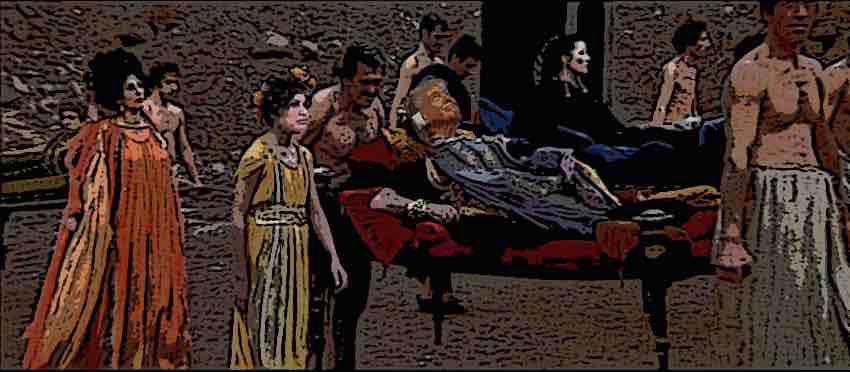
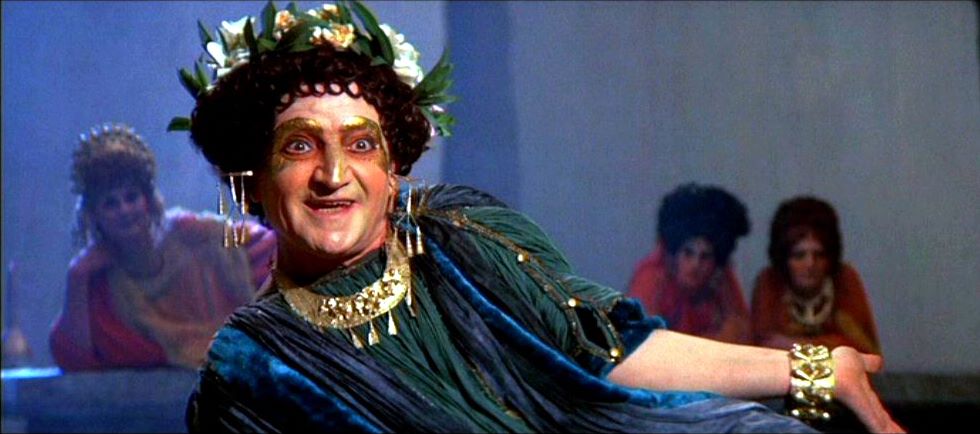
Not surprisingly, the literature of Nero’s Rome provides us with an ancient parallel to our current farcical state of affairs. Check out in your ample spare time The Satyricon by Petronius the Arbiter.[2] Here’s a still from Fellini’s cinematic treatment of Petronius’s classic, from the chapter known as “Trimalchio’s Dinner.”[3]

In his famous statement, “history repeats itself, first as tragedy, then as farce,” Marx was riffing on the Hegelian idea that history repeats patterns but in different ways, e.g., the French Revolution leading to Napoleon I (tragedy) and then to rise and fall of Napoleon III (farce).

Or, to draw a North American Parallel, the American Revolution is followed by the Civil War (tragedy) and then by the MAGA revolution (farce).

However, the thing is that when melodrama is exaggerated it becomes comic a la Reefer Madness, but when farce is overly exaggerated, it can become terrifying in a creepy clown sort of way.

I mean, imagine being trapped in an elevator with Don, Jr.’s fiancé Kimberly Guilfoyle! Imagine the future White House wedding. 

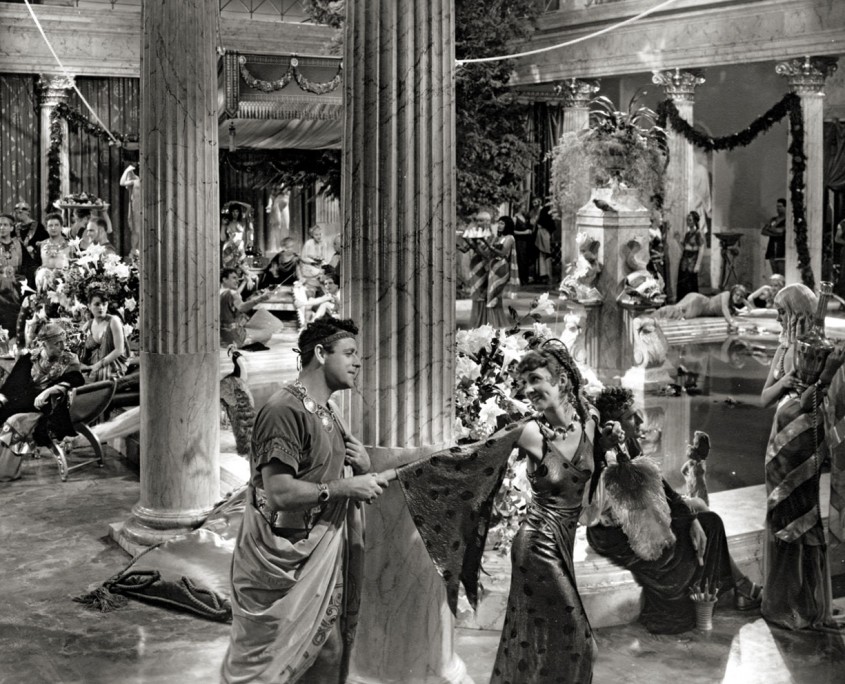
Bring in some pillars and Cecile B DeMille.


[1] from the poison keyboard of Jeff Tiedrich. 

[2] Which also provided TS Eliot with his epigraph for “The Waste Land.”

[3] More fun facts to know and share. Fitzgerald’s working title for The Great Gatsby was Trimalchio.

Episode 3 of “My Boys Were Back in Town, Backroads Edition Featuring Joel Chandler Harris

Episode 3 – Eatonton’s Rural Literary Legacy

[In episode 2, My ex-pat son Ned and I wended our way through backroads headed to Reynolds, formally known as Reynolds Plantation, just outside of Greensboro, Georgia, to reunite with his Aunt Becky at Uncle Dave].

Around four-thirty on Thursday, Ned and I arrived at Reynolds where we negotiated the security gate rigamarole. At the house, Becky and Dave greeted us warmly, plied us with drinks after our long (well, six hour) journey, and we did some catching up. It turns out that Becky and Dave had recently suffered a hair-raising flight from New Jersey to Atlanta, the inside of the plane perpetually rocked by turbulence for the entire time they were airborne. As she was exiting the plane, Becky found it especially disconcerting to see the pilot and copilot exchanging high fives. She informed Ned if she were going to visit him in Nuremberg, she was likely to take an ocean liner.

On Friday, Dave, who is overseeing the construction of one of the houses his son Scott is building in Reynolds, headed off to work, and Becky drove Ned and me to Eatonton so we could check out the Georgia Writer’s Museum, home of the Georgia Writer’s Hall of Fame. 

Eatonton is a lovely, sleepy verdant town that reminds me of the Summerville of my youth. It seems like a pleasant place to retire, that is, if you’re not a Folly Beach hedonist hellbent on cha-cha-cha-ing yourself to death.

The museum itself, located in a coffeeshop, struck me as the literary equivalent of a science fair, consisted of tables lined up with poster board information. Eatonton and its environs have produced a remarkable number of noteworthy writers including Alice Walker, Jean Toomer of Harlem Renaissance fame, and Joel Chandler Harris, who adapted African folk tales in book form, creating the Uncle Remus stories. Milledgeville, the home of Flannery O’Connor, is a mere twenty miles south.

The museum houses both Joel Chandler Harris’s and Flannery O’Connor’s typewriters, plus an exhibit delineating the evolution of machines of writing, starting with primitive typewriters and ending with a progression of computers getting smaller and sleeker through the decades.

As I slowly strolled along the exhibits, The fact that Joel Chandler Harris had been born in the Barnes Inn and Tavern caught my eye. Being born in a tavern seemed odd, colorful, so I read on. 

Here’s a short version of his life:

The year of his birth is uncertain, either 1845 or 1848. His mother Mary, an Irish immigrant who worked at the inn, was impregnated by a cad who abandoned his infant son and Mary.  She named the baby Joel Chandler Harris after her attending physician.

Of course, illegitimacy, as it was called in my youth, was especially problematic in the antebellum South.[1] In addition to that disadvantage, Joel was redheaded and stammered, which made him a target for bullies.[2]  The stigma of his “lowly” birth haunted him throughout his youth and early adulthood.

Fortunately, Dr. Andrew Reid, a prominent Eatonton physician, provided Mary and Joel with a small house behind his mansion. He also paid for Joel’s tuition (in those days public education didn’t exist in the South). Mother Mary fostered Joel’s future literary prowess by reading to him out loud, which helped him to develop the remarkable memory he would utilize in assembling the Uncle Remus tales. She read him Goldsmith’s The Vicar of Wakefield so often that he could recite lengthy passages by heart.

At fourteen, Harris dropped out of school and went to work for a newspaper, Joseph Addison Turner’s The Countrymanwith a circulation around 2,000. There Harris mastered the basics, including typesetting. Addison allowed Harris to publish his own stories and poems. Eventually, Harris moved into Turnwold Plantation, Addison’s home, located nine miles outside of Eatonton. Here Harris had access to a voluminous library and where he began devouring the classics and contemporary authors such as Dickens, Thackery, and Poe.

At Turnwold, Harris spent hundreds of hours in the slave quarters. Wikipedia claims that Harris’s “humble background as an illegitimate, red-headed son of an Irish immigrant helped foster an intimate connection with the slaves. He absorbed the stories, language, and inflections of people like Uncle George Terrell, Old Harbert, and Aunt Crissy,” who in amalgam became the narrator of the Brer Rabbit Tales, Uncle Remus.

I was unfamiliar with Harris’s biography, but what strikes me as truly remarkable is that he replicated these stories in dialect without any written sources. He essentially gave voice to and preserved these tales that had been stored in the brains of Africans, transported across the Atlantic in slave ships, and told and retold in slave cabins throughout dark nights of captivity.

Because of the Disney movie, Song of the South, Harris has been tarred (pun intended) as being a racist, which is unfortunate. What Harris did was preserve a rich trove of folklore featuring an African trickster who used his wiles to outfox foxes, tales where the underdog prevails. Of course, you can accuse Harris of cultural appropriation, but to my mind, the dialect enriches the tales, making them much more linguistically interesting. 

After the war, Harris moved up in the world of journalism, working at the Atlanta Constitution for nearly a quarter century, and addition to the Remus tales, he published novels, short stories, and humorous pieces. Luminaries such as Theodore Roosevelt and Mark Twain were among his admirers. Alas, he was an alcoholic, and died from complications from cirrhosis of the liver at 59.

After our visit to the museum, Becky gave us a driving tour of the area, which includes a dilapidated chapel where Alice Walker’s ancestors are buried. We arrived back at Reynolds in the early afternoon, looking forward to Cousin Scott’s arrival the next day. At the museum, Ned had bought me Jean Toomer’s Cane, a literary mosaic of poems and short stories that brings to life a subculture, which reminds me of my work-in-progress Long Ago Last Summer, an up close and personal exploration of real life Sothern Gothic.

In short, it was a very meaningful morning and afternoon for Ned and me. 

Alice Walker’s Childhood Home around 1910


[1] Of course, “bastard” was the preferred 19th Century nomenclature. 

[2] As a former redhead, I can emphasize. If interested, check this LINK out.