Miss Capers Gives Edgar Allen Poe a Gothic Run for His Money

V0025881 The witch of Endor with a candle. Engraving by J. Kay, 1805,

The witch of Endor with a candle. Engraving by J. Kay, 1805, Credit: Wellcome Library, London.


Of all the many eccentric characters who haunted the streets of my hometown in childhood, including the mentally challenged man known as Pepsi Cola and another more infamous miscreant who trafficked in underwear and firecrackers, I believe that the old crone known as Miss Capers deserves the title of the strangest Summervillian of all.[1]

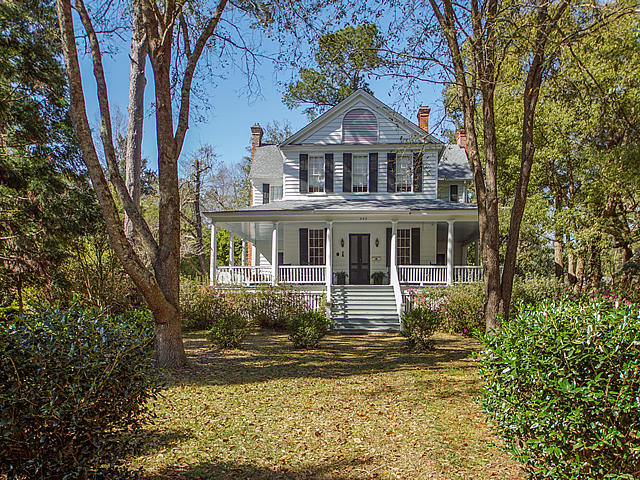
In the early Sixties, my maternal grandparents stayed in a subdivided Victorian house on West 3rd Street, the upstairs having been split into two apartments, the bottom story uninhabited and warehousing a portion of some wealthy family’s estate: furniture, rugs, an extensive library with hundreds of books.[2] In the side yard there was a well.  You could remove the cinder block and then the plywood and peer into an abyss.  I think I remember looking down at my reflection in water, but I may have gotten that idea from a Seamus Heaney poem. Behind the house was an open grassy field and a patch of woods featuring bamboo that we called “Ghost Forest.” It was a convenient neighborhood, two houses down from Timrod Library and close to the Playground via the short cut through Pike Hole.

sepia house copy

Although not an adventurous child, I somehow gained entrance into those off-limit rooms downstairs, the furniture sheeted, the air stale. I’d sneak below and explore. After repeated visitations and investigating some of the books I could reach on the lower shelves, I started secretly “borrowing” individual volumes of the Complete Works of Edgar Alan Poe.
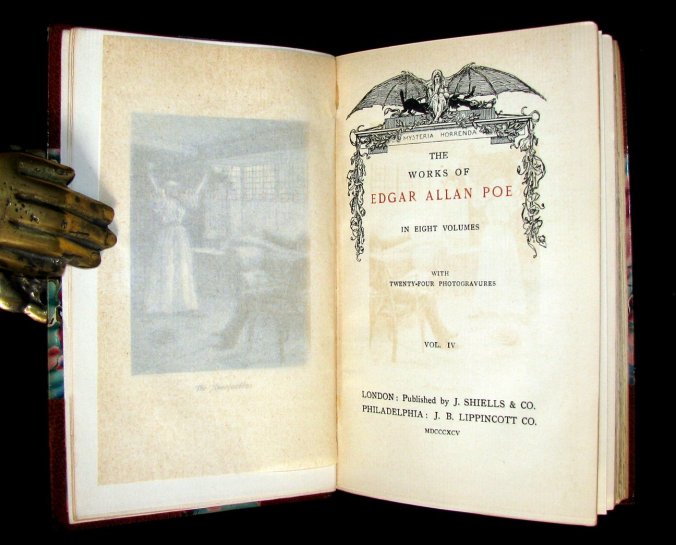
20200308poe-015_1296x

This is from the actual set I’m talking about
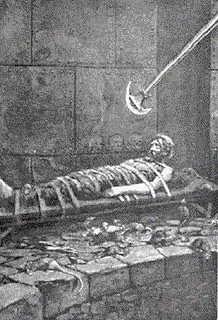
pit-pendulum-bmp-2Each slender volume, bound in red, featured sheer paper sheathing occasional engravings of ravens, subterranean crypts, or rats gnawing on ropes of the dudgeon-bound protagonist of “The Pit and the Pendulum.”  Into the forbidden first-story space I’d sneak, terrified I’d get caught, carefully replacing last week’s purloined octavo, flipping through other volumes, choosing another based solely on the luridness of the illustrations.

I was only eight or nine, so most of the prose lay beyond my reckoning, but I could manage lots of the poetry and some of the stories (“The Tell Tale Heart,” for example). Unable to distinguish bathos from profundity, I became completely enamored of the singsong silliness of “The Raven,” devoting several stanzas to memory. “Annabelle Lee” could bring tears to my eyes. Something sinister lay beneath those works, so the whole enterprise smacked of trafficking in pornography – though pornography would not have been in my early Sixties vocabulary.

I’d smuggle the forbidden text and read it surreptitiously in bed because I knew my parents/ grandparents wouldn’t approve of my trespassing and borrowing without asking. I liked the musty smell of the books, the way the pages whispered when I turned them, the way the illustrations lay perversely beneath diaphanous paper. Despite the buxom space sirens who cavorted on the covers of pulpy paperbacks, Sixties sci-fi couldn’t compete with the deep purple sublimations of diseased consciousness that I found in Poe.

The thing is, though, if it were the gothic that I was craving, I needed only to traipse across the hall and knock on mysterious Miss Capers’ door because she lived in the other apartment in the upstairs of my grandparents’ house. Truth is, I would not have knocked on her door for five dollars, a fortune in those days, because my brother David and I were convinced that she was a witch, and as far as diseased consciousnesses go, Miss Capers could give Bertha Mason, Mr. Rochester’s insane wife in Jane Eyre, a run for her money.

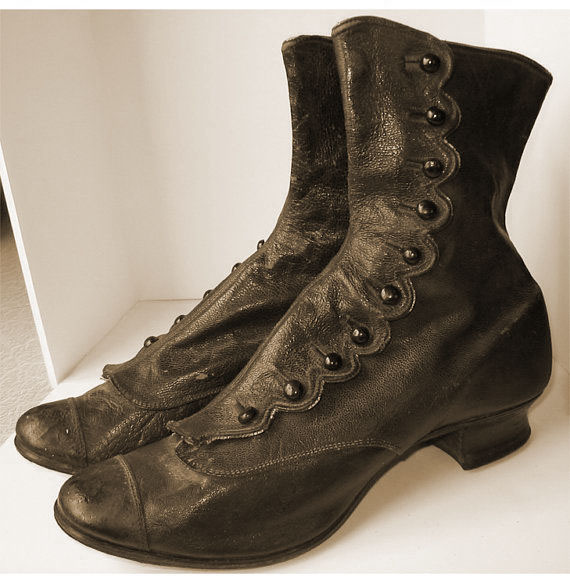
She certainly looked witchlike with her sharp nose and perpetual frown. It seemed that she only possessed two outfits, the one she wore most often a brown, probably woolen, monkish garment, the hood coming to a point pulled up over her stark white hair, even on blistering summer afternoons.  Her other outfit consisted of an old-fashioned white blouse and long blue skirt. Her shoes were strange Victorian contraptions, boots, I guess you’d call them, that had several buttons on the side.  She looked like she’d stepped out of the pages of a 19th Century Gothic novel.
shoes

She rarely left the house, but occasionally you’d spy her walking down the street, hunched over a cane in one hand and a bag in the other. Perpetually belligerent, she’d shake her cane at you if you passed her on the sidewalk. I seem to remember that she was terrified of thunder and lightning. One time my parents took David, my high-school aged aunt Virginia, and me into Miss Capers’ room during a storm, I think to try to comfort her, and she told me the safest thing to do during a thunderstorm was to place your face six inches from a window and to stare out at the rain. It’s the only conversation I ever had with her.

Eventually, a smell began to emanate from Miss Capers’ room, which we thought might be accumulated garbage, but when the smell metastasized into a stench, my father knocked, then pounded on the door, eventually forcing it open. I wasn’t there at the time, but what he found was Miss Capers sitting with her leg wrapped in newspapers, gangrenous, terrible to behold, literally rotting.

Of course, my parents called for an ambulance, and from what I understand, the leg was amputated, and she survived, but was taken away somewhere to live out the rest of her days and nights under some sort of supervision.

Miss Capers would have made an excellent ghost, moaning in that room whenever a thunderstorm passed, but the house has been redone, been spiffed up with all its gothic traces effaced, an incongruous setting for a specter. They should have kept that library, though. It was really something. Perhaps if I ever become a ghost, I’ll haunt it, aggrieved that the books shelves have been replaced with prissy wainscoting.


[1] According to legend, the second man would trade firecrackers to naive newcomers to town for a pair of their underwear and a photograph of them. He would say, “I’ll give you 50 pack of firecracker for your drawers.” If successful in the transaction, he would tie the underwear (always tightie whities) behind his bike, place the photograph of the victim in the underwear, and pedal his bicycle all over town. There was a local band fronted by the late Jerry Stimpson who adapted Yardbirds hit “For Your Love” into “For Your Drawers.”

Also, I realize that “crone” has fallen into disfavor because of its sexist connotations, but I use it here anyway because, well, she fit precisely the definition, especially the bad-tempered part.

[2] It’s still there, across the street from Bethany Methodist Church.
Sometimes the Twain Do Meet

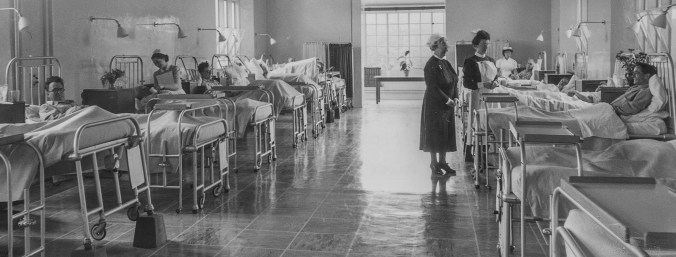
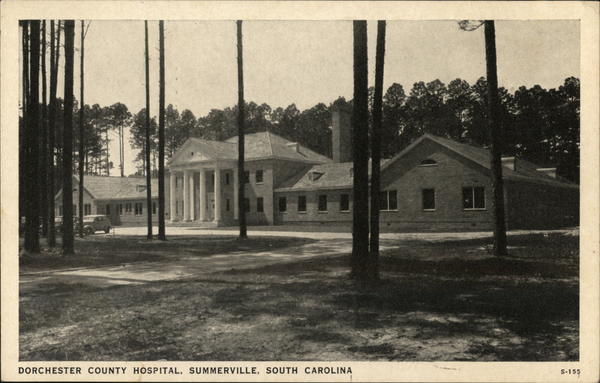
Dorchester County Hospital Summerville, SC

Dorchester County Hospital Summerville, SC 1950s

In the first decade of my life, the 1950s, my mother worked as a practical nurse at Dorchester County Hospital in Summerville, South Carolina. Unfortunately, I got to spend more time at the hospital than I would have liked because I contracted rheumatic fever in 1956, which would result in a two-week stay in a ward at the hospital and two months in bed at home after that.

I was only five at the time, so my memory of the ward is hazy. I remember getting EKGs and Reverend Storm, the Baptist preacher, coming and extolling everyone on the ward to bow their heads and pray for me, which I found embarrassing, and I also remember some of my mother’s friends and my grandmother’s friends coming to visit the hospital.

hospital-ward-1950s-cropped

One of these was Vivian Mallard, a good friend of my grandmother’s. I remember her playing a simple board game called Davy Jones Locker with me as I lay in the hospital bed. If erect posture is a sign of moral uprightness, Vivian was a paragon of virtue. She was a short, trim woman with curly gray hair and glasses, a no-nonsense lady who walked as if she were balancing an etiquette book on her head. After my recovery, when my grandmother kept my brother and me while Mama was nursing, I spent many a boring hour on Vivian Mallard’s porch or in her immaculately trimmed yard while “Mama Blanton,” as we called my grandmother, and Vivian exchanged gossip about the ins and outs and comings and goings of Summerville’s citizenry.

Another of Mama Blanton’s good friends was Miriam Etheridge, who with her husband ran a grocery store attached to their house just down the street from Alston High School, the African American School in those days of segregation. This was a “colored neighborhood,” as we put it back then, so the clientele of the store was almost exclusively African American.  Because of segregation, my only exposure to Black children was at the store. I remember the girls having elaborate, complicated hairdos featuring multiple parts and ponytail like projections. I actually had a crush on one of the Black girls, a tall, pretty light-skinned girl, but even back then I knew better than admit to something like that.[1]

Perhaps, it was at Mrs. Etheridge’s store that I first encountered Harold, a mysterious black man whom people claimed “was not right in the head.”  In addition to mental illness, Harold suffered from a strange, plum-sized, sac-like growth dangling from his ear that my mother called a “wen.” Scouring google for an approximation, the closest image I could come up with is the one below, which isn’t nearly big enough. Why no charitable entity sought to have it removed seems strange. But back then even doctors’ offices were segregated with separate black and white waiting rooms. Perhaps pro bono operations weren’t a thing.

cystAt any rate, among the rumors about Harold was that he had been on a path to becoming a physician but had some sort of mental breakdown in medical school. Whatever the case, Harold’s status in his adulthood was that of a vagrant. Riding my bicycle through the park, one time I saw him passed lying among azalea bushes with a jug next to him.

Another time, in those days before people locked their cars, Harold crawled into the back seat of Vivian Mallard’s Oldsmobile and fell asleep. It’s not clear if he had done so the night before or in the morning when Vivian decided to go grocery shopping.  It wasn’t until she arrived at the Piggly Wiggly parking lot and got out of her car that she discovered Harold curled up unconscious in the back. I suspect that she screamed, but I don’t know for sure. And I also don’t know if Harold was arrested or whatever ultimately became of him. Sometimes cases like his were sent up to the State Mental Hospital on Bull Street in Columbia, an institution featuring the same dark brown bricks that gave Dorchester County Hospital such an uninviting vibe. If he had been sent to Columbia, maybe they would have removed the wen, but at that point, it wouldn’t have done him much good.

maxresdefault-1

The now abandoned State Mental Hospital on Bull Street


[1] She actually appears in a short story I wrote, which you can access here.

Update: Please note in the comments that Harold indeed eventually had the wen removed.

Tales from Old Summerville

carolina inn

Old Carolina Inn, the first building in Summerville to have an elevator

Before the fast food franchises, before the Wal-Marts, before the sprawl, my hometown Summerville, SC, was a lovely, quiet village nestled in a pine forest 25 miles northwest of Charleston.  Settled just after the Revolutionary War and originally known as Pineland Village, the community in those days offered a haven for plantation owners seeking seasonal escape from malaria-bearing mosquitoes.

Eventually, Pineland Village became known as Summerville, and people started settling there year round. In 1847, Summerville officially became a municipality, and that very year the town council passed one of the first conservation laws in the nation, a statue forbidding cutting down trees of a certain circumference without permission.

Town-Hall-3

Town Hall back in the day

This passion for conservation and appreciation for the beauty of nature resulted in the planting of hundreds of azaleas, camellias, and gardenias throughout the town, both in its municipal parks and in the yards of the old clapboard whitewashed Victorian houses.  In the springtime, what is now called “the Old Village” or “the Historic District” has to rank as one of the most beautiful towns in the nation.  It claims as its official motto “Flowertown in the Pines.”

IMG_1211

St Paul’s Episcopal Church (photo credit Fleming Moore)

In 1950, the year my mother graduated from Summerville High School, the population stood at 3,312; in 1970, the year I began my senior year there, the population had barely grown to 3,839.  However, it almost doubled between 1970 and 1980 and grew a startling 247% to 22,519 from 1980 to 1990.  Since then, the population has doubled yet again, and according to a 2019 estimate, now 52,549 people call Summerville home.  When I go there nowadays, have lunch out or hit a bar, I recognize virtually no one.

However, in the old days, being a native and growing up “Flowertown” meant that everyone knew everyone else, which was a real disadvantage if you were a redhead like me.

“Did you recognize any of the boys?”

“No, but one of them was redheaded.”

“I bet it was Rusty Moore.  I’ll call his mother.”

Everyone in town knew everyone else, but outside of the town limits, there were a number of smaller unincorporated communities like Knightsville, which had its own elementary school, the Boone Hill community, Stallsville, New Hope, etc.  By junior high, children from these communities had matriculated in Summerville schools.  Unfortunately, a few of these rural children were dirt poor.  I remember shoeless White children hopping on the bus on the first day of school. We’re talking about the days of segregation when only a few handpicked African Americans had been integrated into our classes, and they were from downtown and academically talented.  Because academically, we were “tracked,” I rarely interacted with any of the disadvantaged kids from the rural areas, although I became good friends with several prosperous college prep kids from Knightsville.

However, when PE started in the 7th grade, I not only interacted with some of the disadvantaged rural kids, but I also showered with them, and since several had failed a year or two, some sported five o’clock shadows rather than peach fuzz.  PE  is where I first met Bobby Bosheen, the antagonist (and protagonist) of this piece.

My attempts to google Bobby Bosheen have turned up zilch.  I heard somewhere decades ago that he had been chained to a tree and bullwhipped and lost an eye.  Another rumor had him throwing a Hanahan boy off the Folly Pier and killing him in a tribal fight between rival high schools.  Although I doubt that either rumor is true, I don’t doubt that Bobby is no longer among the quick.  To say that he had anger issues is to say that Kanye West has ego issues.  Adjectives like volcanic and nuclear come to mind.  I would like to think that Bobby overcame his rage, that he turned out okay because deep down inside I don’t think he was a bad person.  He had this haunted look about him that suggested his childhood hadn’t taken place on Sunnybrook Farm.

For some odd reason, one Saturday, I let my friend, the late Gordon Wilson, talk me in going to Boone Hill Methodist Church to engage in unsupervised tackle football with the natives of that region.  Bobby was among the crew and had a jolly time swinging elbows, crushing ball carriers, and piling on.  Even though I enjoyed the game about as much as I would a root canal, I think my participation reaped the benefit of Bobby’s vaguely recognizing me and therefore not targeting me as an adversary.  True, he did punch me once as I was sitting in a car at the Curve-Inn Pool, but he was rip-roaring drunk and started fights that night with numerous revelers, including Kenny Reese, a popular basketball player.  The very next week I saw Bobby at Tastee Freeze, and Gordon asked him why he had punched me, and Bobby actually apologized, lamenting, “Whiskey and beer don’t mix.”

tastee freeze

The Old Tastee-Freeze

What really solidified my self-identification as a coward was Bobby’s girlfriend, a large, stringy haired bruiser with discolored teeth and the calves of a linebacker.  Unlike, Bobby, she hated me, hated me viscerally on sight. This was in ’70 or ’71, and I had started to grow my hair long and dress like Neil Young.  She used to position herself outside the entrance of the back of the main building and threaten me.  “I can’t wait to cut your ass, you red-headed bitch,” she said one day with arms crossed blocking the entrance.

red neck gal

I suspected she could have, given that she outweighed me and I hadn’t been in a real fight since the fourth grade, so I turned tail and found another entryway.  Whenever I saw her, I avoided her.  She scared the shit out of me.

The last time I heard something concrete about Bobby was in ’75 when I was bumming a ride back to college with one of my mother’s colleagues, a teacher at Newington Elementary School.  As we passed Morris Knight’s, a beer joint, the husband of the teacher, a non-Summerville native, mentioned that he had made the mistake of going in there one time to shoot pool and had been assaulted and actually beaten with pool cues.  He told me that he had pressed charges against the assailant, who was convicted, but that he couldn’t remember his name, that is was something funny sounding.

“Bobby Bosheen,” I suggested.

“Yes, that’s it!  Bobby Bosheen!”

Of course, Bobby’s anger had to come from somewhere.  I suspect at home he was no stranger to corporal punishment.  Perhaps, like Pee Wee Gaskins, he had been strung upside down naked and beaten with a two-by-four.  If he had been born to one of the families living on Carolina Avenue in a Victorian house with a spacious porch beneath moss draped live oaks among the azaleas, I suspect he and the rest of the world would have gotten along much better.

sville house

Surveillance, Non-Adventures in Paradise

Banksy Cheltenham

During the Easter Break of 1971, my senior year in high school, I accompanied my compadre Tim Miskel on a 400-mile excursion to Cocoa Beach in his red TR4 convertible.  The deal was that I would provide gas with my mother’s Citco credit card, which she had generously lent me for the trip – though I had told her our destination was Myrtle, not Cocoa, Beach.  Her receiving credit card bills later from exotic locations like Sebastian’s Inlet, Florida, was troubling, but that would be a month away, and back then a month was an eternity. Cocoa was a surfing mecca. It would be Kerouac, On the Road, Easy Rider, and all that be-bop.

TR4

Except for fueling in Summerville on the way out and in Walterboro on the way back, I was able to use cash for gas in Georgia and Florida and thus managed to escape detection, a feat impossible for contemporary miscreants, at least for miscreants with vigilant parents equipped with the latest technology.  In 2020, moms and dads can trace in real time on computer screens blinking blips that pinpoint their offspring’s progress as they make their way to those unsupervised parties.  

Perhaps because of my parents’ childrearing liberality, I, too, provided our two sons with lots of space, with such long leashes that when Ned was in high school, he accompanied his college-aged brother Harrison on a spring break trip to Munich.  

Did underage Ned drink beer at the Hofbrauhaus?  Did we speak only once via cellphones that weekend? Has Kellyanne Conway undergone plastic surgery?

The answer to all three questions is yes.

I also remember when Ned served as a host for one of the new 9th graders of Porter-Gaud School’s class of 2008, a well-meaning woman approached me at a welcoming get-together to ask if my wife and I would like to join a group they had formed to meet regularly to discuss their children’s activities.

“Absolutely not,”  I said, with perhaps too much emphasis.

She seemed truly surprised.  “Why not?”

“I don’t really want to know what they’re up to.”

She seemed incredulous.

“Didn’t you sneak out of the house and drink beer and make-out in the backseats of cars in high school?” I asked.

“Things were different then,”  she said.  “Safer.”

Actually, I disagree about the safety factor, about the South Carolina lowcountry of the 2000s being more dangerous than it was in 1970, but I didn’t feel like describing the chain fight I witnessed outside of the stadium after a Summerville football game or my hitchhiking encounter with mass murderer Donald “Pee Wee” Gaskins or the murders committed by Richard Valenti on Folly Beach in 1973.

Unfortunately, this parental surveillance now includes 24/7 access to their children’s grades.  Today, if little Mason or Madison blows off a reading assignment and gets a 0 on a pop quiz, parents Karen and Bob can log onto Net Classroom and check their weekly progress.  Some of our more neurotic ambitious parents check Net Classroom as often as day-traders do stock quotes.  Seasoned political junkie that I am, when I taught, I waited until Friday afternoons to post grades the way political campaigns release damaging information after the evening news on Friday nights, in their case to bypass the news cycle, in my case to make Bob and Karen less likely to contact me on the weekend.

If this system had been in place when I was in high school and my parents employed it,  I would have spent those turbulent four years caged in my room.  Chances are, though, they wouldn’t have.  I think my father went three years without ever seeing any of our report cards, thanks to my mother’s wise discretion.

Portrait of the Blogger as a Young Man Studying

Obviously, in this age of celebrity, people don’t value their privacy as they once did, a reclusive Garbo being the exception to the full-exposure Kardashian rule.  Not only are our backyards available for anyone to peek into from above via Google Maps or low flying drones, but on sidewalks and in hallways, parking lots, and supermarkets, our movements are being constantly monitored.  Indeed, a restroom may – and I stress the subjunctive – may be the only place in public where we’re not being spied on with surveillance cameras.  

I wonder if nowadays Tim and I would have dared to make the trip.  If we had, a complicated web of lies would have been necessary, as parent and child would be linked via a cell phone, and I’ve never been good at lying and have always tried to avoid mendacity unless absolutely necessary – this trip to Cocoa an exception. As my unrelenting bad luck would have it, there happened to be a podunk rock festival in Myrtle Beach that weekend.

“How was the rock festival?” my mother asked sarcastically when I got home.

“Rock festival? What are you talking about? There wasn’t any rock festival.”

And there hadn’t been – in Cocoa Beach. She got out the paper and slapped it down on the kitchen table. On the front page screamed an above-the-fold photograph of mass cavorting.

Damn, maybe we should have gone to Myrtle Beach instead. I don’t in fact recall much about the trip to Cocoa.  I remember the wind whipping our long locks as we drove with the top down through Georgia and Florida on Highway 17S. I remember our hooking up with Adam Jacobs, Robbie Summerset, and the surfing Kowalski brothers from West Ashley.  We saw Gimme Shelter at a Cocoa Beach theater.  I remember choppy waves breaking at low tide at Sebastian Inlet and envying the surfer asleep with a girl in a van the first night when I froze my ass off trying to lose consciousness in the uncomfortable confines of Tim’s car.  

In fact, we decided to split the second night, and heroically, Tim drove through the wee hours for a predawn arrival home.

Nevertheless, I’m glad we were free enough to make the trip because it was, if not an adventure, out of the ordinary, something I can write about as opposed to the blurred repetition of the days before and after the trip, those days having tumbled through the hourglass of my life into oblivion.

Tim Miskell, circa 1970