Like the majority of North Americans, high school students don’t like poetry. When I teach my first lesson on poetry, I confront students with this fact, encourage them to be honest, to raise their hands if they don’t like poetry, and all but one or two hands tentatively rise.
I ask them why, and they reply “it’s hard” or “too abstract” or that “teachers read too much into it and that’s off putting.”
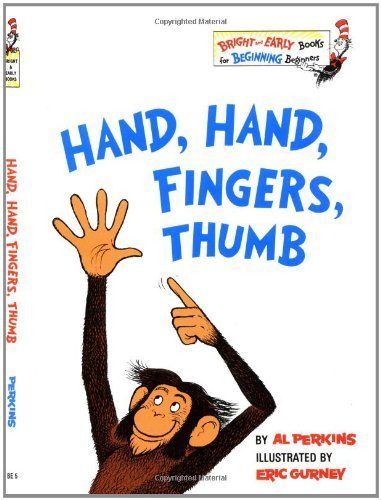
I say, “But you used to like it. You liked Dr. Seuss. See if you like this poem. Then I read them “Hand, Hand Fingers Thumb,” my older son Harrison’s favorite book when he was a preschooler.
Because the illustrations constitute an important facet to the poem’s overall effect, I’m going to provide a video and then read it myself to produce a very different vibe, the one I create in the classroom.
Okay, hit the arrow to get my rendition.
Usually, I receive a rousing round of applause, but then I ruin it for them. I say, “See, you enjoyed that, but you didn’t get its deeper meaning. Let me explain.
“The poem is actually an apocalyptic history of life on the planet that incorporates both Hebraic and Hellenic myths denoting the fall of man that culminates in a population explosion that eventually kills all primates on the planet.”
“What?” they say.
“Listen. At first the monkeys are happy in their prelapsarian state, enjoying music and each other’s company until
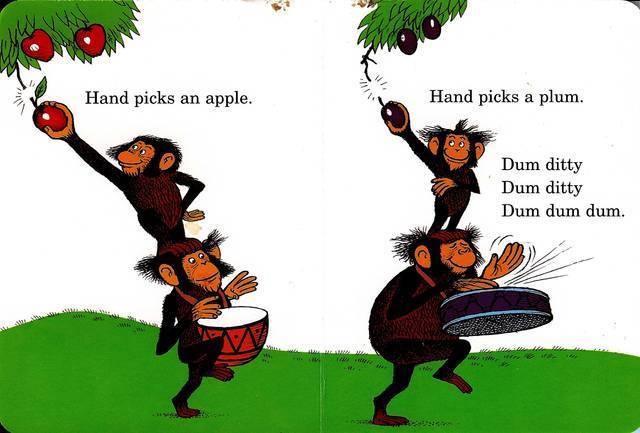
“Here the apple represents the Eden myth’s rendition of the Fall, and the plum represents the Greek concept of the worship of Dionysius, the Greek god of wine. Perkins is using what is called poetic license, substituting one purple fruit for another for the sake of rhyme.
“It’s no accident that in the very next stanza after the chorus, disease enters the rapidly fading paradise of the monkeys’ world.
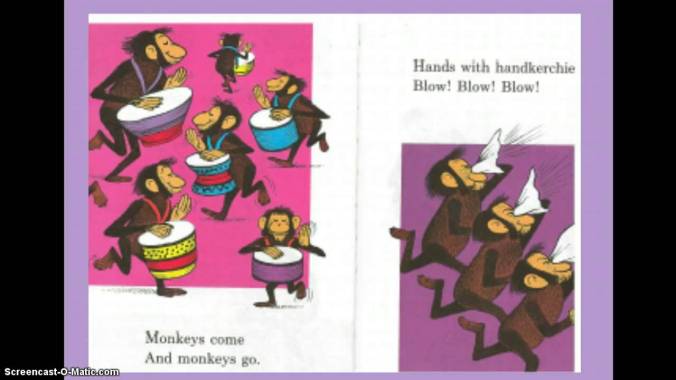
“As civilization advances, instrumentation becomes more sophisticated; banjos and fiddles augment the simple jungle drums at the beginning. An unabated and unsustainable population explosion ensues, choking the planet.
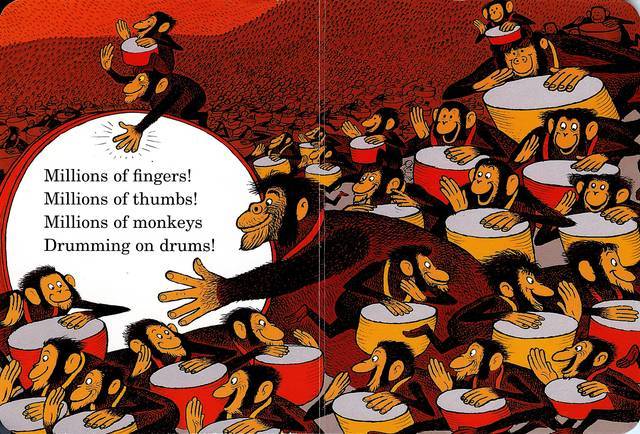
“Hence the diminuendo at the end
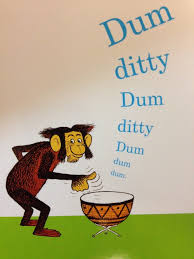
“This is an obvious allusion to TS Eliot’s “The Hollow Men,” its last lines stating that the world will end “not with a bang but a whimper.”
Some kids look generally puzzled, others sport wry smiles. I take my tongue out of my cheek and confess that what I just spewed was bullshit, that the poem exists to delight you with sound, rhythms and rhymes, and that a very important rule is that it’s much better to miss a symbol than to misinterpret one. That, in fact, most poems are the opposite of abstract, they’re concrete.
Ars Poetica
Archibald MacLeish

