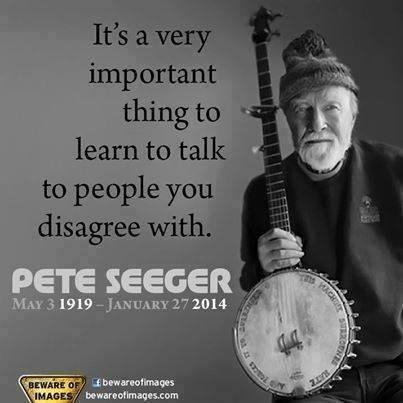
One phenomenon that future historians/anthropologists will cite as a contributing factor in our civilization’s decline is the polarization of our political parties, who have retreated into the echo-chambered bunkers of MSNBC and Fox News where viewers rarely hear cogent arguments that challenge their preconceptions.
Take last night’s Republican debate for example. This a priori premise was embraced, not only by every single candidate, but also by the live audience and assembled focus groups: Obama’s presidency has been unilaterally an unmitigated disaster.
That’s right. The glory days of peace and prosperity of the Bush years have darkened into an era when America is no longer great.
We need Donald or Ted or Marco or Carly to restore us to those halcyon days of 2008!
Well, here’s a non-partisan assessment:
Here’s a chart of the budget deficit:
Of course, the Obama Administration has been far less than perfect, as some of the numbers in the first chart attest; on the other hand, who in her right mind would argue that generally things are worse now than they were under George W Bush?
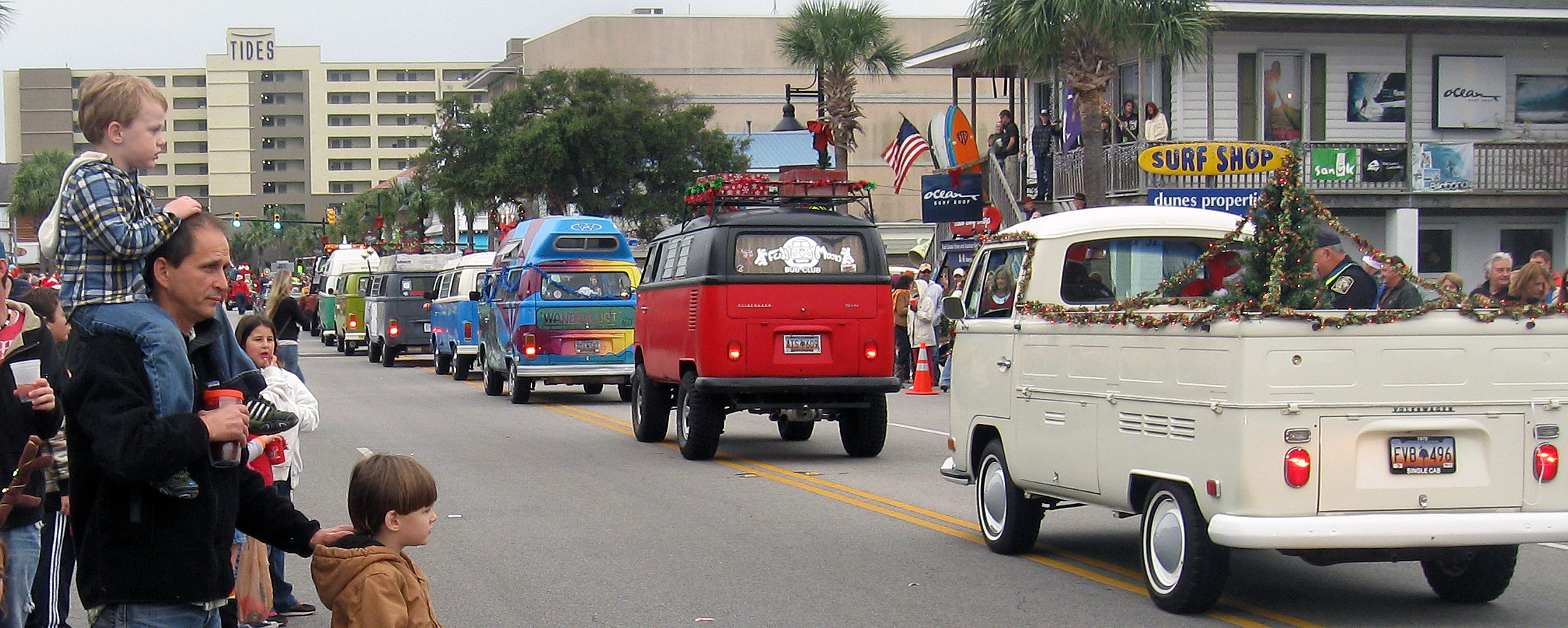
With the specter of terrorism, both domestic and jihadist, haunting contemporary life, it’s no wonder that yesterday’s annual Folly Beach, SC, Christmas parade seemed somewhat subdued. For example, no eardrum-shattering Shriner-produced gun battles “betwixt” Revenuers and Moonshiners terrified toddlers. Instead, we baby boomers were treated to this rather melancholy spectacle.
[For those not proficient in Southern US English, here’s a translation: “This gentleman right here is 91-years-old, still working for the burned and crippled children (not the burning crippled children)].
Compare that to this scene from four years ago when all the little Masons and Benningtons were treated to some semi-authentic street drama, a Western tradition dating back to the glorious days of the Hundred Years War and the bubonic plague.
Also conspicuous in their absence were the vintage car clubs, those MG-Bs, Triumph Spitfires, XKE Jags that ascot-wearing playboys used to tool around the countryside in with their scarf-headed mistresses headed to the Timberland Inn for a mid-afternoon tryst.
And, for me, an owner of two late departed VW microbuses, what a disappointment that nary a one puttered past belching clouds of oil-laden exhaust (as opposed to in years past when they appeared in abundance, transforming Center Street into a miniature Beijing).
Nor did the Surf Rider drill team wow us with their shenanigans.
Not that the parade was a complete bust. The James Island band was in fine form.
Plus, the Roller Derby girls are always a welcome addition.
Of course, Santa appeared, albeit with an armed guard:
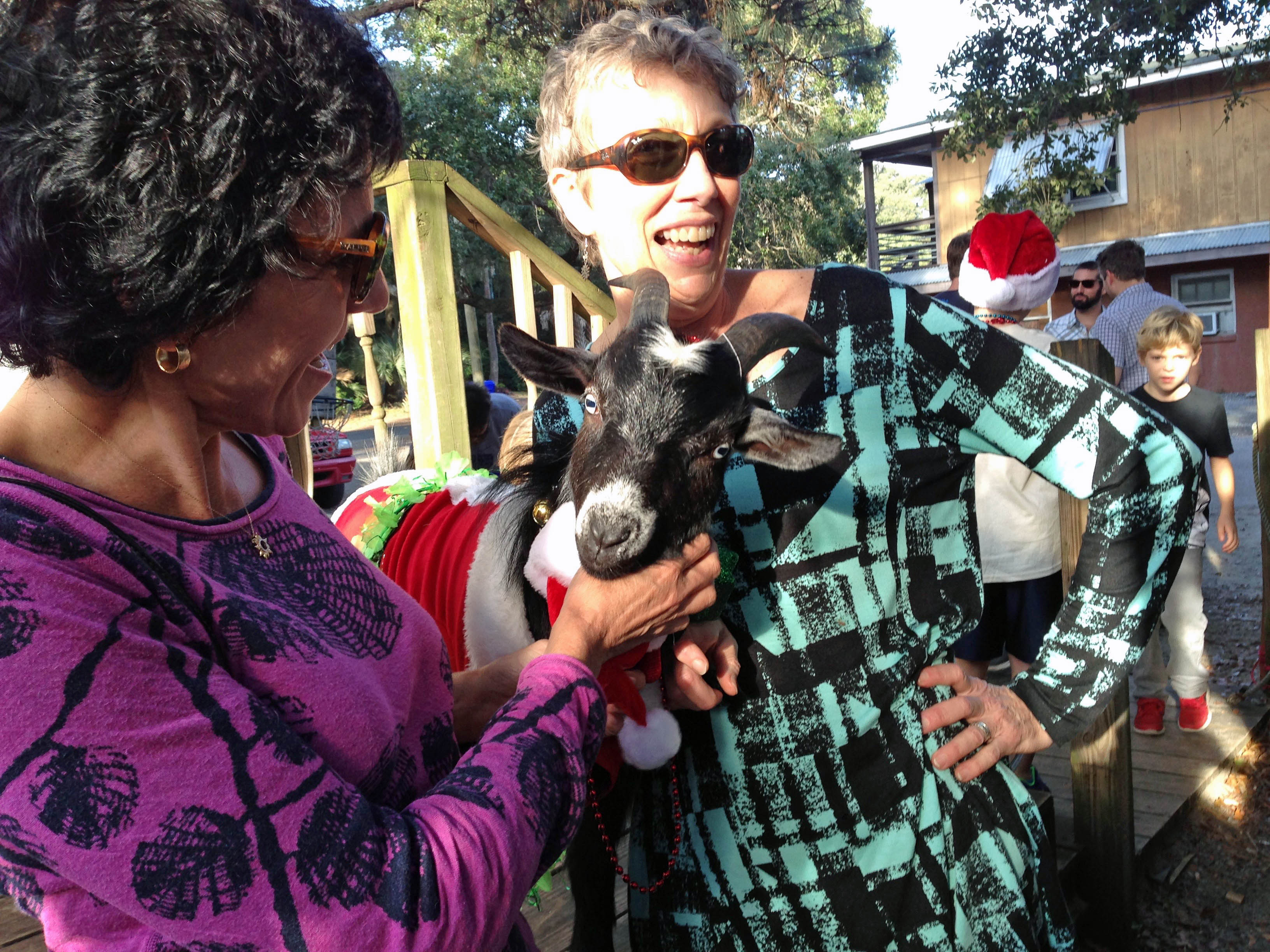
And, of course, the after-party at Chico Feo never disappoints. Check out these not-exactly vestal virgins preparing to sacrifice this cloven-footed beast to Jah so Mr. Weed back in the kitchen can whip up some of his world class curried goat.
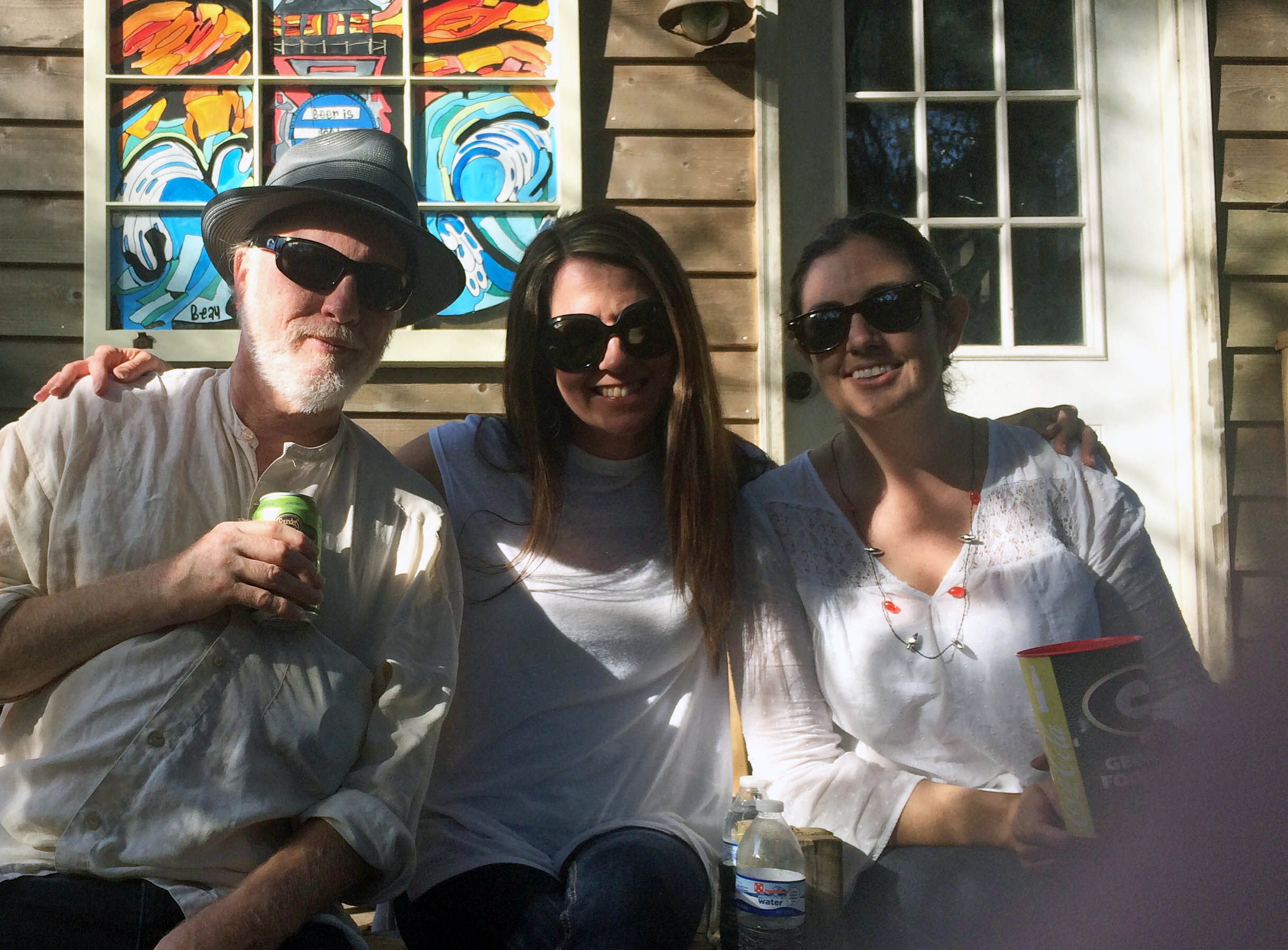
And as Solstice present to all of you wherever you be, a rare photograph of your humble narrator at Chico Feo with his bodyguards.
In the last couple of days, the insult “un-American” has been slung at Donald Trump as if xenophobia is atypical in the home of the brave and land of the free, as if historically, the sons and daughters of the nation’s original Anglican immigrants rolled out red carpets of welcome for those hordes of Irish and Italian immigrants who poured into Manhattan back in the day, as if FDR didn’t round up law-abiding Japanese-American citizens and lock them away in internment camps during WW2, as if the Supreme Court didn’t uphold that action as constitutional. Although I’m opening myself up to the charge of being one of those “hate-America-first” lefties, we should not forget that genocide and enslavement play important roles in the founding of our country. In fact, you could argue – and virtually all the neighbors who flocked to see the Donald at the Yorktown Monday would agree – it’s I-and-I who is un-American for bringing up those offputting historical blights.
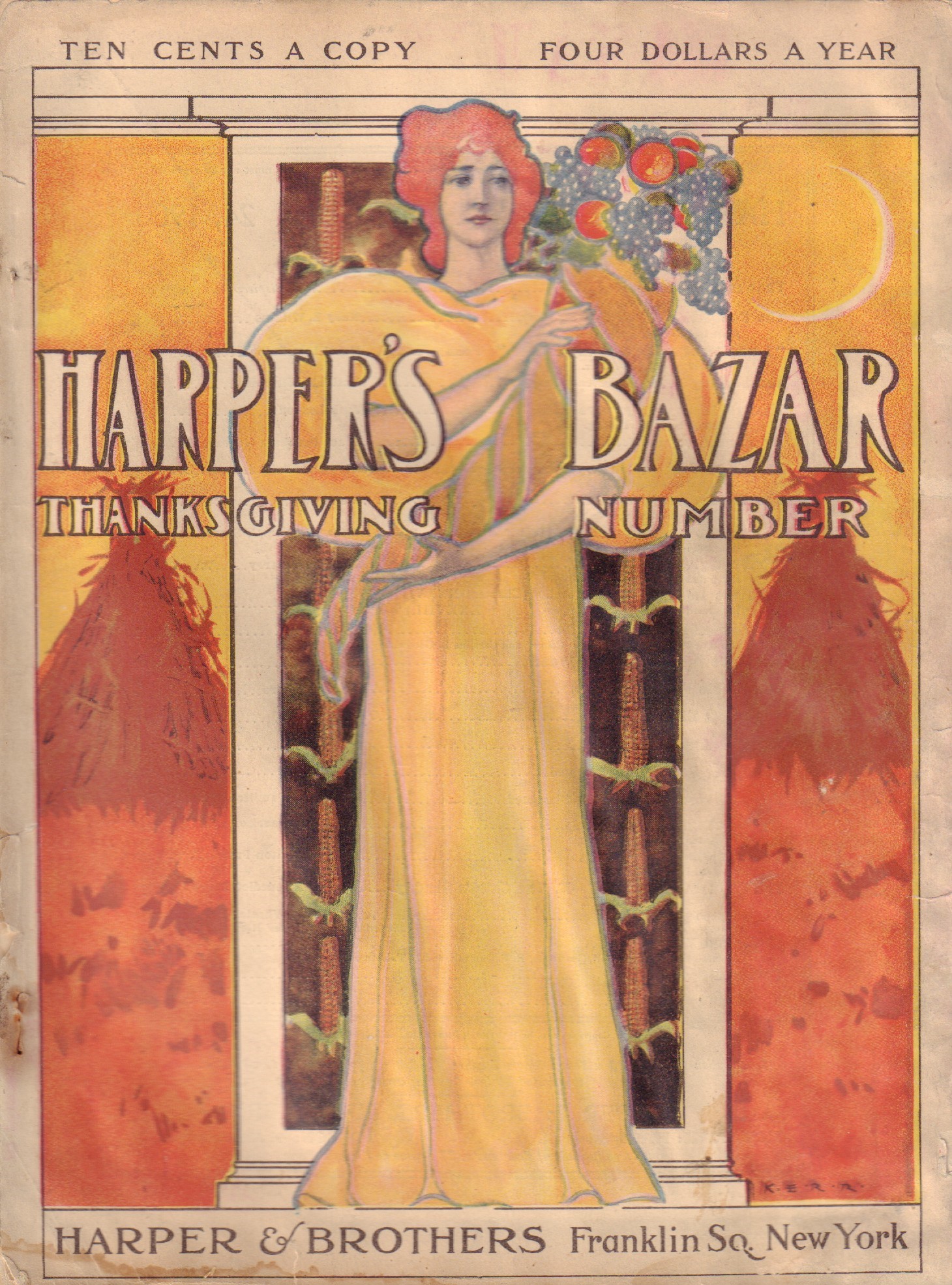
In the current Harpers, Lewis H Lapham, this century’s HL Mencken, casts his satirical eye at the United States’ democratic traditions and the current presidential campaign. I encourage you to read the entire piece [found here], but in the tradition of Harper’s itself, I thought I’d share a few of its highlights, to sort of excerpt the article, and then to end with some personal observations on the Donald.
Lewis H Lapham
Lapham begins the piece by claiming that “throughout most of its history” the US has preferred “concentrated wealth” to “democracy.” He cites Plato’s contention in The Republic that “’noble falsehood’ is the stuff that binds a society together in self-preserving myth.” The myth in this case is that the god who created men “mixed gold into some of them” and that these men “are adequately equipped to rule, because they are the most valuable.” Lapham suggests that the Founding Fathers essentially agreed with Socrates’ elitist vision of leadership and so created “a government in which a privileged few would arrange the distribution of law and property to and for the less fortunate many, an enlightened oligarchy that would nurture both the private and the public good, accommodating both the motions of the heart and the movements of a market.”
These leaders, to quote Madison, possessed the “most wisdom to discern, and most virtue to pursue, the common good of the society.” “But not enough virtue and wisdom,” Lapham reminds us, “to free the republic of its slaves.” That task was left to men neither enlightened nor rich giving their ‘last full measure of devotion’ to consecrate ‘the proposition that all men are created equal.” In other words, common men with rifles who fought fiercely at places like Shiloh, Gettysburg, and Spotsylvania accomplished the task of emancipation.
Lapham credits Lincoln with the establishment of the myth of equality but laments that the myth has lost its power. He argues that now “presidential-election campaigns [are] designed to be seen, not heard, the viewers invited to understand government as representative in the theatrical, not the constitutional, sense of the word.” He goes on to say that “this simplified concept of politics installed Ronald Reagan in the White House in 1981 to represent the country’s preferred image of itself, uproot the democratic style of thought and feeling that underwrote Franklin D. Roosevelt’s New Deal, restore America to its rightful place where “someone can always get rich.”
Let’s just say that Lapham is immune to the Gipper’s charms.
The evening [of the welcoming ceremony produced by Frank Sinatra at the Capital Centre in Landover, Maryland, on the night before Reagan’s inauguration] set the tone of the incoming Republican political agenda, promising a happy return to an imaginary American past — to the amber waves of grain from sea to shining sea, the home on the range made safe from Apaches by John Wayne in John Ford’s Stagecoach. The great leap backward was billed as a bright new morning in an America once again cowboy-hatted and standing tall, risen from the ashes of defeat in Vietnam, cleansed of its Watergate impurities, outspending the Russians on weapons of mass destruction. During the whole of his eight years in office Reagan was near perfect in his lines — “Mr. Gorbachev, tear down this wall!” — sure of hitting his marks on Omaha and Malibu Beach, snapping a sunny salute to a Girl Scout cookie or a nuclear submarine. The president maybe hadn’t read Plato in the ancient Greek, but myth was his métier, and he had the script by heart. Facts didn’t matter because, as he was apt to say, “facts are stupid things.” What mattered was the warmth of Reagan’s bandleader smile, his golden album of red, white, and blue sentiment instilling consumer confidence in the virtuous virtual reality of an America that wasn’t there. The television cameras loved him; so did the voters. To this day he remains up there with Abraham Lincoln in the annual polls asking who was America’s greatest president.
Nor does Lapham have a “man-crush” on Bill Clinton:
The cameras also loved Bill Clinton, who modeled his presidency on The Oprah Winfrey Show rebooted to star himself as both bighearted celebrity host and shamefaced celebrity guest, reaching out at the top of the hour for more love and more cheeseburgers, after the commercial break dealing bravely with the paternity of the stains on Monica Lewinsky’s blue dress. He was admired not only for the ease with which he told smiling and welcome lies but also for his capacity to bear insult and humiliation with the imperturbable calm of a piñata spilling forth presidential largesse as corporate subsidy and tabloid scandal.
Nowadays, “The proposition that all men are created equal no longer wins the hearts and minds of America’s downwardly mobile working classes — employed and unemployed, lower, lower-middle, middle, upper-middle, adjunct, and retired.”
Political campaigns distinguish voters “not by the fact of being American but by the ancillary characteristics that reduce them to a commodity: gun-carrying American, female American, white American, gay American, African American, Hispanic American, Native American, swing-state American, Christian American, alienated American. The subordination of the noun to the adjective makes a mockery of the democratic premise and fosters the bitter separation of private goods, not the binding together of a public good.” A handful of billionaires possess incredible leverage in determining who becomes the nominee, billionaires “said to have earmarked $900 million to be scattered like baubles from a Mardi Gras parade float among Republican hopefuls able to quote from the Constitution as well as from the Bible.”
But, hold on, wait a minute. Enter Donald Trump. He don’t need their filthy lucre:
Trump established the bona fides of his claim to the White House on the simple but all-encompassing and imperishable truth that he was really, really rich, unbought and therefore unbossed, so magnificently rich that he was free to say whatever it came into his head to say, to do whatever it took to root out the corruption and stupidity in Washington, clean up the mess in the Middle East, or wherever else in the world ungrateful foreigners were neglecting their duty to do the bidding of the United States of America, the greatest show on earth, which deserved the helping hand of Trump, the greatest name on earth, to make it worthy of his signature men’s colognes (Empire and Success) and set it free to fulfill the destiny emblazoned on his baseball cap: make America great again
Well, if Ronald Reagan’s and Bill Clinton’s prodigious charm can’t penetrate the force field Lewis H Lapham’s cynicism, how could a Vaudevillian vulgarian like Trump have a chance:
The man [is] a preposterous self-promoting clown, a vulgar lout, an unscripted canary flown from its gilded cage, a braggart in boorish violation of the political-correctness codes, referring to Mexicans (some Mexicans, not all Mexicans) as “criminals” and “rapists,” questioning John McCain’s credentials as a war hero (“I like people who weren’t captured”), telling Megyn Kelly on Fox News that if from time to time he had been heard to describe women he didn’t like as “dogs, slobs, and disgusting animals,” he meant “only Rosie O’Donnell.”
Lapham ends on this melancholy note:
The electorate over the past forty years has been taught to believe that the future can be bought instead of made, and the active presence of the citizen has given way to the passive absence of the consumer. A debased electorate asks of their rulers what the rich ask of their servants — comfort us, tell us what to do. The wish to be cared for replaces the will to act, the spirit of freedom trumped by the faith invested in a dear leader. The camera doesn’t lend itself to democracy, but if it’s blind to muddy boots on common ground, it gazes adoringly at polished boots mounted on horseback.
Lapham wrote this piece before the Paris and San Bernardino attacks and so wasn’t privy to Trump’s incendiary ideas of banning Muslims, statements that aid ISIS in propagandizing the USA as a land of Islam-loathing infidels. Some commentators have jacked up his demagogic profile from being a latter-day self-promoting PT Barnum to a Joe McCarthy and now, most recently, to a Mussolini or Hitler.
Obviously, Trump is an incredibly needy, insecure man who has somehow confused the ability to amass money with wisdom. Back in the summer I found his gargantuan self-aggrandizement amusing – like a blaring trumpeter who’s so bad, it’s funny. It’s gone on long enough. It has become tiresome — if not dangerous.
In fact, I’m getting a little bit scared – not that he’ll be elected President but that his super nationalistic rantings have generated such a following. Check out the screaming woman in the picture below. Is she a protestor who has somehow made her way to the front of the crowd or someone bellowing to keep the damn Muslims out? She certainly doesn’t look like a likely Trump supporter. Nor does the Whitman-looking fellow three people back on the left. Is this a picture of un-American Americans or merely a portrait of likely South Carolina primary voters?
Is poetry really the way into a lover’s heart? Here’s the Swan of Avon, Mr. William Shakespeare himself, having a go at it:
But no roses see I in her cheeks,
And in some perfumes there is more delight,
Than in the breath that from my mistress reeks.
Here, Master Will is attempting to flatter his dark-skinned mistress by underscoring how she doesn’t conform to pale-faced Elizabethan standards of beauty while mocking poets who overstate their lovers’ charms. However, judging by the limited number of women I have courted, I don’t see this strategy working well at all.
For example, I would not have attempted to flatter my late beloved wife with these lines:
My mistress’s breasts are fairly flat
And her hair a sort of mousey brown,
Yet she makes my heart go rat-a-tat-tat
Whenever I take her out on the town.
Nor do I think John Donne’s “The Flea” would work with most women. Sure, his comparing flea bites to sexual intercourse is “imaginative” and his “a-ha” comeback at the end of the poem clever, but, really, do you think this argument has even a Casper-the-Friendly-Ghost of a chance:
It sucked me first, and now sucks thee,
And in this flea our two bloods mingled be.
Thou knowst this cannot be said
A sin, nor shame, nor loss of maidenhead.
Then there’s Andrew Marvell’s “To His Coy Mistress,” which at least starts off on the right foot with some extravagant praise.
An hundred years should go to praise
Thine eyes and on thine forehead gaze;
Two hundred to adore each breast,
But thirty thousand to the rest;
An age at least to every part,
And the last age should show your heart.
For, lady, you deserve this state,
Nor would I love at lower rate.
But then gets all morbid on us:
Thy beauty shall no more be found;
Nor, in thy marble vault, shall sound
My echoing song; then worms shall try
That long preserved virginity . . .
As one of my students once said when I told her that faculty members often lie around unclothed in the faculty lounge:
BAD MENTAL PICTURE!
Sir John Suckling, he of the unfortunate name, creates this sure-not-to-please image:
Her feet beneath her petticoat
Like little mice stole in and out,
As if they feared the light;
But oh, she dances such a way!
No sun upon an Easter-day
Is half so fine a sight.
Maybe chicks back then thought vermin cute, foot-fetishes adorable?
Here’s another from Sir John:
Her lips were red, and one was thin;
Compared with that was next her chin,—
Some bee had stung it newly.
Jacobean Botox!
No, boys and girls, I doubt seriously that poetry is capable of melting hearts. After all, the greatest of poets, William Butler Yeats, devoted god knows how many iambs in his lifelong but vain attempt to win the love of Maud Gonne.
He leaves us with this good advice:
Never give all the heart, for love Will hardly seem worth thinking of To passionate women if it seem Certain, and they never dream That it fades out from kiss to kiss; For everything that’s lovely is But a brief, dreamy, kind delight. O never give the heart outright, For they, for all smooth lips can say, Have given their hearts up to the play. And who could play it well enough If deaf and dumb and blind with love? He that made this knows all the cost, For he gave all his heart and lost.
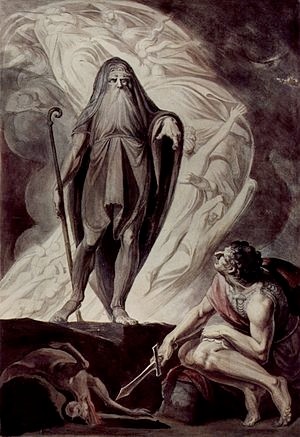
A couple of posts ago, I channeled the late Joseph Campbell and echoed his contention that myths should be considered deep unconscious poetic projections that embody profound truths rather than as demonstrably false tales from antiquated religions. Echoing Northrop Frye, Campbell believed that myths provide models that help us navigate the progression of our lives through the blooming and withering we’re all heir to, maps, as it were, handed over to us from old Tiresias to help us find our way to our ultimate destination – oblivion.
Tiresias appearing to Odysseus by Johann Heinrich Füssli
For example, the requisite trip to Hades that epic heroes like Odysseus and Dante suffer might correspond to the midlife depressions many of us undergo, journeys that though abysmal provide us with secret knowledge, in Odysseus’s case how to navigate his way back to Ithaca and in our case a deeper perspective on what it means to be human.
Take the Eden myth. It offers many interesting possibilities for interpretation. Given that it is a post-agrarian myth (besides death, Adam’s curse is tilling barren soil by the sweat of his brow), I wonder if the myth harkens back to the simpler and more organic lifestyle of hunting and gathering when our ancestors ran around naked picking berries, spearing rabbits, and living communally.
Perhaps knowledge here means the knowledge of agriculture, and if you want to fault anyone for that, why not women, who probably through their foraging discovered that seeds can be cultivated, which led to settled communities, caste systems, factories, ghettos, and ultimately reality television shows like Boy Meets Boy, Megan Wants a Millionaire, and Sarah Palin’s Alaska.
Sarah Palin and Offspring
In the mid-90’s, I took two graduate anthropology courses to satisfy certification requirements. For my midterm take-home exam, I had to provide my opinion on an essay claiming that agriculture has been disastrous for most of humankind. I can’t find the essay, but here’s the first paragraph of my test essay, which summarizes the argument:
In his essay “The Worst Mistake in the History of the Human Race,” Jared Diamond argues that agriculture is responsible for a diminution in the quality of life for the majority of humans who have lived since its inception. Diamond argues that food foragers enjoy a healthier diet procured with less labor and that the population explosion that accompanied the agricultural revolution has given rises to epidemics of infectious diseases. Furthermore, agriculture is directly responsible for class stratification and the subjugation of women. In essence, Diamond’s essay is the Eden myth revisited: food foraging Adam takes up the hoe, and paradise is lost. Diamond could have taken it even further, I suppose, and argued that agriculture, which gave rise to industrialization, can also be traced as a root cause of an ensuing ecological disaster as cultural evolution outstrips biological adaptation. The ultimate balance of life is being destroyed as holes appear in Gaia’s ozone umbrella, oxygen-producing rain forests are slashed and burned, and the water supply disappears.*
*By the way, I received an A- on this essay, the minus probably attributable to its last paragraph: “The question of whether or not agriculture was humankind’s greatest mistake, like most questions, ultimately ends up being an existential one. If I were huddled in an inner-city tenement or wielding a pick in an Appalachian coal mine, I might prefer non-existence and rue the day agriculture came into being. Indeed, food foragers possess a oneness with nature I truly envy. However, at the present moment (which is ultimately all we ever have), I’m off for the summer, preparing to end this essay and grab my surfboard. The agricultural revolution has been kind to the people I love. Jared Diamond would, no doubt, brand me an elite, but then again, I am just a high school English teacher and have never voted for a Republican. Everything is relative. Diamond has probably never been writhing in the Kalahari Desert with an abscessed tooth. [Instructor’s only comment: I get your point, which is indeed elite by world standards].
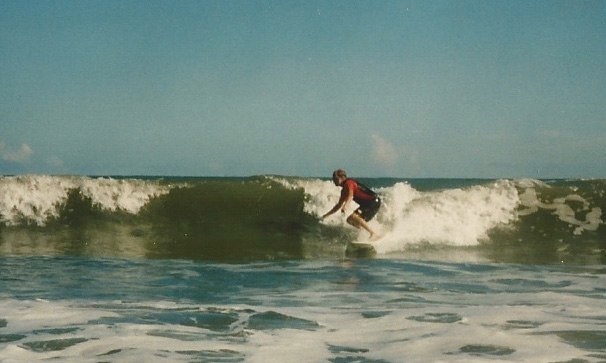
yours truly surfing in the mid-90’s
To return to the Eden myth, Adam and Eve run around naked, pick berries, in essence live off the great bounty that Yahweh has provided, but that damn woman who always has to stick her nose into everything upsets the divine plan by discovering a way to produce food differently. Humankind now possesses the knowledge of how to cultivate the land, but it takes hard work. Eating the apple symbolizes the shift from relying on natural food to being dependent on cultivated food. Hunting is more fun than plowing, making clothes is labor, etc. We have abandoned meaningful communal simplicity for complex stratified world of civilizations.
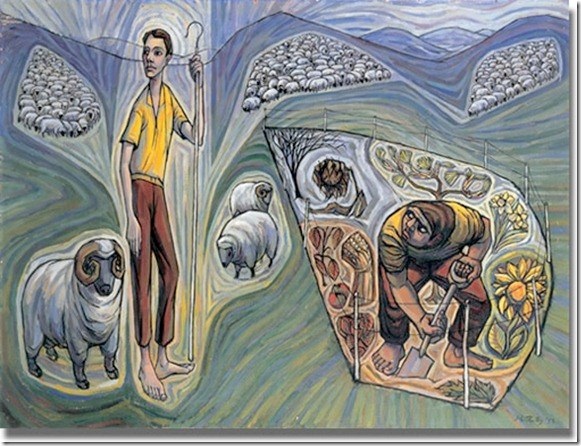
“Cain and Abel” artist unknown
As it happens, a very rarely encountered non-agrarian Peruvian tribe upset by incursion into their territory confronted park rangers this week. In investigating the tribe, the Mashco-Piro, I found video of another tribe, this one from Brazil.
These folks are essentially naked and so far off the grid that they don’t even have immunity to the common cold. Perhaps, Diamond was right after all. Perhaps in the very long run humanity might have had a longer lease on survival if Eve had just left well enough alone.
I’ll leave you with a passage from Mario Vargas Llosa’s The Story Teller as a shaman-like wanderer from tribe to tribe who relates myths to various clans that explain their origins and ways of life:
Thanks to Tsaurinchi, the firefly seripigari, I’m never bored when I’m traveling. Nor sad, thinking: how many moons still before I meet the first man who walks? Instead, I start listening. And I learn. I listen closely, the way he did. Go on listening, carefully, respectfully. After a while the earth feels free to speak. It’s the way the way it is in a trance, when everything and everyone speaks freely. The things you’d least expect speak. There they are: speaking. Bones, thorns. Pebbles, lianas. Little bushes and budding leaves. The scorpion. The line of ants dragging a botfly back to the anthill. The butterfly with rainbow wings. The hummingbird. The mouse up a branch speaks, and circles in the water. Lying quietly, with closed eyes, the storyteller is listening. Thinking: let everyone forget me. Then one of my souls leaves me. And the Mother of something that is all around comes to visit me. I hear, I am beginning to hear. Now I can hear. One and all have something to tell. That is, perhaps, what I have learned by listening. The beetle as well. The little stone you can hardly see, it’s so small, sticking out of the mud. Even the louse you crack in two with your fingernail has a story to tell. If only I could remember everything I’ve been hearing. You’d never tire of listening to me, perhaps.
For all the blah-blah-blah about how killer it is to live in Charleston, the Lowcountry of South Carolina lacks the beautiful season of autumn. This deficiency is especially heinous to us poetical, metaphor-embracing non-haters of Biden, because autumn represents harvest, fullness, and [sigh] impending decline.
Ideally, outside our windows would blaze a burst of colorful foliage that rages against the dying of the light. You could sit there by the window and read Wallace Stevens —
Death is the mother of beauty; hence from her,
Alone, shall come fulfillment to our dreams
And our desires. Although she strews the leaves
Of sure obliteration on our paths,
The path sick sorrow took, the many paths
Where triumph rang its brassy phrase, or love
Whispered a little out of tenderness,
She makes the willow shiver in the sun
For maidens who were wont to sit and gaze
Upon the grass, relinquished to their feet.
She causes boys to pile new plums and pears
On disregarded plate. The maidens taste
And stray impassioned in the littering leaves.
You could look up from Stevens and out of the window and see for yourself.
photo by WLM3
Down here, though, with our loblollies, live oaks, and palms, most leaves don’t change colors, and the ones that do go immediately from green to brown. Autumn down here is like moving aging summer from your house into the nursing home, an extended decline with its good days and bad days, mostly hot and humid, or to shift metaphors, like an older person not aging gracefully, sporting lurid inappropriately tucked-in tropical shirts when tweed blazers with elbow patches are in order.
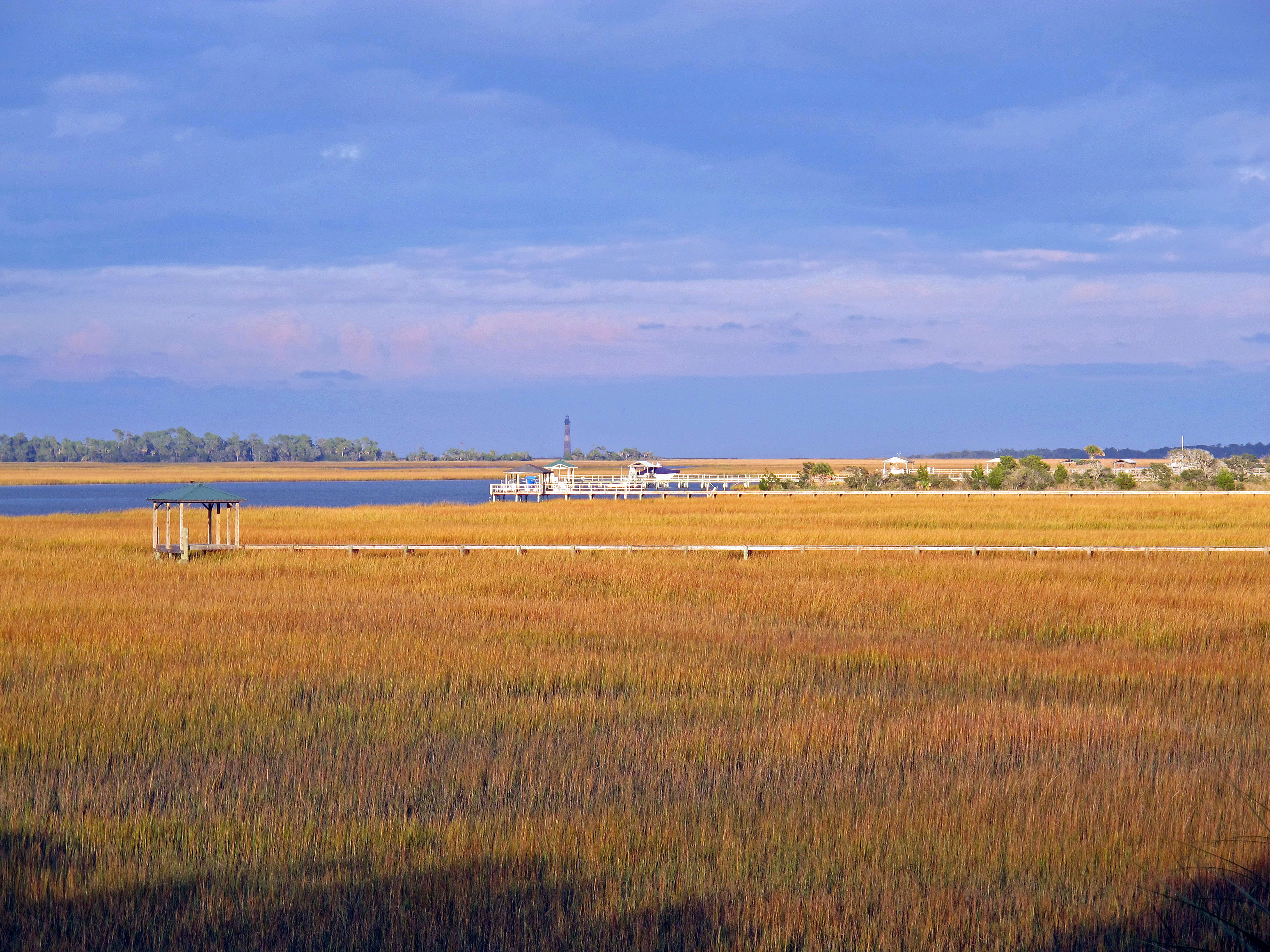
But, on a more positive note, you could argue that autumns do occur down here but are much subtler. Look closely at the marsh; without your noticing, it’s gone from green to gold, like that Japanese maple you kidnapped and planted in the front of the house. Migrating birds flap their way overhead, like a checkmark, a positive sign that things are in motion the way they should be, and let’s not forget that the impending winter will undoubtedly be mild.
photo by WLM3
No, Thanksgiving, is not a time for whining about imperfection, but a time to be grateful for what we have, a time to engorge ourselves, to watch professional football players in their glory years before the CTE sets in.
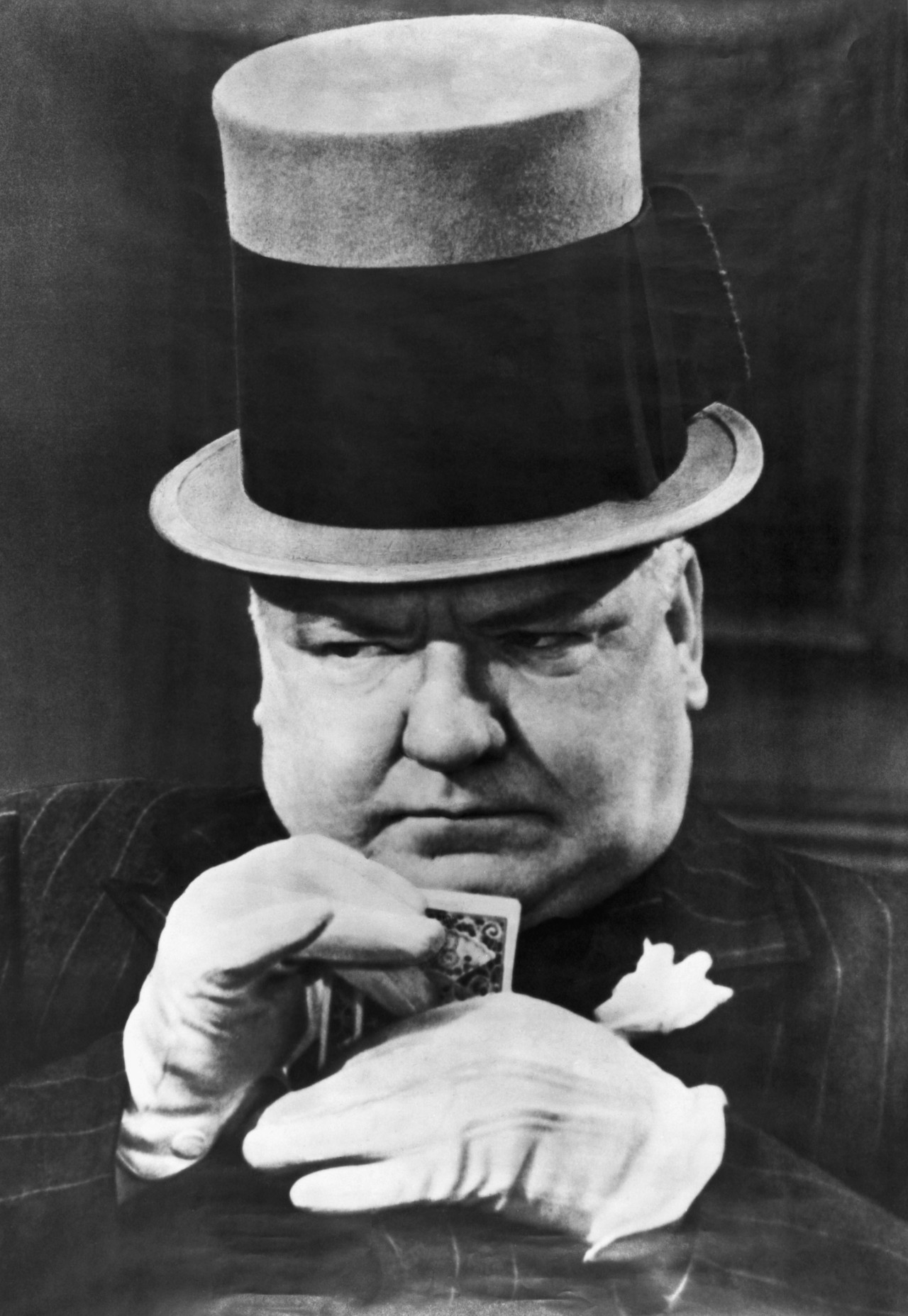
Original Caption: W.C. Fields in typical poker face pose. Undated photograph.
No doubt most curmudgeons begin their careers as a high school cynics, as smart-mouthed skeptics equipped with highly sensitive antennae tuned to hypocrisy. More often male than female, these snarling scoffers tend to mock propagandists dedicated to transforming them into productive contributors to society.
Burned as idealistic children who naively believed the blandishments of their elders, they eventually begin to realize that life’s rewards and punishments can be ridiculously unjust. For example, even though Bobby copies his homework and bullies smaller kids, Santa showers him with $800 skateboards and brand name clothing; meanwhile, the rule-obeying future curmudgeon treats others kindly but ends up with a can of Play Dough and a Wal-Mart fleece.
“Yeah right,” becomes the sardonic rejoinder to uplifting quotes in the morning announcements.
But let’s face it: constant negativity is not one of Dale Carnegie’s strategies in the pursuit of winning friends and influencing people. Although the most talented high school cynics can be fairly entertaining, their shtick can get really, really old after a while.
Eventually, though, with a little luck – a good marriage helps — these young cynics can marinate over the decades into well-seasoned curmudgeons who cultivate a sense of absurdity’s humorous possibilities, rather than becoming outraged at the human tragicomedy. Life becomes not a “tale/ Told by an idiot, full of sound and fury/Signifying nothing” but a “spiritual pickle preserving the body from decay.”
So on this Thanksgiving Eve, I choose not to mock my Facebook brethren for typing “adorable” beneath photos of non-photogenic babies; I choose not to mock sentimentalists for cajoling me to like and share cloying idiocies like “if you ‘heart’ your mother click like and share.”
No, instead, I’ll share, these inspiring quotes from some of my favorite curmudgeons for whom I’m especially thankful. They, by my book, truly have made the world a better place.
Jonathan Swift: “Last week I saw a woman flayed, and you will hardly believe how much it altered her person for the worse.”
Mark Twain: “Go to Heaven for the climate, Hell for the company.”
Amboise Bierce: “OBLIVION, n. Fame’s eternal dumping ground. Cold storage for high hopes. A dormitory without an alarm clock.”
Oscar Wilde: “A gentleman is one who never hurts anyone’s feelings unintentionally.”
HL Mencken: “Democracy is a pathetic belief in the collective wisdom of individual ignorance.”
Dorothy Parker: “If all the girls who attended the Yale prom were laid end to end, I wouldn’t be a bit surprised.”
WC Fields: “Start every day off with a smile and get it over with.”
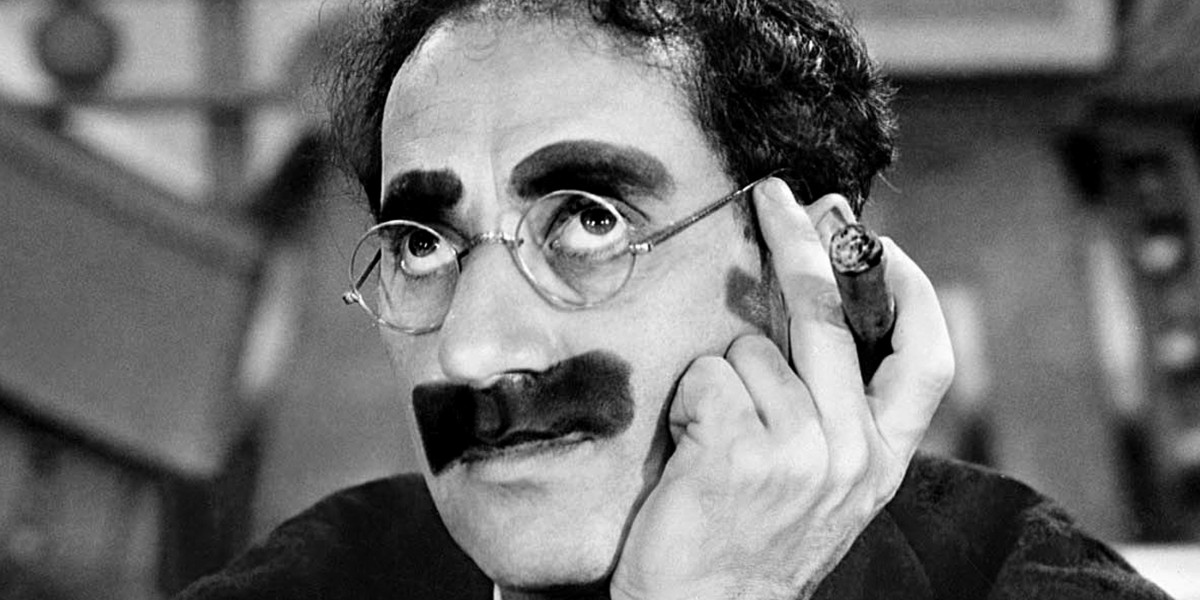
Groucho Marx: “Military justice is to justice what military music is to music.”
Lenny Bruce: “I won’t say ours was a tough school, but we had our own coroner. We used to write essays like: What I’m going to be if I grow up.”
Kurt Vonnegut: “True terror is to wake up one morning and discover that your high school class is running the country.”
But when it all comes down to it:
TC Boyle: “I was in the water for six hours. Shivering, praying, scared full of adrenaline. I kept making deals with the Fates, with God, Neptune, whoever, thinking I’d trade places with anybody anywhere – lepers, untouchables, political prisoners, Idi Amin’s wives – anything, so long as I’d be alive.”
In the misty pre-Darwinian year of 1818, William Cullen Bryant published his oft-anthologized poem “To a Waterfowl.” In the poem he apostrophizes a somewhat generic migratory bird. His vagueness in pinpointing species is probably a good idea here, because the titles “To a Duck” or “To an Egret” or “To a Wood Stork,” not only sound a bit cacophonous, but they also create concrete images that might distract from the poem’s high-minded contemplations. The image of an egret awkwardly lumbering into the air might call into question Bryant’s central message: Don’t worry; God’s in charge.
“[W]ither [. . .] dost though pursue thy solitary way?” the poet asks, addressing the waterfowl. “Seekest thou [. . .] weedy lake [. . .] or marge of river wide” or “chafed ocean side?”
Dangers abound – “Vainly the fowler’s eye/Might mark [the waterfowl’s] distant flight to do [it] wrong.”
However, not to worry, “There is a Power/Whose care/Teaches [the waterfowl’s] way along [the] pathless coast” towards “a summer home” where it can “rest/And scream among [its] fellows.”
Bryant concludes the poem with this stanza:
He, who, from zone to zone,
Guides through the boundless sky thy certain flight,
In the long way that I must trace alone
Will lead my steps aright.”
Flash forward 101 years:
Turning and turning in the widening gyre,
The falcon cannot hear the falconer.
Things fall apart; the centre cannot hold;
Mere anarchy is loosed upon the world,
The blood-dimmed tide is loosed, and everywhere
The ceremony of innocence is drowned;
The best lack all conviction, while the worst
Are full of passionate intensity.
Charles Darwin
Forty-one years after the publication of Bryant’s “To a Waterfowl” and sixty years before Yeats’ composition of “The Second Coming,” Darwin published the Origin of the Species. Now, very few would buy into the concept that a micromanaging deity orchestrates the flight of migratory birds.[1]
What Darwin did was to thrust randomness and happenstance into the forefront of the scientific version of how human beings came to be human beings, which, of course, suggests that randomness and happenstance play roles in our petty lives from day to day for better or for worse.
No wonder, then, that Yeats’s poem resonates more with modern readers than does Bryant’s.
“The Second Coming” may well be the most thoroughly pillaged piece of literature in English. (Perhaps Macbeth’s famous “sound and fury” monologue is a distant second.) Since Chinua Achebe cribbed Yeats’s lines for Things Fall Apart in 1958 and Joan Didion for Slouching Towards Bethlehem a decade later, dozens if not hundreds of others have followed suit, in mediums ranging from CD-ROM games to heavy-metal albums to pornography.
[. . .]
In the wake of Didion’s success, publishers have come to realize they can apply Yeats’s lines to pretty much any book that documents confusion and disarray. Thus Elyn Saks’s 2008 memoir, The Center Cannot Hold: My Journey Through Madness, concerning her bout with schizophrenia. Though these four words from Yeats surely resonate with Saks’s feelings, the “center” in question here isn’t the moral authority of the Western world, it’s one person’s sense of stability. The trend has held for art books (David Gulden’s photography collection The Centre Cannot Hold), politics (The Center Holds: Obama and His Enemies), alternate history (American Empire: The Center Cannot Hold), popular history (A Blood-Dimmed Tide: The Battle of the Bulge by the Men Who Fought It), reportage (A Blood-Dimmed Tide: Dispatches from the Middle East), religion (The Second Coming: A Pre-Mortem on Western Civilization), international affairs (Slouching Towards Sirte: NATO’s War on Libya and Africa), right-wing moral hectoring (Slouching Toward Gomorrah), memoir (Slouching Toward Adulthood), and even humor (Slouching Towards Kalamazoo; Woody Allen’s Mere Anarchy). It seems that for every cogent allusion (Northrop Frye’s Spiritus Mundi, anyone?) there are a dozen falcons that truly can’t hear the falconer.
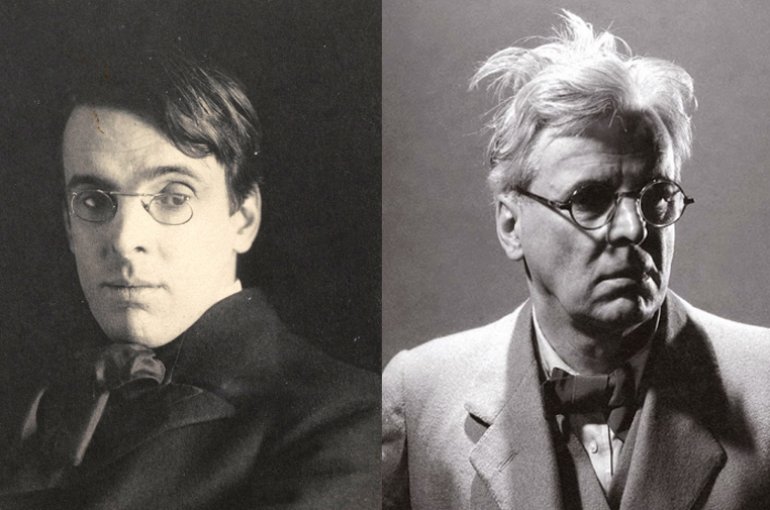
William Butler Yeats
Well, as matter of fact, the polarization of our own politics in addition to the utter disregard for human life of those who strap on suicide vests do suggest that “the centre cannot hold’ and “the worst are full of passionate intensity.” Virtually, every day we’re confronted with slaughter, whether it be at a bistro in Paris, a luxury hotel in Mali, or a African American church in Charleston, South Carolina.
The blood-dimmed tide has been loosed. No wonder incorporating a quote from “The Second Coming” into a title has become cliché.
[1] Of course, many still reckon that God micromanages our human existences, His making sure, for example, that Judy Birdsong’s application to her first choice graduate school was rejected so that she could meet up and marry me at USC, her second choice. (Not to mention how He later saw to it that teachers misbehaved at my present place of employment so that they would be fired to make room for me). Cf., Dabo Swinney’s “Game Plan for Life.”
We have a Thanksgiving tradition of inviting friends who can’t make it home for Turkey Day to share a meal with us at our house. When he was in graduate school studying linguistics, our younger son Ned invited colleagues whose families live abroad, and, of course, their presence made the holiday more interesting for us, and it provided them with an anthropological peek into some of our American cultural peculiarities, for example, grown men whooping and hollering and dancing around a table to celebrate a game winning interception. Nonjudgmentally, our foreign guests tolerated these absurdities with good humor.
Two years ago Ned brought with him a young woman from Syria. In pursuit of a PhD in linguistics, our guest Manar found herself cut off from her homeland, unable to return to see her parents and siblings, professional people trapped in a maelstrom not of their own making. I could only imagine the anxiety she must have suffered knowing her loved ones were trapped in a civil war in a world where bombs rain down on civilians as well as military targets. How hard it must be to concentrate on your studies when you’re bracing yourself for bad news at any moment.
Yet, except for one point when she wept in front of my wife Judy Birdsong and another female guest, Manar was vivacious, outspoken, generous, and open-minded. Indeed, she’s much more open-minded than many of the xenophobic Facebook feeds I’ve seen in the days following the Paris massacre.
Of course, we can attribute much of these paradoxically un-American outbursts to fear and ignorance. Certainly, these xenophobes don’t realize that the Syrians slated to emigrate to the United States consist of families who have been thoroughly vetted, who have undergone extensive background tests conducted by various agencies and who undergo one-on-one interviews, the entire process taking 24 months according to the State Department.
Certainly, my neighbors writing to Nikki Haley demanding that no Syrians enter Dylan Roof’s home state don’t realize that only 2% of the Syrian refugees are military-aged single males. Forty percent are children, and twenty-five percent senior citizens. Less understandable is that many governors have declared they’ll be no Syrians moving into their states, even though governors lack the power to enforce such an edict. If they possessed that power, I suspect we’d have fewer Ohioans settling in the Palmetto State.
C’mon, Nikki, this isn’t the old Soviet Union where a traveller needed a visa to visit individual republics. Thank goodness, our vehicles aren’t stopped and searched at the North Carolina border when we head to Asheville. I thought we were the home of the brave and the land of the free, not the home of the paranoid and land of the constrained.
What really depresses me, though, are presidential candidates suggesting we close our national borders to Syrians, or more, liberally, to limit admission to only Christians. (Agnostics and Buddhists need not apply). Just today, Jeb Bush blamed President Obama for “creating a quagmire in Iraq” a remarkable act of chutzpah considering it was his brother (and enablers like Hillary Clinton) who created the mess in the first place by scapegoating Saddam Hussein for 9/11 and destabilizing the region by misjudging the Iraqis’ desire for freedom and democracy’s potency in a region unfamiliar with the concept. People on Facebook are actually blaming Obama for the Paris carnage. One of my Facebook friends cited Reagan as a model for the type of leader we need to fight terrorism — never mind that after 241 military personnel were killed in Beirut in 1983 when terrorists blew up their barracks, Reagan removed our soldiers from Lebanon and never launched a retaliatory attack.
Meanwhile, for the sake of making political hay, Cruz, an immigrant, has introduced a bill banning Syrians. Rubio, another immigrant, is also against thoroughly vetted families seeking to escape a repressive regime to start a new life.
Of course, all of this Islam-bashing delights ISIS. Certainly, our stigmatizing all Muslims as terrorists paints us in a bad light with the vast majority of law-abiding moderate Arabs. What would make ISIS even happier is if the West sent ground troops into the region, which is a prerequisite to their theory of the Apocalypse. However, you never hear hawks like Lindsey Graham talk about how we could finance such a massively expensive endeavor. Maybe the Koch brothers might be willing to underwrite it?
Coincidentally, I’m teaching To Kill a Mockingbird now, and today, we dropped in on the lily-white Christian ladies of Maycomb at Aunt Alexandra’s tea party, a get-together orchestrated to help the horrid living conditions of an African tribe. The irony is a bit heavy handed – innocent Tom Robinson has recently been convicted of rape and sentenced to death by an all-white jury – but I beginning to doubt our ability to appreciate irony, much less subtlety.
 One phenomenon that future historians/anthropologists will cite as a contributing factor in our civilization’s decline is the polarization of our political parties, who have retreated into the echo-chambered bunkers of MSNBC and Fox News where viewers rarely hear cogent arguments that challenge their preconceptions.













 You Do Hoodoo