Why Donald Trump Is an Orwellian Nightmare for English Teachers


yakov_guminer_-_arithmetic_of_a_counter-plan_poster_1931

You know I hate, detest, and can’t bear a lie, not because I am straighter than the rest of us, but simply because it appalls me. There is a taint of death, a flavour of mortality in lies – which is exactly what I hate and detest in the world – what I want to forget. It makes me miserable and sick, like biting something rotten would do.

Charlie Marlow to his shipmates in Joseph Conrad’s Heart of Darkness

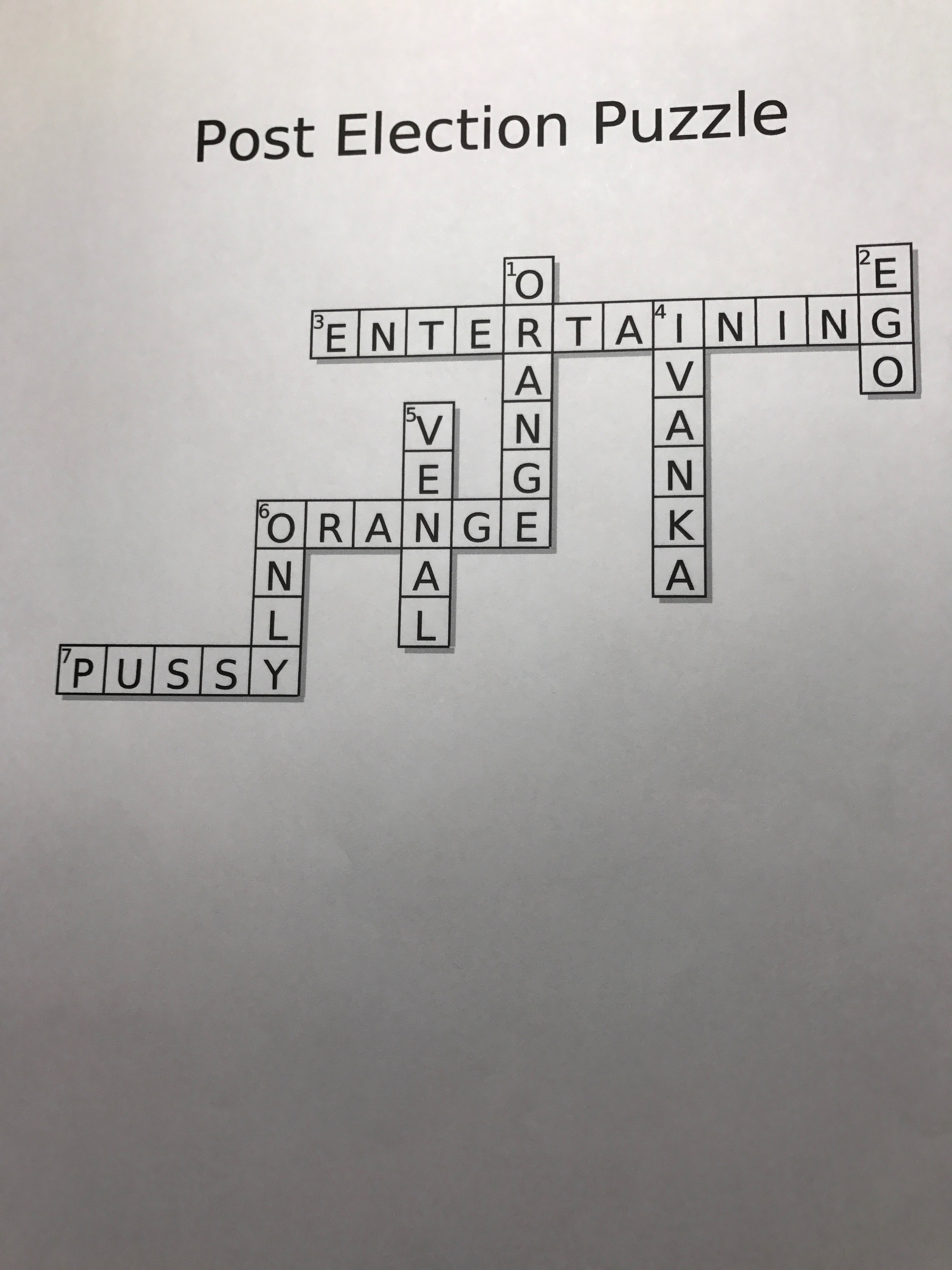
No, Donald Trump isn’t a nightmare for English teachers because he uses bigly as an adverb. Nor is it that when it comes to oratory, Trump’s speeches make George W Bush seem practically Churchillian in comparison. No, the reason that Donald Trump is a nightmare for English teachers is that words to him are meaningless.

Why bother teaching someone the difference in shades of meaning between the words venial and abominable when 2 + 2 = 5?[1]

To Trump, words are just things, commodities to be manipulated for bargaining or seduction or braggadocio. We English teachers, on the other hand, tend to see words as sacred, as vessels of meaning, and we try to teach our students to choose them carefully so that their descriptions are as clear and accurate as possible, whether they are writing about their grandmothers or analyzing Lear’s betrayal by his daughters Regan and Goneril.

Of course, most if not virtually all politicians occasionally lie, but generally with subtlety and rarely when the lie can be easily refuted.  This is not the case with Trump who seems to be a pathological liar. His lies are legion.  He lies when it’s not necessary, seemingly for the sake of lying.  To me, this lying is a very big deal, and I believe it is both my patriotic and moral duty to point out to my students why his lies are lies when they are applicable to the literature we are studying, the way I would like to think I would with Hitler’s lies if I had been teaching in Germany in the 1930’s.

Our school prayer begins with these words.

May our words be full of truth and kindness . . .

Not only are Trump’s words essentially devoid of truth and kindness, his kleptocratic tendencies as evidenced by his violation of the emolument clause, his packing the cabinet with sycophantic billionaires, and his admiration of Putin as soulmate put our very republic in danger. Nor does it help that it seems as if most Republicans in Congress don’t care about the rule of law now that one of their own can aid them in dismantling health care and cutting taxes for the 1%.

Remember Whitewater? All those Clinton investigations?  Those were different people and different times.

* * *

To see what I’m getting at, allow me just one recent example of Trump’s misuse of a phrase (see italics below) and how it can distort reality to his favor.

Yesterday, on hearing that the Electoral College had made it official he would be our next president, Trump crowed, “Today marks a historic electoral landslide victory in our nation’s democracy.”

Never mind that he lost the popular vote by nearly 3 million; here’s a handy chart mapping Electoral College margins of victory from Washington to Trump:

screen-shot-2016-12-19-at-6-35-55-am


Politfact quotes Larry Sabato, the director of the Center of Politics at the University of Virginia: “Calling a 306 electoral-vote victory a ‘landslide’ is ridiculous. Trump’s Electoral College majority is actually similar to John F. Kennedy’s 303 in 1960 and Jimmy Carter’s 297 in 1976. Has either of those victories ever been called a landslide? Of course not — and JFK and Carter actually won the popular vote narrowly.”

Of course, by declaring his historically comfortable but by no means overwhelming victory a landslide, Trump gets to have the words “historic electoral landslide” plastered in headlines and on screens across the planet. If he’s won by a landslide, the vast majority of people want whatever he wants, so that means that most people want the wealthiest Americans to receive enormous tax cuts.  If this election has taught us anything, it is that a majority of voters in 30 states aren’t all that discriminating. If some hear it was a landslide on Fox News, that’s good enough for them. Here’s a quote from today’s Washington Post: 

An editor at Breitbart, formerly run by senior Trump adviser Steve Bannon, said that fear [of reprisal from Trump and his minions] is well-founded [among lawmakers].

“If any politician in either party veers from what the voters clearly voted for in a landslide election … we stand at the ready to call them out on it and hold them accountable,” the person said.

In fact, if those who attend Trump rallies hear him say  2+2=5, they very well might believe him, even without having to go through the torture that O’Brian puts poor Winston Smith through in Orwell’s 1984.

How chilling to read these passages from 1984 in light of Trump’s “historic electoral landslide”:

There will be no laughter, except the laugh of triumph over a defeated enemy. There will be no art, no literature, no science. When we are omnipotent we shall have no more need of science. There will be no distinction between beauty and ugliness. There will be no curiosity, no enjoyment of the process of life. All competing pleasures will be destroyed. But always — do not forget this, Winston — always there will be the intoxication of power, constantly increasing and constantly growing subtler. Always, at every moment, there will be the thrill of victory, the sensation of trampling on an enemy who is helpless. If you want a picture of the future, imagine a boot stamping on a human face — for ever.

[. . . ]

We control life, Winston, at all its levels. You are imagining that there is something called human nature which (sic) will be outraged by what we do and will turn against us. But we create human nature. Men are infinitely malleable. Or perhaps you have returned to your old idea that the proletarians or the slaves will arise and overthrow us. Put it out of your mind. They are helpless, like the animals. Humanity is the Party. The others are outside — irrelevant.’

Will I be teaching 1984 in the spring?[2] Yes. Will Trump’s name come up? You betcha!  Will I be teaching “Heart of Darkness” this spring?  Yes sir, of course.

599bd4e393673bf37d243e7cc32b614c


[1] The latter word in this case being a much more accurate descriptor of Trump, a known swindler and self-professed sexual assaulter.

[2] By the way, click here for an extensive Pre-Trumpian lesson plans for teaching 1984.

Post Retirement Projects

Now that my career’s closure lies a mere nineteen months away,[1] I’ve started thinking about how to spend the overabundance of free time that a retirement without ailing parents or wastrel children or impending lawsuits provides a relatively well-to-do Late Empire US citizen.

Some people have suggested I write a book about growing up in a small Southern town teeming with lovable oddball characters (and few mean-as-cuss rapscallions), you know, back in the days when polite whites called African Americans “colored people” or “Negros.”

Hasn’t this story already been done a time or two? Anyway, because my sensibilities run closer to the filmmaker David Lynch’s than to Ferrol Sams’, I can’t see myself pulling anything off that print publishers would touch, even with gloves, certifiably impermeable, approved for Ebola victim corpse-removal. [2]

The character Bobby Peru from David Lynch's "Wild at Heart"

The character Bobby Peru from David Lynch’s “Wild at Heart”

Thinking, as they say, outside of the container, it occurred to me that I might come up instead with a project that benefits society, something like a post-Trump etiquette manual to help citizens negotiate the shifting sands of what’s now socially acceptable while providing them with a historical context for cultural changes, a sort of map of decline in manners over time.

Excerpt from working manuscript:

On Chivalry

In the Age of Elizabeth (1558-1603), an act of chivalry might be a courtier’s removing his cloak and throwing it over a puddle so a lady wouldn’t get her dainty foot wet.

In the Age of Eisenhower (1953-1960), an act of chivalry might be a gentleman’s getting out of the driver’s side of a car, walking around to the passenger’s side, and opening that door for a lady sitting there.

In the Age of Clinton (1993 -2000), an act of chivalry might be a dude’s submitting to a chick’s request that he use a condom.

In the Age of Trump (2017- ), an act of chivalry might be a dudebro’s refraining from grabbing a bitch’s snatch even though she’s oh so fuckable.[3]

Emanuel Gottilieb Leute "Elizabeth and Raleigh"

Emanuel Gottilieb Leute “Elizabeth and Raleigh”

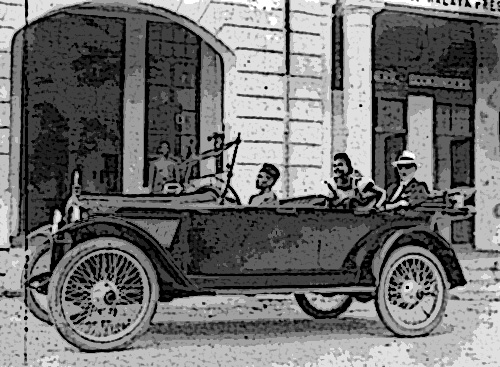
Or maybe I could spend my days in fantasyland, Walter Mitty style, imagining myself riding around in a backseat of chauffeur-driven Cadillac with Memphis Minnie, me in a double-breasted suit and matching fedora, she in cotton dress while playing her guitar and singing about how much she adores me.

chauffeur


Worse idea: Out-Milton-Milton and memorize the Holy Bible and Sartre’s On Being and Nothingness word-for-word.

Better idea: Take golf lessons. Play nine holes a day.

Even better idea, enlightened hedonism: go through the stages of Yoga’s sun salutation upon awakening each morning. Then mindfully concoct breakfast, noting the crack of eggshell on skillet rim, the rain-like sizzle of the bacon. Eat those eggs, bacon and grits deliberately, mouthful by mouthful, savoring. Go retrieve the paper and peruse it on the deck or screened porch while sipping coffee. Discuss the fall of civilization with also retired spouse. Afterwards, meditation followed by a walk on the beach or a paddle on the river or a bike ride off the island to Fort Henry. The remainder of the morning spent reading or writing. Tomato and cheese sandwiches. The NY Times crossword. Happy Hour. Preparing dinner with spouse followed by TCM or conversation. More social media. A nightcap. Yawn. Morpheus descending. Sweet dreams . . . ennui.

Okay, what was the name of the pervert in my hometown who dressed like Castro and rode his bike around town dragging behind it underwear he had traded newcomers for firecrackers?

[1] Discounting the possibility of a nuclear exchange with China

[2] As I write this, I suddenly remember a woman and severely mentally challenged grown daughter who used to patronize my granddaddy’s gas station. I can’t remember the daughter’s name, but she always carried a baby doll with her and spoke in garbled cassette-tape-getting-eaten slo-mo. My Aunt Virginia told me my grandmama forced Virginia to play with the girl/woman. Click here to see why that might not have been such a great idea.

[3] On the function of scatological language in satire, click here.

Celebrating My Two Favorite Commies, Jesus and Santa, to the Tune of Mojo Nixon’s “Santa, Get Straight to the Ghetto”

I know this blog’s been a downer since the election – a negative screed, a longwinded lamentation, a Cassandra-like catalogue of bleak prophecies heralding the end of civilization as we know it.

But, as my ace commentator Sherman T Langston suggests I should, I’m putting on a happy face for this post by providing a heart-warming movie that boasts moving picture images of yours truly introducing Mojo Nixon’s “Santa, Get You to the Ghetto,” which serves as the soundtrack for the rest of the film, featuring Folly Beach’s Christmas Parade.

Hope you enjoy.


Trump as Satiric Butt

2-rabelais-gargantua-1873-granger

Traditionally satire has been classified as Horatian or Juvenalian in honor of two ancient Roman practitioners of the genre. Horace (65-8 BCE) cleverly but gently mocked Roman opinions and institutions that he considered worthy of ridicule. In Horatian satire – Geoffrey Chaucer falls into this category – you get the feeling that overall the satirist generally is fond of humankind (in spite of itself) but wishes to poke fun at its foibles, perhaps in hopes of ameliorating them. Almost all of non-literary contemporary satire falls into this category. For example, Mad Magazine, The Daily Show, and Saturday Night Live exemplify characteristics of Horatian satire, particularly in their employment of exaggeration and irony, holding up, as it were, a funhouse mirror to human nature.

Take SNL’s satires of Hillary Clinton and Donald Trump, for instance. Despite exaggerating those politicians’ personas, the skits do so with good humor. The writers portray Hillary as incredibly calculating and Trump as a bit of a buffoon, but certainly neither comes off as monstrous (despite thin-skinned Trump’s overreactions) as they very well might in a Juvenalian satire.  The fact that Clinton herself has appeared in some skits underscores the “gentleness” of the satire.

Unlike Horace, whose satires might be likened to the clucking of a tongue, Juvenal’s[1] satires are more like spitting into the face of the target. Juvenal held humankind in utter contempt, like his artistic soul brother Jonathan Swift, and employed scatology – images of excrement, disease, and filth – to transform the object of the satire into a monster. In Juvenalian satire, the motive is not so much to emend but to mock, as Swift does in his portrayal of the Yahoos in Gulliver’s last voyage. The ill-fated Charlie Hebdo satires on Muhammad offer another example of Juvenalian satire’s mean-spirited mockery.

If Trump finds the rather light touch of SNL’s satire outrageous, let’s hope he never encounters a Juvenalian satirist’s assessment of his character.

For example, a Juvenalian satirist might come up with the following Trump Insult Kit (based on those Shakespearian insult kits you can find on the Internet). Essentially, these “kits” have three columns, the first two containing adjectives culled from Shakespeare’s plays and the third containing nouns. Scanning the columns, you choose adjectives from the first and second columns and attach them to a noun of your choice from the third column, coming up with something like, “Ye churlish, toad-spotted miscreant.”

Rather than copping words from Shakespeare’s plays, however, the Juvenalian satirist (who shall remain nameless) that came up with the Trump Insult kit mined the scatological recesses of the gothic Anglo-Saxon subterranean wing of his or her vocabulary to choose caustic, ugly words to ridicule Trump’s appearance – his Kraft-cheese colored epidermis, his corpulence, etc. The idea is someone this hideous needs to be described hideously.  It’s as if the satirist has gone beyond stooping to Trump’s level but has out Trumped Trump in a vulgar way that brings to mind Rabelais, another Juvenalian satirist.


***

The Donald Trump Trolling Insult Kit


Choose a term from each column to create a salutation for your next reply to one of Trump’s tweets:


Hepatitis-hued                                     canker-encrusted                              shrivel-dick

Tangerine-tinted                                  syphilitic                                             pus sac

Spray-painted                                       diarrheic                                              sewer spawn

Swag-bellied                                         sociopathic                                          rat’s turd

Cheezit-colored                                   micro-cephalic                                     boar’s snout

Dabbo-brained                                     tick-ridden                                           bed-wetter

Soul-stunted                                        triple-chinned                                      piece-of-shit

Sphincter-mouthed                             fecal-friendly                                       piss pool

Crotch-crippled                                  snot-spewing                                      scum-slurper

Shit-flecked                                         imbecilic                                              offal-gorger

We suggest you mix and match on different days for variety’s sake: “You, tangerine-tinted, tick-ridden boar’s snout” on Monday but then perhaps “You swag-bellied, triple-chinned scum-slurper on Friday.

* * *

Ultimately, Horatian satire tends to be more palatable for most audiences because, let’s face it, Juvenalian satire is disgusting  —  it’s meant to be.  The prudish consider it crude, in bad taste, which ultimately is the point.

Think of it as a Lear-like lacerating scream penetrating the desert air.  It might not help in any practical way, but releasing righteous indignation is cathartic and in that sense healthy — at least for the satirist herself.


[1] Late 1st, early 2nd century CE

A Very Cursory Review of The Stones’ “Blue and Lonesome”

stones

When I was a teenager, I came awfully damned close to becoming an idolater, a worshiper of Mick Jagger, whom I considered the coolest cat in non-Christendom. He provided non-athletes like I-and-I a deviant path to popularity. Rather than snagging winning touchdown passes on the gridiron, we could pump and grind on the dance floor, slouch down the halls instead of swagger, ditch rah! rah! rah! for so what.

Plus Jagger somehow transcended his ugliness. Livered-lipped and as muscular as a spear of asparagus, his charisma, aided and abetted by that 200-watt grin of his, dazzled away those physical shortcomings. He made us ugly boy children with pepperoni complexions feel as if we had a shot.

best-htw
Actually, as far as music went, I preferred the mid-60s Animals to the mid-‘60s Stones, but when “Jumpin’ Jack Flash” and “Honky Tonk Women” hit the airwaves, I became a true Stones believer. In fact, even now when I hear Charlie Watts hit the cowbell that initiates “Honky Tonk Women,” I let loose a beatific smile.

A string of Stones’ albums of the Late ‘60s and Early ‘70s are arguably the greatest rock-n-roll records in the history of the genre – Beggers’ Banquet, Let It Bleed, Sticky Fingers, and Exile on Main Street – a series of masterpieces. In both sound and sense, they expressed my anger, my disdain for society. I can remember fantasizing in high school about taking over the main building and blasting “Midnight Rambler” over the intercom system as a clarion call for destruction.

However, as the hormones settled down, my fascination with Jagger and Company waned. Truth be told, I haven’t bought a new Stones album since Tattoo You. Let’s face it: in the realm of rock, it’s hard for performers to maintain their creativity past middle age.

On the other hand, in the realm of the blues, it is not only possible but not all that unusual for a bluesman or woman to continue to improve –like Yeats, to continue to create masterworks right up to the end. Sure, Etta James lost some of her range over the years, but it didn’t diminish her artistry. She had so much more heartache to tap into. As they say, you got to suffer if you want to sing the blues, and I’m here to tell you getting old is all about suffering – looks fade, loved ones die, minds go bad, civilization declines.

As Willie B himself put it:

An aged man is but a paltry thing,

A tattered coat upon a stick, unless

Soul clap its hands and sing, and louder sing

For every tatter in its mortal dress.

Old age is all about tatters, and so is the blues.

Blind Willie McTell

Blind Willie McTell

So when I heard the Stones were going to come out with an album dedicated solely to the blues, I looked forward to it. Jagger actually plays a pretty mean harp. Charlie Watts is a great drummer. Keith and Ronnie can hold their own. However, after one, albeit cursory, listen of Blue and Lonesome, I have to express some mild disappointment.

The tracks sound to me – how should I put this – like approximations – maybe mannered? – though I wouldn’t go far enough to say inauthentic. My favorite cut on the record, “I Hate to See You Go,” is a fine rendition, but then again, as Mick himself once said in an interview way back when, “Why listen to us do ‘King Bee’ when you can listen to Slim Harpo do ‘King Bee?’” – or in this case, why listen to Mick do “I Hate to See You Go” when you can listen to Little Walter do it?


You can check out the Stones’ version here.

Maybe the problem lies in that the Stones tried to make these tunes sound too authentic instead of making them sound fresh. Certainly, their cover of “I Should Have Quit You, Baby” pales, not only to Little Milton’s version, but also Led Zeppelin’s.

That said, I’ll probably end up buying Blue and Lonesome anyway. Maybe it will grow on me. I wouldn’t be surprised.  When it comes to records, sometimes not being wowed at first is good for longevity’s sake.

mick-jagger


Recasting To Kill a Mockingbird

ewell-atticus

The other day I put a poll on Twitter asking which character from To Kill a Mockingbird most resembles Donald Trump. Unbelievably, the results ended up tied, 50-50 between Bob Ewell and Mrs. Dubose.[1]

The other choices were Prosecutor Gilmer and Atticus himself.

Of course, Atticus is the throw-away, obviously-wrong answer, like letter D in the test on Macbeth I gave yesterday:

According to your Beloved Taskmaster,[2] who wrote Macbeth?

A. Christopher Marlowe B. The Earl of Oxford

C. William Shakespeare D. Ten million monkeys randomingly typing

Gilmore, the prosecutor of Tom Robinson, is like Trump a bigot and in the movie suffers a Trumpian oral fixation, but Gilmore is too mild mannered to be the Donald. When Robinson on the stand admits he didn’t charge white Mayella Ewell for doing her chores because he pitied her, Trump would have been all over that perversion of ‘60s Alabama race relations, dramatizing the incident minstrel-show-style mocking both Robinson’s speech patterns and his mangled arm.

giphy

That leaves two choices, Bob Ewell and Mrs. Dubose. If it were a multiple choice test instead of a poll, you’d have to go with Ewell. One, there’s the gender issue, and, of course, Ewell, unlike wheelchair bound Mrs. Dubose, actually destroys people’s lives.  Plus her poison-of-choice is morphine whereas Donald’s is Diet Coke.[3]

Nevertheless, in the poll, my vote would go to bitter, belligerent Mrs. Dubose, based entirely on this one scene.

Note the mollification after the buttering up.


[1] Sigh, the vote was 1 to 1.

[2] I.e., I-and-I, your beloved blogger.

[3] Imagine, if you dare, Trump drunk.

The Death of Irony


canopy-bed

Old habits die hard. On the morning Irony plans to end it all, he puts a ridiculously upbeat polka record on the crank-up gramophone that shares a bedside table with a bottle of multi-vitamins and a half-liter of Jameson’s. As always, he rattles two of the tablets into his palm, pops them in his mouth, uncorks the adjacent bottle of Jameson’s, takes a slug, and washes the vitamins down  – all to the oom-pah of manic tubas, trombones, trumpets, and accordions.

The décor of his windowless room: an eclectic mixture of elegance and shabbiness. Maxwell Parrish’s Daybreak hangs on the one wall not lined with bookshelves. Hanging next to the Parish poster a black-and-white photograph of a pyramid of human skulls courtesy of Pol Pot. Both clash with the overly florid Victorian wallpaper. A chandelier hangs from the vaulted ceiling; a lava lamp pulsates atop one of the bookshelves.

parrish
Day Break by Maxwell Parrish

Irony recalls an old New Yorker cartoon featuring a firing squad posed to shoot a prisoner who refuses the offer of one last cigarette. The caption: “No thanks, I’m trying to quit.”

The needle of the gramophone slides across the 78 record’s end.

Thump thump, thump thump.

He carefully lifts the tone arm of the gramophone, gently replaces it in its cradle, removes the record, using two hands, careful not to smear the shellac resin with his fingerprints. He slides the disc into its plastic sleeve and then into the cardboard cover. He removes a lighter from the pocket of his bathrobe and tries to light the corner of the album cover. It doesn’t ignite, so he places the record back into its rightful place in the rack.

weiners-001

He shuffles out into the hall to retrieve the paper, its headline announcing the President’s bestowing Medals of Freedom to David Allan Coe, David Duke, Steve Bannon, Ann Coulter, Steven Segal, and Vladimir Putin.

In dressing for his suicide, Irony’s as meticulous as Quentin Compson, though, of course, Irony is no gentleman, far from it. He prepares his own shaving lather, applies it with a brush, and whips out his straight razor.

Why not just end it right here with one deft swipe across the jugular? No, too melodramatic. Plus, he’s already bought the rope. That would be a waste.  Instead, he applies his pancake makeup and then riffles through his costumes.

Irony lives in the Tower of Song, and although he’s been around for a long time (he can count Aristophanes and Voltaire as fans), nothing lasts forever. Nowadays, when he goes out on the boulevard, even in his polka-dotted shirt and checkered pants, virtually no one recognizes him.   He’s a has been. When Pete Hegseth, an alcoholic National Guard officer, is chosen over god knows how many more competent generals for Secretary of Defense, it’s time to hang it up.

Or in Irony’s case, to hang himself.

He pulls out a suitcase from underneath his four-poster canopied bed, heaves it up on the mattress, and snaps it open. The rope he retrieves from the wardrobe, the noose already fashioned. Even though nowadays, it’s not uncommon to see pedestrians with assault rifles slung over their shoulders or with holstered six-shooters dangling from their hips strolling into a 7-11, Irony doesn’t want to be seen on the sidewalk carrying a rope.  After placing it in the suitcase, he gently closes the lid, snaps it shut.

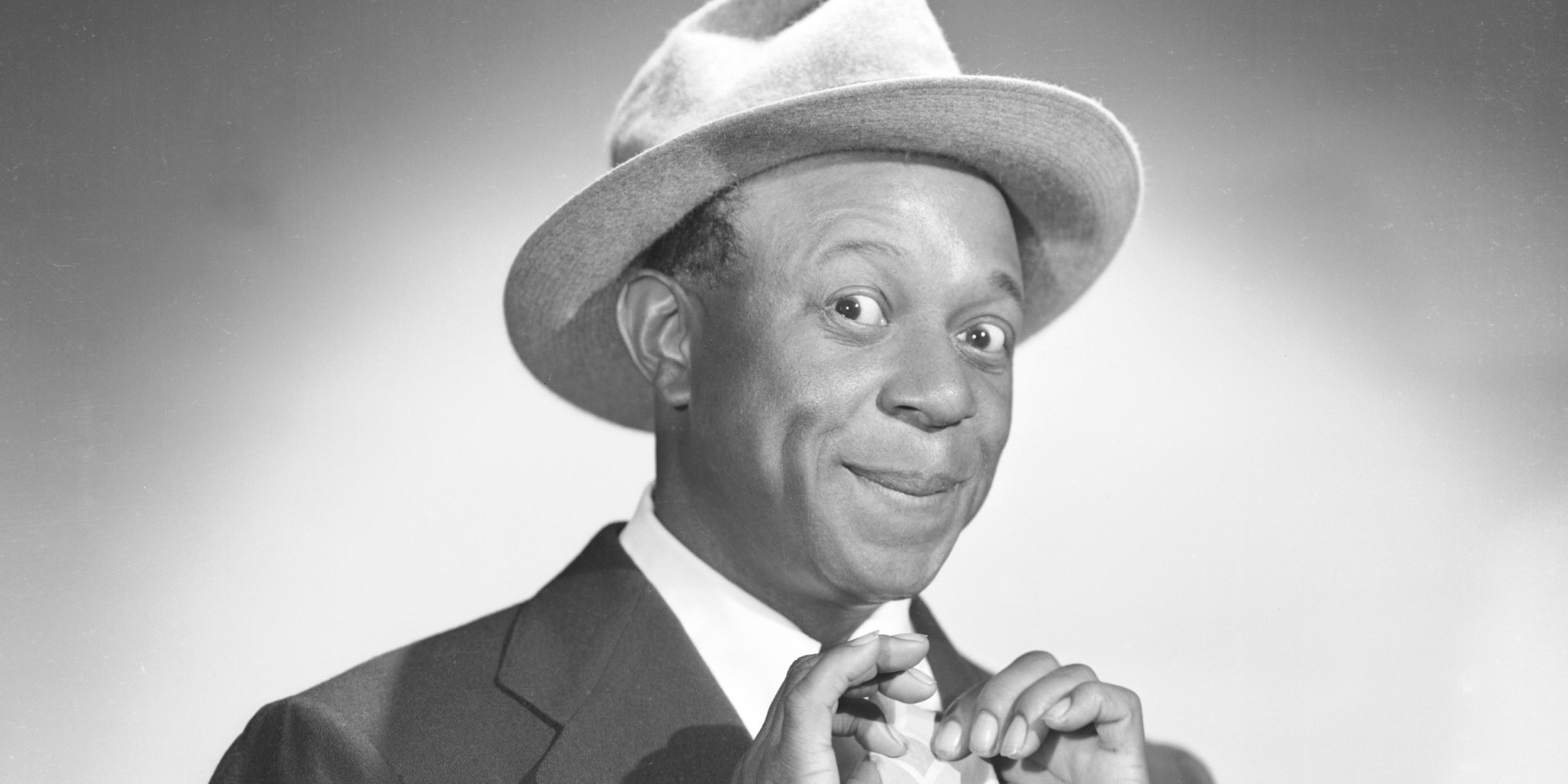
The elevator man in the Tower of Song is Eddie Rochester Anderson.

Eddie "Rochester" Anderson
Eddie “Rochester” Anderson

“How you doin’ today, Mr. Irony,” Eddie says as Irony steps into the elevator.

“Fine and dandy — except I’ve lost the will to live.”

Rochester cackles. “You sure are a card. Yes sir-ree. Looks like you headed on a trip. Where you goin’?

Staring up at the descending lighted numbers of floors, Irony says, “I’m headed to that undiscovered country from whose bourne no traveler returns.”

“Sounds like a real vacation.”

The elevator clunks to a stop, and Rochester slides open the cage before the big door opens up into the lobby.

“Catch you on the flip side,” he says. “Bon voyage.”

Irony is displeased to discover that the day is not bright and sunny; rather, it looks as if Ingmar Bergman might have had a hand in casting the weather – a dark, miasmic day beneath leaden skies guaranteeing rain.

He hails a cab, gives the driver the address of Big Dick’s Halfway Inn, Home of the Original Minnow Shot. Looking out of the window, he sees a bus of about-to-be deported immigrants thundering past.

Irony removes his IOS device, inserts his ear buds, scans iTunes for the “Up With People” theme song, and hits play.


How Democritus and Heraclites Might Have Reacted to the Trump Election

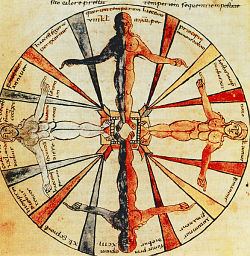
four-elements


This evening after a series of minor vexations – son sick, Gamecocks clobbered, eye invaded by wayward particle – I got to thinking about Horace Walpole’s observation that “[l]ife is a tragedy for those who feel, and a comedy for those who think.” I quote Walpole when I’m teaching tragedy and ask students to offer an interpretation.

It’s a hard question, hard to put the answer into words.

Of course, to address the question, you need context.   For example, let’s examine the thinking/ feeling/comedy/tragedy conundrum from the perspective of Trump’s election.

(I know some of you may have supported Trump, perhaps because you feel immigrants are overrunning the country or that massive tax cuts will defy history and fuel an economic boom or that you consider Hillary Clinton/Barack Obama Satanic spawn or some/all of the above).

However, the [tautology alert] a priori premise in this thought experiment is that Trump is a vulgarian with authoritarian tendencies whose boorish pronouncements during the campaign have eroded codes of civility and whose total lack of a sense-of-history and intellectual curiosity make his election as leader of the free world very, very unfortunate.

Not to mention his pathological avariciousness.

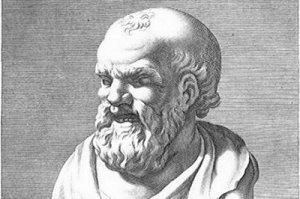
Democritus

Democritus

Okay, let’s bring in the cynical pre-Socratic philosopher Democritus, aka “the laughing philosopher.”

Seneca claimed that Democritus, whom he called “the Mocker,” laughingly held human beings in disdain, modeling a detached amusement at the foibles of the masses. In temperament think Bill Maier as opposed to Louis Black.

If human folly is laughable, this election might very well provoke Democritus to guffawing at this turn of events:

A swindler and pathological liar who pleads guilty to fraud a week after the election and who referred to his opponent as “Crooked Hillary” with the help of Fox News and Russian hackers (not to mention the New York Times) convinces a majority populace that he’s “more trustworthy” than she.

[cue laugh track]

Coal miners in Kentucky counties who have decreased their uninsured rate by almost twenty percent vote 93% to 6% for a man who wants to abolish the estate tax.

[cue laugh track]

Thinkers like Democritus take the long view.   Human folly is essentially history’s major motif. Thinkers are familiar with not only Huck Finn’s the “Duke and the Dolphin” but have read Swift and Shakespeare and perhaps Horace and Juvenal.

In their view, only incredibly naïve pollyannas would expect their generation to be less prone to foolishness than their forebears. Most of humankind is purblind, always have been, always will be.

After all, anyone reading this will be literally dead in 80 years. So what if the American Experiment fails? So what if Arizona once again boasts a view of the Pacific? Letting the little people decide was a very, very bad idea.

Just desserts.

By the way, should I add that this view might be considered elitist?

Heraclitus

Heraclitus

Heraclitus, on the other hand, aka the “weeping philosopher,” was a feeler, invested in the here and now. So what if Swift’s view of Yahoos was essentially correct? Those yahoos who voted for Trump in Kentucky lives will not get any better but actually worse: they will lose that recently acquired insurance, babies will die, and those promised coal mining jobs ain’t coming back ever.  Once again, they’ve been lied to.

How horrible, Heraclitus laments, that such chicanery is so rewarded. A spoiled, 70-year-old adolescent tweets preposterous lies and pays no apparent price for his dishonesty and in the mean time transforms the Founding Fathers’ republican democracy into an authoritarian kleptocracy!

People are real, not abstractions to be mocked. Pain is real.

In fact, sorry. My eye is killing me. I got to sign off.


fallout1


Thank God It’s Monday (or Tuesday)

shapeimage_2

Ah, get born, keep warm

Short pants, romance, learn to dance

Get dressed, get blessed

Try to be a success

Please her, please him, buy gifts

Don’t steal, don’t lift

Twenty years of schoolin’

And they put you on the day shift.

Bob Dylan, “Subterranean Homesick Blues”

Another Thanksgiving has come and gone, and for some reason, even though it’s only Friday morning, already a Sunday evening sadness has descended, which is essentially the consequence of wrong-thinking.

I’ve committed a common error, perceiving life as linear, a journey. A pilgrimage. But there’s a real problem in perceiving our existence in this manner, because the payoff of a journey or pilgrimage is reaching the final destination – Emerald City or Canterbury Cathedral – and, of course, when we reach the end of our life’s journey/pilgrimage, we’re no longer we but something to be disposed of, to be burned or buried.

detail from All Our Yesterdays, Michael Bilotta

detail from All Our Yesterdays, Michael Bilotta

Alan Watts:

And then you wake up one day, about 40 years old and you say “My God! I’ve arrived.” ”I’m there.” And you don’t feel very different from what you always felt And there is a slight letdown because you feel is a hoax And there was a hoax. A dreadful hoax They made you miss everything. We thought of life by analogy with a journey, with a pilgrimage, which had a serious purpose at the end and the thing was to get to that end. Success or whatever it is, maybe heaven, after you’re dead. But we missed the point the whole way along. It was a musical thing and you were supposed to sing, or to dance, while the music was being played.

Ulysses to Achilles in Shakespeare’s Troilus and Cressida:

Time hath, my lord, a wallet at his back,

Wherein he puts alms for oblivion

Yet, I keep wishing away the present, for the workday to end, for the workweek to end, for football season to begin or the holidays to arrive, or for retirement.

Cindy Streit Mazzaferro: Sometimes Broadway, Sometimes the Catskills

Cindy Streit Mazzaferro: Sometimes Broadway, Sometimes the Catskills

But who are they – the they Watts accuses of making us “miss everything?”

Well, as Porfiry Petrovich  famously said to Rodion Romanovich Raskolnikov when the latter asked him who had killed the old pawnbroker and her sister:

“What do you mean, who killed?” he asked as if he couldn’t believe his own ears.  “Why, Rodion Romanovich, you killed!  You committed the murders, yes.”

The they are we.  We possess free will, BF Skinner be damned.  How many sages have walked upon the earth extolling us to consider the lilies of the fields or that it is better to travel well than arrive?

Those sages say we must murder that conception-of-self psychologists call the ego, abandon the self-delusion that a homunculus somewhere inside our brain is the sum total of who we are, to realize that we and the lilies of the fields and the clouds in the sky and the birdcall are one.

Easier said than done.  Droughts can decimate fields, and although form is emptiness, the swirling subatomic particles of an axe can do real damage.  Food and shelter demand, unless you’re a Trump or Kennedy, labor, and most of us labor under the supervision of someone more powerful, whether it be a foreman or the always-right customer.  And, in truth, a very few people own and control almost everything, but we do ostensibly have autonomy over our lives (at least for the time being here in the good ol’ US of A).


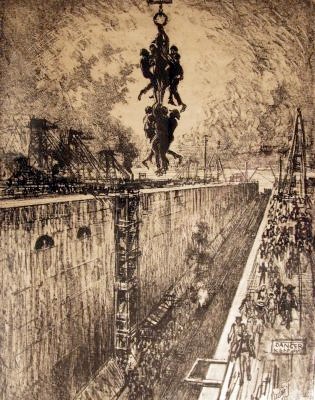
Joseph Pennel: End of Work Day, Gatun Lock

Joseph Pennel:
End of Work Day, Gatun Lock

Ultimately, I think, it’s crucial to find employment that we love and to train our minds to concentrate on the bits and pieces of that employment, whether it be whisking an egg, laying a brick, or constructing a math test, in other words, to enjoy the music of the moment rather than racing forward in our minds to the final cymbal crash of the coda.

It’s hard to do, especially with all of the distractions, the mechanical slicing of time into periods, shifts, breaks, etc. – but we certainly don’t want to end up like John Marcher in Henry James’s “The Beast in the Jungle”:

He had justified his fear and achieved his fate; he had failed, with the last exactitude, of all he was to fail of; and a moan now rose to his lips as he remembered she had prayed he mightn’t know. This horror of waking–THIS was knowledge, knowledge under the breath of which the very tears in his eyes seemed to freeze. Through them, none the less, he tried to fix it and hold it; he kept it there before him so that he might feel the pain. That at least, belated and bitter, had something of the taste of life. But the bitterness suddenly sickened him, and it was as if, horribly, he saw, in the truth, in the cruelty of his image, what had been appointed and done. He saw the Jungle of his life and saw the lurking Beast; then, while he looked, perceived it, as by a stir of the air, rise, huge and hideous, for the leap that was to settle him. His eyes darkened–it was close; and, instinctively turning, in his hallucination, to avoid it, he flung himself, face down, on the tomb.

So, ladies and gents, let’s don our dancing shoes before it’s too late.

51bdc1c3985c09d44e20898262ffaf02